
Inconsistent Mayonnaise or Cosmetic Emulsions? Vacuum Homogenizer Emulsifier Mixer Solutions
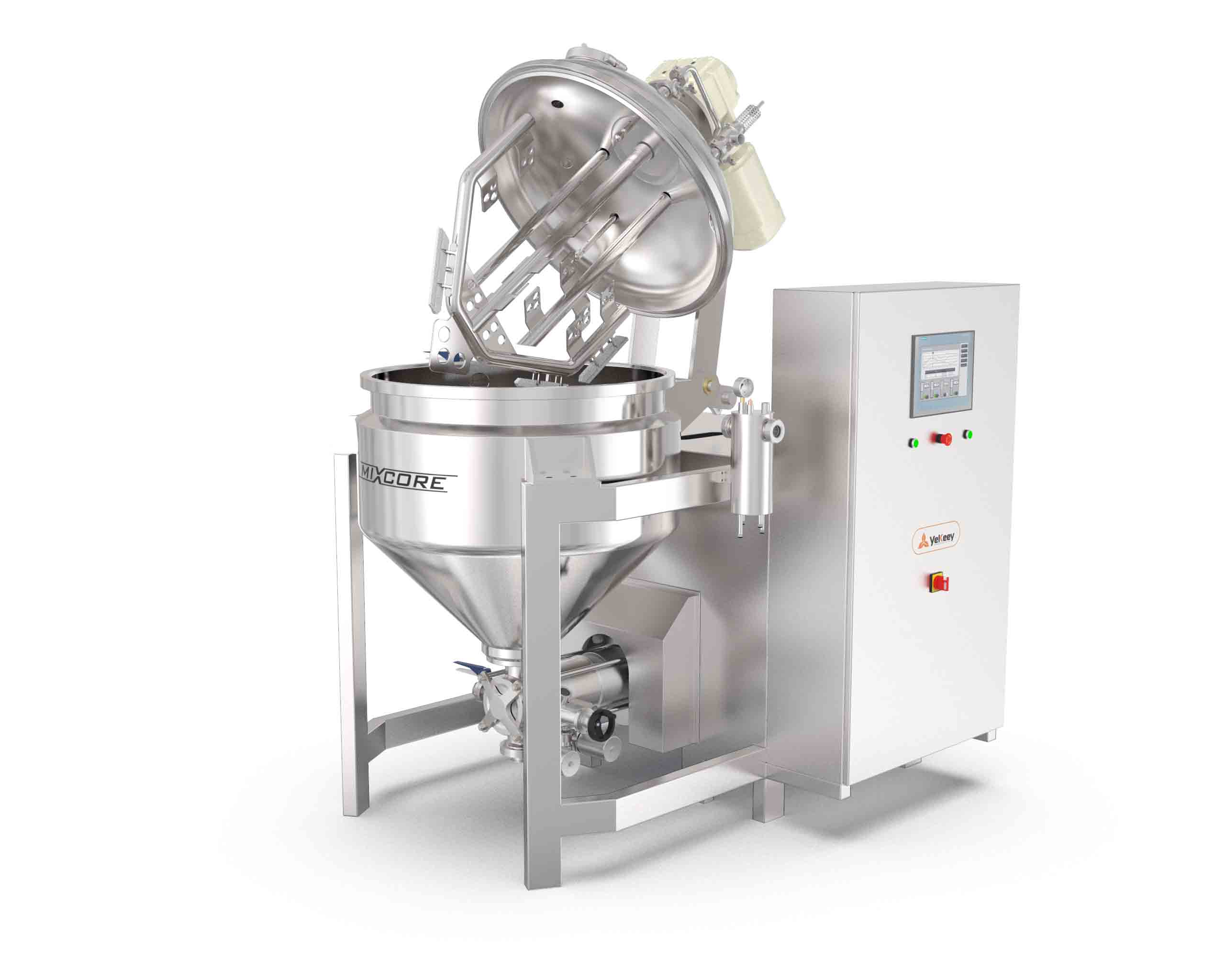
MC series vacuum homogenizer emulsifier mixer — a closed vessel that emulsifies, homogenizes, mixes and disperses under vacuum.
Inconsistent emulsification is a process-control problem before it is a formulation problem. When mayonnaise turns grainy or a cosmetic cream changes viscosity from batch to batch, three variables are almost always responsible: droplets that are not reduced to a stable size, air that is beaten into the product and never removed, and temperature that drifts outside the window in which the phases combine. A vacuum homogenizer emulsifier mixer controls all three inside one closed vessel — operating under vacuum at −0.09 MPa with a jacket capable of up to 110 °C, and delivering up to 2800 r/min of homogenizing speed.
That is why the same equipment platform appears in both food sauce plants and cosmetic cream lines. The unit is defined by four functions — emulsifying, homogenizing, mixing and dispersing — and each of those functions answers a specific failure mode on the production floor.
This guide is written for buyers and process engineers who are in the research and evaluation stage of a purchase. It defines the failure modes first, reviews the market context, and then works through the equipment constraints that decide whether a line produces a stable emulsion: pressure, temperature, homogenizer speed, materials of construction, control type, matched utilities, and compliance documentation. Product facts used here come from the vacuum emulsifying mixer range of YeKeey (Wuxi YK Automation Technology Co., Ltd), a manufacturer of emulsifying, mixing and filling equipment based in Wuxi, Jiangsu Province, China.
Problem Definition: What Inconsistent Emulsification Looks Like on the Line
Unstable emulsions announce themselves in a small number of recognisable ways, whether the product is mayonnaise, salad dressing, a cream or a lotion:
- Free oil on the surface, or visible separation after a short storage period
- Graininess or a sandy mouthfeel in sauces and dressings
- Viscosity that drifts between batches, forcing rework or reformulation
- Entrained air, giving a lighter-than-target density and a pale, foamy surface
- Uneven colour or texture in cosmetic creams and lotions
- Creaming or sedimentation during shelf life rather than a stable, uniform body
In all of these cases, the defect is created before filling. It is generated in the emulsification step, and it is usually traceable to one of five root causes: insufficient shear energy, entrained air, a temperature that falls outside the working window, poor dispersion of powders such as thickeners, gums or egg-based ingredients, or an inconsistent sequence and rate of ingredient addition.
The useful consequence is that each root cause maps to a machine specification rather than to a reformulation. That mapping is the core of this article.
Industry Background: Why Emulsification Equipment Demand Keeps Rising
Emulsification quality has become a harder commercial problem because volumes in both target categories are growing. The global homogenizers market was valued at USD 2.10 billion in 2024 and is projected to reach USD 3.79 billion by 2035, a CAGR of 5.4%, according to Roots Analysis. The vacuum mixer homogenizer segment is estimated at USD 1.02 billion in 2026, with cosmetics and personal care leading at a 38% share of that market, based on Future Market Insights data.
The food side is a comparable driver. The global mayonnaise market was worth approximately USD 12.58 billion in 2024, according to Zion Market Research, and that demand flows directly into orders for high-shear vacuum emulsification equipment. On the supply side, Asia-Pacific holds a 36.2% revenue share of the homogenizing mixer market as of 2025, led by China's manufacturing ecosystem, according to Dataintelo. Emulsifier demand more broadly is expected to reach USD 12.13 billion by 2030 at a 4% CAGR, per Mordor Intelligence.
Detailed Solution: The Four Core Functions That Stabilise an Emulsion
YeKeey vacuum emulsifying mixers are specified by four process functions: emulsifying, homogenizing, mixing and dispersing. Each function addresses a distinct failure mode rather than acting as a general-purpose agitation step.
Emulsifying
Emulsifying brings the water phase and the oil phase together under controlled shear so that the dispersed phase is subdivided inside a continuous phase. Performing this step under vacuum changes the starting conditions: air is pulled out of the product before it can be incorporated, so droplets form in a de-aerated matrix instead of a foam. For mayonnaise, where the oil phase is dispersed into an aqueous, egg- or starch-based system, this is the step that determines whether the emulsion starts dense and uniform or aerated and unstable.
Homogenizing
Homogenizing is the droplet-size reduction step and is the direct answer to oil separation and graininess. The homogenizing head delivers high shear, and output speed is a specification buyers should confirm rather than assume. On the MC and SP series, output speed reaches up to 2800 r/min; the ZJR series is specified from 2800 to 6000 r/min. The MC series uses a recirculation homogenizing configuration, repeatedly passing product through the shear zone so that the full batch receives comparable shear energy — a design point that matters when batch viscosity is high, as it is in mayonnaise and in thick creams.
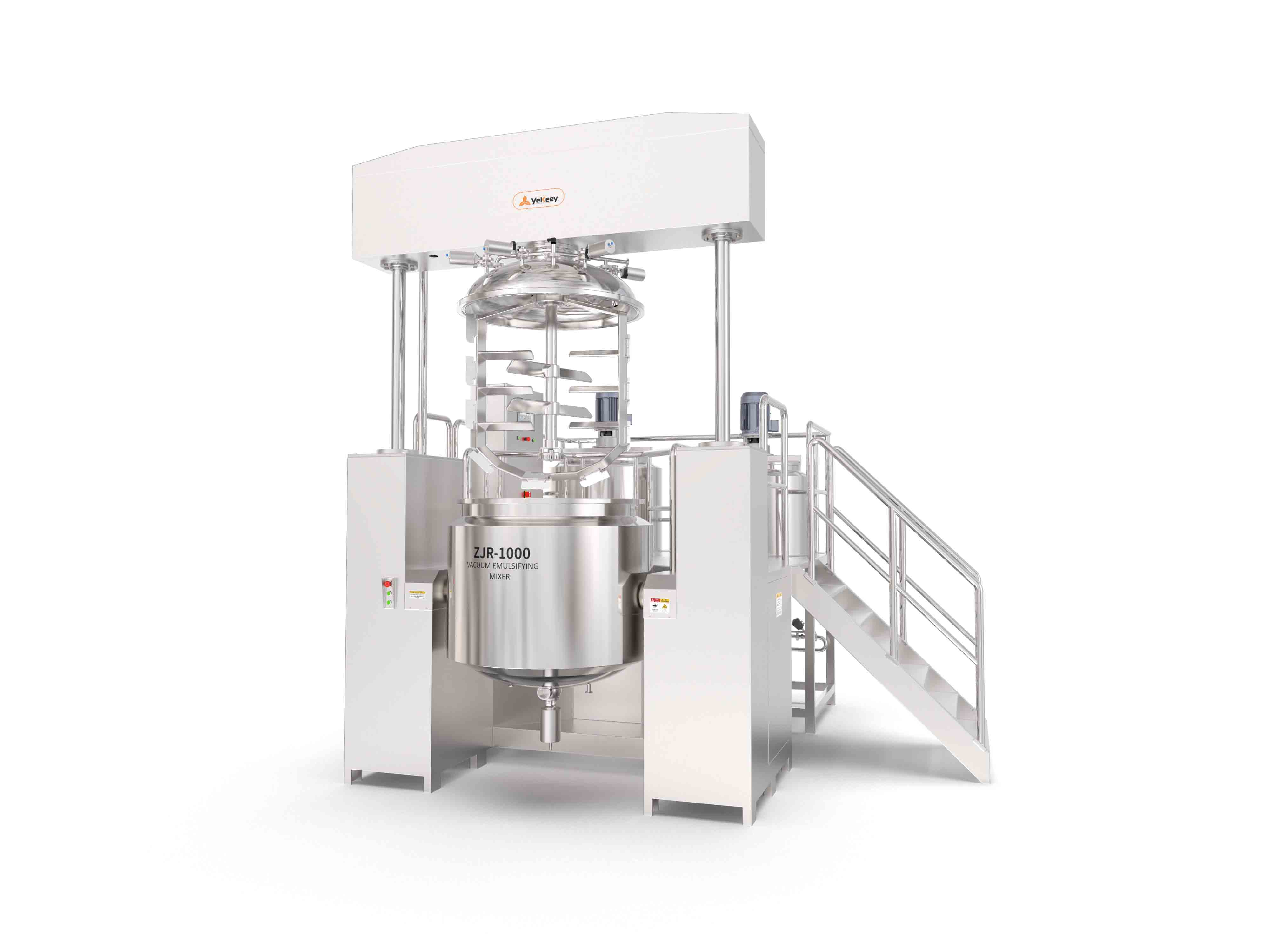
ZJR series vacuum emulsifying mixer — output speed range of 2800–6000 r/min for droplet-size reduction in sauces and cosmetic creams.
Mixing
Mixing addresses batch-to-batch viscosity drift, which is usually a temperature and uniformity problem as much as a shear problem. The vessel jacket is rated to temperatures up to 110 °C, which allows heat steps to be carried out in the same closed unit, and the agitation system keeps the mass thermally and compositionally uniform throughout the emulsification window. For food sauce production, the vessel operates under high-temperature, ambient temperature and vacuum conditions within the same process recipe.
Dispersing
Dispersing handles the powders that cause lumps: thickeners, starches, gums and pigments. When these are introduced into a vacuum vessel under agitation, agglomerates are less likely to form and less likely to survive into the finished product. Poor dispersion is a frequent hidden cause of perceived emulsion inconsistency, because the lump is not always visible in the final texture but does alter viscosity and appearance.
Power range is the other headline constraint. The MC and ZJR series are specified from 5 to 91.5 kW; the SP series is specified from 3.7 to 110 kW, which allows the same platform to cover small evaluation units and larger standard processing units. All three series share a vacuum capability of −0.09 MPa, a temperature capability of up to 110 °C, and material options in SS304 or SS316.
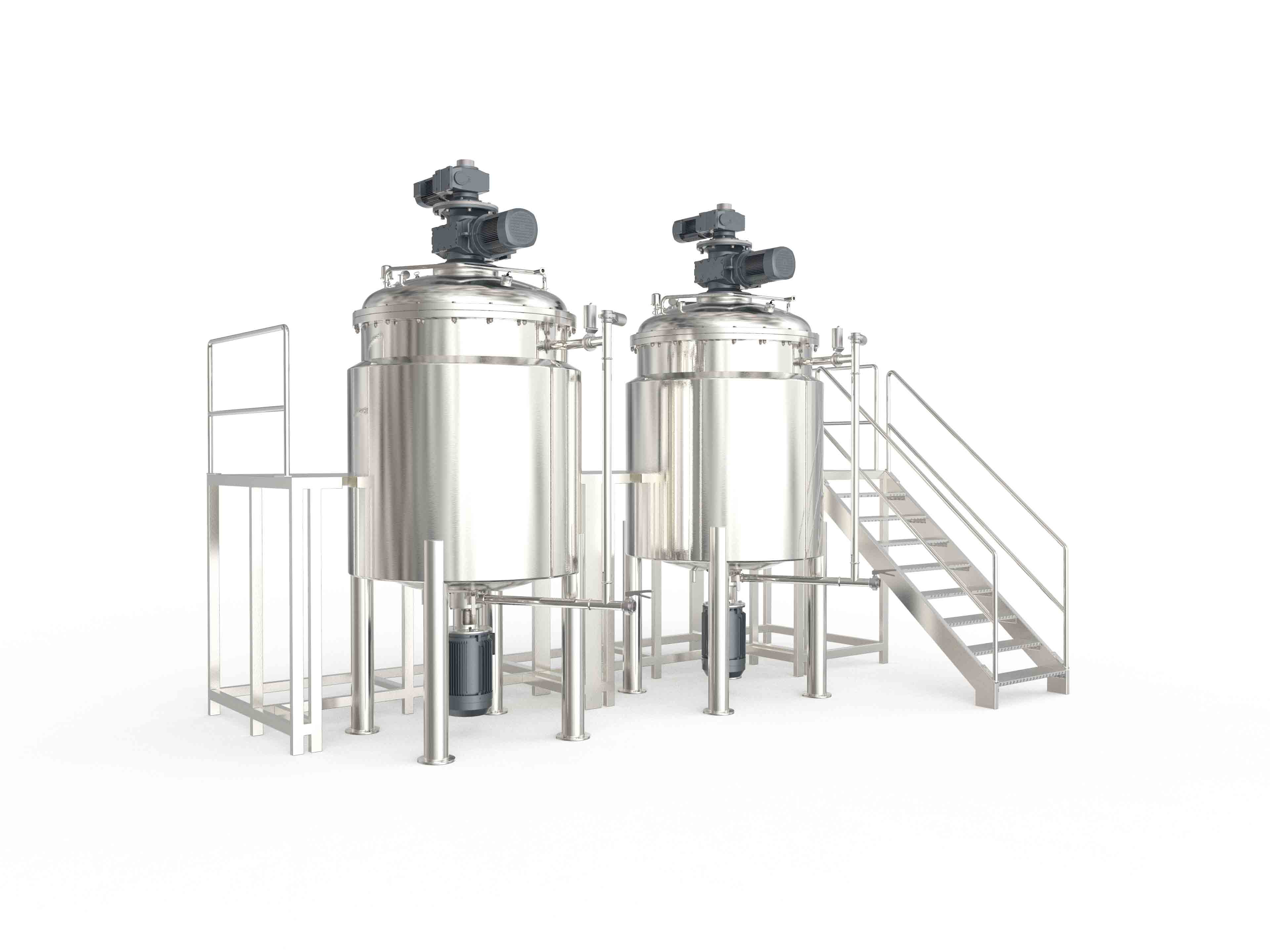
SP series standard vacuum processing unit — power range 3.7–110 kW, vacuum to −0.09 MPa, jacket temperature up to 110 °C.
Failure Mode to Specification Map
| Observed problem | Function that addresses it | Specification to confirm |
|---|---|---|
| Oil separation or surface free oil | Homogenizing | Output speed: up to 2800 r/min (MC, SP); 2800–6000 r/min (ZJR) |
| Trapped air, low density, foamy surface | Emulsifying under vacuum | Vacuum operation at −0.09 MPa |
| Viscosity drift between batches | Mixing with controlled temperature | Jacket temperature up to 110 °C |
| Lumps from thickener or gum addition | Dispersing under vacuum | Vacuum vessel plus agitation during addition |
| Uneven texture and appearance in creams | Combined emulsify, homogenize, mix, disperse | PLC control option for repeatable recipes |
Step-by-Step Breakdown: How to Specify a Unit That Removes the Problem
A vacuum homogenizer emulsifier mixer is only a solution if it is specified against the actual failure mode. The following sequence reflects how a research-to-evaluation purchase decision is normally worked through.
- Name the dominant failure mode. Graininess and oil separation point to homogenizing capacity. Foamy, low-density product points to vacuum performance. Variability between operators points to control type. Start from the defect, not from the model number.
- Match batch size to a series and model. The SP Series Standard Vacuum Processing Unit covers SPA-30 through SPA-10T. The ZJR Series Vacuum Emulsifying Mixer covers ZJR-5 through ZJR-2500. The MC Recirculation Homogenizing mixer covers MC-100 through MC-2500. A ZJR-Lab laboratory emulsifying mixer and an MC Lab recirculation homogenizing mixer are also available for small-volume work.
- Confirm the pressure and temperature envelope. All three series operate at −0.09 MPa and up to 110 °C, which defines the working environment as vacuum, high temperature or ambient temperature depending on the recipe stage.
- Confirm the shear requirement. Up to 2800 r/min on the MC and SP series; 2800–6000 r/min on the ZJR series. Higher shear speeds are relevant where droplet size reduction is the limiting factor.
- Select the material of construction. SS304 or SS316. The choice should be driven by the product's acidity, salt content and cleaning regime, not by default.
- Select the control mode. Button control or PLC control. PLC control supports recipe repeatability, which is the practical answer to operator-driven variation in mayonnaise and cream production.
- Plan the site utilities. A ducting system is the matched equipment for these units and should be included in the layout review, together with the power supply rating appropriate to the selected model.
- Confirm special requirements and documentation. Food sauce, daily chemical and cosmetic applications frequently specify explosion-proof electricals and pressure-vessel-rated construction as special requirements. These change engineering, lead time and documentation, so they should be stated at the enquiry stage rather than after order.
Series Comparison: SP, ZJR and MC Vacuum Emulsifying Mixers
All three YeKeey series share the same pressure, temperature and material envelope, and all three are stated as applicable to cosmetics and to food products with mayonnaise as a key focus. The differences that matter to a buyer are the model range, the drive power and the achievable homogenizing speed.
| Series | Type | Available models | Power range | Vacuum / temperature | Output speed | Material |
|---|---|---|---|---|---|---|
| SP Series | Standard Vacuum Processing Unit | SPA-30 to SPA-10T | 3.7–110 kW | −0.09 MPa / up to 110 °C | Up to 2800 r/min | SS304 / SS316 |
| ZJR Series | Vacuum Emulsifying Mixer (plus ZJR-Lab laboratory unit) | ZJR-5 to ZJR-2500 | 5–91.5 kW | −0.09 MPa / up to 110 °C | 2800–6000 r/min | SS304 / SS316 |
| MC Series | Recirculation Homogenizing mixer (plus MC Lab unit) | MC-100 to MC-2500 | 5–91.5 kW | −0.09 MPa / up to 110 °C | Up to 2800 r/min | SS304 / SS316 |
Use Cases: Food Sauce, Daily Chemical and Cosmetic Lines
Food sauce and mayonnaise production lines
In food sauce applications the unit is deployed as a food emulsification line or an emulsifier unit, running under high temperature, ambient temperature and vacuum conditions while performing emulsifying, homogenizing, mixing and dispersing. Mayonnaise and salad dressing are the typical products, where the requirement is a dense, non-aerated body with a consistent droplet size. Explosion-proof and pressure-vessel requirements are commonly listed as special requirements for these lines, and a ducting system is the matched equipment.
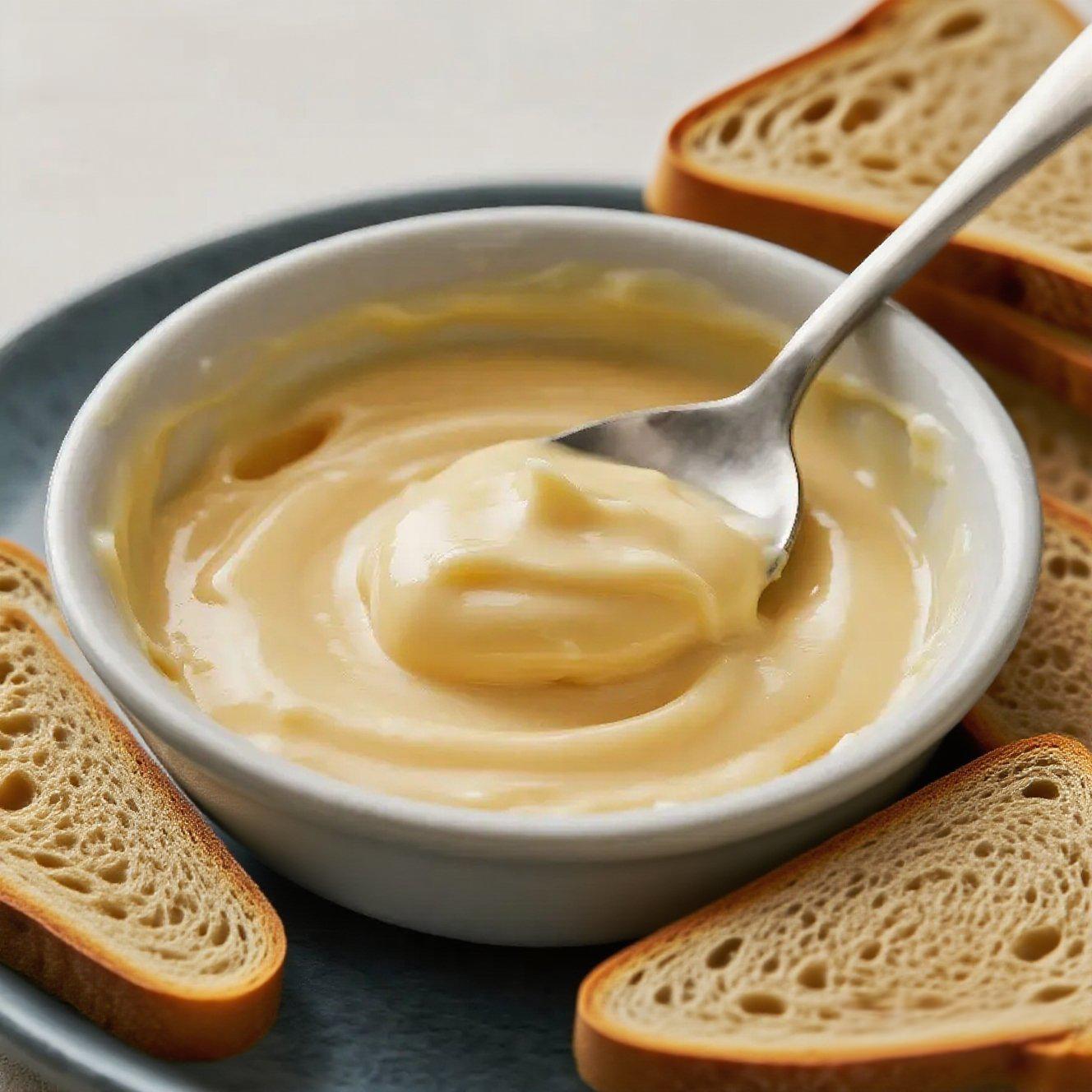
Food sauce application — mayonnaise and dressing lines rely on vacuum emulsification to control density and droplet size.
Daily chemical and personal care lines
In the daily chemical industry, the same platform is configured as a personal care product production line, and in cosmetics as a cosmetic manufacturing line or a cosmetics emulsifying machine unit. Creams, lotions and skin care products place the emphasis on texture uniformity and appearance consistency rather than on density alone, which makes PLC control and repeatable recipes more valuable than raw throughput.

Daily chemical and personal care production — emulsifying, homogenizing, mixing and dispersing in one vacuum vessel.
A long-running cosmetics reference
One documented reference is a Nigerian OBM cosmetics producer that operates three sets of this equipment. The application is cosmetics, the reported result is stable operation, the highlighted benefit is high production efficiency, and the working relationship is recorded as spanning at least ten years. For buyers evaluating durability rather than specification sheets alone, references of this type are more informative than catalogue output figures, because they speak to what happens after installation.
Compliance, Construction and Site Constraints Buyers Should Verify
For an equipment category that touches food and cosmetic products, compliance documentation is part of the specification, not an afterthought. YeKeey holds CE certification for its vacuum emulsifying mixers and related equipment, issued by ECM for the EU market. The relevant certificate numbers are:
- CE Certificate of Compliance for the Vacuum Emulsifying Mixer (MC series): certificate number 0P210922.WYAQT12
- CE Certificate of Compliance for the High Shear Homogenizer (models LR-5 to LR-5000): certificate number 0P210922.WYAQT10
- CE Certificate of Compliance for the Filling Machine (models including FGF-5, SGF-50, GFJX-3A, GS-1, GS-2, SGX-1, SGX-2, SGX-3, CZ-R, CZ-G, CZ-D): certificate number 0P210922.WYAQT11
The harmonised standards cited on these certificates are EN ISO 12100:2010, EN 60204-1:2018, EN IEC 61000-6-2:2019, EN IEC 61000-6-4:2019, EN IEC 61000-3-2:2019 and EN 61000-3-3:2013+A1:2019. In addition to product certification, YeKeey has fully implemented the ISO9001 quality system since 2003 and passed the high-tech enterprise certification in 2018.
Two further constraints commonly appear in specifications and deserve explicit confirmation. First, hygiene standards: vacuum emulsifying homogenizers for pharmaceutical and cosmetic use are typically required to comply with GMP standards, which in practice often means SUS316L stainless steel for contact parts, according to publicly available machinery safety and standards guidance. YeKeey's standard material options are SS304 and SS316, so if your internal GMP or food-safety policy requires a specific contact-part grade, that must be confirmed as a specification item rather than assumed. Second, site requirements: explosion-proof electricals, pressure-vessel-rated construction and the matched ducting system all affect engineering and installation, and all are recorded as special requirements for food sauce, daily chemical and cosmetic applications.
Frequently Asked Questions
What compliance documentation is available for these vacuum homogenizer emulsifier mixers?
YeKeey holds CE certification issued by ECM for the EU market. The CE Certificate of Compliance for the Vacuum Emulsifying Mixer (MC series) carries certificate number 0P210922.WYAQT12, and a CE Certificate of Compliance for the High Shear Homogenizer (models LR-5 to LR-5000) carries certificate number 0P210922.WYAQT10. The cited standards are EN ISO 12100:2010, EN 60204-1:2018 and the EMC series EN IEC 61000-6-2:2019, EN IEC 61000-6-4:2019, EN IEC 61000-3-2:2019 and EN 61000-3-3:2013+A1:2019. The company has also implemented the ISO9001 quality system since 2003 and holds high-tech enterprise certification from 2018. Because certificate terms are time-limited, buyers should request the current certificate copy for the specific model before confirming an order.
What operating parameters and configuration options can be specified?
The core envelope is consistent across the range: vacuum operation at −0.09 MPa, jacket temperature capability up to 110 °C, and materials of construction in SS304 or SS316. Drive power ranges from 3.7 to 110 kW on the SP series and from 5 to 91.5 kW on the ZJR and MC series. Output speed reaches up to 2800 r/min on the MC and SP series, and 2800–6000 r/min on the ZJR series. Control is available as button control or PLC control, and a ducting system is the matched equipment. Explosion-proof execution and pressure-vessel-rated construction can be specified as special requirements for food sauce, daily chemical and cosmetic lines. OEM/ODM/OBM production is available, with customization covering voltage, designated appliance brands, weighing module, logo, machine dimensions, jar size and heating method.
What drives the cost of a vacuum homogenizer emulsifier mixer?
Cost is driven by the specification rather than by a single headline factor. The main variables are the model size and working volume, the material of construction (SS304 versus SS316), the control package (button control versus PLC control), the homogenizer drive power and achievable speed, and the vacuum and heating configuration. Special requirements such as explosion-proof electricals and pressure-vessel-rated construction change engineering scope and therefore cost. Optional customization — voltage, weighing module, logo, machine dimensions, jar size and heating method — is another cost variable. The most reliable approach is to define the failure mode and the required parameters first, then request a quotation for the models that satisfy them, rather than comparing prices between differently specified units.
Can a trial be run before committing to a full production unit?
Yes. The range includes laboratory-scale units: the ZJR-Lab Laboratory Emulsifying Mixer and the MC Lab Recirculation Homogenizing mixer. These allow a formulation or a process recipe to be validated at small volume before a production model is selected, and the minimum order quantity is one unit. Quality control on production units is 100% test. Testing at lab scale is the most effective way to confirm that vacuum emulsification actually resolves the specific defect — oil separation, entrained air or viscosity drift — before capital is committed to a full line.
What is the typical lead time and production capacity?
Monthly production capacity is 50 units, and lead time is 30–60 days depending on the model, the material grade and whether special requirements such as explosion-proof or pressure-vessel execution are included. Minimum order quantity is one unit. Because customized components affect procurement, buyers who specify non-standard voltage, dimensions, jar size, heating method or weighing modules should confirm the lead time in writing as part of the quotation. After-sales support includes remote video guidance, supply of custom components and wear parts, and dispatch of technical personnel to site when required.
Conclusion: Specify Against the Defect, Not the Catalogue
Inconsistent mayonnaise and unstable cosmetic emulsions are rarely solved by changing the recipe alone. The defect is generated in the emulsification step, and it is corrected by controlling three variables inside one closed vessel: droplet size reduction through homogenizing, air removal through vacuum operation at −0.09 MPa, and thermal control up to 110 °C during phase combination — supported by mixing and dispersing functions in the same unit. Material choice in SS304 or SS316, control type as button or PLC, ducting, and special requirements such as explosion-proof and pressure-vessel execution then determine whether the installation runs repeatably in a real plant.
YeKeey (Wuxi YK Automation Technology Co., Ltd) has manufactured emulsifying, mixing and filling equipment since 1998, with an 8-engineer R&D team, a 20,000 m² facility, an annual output of 600 units, and equipment operating in more than 70 countries. If you are evaluating a vacuum homogenizer emulsifier mixer for a mayonnaise or cosmetic line, the most efficient next step is to define the failure mode and the required parameters, then validate them at lab scale before specifying the production model.
Request a Sample Test or a Specification-Based Quotation
Send us your product type, target batch volume and the defect you need to eliminate — oil separation, entrained air, or batch-to-batch viscosity variation. We will respond with the recommended series and model from the SP, ZJR or MC range, the relevant parameters, and the compliance documentation for your market.
Website: www.yekeey.com | Email: sales@yekeey.com | Tel: 86-510-88530599 | WhatsApp: +8615050678988
Address: NO.2855 Jiaoyang Road, An Zhen, Wuxi, Jiangsu Province, China
Download the full product brochure: YeKeey Vacuum Homogenizer Emulsifier Mixer Catalogue (PDF)

After-sales support: remote video guidance, custom components and wear parts, and on-site technical dispatch.
Have Questions or Need More Details?
Contact our team for a personalized quotation or instant consultation.
Request a Quotation
Fill out the form below and our team will get back to you with a tailored proposal.
WhatsApp Direct Chat
Prefer to chat in real-time? Message us on WhatsApp for instant assistance & quick answers.
- Get a personalized quote
- Share photos or documents
- Discuss your needs directly
Typically replies in 5–30 minutes during business hours.