
PLC vs Button Control in Vacuum Homogenizer Emulsifier Mixers: Mayonnaise & Cosmetics Comparison
PLC vs Button Control in Vacuum Homogenizer Emulsifier Mixers: Mayonnaise & Cosmetics Comparison
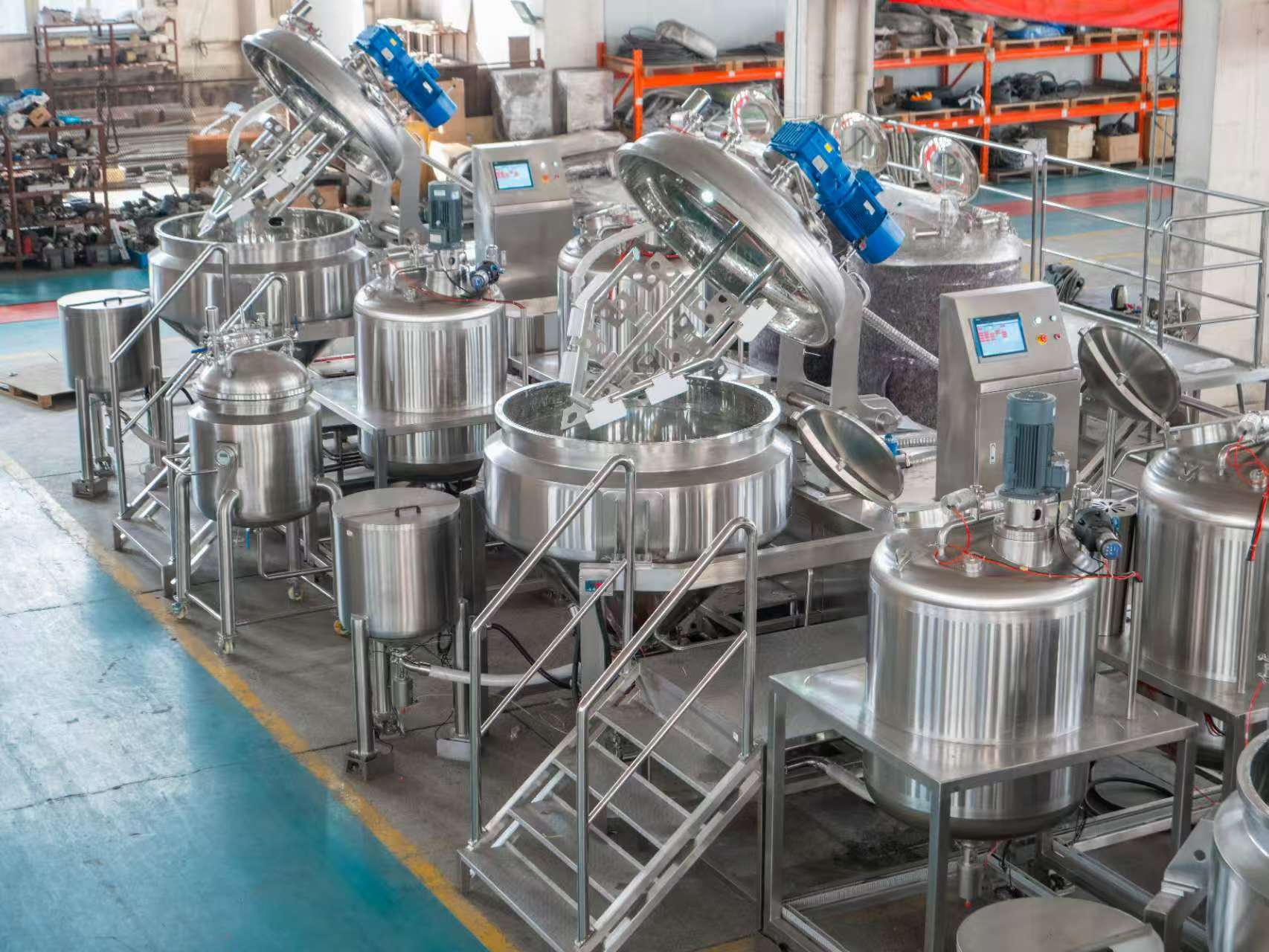
Cover: a YeKeey MC series vacuum homogenizer emulsifier mixer. Control mode is specified per project, not per machine family.
The short answer: if your line runs one or two stable recipes with experienced operators, button control is usually sufficient; if you run a multi-recipe portfolio, change over frequently, or produce emulsions where parameter repeatability decides whether a batch passes, PLC control is the more defensible specification. Both modes are offered on YeKeey vacuum homogenizer emulsifier mixers, which operate at a vacuum pressure of -0.09 MPa, at temperatures up to 110°C, and in SS304 or SS316 construction.
YeKeey (Wuxi YK Automation Technology Co.,Ltd) is a Wuxi, Jiangsu-based manufacturer of emulsifying, mixing, and filling equipment founded in 1998. Its vacuum emulsifying mixers are offered for cosmetics and for food products with mayonnaise as a key focus, with button control or PLC control listed as the operation mode for food sauce, daily chemical, and cosmetic projects. The purpose of this comparison is not to declare one mode better, but to help mayonnaise, sauce, daily chemical, and cosmetic producers match the control mode to the project so that neither capability nor budget is wasted.
Machine envelope that stays constant across both control modes
- Vacuum pressure: -0.09 MPa
- Operating temperature: up to 110°C
- Output speed: up to 2800 r/min (ZJR series listed at 2800-6000 r/min)
- Power range: 5-91.5 kW (MC and ZJR series); 3.7-110 kW (SPA series)
- Materials: SS304 or SS316
- Functions: emulsifying, homogenizing, mixing, dispersing
- Supporting equipment: a ducting system is required
Problem Definition: Control Mode Is a Project Decision, Not an Accessory
Two machines can carry identical nameplate data - the same -0.09 MPa vacuum, the same 110°C temperature ceiling, the same SS316 contact parts - and still deliver visibly different production outcomes. The difference is rarely the vessel. It is the way the recipe is executed inside the vessel: who sets the vacuum level, who starts the homogenizer, in what order, and how much of that depends on the person standing at the panel.
That is why control mode belongs in the project brief at the same stage as capacity, material, and compliance scope. It gets mis-specified in two directions.
Under-specification happens when a producer with several mayonnaise or cream recipes buys button control because the headline parameters look identical to a PLC unit. The line then compensates for manual setting with supervision, rework, and informal operator knowledge. The homogenizer is blamed for inconsistency that originates upstream of the machine.
Over-specification happens when a single-recipe sauce plant buys PLC control, then pays for programming, commissioning, documentation, and operator training that its process never uses. The equipment is capable but the commercial case is weak.
A practical way to frame the question: the machine sets the process window; the control mode determines how repeatably you land inside that window. Vacuum, temperature, shear speed, and material of construction define what the process can do. Button versus PLC defines how consistently a batch returns to the same point in that window.
Industry Background: Why This Comparison Matters Now
Demand for vacuum processing capacity is being pulled from both sides of the application divide. Fact.MR estimates the global vacuum mixer homogenizer market at USD 1.02 billion in 2026, expanding to approximately USD 1.61 billion by 2036. On the end-product side, Market Research Future projects the mayonnaise market growing from USD 12.34 billion in 2025 to USD 19.27 billion by 2035. Grand View Research reports that Asia Pacific held a 44.1% revenue share of the homogenizer market in 2023.
Those two demand curves converge on the same equipment category. Manufacturers market vacuum homogenizing and emulsifying machines across both food and personal care: LIENM lists lotions, creams, body wash, toothpaste, and laundry liquids among applications and markets vacuum emulsifier homogenizers for mayonnaise production, stating that vacuum processing removes air bubbles from mayonnaise. VMI Mixing describes laboratory and production vacuum homogenizers covering dispersion, emulsification, homogenization, and heat exchange for cosmetics, personal care, and pharmaceutical emulsions. A single machine platform serving both industries means buyers frequently compare control specifications across product categories where the recipes behave very differently.
Mayonnaise is the demanding case on the food side. It is an oil-in-water emulsion built on shear and stabilised by a fine oil droplet distribution; air entrainment during mixing is a quality issue, which is why vacuum processing is used. On the cosmetic side, creams and lotions add a second layer of difficulty: many SKUs, smaller batches, and frequent changeovers between formulations with different viscosity and heat sensitivity.
YeKeey has manufactured fine chemical, pharmaceutical, and high-end processing equipment since 1998 from a 20,000 m² facility with 80 employees and an annual output of 600 units, supported by an R&D team of 8 engineers. The company reports 55 patents and 3 software programs as of 2023, ISO 9001 implementation since 2003, EU CE safety certification, and equipment running at more than 4,000 enterprises and institutions in over 70 countries, with 35% of output exported to Europe, Central Asia, North Africa, Latin America, and Southeast Asia. In practical terms for this comparison, that means the control mode is a configured option on a mature machine platform rather than a bespoke engineering project.
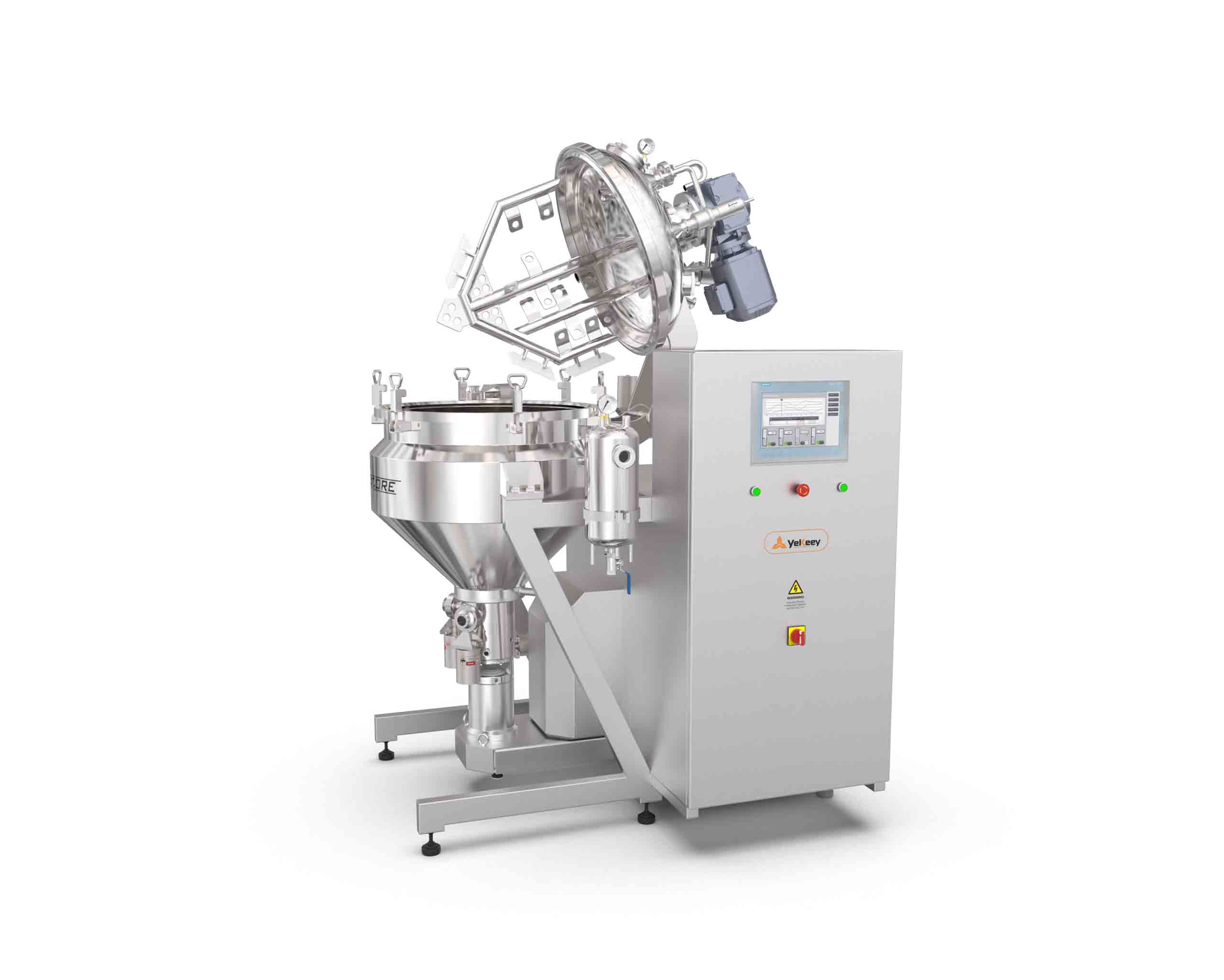
The vessel, homogenizer head and material of construction are fixed by the process window; the control cabinet is where button and PLC configurations diverge.
Detailed Solution: What Each Control Mode Actually Governs
Button control: direct, visible, operator-led execution
With button control, each process step is initiated and set at the panel: vacuum, heating, homogenizer speed, mixing, and the sequence between them. The logic lives in the operator and in the written procedure, not in a stored program. This has real advantages that are often understated in procurement discussions.
The first is transparency. Anyone at the panel can see what is running and what is not, which makes the mode easy to teach and easy to supervise on a line with stable routines. The second is simplicity of maintenance: fewer programmed dependencies means fewer places for a configuration fault to hide. The third is commercial: the control scope is narrower, so the specification, commissioning, and training effort is smaller.
The limitation is equally clear. Repeatability is only as good as the discipline behind it. When the same recipe is run by three shifts, small differences accumulate - a slightly different vacuum hold time, a homogenizer started a few seconds earlier, heating stopped at a marginally different point. In mayonnaise, where emulsion stability depends on consistent shear and aeration control, and in cosmetic creams, where texture and viscosity are sensitive to the temperature and homogenizing sequence, those small differences surface as batch-to-batch variation.
PLC control: sequence-led, parameter-repeatable execution
With PLC control, the process sequence and its setpoints are held in a program and executed the same way at every batch. The operator selects a recipe and starts the cycle; the controller manages the order of vacuum, heating, homogenizing, and dispersing steps, and holds each parameter to its setpoint for the defined duration. The practical effect is that the -0.09 MPa vacuum level and the up-to-110°C temperature stage are reached and held the same way on shift one and shift three.
This is where PLC earns its cost in mayonnaise and cosmetics alike. In mayonnaise, consistent vacuum and shear sequence reduce the variability that shows up as inconsistent texture or occluded air. In cosmetics, where a plant may run a dozen creams and lotions, stored recipes shorten changeover and lower the risk of a formulation being run with the wrong sequence.
The trade-offs are real and should be stated plainly. PLC control adds programming, commissioning, and validation scope to the project, and it adds a documentation obligation: the recipe setpoints must be defined, authorised, and controlled, or the program simply automates an undefined process. It also shifts the skill requirement rather than removing it - operators need to understand recipe selection and alarm handling, and someone on site needs to own parameter changes. A PLC does not make a bad process good; it makes a defined process repeatable.
What the control mode does not change
Several specification items sit outside the button-versus-PLC decision and should not be traded against it.
Material of construction. SS304 and SS316 options are available across the MC, ZJR, and SPA vacuum emulsifying mixer series, and the choice is driven by the product and cleaning regime, not by the control cabinet.
Supporting equipment. These mixers require supporting equipment such as a ducting system. This is a project-scope item: it must be included in the line layout and budget regardless of control mode, and it affects the available footprint at the installation point.
Special compliance requirements. Explosion-proof and pressure vessel requirements are recorded as project-specific special requirements for food sauce, daily chemical, and cosmetic installations. They constrain which instrumentation and control hardware can be installed, which means the control mode must be decided together with the compliance scope - not after it. Any claim about conformity should be confirmed against the specific destination market and the project documentation.
Power and utility envelope. Power consumption ranges from 5 kW to 91.5 kW on the MC and ZJR series and from 3.7 kW to 110 kW on the SPA series, depending on model. Electrical supply, heating method, and control voltage are project-level decisions; YeKeey lists voltage, machine dimensions, jar size, heating method, weighing module, logo, and designated appliance brands among the customisation options available under OEM, ODM, or OBM supply.
Step-by-Step Breakdown: Matching Control Mode to Your Project
The sequence below is designed to be run during research and evaluation, before an RFQ is issued. Each step produces an input the next step needs.
- Map the recipe portfolio, not just the current product. Count the formulations the line must run over the next three years, including private-label variants, seasonal sauces, and any cosmetic SKUs planned for launch. A single-recipe line and a ten-recipe line are different control problems even when batch size is identical.
- Name the parameters that must repeat. List the setpoints whose drift causes a rejected batch: vacuum level (-0.09 MPa), holding temperature (up to 110°C), homogenizer speed (up to 2800 r/min), mixing and dispersing sequence, and step duration. If the list is short and forgiving, button control becomes viable. If several parameters must be held simultaneously and in order, the case for PLC strengthens.
- Score operator dependency honestly. Consider shift patterns, staff turnover, and how much process knowledge currently lives in individual operators. High turnover and multi-shift running push the decision toward PLC, because the program preserves the sequence when people change.
- Fix the compliance and utility envelope first. Confirm the explosion-proof and pressure vessel requirements for the project, confirm the ducting system scope, and confirm the available power and heating utilities. These items determine what control hardware can be installed, so resolving them after the control mode is chosen frequently forces a redesign.
- Match batch size to the vessel series. YeKeey MC series covers MC-100 to MC-2500, ZJR series covers ZJR-5 to ZJR-2500, and SPA series covers SPA-30 up to SPA-10T. Laboratory units (ZJR-Lab and MC Lab Recirculation Homogenizing mixer) allow formulation work to run on the same process principle before production scale-up.
- Decide the documentation scope. If the line will be audited, or if recipe integrity must be demonstrable, define the parameter authorisation and change-control expectations in the specification. This applies to button-controlled lines as much as to PLC lines, but PLC projects need it settled earlier because the program is built around it.
- Validate on a sample batch, then lock lead time. Run the actual recipe - mayonnaise or cream - and judge the control mode on the batch, not on the panel. YeKeey runs 100% testing on units, accepts a minimum order quantity of 1 unit, and quotes a lead time of 30-60 days, which allows a validation step to be scheduled before the line installation date.

Food sauce projects: high temperature, ambient temperature, and vacuum conditions are the recorded working envelope, with emulsifying, homogenizing, mixing, and dispersing as the core functions.
Use Cases: Where Each Mode Fits
Single-recipe mayonnaise or sauce line, one shift pattern
A producer running one mayonnaise formulation on a fixed daily schedule, with operators who have run the same procedure for years, gets limited additional value from PLC. Button control keeps the capital and commissioning scope minimal, and the process discipline already exists in the procedure. The important condition is that the recipe really is stable: if a private-label customer arrives with a variant, the assumption breaks.
Multi-SKU sauce plant or private-label producer
Here the cost of changeover dominates. Each switch between formulations introduces a window where the wrong vacuum hold or homogenizing sequence can be applied. PLC control converts the changeover from a manual reset exercise into a recipe selection, which is the main operational argument for the investment in this segment.
Cosmetic cream and lotion manufacturing with frequent launches
Cosmetic lines typically run more formulations at smaller batch sizes, with texture and viscosity as visible quality attributes. The combination of many recipes and high sensitivity to sequence makes PLC control the natural fit, particularly where R&D hands a formulation to production and expects the same result. Laboratory units in the ZJR and MC ranges let the formulation be fixed on the same process principle before the production unit is specified.
Daily chemical production with a narrow, high-volume portfolio
Daily chemical projects sit between the two extremes. Where the portfolio is narrow and volumes are high, button control with a disciplined procedure remains workable; where several product families share one unit, PLC shortens changeover and reduces cross-batch error. The deciding question is the same in every case: how many recipes, and how much does a deviation cost.
Reference case: cosmetic OBM production in Nigeria
YeKeey supplied 3 sets of vacuum emulsifying equipment to an OBM cosmetic producer in Nigeria, with at least 10 years of operation recorded. The reported outcomes are stable operation and high production efficiency. For buyers evaluating control mode, the relevant lesson is not the tonnage but the operating horizon: equipment specified for a decade of running has to be specified around the recipes and operators it will actually see over that period, not only around the launch formulation.

Daily chemical and personal care projects use the same recording of working conditions: high temperature, ambient temperature, and vacuum, with button or PLC control.
Comparison Table: PLC vs Button Control
The table compares the two control modes on decision factors that matter during evaluation. Where a row describes general engineering behaviour rather than a YeKeey-specific specification, it is marked as typical.
| Decision factor | Button control | PLC control |
|---|---|---|
| Batch execution | Steps set and started at the panel by the operator | Steps held in a program and executed in sequence |
| Parameter repeatability | Depends on procedure discipline and operator consistency | Depends on how well setpoints are defined and controlled |
| Recipe changeover | Manual reset per changeover (typical) | Recipe selection instead of manual reset (typical) |
| Operator skill dependence | Higher influence on batch outcome | Shifted to recipe handling and alarm response |
| Process window | -0.09 MPa vacuum, up to 110°C, up to 2800 r/min | Same process window |
| Material options | SS304 or SS316 | SS304 or SS316 |
| Supporting equipment | Ducting system required | Ducting system required |
| Explosion-proof and pressure vessel scope | Constrains permitted hardware; must be defined with the project | Same constraint, plus program scope must match it |
| Project scope drivers | Narrower specification and training scope | Adds programming, parameter definition, commissioning and training |
| Typical fit | Few recipes, stable schedule, experienced operators | Many recipes, frequent changeover, repeatability-critical batches |
| Where it fits best by application | Single-sauce or single-product lines | Multi-SKU mayonnaise, cream and lotion production |
The second table lists the machine series data that applies regardless of the control mode selected.
| Series | Model range | Power | Vacuum / temperature | Output speed |
|---|---|---|---|---|
| MC Recirculation Homogenizing mixer (incl. MC Lab) | MC-100 to MC-2500 | 5-91.5 kW | -0.09 MPa / up to 110°C | up to 2800 r/min |
| ZJR Series Vacuum Emulsifying Mixer (incl. ZJR-Lab) | ZJR-5 to ZJR-2500 | 5-91.5 kW | -0.09 MPa / up to 110°C | 2800-6000 r/min |
| SP Series Standard Vacuum Processing Unit | SPA-30 to SPA-10T | 3.7-110 kW | -0.09 MPa / up to 110°C | up to 2800 r/min |
FAQ
Does the control mode affect explosion-proof or pressure vessel compliance on a vacuum homogenizer emulsifier mixer?
It does not change the requirement, but it changes how the requirement is met. Explosion-proof and pressure vessel requirements are recorded as special project requirements for food sauce, daily chemical, and cosmetic installations. Because those requirements constrain which instrumentation and control hardware can be installed, the control mode must be specified together with the compliance scope. Choosing the control cabinet before the compliance envelope is fixed creates rework. Conformity claims should be verified against the specific destination market and the project documentation rather than assumed from a general certificate.
Can button control handle mayonnaise and cosmetic cream, or is PLC required?
Both modes are listed as operation modes for food sauce, daily chemical, and cosmetic projects, and both operate within the same process window of -0.09 MPa vacuum, temperatures up to 110°C, output speeds up to 2800 r/min, and SS304 or SS316 construction. Button control handles mayonnaise and creams adequately where the recipe set is narrow and the procedure is disciplined. PLC becomes the stronger choice when several recipes share one unit, when changeovers are frequent, or when a deviation carries a high cost. The functions themselves - emulsifying, homogenizing, mixing, dispersing - are unchanged by the control mode.
Which control mode costs more to specify, and what drives the difference?
PLC control adds scope rather than only hardware. The project gains programming, setpoint definition, commissioning, parameter authorisation and training, so the engineering and validation effort is larger than on a button-controlled unit. Button control carries a narrower specification and training scope but depends more heavily on documented procedure and operator consistency. The honest comparison is not the panel cost alone: it is the panel plus the engineering, documentation and training attached to it, weighed against the cost of batch deviation. YeKeey accepts a minimum order quantity of 1 unit, which lets a buyer evaluate scope on a single configured unit rather than a full line commitment.
Can we validate the control mode on a sample batch before ordering a line?
Yes, and it is the most reliable way to decide. YeKeey runs 100% testing on units and offers laboratory models - the ZJR-Lab Laboratory Emulsifying Mixer and the MC Lab Recirculation Homogenizing mixer - so a formulation can be fixed on the same process principle before production scale-up. The evaluation should use the real recipe, real batch size, and the real operating conditions of high temperature, ambient temperature, and vacuum, with explosion-proof and pressure vessel scope defined in advance. Brochure and catalogue data can be reviewed first, then confirmed against a trial batch.
What is the lead time for a configured unit, and what support follows delivery?
YeKeey quotes a lead time of 30-60 days with a monthly capacity of 50 units, and the operation mode, voltage, machine dimensions, jar size, heating method, and weighing module can be specified as part of an OEM, ODM, or OBM order. After delivery, support includes remote video guidance, supply of custom components and wear parts, and dispatch of technical personnel to site for repairs. To move from evaluation to a concrete comparison, request a quotation and a sample validation on your own formulation through sales@yekeey.com; the product brochure can be downloaded from the link at the end of this article.
Conclusion: Specify the Control Mode Against the Project, Not the Brochure
Button control and PLC control on a vacuum homogenizer emulsifier mixer are not quality tiers. They are two ways of executing the same process window of -0.09 MPa vacuum, temperatures up to 110°C, and shear speeds up to 2800 r/min inside an SS304 or SS316 vessel. Button control keeps scope small and visibility high, and it works when the recipe set is narrow and the operators are stable. PLC control makes the sequence repeatable and shortens changeover, and it earns its cost when recipes multiply or when batch deviation is expensive.
The reliable decision path runs through the project, not the datasheet: count the recipes, name the parameters that must repeat, assess operator dependency, fix the explosion-proof and pressure vessel scope together with the ducting system, match batch size to the MC, ZJR, or SPA series, and validate on a real batch. Buyers who follow that order usually specify the cheaper of the two adequate options - and avoid paying for capability the line never uses, or discovering later that repeatability was the missing specification all along.

Support after delivery: remote video guidance, custom components and wear parts, and on-site technical personnel when required.
Next step: compare the two modes on your own recipe
Send your formulation, batch size, and compliance scope to YeKeey and request a quotation or a sample validation. Both button-control and PLC-control configurations are quoted against the same process window, so the difference you see is the control scope itself.
Email: sales@yekeey.com | Tel: 86-510-88530599 | WhatsApp: +8615050678988 | Web: www.yekeey.com
Address: NO.2855 Jiaoyang Road, An Zhen, Wuxi, Jiangsu Province, China
Download the product brochure for model ranges, dimensions and configuration options: YeKeey Vacuum Emulsifying Mixer Brochure (PDF)
Company background in this article: Wuxi YK Automation Technology Co.,Ltd (YeKeey), founded 1998, 20,000 m² facility, 80 employees, 600 units annual output, 8-engineer R&D team, 35% export ratio, ISO 9001 implementation since 2003, EU CE safety certification, 55 patents and 3 software programs as of 2023.
Have Questions or Need More Details?
Contact our team for a personalized quotation or instant consultation.
Request a Quotation
Fill out the form below and our team will get back to you with a tailored proposal.
WhatsApp Direct Chat
Prefer to chat in real-time? Message us on WhatsApp for instant assistance & quick answers.
- Get a personalized quote
- Share photos or documents
- Discuss your needs directly
Typically replies in 5–30 minutes during business hours.