
Vacuum Homogenizer Emulsifier Mixer: Pressure, Temperature & Material
Vacuum Homogenizer Emulsifier Mixer: Pressure, Temperature & Material
A vacuum homogenizer emulsifier mixer is defined by three parameters before anything else is discussed: vacuum pressure, working temperature, and the stainless steel grade of the product-contact parts. On the equipment referenced in this guide, those values are -0.09 MPa vacuum pressure, up to 110 °C operating temperature, and SS304 or SS316 material options. This technical guide explains what each parameter controls, how the MC, ZJR and SP series differ, and how engineers and buyers can map these numbers onto a mayonnaise sauce line or a cosmetic cream line.
Why Parameter Mismatch Is the Most Expensive Specification Error
A vacuum homogenizer emulsifier mixer is a Vacuum Emulsifying Mixer that performs four functions in one vessel: emulsifying, homogenizing, mixing, and dispersing. Because those four functions run simultaneously, a wrong parameter does not fail in isolation. It propagates.
The most common mismatch pattern is selecting on tank volume while ignoring the process envelope. Volume tells you how much material fits. Pressure, temperature, speed and material tell you whether the material in the tank will actually reach the specification your customer or your own QA department requires.
- Pressure mismatch. Vacuum homogenizer emulsifier mixers operate under vacuum conditions with a pressure range of -0.09 MPa. Vacuum in this context supports the emulsifying and homogenizing action by helping remove entrained air from the batch. If the vacuum level is not matched to the formulation, the consequences tend to show up as batch-to-batch inconsistency in texture and density rather than as an obvious machine fault.
- Temperature mismatch. The equipment is designed for high-temperature environments up to 110 °C. Process temperature is normally set by the formulation — the melting point of the oil phase, the thermal sensitivity of active ingredients, or the pasteurisation step in a food sauce. A jacket and seal package that is underspecified for the required process temperature becomes a maintenance issue, not a quality issue at first.
- Material mismatch. SS304 and SS316 are both offered across the series, but they are not interchangeable in every product. The correct choice depends on the chemistry of the recipe, the cleaning regime, and the regulatory framework the finished product must satisfy.
- Interface mismatch. Control mode (button or PLC) and supporting equipment such as a ducting system are decided late in most projects, which is exactly when they cause scope changes. Explosion-proof and pressure vessel requirements fall into the same category.
The practical lesson is that pressure, temperature, material and control mode should be fixed as a single decision set, before capacity and layout are finalised.
Industry Background: Where the Demand for These Parameters Comes From
Two product families dominate the demand for vacuum emulsifying equipment: food sauces — with mayonnaise as the leading application — and cosmetics and personal care creams. The market data behind that demand is reasonably consistent across published research.
- The global homogenizers market was valued at USD 2.10 billion in 2024 and is projected to reach USD 3.79 billion by 2035, at a CAGR of 5.4% (Roots Analysis).
- The vacuum mixer homogenizer market is estimated at USD 1.02 billion in 2026, with cosmetics and personal care leading at a 38% market share (Future Market Insights).
- The global mayonnaise market was worth approximately USD 12.58 billion in 2024, which supports continued demand for high-shear vacuum emulsification equipment (Zion Market Research).
- The global emulsifier market is expected to reach USD 12.13 billion by 2030, growing at a CAGR of 4% (Mordor Intelligence).
- Asia-Pacific dominates the homogenizing mixer market with a 36.2% revenue share as of 2025, led by China's manufacturing ecosystem (Dataintelo).
For a buyer, the useful signal is structural rather than numeric. Mayonnaise and cosmetic cream sit at opposite ends of the viscosity and hygiene spectrum, yet both are produced on the same class of machine. That is why the parameter set has to be read against the application rather than against a generic specification sheet.
Core Parameters in Detail
1. Vacuum Pressure: -0.09 MPa
Vacuum homogenizer emulsifier mixers in the MC, ZJR and SP series all operate under vacuum conditions with a stated pressure range of -0.09 MPa. In practice, the vacuum level is one of the few parameters a buyer should treat as a fixed engineering target rather than an adjustable preference.
Vacuum performs a supporting role in the emulsification process. By reducing the pressure above the batch, it assists in removing air that would otherwise be folded into the emulsion during high-shear mixing. In a mayonnaise or sauce application, entrained air affects visual appearance and batch density. In a cosmetic cream, it affects how the product fills and how stable the emulsion remains over its shelf life.
Specification note: -0.09 MPa is the stated working pressure range for the Vacuum Emulsifying Mixer product family. Because vacuum interacts with temperature and product viscosity, the vacuum level should always be confirmed together with the process temperature, not separately.
2. Temperature: Up to 110 °C
The equipment is designed for high-temperature environments with operational capability up to 110 °C. The application scenarios recorded for food sauce and daily chemical projects list the working conditions as high temperature, ambient temperature, and vacuum — meaning the same vessel is expected to handle a heated emulsification phase and a cooled, vacuum-held finishing phase.
Temperature selection is driven by the formulation, not by the machine:
- Food sauce and mayonnaise. The oil phase must be fully melted and the aqueous phase brought to a compatible temperature before emulsification. Where the process includes a thermal step for stability, that step sets the upper temperature requirement.
- Cosmetic cream and skincare products. Heat is used to melt waxes and emulsifiers and to form the oil phase; the limit is set by the thermal sensitivity of the actives and fragrance components, which is usually well below the equipment ceiling.
- Daily chemical production. The same principle applies to personal care and household formulations where phase inversion and viscosity are temperature dependent.
A machine rated up to 110 °C gives most formulators headroom. The more important question is whether the jacket, seals and control logic hold the process temperature steadily, because temperature drift during the cooling phase is a common cause of inconsistent viscosity.
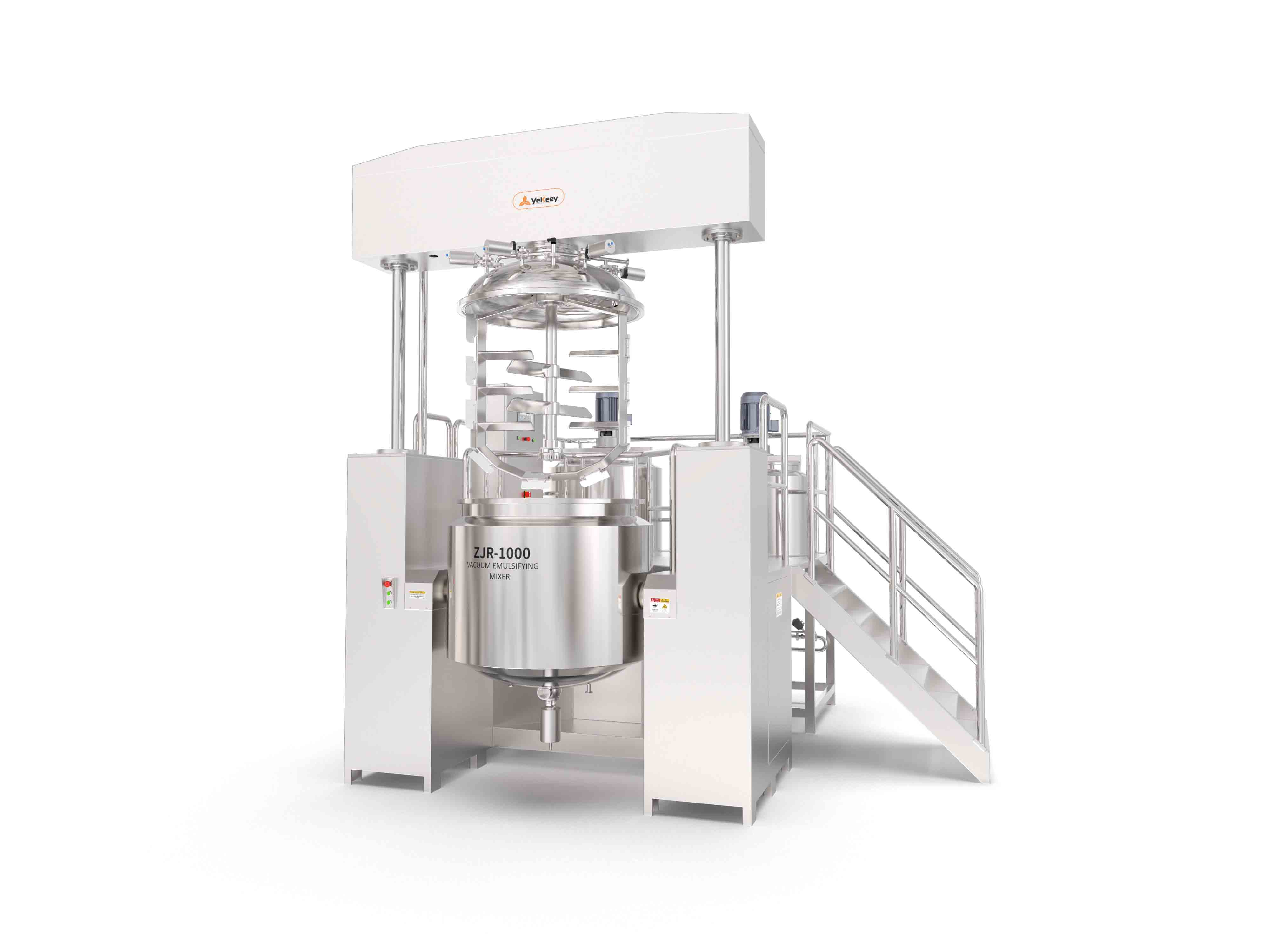
3. Material Selection: SS304 vs SS316
Both SS304 and SS316 are offered as material options for the Vacuum Emulsifying Mixer range. The choice is a corrosion-resistance decision with a cost and heat-transfer dimension attached to it.
SS304 is the standard food and general-purpose stainless steel. It is widely used in sauce and mayonnaise equipment, where the product is typically near-neutral to mildly acidic and cleaning is done with standard CIP chemistry. SS316 adds molybdenum to the alloy, which improves resistance to chloride attack and to more aggressive cleaning or process chemistries. It is normally specified when the recipe contains higher salt levels, acidic components, or active ingredients that would attack a 304 surface over time.
Regulatory context matters here as well. Vacuum emulsifying homogenizers used in pharmaceutical and cosmetic applications must generally comply with GMP standards, and published guidance for those applications typically points to SUS316L stainless steel for product-contact parts. Buyers should therefore confirm the exact grade that a specific regulated application requires, rather than assuming that any stainless steel option satisfies the standard.
Selection rule of thumb: start with SS304 for standard food sauce and mayonnaise lines, and move to SS316 when the formulation, the cleaning regime, or the customer's compliance requirement makes corrosion resistance the dominant risk. Do not upgrade the alloy to compensate for a process problem that should be solved with temperature or vacuum control.
4. Control Mode: PLC vs Button Control
Two operation modes are available across the range: button control and PLC control.
Button control is the direct option. Operators start, stop and adjust the machine through physical controls, which suits single-product lines, smaller plants, and situations where the workforce is already familiar with the process. It is straightforward to maintain and easy to train on.
PLC control is the recipe-driven option. It suits plants that run multiple formulations on the same vessel, that need repeatable ramp profiles for temperature and vacuum, or that intend to connect the emulsifier unit to a wider production line control system. For a manufacturer scaling from one mayonnaise recipe to a family of sauce SKUs, or from one cream base to several cosmetic variants, PLC control is usually the point at which batch consistency stops depending on operator memory.
The decision is not purely technical. It is a decision about how much process knowledge the plant wants to hold in the machine versus in the people operating it.
5. Supporting Equipment and Special Requirements
Operation requires supporting equipment such as a ducting system. Ducting is easy to overlook during budgeting because it is not part of the mixer itself, yet it is part of the installed scope and must be planned alongside the main unit.
Project-specific special requirements also appear in this equipment category. Recorded application requirements include explosion-proof construction and pressure vessel certification for certain installations. Both change the engineering, the documentation and the delivery schedule, so they should be raised at the specification stage rather than after the purchase order.
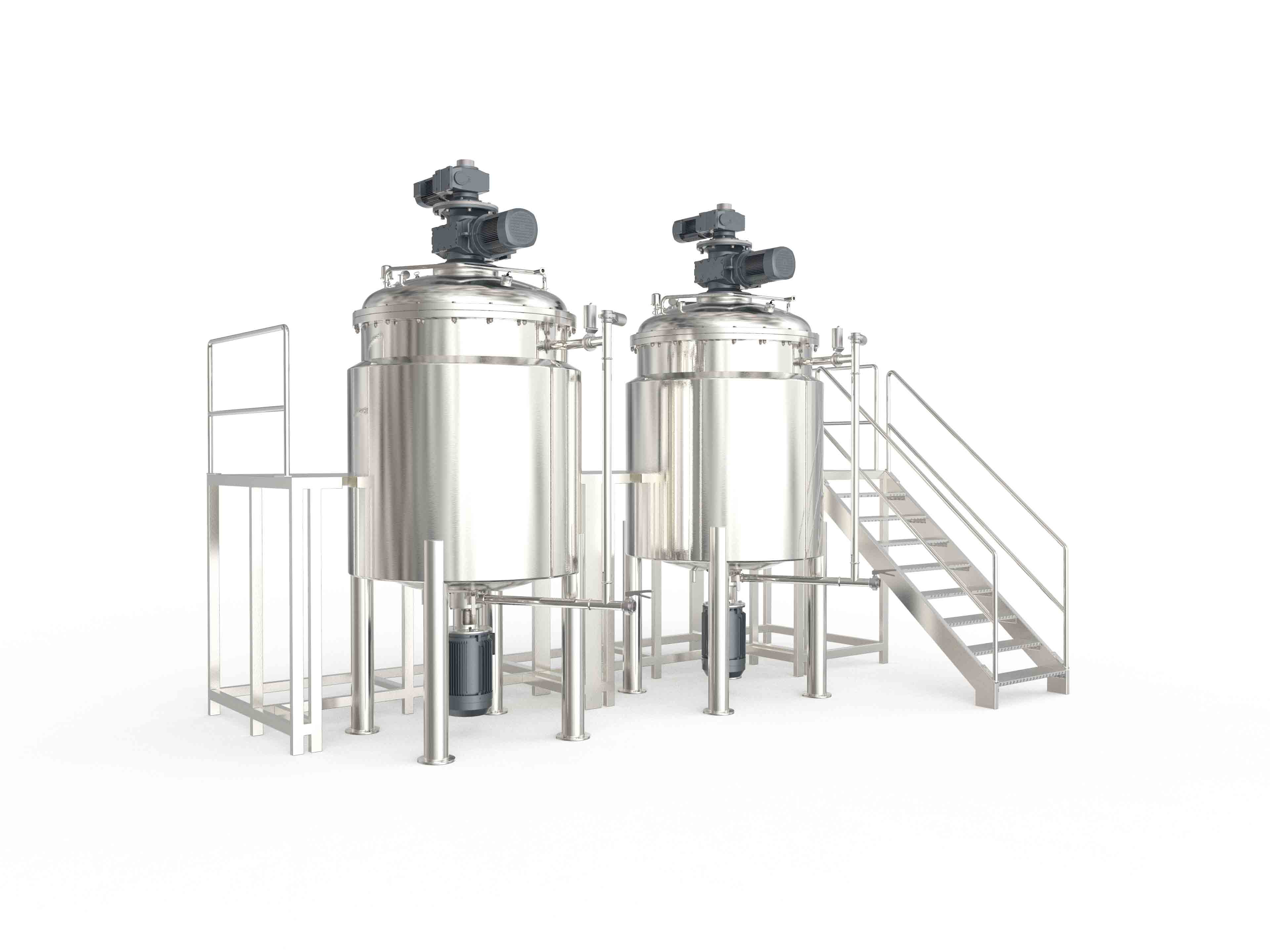
Step-by-Step: Mapping Parameters to Your Project
The following sequence keeps the parameter set coherent and avoids late scope changes. It applies whether the project is a standalone emulsifier unit or a full production line.
- Define the product family and viscosity band. Mayonnaise sauce, salad dressing, cosmetic cream and skincare lotion behave differently in the same vessel. Write down the target viscosity and the shear requirement before looking at models.
- Fix the temperature window. Record the maximum process temperature the formulation will reach, including any thermal step, and confirm it sits within the equipment capability of up to 110 °C with margin.
- Confirm the vacuum requirement. Treat -0.09 MPa as the reference working pressure and decide how critical air removal is to the finished product. For aeration-sensitive sauces and creams, this is a quality parameter, not a convenience.
- Select the steel grade. Choose SS304 or SS316 against the chemistry of the recipe, the cleaning chemicals, and any compliance framework the finished product must meet.
- Choose the control mode. Button control for single-product or simple lines; PLC control for multi-recipe production, repeatable ramp profiles, or line-level integration.
- List supporting equipment and special requirements. Ducting system, explosion-proof construction and pressure vessel requirements all belong in the original scope.
- Match capacity and power. Only now select the model, based on working volume, power range and output speed.
- Validate before full-scale commitment. Where the formulation is new or the parameters are uncertain, run the process on a laboratory-scale unit first.
How the Three Series Differ
Three vacuum emulsifying mixer families are available, and the parameter differences between them are the practical starting point for model selection.
| Series | Model Range | Power Range | Output Speed | Pressure | Temperature | Material |
|---|---|---|---|---|---|---|
| MC Recirculation Homogenizing Mixer | MC-100 to MC-2500 | 5–91.5 kW | Up to 2800 r/min | -0.09 MPa | Up to 110 °C | SS304 / SS316 |
| ZJR Series Vacuum Emulsifying Mixer | ZJR-5 to ZJR-2500 | 5–91.5 kW | 2800–6000 r/min | -0.09 MPa | Up to 110 °C | SS304 / SS316 |
| SP Series Standard Vacuum Processing Unit | SPA-30 to SPA-10T | 3.7–110 kW | Up to 2800 r/min | -0.09 MPa | Up to 110 °C | SS304 / SS316 |
The ZJR series is the only one of the three with an output speed spanning 2800–6000 r/min, which matters when a formulation needs higher shear intensity. The SP series covers the widest power band, from 3.7 kW up to 110 kW, which makes it relevant for both smaller daily chemical units and larger processing installations. The MC series is a recirculation homogenizing design, and the range includes a lab variant, which is useful for formulation development before production scale-up.
| Selection Question | SS304 | SS316 |
|---|---|---|
| Typical product fit | Standard food sauce and mayonnaise lines | Saltier, more acidic, or chemically active formulations |
| Corrosion resistance | Good for general food processing conditions | Higher resistance, including chloride-bearing environments |
| When it is usually specified | Default choice for cost-efficient food equipment | When cleaning chemistry, recipe chemistry, or compliance pushes the requirement |
| Decision driver | Process conditions are moderate | Corrosion risk is the dominant lifetime cost |
Use Cases: Mayonnaise Sauce and Cosmetic Cream
Food Sauce and Mayonnaise Production
A high-shear mayonnaise homogenizer has to deliver a stable oil-in-water emulsion at high oil content while keeping the texture uniform across the batch. The vacuum homogenizer for mayonnaise applications relies on the combination of -0.09 MPa vacuum, a controlled temperature window, and high-shear homogenizing to reach that result. The four functions — emulsifying, homogenizing, mixing and dispersing — run in the same vessel, which is why the parameters cannot be optimised one at a time.
For plants producing mayonnaise, salad dressing and related sauces, the most useful configuration decisions are usually the vacuum level to control aeration, the temperature profile for the oil and aqueous phases, and the steel grade that matches the acidity and salt content of the recipe.
Cosmetic Cream and Skincare Production
A cosmetic homogenizer mixer works to a different constraint set. The vacuum homogenizer for cosmetic cream is chosen for emulsion fineness and for the absence of entrained air, because both affect the appearance and feel of the finished cream. Temperature control is tighter, because the oil phase and the actives have narrow tolerance windows. Cleaning and material compliance carry more weight than in food sauce production.
For skincare and personal care lines, PLC control is often specified because the plant runs several formulations on the same vessel and needs the machine to reproduce ramp profiles rather than rely on operator judgement.

Frequently Asked Questions
What materials should a vacuum homogenizer emulsifier mixer use for food and cosmetic production?
The Vacuum Emulsifying Mixer range is available in SS304 and SS316. SS304 is the standard choice for general food sauce and mayonnaise production. SS316 is selected when the recipe, the cleaning chemicals, or a customer compliance requirement makes corrosion resistance the dominant risk. For pharmaceutical and cosmetic applications, published GMP guidance typically specifies SUS316L stainless steel for product-contact parts, so buyers in regulated categories should confirm the exact grade required for their application before ordering.
What vacuum pressure and temperature can a vacuum homogenizer emulsifier mixer reach?
The equipment operates under vacuum conditions with a pressure range of -0.09 MPa and is designed for high-temperature environments up to 110 °C. Output speed differs by series: the MC Recirculation Homogenizing Mixer and the SP Series Standard Vacuum Processing Unit run up to 2800 r/min, while the ZJR Series Vacuum Emulsifying Mixer spans 2800–6000 r/min. Power range is 5–91.5 kW for the MC and ZJR series and 3.7–110 kW for the SP series.
What determines the cost of a vacuum homogenizer emulsifier mixer?
Cost is driven by the specification decisions covered in this guide rather than by volume alone. The main drivers are the working volume and model selected, the material grade (SS304 or SS316), the control mode (button control or PLC control), and whether the project requires special construction such as explosion-proof equipment or a certified pressure vessel. Supporting equipment such as a ducting system is a separate scope item and should be included when comparing quotations, because two offers with different installed scope are not directly comparable.
How can a buyer validate parameters before committing to a full production unit?
Laboratory-scale options are available within the range. The MC series includes a lab recirculation homogenizing variant, and the ZJR series includes the ZJR-Lab Laboratory Emulsifying Mixer. A lab unit lets a formulator test vacuum level, temperature profile and shear intensity on the actual recipe before the production parameters are fixed. Buyers evaluating a mayonnaise sauce or cosmetic cream project can request a specification review and a sample validation discussion through YeKeey, or download the product brochure below.
Conclusion
Pressure, temperature and material are the three decisions that determine whether a vacuum homogenizer emulsifier mixer fits a mayonnaise sauce line or a cosmetic cream line. The reference values for this equipment family are -0.09 MPa vacuum pressure, up to 110 °C operating temperature, and SS304 or SS316 product-contact materials. Control mode and supporting equipment — button or PLC control, and a ducting system along with any explosion-proof or pressure vessel requirement — complete the specification set.
Wuxi YK Automation Technology Co., Ltd., also known as YeKeey, was established in 1998 and has over 20 years of experience in the research, development, design, manufacture and technical service of fine chemical, pharmaceutical and high-end processing equipment. The company's main products include Emulsifying Machines, Industrial Mixers, Lab Mixers and Filling Machines, and its mixing, emulsifying and filling equipment and whole-plant output schemes have been applied in more than 70 countries and regions, serving more than 4,000 enterprises and institutions globally. YeKeey operates from a 20,000 m² manufacturing facility in Wuxi, Jiangsu Province, China, with an annual production capacity of approximately 600 units, a workforce of about 80 staff, and an R&D team of 8 engineers. Approximately 35% of sales are from exports, with major markets in Europe, Central Asia, North Africa, Latin America and Southeast Asia.
Next Step: Map the Parameters to Your Line
If you are specifying a vacuum homogenizer for mayonnaise, a sauce emulsifier mixer for food industry production, or a vacuum emulsifier for skincare products, the fastest way to close the specification is to share your product viscosity, process temperature, batch size and required control mode with our engineering team.
Email: sales@yekeey.com | Tel: 86-510-88530599
Website: www.yekeey.com
Address: NO.2855 Jiaoyang Road, An Zhen, Wuxi, Jiangsu Province, China
You can also review the full equipment range in the YeKeey product brochure (PDF).

Specification figures in this article refer to the Vacuum Emulsifying Mixer product family: pressure range -0.09 MPa, temperature up to 110 °C, material options SS304 and SS316, operation modes button control and PLC control, and supporting equipment including a ducting system, with explosion-proof and pressure vessel requirements handled as project-specific options.
Have Questions or Need More Details?
Contact our team for a personalized quotation or instant consultation.
Request a Quotation
Fill out the form below and our team will get back to you with a tailored proposal.
WhatsApp Direct Chat
Prefer to chat in real-time? Message us on WhatsApp for instant assistance & quick answers.
- Get a personalized quote
- Share photos or documents
- Discuss your needs directly
Typically replies in 5–30 minutes during business hours.