
Vacuum Homogenizer Emulsifier Mixer: What It Is and How It Works in Mayonnaise and Cosmetic Production
What Is a Vacuum Homogenizer Emulsifier Mixer and How Does It Support Mayonnaise and Cosmetic Production?
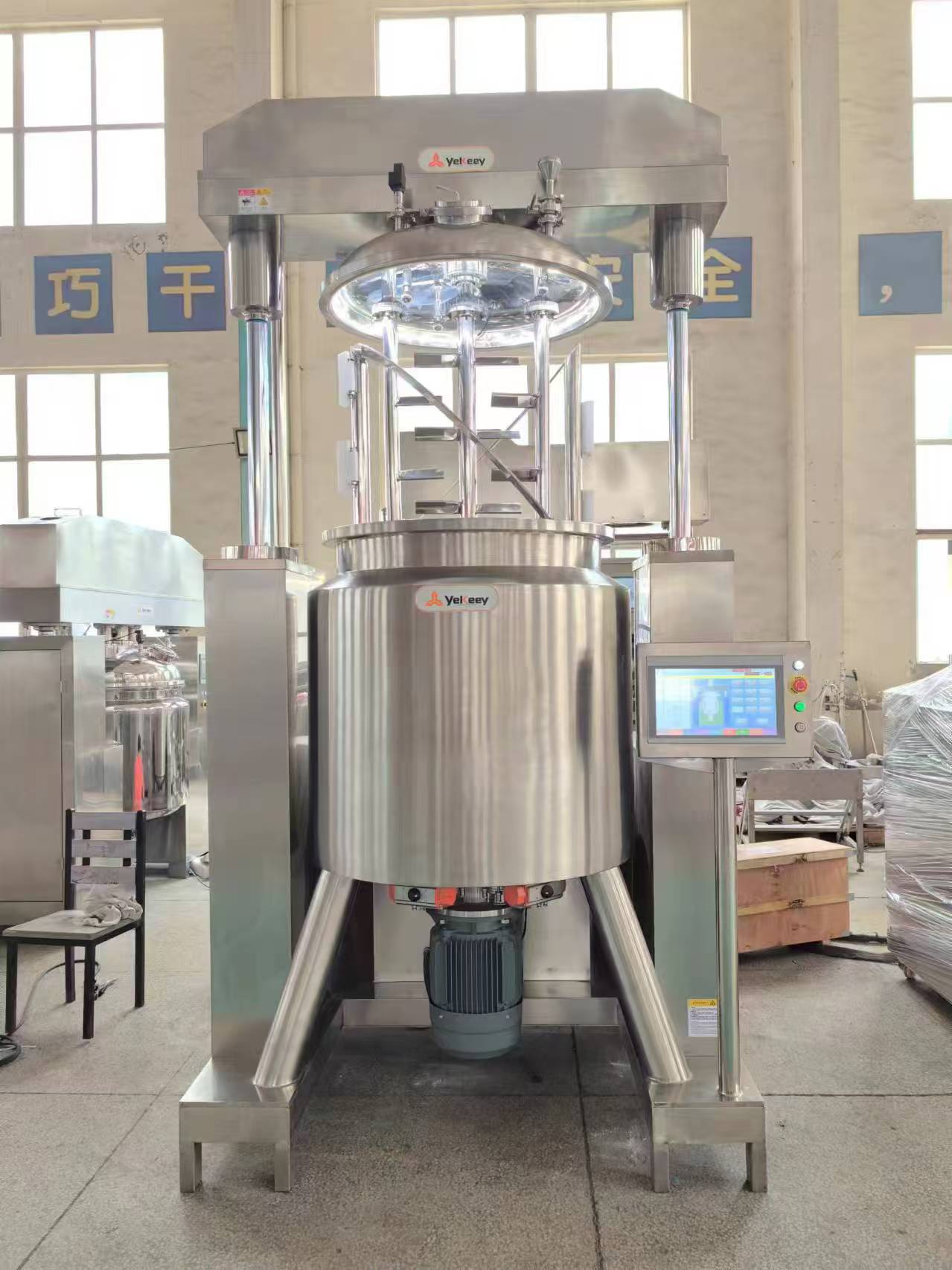
For buyers new to processed food and cosmetics manufacturing, the term “vacuum homogenizer emulsifier mixer” often raises a practical question: what exactly does this machine do, and why would a mayonnaise line or a skincare cream line need one? This guide explains the equipment, core functions, design variants, typical selection criteria, and how the technology supports emulsion quality in both food sauce and cosmetic applications.
Problem Definition: Why Emulsion Stability Is the Central Challenge
Mayonnaise, salad dressing, cosmetic cream, lotion, and many personal care products share a common structural challenge: they are emulsions, meaning they combine oil-phase and water-phase ingredients that would naturally separate over time. To create a stable, smooth, pourable or spreadable product, manufacturers need a process that breaks droplets into fine particles and disperses them uniformly before they can recombine.
Traditional mixing approaches often struggle with this task. Air entrapment can create microbubbles that affect texture, shelf appearance, and product density. Inconsistent droplet size can result in a gritty mouthfeel in mayonnaise or an unstable cream that separates during storage. These failures are not simply cosmetic. In commercial production, they can lead to batch rejection, reduced shelf life, and higher rework cost.
The vacuum homogenizer emulsifier mixer is an equipment category designed to address these problems by combining three operations: emulsifying, homogenizing, and mixing, often while removing air and controlling temperature. For mayonnaise and cosmetics applications, the machine is usually engineered to process under vacuum conditions, which helps remove air and produce a finer, more uniform emulsion.
Industry Background: Market Demand and Manufacturing Context
The demand for this equipment is connected to growing production volumes in both food and cosmetics categories. According to publicly available market research, the global mayonnaise market was worth approximately USD 12.58 billion in 2024, which supports continued investment in high-shear emulsification equipment. The broader homogenizers market has also been projected to grow from USD 2.10 billion in 2024 to USD 3.79 billion by 2035 at a compound annual growth rate of 5.4%. In the vacuum mixer homogenizer segment, the cosmetics and personal care sector has been cited as a leading application area, with an estimated 38% market share in 2026.
From a regional perspective, Asia-Pacific has been reported to account for a significant share of the homogenizing mixer market, estimated at 36.2% as of 2025, supported by China’s manufacturing ecosystem. For buyers evaluating equipment suppliers, this helps explain why an experienced Chinese manufacturer can offer competitive options for international food and cosmetics production lines.
At the equipment level, the market has developed several design families that serve different scale and process needs. One commonly used classification is based on the type of homogenizing and recirculation system, the operating scale, and the level of process control. Buyers will encounter standard vacuum processing units, recirculation homogenizing mixers, laboratory-scale units, and production-scale systems in the same equipment category.
What Is a Vacuum Homogenizer Emulsifier Mixer?
A vacuum homogenizer emulsifier mixer is a processing unit designed to emulsify, homogenize, mix, and disperse materials under vacuum conditions. It is used across several industries, including cosmetics, daily chemical, food products, and food sauce, with mayonnaise identified as a key food application area.
The machine performs four interrelated functions:
- Emulsifying: combining oil-phase and water-phase liquids into a uniform dispersion;
- Homogenizing: reducing particle or droplet size to create a consistent texture;
- Mixing: blending all ingredients evenly;
- Dispersing: distributing solid particles or thickeners uniformly throughout the liquid phase.
In mayonnaise production, these functions help create the stable, creamy structure expected from the product. In cosmetics manufacturing, the same principles apply to creams, lotions, and other emulsion-based personal care products.
A key characteristic of this equipment is that it operates under vacuum conditions, with equipment such as YeKeey’s vacuum emulsifying mixers designed for a pressure range of −0.09 MPa. Vacuum operation removes air from the product, reducing oxidation and air bubbles that could otherwise compromise texture and shelf life.
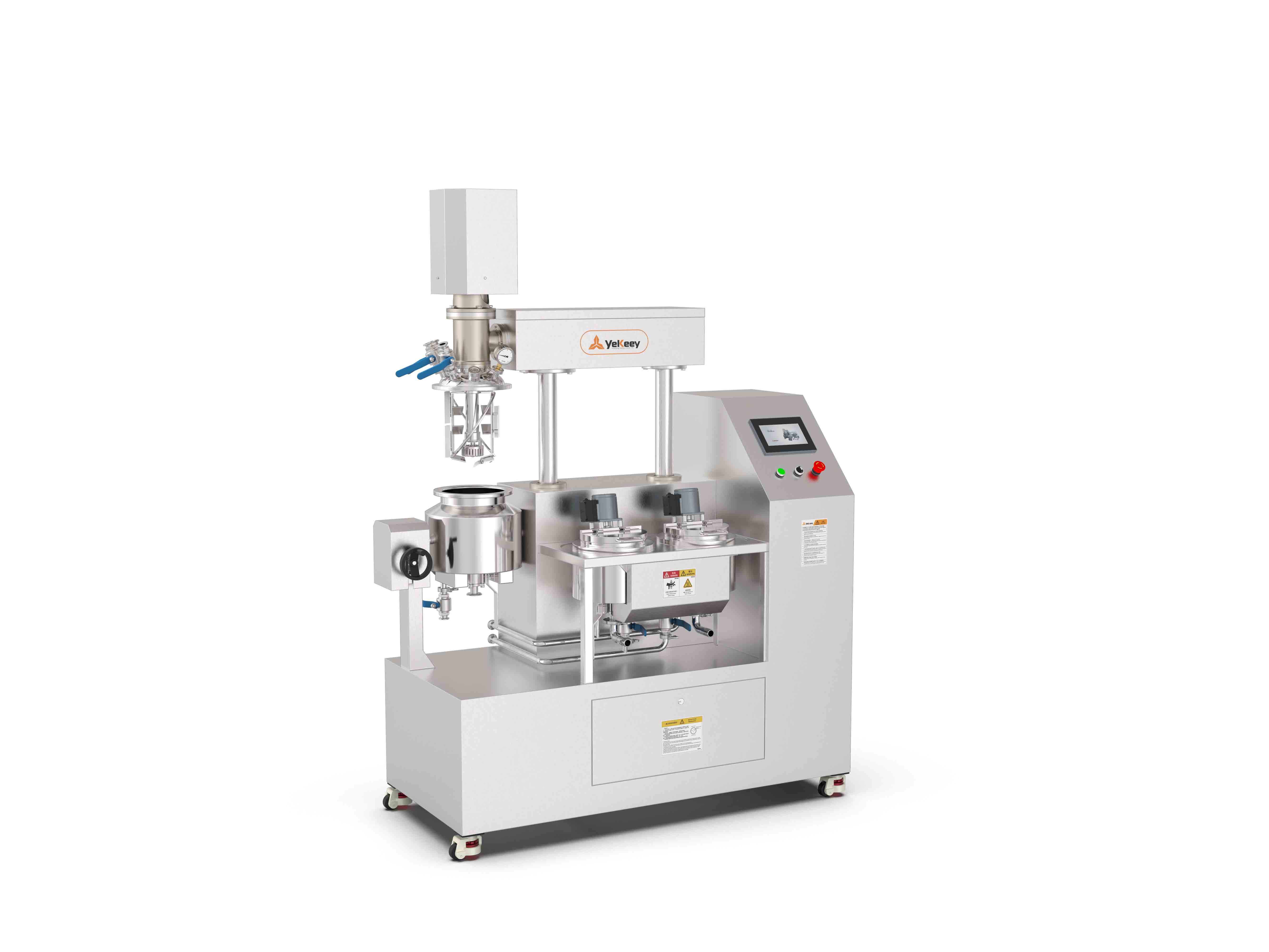
Technical Design and Construction
Vacuum emulsifying mixers are typically constructed from stainless steel grades SS304 or SS316 to meet food safety and hygiene requirements. SS316 is often preferred where higher corrosion resistance is needed, and industry guidance for pharmaceutical and cosmetic use has pointed to SUS316L stainless steel for contact parts in GMP-compliant processes.
Temperature capability is another important design parameter. Many YeKeey vacuum emulsifying mixers are designed for high-temperature environments up to 110°C, which supports heating, cooking, and hot-fill processes in mayonnaise, sauce, and cream production. This temperature range is useful when ingredients must be heated to fully dissolve thickeners or to ensure the oil phase remains stable during emulsification.
Control systems on this equipment typically fall into two categories: button control and PLC control. Button control is straightforward for smaller units and simpler applications. PLC control provides programmable, repeatable process management, which supports consistent batch-to-batch quality and integration into larger production lines.
Additional design options may include explosion-proof configurations and pressure vessel specifications, depending on the project brief and local regulations. Buyers should confirm the required configuration with the supplier rather than assuming every unit includes these features.
Equipment Families Used in Food and Cosmetic Lines
Manufacturers such as YeKeey offer multiple series within the vacuum emulsifying mixer category. Each series has a different emphasis, and the choice depends on the product, batch size, and process requirements.
SP Series Standard Vacuum Processing Unit. This series is available in models ranging from SPA-30 to SPA-10T, covering a broad capacity span from laboratory to large-scale production. It is classified as a standard processing unit and is suitable for cosmetics, food products, and food sauce applications. The SP series uses a power range of 3.7–110 kW, supports temperatures up to 110°C, and reaches output speeds of up to 2800 rpm, with construction in SS304 or SS316.
ZJR Series Vacuum Emulsifying Mixer. The ZJR series includes models from ZJR-5 to ZJR-2500, as well as the ZJR-Lab Laboratory Emulsifying Mixer for pilot or formulation work. It offers a power range of 5–91.5 kW, output speeds of 2800–6000 rpm, and the same pressure and temperature ratings. This series is often associated with the classic vacuum emulsifier configuration used in cosmetics and food emulsion production.
MC Recirculation Homogenizing Mixer. The MC series includes models from MC-100 to MC-2500, plus the MC Lab Recirculation Homogenizing mixer for smaller test batches. It operates with a power range of 5–91.5 kW and output speed up to 2800 rpm. The recirculation design can improve batch consistency by continuously passing the product through the homogenizing zone.
| Series | Model Range | Power | Output Speed | Typical Focus |
|---|---|---|---|---|
| SP | SPA-30 to SPA-10T | 3.7–110 kW | Up to 2800 rpm | Standard vacuum processing unit |
| ZJR | ZJR-5 to ZJR-2500 | 5–91.5 kW | 2800–6000 rpm | Laboratory and production emulsifying mixer |
| MC | MC-100 to MC-2500 | 5–91.5 kW | Up to 2800 rpm | Recirculation homogenizing mixer |
How It Works: Step-by-Step Process for Mayonnaise and Cosmetic Batches
While batch recipes vary, the general workflow in a vacuum homogenizer emulsifier mixer follows a consistent pattern.
- Preparation of raw materials: Water-phase and oil-phase ingredients are prepared separately. In mayonnaise production, the water phase may contain vinegar, water, egg yolk, and water-soluble thickeners, while the oil phase is typically the edible oil. In cosmetics, similar separation is used for water-based actives and oil-based emollients or emulsifiers.
- Loading: Ingredients are introduced into the main vessel. Depending on the unit, this may be done through an upper feeding port, a powder feeding system, or an integrated liquid feeding line.
- Heating: The batch is heated to the required process temperature, up to a design limit of 110°C. Heating helps dissolve solid ingredients and prepares the phases for emulsification.
- Mixing and homogenizing: The mixer and homogenizer are activated. The high-shear homogenizer breaks droplets into smaller sizes, while the anchor or counter-rotating mixer sweeps the vessel to ensure all material reaches the homogenizing zone.
- Vacuum deaeration: The vacuum system evacuates air from the vessel, operating at a pressure range of −0.09 MPa. This step removes air bubbles that would otherwise remain trapped in the final product.
- Cooling and final adjustment: After homogenization, the batch may be cooled to a specified temperature. Active ingredients or heat-sensitive components can be added at this stage in some designs.
- Discharge and downstream processing: The finished emulsion is discharged for filling, packaging, or further processing. In a food sauce line, the product may move directly to a filling machine; in cosmetics production, it may proceed to cooling, aging, and filling stages.
The exact cycle time, temperature profile, and mixing speed are determined by product formulation and quality requirements. This is why PLC-controlled units are often preferred in commercial production: they allow the same recipe to be run consistently.
Use Cases: Where This Equipment Is Applied
The vacuum homogenizer emulsifier mixer is used across a range of manufacturing lines. The main project types include cosmetic manufacturing lines, cosmetics emulsifying machine units, personal care production lines, food emulsification lines, and emulsifier units for food sauce.
Mayonnaise production. In a mayonnaise line, the machine performs emulsifying, homogenizing, mixing, and dispersing functions. The high-shear homogenizing action helps create the fine oil-in-water emulsion that gives mayonnaise its characteristic viscosity and mouthfeel. Because mayonnaise is a high-oil-content emulsion, the uniformity of droplet size strongly influences shelf stability.
Food sauce production. The same equipment family is used for salad dressing and other food sauces. These products may also require vacuum operation to reduce air content, improve suspension of spices and thickeners, and achieve a consistent appearance.
Cosmetic and personal care production. For cosmetic creams and lotions, the machine supports the production of stable emulsions with fine texture. The daily chemical industry also uses this equipment for personal care products, including products that may require temperature control and vacuum deaeration.
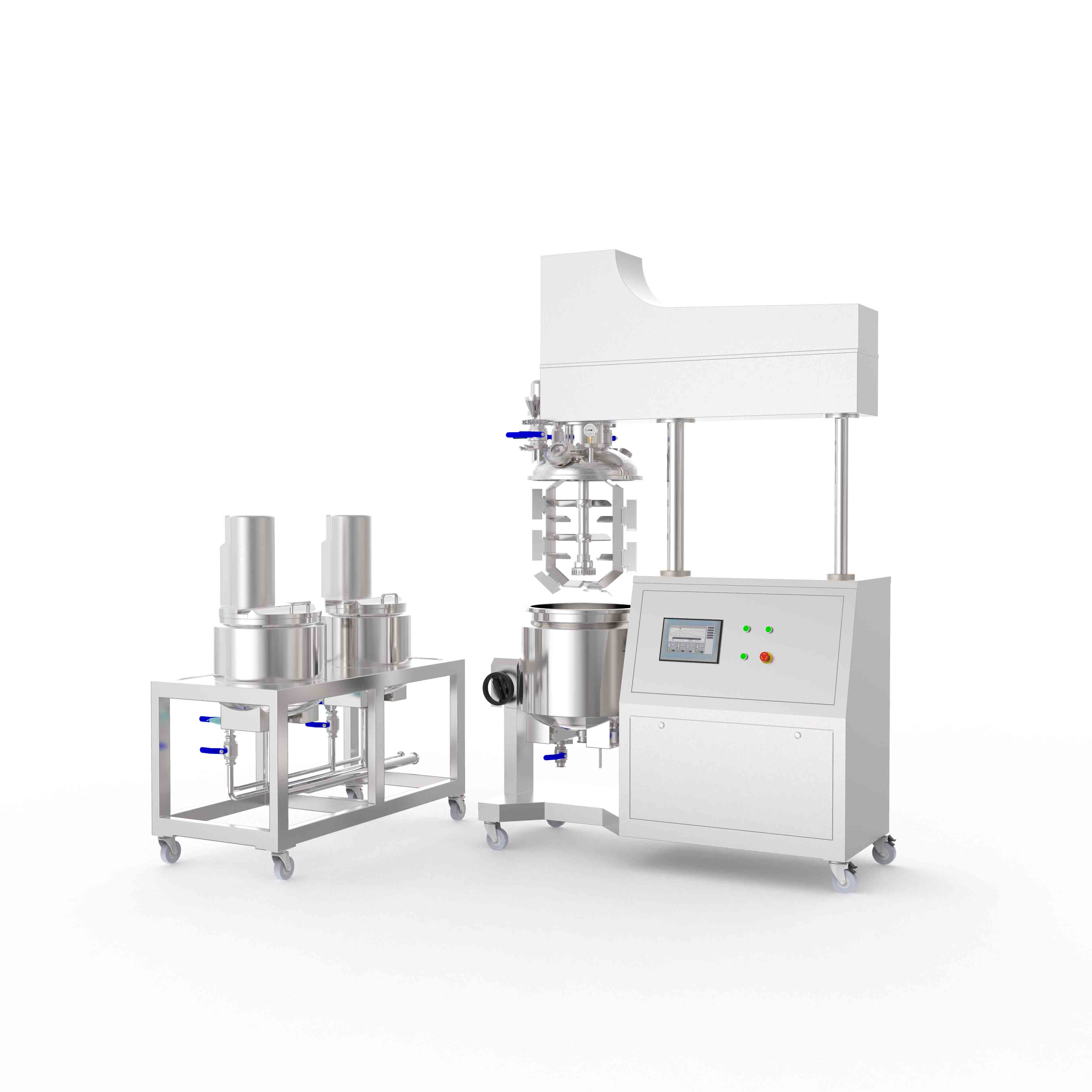
What to Evaluate When Choosing a Vacuum Homogenizer Emulsifier Mixer
For a first-time buyer or an engineering team preparing a purchase specification, the following factors matter more than brand preference alone.
1. Material and Compliance
Confirm that wetted parts are made from suitable stainless steel. SS304 is commonly used in food and cosmetics equipment, while SS316 offers greater corrosion resistance and is often preferred for pharmaceutical and high-grade cosmetic applications. If your market requires GMP, CE, or other certifications, check the compliance evidence before ordering.
2. Capacity and Scale
Manufacturers offer laboratory models, pilot models, and production models. A lab-scale unit is useful for formulation development, while a production unit must match your required batch size. YeKeey’s model ranges show how this scales: the ZJR series starts at ZJR-5 for lab work and reaches ZJR-2500 for production, while the SP series extends from SPA-30 up to SPA-10T.
3. Emulsifying Performance
Output speed is one indicator of high-shear capability. In YeKeey’s product lines, the ZJR series supports output speeds of 2800–6000 rpm, while the SP and MC series reach up to 2800 rpm. The right speed depends on the product viscosity and the required droplet size. A thicker product such as mayonnaise may need a machine with enough torque and homogenizing power to process the full batch evenly.
4. Vacuum and Temperature Control
Vacuum capability helps remove air and stabilize the emulsion; temperature control supports heating and cooling during the process. Both are important for mayonnaise and cosmetics, where product behavior changes with temperature. Buyers should confirm the pressure rating, such as −0.09 MPa, and the maximum temperature, such as 110°C, are sufficient for their process.
5. Control System
Decide whether button control is adequate or whether PLC control is necessary for repeatable production. PLC-controlled systems allow operators to save process recipes, monitor parameters, and maintain consistent quality across batches.
How to Evaluate a Manufacturer Before Inquiry
For buyers researching the category at an early stage, the supplier’s engineering background and manufacturing capability are as important as the machine specification.
Wuxi YK Automation Technology Co., Ltd., also known as YeKeey, is a manufacturer established in 1998 in Wuxi, Jiangsu Province, China. The company specializes in fine chemical equipment, pharmaceutical equipment, and high-end processing equipment, covering research, development, design, manufacture, and technical service. Its main products include Emulsifying Machines, Industrial Mixers, Lab Mixers, and Filling Machines.
YeKeey operates a 20,000 m² manufacturing facility with a workforce of about 80 employees and an annual production capacity of approximately 600 units. The R&D team includes 8 engineers, including undergraduates, graduate students, and foreign experts, and the company reports allocating 10% of annual sales profit to research and development. As of 2023, YeKeey reports 55 patents and 3 software programs.
About 35% of YeKeey’s total sales come from exports, with major markets in Europe, Central Asia, North Africa, Latin America, and Southeast Asia. The company’s mixing equipment, emulsifying equipment, filling equipment, and whole plant output schemes have been applied in more than 70 countries and regions, serving over 4,000 enterprises and institutions globally.
For a procurement evaluation, these details matter because they show whether a manufacturer can support scale, provide documentation, and maintain long-term spare parts and service.
Limitations and Practical Considerations
Vacuum homogenizer emulsifier mixers are not a one-size-fits-all solution. Some practical limitations deserve attention during evaluation.
- Cost: Vacuum emulsifying equipment is generally more complex than conventional mixing tanks, with higher initial investment and greater maintenance requirements.
- Space and installation: These systems include vacuum pumps, control panels, heating/cooling loops, and possibly additive feeding systems, requiring more plant space and utility connections than a simple mixer.
- Cleaning and changeover: For manufacturers running multiple recipes, cleaning between batches is critical. Confirm the design supports easy access to wetted parts and that the surface finish is appropriate for food-grade or cosmetic-grade hygiene requirements.
- Process development: Moving from a lab model to a production model may require re-validation because shear rate, dwell time, and cooling behavior do not always scale linearly.
- Custom requirements: Explosion-proof electrical components and pressure vessel design may be required for certain solvents or processes. These must be specified during the inquiry stage.
Comparing Vacuum Homogenizer Technology with Simpler Mixing Equipment
Buyers often ask whether a vacuum homogenizer emulsifier mixer is necessary or whether a conventional high-shear mixer can achieve the same result. The difference usually comes down to process control and final product quality.
A conventional mixer may be sufficient for simple liquids that do not require fine droplet size, full deaeration, or temperature-sensitive processing. However, for products such as stable mayonnaise, salad dressing, and cosmetic creams, the combination of vacuum, heating, high-shear homogenization, and uniform mixing is more likely to deliver consistent texture, appearance, and shelf life.
For existing producers that already operate conventional mixing equipment, switching to a vacuum homogenizer can be a capital-intensive decision. It is advisable to run trials—ideally on laboratory or pilot equipment—before committing to a production-scale unit. Many manufacturers offer lab models precisely to support this kind of validation.
FAQ
1. Is a vacuum homogenizer emulsifier mixer necessary for mayonnaise production?
For commercial mayonnaise production, a vacuum homogenizer emulsifier mixer is a widely used approach because it combines emulsifying, homogenizing, mixing, and dispersing functions in one processing unit. This equipment supports the fine droplet size and stable structure expected in mayonnaise. If you are producing at small scale or have a simple formula, a less complex mixer may be sufficient, but commercial lines often benefit from vacuum homogenization.
2. What are the key technical parameters to check when choosing a mayonnaise vacuum homogenizer mixer?
Key parameters include the vacuum pressure rating, typically −0.09 MPa in YeKeey vacuum emulsifying mixers; the maximum operating temperature, up to 110°C; the output speed range, with ZJR series models reaching 2800–6000 rpm; the power range; and the construction material, usually SS304 or SS316. You should also confirm the control mode, either button control or PLC control, and whether the unit is available with explosion-proof or pressure vessel options if needed.
3. Can the same vacuum homogenizer be used for mayonnaise and cosmetic cream production?
Yes. YeKeey vacuum emulsifying mixers are designed for applications in the cosmetics industry, food products sector, food sauce sector, and daily chemical industry. The core functions—emulsifying, homogenizing, mixing, and dispersing—are common across mayonnaise, salad dressing, cosmetic cream, and personal care products. However, the specific configuration, capacity, and process controls should be matched to the product being produced. A machine designed for high-viscosity mayonnaise may need different mixing geometry or control settings than one used for a low-viscosity lotion, so this should be discussed with the manufacturer.
4. What is the difference between SS304 and SS316 in a vacuum emulsifying mixer?
SS304 and SS316 are both stainless steel grades used in vacuum emulsifying mixers. SS304 is a common food-grade stainless steel with good corrosion resistance. SS316 contains molybdenum, which provides higher corrosion resistance and is often preferred for pharmaceutical, cosmetic, and more aggressive chemical applications. Industry guidance for pharmaceutical and cosmetic homogenizers often indicates SUS316L stainless steel for contact parts. The choice affects cost, corrosion resistance, and compliance suitability for different products.
5. How can I get a specification or sample quote for a mayonnaise or cosmetics emulsifier?
To get a specification or quote, contact the manufacturer with your product type, target batch size, required materials, and any special requirements such as PLC control, explosion-proof configuration, or pressure vessel design. YeKeey can be contacted by email at sales@yekeey.cn, by phone at 86-510-88530599, or through the website www.yekeey.com. You can also request the company brochure or arrange a discussion with the sales and engineering team.
Conclusion: Start with the Process, Not the Product Name
A vacuum homogenizer emulsifier mixer is not a single generic machine but an equipment category with different series, capacities, control options, and material specifications. For mayonnaise and cosmetics manufacturers, the value of the technology lies in its ability to repeatedly produce stable emulsions with controlled temperature, vacuum, and high-shear homogenization.
When evaluating a supplier, focus first on your own process requirements: the product you make, the viscosity and texture you need, the batch size you plan to run, and the hygiene standards you must meet. Then compare whether the supplier’s equipment specifications, certifications, and manufacturing experience align with those needs.
For buyers at the awareness and research stage, a useful next step is to request the equipment brochure and speak with an applications engineer before making a final specification. This approach reduces the risk of choosing a machine that works in theory but not in your actual production environment.
Ready to assess the right vacuum emulsifying mixer for your line?
Request YeKeey’s company brochure or contact the team for a specification discussion.
Download Company Brochure