
Vacuum Mixer vs. High-Shear Disperser: A Comparison Guide for Sauce and Cosmetic Lines
Vacuum Mixer vs. High-Shear Disperser: A Comparison Guide for Sauce and Cosmetic Lines
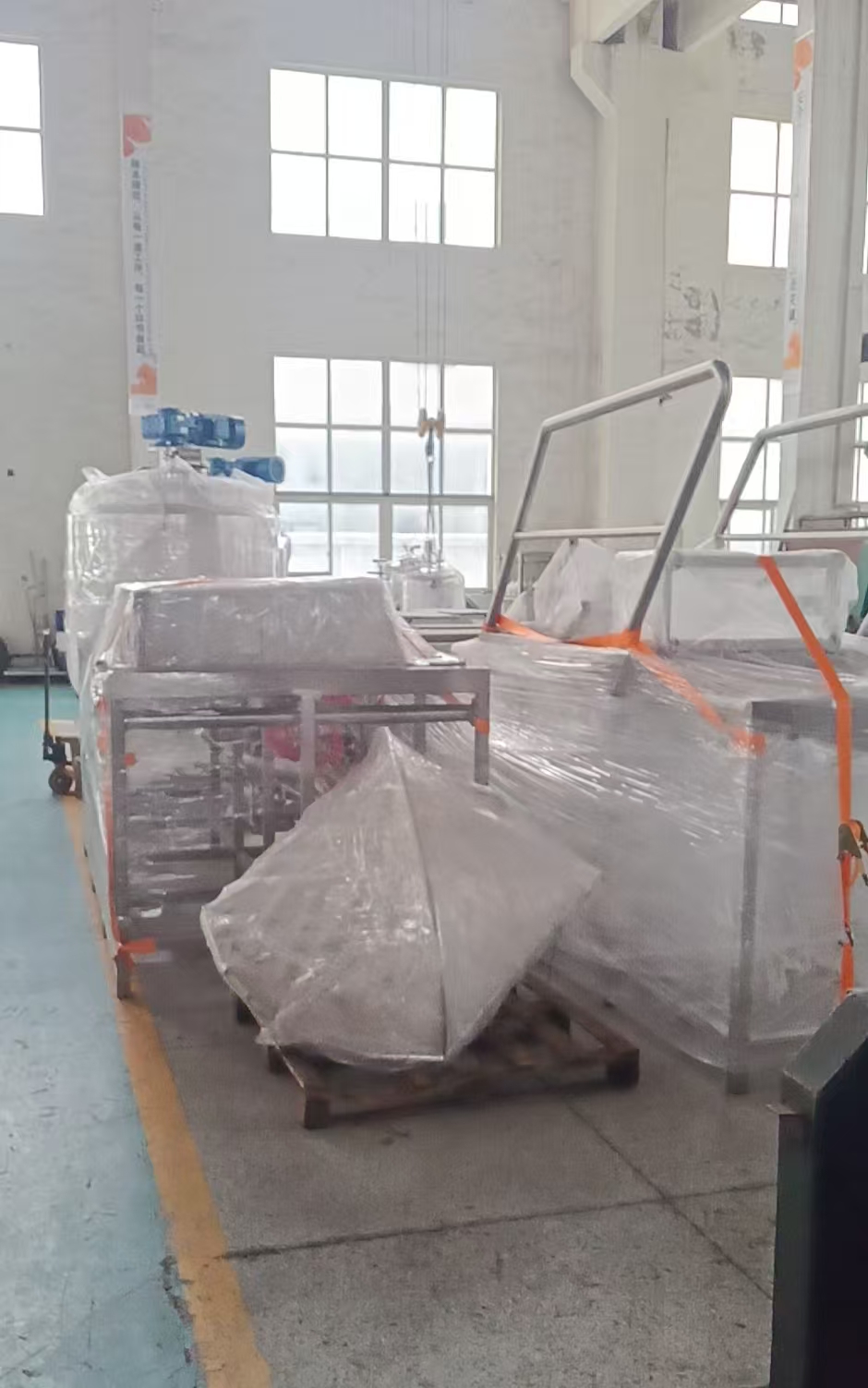
When a sauce or cosmetic emulsion is not stable, the first reaction is often to add a faster or stronger high-shear unit. But the real decision starts earlier: should the line be built around a single-function high-shear disperser, or around a vacuum homogenizer emulsifier mixer that can emulsify, homogenize, mix and disperse in one controlled vessel? This guide compares both equipment routes for manufacturers planning emulsifier units and food emulsification lines.
The comparison uses the YeKeey Vacuum Emulsifying Mixer as the vacuum-process reference. YeKeey is the brand used by Wuxi YK Automation Technology Co.,Ltd, a China-based manufacturer founded in 1998. The YeKeey Vacuum Emulsifying Mixer is designed for use in the production of cosmetics and food products, with a key focus on mayonnaise production.
What Is Being Compared
A high-shear disperser, in its common standalone form, is a processing unit that applies intensive rotor-stator shear to a liquid or semiliquid batch. It can wet out powders, break agglomerates, reduce droplets and improve dispersion in a relatively short process step. This makes it useful as a dedicated mixing tool when the surrounding process already provides heating, cooling, vacuum, and finished-product handling.
A vacuum homogenizer emulsifier mixer is different in scope. It combines several mechanical actions inside one vessel. In the YeKeey configuration, the equipment functions to emulsify, homogenize, mix, and disperse in the application. It is not only a homogenizer; it is a process platform where multiple unit operations can be planned around the same batch.
The Problem: More Shear Does Not Automatically Mean Better Emulsion
For mayonnaise, sauces, and cosmetic creams, stability depends on more than shear force. Oil droplet size, water-phase temperature, oil-phase temperature, cooling profile, viscosity, and air content all influence the final texture. A high-shear disperser can deliver strong mechanical energy, but if the batch is open to air, if heating and cooling are not controlled, or if multiple transfer steps are needed, the final emulsion can still split, become aerated, or require repeated reprocessing.
That is why evaluation-stage buyers should compare process coverage, not just machine speed. The question is not whether a high-shear disperser can create shear. The question is whether a given equipment configuration can handle the complete production routine for sauce and cosmetic emulsions.
Industry Context: Emulsion Demand Is Still Expanding
Market estimates prepared by third-party research firms show sustained interest in this equipment category. The global mayonnaise market was worth approximately USD 12.58 billion in 2024, according to Zion Market Research, which helps explain continuing demand for high-shear vacuum emulsification equipment in dressing and sauce production.
Future Market Insights estimates the vacuum mixer homogenizer market at about USD 1.02 billion in 2026, with the cosmetics and personal care segment holding around 38% of the market. A broader homogenizers market study by Roots Analysis values the global market at USD 2.10 billion in 2024 and projects USD 3.79 billion by 2035, at a CAGR of 5.4%. These figures do not tell a manufacturer which machine to buy, but they do show why food and cosmetics producers are actively comparing emulsion equipment.
Detailed Solution: Map the Full Emulsification Process First
For sauce and cosmetic applications, the practical solution begins with a process map. A typical batch may require water-phase preparation, oil-phase preparation, dosing, mixing, dispersing, emulsifying, homogenizing, vacuum deaeration, heating, cooling, and discharge. Some of these steps can happen in one vessel. Others may require separate tanks and pumps.
When a producer uses only a high-shear disperser, the machine normally covers one action: high-shear mixing or homogenization. That is acceptable when the product is a simple dispersion or when the line already has a vacuum emulsifier downstream. It becomes a limitation when the same batch still needs vacuum, heating, cooling, and gentle mixing before and after the shear stage.
Vacuum Homogenizer Emulsifier Mixer at a Glance
It functions to emulsify, homogenize, mix, and disperse in this application.
That single sentence explains why the vacuum emulsifier is often considered the main vessel in a sauce or cosmetic emulsion line. In addition to high-shear work, a vacuum-capable vessel can maintain a controlled pressure range and a controlled temperature profile during the batch.
YeKeey documents a pressure range of -0.09 MPa for its vacuum emulsifying mixers. This means the vessel is designed to operate under vacuum conditions that help reduce entrapped air during emulsification. Air is important in food and cosmetic texture: too much air can change viscosity, appearance, fill weight, and shelf-life behaviour.
YeKeey also documents a temperature capability up to 110°C. For a mayonnaise or cosmetic cream process, this matters because many water-phase and oil-phase ingredients must be heated or melted before emulsification. Temperature control is not a luxury when a recipe depends on consistent phase behaviour.
High-Shear Disperser or High-Shear Homogenizer at a Glance
A high-shear disperser or high-shear homogenizer can be an effective tool in a processing line. Its normal strength is concentrated mechanical shear, which helps produce finer droplets or better dispersion. Some products, especially lower-viscosity emulsions or pre-mixes, can be processed well with this type of unit.
However, a standalone high-shear unit should not be mistaken for a complete vacuum emulsifying system. If the product specification requires vacuum, controlled heating, and simultaneous mixing during cooling, those functions must be obtained elsewhere. This can mean separate tanks, an additional vacuum system, more transfer steps, and longer cleaning trains.
YeKeey Vacuum Emulsifying Mixer Series Used in This Guide
YeKeey catalog information includes three documented vacuum emulsifying mixer families relevant to sauce and cosmetic applications. All three families list stainless steel grades SS304 and SS316 as primary construction material options, with a pressure range of -0.09 MPa and temperature capability up to 110°C.
| Series family | Documented type | Model span | Power range | Output speed |
|---|---|---|---|---|
| SP | SP Series Standard Vacuum Processing Unit | SPA-30 to SPA-10T | 3.7-110 kW | Up to 2800 r/min |
| ZJR | ZJR Series Vacuum Emulsifying Mixer, including ZJR-Lab Laboratory Emulsifying Mixer | ZJR-5 to ZJR-2500 | 5-91.5 kW | 2800-6000 r/min |
| MC | MC Recirculation Homogenizing Mixer, including MC Lab Recirculation Homogenizing Mixer | MC-100 to MC-2500 | 5-91.5 kW | Up to 2800 r/min |
The primary construction materials for the Vacuum Emulsifying Mixer are stainless steel grades SS304 and SS316. For buyers in food and cosmetics, material selection is a process decision, not only a purchasing preference. The product-contact surface can affect cleaning, corrosion resistance, and compliance documentation.
Key Technical Decision Criteria
1. Functions Required in the Final Recipe
Start with the end product. Mayonnaise, dressing, sauce, cream, and lotion all have different flow behaviour, solids content, oil content, and sensitivity to process time. If the recipe needs emulsifying, homogenizing, mixing, and dispersing in one production routine, the vacuum homogenizer emulsifier mixer is the more complete platform. If only one step is missing from an existing line, a high-shear disperser may be enough.
2. Vacuum Conditions
YeKeey lists -0.09 MPa as the pressure range for its SP, ZJR, and MC vacuum emulsifying mixers. Ask whether the alternative equipment can operate under vacuum inside the same vessel, or whether vacuum is only possible in a separate tank.
3. Temperature Capability
YeKeey lists temperatures up to 110°C across the vacuum emulsifying mixer range. This is useful for hot-process mayonnaise, sauce cooking, oil-phase melting, and cosmetic water/oil phase preparation. If the alternative unit cannot heat and cool in the same vessel, batch transfer becomes more complex.
4. Material of Construction
The YeKeey Vacuum Emulsifying Mixer is available in SS304 or SS316. Stainless steel grade selection should be reviewed with the supplier before the final specification. Industry guidance for pharmaceutical and cosmetic production often points toward higher-grade stainless steel for product-contact parts; confirm the actual grade, finish, and weld documentation with the equipment maker.
5. Batch Scale and Process Speed
YeKeey model ranges cover small laboratory-style units and larger production units. The SP range extends to SPA-10T, while ZJR starts at ZJR-5 and MC starts at MC-100. This allows a producer to start with development trials and later scale to production, provided the process parameters are documented consistently.
6. Controls and Line Integration
Control logic is another integration criterion. A production environment running a fixed set of recipes may work with a clear button-based panel; a plant with frequent product changeovers usually wants programmable control, often PLC-based. YeKeey's OEM/ODM scope includes customization of voltage, designated appliance brands, weighing module, logo, machine dimensions, jar size, and heating method, so control integration should be raised during specification review.
7. Total Process Cost
The purchase price of one machine is only part of the comparison. A vacuum homogenizer emulsifier mixer may require a larger initial investment than a compact high-shear disperser, but it can also eliminate separate tanks, vacuum vessels, transfer pumps, and additional cleaning cycles. Compare batch time, labour, yield loss, rework, cleaning, and validation effort before making a final decision.
Step-by-Step Comparison Method
- Define the product family. Record viscosity, oil/water ratio, solids, air sensitivity, final texture target, and required batch temperature.
- Map every unit operation. Write down whether heating, cooling, vacuum, homogenizing, mixing, dispersing, and discharge are needed in one campaign.
- Set process limits. Use documented values when comparing equipment. For the YeKeey Vacuum Emulsifying Mixer, the relevant limits include -0.09 MPa vacuum and up to 110°C operating temperature.
- Compare material and surface finish. Confirm whether the standard machine uses SS304 or SS316 and whether product-contact parts can be adjusted for the intended quality system.
- Review speed and power range. For YeKeey, the output speed range depends on the series: up to 2800 r/min for the SP and MC series, and 2800-6000 r/min for the ZJR series.
- Check control and automation options. Ask how operating parameters will be set, recorded, and repeated from batch to batch.
- Evaluate the supplier's manufacturing process. YeKeey documentation includes a 100% test step as part of quality control. This matters more when the equipment will be installed in a food or cosmetic production line.
- Assess after-sales support. YeKeey lists remote video guidance, after-sales support for custom components and wear parts, and dispatch of technical personnel to the site for repairs.
Use Cases
Mayonnaise and Food Sauce Lines
In mayonnaise production, the product's role is to emulsify, homogenize, mix, and disperse materials. A mayonnaise vacuum homogenizer mixer is normally evaluated when the producer needs a stable, air-controlled texture and a repeatable heating profile. The same reasoning applies to dressing and sauce applications where oil-in-water emulsion stability affects appearance and shelf life.
For buyers searching for a high shear mayonnaise homogenizer, the useful distinction is simple: high shear alone can refine droplets, but a mayonnaise vacuum homogenizer mixer can also keep the batch under vacuum and at the required temperature during emulsification. That combination is often what makes the finished mayonnaise dense, glossy, and stable.
Cosmetic Cream and Skin-Care Lines
Cosmetic creams, lotions, and skin-care products often require fine and uniform emulsion droplets. A vacuum homogenizer for cosmetic cream is used when the formulator wants to minimise air bubbles, control heating and cooling, and obtain a consistent cream structure. YeKeey lists cosmetics as a core applicable industry for the vacuum emulsifying mixer range.
In practice, a cream making homogenizer mixer is frequently selected when the production plan also includes deaeration, heating, and homogenising in one vessel. A high shear mixer for cosmetics can solve a narrower problem, but it may not replace the full vacuum emulsification cycle required by many skin-care formulas.
Documented Reference Case: Cosmetics Production in Nigeria
A project for a cosmetics OBM client in Nigeria involved an installation of 3 sets. The project, with a duration of at least 10 years, achieved stable operation results and high production efficiency. This case is useful to procurement teams because it shows that equipment reliability and throughput matter as much as initial price in cosmetics manufacturing.
For a producer weighing a vacuum homogenizer vs a high-shear disperser, the Nigeria reference does not prove that one machine is universally better. It does show that a vacuum emulsifying mixer installation can remain productive in a commercial cosmetics environment for a long period.
Comparison Table: Vacuum Homogenizer Emulsifier Mixer vs High-Shear Disperser
| Selection factor | YeKeey vacuum homogenizer emulsifier mixer | Standalone high-shear disperser / homogenizer concept |
|---|---|---|
| Mechanical role | Emulsifies, homogenizes, mixes, and disperses in one application | Provides high-shear dispersion or homogenisation, typically as one process action |
| Vacuum capability | Documented pressure range of -0.09 MPa | Depends on the design; vacuum usually requires a separate closed vessel |
| Temperature capability | Up to 110°C documented for YeKeey vacuum emulsifying mixers | Depends on the vessel; heating and cooling must be confirmed separately |
| Material options | Stainless steel SS304 or SS316 | Material grade depends on the unit design and specification |
| Process fit | Suitable when a sauce or cosmetic recipe needs multiple unit operations in one closed system | Suitable when the surrounding line already covers heating, cooling, vacuum, and emulsion finishing |
| Decision question | Can one multifunction vessel shorten the batch and produce a more stable emulsion? | Would a single high-shear step solve the bottleneck without adding extra handling? |
Manufacturer Context and Documentation
YeKeey is the brand name of Wuxi YK Automation Technology Co.,Ltd, located at No.2855 Jiaoyang Road, An Zhen, Wuxi, Jiangsu Province, China. The company was founded in 1998 and operates a 20,000 m² factory. YeKeey's documented capabilities include an 8-engineer R&D team, annual output of about 600 units, and export activity to Europe, Central Asia, North Africa, Latin America, and Southeast Asia.
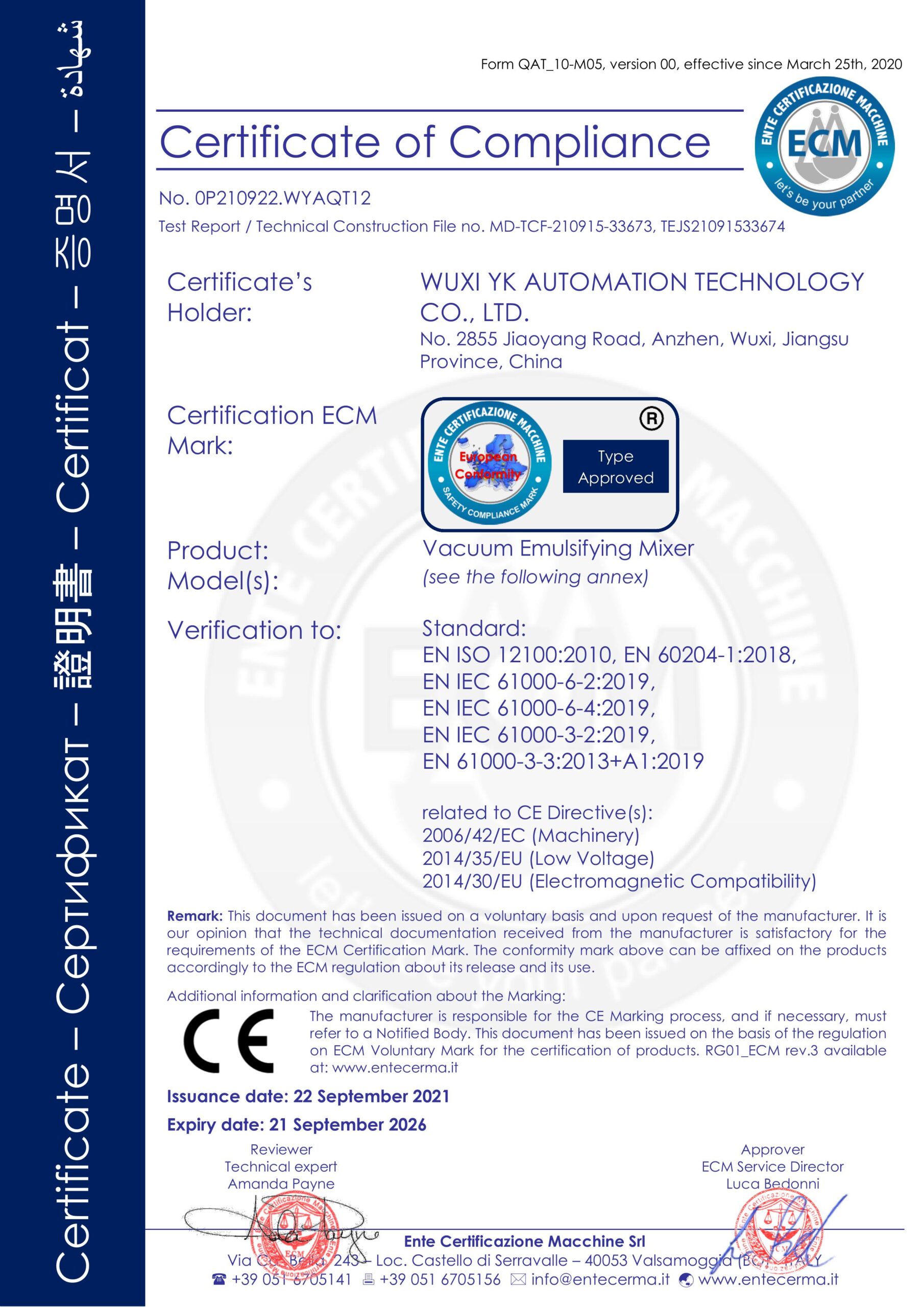
From a compliance point of view, YeKeey has provided CE certification documentation for its Vacuum Emulsifying Mixer and High Shear Homogenizer product categories, issued by the certification body ECM. The CE certificate for the Vacuum Emulsifying Mixer carries certificate number 0P210922.WYAQT12 in the reviewed supply documents. Buyers should always request the certificate copy matching the exact model and destination before order confirmation.
YeKeey also supports OEM and ODM projects. Documented customization areas include voltage, designated appliance brands, weighing module, logo, machine dimensions, jar size, and heating method. The stated MOQ is 1 unit, and the typical lead time range is 30-60 days. Production capacity is listed at 50 units per month.
When a High-Shear Disperser May Be the Right Choice
The point of this comparison is not to rule out high-shear dispersers. There are production situations where a compact, single-purpose high-shear unit is the right answer: when the product is a simple dispersion, when a vacuum emulsifying line already exists, or when the bottleneck is clearly limited to droplet refinement after the main emulsion has been formed.
The point is that a high-shear disperser should not be selected merely because it looks faster on paper. If the product requires vacuum, controlled heating, and multiple mechanical actions, the line-level process cost may be lower with a vacuum homogenizer emulsifier mixer.
Frequently Asked Questions
Why choose a vacuum homogenizer emulsifier mixer over a high-shear disperser for sauce or cosmetic lines?
Start with the process requirements. When emulsifying, homogenizing, mixing, and dispersing must happen with vacuum and controlled heating in one vessel, a vacuum homogenizer emulsifier mixer is usually the stronger fit. A high-shear disperser makes sense when the line already has separate vacuum and handling steps, or when only one dispersion stage is missing.
Can the YeKeey Vacuum Emulsifying Mixer handle mayonnaise and other food sauces?
YeKeey designs this Vacuum Emulsifying Mixer for use in the production of cosmetics and food products, with a key focus on mayonnaise production. In mayonnaise processing, the equipment functions to emulsify, homogenize, mix, and disperse materials. The documented vacuum level is -0.09 MPa, and the temperature capability is up to 110°C.
What stainless steel grades are used for the Vacuum Emulsifying Mixer?
The primary construction materials for the Vacuum Emulsifying Mixer are stainless steel grades SS304 and SS316. Buyers should confirm which grade will be used for product-contact parts, especially when the line must meet food or cosmetic quality guidelines.
Is the YeKeey Vacuum Emulsifying Mixer CE certified?
YeKeey has provided CE certification documentation for the Vacuum Emulsifying Mixer category, issued by ECM. The reviewed certificate number for the Vacuum Emulsifying Mixer is 0P210922.WYAQT12. Certificate details should be matched to the exact machine model before shipment.
What is the minimum order quantity and lead time for YeKeey emulsifying mixers?
YeKeey lists an MOQ of 1 unit and a typical lead time range of 30-60 days. The company also lists a production capacity of about 50 units per month and performs 100% testing as part of quality control.
How should a buyer take the next step after comparing the two equipment types?
Send your batch size, formulation profile, target viscosity, and utility conditions to YeKeey for a specification-based response. A brochure is available for download to support internal review, and the sales team can clarify model options, customization, documentation, and after-sales support.

Conclusion
For a sauce or cosmetic line, the equipment decision should be guided by the recipe and the intended production routine. A vacuum homogenizer emulsifier mixer is valuable when the product needs several mechanical actions plus vacuum and heat in one repeatable process. A high-shear disperser is valuable when the process bottleneck is narrower and the surrounding line already provides the remaining functions.
YeKeey's vacuum emulsifying mixer range supports the comparison with documented parameters: -0.09 MPa vacuum, temperature up to 110°C, stainless steel options in SS304 or SS316, and series choices from lab-style to larger production units. For an evaluation-stage buyer, these documented facts are a more reliable starting point than generic equipment claims.
If you are planning a mayonnaise, sauce, or cosmetic emulsion line and need help turning these criteria into a practical specification, contact YeKeey's team at sales@yekeey.com or visit www.yekeey.com. You can also download the YeKeey brochure to review product ranges and plant output capabilities: Download YeKeey brochure.
Contact YeKeey
Name: Xiong
Email: sales@yekeey.com
Tel: 86-510-88530599
WhatsApp: +8615050678988
Address: No.2855 Jiaoyang Road, An Zhen, Wuxi, Jiangsu Province, China