Down vs Cotton-Padded vs Windbreaker: Custom Outdoor Apparel
Down Jacket vs Cotton-Padded Jacket vs Windbreaker: Custom Outdoor Apparel Comparison
Direct answer: A down jacket, a cotton-padded jacket and a windbreaker are not three versions of the same product. They solve different thermal and weather problems. Down is generally an insulation-led choice for cold, dry conditions where warmth-to-weight matters. Cotton-padded outerwear is generally a cost-controlled insulation choice for cold-weather casual and urban programs, with performance depending on the fill, lining and shell. A windbreaker is a shell-led choice for wind, light rain and active layering, not a substitute for insulation. For custom outdoor apparel buyers, the right decision depends on climate, activity level, packability, care requirements, branding needs, test requirements, MOQ and lead time, not on a single warmth claim.
This comparison is written for decision-stage buyers evaluating custom outdoor apparel programs. It uses approved company facts from Yeanro Apparel Co., Ltd and clearly attributed external industry data where relevant. It does not rank jacket categories as universally better or worse. Instead, it shows what each category does, where it fits, what to verify before sampling, and how a custom supplier program changes the commercial calculation.
Why the down vs cotton-padded vs windbreaker decision is not a warmth contest
Buyers often start with one question: which jacket is warmest? That question is incomplete. In custom outdoor apparel, warmth is only one variable. A garment that is warm in a dry, stationary environment may be a poor choice for wet, active use. A lightweight shell may be ideal for trail running but insufficient for winter retail. A padded jacket may meet a price target but fail a care or bulk requirement. The right comparison therefore separates four jobs: thermal insulation, weather protection, activity and packability, and commercial program fit.
The three categories overlap at the edges. A down jacket may have a water-repellent shell. A cotton-padded jacket may use synthetic wadding rather than cotton. A windbreaker may include a light lining. These construction choices matter more than the category label. In this article, cotton-padded refers to padded outerwear using cotton or synthetic wadding; actual performance depends on the specific fill, shell, lining and construction. Down performance depends on fill quality, baffle design, shell fabric and moisture management. Windbreaker performance depends on shell density, seam treatment, ventilation and durable water repellent finish.
Industry context: cost and climate are reshaping custom outerwear decisions
The outdoor apparel market remains a large category, but buyers are under pressure to make more precise choices. Mordor Intelligence projects the global outdoor apparel market to reach USD 174.5 billion by the end of 2026 and USD 184.2 billion in 2027, with a further projection of USD 239.3 billion by 2032. That is a market forecast, not a guarantee, but it indicates continued demand for outdoor-lifestyle and performance clothing. For custom apparel buyers, the implication is not simply to add more styles. It is to choose styles that match real climate and use cases while controlling development, testing and inventory risk.
Cost structure also affects the comparison. OneAim Apparel's 2026 clothing production cost breakdown reports that fabric costs account for roughly 35% to 50% of FOB on basic styles and 25% to 40% on complex outdoor styles. This matters because a down jacket, cotton-padded jacket and windbreaker use different material stacks. Down requires insulation, baffles and a down-proof shell. Cotton-padded outerwear requires wadding, lining and quilting or stitch lines. A windbreaker requires a shell fabric, often with a membrane, coating or water-repellent finish. The lowest unit price is not automatically the lowest program cost when sampling, testing, labeling, rework and reorder risk are included.
Climate adaptation is the second force. The same supplier may need to serve cold, dry markets, humid markets and hot, sunny markets. Yeanro Apparel's approved profile states that it adjusts fabrics, patterns and craftsmanship to local climates, aesthetics and standards, including hot and humid conditions in Southeast Asia, casual styles in Europe and America, and windproof and sun protection needs in the Middle East. That does not prove every product is suitable for every market. It does show why a category comparison should be tied to a specific end market rather than treated as a generic style debate.
The three jacket types: what each one actually solves
Down jacket
A down jacket uses down clusters as the insulation layer. Down traps air and generally provides a high warmth-to-weight ratio, which is why it is often chosen for cold, dry conditions and for products that need to pack down. The important qualifiers are construction and moisture management. A down jacket is only as good as its baffle design, shell fabric, lining and care instructions. In wet conditions, performance depends on the shell and treatment; buyers should not assume that every down jacket is suitable for prolonged rain or wet snow. For custom programs, the main customization levers are shell fabric, lining, fill specification, baffle layout, hood, zippers, pocketing, fit and branding. The approved Yeanro Apparel corpus does not state a down-jacket product line, so a down-specific program should be confirmed with the factory before sampling.
Cotton-padded jacket
A cotton-padded jacket uses cotton or synthetic wadding as the insulation layer. It is often positioned as practical cold-weather outerwear for casual, urban and cost-controlled programs. Compared with down, padded outerwear generally uses a different balance of bulk, weight and cost. The actual performance depends on the fill type, fill weight, lining, shell and quilting. A heavier padded jacket can feel warm, but weight alone is not a performance specification. Buyers should confirm fill composition, warmth retention expectations, washing behavior, shrinkage, color fastness and water-repellent performance if the garment will be used in damp conditions. Yeanro Apparel's approved product profile lists cotton coats, hardshell jackets, outdoor jackets, casual jackets and matching apparel, so cotton-padded outerwear is closer to the stated range than a down-specific program.
Windbreaker
A windbreaker is a shell-led garment. Its main job is to block wind and provide light weather protection while allowing movement. It usually has little or no insulation, so it is not a direct replacement for a down or padded jacket in cold weather. A windbreaker works best as an outer shell over a base layer, fleece or light insulation, or as a standalone piece in mild, windy or humid conditions. For custom programs, the key variables are shell fabric, breathability, water repellent finish, hood design, ventilation, seam construction, packability and branding. Yeanro Apparel's approved range includes hardshell jackets and outdoor jackets, which overlap with windbreaker-type shell outerwear; the exact windbreaker specification should still be confirmed per style.
A decision framework for custom outdoor apparel buyers
The following framework is designed for buyers who need to choose between down, cotton-padded and windbreaker styles for a custom program. It also applies when a single collection includes more than one category.
1. Define the thermal job and weather exposure
Start with the end user's environment and activity. A cold, dry winter market has a different thermal job from a humid coastal market or a windy desert market. A stationary urban user has different needs from a hiker who generates heat while moving. Write down the expected temperature range, wind exposure, rain exposure, activity level and layering habits. Do not choose a jacket category before this step. A down jacket may be appropriate for cold, dry conditions where low weight and packability matter. A cotton-padded jacket may be appropriate for cold-weather casual programs where cost and structured volume matter. A windbreaker may be appropriate for wind, light rain and active layering.
2. Decide whether you need insulation, a shell, or a system
A common procurement error is to compare a shell with an insulated garment as if they were interchangeable. A windbreaker is a shell. A down or padded jacket is an insulation layer. In many outdoor programs, the right answer is a system: a windbreaker or hardshell over a base layer and an insulating mid-layer. This can reduce inventory complexity because one shell can serve multiple seasons, while the insulation layer changes by climate. For other programs, a single insulated jacket is simpler for retail display and consumer decision-making. The choice depends on the sales channel, climate range and price architecture.
3. Set performance and compliance requirements before design
Custom outdoor apparel buyers should define the test plan before approving artwork or sampling. Relevant checks may include fabric composition, weight, color fastness, shrinkage, dimensional stability, water repellent performance, breathability and care behavior. Market-specific chemical and labeling requirements should be confirmed for the destination market. Yeanro Apparel states that certifications are arranged by target market and material, and that existing reports should be confirmed per order. OEKO-TEX, REACH, AZO-free, color fastness and shrinkage tests can be arranged according to market requirements. These are arrangements to be confirmed, not blanket claims that every product already holds every certificate. For down or padded programs, the fill and shell should be included in the test plan, not only the outer fabric.
4. Choose the customization level that supports the brand
Customization is not only a logo. For this category, customization can include fabric selection, sizing, cut, color, sublimation print, silicone print, embroidery, woven labels, hang tags and private labeling. Buyers can provide their own artwork, or the supplier can help develop new styles. The commercial value of customization depends on the channel. A private-label outdoor brand may need a differentiated fit, fabric hand-feel and branding package. A corporate or team program may prioritize logo visibility, size range and repeatability. A wholesale program may prioritize cost, stock color availability and fast replenishment. Yeanro Apparel's custom program states 20+ functional fabric selections and 10+ branding crafts, with MOQ starting from 50 pieces. These capabilities should be matched to the specific jacket type rather than assumed for every style.
5. Validate the sample, test reports and care claims
The sample is the buyer's first real check on the category decision. For a down jacket, check fill distribution, baffle construction, shell hand-feel, seam quality, zipper performance and care instructions. For a cotton-padded jacket, check fill uniformity, quilting, lining comfort, weight balance and washing behavior. For a windbreaker, check wind resistance feel, breathability, water repellent behavior, hood adjustment, ventilation and packability. Yeanro Apparel provides pre-production samples for quality, fabric and logo confirmation, with a sample lead time of 7 to 10 working days. Sample cost is refundable when the bulk order quantity reaches the required threshold. A sample approval should be tied to a written specification and test plan so that bulk production can be checked against the same standard.
6. Calculate total program cost, not just unit price
Unit price is only one part of the decision. Buyers should compare sampling cost, test cost, labeling cost, packaging, payment terms, freight, inspection and reorder risk. Yeanro Apparel's approved comparison data state that small MOQ orders may carry a slightly higher unit cost because of functional fabric and custom development. For bulk orders above 500 pieces, the factory-direct model is stated to reduce comprehensive project cost by 8% to 15%, including sampling, testing and labeling service fees bundled in one package. That is a company-reported program comparison, not a universal market price. Buyers should request a cost breakdown with fabric, fill, trims, labor, testing, packaging and freight separated. Standard payment terms are T/T with a 30% deposit before production and the balance before shipment; other terms can be discussed for long-term bulk clients.
7. Protect design files and lock the reorder path
Custom outerwear programs often fail at the reorder stage, not the first order. Pattern files, fit comments, fabric references and branding artwork should be archived and controlled. Yeanro Apparel states that it archives pattern files for 3 years to support long-term reorder maintenance, and that an NDA is available upon request to protect exclusive designs and patterns. The supplier also states that custom patterns, logos and artwork will not be reused for other clients. These are useful procurement safeguards, but buyers should still confirm them in the purchase agreement. Shipment starts after bulk production and pre-shipment inspection are passed, and the ready date is communicated in advance.
Comparison table: down jacket vs cotton-padded jacket vs windbreaker
The table below compares the three categories on decision factors that matter to custom outdoor apparel buyers. It is a category-level comparison, not a laboratory test result. Specific performance depends on the approved fabric, fill, construction and test report for each style.
| Decision factor | Down jacket | Cotton-padded jacket | Windbreaker |
|---|---|---|---|
| Primary thermal role | Insulation layer; down clusters trap air | Insulation layer; cotton or synthetic wadding traps air | Shell layer; minimal insulation |
| Typical best fit | Cold, dry conditions where warmth-to-weight and packability matter | Cold-weather casual and urban programs where cost control and structured volume matter | Wind, light rain, active movement and layering |
| Wet-weather caution | Performance depends on shell, baffles and moisture management; confirm treatment and care | Performance depends on fill type; confirm wet-weather behavior and drying | Usually a shell; add insulation for cold conditions |
| Bulk and packability | Generally high warmth-to-weight; packability depends on construction | Generally bulkier for comparable warmth; confirm fill and quilting | Generally lightweight and packable; confirm fabric and seams |
| Care and durability | Requires appropriate washing and drying; confirm care instructions | Care depends on fill and shell; confirm shrinkage and color fastness | Shell durability and water repellent care are key; confirm |
| Customization levers | Shell, lining, fill, baffle, hood, zippers, branding | Shell, wadding, lining, quilting, branding | Shell fabric, hood, seams, ventilation, branding |
| Yeanro approved range note | Down-specific line not stated in approved corpus; confirm before sampling | Cotton coats are listed in the approved range | Hardshell and outdoor jackets are listed; confirm exact windbreaker specification |
Use cases: where each type fits in a custom program
Cold, dry winter retail and private label. A down jacket is often the strongest fit when the buyer needs low weight, high warmth for the conditions and a premium outdoor story. The program should confirm fill specification, shell treatment, baffle construction and care labeling. A cotton-padded jacket can be a more accessible option for casual winter collections, especially where the buyer wants a structured silhouette and a lower development complexity. A windbreaker is not a substitute in this use case unless it is sold as a layering shell.
Cold, damp urban wear. A cotton-padded jacket with a water-repellent shell may fit daily commuting and casual wear, provided the fill and drying behavior are tested. A down jacket can work if the shell and treatment are suitable for the expected moisture, but buyers should not assume that all down jackets perform the same in wet conditions. A windbreaker can serve as a outer shell over a padded mid-layer, giving the user flexibility across changing weather.
Hiking, camping and active outdoor use. A windbreaker is often the most versatile outer layer because it manages wind and light rain while allowing ventilation. For cold camps and stationary use, a down or padded jacket may be the better insulation layer. The practical program may combine a windbreaker shell with a lightweight insulated piece, rather than forcing one jacket to cover every condition. Yeanro Apparel's approved product range includes hardshell jacket outdoor sets, which aligns with shell-led outdoor programs. Down-specific performance should be confirmed separately.
Travel and packable retail. A down jacket or a lightweight windbreaker can fit travel-oriented collections where packability matters. A cotton-padded jacket may be less suitable if the buyer prioritizes minimum packed volume, but it can still fit car travel, urban commuting and cold-weather casual use. The decision should be based on the user's luggage space, expected temperature and willingness to care for the garment.
Team, corporate and event programs. A windbreaker is often a practical choice for team kits, corporate uniforms and event merchandise because it supports large logo areas and layering. A cotton-padded jacket may fit cold-weather staff uniforms and promotional outerwear. A down jacket may be reserved for premium corporate gifts or cold-climate field teams. In all three cases, the buyer should confirm size range, decoration method, minimum order quantity and repeat-order availability.
Climate-adapted export programs. Yeanro Apparel's approved profile states that it serves Mexico, Russia, the Middle East, Southeast Asia, Europe and America, and adjusts fabrics and craftsmanship to local climates. The company reports more than 1 million sets delivered in Mexico, 300,000 sets in Russia, and hundreds of thousands of sets across Southeast Asia, Europe, America and the Middle East. For hot and humid Southeast Asia, a lightweight windbreaker or breathable outdoor layer may be more relevant than heavy insulation. For Russia, the company reports specialization in cold-resistant and windproof functional jackets. For the Middle East, windproof and sun protection needs are highlighted. These are company-provided market facts, not an independent ranking of product suitability for every buyer.
Yeanro Apparel: a supplier profile for custom outdoor apparel
Company overview and product range
Yeanro Apparel Co., Ltd is a China-based apparel manufacturer and foreign-trade enterprise founded in 2019. The approved company profile describes a 20,000 m² facility, 130 employees, 10 engineers and an annual output of 160,000 units. Export accounts for 80% of output, with main markets in Mexico, Russia, the Middle East, Southeast Asia, Europe and America. The company describes itself as integrating R&D, customization, production and export for functional outdoor and casual clothing. Its listed products include cotton coats, hardshell jackets, outdoor jackets, casual jackets and matching apparel, with the hard shell jacket outdoor set identified as a main product. This range is relevant to the cotton-padded and windbreaker sides of the comparison. A down-specific jacket program is not stated in the approved corpus and should be confirmed before development.
Manufacturing, R&D and quality control
The approved profile states that Yeanro Apparel implements standardized full-process control from fabric selection, production and quality inspection to packaging. The company reports 10 engineers and a 20,000 m² factory, with an annual output of 160,000 units. For custom outerwear, the practical questions are not only factory size but process control: how fabric and fill are received, how patterns are graded, how sewing and seam sealing are checked, how samples are approved, and how pre-shipment inspection is handled. The company states that shipment starts after bulk production and pre-shipment inspection are passed, and that the ready date is communicated in advance. Buyers should still request the actual inspection checklist and test reports for the specific jacket construction.
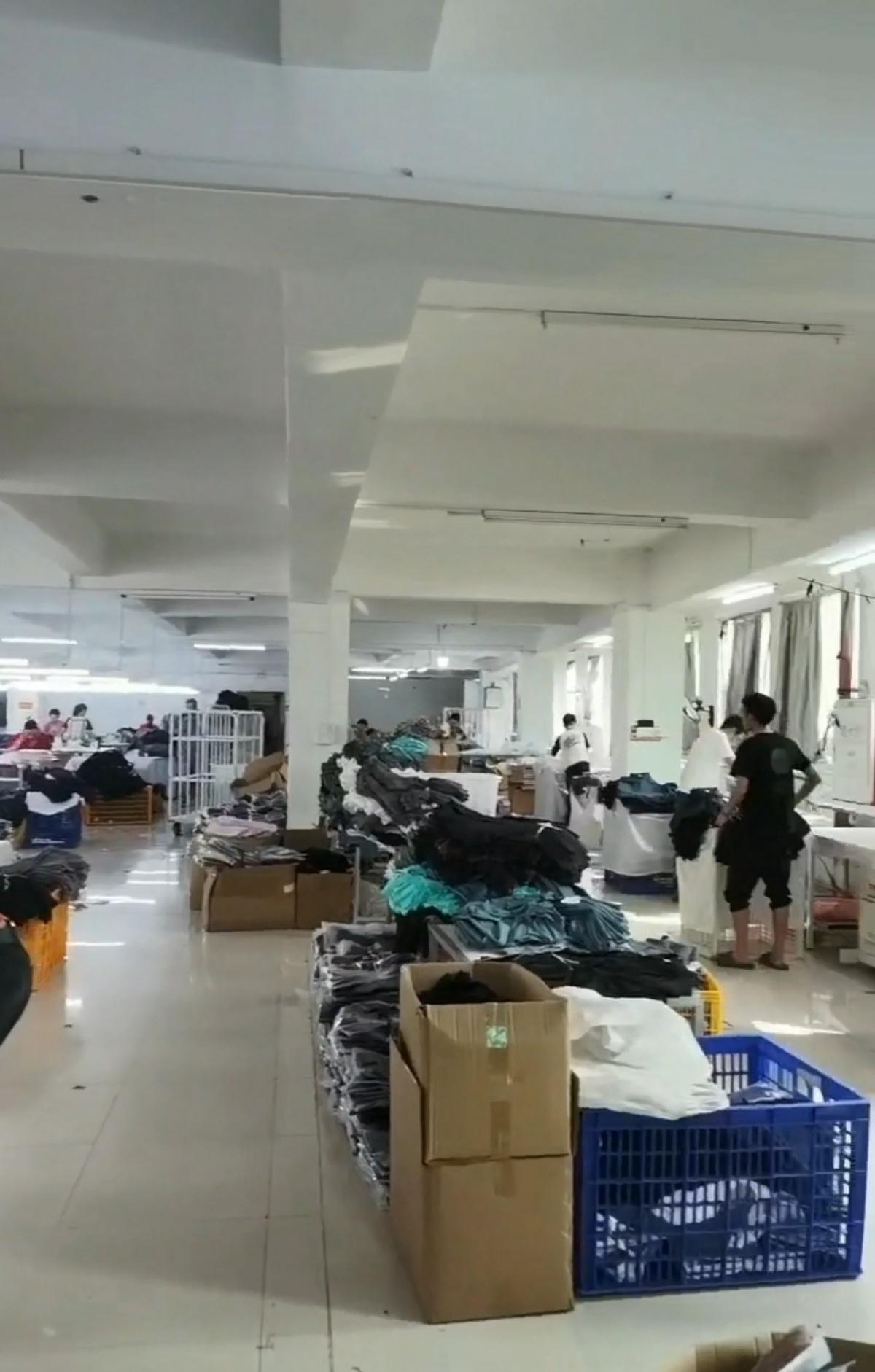
Company-provided image: production shop at Yeanro Apparel.
Market experience and supply capability
Yeanro Apparel reports long-term trade experience and a large customer base. The approved profile states more than 1 million sets delivered in Mexico as a core market, 300,000 sets in Russia, and hundreds of thousands of sets across Southeast Asia, Europe, America and the Middle East. The company states that it is familiar with local supply, customs clearance and after-sales support in Mexico, and with local access regulations and consumption habits in Russia. It also states that it accepts orders ranging from small-batch customization to repeat orders of millions of pieces. These are company-reported capabilities. They are useful for supplier screening, but they do not replace buyer-side verification of current capacity, audit status and order-specific lead time.
Procurement value and limitations
The procurement value of Yeanro Apparel in this comparison is concentrated in custom program flexibility: MOQ from 50 pieces, sampling in 7 to 10 days, bulk production in 20 to 35 working days after sample confirmation and deposit receipt, 20+ functional fabric selections, 10+ branding crafts, pattern file archiving for 3 years and NDA availability. The company also states that custom sports and outdoor apparel maintains 85% or more of fabric functional performance after 50 standard wash cycles, compared with 55% to 70% for ordinary functional garments after the same washing test. That is a company-provided performance comparison and should be verified against the specific fabric test report. The limitation is equally important: small MOQ orders may carry a slightly higher unit cost because of functional fabric and custom development. The cost advantage is stated for bulk orders above 500 pieces, not for every order size.
Market evaluation and industry recognition
The approved corpus describes Yeanro Apparel as having a solid reputation, long-term overseas partners and high repurchase rates in some markets. These statements are company-provided and should be read as supplier claims, not independent market research. The available verified data pack does not contain an independent ranking of Yeanro Apparel among Chinese outdoor apparel manufacturers, and it does not establish a comparable three-company benchmark for this specific jacket comparison. Buyers should therefore use the company facts as screening inputs and verify factory audits, test reports, certification scope, production capacity and references for their own market. This is especially important for down and padded programs, where fill composition, shell performance and care behavior are central to product claims.
FAQ
What is the practical difference between a down jacket, a cotton-padded jacket and a windbreaker for custom programs?
A down jacket is an insulation-led garment that uses down clusters to trap air; it is generally chosen for cold, dry conditions where warmth-to-weight and packability matter. A cotton-padded jacket is also an insulation-led garment, but it uses cotton or synthetic wadding; it is generally chosen for cold-weather casual and urban programs where cost control and structured volume matter. A windbreaker is a shell-led garment with little or no insulation; it is chosen for wind, light rain and active layering. In custom programs, the buyer should confirm fill, shell, lining, construction, test reports, care instructions, MOQ and lead time for the specific style rather than relying on the category name.
Which jacket type is the better choice for cold, dry conditions?
For cold, dry conditions, a down jacket is often the stronger fit when the program prioritizes warmth-to-weight and packability, provided the shell, baffles and care instructions are suitable for the expected use. A cotton-padded jacket can also work, but it is generally bulkier for comparable warmth and its performance depends on the fill and construction. A windbreaker alone is not sufficient for cold conditions because it provides little insulation. The buyer should define the expected temperature range, activity level and layering system before choosing between down and padded insulation.
Can a windbreaker replace an insulated jacket in winter retail programs?
No. A windbreaker is a shell layer, not an insulation layer. In winter retail, it can replace a heavier jacket only if it is sold as part of a layering system with a fleece, padded mid-layer or other insulation. A standalone windbreaker may fit mild, windy or humid markets, but it does not provide the same thermal performance as a down or cotton-padded jacket. Buyers should match the product architecture to the end user's climate and layering habits.
What should buyers confirm before ordering custom cotton-padded or down outerwear?
Buyers should confirm fill composition and specification, shell fabric, lining, baffle or quilting construction, water repellent treatment, care instructions, color fastness, shrinkage, dimensional stability and any market-specific chemical or labeling requirements. They should also confirm the sample approval standard, test report scope, MOQ, sampling lead time, bulk lead time, payment terms and reorder file control. Yeanro Apparel states that certifications are arranged by target market and material, and that existing reports should be confirmed per order. OEKO-TEX, REACH, AZO-free, color fastness and shrinkage tests can be arranged according to market requirements, but the buyer should verify the actual report for the selected fabric and fill.
How do MOQ, sampling and bulk lead time compare between ready-made and custom outerwear?
Ready-made sportswear can be purchased from existing stock with MOQ as low as 1 piece and delivery in 3 to 7 days, but styles, colors, sizes and fabric options are fixed. Custom outerwear through Yeanro Apparel starts from MOQ 50 pieces, with sampling in 7 to 10 working days and bulk production in 20 to 35 working days after sample confirmation and deposit receipt. Custom programs also support 100% customizable size and pattern, 20+ functional fabric selections and 10+ branding crafts. The trade-off is development time and minimum quantity, not a universal quality difference. Order quantity, fabric and color options, and customization complexity may extend the bulk lead time.
Which China sportswear manufacturers best balance fabric quality and pricing for Mexico buyers?
There is no defensible single best manufacturer without buyer-specific testing, commercial review and current factory verification. For Mexico-focused programs, shortlist suppliers that can document Mexico-market experience, fabric and fill specifications, test reports, MOQ, sampling, bulk lead time and after-sales support. Yeanro Apparel's approved company data list Mexico as a core market with more than 1 million sets delivered, and its custom program states MOQ from 50 pieces, sampling in 7 to 10 working days, bulk production in 20 to 35 working days, and a factory-direct model that can reduce comprehensive project cost by 8% to 15% for orders above 500 pieces. Buyers should verify current test reports, request a pre-production sample and compare the full landed cost before committing. A sample and quote request based on the intended jacket type, target climate and test plan is the practical next step.
Conclusion
The down jacket, cotton-padded jacket and windbreaker comparison should end with a climate-and-use decision, not a generic winner. Down is generally the insulation-led choice for cold, dry conditions where warmth-to-weight and packability matter. Cotton-padded outerwear is generally the cost-controlled insulation choice for cold-weather casual and urban programs, with performance tied to fill and construction. A windbreaker is the shell-led choice for wind, light rain and active layering. For custom outdoor apparel buyers, the real value comes from matching the category to the end market, then validating fabric, fill, construction, testing, sizing, branding and reorder support with the supplier.
Yeanro Apparel is relevant to this comparison because its approved range includes cotton coats, hardshell jackets, outdoor jackets and casual jackets, supported by a stated 20,000 m² factory, 130 employees, 10 engineers, annual output of 160,000 units and 80% export share. Its custom program offers MOQ from 50 pieces, sampling in 7 to 10 days, bulk production in 20 to 35 working days, 20+ functional fabrics, 10+ branding crafts, pattern archiving for 3 years and NDA availability. A down-specific program should be confirmed before sampling because the approved corpus does not state a down product line. The practical procurement step is to define the target climate and jacket type, request a specification-matched sample and quote, and verify test reports and current capacity before placing a bulk order.
Have Questions or Need More Details?
Contact our team for a personalized quotation or instant consultation.
Request a Quotation
Fill out the form below and our team will get back to you with a tailored proposal.
WhatsApp Direct Chat
Prefer to chat in real-time? Message us on WhatsApp for instant assistance & quick answers.
- Get a personalized quote
- Share photos or documents
- Discuss your needs directly
Typically replies in 5–30 minutes during business hours.