Hybrid Inverter vs On & Off Grid Inverter: A Comparison Guide for EU Solar & Storage Buyers
Hybrid Inverter vs On & Off Grid Inverter: A Comparison Guide for EU Solar & Storage Buyers
For an EU solar-plus-storage project, the choice between a hybrid inverter and an on & off grid inverter is settled by three project inputs, not by brand preference: whether the site must keep operating when the grid is unavailable, what power class the load and the PV array require, and which battery architecture the inverter has to control. This guide compares the Hybrid Inverter 6KW/10KW/12KW/15KW series designed for EU markets with the On & Off Grid EU-Standard 1.2KW/2.2KW/4.2KW/6.2KW/12KW range and the On-Grid 2KW–320KW range, and converts the comparison into a decision framework that can be applied directly to a project brief.
Guangdong Yeyanghong Energy Technology Co.,Ltd. (Yeyanghong Energy) is a Chinese manufacturer of on-grid inverters, off-grid inverters, micro inverters, all-in-one energy storage systems, BESS, stacked home energy storage systems, wall mounted & floor standing battery storage and PCBA. The company reports an export share of 90% and supplies the USA, the EU, Southeast Asia, the Middle East, Australia, Africa, South America and Central America. Its inverter and storage ranges are used below as reference points because they cover all three inverter classifications side by side.
Problem Definition: Three Classifications, One Project Brief
The practical confusion for EU buyers is that “hybrid” and “on & off grid” both accept a battery, both are described in installer language as “storage-ready”, and both appear in the same tender line item. They are not interchangeable, because they answer different questions about grid interaction.
An on-grid inverter converts DC power from the PV array into grid-compliant AC and synchronises with the grid. It has no dedicated battery interface and no island operation in its basic function — when the grid is absent, it stops exporting. An off-grid inverter builds its own AC reference for a load that is not connected to the grid at all. An on & off grid inverter, by classification, is built to work in both situations: it can operate against the grid and against a battery-based island. A hybrid inverter is the classification that combines grid-tied operation with battery management and backup output in a single enclosure, so that PV, battery and grid are coordinated internally rather than by external switching equipment.
Three failure modes follow from getting this wrong:
- Over-specification. A pure grid-export rooftop with no storage requirement is served by an on-grid unit; adding hybrid hardware adds cost and a battery interface the project will not use.
- Under-specification. A site that must ride through a grid outage cannot be delivered with an on-grid unit alone, regardless of inverter quality.
- Mismatched battery architecture. The inverter must be planned together with the storage it controls — capacity, chemistry and physical format — not selected first and matched afterwards.
The correct entry point is therefore the load and grid requirement, not the inverter label. The classification is a consequence of the design decision.
Industry Background: What EU Buyers Are Actually Buying Into
Solar hybrid inverters are a defined market segment, not a marketing description. Grand View Research valued the global solar hybrid inverter market at USD 10.7 billion in 2024, and reported that three-phase hybrid inverters held a 61.3% share of that market revenue in 2024 — a signal that the segment is being pulled by commercial and larger residential architectures rather than by single-phase retrofit alone.
Two technical reference points matter when comparing classifications for EU delivery:
- IEC 62109-2:2011 specifies particular safety requirements for DC-to-AC inverter products and products that perform inverter functions, where the inverter is intended for use in photovoltaic power systems. It is the safety scope that a PV inverter — including a hybrid unit — is assessed against.
- IEC TS 62257-301:2025 addresses the design and implementation of hybrid off-grid solar systems, with or without energy storage. It is directly relevant to the “off grid” half of an on & off grid project, where the system must supply a load alongside other energy sources.
For trade and duty planning, hybrid inverters with Maximum Power Point Tracking (MPPT) are classified under HS Code 8504.40.84. Note that the broader heading HS 850440 covers all static converters — chargers, rectifiers and power supplies as well as solar inverters — so it cannot be used as a proxy for solar inverter trade volume without product-level filtering.
On the EU delivery side, the parameters that recur in every quotation are the output voltage and the rated grid frequency. Across the Yeyanghong Energy ranges referenced in this guide, EU-standard output is 220V~230V, and rated grid frequency is 50 Hz for the EU-standard models (the on-grid range is also offered at 50Hz/60Hz, with US Standard 110V~120V output available as a separate variant).
Detailed Solution: The Three Ranges Side by Side
1. Hybrid Inverter 6KW / 10KW / 12KW / 15KW
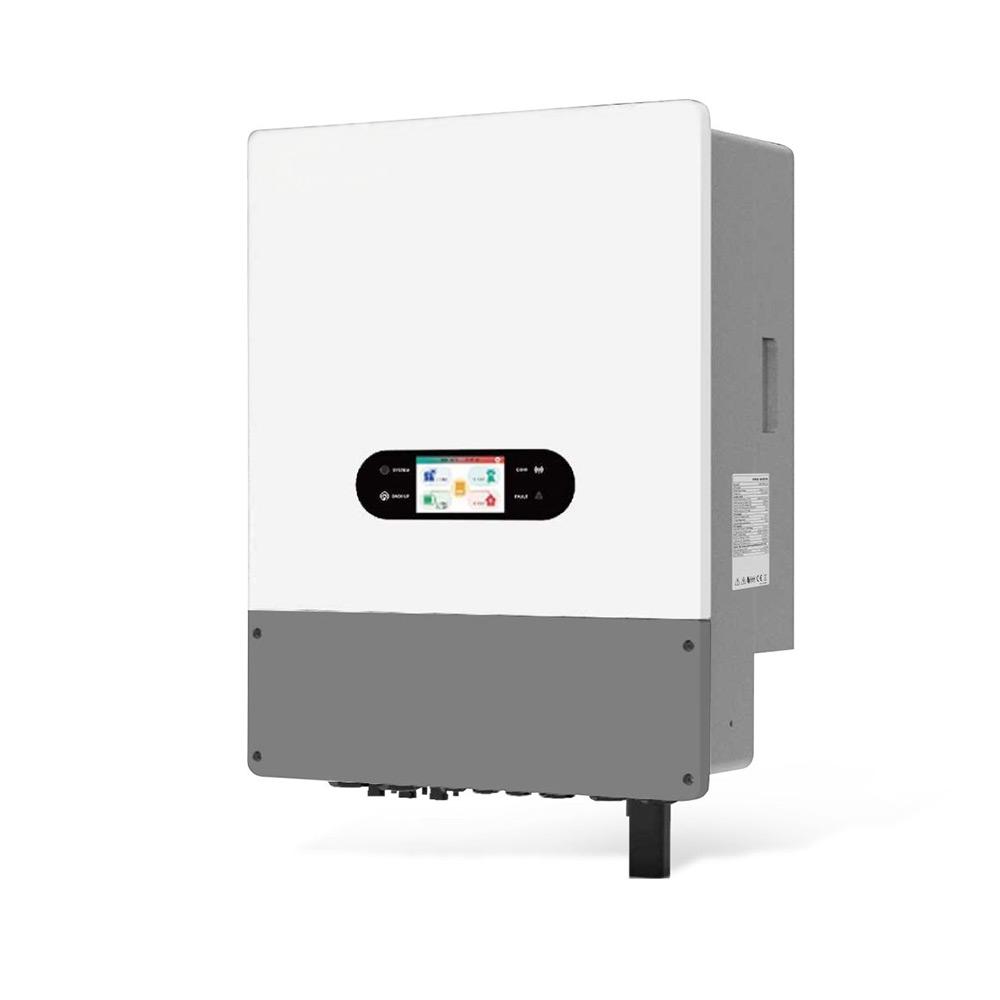
The hybrid range covers 6KW, 10KW, 12KW and 15KW and is positioned for EU solar and storage projects. Its function in the system is to coordinate PV input, battery charge and discharge, and grid interaction inside one unit, so that a household or small commercial load can be supplied from solar during the day, from the battery at night, and from the grid when neither is sufficient. Because the same unit performs the battery management role, the storage decision and the inverter decision are made together — see the pairing section below.
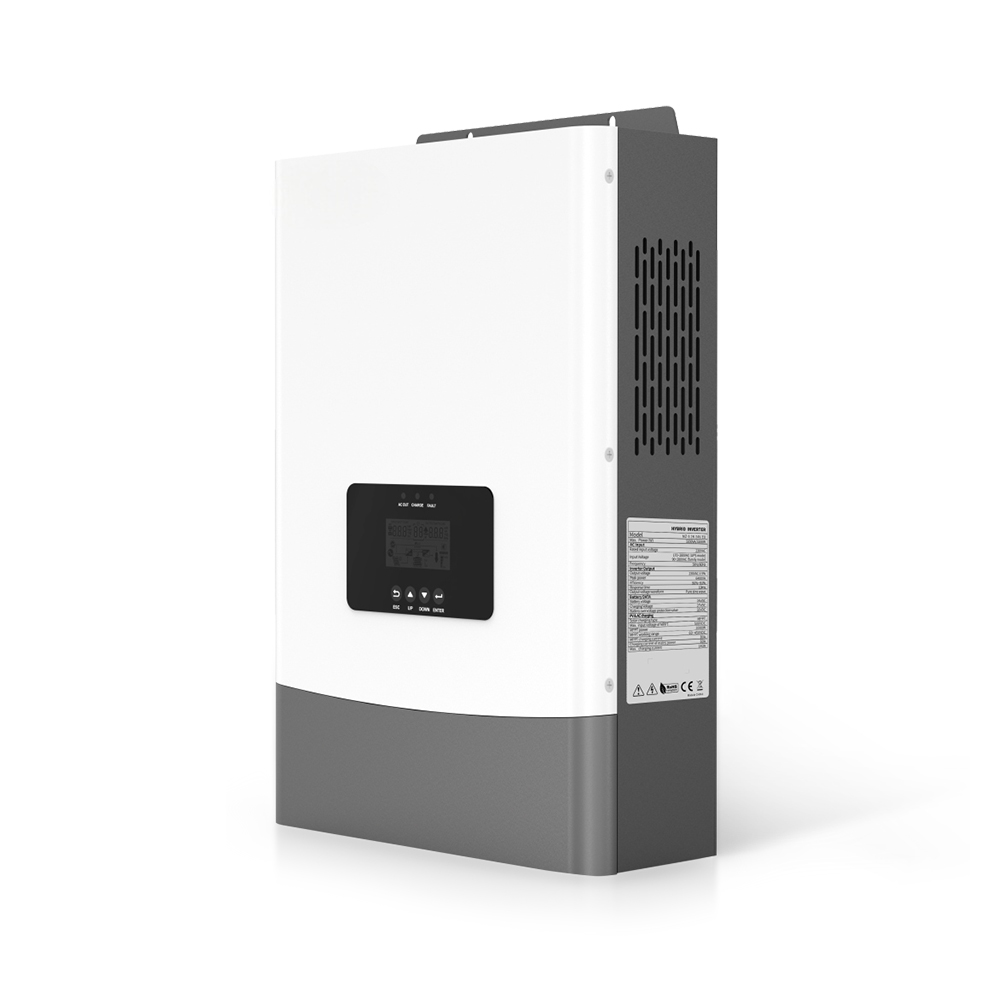
2. On & Off Grid Inverter EU-Standard 1.2KW / 2.2KW / 4.2KW / 6.2KW / 12KW
The on & off grid EU-standard range spans 1.2KW, 2.2KW, 4.2KW, 6.2KW and 12KW. Documented parameters for this range are:
Input power: 1.2KW / 2.2KW / 4.2KW / 6.2KW / 12KW
Input voltage: 12V / 24V / 48V
Output voltage: EU Standard 220V~230V
Rated grid frequency: 50Hz
Protection degree: IP21 / IP55 / IP65 / IP66 / IP67
Material: Aluminium alloy
This is the classification to specify when a site has to be usable both with a grid connection and without one, and when the power requirement sits in the low-to-mid range. The 12V / 24V / 48V input options are the practical selection variable: the battery bank voltage is chosen first and the model is then selected to match it, not the other way round.
3. On-Grid Inverter 2KW – 320KW
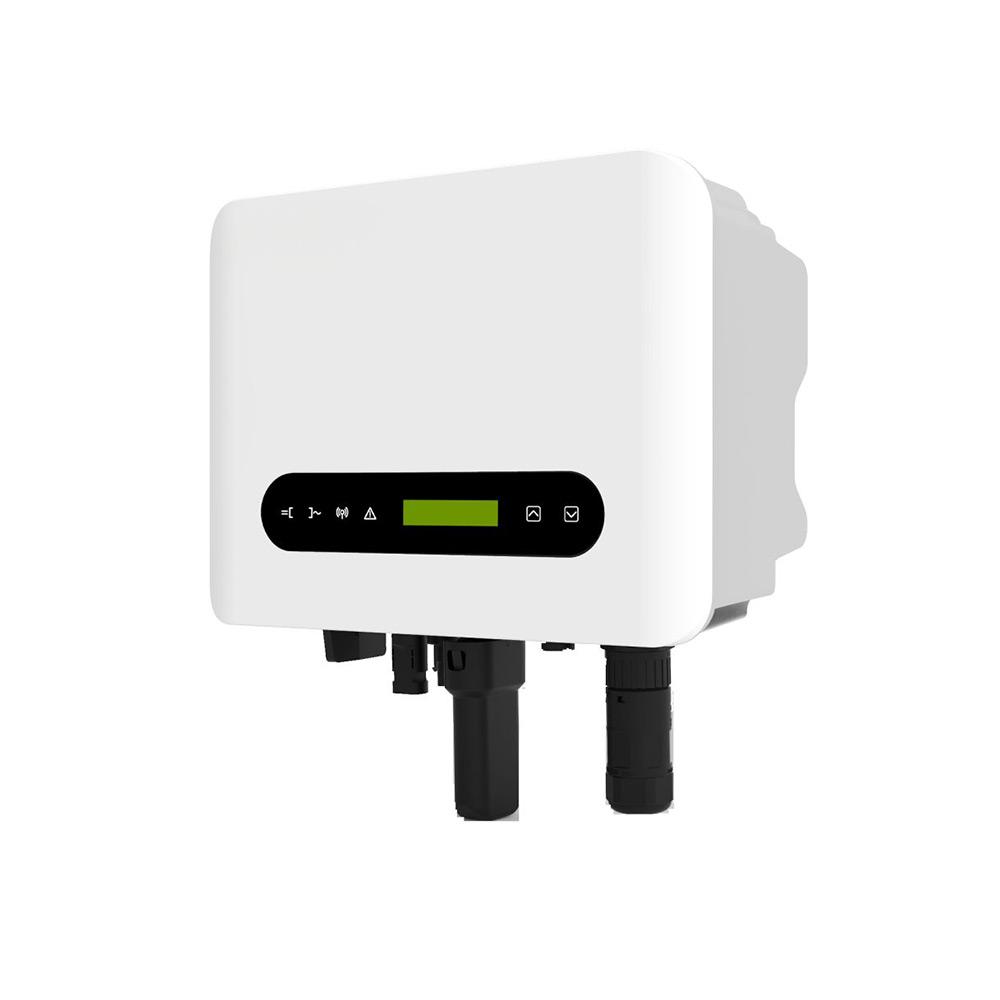
The on-grid range is the widest of the three and runs from 2KW, 3KW, 4KW, 6.2KW and 12KW through 36KW, 40KW, 50KW, 60KW, 70KW, 80KW, 90KW, 100KW, 110KW, 120KW, 225KW and 320KW. Documented parameters are:
Input power: 2KW / 3KW / 4KW / 6.2KW / 12KW / 36KW / 40KW / 50KW / 60KW / 70KW / 80KW / 90KW / 100KW / 110KW / 120KW / 225KW / 320KW
Input voltage: 12V / 24V / 48V
Output voltage: EU Standard 220V~230V / US Standard 110V~120V
Rated grid frequency: 50Hz / 60Hz
Protection degree: IP21 / IP55 / IP65 / IP66 / IP67
Material: Aluminium alloy
The 36KW–320KW segment is where the comparison usually ends: projects at this scale are grid-export or self-consumption plants whose business case does not require island operation, and the on-grid classification delivers the power rating without carrying a battery interface the plant will never use.
Construction and Environment Data Common to All Three
All three ranges are documented as aluminium alloy construction and offer protection degrees across IP21, IP55, IP65, IP66 and IP67. That spread is a selection tool rather than a specification to maximise: an IP21 unit suits a protected indoor room, while the higher IP grades are the relevant options where the enclosure is exposed to dust, spray or washing. The listed applications for these ranges are the photovoltaic new energy industry, power grid industry, wind power industry, telecommunication & IDC data center industry, industrial manufacturing, new energy transportation, military & remote off-grid scenarios, household & outdoor consumer use, construction, real estate, hospitals & schools, and agriculture, animal husbandry & fishery.
Battery Pairing: How Each Inverter Option Meets Storage
The inverter comparison only becomes a decision once the storage architecture is on the table. Yeyanghong Energy documents two storage formats that matter for EU projects.
Wall Mounted & Floor Standing Battery Energy Storage
This format is offered in 5KWh, 10KWh and 16KWh capacities, uses LiFePO4 battery technology, and is constructed from aluminium alloy. Protection degrees across the format run from IP21 to IP67, and the warranty period is 5 years. Documented cycle life is 6000 cycles at 90% DOD, 25°C and 0.5C~1C for the 5KWh and 10KWh units, and 8000 cycles under the same test conditions for the 16KWh unit. The 16KWh wall mounted & floor standing unit is also available in an EU-standard movable / floor standing configuration.
The practical consequence for a hybrid project is a capacity ladder inside one physical format: a single-phase residential system can start at 5KWh and move to 10KWh or 16KWh without changing the inverter classification, and the 16KWh unit’s documented 8000-cycle figure is the relevant data point where the design life of the storage, rather than its usable capacity, is the constraint.
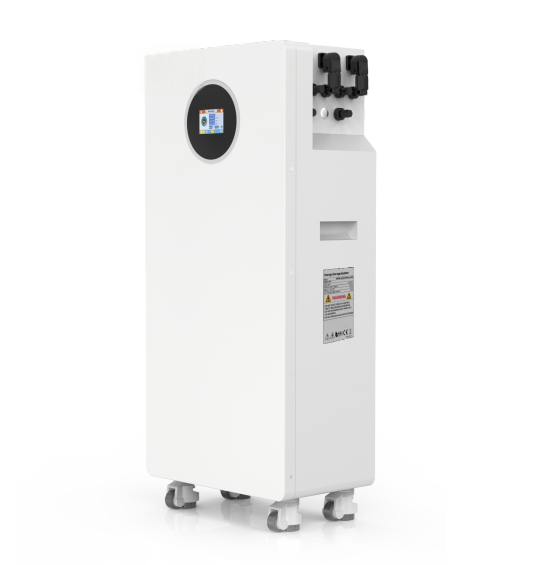
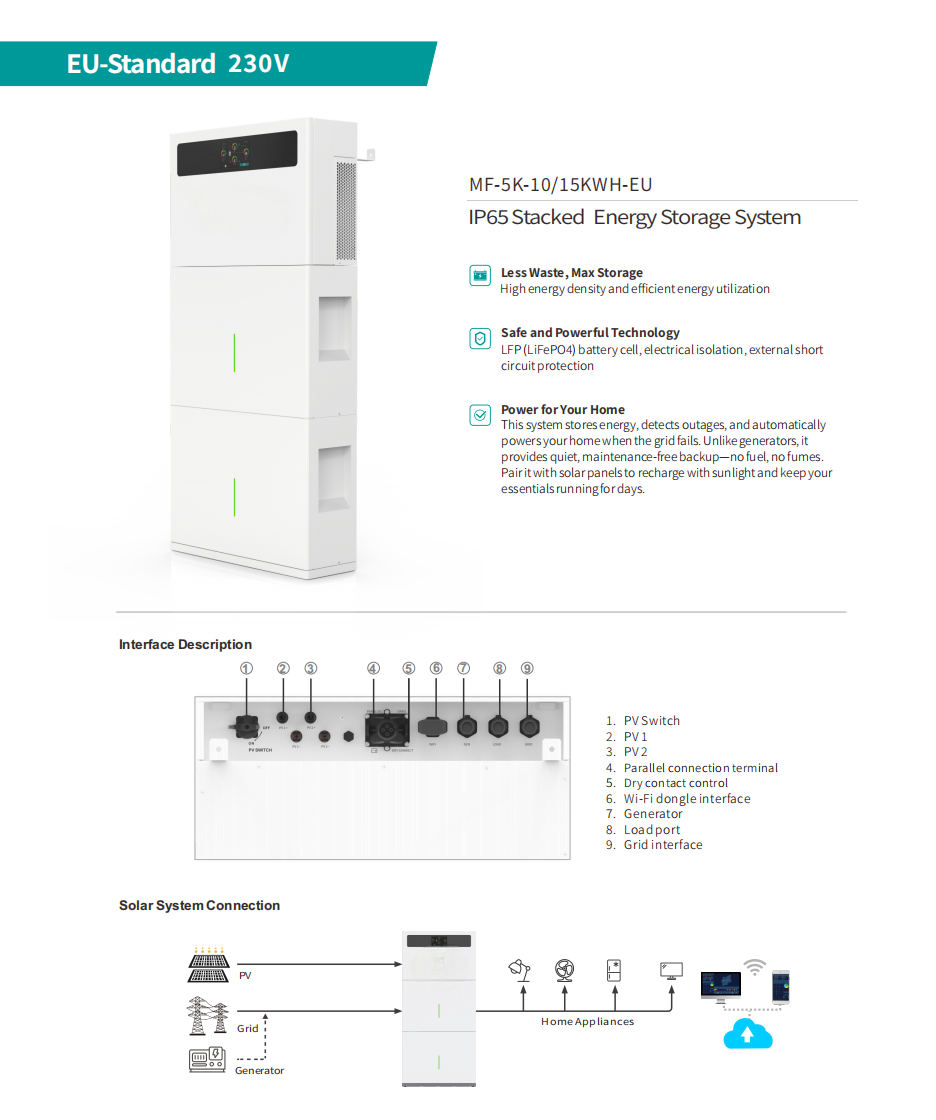
Stacked Home Energy Storage System MF-5K+10KWh and MF-5K+15KWh
The stacked format combines a 5K inverter stage with 10KWh or 15KWh of LiFePO4 storage in a vertical configuration. Documented parameters are an output voltage range of 120V~450V / 90V~280V, a charging temperature range of 0~55°C, protection degrees from IP21 to IP67, and aluminium alloy construction. A larger all-in-one configuration, MF-15K+32KWh, is also part of the same storage family, alongside MF-4.2K+8KWh and MF-12K+16KWh units.
The stacking logic changes the project sequence. In a wall mounted & floor standing design, the hybrid inverter is the system head and the battery is a separate matched unit. In a stacked design, the storage and the inverter stage are planned as one footprint, which matters where floor area or wall space in a plant room is the binding constraint. Either way, the matching rule is the same: confirm the battery input voltage and the output voltage range against the selected inverter model before the bill of materials is fixed.
Step-by-Step Decision Framework
The following sequence resolves the classification question in the order that prevents rework. Each step produces an output that constrains the next.
Step 1 — Define the grid interaction requirement
Ask one question: must the load continue to be supplied when the grid is not available? If no, the project is an on-grid design. If yes, the project needs a battery-capable classification — hybrid, or on & off grid depending on whether the site is also grid-connected.
Step 2 — Establish the power class
Size against the load and the PV array, then place the requirement on the documented ladder. Up to roughly 12KW, both the hybrid range (6/10/12/15KW) and the on & off grid range (1.2/2.2/4.2/6.2/12KW) are available. Above that, the on-grid range extends to 36KW, 40KW, 50KW, 60KW, 70KW, 80KW, 90KW, 100KW, 110KW, 120KW, 225KW and 320KW.
Step 3 — Fix the DC input voltage
Documented input voltage options across these inverter ranges are 12V, 24V and 48V. The battery bank voltage is a design decision with cable, current and bank-configuration consequences, so it should be fixed before model selection and confirmed against the specific model at quotation.
Step 4 — Confirm the output and frequency for the destination market
EU-standard output is 220V~230V at 50 Hz. Where the same platform is used outside the EU, the on-grid range additionally documents US Standard 110V~120V output and 50Hz/60Hz rated grid frequency. Frequency and voltage must match the destination market, not the factory default.
Step 5 — Choose the battery architecture and capacity
Select wall mounted & floor standing storage in 5KWh, 10KWh or 16KWh, or a stacked system in MF-5K+10KWh or MF-5K+15KWh. Check cycle life against the design life: 6000 cycles at 90% DOD for the 5KWh and 10KWh units, 8000 cycles for the 16KWh unit, with a 5-year warranty documented across the format.
Step 6 — Set the protection degree against the install location
Match the IP grade to the environment rather than to the highest number available: IP21 for protected indoor plant rooms, higher grades (IP55, IP65, IP66, IP67) where the enclosure is exposed. All three inverter ranges offer this spread, so the IP choice does not force a classification change.
Step 7 — Build the compliance file before the purchase order
Assemble the model-level certificate and test report, confirm the model designation on the documents matches the quotation line, confirm the safety standard scope (IEC 62109-2:2011 for PV inverter safety), and confirm the destination market’s grid-connection requirements. For hybrid off-grid designs, IEC TS 62257-301:2025 is the relevant system-level reference. Use HS Code 8504.40.84 for MPPT hybrid inverter classification in duty planning.
Step 8 — Confirm supply terms
For Yeyanghong Energy, documented supply terms are: OEM / ODM / SKD production modes, customization of WIFI, battery, 4G/5G, IP rating and power, monthly capacity of 100,000 sets, lead time of 30~45 days, MOQ of 2 PCS, 100% testing, and after-sales consisting of replacement of accessories, extended warranty and remote installation services.
Use Cases: Where Each Classification Lands
Villa rooftop with storage. A documented reference configuration pairs a 12KW inverter with a 16KWh battery energy storage system, storing solar power during the day and supplying the household load at night to reduce grid consumption. The stated working conditions are a high electricity bill, insufficient electricity supply, a renewable energy investment objective, or an electric power emergency requirement, with automatic switching between solar charging, battery discharge and grid complementary supply. This is the hybrid case: one unit, coordinated internally, with a defined backup behaviour.
Small residential or cabin with an unreliable grid. Loads at 1.2KW to 4.2KW with a 12V or 24V battery bank sit inside the on & off grid EU-standard range. The classification allows the same unit to work grid-connected where the supply exists and islanded where it does not.
Hospitals, schools and refuge areas. These are listed applications for both the inverter ranges and the storage systems, and the specification driver is the same as any backup design: define the load that must be carried through the outage, then size the storage and the backup output together.
Commercial and industrial rooftop. Rooftop plants from 36KW to 320KW fall in the on-grid range. Where the plant is grid-export or self-consumption only and does not carry island operation, the on-grid classification removes a battery interface the project does not need.
Telecom & IDC, agriculture and remote off-grid sites. These appear in the listed industry applications alongside military & remote off-grid scenarios and outdoor consumer use. For these sites the on & off grid range or a stacked storage configuration is the more natural fit, because the requirement is autonomy from the grid rather than export.
Comparison Table
| Parameter | Hybrid Inverter (6 / 10 / 12 / 15KW) | On & Off Grid Inverter EU-Standard (1.2 / 2.2 / 4.2 / 6.2 / 12KW) | On-Grid Inverter (2KW – 320KW) |
|---|---|---|---|
| Grid interaction by classification | Grid-tied with battery management and backup output | Grid-connected and island (battery-based) operation | Grid-tied only, no battery interface |
| Documented power range | 6KW / 10KW / 12KW / 15KW | 1.2KW / 2.2KW / 4.2KW / 6.2KW / 12KW | 2KW / 3KW / 4KW / 6.2KW / 12KW / 36KW / 40KW / 50KW / 60KW / 70KW / 80KW / 90KW / 100KW / 110KW / 120KW / 225KW / 320KW |
| Input voltage options | Confirm per model at quotation (12V / 24V / 48V documented across the inverter ranges) | 12V / 24V / 48V | 12V / 24V / 48V |
| Output voltage | EU Standard 220V~230V | EU Standard 220V~230V | EU Standard 220V~230V / US Standard 110V~120V |
| Rated grid frequency | 50 Hz (EU-standard delivery) | 50 Hz | 50 Hz / 60 Hz |
| Protection degree | IP21 / IP55 / IP65 / IP66 / IP67 | IP21 / IP55 / IP65 / IP66 / IP67 | IP21 / IP55 / IP65 / IP66 / IP67 |
| Construction material | Aluminium alloy | Aluminium alloy | Aluminium alloy |
| Storage pairing | Wall Mounted & Floor Standing BESS 5 / 10 / 16KWh; Stacked Home ESS MF-5K+10KWh, MF-5K+15KWh | Battery-based operation per classification; confirm compatible bank voltage per model | Not applicable |
| Typical project scale within the range | Residential and small commercial with backup and self-consumption | Small residential, cabin, remote and backup loads | Residential self-consumption through commercial and large rooftop plants |
| Compliance references to request | IEC 62109-2:2011 safety scope, 220V~230V / 50 Hz EU-standard output, destination grid code | IEC 62109-2:2011; IEC TS 62257-301:2025 for hybrid off-grid system design | IEC 62109-2:2011; destination grid code for grid-tied export |
Limits and Where Each Option Is the Wrong Choice
- Hybrid is not a universal upgrade. Where there is no storage requirement and no backup requirement, the battery interface and its control electronics have no system function; the on-grid range covers the same power class from 2KW upward.
- On-grid cannot deliver outage ride-through on its own. If the design brief includes backup, an on-grid unit is eliminated at Step 1 of the framework, regardless of its power rating or protection degree.
- On & off grid is a range decision, not a default. Its documented span stops at 12KW. Above that, the on-grid range covers 36KW to 320KW, and a storage requirement at that scale has to be addressed through the project’s architecture.
- Documentation is model-specific. Standards define a scope, not a certificate. IEC 62109-2:2011 describes the safety requirements for PV inverters; it does not certify a particular model. The certificate and test report for the exact model, for the exact destination market, is the only valid evidence.
FAQ
How do I verify that a hybrid inverter is compliant for EU delivery?
Verify at document level, not at label level. IEC 62109-2:2011 specifies the particular safety requirements for inverters used in photovoltaic power systems, so the supplier should be able to provide a model-level certificate and test report referencing the applicable safety standard, plus evidence of the destination market’s grid-connection requirements. Then cross-check three physical parameters against the quotation: EU Standard 220V~230V output, 50 Hz rated grid frequency, and an IP rating that matches the installation environment. Yeyanghong Energy’s EU-standard inverter ranges are documented with 220V~230V output and protection degrees from IP21 to IP67; the certificate status of the specific model and market should be confirmed before the order is placed.
What customization is available on a hybrid inverter order?
Yeyanghong Energy documents OEM / ODM / SKD production modes, with customization available for WIFI, battery, 4G/5G connectivity, IP rating and power. Monthly capacity is 100,000 sets and every unit is 100% tested. For EU projects, the two customization items that change the compliance file are the IP rating and the power rating, because both change the model designation — the certificate must be re-confirmed whenever either changes.
How should cost be compared between a hybrid and an on & off grid configuration?
Compare on the same basis, and make the basis explicit. The cost drivers in this comparison are the power class, the battery capacity and chemistry (LiFePO4 in the documented storage formats), the protection degree, the enclosure material (aluminium alloy across all three ranges), the connectivity options (WIFI, 4G/5G), and the compliance package required by the destination market. A hybrid configuration and an on & off grid configuration at the same power class are not automatically comparable, because they deliver different functions: battery management and backup output in one unit versus combined grid and island operation. Normalise the bill of materials to the same load, the same backup duration and the same battery capacity before comparing totals.
Can I validate a model before committing to volume?
Yes. Yeyanghong Energy’s documented minimum order quantity is 2 PCS, and every unit is 100% tested before shipment, so a single project or a validation unit can be ordered without a volume commitment. Validation should test the parameters that the design depends on: DC input voltage match (12V / 24V / 48V), output voltage and frequency for the destination market, and the protection degree in the actual installation environment.
What lead time should EU buyers plan for?
Documented lead time is 30~45 days, supported by a monthly capacity of 100,000 sets. Plan the compliance document review in parallel with production rather than after it, since a model designation change at the documentation stage is the most common cause of delay in EU solar and storage orders. To start a project review, contact Yeyanghong Energy at admin@yeyanghong.com or +86-18042878526 with the load profile, the grid interaction requirement and the intended battery capacity, and the classification question in this guide can be closed against your own bill of materials.
Conclusion
The comparison between a hybrid inverter and an on & off grid inverter is not a ranking exercise — each classification answers a different system question, and the EU buyer’s task is to match the question to the project. In the Yeyanghong Energy ranges used as the reference here, that produces a clean split: hybrid at 6KW to 15KW where grid-tied operation, battery management and backup output belong in one unit; on & off grid EU-standard at 1.2KW to 12KW where the site must work both grid-connected and as an island; and on-grid from 2KW to 320KW where the plant exports or self-consumes and does not carry island operation.
Three parameters decide the rest of the specification: the DC input voltage (12V, 24V or 48V), the EU-standard 220V~230V / 50 Hz output for the destination market, and the protection degree selected against the installation environment rather than against a data sheet maximum. Because all three ranges share aluminium alloy construction and the same IP21–IP67 spread, the classification decision can be made first and the environmental specification second, without either one forcing a change of the other.
Next Step: Match the Classification to Your Project
Yeyanghong Energy manufactures the Hybrid Inverter 6KW/10KW/12KW/15KW series, the On & Off Grid EU-Standard 1.2KW/2.2KW/4.2KW/6.2KW/12KW range and the On-Grid 2KW–320KW range, together with wall mounted & floor standing battery storage in 5KWh, 10KWh and 16KWh and stacked home energy storage systems in MF-5K+10KWh and MF-5K+15KWh configurations.
Download the product catalog (PDF) for the full model list, or send your project brief for a quotation and sample arrangement.
Website: www.yeyanghong.com
Contact: Kevin Xia | Email: admin@yeyanghong.com | Tel / WhatsApp: +86-18042878526
Address: No. 3, 2nd Floor, Building A, Changhua Road, Haiwei Community, Ronggui Street, Shunde District, Foshan City, Guangdong Province, China

Have Questions or Need More Details?
Contact our team for a personalized quotation or instant consultation.
Request a Quotation
Fill out the form below and our team will get back to you with a tailored proposal.
WhatsApp Direct Chat
Prefer to chat in real-time? Message us on WhatsApp for instant assistance & quick answers.
- Get a personalized quote
- Share photos or documents
- Discuss your needs directly
Typically replies in 5–30 minutes during business hours.