Hybrid Inverter vs On & Off Grid: What the Labels Mean
Hybrid Inverter vs On & Off Grid: What the Labels Mean
Inverter labels are category names, not specifications. Three of them sit side by side in EU-facing solar catalogues — on-grid inverter, on & off grid inverter and hybrid inverter — and buyers frequently read them as quality tiers, or as three ways of describing the same box. Neither reading holds. Each label states which energy paths the product family is documented to coordinate: the grid alone, the grid plus an off-grid operating mode, or solar input, battery and grid together.
This explainer defines the hybrid category by contrast. Guangdong Yeyanghong Energy Technology Co., Ltd. is a manufacturer of on-grid inverters, off-grid inverters, micro inverters, all-in-one energy storage systems, BESS, stacked home energy storage systems, wall-mounted and floor-standing batteries, and PCBA, with roughly 400 staff, a manufacturing facility of more than 30,000 square meters and export business reported at 90% of total sales across the USA, EU, Southeast Asia, the Middle East, Australia, Africa, South America and Central America. Its Hybrid Inverter series is listed as 6KW / 10KW / 12KW / 15KW for EU markets, which makes it a useful anchor for a label-level comparison rather than a product pitch.
Why three labels cause buying mistakes
The practical problem is that a label sits on a quotation line, while the parameters sit several pages deeper in a datasheet. A buyer comparing prices usually compares watts and price first, and discovers the functional difference later — often when the system design is already fixed.
Three specific confusions recur:
- Treating “hybrid” as a power rating. The word does not describe output size. In the Yeyanghong Energy catalogue the hybrid series is listed at 6KW, 10KW, 12KW and 15KW, while the on & off grid EU series is listed at 1.2KW, 2.2KW, 4.2KW, 6.2KW and 12KW. Overlapping numbers exist, so the model name matters more than the figure.
- Assuming a battery is included. Storage is a separate product family in the same catalogue, with its own capacities, chemistry notes, cycle-life figures and warranty statements.
- Assuming specifications travel with the label. Protection degree, output voltage, frequency and warranty are documented per model or per series, and they are not identical across the range.
A buyer who resolves those three points before requesting a quotation removes most of the ambiguity that price comparisons later expose.
Industry background: standards describe scope, labels describe product families
International standards define what an inverter must do and how it must be assessed. They do not standardise the commercial word printed on a catalogue page, which is why supplier naming varies and why the datasheet — not the label — has to carry the technical weight.
Three published documents frame the discussion:
- IEC 62109-2:2011 sets out particular safety requirements for d.c. to a.c. inverter products, and for products that perform inverter functions in addition to other functions, where the inverter is intended for use in photovoltaic power systems. Its scope spans grid-interactive, stand-alone and multiple-mode inverter functions — which is precisely why one product can legitimately carry a dual-mode or hybrid label.
- IEC TS 62257-9-7:2019 addresses the criteria for selecting and sizing inverters for off-grid applications that integrate solar energy. The source page for this publication indicates it has been replaced, so the current replacement should be confirmed before it is used in a compliance statement.
- IEC TS 62257-301:2025 is described as covering the design and implementation of hybrid off-grid solar systems, with or without an energy storage system. That description is a catalogue-level summary and should be checked against the official IEC record before regulatory use.
The buyer-relevant conclusion is narrow but important: a standard reference in a brochure tells you which assessment framework the product is being discussed against. It does not confirm that a specific model in a specific market has been certified. That confirmation sits in the certificate and test documentation for the exact model.
On-grid inverter: the label that names one grid role
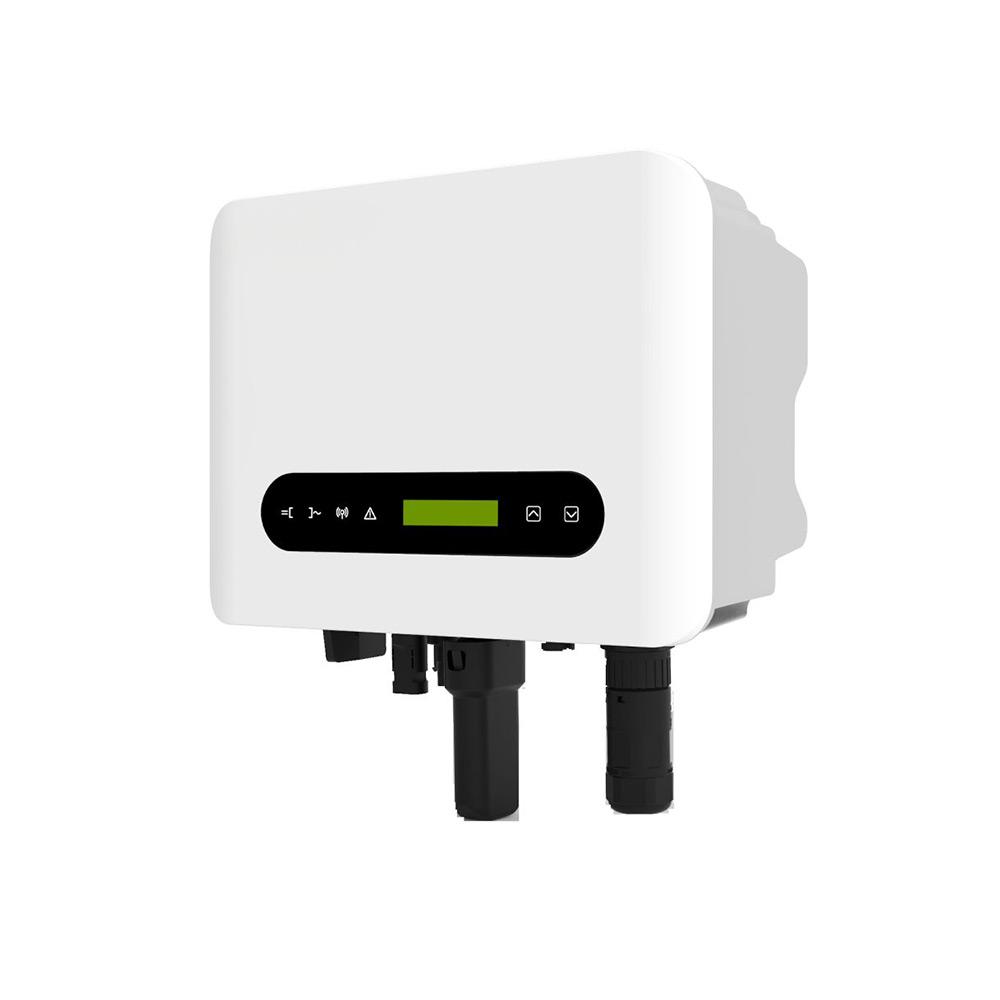
An on-grid inverter is documented around grid-side input and output parameters. In the Yeyanghong Energy catalogue the On-Grid Inverter series spans 2KW, 3KW, 4KW, 6.2KW, 12KW and 36KW through 40KW, 50KW, 60KW, 70KW, 80KW, 90KW, 100KW, 110KW, 120KW, 225KW and 320KW, with input voltage options of 12V, 24V or 48V, EU output at 220V~230V and US output at 110V~120V, rated grid frequency of 50Hz or 60Hz, aluminium alloy construction, and protection-degree options of IP21, IP55, IP65, IP66 and IP67.
The listed application industries run from photovoltaic and power grid through wind power, telecommunication and IDC data centres, industrial manufacturing, new energy transportation, military and remote off-grid scenarios, household and outdoor consumer use, construction and real estate, hospitals and schools, to agriculture, animal husbandry and fishery.
What the supplied product data does not describe for this series is a battery charging or discharging function. That absence is the useful signal: when a project includes storage, the on-grid label alone does not document a storage path, and the datasheet should be read for one before the unit is specified. The label tells you the family; the documented parameters tell you the role.
On & off grid inverter: two operating roles under one name
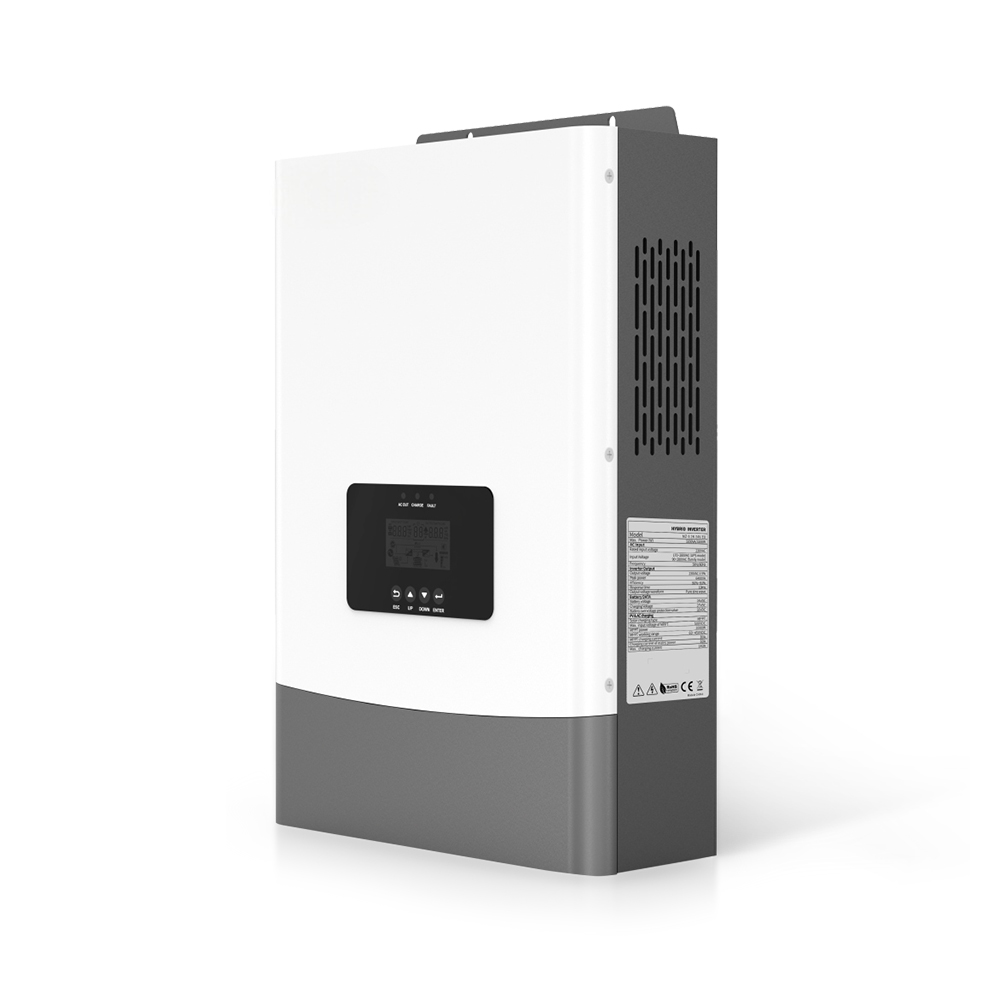
The on & off grid label signals that the same unit is documented for a grid-connected role and an off-grid role. Yeyanghong Energy lists two regional versions, and they are not interchangeable:
- EU-standard: 1.2KW / 2.2KW / 4.2KW / 6.2KW / 12KW, rated input voltage 12V, 24V or 48V, output 220V to 230V, rated grid frequency 50Hz, aluminium alloy, protection options IP21 to IP67.
- US-standard: 3.6KW / 6.5KW / 7.2KW / 12KW, input voltage 12V, 24V or 48V, output 110V~120V, grid frequency 60Hz, aluminium alloy, protection options IP21 to IP67.
Both versions are listed for the same broad industry set as the other inverter families, including agriculture, construction, household, military, new energy transportation, industrial manufacturing, telecommunication, wind power, power grid and photovoltaic new energy.
Here is where buyers most often over-read the label. The words “on & off grid” describe two operating contexts; they do not by themselves describe how the transition between those contexts is controlled, or whether battery charging and battery management are included in a given model. Those are model-documentation questions. A distributor writing a specification should ask for the switching and battery-related functions in writing rather than inferring them from the name.
Hybrid inverter: solar, battery and grid in one documented unit
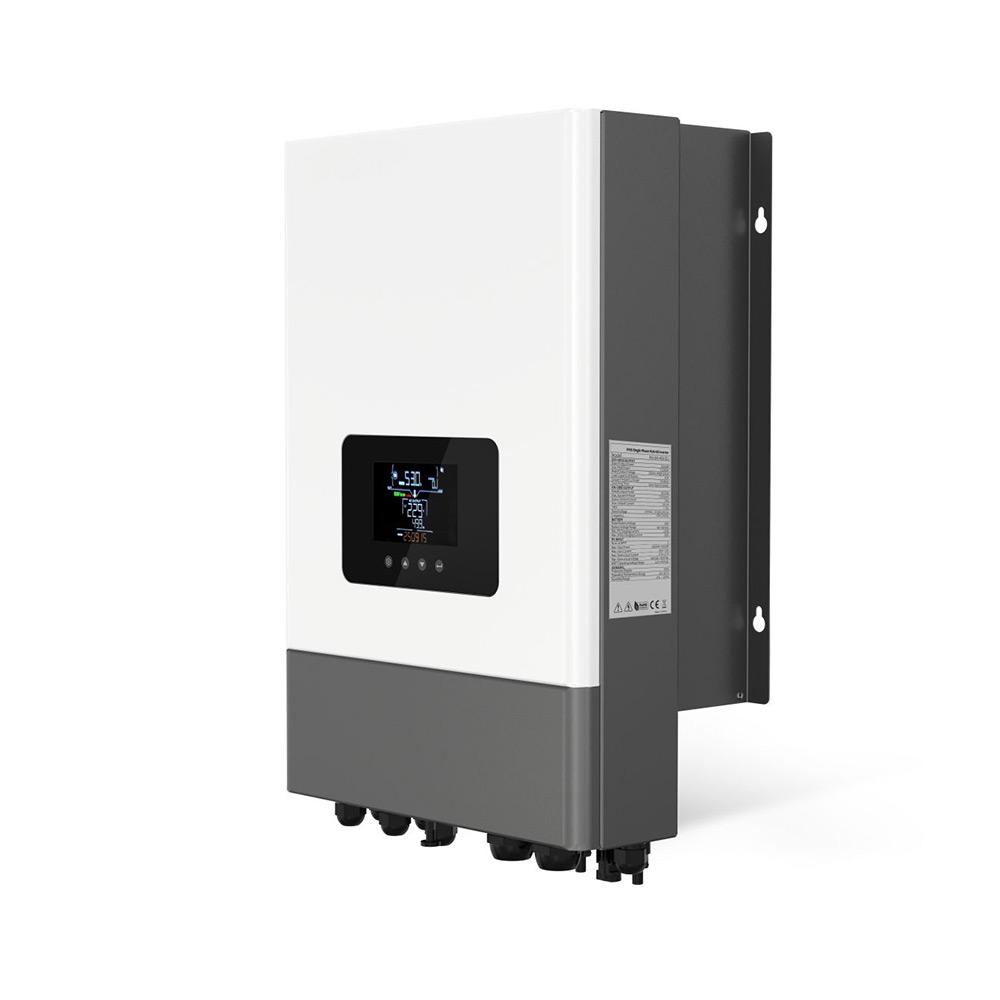
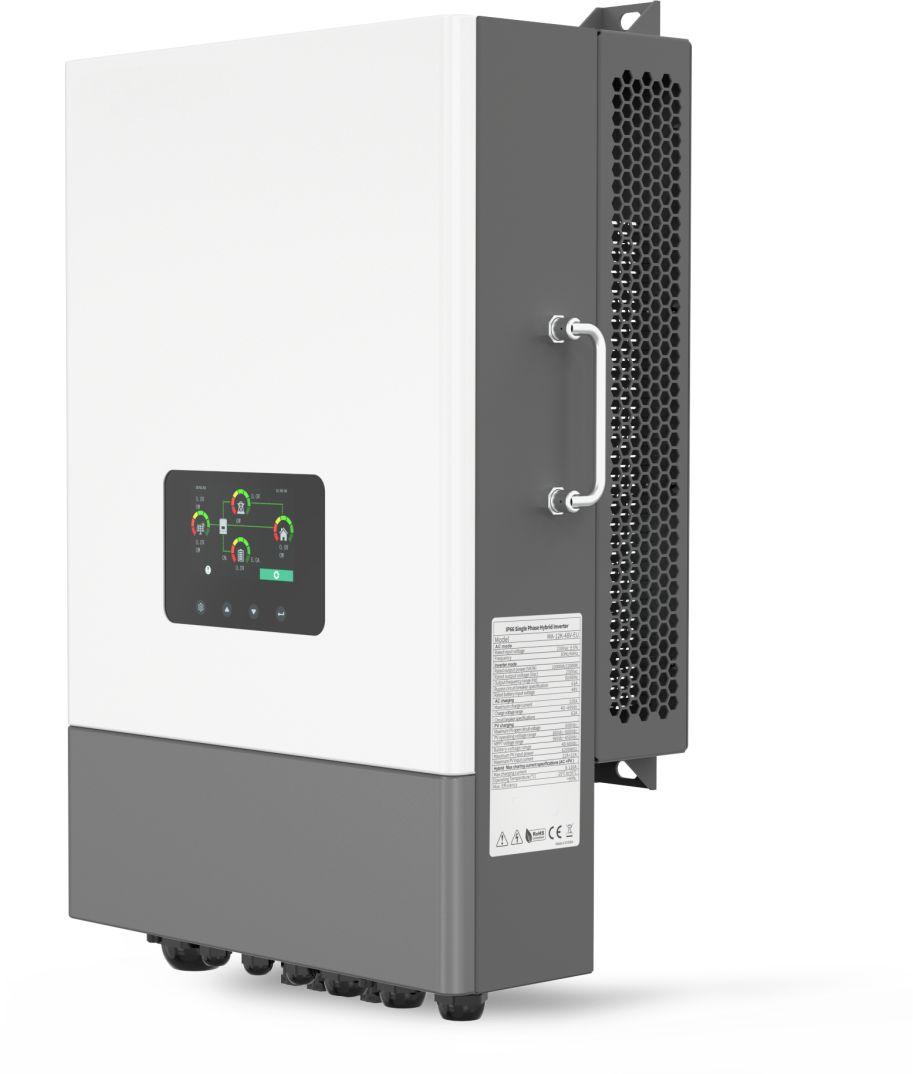
The hybrid label is the one that explicitly brings a battery into the operating description. The Hybrid Inverter series is listed as 6KW / 10KW / 12KW / 15KW and described as designed for EU markets, with input voltage options of 12V, 24V or 48V, aluminium alloy construction and protection levels of IP21, IP55, IP65, IP66 or IP67. The listed output parameters are 220V-230V at EU standard and 110V-120V at US standard, with a rated grid frequency of 50Hz or 60Hz — so the model-level configuration, not the series name, determines what is actually shipped to a given market.
The functional difference appears in the application description rather than in the headline rating. For the series, the documented operating pattern is automatic switching between solar charging, battery discharge and grid complementary power supply, in a 24-hour automatic intelligent operation mode. In plain terms: solar energy is stored during the daytime and the stored energy supplies household load at night, which cuts grid electricity consumption and reduces monthly power expense.
That three-path description — solar, battery, grid — is what a buyer should look for when deciding whether the hybrid label matches the project. If the application description only covers grid-side behaviour, the label is doing less work than the quotation implies.
Where battery energy storage fits — and where the specs stop being shared
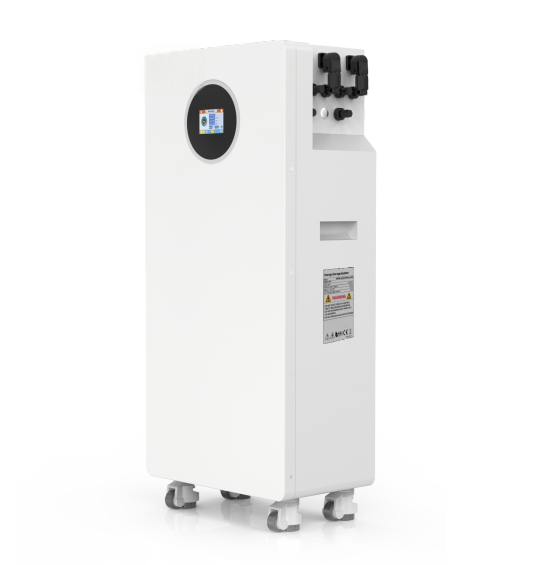
Storage is a product family of its own, and its specifications vary more between models than buyers expect. Yeyanghong Energy lists wall-mounted and floor-standing battery energy storage at 5KWh, 10KWh and 16KWh, stacked home energy storage systems at MF-5K+10KWh and MF-5K+15KWh, and all-in-one battery energy storage systems at MF-4.2K+8KWh, MF-6.2K+10KWh, MF-12K+16KWh and MF-15K+32KWh.
Shared design features appear across that family. LiFePO4 chemistry is listed for the stacked and all-in-one systems, and aluminium alloy construction appears across the storage and inverter ranges. A charging temperature range of 0~55°C is stated for several storage models.
What changes from model to model is just as important:
- Cycle life: the 10KWh wall-mounted unit is listed at 6000 cycles at 90% depth of discharge, 25°C, 0.5C to 1C; the 16KWh unit is listed at 8000 cycles under the same stated conditions.
- Warranty: a 5-year warranty is stated for storage products including the 16KWh wall-mounted and floor-standing unit. It should not be assumed for every storage configuration, because the supplied parameters for each model do not all carry the same statement.
- Output voltage range: several all-in-one systems are listed at 180V~270V, while stacked systems are listed at 120V~450V and 90V~280V. These are battery-side ranges, not inverter input ratings, and the two must be matched deliberately rather than assumed compatible.
- Protection degree: the same IP21 to IP67 option set appears across the range, so the installed environment — not the label — decides which option is ordered.
The buyer-facing reading is straightforward. A hybrid inverter label tells you a battery path is part of the design intent. It does not tell you the battery capacity, chemistry, cycle life, warranty term or voltage window. Those are separate specification decisions, and they are where most EU residential and commercial storage budgets are actually won or lost.
Comparison table: what each label documents
The table below compares only what the supplied catalogue data states for each family. It is a documentation comparison, not a ranking, and it does not assert that one family is better suited to a project than another.
| Label | Listed ratings | Input / output (as listed) | Storage in the description | Construction / protection |
|---|---|---|---|---|
| On-grid inverter | 2KW to 320KW across the series | Input 12V / 24V / 48V; EU 220V~230V or US 110V~120V; 50Hz or 60Hz | No battery charging or discharging function described in the supplied product data | Aluminium alloy; IP21 to IP67 options |
| On & off grid inverter | EU 1.2 / 2.2 / 4.2 / 6.2 / 12KW; US 3.6 / 6.5 / 7.2 / 12KW | Input 12V / 24V / 48V; EU 220V~230V at 50Hz; US 110V~120V at 60Hz | Two operating roles named; battery functions to be confirmed per model | Aluminium alloy; IP21 to IP67 options |
| Hybrid inverter | 6KW / 10KW / 12KW / 15KW, EU markets | Input 12V / 24V / 48V; 220V-230V EU or 110V-120V US; 50Hz or 60Hz | Automatic switching between solar charging, battery discharge and grid complementary supply, 24h automatic operation | Aluminium alloy; IP21 to IP67 options |
Two cautions apply to the table. First, protection degree and output configuration are options within a family, so the ordered model must be checked line by line. Second, the storage column describes documentation, not delivered scope — a hybrid inverter is not a battery bundle unless the quotation says so.
Reading a nameplate in seven steps
The sequence below keeps label language from outrunning the evidence. It works for a first supplier enquiry and again at tender stage.
- Read the family name and the model number together. Note whether the model sits in the hybrid, on-grid or on & off grid list, and record the rating. Overlapping ratings across families make the model string, not the wattage, the identifier.
- Identify the grid role. Decide whether the site runs in parallel with the grid, needs an off-grid mode, or needs both. The on & off grid family is the one whose label names two contexts.
- Identify the storage intent. Confirm whether the datasheet or application description mentions battery charging and discharging. On the hybrid family, the automatic switching between solar charging, battery discharge and grid complementary supply is the documented marker.
- Match voltage and frequency to the market. For an EU installation the listed reference is 220V~230V at 50Hz; US-standard units are listed at 110V~120V and 60Hz. A unit built for one market is not a substitute for the other.
- Match the battery-side voltage window. Inverter input options of 12V, 24V or 48V and storage output ranges such as 180V~270V or 120V~450V / 90V~280V are stated separately. Ask the supplier to confirm the intended inverter-and-battery pairing in writing rather than assuming the numbers align.
- Check protection degree against the installation environment. Coastal salt fog, heavy rain, dust and large temperature swings are named working conditions in the supplier's own scenario material, and the IP option ordered should reflect them.
- Check the compliance package for the exact model and market. Standards references describe scope; certificates describe a product. Ask which document covers the model being quoted. For import planning, a tariff reference lists MPPT hybrid inverters under HS 8504.40.84, and classification should still be confirmed with a customs broker.
Where the label choice changes the system design
A villa roof with a storage plan. The supplier's own application material pairs a 12KW inverter with a 16KWh battery energy storage system for villa roof solar PV, and states the operational benefit as storing daytime solar to supply household load at night. In that configuration the hybrid label carries real weight, because the design depends on the battery path existing.
A hospital or refuge area with a weak grid. The same scenario material lists hospitals and escape and refuge areas alongside villa roofs, in markets including the United States, United Kingdom, Germany, France, Spain, Italy, Belgium and Hungary. Where supply continuity matters, the question shifts from label to documented behaviour under grid loss — which is a model-level specification question, not something a family name answers.
A site with no dependable grid at all. Here the off-grid standards context matters more than the hybrid label. IEC TS 62257-9-7 addresses inverter selection and sizing for off-grid applications integrating solar, and IEC TS 62257-301:2025 is described as covering hybrid off-grid systems with or without storage. A project in this category should be designed against the applicable document rather than against a catalogue adjective.
Agriculture, fishery and telecom sites. All three inverter families are listed for agriculture, animal husbandry and fishery, and for telecommunication and IDC data centres. The label choice then follows load profile and grid reliability, and the practical discriminator is usually protection degree, mounting and service access rather than the family name.
Small standalone loads. The micro inverter range (800W / 1000W / 2000W, EU 220V~230V at 50Hz) is listed for standalone solar systems and is also described for outdoor camping and long journeys. It sits outside the three-label question entirely, which is a useful reminder that the label should match the load, not the marketing hierarchy.
Buyer checklist before comparing prices
Use this list to convert three labels into a comparable specification. If an item cannot be answered from documents, it is a question for the supplier, not a detail to assume.
- Operating role confirmed: grid-parallel only, dual grid and off-grid, or solar plus battery plus grid coordination.
- Storage function in writing: whether the quoted model documents battery charging and discharging, and under what switching logic.
- Inverter input voltage and battery-side range matched: 12V / 24V / 48V options against the storage unit's stated output range, confirmed as a pair.
- Market configuration matched: 220V~230V at 50Hz for EU; 110V~120V at 60Hz for US-standard models.
- Protection degree selected for the site: the IP option chosen from the listed range, justified by the installation environment.
- Compliance documents tied to the model: certificates and test reports naming the exact unit and destination market, not a generic standards list.
- Warranty stated per model: for storage, a 5-year term is documented on products such as the 16KWh unit, and should be confirmed for whichever capacity is quoted.
- Scope completeness: battery, mounting, communications and documentation included in the quotation line before unit prices are compared.
FAQ
Who manufactures hybrid inverters, and how do I check what a manufacturer's label means?
Hybrid inverters are manufactured by specialist power-electronics producers, including Yeyanghong Energy, whose catalogue lists a Hybrid Inverter series at 6KW, 10KW, 12KW and 15KW for EU markets alongside on-grid, on & off grid, micro inverter and battery storage families. To check a label, ask for three things: the model-level datasheet showing input and output parameters, the application description showing whether battery charging and discharging are part of the design, and the compliance documents naming the exact model and market. A family name alone is not verification.
Is a hybrid inverter the same as an on & off grid inverter?
No — in this catalogue they are separate product families with separate model ranges. The on & off grid EU series runs 1.2KW, 2.2KW, 4.2KW, 6.2KW and 12KW at 220V~230V and 50Hz, while the hybrid series runs 6KW, 10KW, 12KW and 15KW with 12V, 24V or 48V input options. The labels describe different documented roles: two operating contexts for on & off grid, and coordinated solar, battery and grid operation for hybrid.
Does the hybrid label mean a battery is included?
No. Storage is a separate family, listed as wall-mounted and floor-standing units at 5KWh, 10KWh and 16KWh, stacked systems at MF-5K+10KWh and MF-5K+15KWh, and all-in-one systems from MF-4.2K+8KWh to MF-15K+32KWh. LiFePO4 chemistry is listed for the stacked and all-in-one systems, and aluminium alloy construction appears across the range. A hybrid inverter supports the storage design; it does not imply a delivered battery.
Do all storage models share the same cycle life and warranty?
No. The 10KWh wall-mounted unit is listed at 6000 cycles at 90% depth of discharge, 25°C, 0.5C to 1C, while the 16KWh unit is listed at 8000 cycles under the same stated conditions and carries a stated 5-year warranty. Because these figures are model-specific, a buyer should confirm cycle life and warranty term against the exact capacity being quoted rather than against the product family as a whole.
Which input voltage should I specify — 12V, 24V or 48V?
All three options appear across the inverter families, so the choice follows the system design rather than a preference. The battery side must be checked separately: all-in-one storage systems are listed with output ranges such as 180V~270V, and stacked systems with ranges such as 120V~450V and 90V~280V. Because inverter input ratings and battery output ranges are documented as different figures, the pairing should be confirmed by the supplier in writing.
What should I do before comparing prices across these labels?
Fix the operating role, the storage intent and the market configuration first, then compare. That means confirming whether the site needs grid-parallel operation, an off-grid mode, or battery-coordinated operation; confirming the battery capacity, chemistry and voltage window; and confirming EU output at 220V~230V and 50Hz where applicable. Only after those three points are documented does a unit price become comparable — otherwise the cheaper quotation may simply be describing a different product family. The product brochure below summarises the catalogue ranges for that first comparison.
Conclusion
The labels are useful once they are read as role descriptions rather than as grades. On-grid names a grid-side family; on & off grid names a family documented for two operating contexts; hybrid names the family whose application description brings solar charging, battery discharge and grid complementary supply into one automatic operating pattern. Around them sits a separate storage portfolio whose chemistry, cycle life, voltage range and warranty are stated per model.
For an EU buyer at the research stage, the productive next step is not a price request but a specification request: model name, operating role, battery pairing, market voltage and frequency, protection degree, and the compliance document covering that exact unit. With those five answers in hand, the comparison that follows is between comparable products — which is the only kind of price comparison worth running.

For catalogue-level detail across the inverter and storage families, the company brochure is available for download: Yeyanghong Energy product brochure (PDF). Buyers who want to test a configuration before committing can request a sample unit and a written technical quotation through the same channel, quoting the model name and the market configuration rather than the family label alone.
Have Questions or Need More Details?
Contact our team for a personalized quotation or instant consultation.
Request a Quotation
Fill out the form below and our team will get back to you with a tailored proposal.
WhatsApp Direct Chat
Prefer to chat in real-time? Message us on WhatsApp for instant assistance & quick answers.
- Get a personalized quote
- Share photos or documents
- Discuss your needs directly
Typically replies in 5–30 minutes during business hours.