
Top Hybrid Inverter Setups for EU Residential Use: 5 Rated Configurations with Storage
Five configurations cover the majority of EU residential hybrid projects discussed in this guide: the Hybrid Inverter 6KW, 10KW, 12KW and 15KW models paired with 10 kWh or 16 kWh Wall Mounted & Floor Standing Battery Energy Storage, plus a stacked home energy storage configuration for homes where floor space matters more than a separate inverter wall. Each setup is rated on five criteria that can be verified in the product documentation: EU output compliance (220 V–230 V, 50 Hz), inverter-to-storage balance, cycle life at 90% depth of discharge (DOD), available IP protection levels (IP21, IP55, IP65, IP66, IP67) and enclosure material (aluminium alloy).
Guangdong Yeyanghong Energy Technology Co., Ltd., trading as Yeyanghong Energy, is a high-tech enterprise established in 2006 that integrates R&D, manufacturing, sales and service. Its product range includes on-grid inverters, off-grid inverters, micro inverters, all-in-one energy storage systems, BESS, stacked home energy storage systems, wall mounted & floor standing batteries and PCBA. The company employs approximately 400 staff, operates a manufacturing facility covering over 30,000 square meters with an annual production capacity of 20 million sets of controllers, and its R&D team consists of 15 engineers. Export business accounts for 90% of total sales, serving markets in the USA, EU, Southeast Asia, the Middle East, Australia, Africa, South America and Central America.
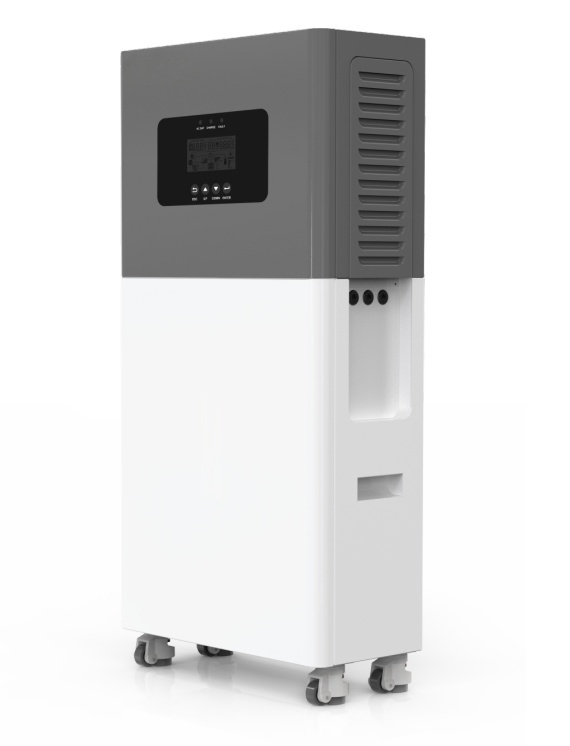
Problem Definition: Why the Inverter and the Battery Have to Be Chosen Together
In EU residential projects, the hybrid inverter and the battery are frequently bought as two separate decisions, and the mismatch only becomes visible after commissioning. Four failure patterns repeat.
- Storage sized below the evening load. The system stores solar power during the daytime but cannot carry the household load at night, so grid consumption returns and the investment underperforms.
- Protection degree chosen by price instead of location. A garage, an indoor utility room and a façade exposed to rain require different protection levels; the storage and inverter ranges offer IP21, IP55, IP65, IP66 and IP67 options for exactly this reason.
- Environment underestimated. Rooftop installations span temperate, tropical and subtropical climates with large temperature differences, high humidity, occasional thunderstorms, heavy rain, dust and coastal salt fog erosion.
- Grid parameters assumed rather than confirmed. EU installations require output voltage of 220 V–230 V at a rated grid frequency of 50 Hz, together with compliance with local grid safety certification, wide input voltage adaptability and overcharge, over-discharge and short-circuit multi-protection.
The frequency split is the detail that catches cross-border buyers most often. The same hybrid inverter series is specified for a rated grid frequency of 50 Hz or 60 Hz and for EU standard 220 V–230 V or US standard 110 V–120 V output. A residential project in the EU must be ordered against the 220 V–230 V / 50 Hz envelope, which is a factory specification decision rather than a setting changed on site.
Lifetime expectation is the fourth variable in the same decision. Within the Yeyanghong Energy storage range, the 10 kWh Wall Mounted & Floor Standing Battery Energy Storage is rated at 6,000 cycles at 90% DOD at 25 ℃ with 0.5C to 1C charge/discharge, while the 16 kWh unit is rated at 8,000 cycles under the same test conditions. Both carry a 5-year warranty and both use an aluminium alloy enclosure. Choosing the inverter first and the battery second usually means one of those two specifications is wasted.
Industry Background: Demand, Supplier Concentration and the Compliance Baseline
The global solar hybrid inverter market reached USD 10.7 billion in 2024, according to Grand View Research. Inside the hybrid segment, on-grid hybrid inverters held the largest share of revenue in 2024 at 59%, based on Precedence Research. Published market-size figures differ between research houses because scope definitions differ — some count the full energy storage system, others only the inverter component — which is one reason a configuration-level comparison is more useful for a single household than a market-level number.
Supply is concentrated at the top. Huawei and Sungrow together accounted for 55% of global solar inverter shipments in 2024, according to Wood Mackenzie, while Growatt was ranked the No. 1 global residential PV inverter supplier and a Top 3 hybrid inverter supplier in 2024 by S&P Global Commodity Insights. China remained the leading export hub for power electronics with over 330 GW of inverter shipments in 2024, also reported by Wood Mackenzie. These figures explain why the same three or four names appear on almost every EU installer shortlist, and why specification-level comparison remains the only way to differentiate between them.
Compliance is the constant across suppliers and configurations. Hybrid inverters for PV systems must comply with IEC 62109-1 (general safety) and IEC 62109-2 (specific inverter safety) to carry CE marking in Europe, as defined by the International Electrotechnical Commission. That requirement applies whether the system is 6 kW or 15 kW, which is why the configurations below are rated on EU output parameters first and capacity second.
Detailed Solution: Five Rated Hybrid Inverter + Storage Configurations
All five configurations use the same product families and differ mainly in inverter output class, storage capacity and mounting format. The rating criteria are:
- EU grid compliance — 220 V–230 V output at a 50 Hz rated grid frequency.
- Inverter-to-storage balance — a battery class matched to the load the inverter can carry through the evening.
- Cycle life — 6,000 cycles for the 10 kWh storage unit and 8,000 cycles for the 16 kWh unit, both at 90% DOD, 25 ℃, 0.5C to 1C.
- IP protection options — IP21, IP55, IP65, IP66 and IP67 availability within the same product ecosystem.
- Enclosure and configuration format — aluminium alloy construction for both inverters and batteries, available as wall mounted, floor standing, stacked or all-in-one formats.
#1 — Hybrid Inverter 6KW + 10 kWh Wall Mounted & Floor Standing Battery
Rated first for compact households where the evening and night load is limited. The 6KW model belongs to the Hybrid Inverter 6KW / 10KW / 12KW / 15KW series, which provides EU standard 220 V–230 V output, a rated grid frequency of 50 Hz, input voltage options of 12 V, 24 V or 48 V, an aluminium alloy enclosure and protection degrees of IP21, IP55, IP65, IP66 and IP67. Paired with the 10 kWh Wall Mounted & Floor Standing Battery Energy Storage — 6,000 cycles at 90% DOD at 25 ℃, 0.5C to 1C, aluminium alloy enclosure, 5-year warranty — this is the lowest-complexity entry point into the series and the configuration where an overspecified battery would add cost without adding usable evening capacity.
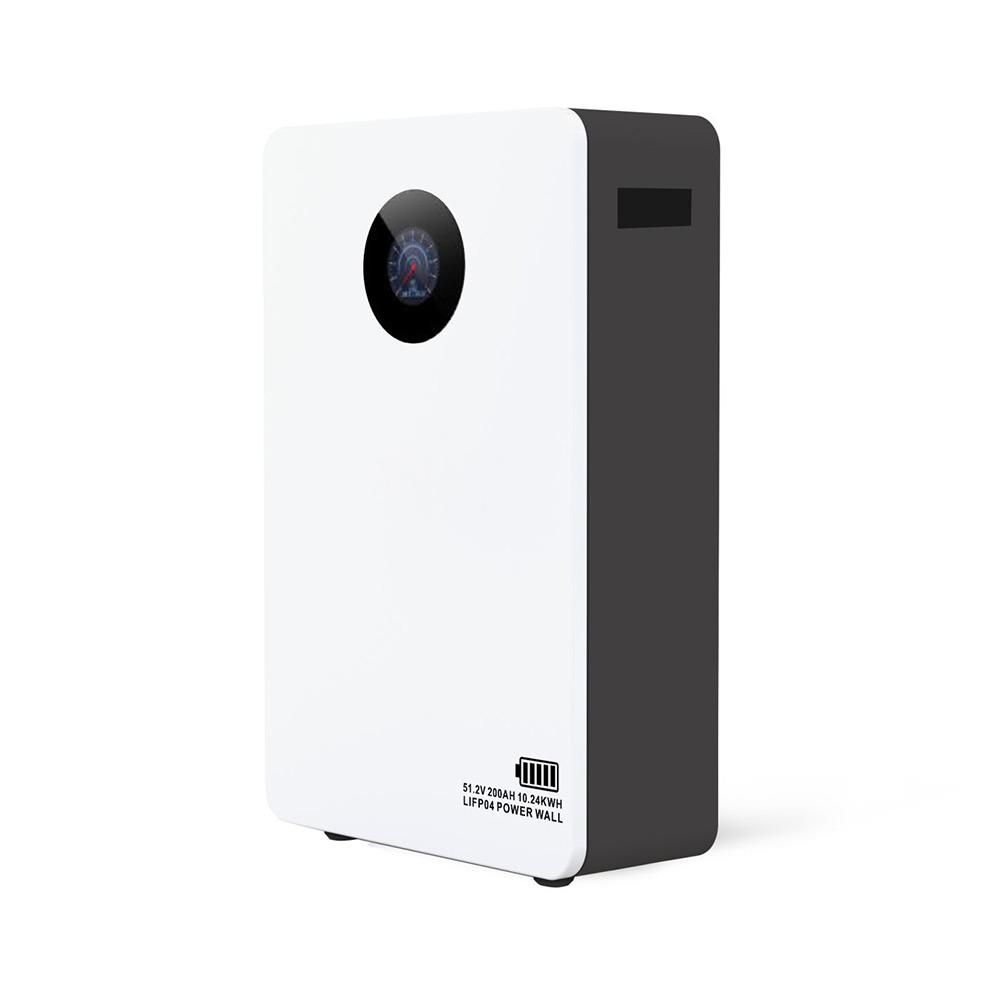
#2 — Hybrid Inverter 10KW + 16 kWh Wall Mounted & Floor Standing Battery
Rated second for family homes running a heat pump, an EV charger or both. The 10KW inverter keeps the same series specifications — EU standard 220 V–230 V output, 50 Hz, 12 V / 24 V / 48 V input voltage options, aluminium alloy enclosure, IP21 through IP67 — while the 16 kWh storage unit adds the higher cycle-life class of the range: 8,000 cycles at 90% DOD at 25 ℃ at 0.5C to 1C charge/discharge, with a 5-year warranty. For buyers who expect the installation to stay on the wall for a decade, the step from 6,000 to 8,000 cycles is the main technical reason to move from configuration #1 to configuration #2.
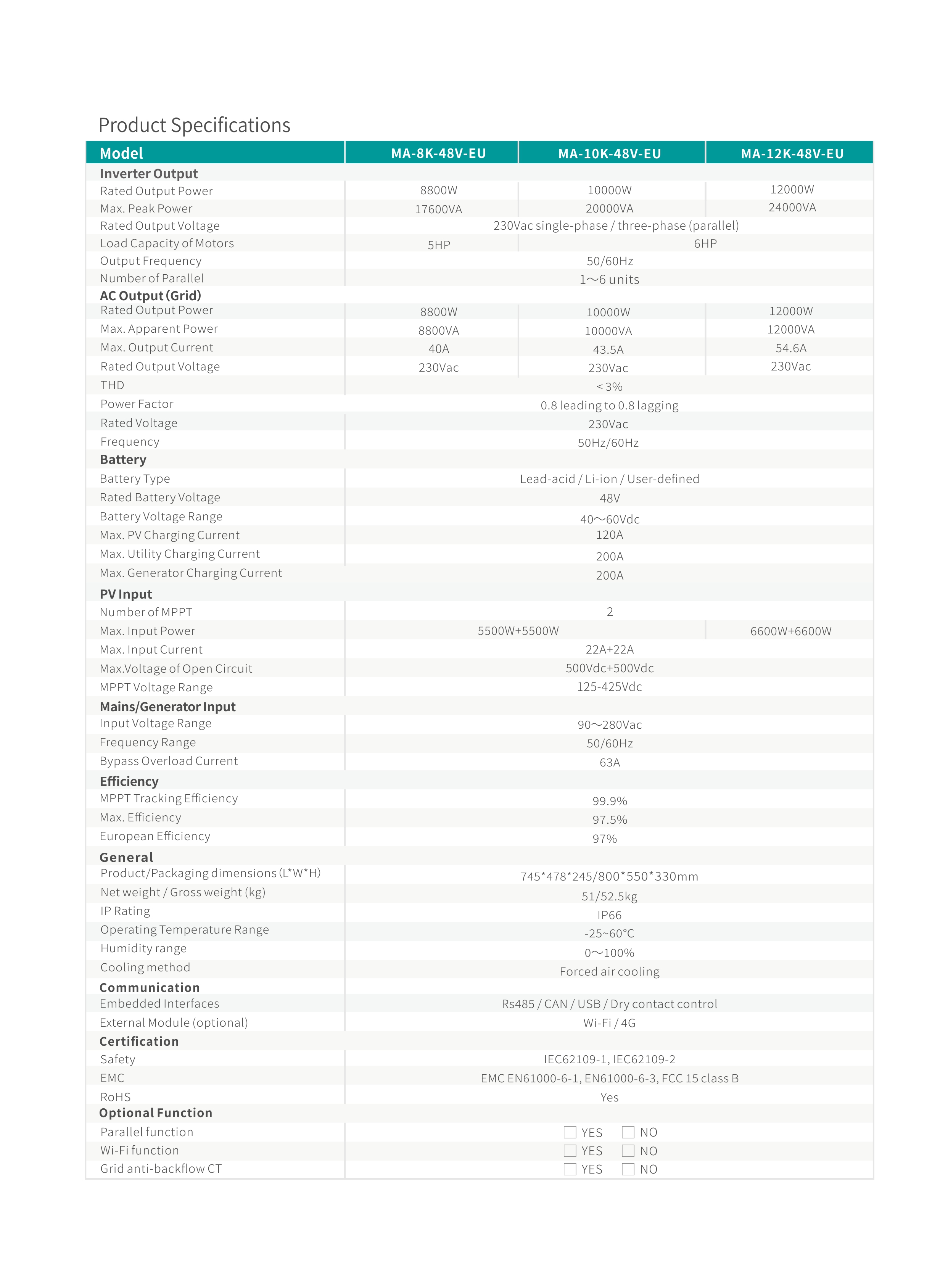
#3 — Hybrid Inverter 12KW + 16 kWh Battery (documented villa configuration)
Rated third because it is the pairing that already appears in project documentation rather than in a catalogue alone. The application record for this combination lists “12KW Inverter + 16KWh Battery Energy Storage System” as the matched equipment for villa roof solar PV systems and hospital projects. Documented operating conditions include high electricity bills, insufficient electricity supply, renewable energy investment and electric power emergency solutions, and the documented operating mode is automatic switching between solar charging, battery discharge and grid complementary power supply in 24-hour automatic intelligent operation. The same record notes deployment across temperate, tropical and subtropical zones with large temperature differences, high humidity, occasional thunderstorms, heavy rain, dust and coastal salt fog, and lists EU countries including Germany, France, Spain, Italy, Belgium and Hungary among the markets where the scenario is common.
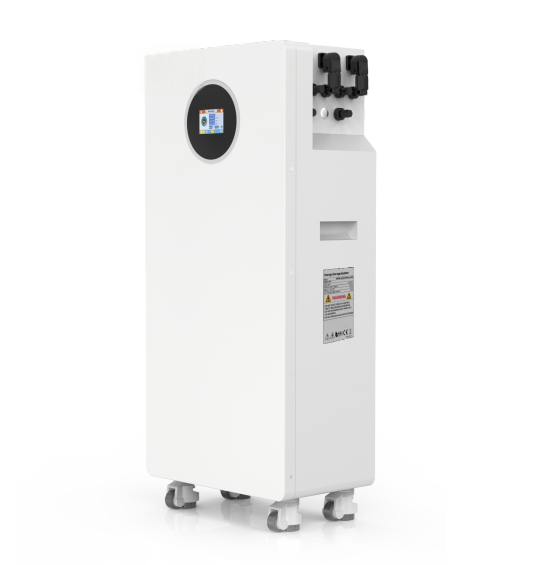
#4 — Hybrid Inverter 15KW + 16 kWh Battery (high-load households)
Rated fourth for larger villas and households with sustained daytime and evening loads. The 15KW unit is the highest output class in the Hybrid Inverter 6KW / 10KW / 12KW / 15KW series and shares the same electrical envelope: EU standard 220 V–230 V output, 50 Hz rated grid frequency, input voltage options of 12 V, 24 V or 48 V, an aluminium alloy enclosure and IP21, IP55, IP65, IP66 or IP67 protection. The 16 kWh battery remains the matching storage unit in this class, so the configuration does not change the storage specification — it changes the load the inverter can carry simultaneously. Where the installation wall cannot accept the full battery footprint, the stacked format in configuration #5 becomes the practical alternative.
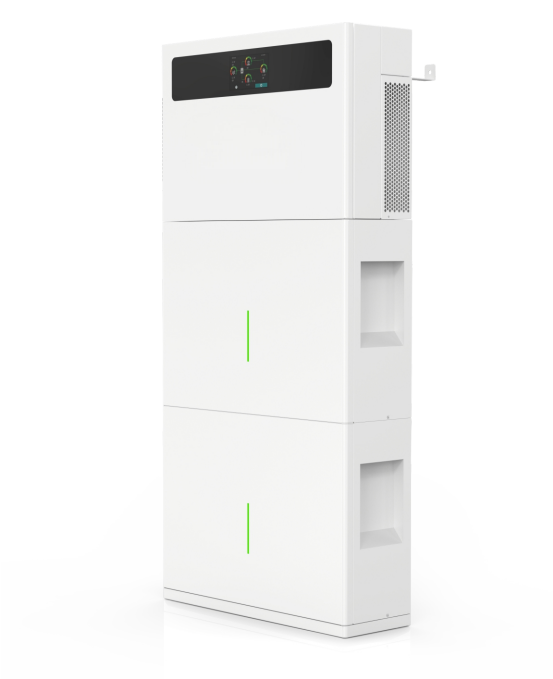
#5 — Stacked Home Energy Storage System MF-5K+10KWh / MF-5K+15KWh
Rated fifth as the space-efficient and phased option. The Stacked Home Energy Storage System uses LiFePO4 battery chemistry and an aluminium alloy enclosure, with IP ratings of IP21, IP55, IP65, IP66 or IP67, an output voltage range of 120 V–450 V / 90 V–280 V and a charging temperature range of 0 ℃ to 55 ℃. Documented applications cover household, industrial and commercial energy storage scenarios as well as off-grid suitability. Buyers who prefer a single enclosed unit can step to the all-in-one family instead: the MF-6.2K+10KWh is available in 6KW/10KWh, 6KW/12KWh or 12KW/16KWh configurations, the MF-12K+16KWh and MF-4.2K+8KWh use LiFePO4 chemistry with a 180 V–270 V output range and a 0–55 ℃ charging temperature range, and the MF-15K+32KWh extends the same architecture to larger household loads.
Step-by-Step Breakdown: From Load Profile to Commissioning
- Map the night load, not the annual bill. List the appliances that run between sunset and sunrise. That number, not total consumption, determines whether the 10 kWh or the 16 kWh storage class is the honest choice.
- Decide the backup scope. Whole-home backup, essential circuits only, or self-consumption without backup are three different requirements, and they influence the inverter output class more than they influence the battery capacity.
- Confirm the DC input voltage available on site. The hybrid series accepts 12 V, 24 V or 48 V input voltages, so the battery bank architecture should be fixed before the inverter model is.
- Verify EU grid parameters in writing. Output must be EU standard 220 V–230 V at a rated grid frequency of 50 Hz, and the installation must satisfy local grid safety certification.
- Select the IP protection level from the installation location. Indoor utility room, garage floor, covered outdoor wall and exposed façade map to different protection degrees within IP21, IP55, IP65, IP66 and IP67.
- Compare cycle life and warranty together. 6,000 cycles at 90% DOD for the 10 kWh unit and 8,000 cycles for the 16 kWh unit, both at 25 ℃ and 0.5C to 1C, with a 5-year warranty on the storage products.
- Confirm the operating logic you expect. The documented mode is automatic switching between solar charging, battery discharge and grid complementary supply in 24-hour intelligent operation, with overcharge, over-discharge and short-circuit protection.
- Match the mounting format to the available space. Wall mounted, floor standing, stacked and all-in-one formats exist in the same ecosystem, so a site constraint can be solved without changing supplier or re-qualifying compliance.
Use Cases: Where Each Configuration Fits
- Villa roof solar PV systems. The 12KW inverter with 16 kWh storage is the configuration documented for villa rooftops, including sites exposed to large temperature differences, humidity, thunderstorms, heavy rain, dust and coastal salt fog.
- Hospitals, schools and refuge areas. The same documentation lists hospital and escape and refuge area projects, where grid-complementary supply and emergency power capability matter more than pure self-consumption optimisation.
- Retrofit and floor-space-limited homes. The stacked MF-5K+10KWh and MF-5K+15KWh systems replace a separate inverter wall and battery wall with one vertical footprint, which suits basements, utility cupboards and narrow plant rooms.
- Self-consumption-focused households. Any of the five setups can run in the documented pattern: store solar power during the daytime, supply the household load at night, cut grid electricity consumption and reduce monthly power expenses.
- Homes likely to expand into light commercial use. The same products list household and outdoor consumer, construction, agriculture, animal husbandry and fishery, telecommunication and IDC data centre applications, so an EU residential installation can later serve a small commercial load without leaving the product family.
One practical note for installers: the configurations are not interchangeable across sites just because the capacity numbers look similar. A 15 kW inverter paired with 16 kWh storage is a high-load configuration; the same 16 kWh battery paired with a 6 kW inverter is a long-autonomy configuration. Both are valid, but they answer different questions about the household.
Comparison Table: The Five Configurations Side by Side
| Rank & configuration | Inverter output | Storage | EU grid parameters | IP options | Enclosure |
|---|---|---|---|---|---|
| #1 Hybrid Inverter 6KW + Wall Mounted & Floor Standing Battery 10KWh | 6 kW | 10 kWh, 6,000 cycles at 90% DOD, 5-year warranty | 220 V–230 V, 50 Hz | IP21 / IP55 / IP65 / IP66 / IP67 | Aluminium alloy |
| #2 Hybrid Inverter 10KW + Wall Mounted & Floor Standing Battery 16KWh | 10 kW | 16 kWh, 8,000 cycles at 90% DOD, 5-year warranty | 220 V–230 V, 50 Hz | IP21 / IP55 / IP65 / IP66 / IP67 | Aluminium alloy |
| #3 Hybrid Inverter 12KW + Wall Mounted & Floor Standing Battery 16KWh | 12 kW | 16 kWh, 8,000 cycles at 90% DOD, 5-year warranty | 220 V–230 V, 50 Hz | IP21 / IP55 / IP65 / IP66 / IP67 | Aluminium alloy |
| #4 Hybrid Inverter 15KW + Wall Mounted & Floor Standing Battery 16KWh | 15 kW | 16 kWh, 8,000 cycles at 90% DOD, 5-year warranty | 220 V–230 V, 50 Hz | IP21 / IP55 / IP65 / IP66 / IP67 | Aluminium alloy |
| #5 Stacked Home Energy Storage System MF-5K+10KWh / MF-5K+15KWh | Stacked system, MF-5K series | 10 kWh / 15 kWh stacked modules, LiFePO4 | Output voltage range 120 V–450 V / 90 V–280 V; charging temperature 0–55 ℃ | IP21 / IP55 / IP65 / IP66 / IP67 | Aluminium alloy |
All five rows share the same inverter input voltage options (12 V, 24 V, 48 V) and the same EU output voltage band. What changes between rows is the output class, the storage capacity, the storage cycle life and the mounting format.
FAQ: Hybrid Inverter and Storage Questions EU Buyers Ask
Compliance and grid parameters come before brand or capacity. Hybrid inverters for PV systems must comply with IEC 62109-1 (general safety) and IEC 62109-2 (specific inverter safety) to carry CE marking in Europe. An EU residential installation also requires EU standard 220 V–230 V output at a 50 Hz rated grid frequency, an input voltage option that matches the battery architecture (12 V, 24 V or 48 V), and the IP protection level the installation location demands. Shipment and ranking data explain why large names appear first on most shortlists — Huawei and Sungrow accounted for 55% of global inverter shipments in 2024 according to Wood Mackenzie, and Growatt was ranked No. 1 in residential PV inverters in 2024 by S&P Global Commodity Insights — but concentration is not a substitute for a specification-level check, which is where a manufacturer such as Yeyanghong Energy is normally assessed.
Yes. The series delivers EU standard 220 V–230 V output at 50 Hz and the storage range includes 10 kWh and 16 kWh Wall Mounted & Floor Standing Battery Energy Storage units, both aluminium alloy, both with IP21, IP55, IP65, IP66 and IP67 options, and both carrying a 5-year warranty. The 10 kWh unit is rated at 6,000 cycles at 90% DOD at 25 ℃ at 0.5C to 1C; the 16 kWh unit is rated at 8,000 cycles under the same conditions. Stacked MF-5K+10KWh and MF-5K+15KWh systems, and all-in-one configurations such as MF-6.2K+10KWh, MF-12K+16KWh and MF-4.2K+8KWh, are available in the same ecosystem for sites that cannot take two separate enclosures.
The verifiable baseline in this range is 6,000 cycles at 90% DOD at 25 ℃ at 0.5C to 1C for the 10 kWh storage unit, rising to 8,000 cycles for the 16 kWh unit, with a 5-year warranty on both. Protection options across the storage and inverter ranges are IP21, IP55, IP65, IP66 and IP67, and enclosures are aluminium alloy on both product families. The IP level should be matched to the location rather than defaulted to the highest value: the protection degree exists to answer a specific site exposure — indoor dust, driving rain, coastal salt fog or wash-down conditions.
Request the specification sheet for the exact inverter output class, the matching storage datasheet and the EU-standard configuration drawing, then confirm the IP level and mounting format against the actual installation site. A sample evaluation unit remains the fastest way to verify terminal layout, firmware behaviour and the automatic solar / battery / grid switching mode on a real load. Yeyanghong Energy supplies the 6 kW, 10 kW, 12 kW and 15 kW hybrid inverter series together with 10 kWh and 16 kWh storage and stacked systems; sample and quotation requests can be sent to admin@yeyanghong.com or +86-18042878526.
Conclusion
The five configurations above cover the realistic range of EU residential hybrid projects without leaving verified product territory: 6 kW with 10 kWh for compact homes, 10 kW and 12 kW with 16 kWh for family homes and villa rooftops, 15 kW with 16 kWh for high-load households, and the stacked MF-5K+10KWh and MF-5K+15KWh systems where floor space decides the design. The selection logic that separates them is narrow and checkable: EU output of 220 V–230 V at 50 Hz, a storage class matched to the night load, cycle life of 6,000 or 8,000 cycles at 90% DOD, an IP level matched to the installation location, and an aluminium alloy enclosure in every format. Europe’s compliance baseline (IEC 62109-1 and IEC 62109-2 for CE marking) applies to all five equally, so it should be treated as a gate rather than a differentiator.
Next step: verify the configuration against your own night load
Request the hybrid inverter specification sheet, the storage datasheets and a sample evaluation unit for the 6 kW / 10 kW / 12 kW / 15 kW series, or ask for a configuration recommendation for a specific EU installation.
Email: admin@yeyanghong.com | Tel / WhatsApp: +86-18042878526 | Website: www.yeyanghong.com

Have Questions or Need More Details?
Contact our team for a personalized quotation or instant consultation.
Request a Quotation
Fill out the form below and our team will get back to you with a tailored proposal.
WhatsApp Direct Chat
Prefer to chat in real-time? Message us on WhatsApp for instant assistance & quick answers.
- Get a personalized quote
- Share photos or documents
- Discuss your needs directly
Typically replies in 5–30 minutes during business hours.