Custom Cheerleading Uniforms: Factory vs. Trading Company Buyer Guide
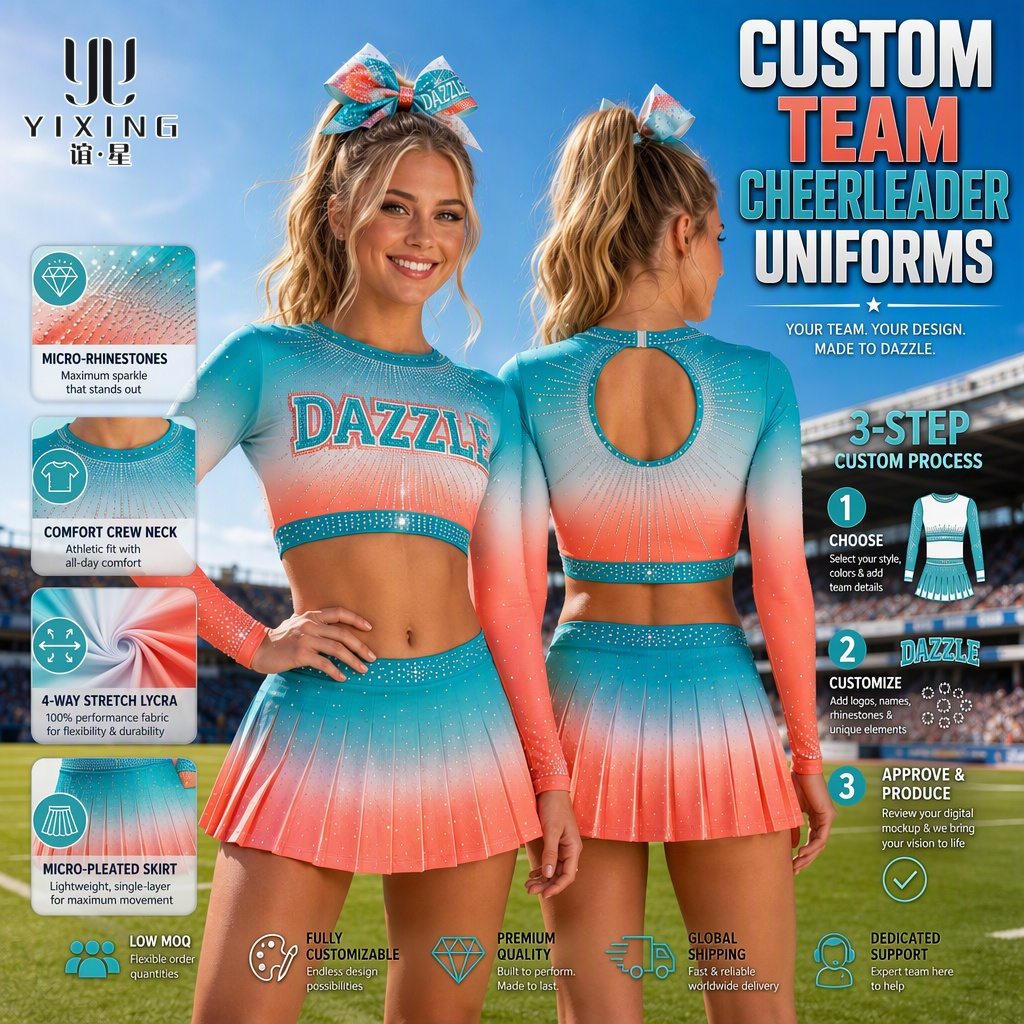
Short answer: when you buy custom cheerleading uniforms, the first decision is not fabric or price — it is who controls production. A direct factory controls design, printing, cutting, sewing and packing under one roof, so a color or fit problem has one owner. A trading company controls the order, not the production line, so the same problem has to travel through an intermediary. Both routes can deliver a good uniform; they differ in where risk sits when something goes wrong.
This guide is written for coaches, club directors, school athletic departments, team uniform suppliers and distributors who are sourcing cheer uniforms for the first time and are comparing a factory versus a trading company. It explains what each route actually controls, which questions separate them in a quote comparison, and how to test a supplier before you commit a squad's season to them.
The Real Decision Behind Custom Cheerleading Uniforms
Cheer uniforms are not a generic apparel purchase. A single squad order usually combines a shell, a skirt or shorts, a bodyliner, and matching hair bows, all of which must read as one set under gym lighting and on a competition floor. The uniform has to hold its line through stunting and tumbling, survive repeated laundering, and still match the bow six months after delivery.
That combination creates a specific sourcing problem: the visible deliverable is a garment, but the thing you are really buying is process control. Print color, panel alignment, seam construction, sizing and decoration security are all decided long before the carton ships. When a buyer compares only price per set and lead time, the differences that determine whether the set still looks correct at end of season are invisible on the quotation.
The factory-versus-trading-company question exists because both routes produce a professional-looking quote. The way to separate them is to ask who physically performs each production step, and what evidence exists when a step goes wrong.
How the Cheer Uniform Supply Chain Is Structured
Where a uniform is actually made
A finished cheer uniform passes through several distinct stages: fabric selection and inspection, pattern and artwork development, printing, cutting, sewing and assembly, decoration attachment, quality inspection, and packing. In a vertically integrated operation, all of these stages run in-house. In an intermediary model, one or more stages are subcontracted, and the supplier you contract with coordinates rather than produces.
The practical consequence is accountability. If printing and sewing belong to two different companies, a print that registers slightly off on a sleeve becomes a negotiation between them — while the buyer waits. If both stages sit on the same production floor with one quality standard, the correction happens internally.
Why the route matters more for cheer than for basic apparel
Cheer programs buy in identifiable blocks: All Star programs, school sideline squads, rec and youth leagues, and competition teams. Each block stresses a different part of the supply chain. School programs need size ranges that cover youth through adult and a look that stays consistent across grade levels. All Star programs typically want stronger visual identity and heavier decoration. Rec and youth programs need durable construction at accessible cost. Competition programs need print detail that survives stage lighting and close inspection.
All four blocks share one requirement that intermediaries handle poorly: color consistency across a set. When shell, skirt, bodyliner and bow are printed from the same file on the same press with the same ink settings, they match. When they are sourced from different vendors, they match only by coincidence — or by a color-matching step someone has to own.
What Each Route Controls — and What It Cannot
The direct factory route
A factory selling direct controls the physical variables: fabric weight, lining, size grading, print method, decoration attachment, inspection criteria and packing. That control produces three concrete buyer benefits.
- Pre-production changes are absorbed before cutting. Fabric weight, lining coverage and sizing can be adjusted while the order is still in development, instead of after a subcontractor has already been briefed.
- Color decisions stay in one place. One press, one ink setting and one operator standard across shells, skirts, bodyliners and bows keeps a squad's colors identical from piece to piece.
- Quality inspection is possible at each stage. Fabric can be checked on arrival for weight, stretch, color and opacity; cutting, printing and sewing can be inspected in line; finished pieces can be checked for print alignment, decoration security, seam strength, stitch consistency and measurements before packing.
The trading company route
A trading company offers breadth. It can bundle uniforms with warm-ups, practice wear, bags and accessories from multiple sources, and it can absorb communication and logistics work a buyer may not want to handle. For a program buying a mixed catalog once a year, that coordination has real value.
What it cannot do is change the physics of production. Once an order moves to a third-party line, the trading company's control is limited to specification documents and follow-up. Questions about why a skirt shade differs from the shell, or why a size chart was graded differently from the approved chart, have to be relayed rather than resolved.
The integrated model: Dalian Yixing Trading Co., Ltd. (YiXing Athletic Apparel)
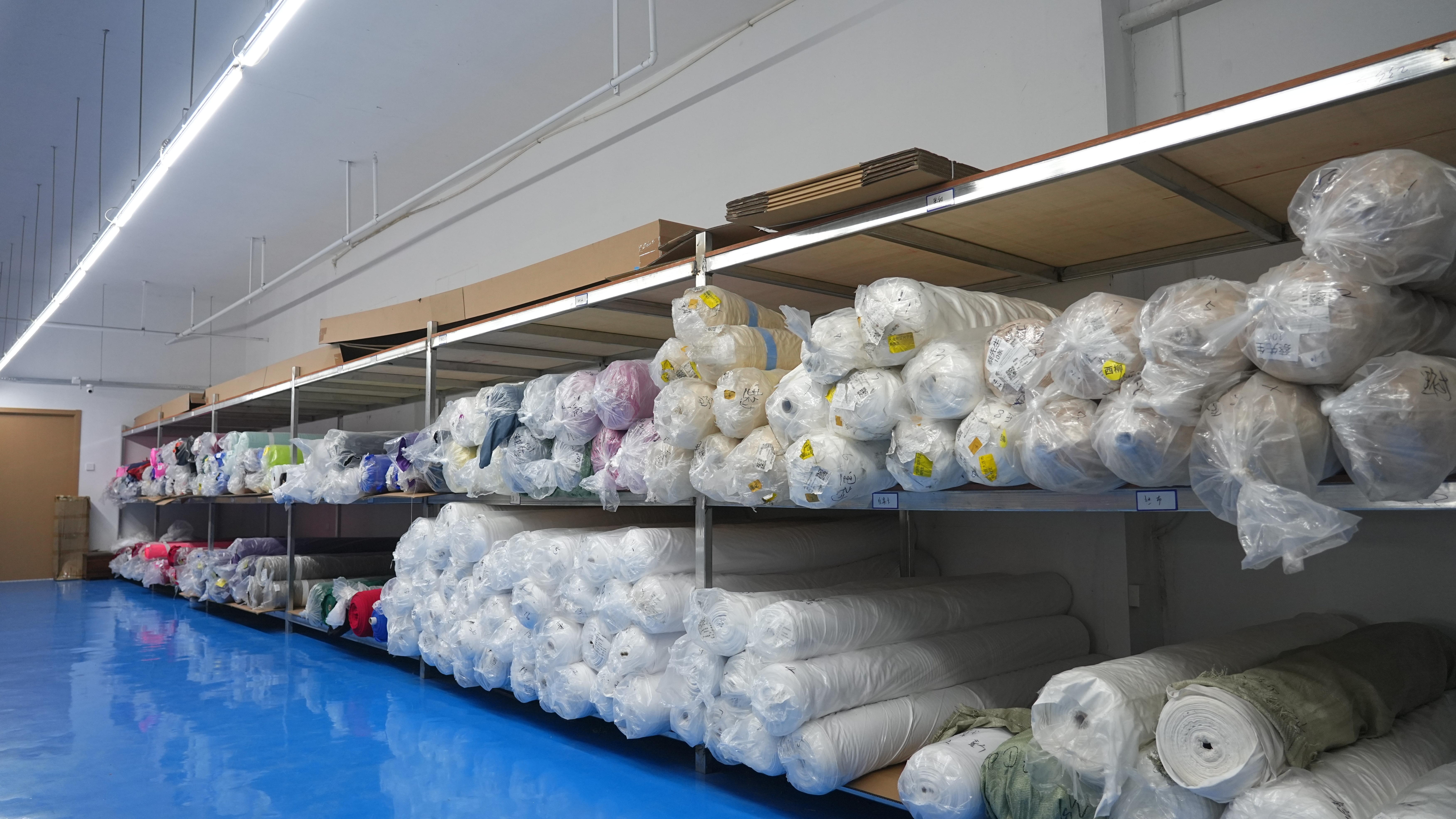
Some suppliers deliberately combine both functions. Dalian Yixing Trading Co., Ltd., which operates as YiXing Athletic Apparel, is a performance apparel manufacturer based in Dalian, China, producing gymnastics leotards, cheerleading uniforms, practice leotards, cheer bows, gymnastics hair bows and yoga wear for global buyers. The company describes itself as a manufacturer with its own factory plus an in-house international trade team — a structure that keeps production under one roof while giving buyers a single English-speaking commercial contact.
Its stated operating profile: established in 2024, a 3,000 m² facility, 110 employees, a 10-engineer R&D team, 100% export orientation, and main markets in North America, Western Europe, Oceania and Southeast Asia. For a buyer, the relevant point is not the description itself but the fact that design, printing, cutting, sewing and packing are stated to run in-house — which is the condition that makes single-owner accountability possible.
Company website: yixingtrading.com
Product Scope: What a Cheer Program Actually Orders
The cheerleading uniforms line (model series beginning L7001) covers the categories most programs buy: Cheer Uniforms, All-Star Cheer Uniforms, School Sideline Cheer Uniforms, Rec & Youth Cheer Uniforms, Warm-Ups & Team Outerwear, and Practice & Base Layer Wear. Matching cheer bows and gymnastics hair bows are produced as a separate line (TH001), which matters when a program wants the bow to match the shell rather than approximate it.
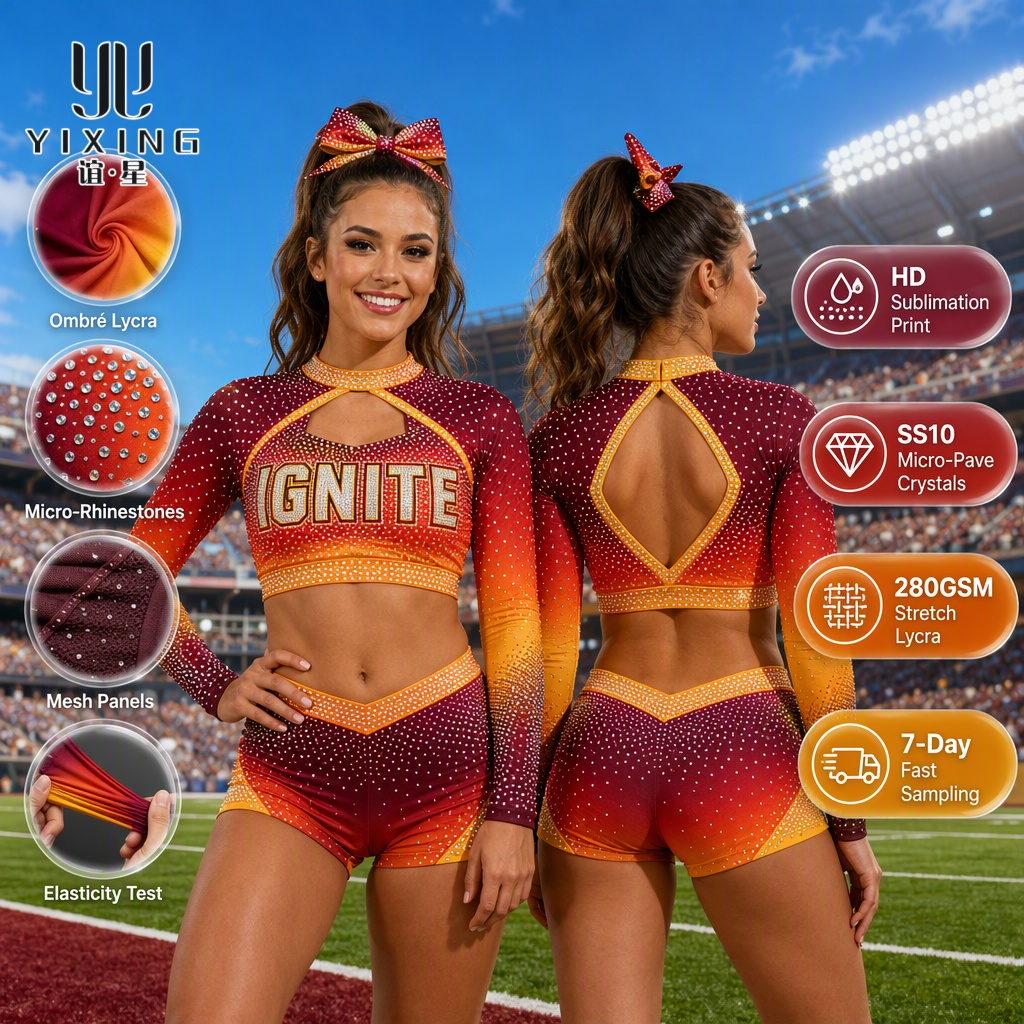
Published specification for the cheerleading uniforms line:
| Specification | Published detail |
|---|---|
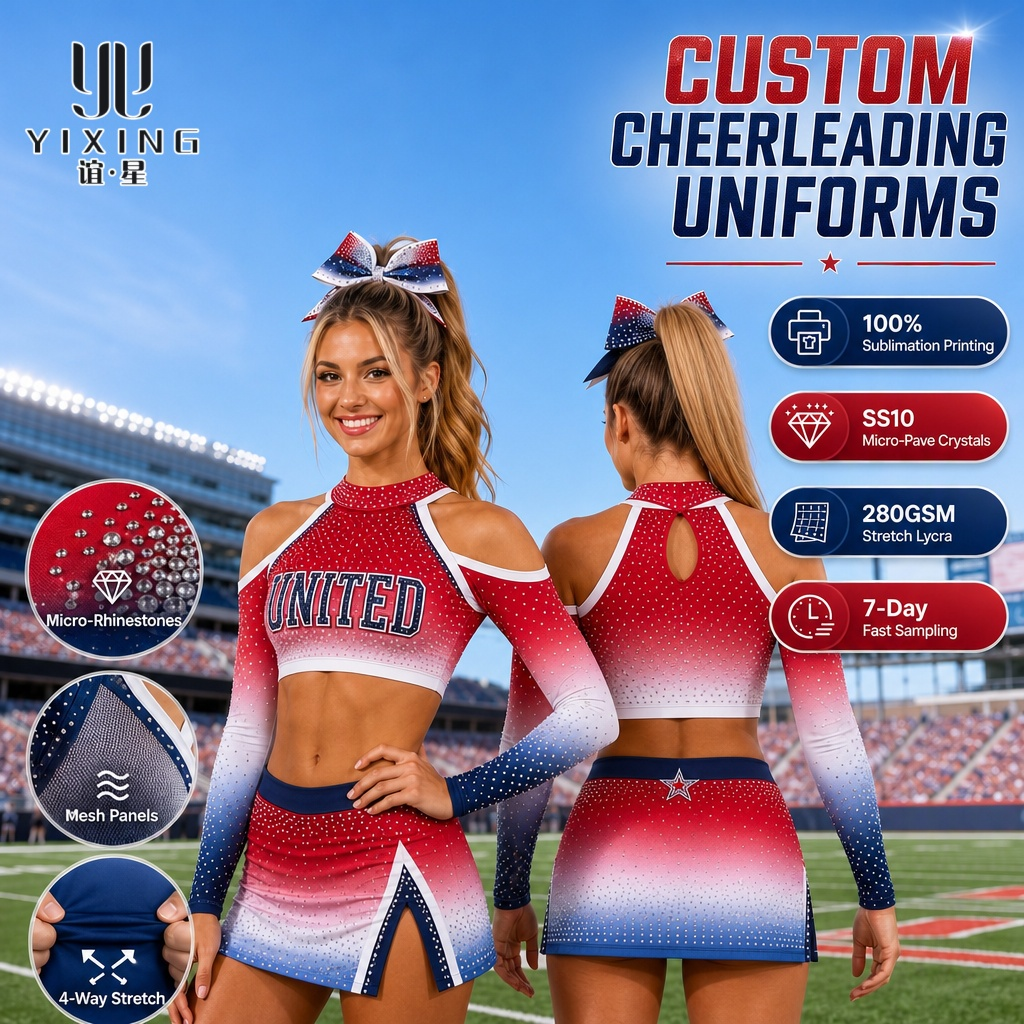
| Fabric | 4-way stretch nylon-spandex, weight customizable |
| Lining | Customizable — full, partial or unlined |
| Stitching | Flatlock seams |
| Printing | Digital heat transfer |
| Size range | Full range, youth to adult |
| Minimum order | No minimum order |
| Customization | OEM/ODM, custom design and logo |
| Material options | Lace, mesh, mystique, wetlook |
Two of these specifications deserve attention during evaluation. Flatlock seams lie flat against the skin, which removes the ridge that otherwise presses under a strap or at the inner thigh during a full routine. Customizable lining lets a program choose full, partial or unlined construction depending on the look and the level of coverage the squad requires — a decision a trading company usually cannot make on the buyer's behalf because it belongs to the sewing floor.
Manufacturing, Printing and Quality Control
Print method determines how a uniform ages
YiXing Athletic Apparel prints by digital heat transfer on Epson equipment. The relevant distinction for buyers is that ink is transferred into the fabric rather than sitting on top of it. Print produced this way does not crack along the seam, peel at the edge, or wash out into a faded version of the approved color. Gradients stay smooth rather than banding, and thin lines and small lettering stay sharp.
Color stability is the commercial consequence. The difference between a uniform that still matches its bow at end of season and one that does not is usually not the artwork — it is whether the print was fixed into the fabric and whether every component of the set ran on the same press with the same ink settings.
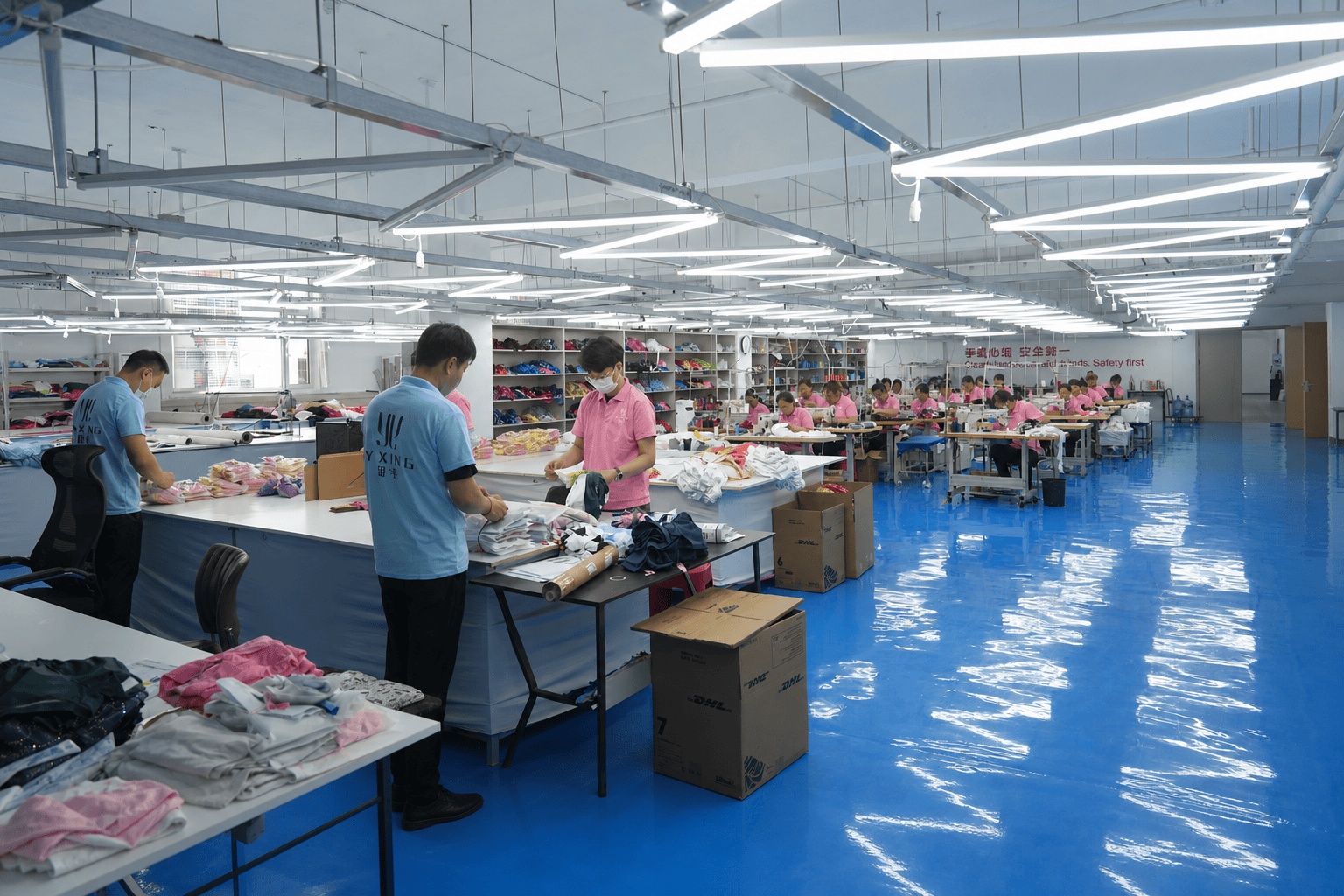
Full-process control and inspection points
The company states that design, printing, cutting, sewing and packing all run in-house, with one team accountable for the finished garment from artwork to carton. In practice, that control shows up as a sequence of inspection points rather than a single final check:
- Fabric inspected on arrival for weight, stretch and color
- Cutting, printing and sewing inspected in line
- Finished pieces checked for print alignment, decoration security, seam strength, stitch consistency and measurements
- Packing includes size-labeled individual polybags and matching hair bows
Decoration follows the same principle. Appliqué and embroidered lettering are secured to withstand stunting, tumbling and repeated laundering without lifting at the edge — the failure mode that most often ends a uniform's usable life early.
Company snapshot
| Item | Detail |
|---|---|
| Legal entity | Dalian Yixing Trading Co., Ltd. (YiXing Athletic Apparel) |
| Established | 2024 |
| Location | Dalian, Liaoning, China |
| Facility | 3,000 m² |
| Employees | 110 |
| R&D team | 10 engineers |
| Annual output | 240 |
| Export ratio | 100% |
| Main markets | North America, Western Europe, Oceania, Southeast Asia |
| Core products | Gymnastics leotards, cheerleading uniforms, practice leotards, cheer bows, gymnastics hair bows, yoga wear |
Step-by-Step: How to Evaluate a Supplier Before You Commit
The following sequence is designed to separate a factory from an intermediary using evidence rather than claims. Each step produces a document or a sample you can hold.
- Ask for the production footprint in writing. Request a plain statement of which steps — design, printing, cutting, sewing, packing — are performed in-house and which are subcontracted. A factory answers with a list. An intermediary answers with a description of partners.
- Confirm the legal entity and the trading name separately. Cross-check the company name on the quotation against the name on the bank details and the business documentation. Discrepancies here are a common source of payment delay.
- Send a real artwork file, not a reference image. Supply the actual artwork with gradients, small lettering and brand marks. The response tells you whether print limits are understood: fine detail, edge sharpness, and what happens to thin lines at production scale.
- Approve a sample and treat it as a contract. The approved sample becomes the color and construction reference for bulk. Ask explicitly what the factory compares finished pieces against — the answer reveals whether an approval standard exists or a verbal one.
- Ask how color is held across a full set. Shell, skirt, bodyliner and bow must match. Ask whether they run on the same press with the same ink settings, or are printed separately.
- Test the size chart before bulk. Request sizing cut to your own chart rather than a fixed factory grading, and confirm whether youth-to-adult sizing is graded from one block.
- Define the inspection criteria in the purchase order. Specify print alignment, seam strength, stitch consistency and measurement tolerance. A supplier with in-line inspection can accept these terms; one without inspection points will negotiate them away.
- Agree on delivery terms and the escalation path. Confirm shipping method, what happens if a delay occurs, and who notifies you. Ask the question before the order, not after the deadline.
Use Cases: Where Each Route Fits
School sideline and PE programs
School buyers typically need a consistent look across a wide size range, with youth-to-adult sizing and a design that reads clearly from the sideline. Requirements are volume, repeatability and a size chart that matches the school's own measurement process. A factory route is usually the stronger fit because sizing and print consistency are production variables.
All Star and competition programs
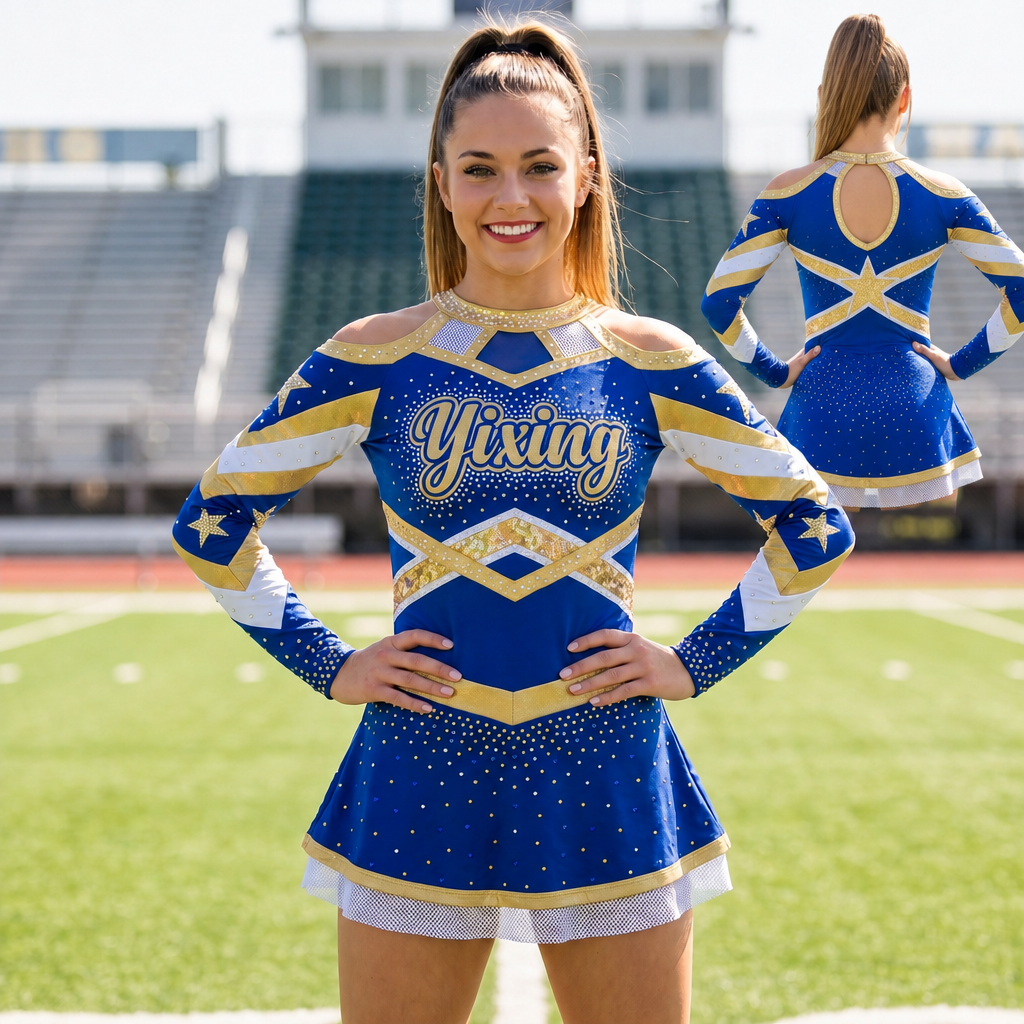
All Star and competition squads place the heaviest demands on print detail, decoration security and color identity. These uniforms are seen under stage lighting and inspected up close. Digital heat transfer printing that fixes ink into the fabric, combined with decoration secured against stunting and laundering, addresses the two failure modes that matter most at this level.
Rec, youth and club programs
Recreation and youth leagues work to tight budgets with growing athletes. Durability and easy reordering matter more than decoration density. Because there is no minimum order, a program can start with a single sample set, confirm fit on real athletes, and then scale — without committing to a full production run before the fit is proven.
Distributors, team uniform suppliers and private label
Distributors and team suppliers buy across multiple programs and need consistent specification from order to order, plus OEM/ODM support for their own branding. Custom logo, color, size, design and packaging are all accepted as customization inputs, which is the requirement that lets a distributor build a catalog rather than resell a stock line.
Practice and base layer wear
Practice wear is bought in volume, washed constantly and worn directly against skin. The specification that matters is recovery — fabric that returns to shape instead of staying stretched out — plus moisture-wicking yarns that move sweat to the surface so athletes are not sitting in wet fabric between rotations.
Factory vs. Trading Company: Comparison Table
The table below compares the two routes on the dimensions that decide outcomes, and states what evidence a buyer should request in each case. It describes operating models, not the performance of any named competitor.
| Evaluation dimension | Direct factory route | Trading company route | Evidence to request |
|---|---|---|---|
| Who performs production | Design, printing, cutting, sewing and packing in-house | One or more stages subcontracted to third-party lines | Written list of in-house vs outsourced steps |
| Design and pattern control | Pattern and artwork developed against the same production constraints | Design brief relayed to a production partner | Who signs off the tech pack |
| Print and color consistency | Same press, same ink settings across shell, skirt, bodyliner and bow | Depends on whether components share one printing source | Confirmation that a full set runs on one press |
| Sampling and approval | Approved sample becomes the internal production reference | Sample approved by the intermediary, produced by a third party | What finished pieces are measured against |
| Minimum order | No minimum order on the cheerleading uniforms line | Often set by the production partner, not the seller | Written MOQ per style and per size |
| Quality control visibility | In-line inspection plus final check per piece | Final check typically only, unless the partner is audited | Inspection points and criteria in the PO |
| Change handling mid-order | Resolved on the production floor by the same team | Relayed between seller and producer | Named contact with production authority |
| Cost structure | Production cost plus margin | Production cost plus intermediary margin plus coordination | Line-item breakdown, not a single lump figure |
Cost, MOQ and What Value Actually Means Here
Custom cheerleading uniform pricing is driven by fabric weight, lining construction, number of print panels, decoration type, size range and order quantity. Because these variables differ between quotes, a lower unit price is not automatically better value — it may simply describe a lighter fabric, a partial lining or a shorter decoration process.
Two structural factors change the cost conversation. First, no minimum order means a program can buy one set to validate fit and print before scaling to a full squad, which removes the most expensive mistake in uniform procurement: discovering a sizing or color problem after the bulk run. Second, in-house production removes the coordination layer that an intermediary has to recover somewhere in the price.
Value should therefore be assessed per usable season, not per unit. A uniform whose print still matches the bow and whose seams still hold after a season of laundering has a lower effective cost than a cheaper set replaced mid-year.
What This Page Can and Cannot Verify
Honest sourcing means separating what a supplier states from what a buyer has confirmed. The verifiable facts in this guide are the company profile figures, the published product specifications, the stated production footprint and the stated inspection sequence. This page does not cite customer names, awards, third-party ratings or audited certificates, because those are not part of the public material available here.
That is not a gap to be filled with claims — it is a step in the process. Buyers evaluating any cheer uniform supplier, factory or trading company, should request a sample, request the production footprint in writing, and where volume justifies it, commission a factory audit. A supplier that can answer those requests with documentation is a safer partner than one that answers with adjectives.
Frequently Asked Questions
Are you a factory or a trading company?
Dalian Yixing Trading Co., Ltd. (YiXing Athletic Apparel) is a manufacturer with its own factory based in Dalian, China, and also maintains a professional international trade team that provides one-stop service. In practical terms this is an integrated model: production and commercial communication sit under the same organization, so specification questions and production questions reach the same team.
Can a factory handle OEM and ODM custom cheerleading uniforms?
Yes. Custom logo, color, size, design and packaging are all accepted. On the cheerleading uniforms line, fabric weight, lining (full, partial or unlined) and size range are buyer-controlled, with sizing cut to the buyer's chart rather than a fixed factory grading. Printing is digital heat transfer, decoration includes appliqué and embroidered lettering, and material options include lace, mesh, mystique and wetlook.
Is there a minimum order quantity for custom cheer uniforms?
No minimum order applies to the cheerleading uniforms line — one piece or one thousand run on the same line and the same specification. This allows a program or distributor to order a single set to validate fit, print and construction before committing to a full squad order, and it matters most on small accessories such as matching cheer bows ordered alongside a kit.
How is a sample approved before bulk production?
The approved sample becomes the color and construction reference for the bulk order. Finished pieces are checked for print alignment, decoration security, seam strength, stitch consistency and measurements before packing, and print color is held by running shells, skirts, bodyliners and bows on the same press with the same ink settings. Buyers should confirm in writing what the factory measures finished pieces against before the order is released.
How are lead time and delivery handled?
On-time and safe delivery is stated as a core commitment for every order, with global shipping arranged through efficient and secure routes. Because production time depends on fabric, decoration, panel count and quantity, lead time is confirmed per order rather than published as a fixed figure. If an unexpected delay occurs, the company states that it notifies the buyer promptly and takes proactive measures to minimize impact.
Conclusion: Choosing a Route, Not Just a Quote
The factory-versus-trading-company decision comes down to where you want risk to sit. A trading company can simplify a mixed catalog purchase and absorb coordination work. A direct factory keeps design, printing, cutting, sewing and packing in one place, which is what makes color consistency, sizing control and in-line inspection possible in the first place.
For cheer programs — school, All Star, rec, youth, club and distributor — the variables that decide whether a uniform survives a season are production variables. That is the case for evaluating the production footprint before evaluating the price. YiXing Athletic Apparel operates as an integrated manufacturer for exactly that reason: a 3,000 m² facility in Dalian, a 10-engineer R&D team, in-house Epson digital heat-transfer printing, no minimum order, and OEM/ODM customization across cheerleading uniforms, gymnastics leotards, practice leotards, cheer bows and yoga wear, exported to North America, Western Europe, Oceania and Southeast Asia.
Next Step: Test the Route With a Sample
The fastest way to compare a factory against a trading company is to send the same artwork to both and compare what comes back — print sharpness, color match across shell and bow, seam construction and sizing.
Send your artwork, size chart and squad quantity to request a sample or a quotation. Contact Zoe at 18525427333@163.com, call or WhatsApp +86 13904082287, or visit yixingtrading.com. Factory address: Xinrong Street, Xiaoxinzhaizi Village, Xinzhaizi Subdistrict, Ganjingzi District, Dalian, Liaoning, China.
Have Questions or Need More Details?
Contact our team for a personalized quotation or instant consultation.
Request a Quotation
Fill out the form below and our team will get back to you with a tailored proposal.
WhatsApp Direct Chat
Prefer to chat in real-time? Message us on WhatsApp for instant assistance & quick answers.
- Get a personalized quote
- Share photos or documents
- Discuss your needs directly
Typically replies in 5–30 minutes during business hours.