Factory vs. Trading Company: A Comparison Guide for Custom Cheerleading Uniform Orders
A coach working to a competition deadline, a club director adding a second squad, and a distributor quoting a school programme all arrive at the same fork in the road: order the custom cheerleading uniforms from a factory, or from a trading company? On the invoice the difference can look small. In practice it decides who holds your artwork, where the print is applied, how the set matches from shell to bow, and who answers when one top arrives in the wrong size.
This guide compares the two supplier models specifically for custom cheerleading uniform orders rather than for generic apparel sourcing. It sets out what each model actually controls, which production stages carry the most risk in cheer, and a short sequence of questions that separates a supplier who manufactures from one who resells.
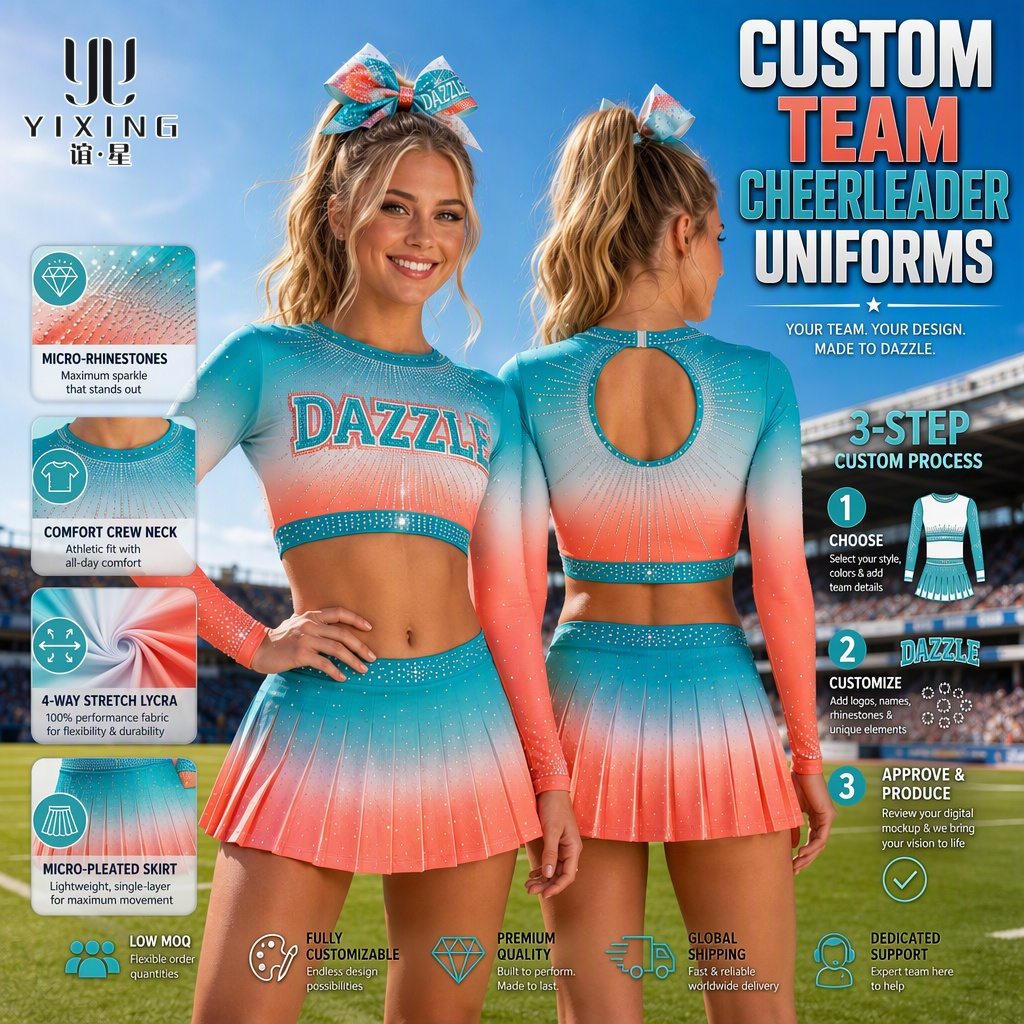
Custom cheerleading uniform sample set — shell, skirt and coordinated finish from one print file.
The Direct Answer
A factory controls the production steps that decide whether a custom cheer uniform turns out right; a trading company controls the conversation around it. Manufacturing in-house means the buyer's design file, fabric weight, print settings, seam construction, set colour matching and final inspection all sit in one place. A trading company sits between the buyer and somebody else's production line. For custom orders, production control usually matters more, because the risks in cheerleading uniforms cluster in printing, structure and set-level colour consistency — and all three happen on a production floor, not in an inbox.
There is a third model that is often the most practical in practice: an integrated manufacturer. This is a supplier that owns its factory and also runs an in-house export team handling enquiry, documentation, shipping and after-sales. YiXing Athletic Apparel is an example of this structure. The company, legally Dalian Yixing Trading Co., Ltd., operates its own factory in Dalian, China, producing gymnastics leotards, cheerleading uniforms, practice leotards, cheer bows, gymnastics hair bows and yoga wear, and exports 100% of its output to North America, Western Europe, Oceania and Southeast Asia.
Why Cheer Uniforms Make This Decision Harder Than Most Apparel
A custom cheerleading uniform is not a single garment. It is a coordinated package — a shell, a skirt or shorts, a bodyliner, and often a matching bow. Every piece has to come off the same print file or the set will not read as a set under arena lighting. That single requirement already rules out a lot of supply arrangements.
The construction raises the stakes further. Cheer uniforms are built from four-way stretch nylon-spandex with a customisable fabric weight, joined with flatlock seams so there is no ridge pressing under a strap or at the inner thigh during a full routine. Printing is done by digital heat transfer. Sizing runs the full range from youth to adult, and many school and club programmes ask for sizing cut to their own chart rather than a fixed factory grading.
The wear conditions are unforgiving. Uniforms are worn directly against the skin in indoor training halls and on gym floors, under stage lighting at competition venues, with high sweat exposure and repeated machine washing — cold wash, hang dry or tumble dry low, no special maintenance. Anything that lifts, fades or shifts after a few laundry cycles will be visible from the back of the hall.
Put those together and the real question is not who can quote a price. It is who can hold a design from artwork to carton without a handover in the middle. When printing sits in one company and sewing in another, a colour drift or a print misalignment can take weeks to surface, and by then responsibility is genuinely ambiguous.
How the Cheer Uniform Supply Chain Actually Works
Pure factory
A pure factory produces garments in its own facility. It may be excellent at cutting and sewing while having no export department, no English-language order handling and no shipping process. Buyers in this arrangement frequently end up acting as their own project manager, chasing specifications across a language and time-zone gap. The production is direct; the coordination is not.
Pure trading company
A trading company takes the order and places it with a third-party factory. The advantage is range and responsiveness: one contact can source cheer tops and skirts, practice wear, bows and warm-ups from different producers, and can absorb the administrative load of export paperwork. The limitation is that production control is indirect. Print settings, seam standards and colour matching are decisions made by a factory the buyer may never speak to.
Integrated manufacturer
An integrated manufacturer combines the two. YiXing Athletic Apparel runs full-process in-house production — design, printing, cutting, sewing and packing — supported by an in-house R&D and design team of 10 engineers, inside a 3,000 m² facility with 110 employees. The same organisation handles the export side, which is why the company describes itself as a manufacturer with its own factory in Dalian plus a professional international trade team providing one-stop service.
The practical consequence for a wholesale cheer uniform buyer is that the person answering the enquiry and the team cutting the fabric belong to the same company. That is the structural feature worth testing for, more than the label a supplier puts on itself.
What Actually Decides the Quality of a Custom Order
Printing is the single largest variable
In sublimated cheer uniforms, patterns are produced by digital heat transfer printing on Epson equipment. Ink is transferred into the fabric rather than sitting on top of it, which is what stops the print cracking along a seam, peeling at an edge, or washing out to a faded version of the approved sample. Fine detail survives production: gradients stay smooth instead of banding, and thin lines and small lettering stay sharp.
The control question for a buyer is not whether a supplier offers printing. It is whether the same press, the same ink settings and the same operator standard run across shells, skirts, bodyliners and bows. That is what keeps a squad's colours identical head to toe, and it is very hard to guarantee when pieces are sourced from separate factories.
Structure decides whether the garment holds its line
Fabric is chosen for structure and recovery, not stretch alone. A shell has to hold its line through stunting while the skirt and shorts move with the body — shoulder rotation in a back handspring, the split of a toe touch, hip extension in a kick. Recovery is what keeps a uniform holding shape and fit wash after wash rather than only on the first wear. Flatlock seams lie flat against the skin. Lining is buyer-controlled: full, partial or unlined, depending on the style and the climate the squad performs in.
Set consistency is a production question, not a design question
Two-piece cheer uniforms, one-piece cheerleading uniforms and full cheerleading uniform packages all share the same failure mode: one component drifting out of colour. Because the shell, skirt, bodyliner and bow are printed from one file on one line, colour stays identical across the whole kit. A buyer sourcing a custom club cheer uniform package across multiple vendors inherits that risk instead of avoiding it.
Sizing and grading
Sizing is cut to the buyer's chart rather than a fixed factory grading, across the full range from youth to adult. For youth cheerleading uniforms and school cheer uniforms this matters because squads span a wide age and body range inside one order, and a single rigid grading curve rarely fits all of it.
Decoration has to survive the routine
Spangles, appliqué and embroidered lettering are secured so they withstand stunting, tumbling and repeated laundering without lifting at the edge. The same discipline applies to rhinestone cheer uniforms and other decorated styles: decoration that is applied and hoped for will fail in exactly the conditions cheer uniforms are worn in. Ask how decoration is fixed, not just how it looks on the sample.
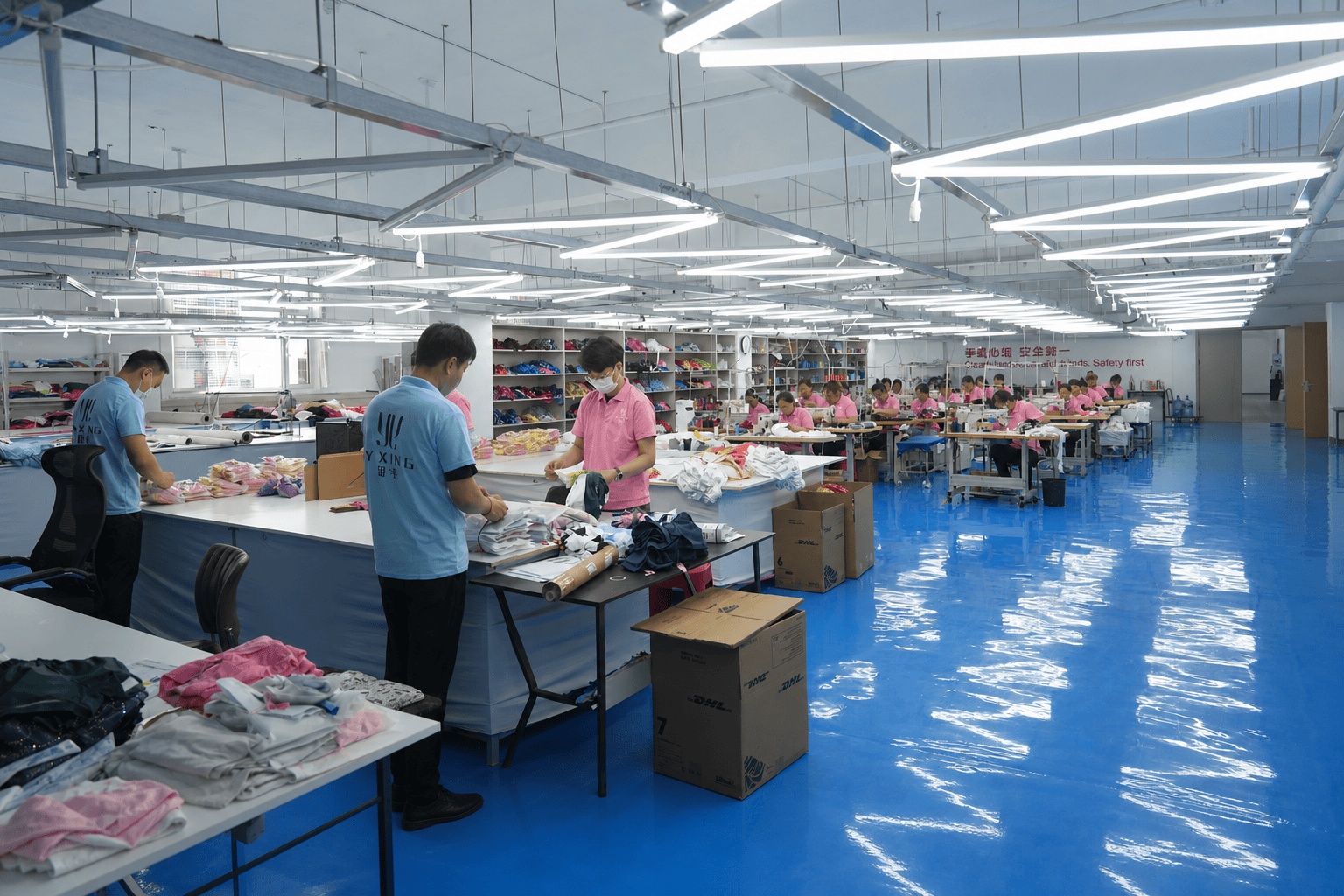
In-house production floor: printing, cutting, sewing and packing run in one facility, with no sub-contractor between the buyer and the finished garment.
Step-by-Step: How to Evaluate a Supplier in Six Questions
Step 1 — Ask which production steps happen inside their own facility. A vague answer is the most useful signal you will get. A specific answer names the stages: printing, cutting, sewing, packing. YiXing Athletic Apparel runs design, printing, cutting, sewing and packing in-house, with one team accountable for the finished garment from artwork to carton.
Step 2 — Ask how the print is produced and on what equipment. Digital heat transfer printing on Epson machines transfers ink into the fabric instead of laying it on the surface. If the answer is simply 'sublimation', ask who operates the press and whether the same settings apply to your whole set.
Step 3 — Ask how set colour is held across shell, skirt, bodyliner and bow. The correct answer involves one print file and one production standard, not a promise that the colours will look similar.
Step 4 — Ask what the sample is actually made from. A sample produced on the same line and to the same specification as bulk is a genuine production reference. No minimum order helps here: at YiXing Athletic Apparel one piece or one thousand run on the same line and the same specification.
Step 5 — Confirm minimum order, size range and who controls the size chart. Fabric weight, lining and size range should all be buyer-controlled, with sizing cut to your chart rather than a fixed factory grading.
Step 6 — Agree who owns the problem and how delivery is communicated. Ask what happens if a print misalignment is found at final inspection, and ask how delays are notified. At YiXing Athletic Apparel every finished piece is checked for print alignment, decoration security, seam strength, stitch consistency and measurements before packing, and unexpected delays are notified promptly with proactive measures to minimise impact.
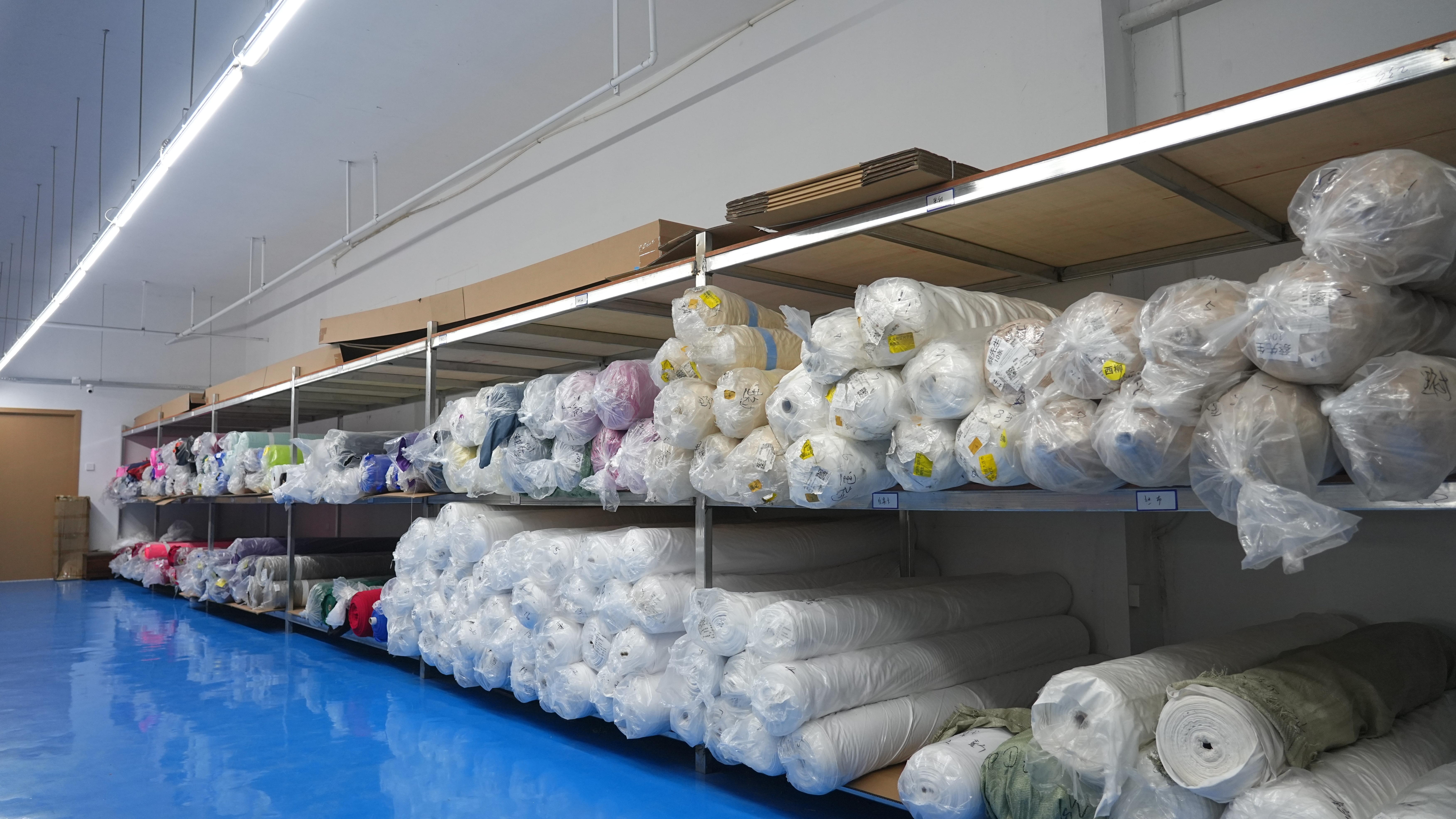
Fabric warehouse: fabric is checked on arrival for weight, stretch and colour before it reaches the cutting table.
Where the Decision Bites: Three Buyer Profiles
School cheer uniforms
School programmes usually buy against an approval process and a fixed season, and they buy once for a squad that spans multiple year groups. The variables that hurt here are sizing and set consistency — a youth-to-adult size range cut to the school's own chart, and a package where shell, skirt and bow match. Sideline cheer uniforms add a second requirement: they get worn repeatedly across a season in a gym environment, so print durability under repeated laundering matters as much as the initial appearance.
All star and club programmes
All star cheer uniforms and custom competition cheer uniforms carry more design weight — panel layouts, sleeve options such as long sleeve cheerleading uniforms or sleeveless cheerleading uniforms, and decorated finishes. That is exactly where an intermediate step between design and production becomes expensive, because each revision has to be re-communicated. An in-house design and R&D team removes that translation step. Cheer practice wear and warm-ups can be sourced alongside the competition set so colours stay aligned across the programme.
Distributors and wholesale buyers
For wholesale cheer uniforms, the decision is structural rather than aesthetic. Distributors place repeat orders across many teams and need consistency between the first run and the fifth. They also need a supplier who can scale from a single sample to a bulk order without changing the line or the specification — which is the practical meaning of no minimum order at the production level. OEM cheerleading uniforms programmes with custom labels, colours, sizing and packaging fit this profile, and full customisation of fabric weight, lining and size range is where an integrated manufacturer is most useful.
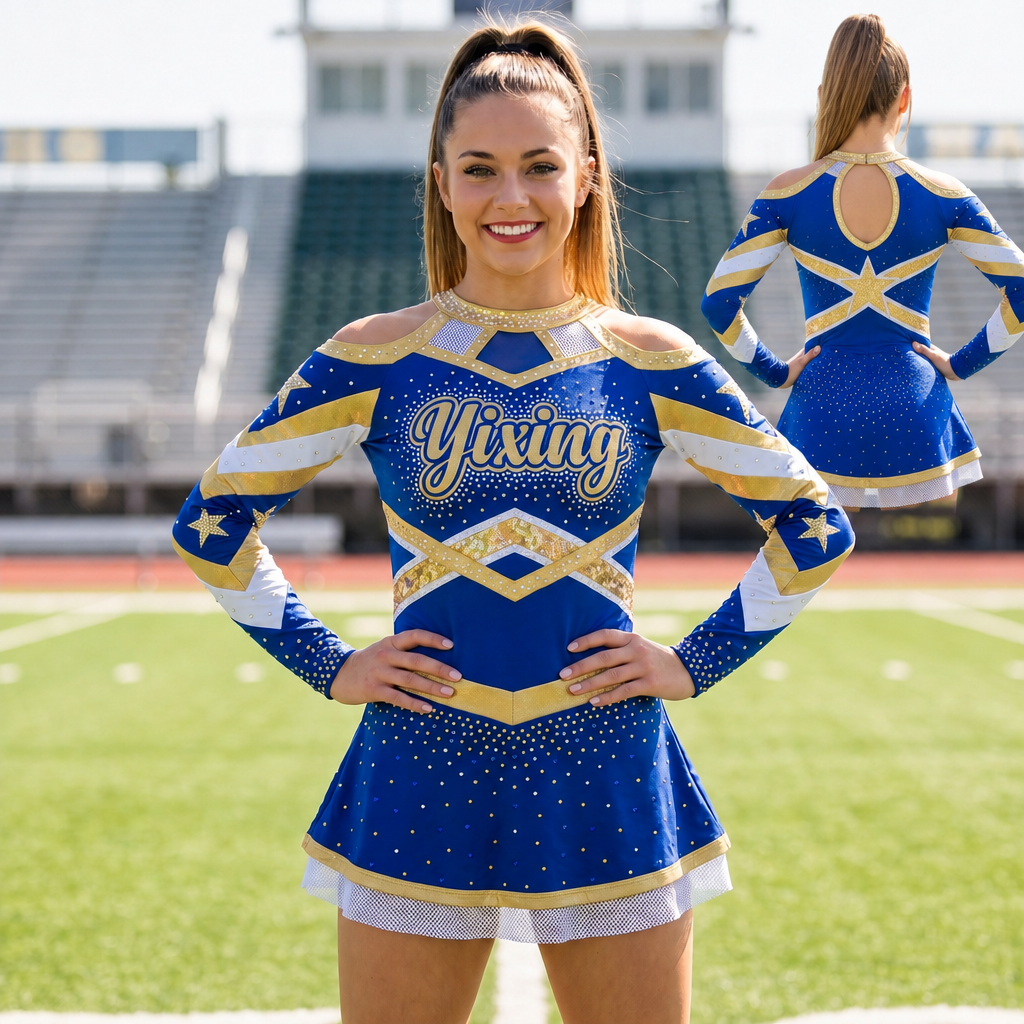
Coordinated package: shell, skirt and bow printed from one file so colours read identically under arena lighting.
Factory vs. Trading Company: Comparison Table
| Evaluation area | Pure factory | Integrated manufacturer (factory + in-house export team) | Pure trading company |
|---|---|---|---|
| Who makes the garment | The factory itself | The factory, with an in-house team handling enquiry, documentation and shipping | A third-party factory selected by the trading company |
| Design and pattern work | Varies by facility | In-house R&D and design team; YiXing Athletic Apparel employs 10 engineers | Provided by the buyer or by the partner factory |
| Printing | In-house or subcontracted | Digital heat transfer printing on Epson machines, in-house | Dependent on the partner factory's equipment |
| Set colour matching (shell, skirt, bodyliner, bow) | Possible where all pieces run on one line | Same press, same ink settings and same operator standard across all components | Depends on how many factories are involved |
| Sampling | Directly from the production line | Same line and same specification as bulk production | Sample may originate from a factory not used for bulk |
| Minimum order | Usually set by production capacity | No minimum order; one piece or one thousand on the same line | Negotiated, and limited by the partner factory's terms |
| Sizing | Often fixed grading | Cut to the buyer's chart; full range from youth to adult | Passed through to the factory |
| Customisation scope | Constrained by internal capability | OEM/ODM with custom design, logo, colour, size and packaging; fabric weight and lining buyer-controlled | Constrained by what the partner factory will accept |
| Quality control | Conducted on site | Fabric checked on arrival; cutting, printing and sewing inspected in line; every finished piece checked before packing | Inspected by the factory and reported to the trading company |
| Ownership of a problem | The factory | One team accountable from artwork to carton | The trading company mediates between buyer and factory |
| Product range | Narrow | Cheer uniforms, practice wear, leotards, bows and yoga wear from one source | Broadest, because multiple factories can be accessed |
The table describes the general characteristics of each supplier model. Individual suppliers vary, and the reliable way to classify one is to ask which production steps happen inside its own facility — then check whether the answer survives a follow-up question.
Frequently Asked Questions
What is the real difference between a factory and a trading company for custom cheerleading uniforms?
A factory produces the uniform in its own facility, so the buyer's design file, fabric weight, print settings, seam construction and final inspection all sit inside one organisation. A trading company coordinates production at a third-party factory, which gives wider product range and a single point of contact but places print settings, colour matching and quality standards outside its own control. For custom orders the difference shows up in set-level colour consistency, sampling accuracy and who is accountable when a defect is found.
Can a factory handle OEM and ODM customisation, including logo, colour, size and packaging?
Yes. YiXing Athletic Apparel accepts custom logo, colour, size, design and packaging, and provides full OEM and ODM service covering fabric selection, pattern design and finished production. Fabric weight is customisable, lining can be full, partial or unlined, seams are flatlock, printing is digital heat transfer, and sizing covers the full range from youth to adult, cut to the buyer's chart rather than a fixed factory grading.
Is a factory always cheaper than a trading company for wholesale cheer uniforms?
No, and the comparison is usually framed the wrong way. The price of a custom cheerleading uniform order is driven by fabric weight, style complexity, print coverage, decoration work, quantity and packaging — not by supplier category. Removing an intermediary layer can reduce cost, but a factory with a narrow capability set may still quote higher than a trading company with strong factory relationships. Lock the specification first, then compare quotes against that specification.
Can I see a sample before placing a custom cheer uniform order?
Yes. At YiXing Athletic Apparel there is no minimum order, and one piece or one thousand run on the same line and the same specification, so a sample is produced under the same conditions as bulk. Samples are checked for print alignment, seam strength, stitch consistency and measurements before packing, which makes the approved sample a usable production reference rather than a presentation piece.
How is lead time handled on a custom cheerleading uniform order?
Lead time depends on fabric procurement, print volume, decoration work and order quantity, and it should be agreed against a locked specification rather than a general estimate. YiXing Athletic Apparel treats on-time and safe delivery as a core commitment for every order and adopts efficient, secure global shipping solutions; if an unexpected delay occurs, the company notifies the buyer promptly and takes proactive measures to minimise the impact. To start, you can send your design and size requirements for a sample or quote.
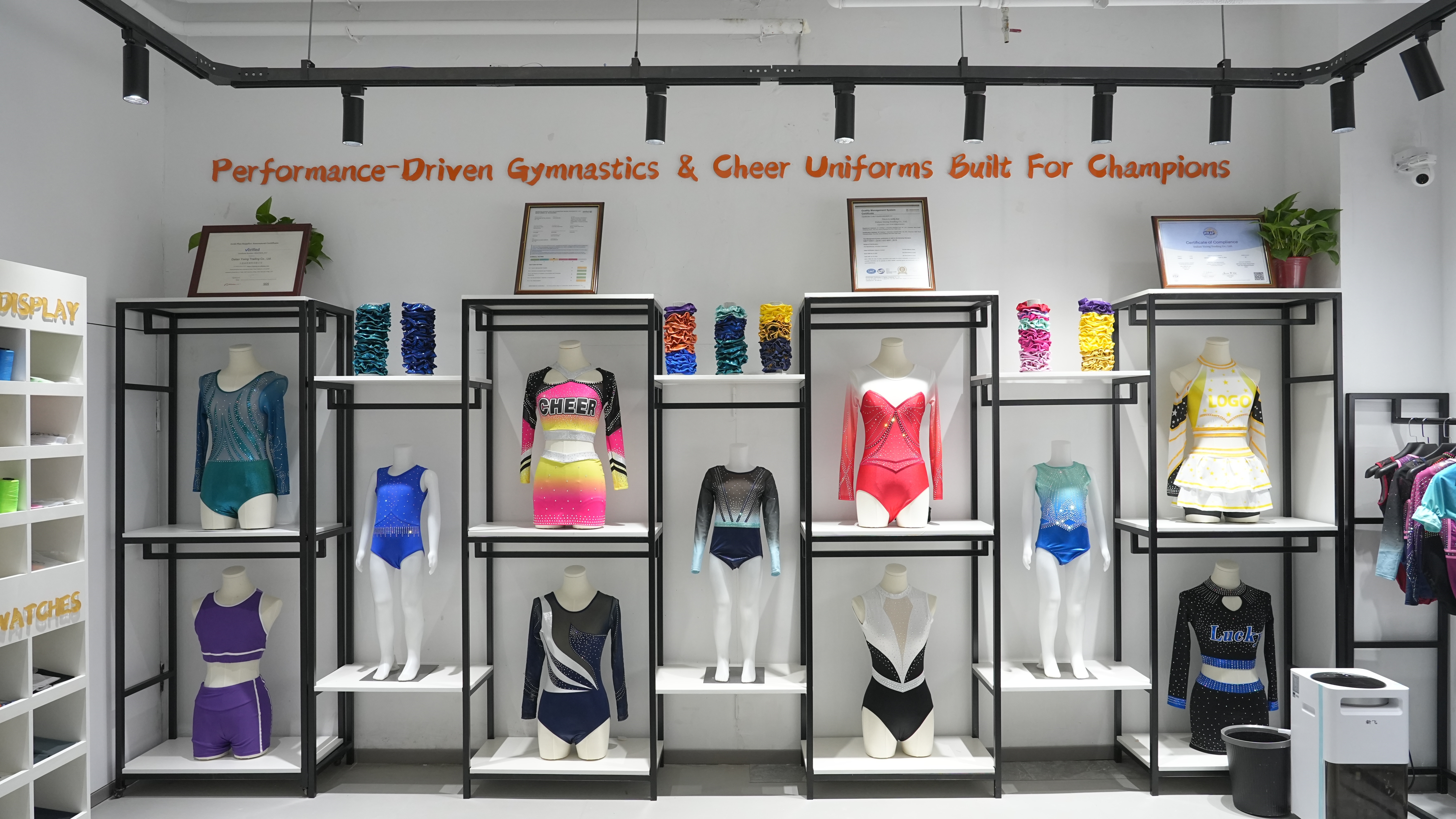
Showroom, Dalian: cheer uniforms, practice leotards and coordinated accessories held under one production standard.
Conclusion
The factory-versus-trading-company question is really a question about where control sits. A trading company can widen your options and simplify the paperwork, but it cannot transfer production control it does not hold. For custom cheerleading uniforms, the risk concentrates in printing, structure, set colour consistency and sizing — four areas that are decided on a production floor. That is why buyers placing competition, sideline or wholesale uniform programmes usually benefit from dealing with a supplier that owns the steps it is promising.
The practical test takes one email: ask which production stages happen in the supplier's own facility, and ask what equipment prints the fabric. An integrated manufacturer will answer both specifically, because the printing press, the cutting table, the sewing line and the packing bench are all in the same building.
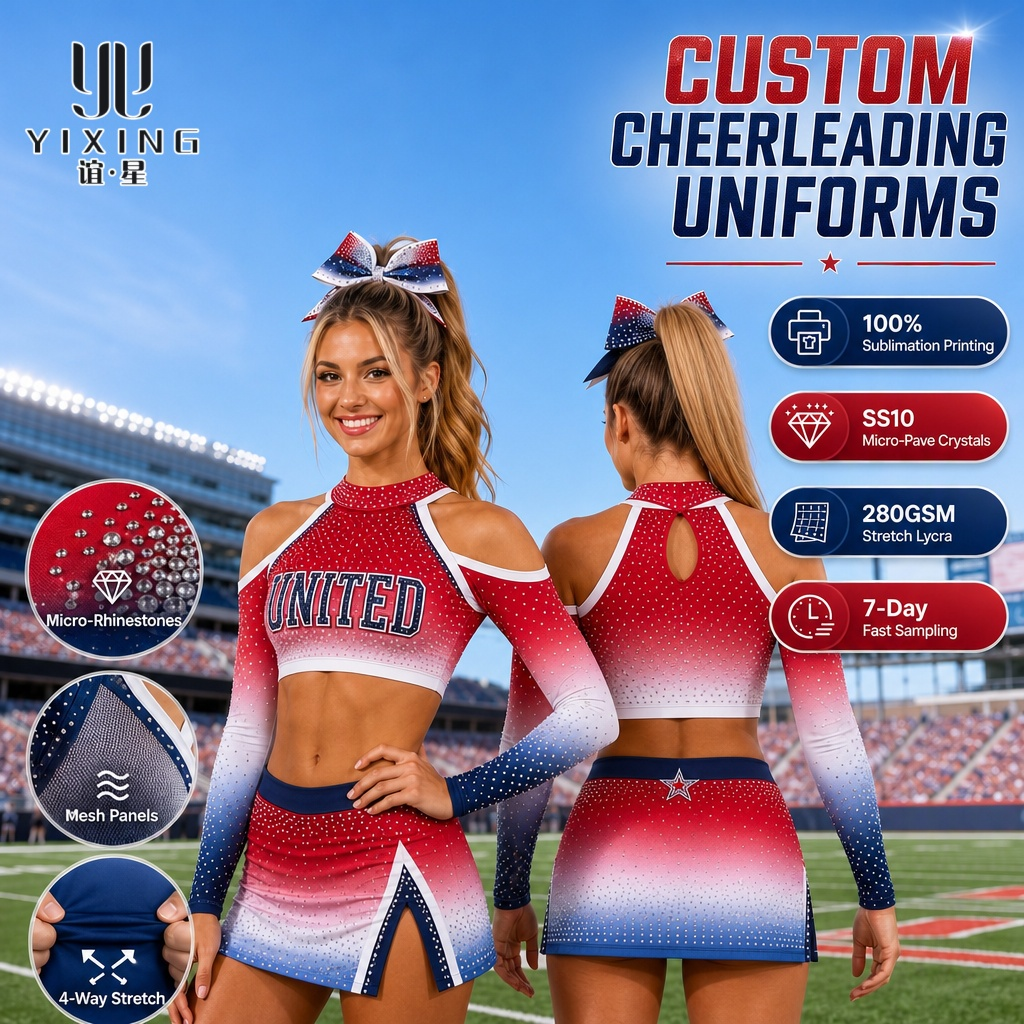
Ready for sampling: custom competition cheer uniform produced on the same line and specification as bulk orders.
Next Step: Sample, Quote or Catalogue
YiXing Athletic Apparel supplies custom cheerleading uniforms, wholesale cheer uniforms, OEM cheerleading uniforms, cheer tops and skirts, practice wear and matching bows to distributors, clubs and institutional buyers across North America, Western Europe, Oceania and Southeast Asia.
Send your design file, size chart and target quantity for a sample or a quotation.
Contact: Zoe | Email: 18525427333@163.com | Tel / WhatsApp: +86 13904082287
Website: yixingtrading.com | Address: Xinrong Street, Xiaoxinzhaizi Village, Xinzhaizi Subdistrict, Ganjingzi District, Dalian, Liaoning, China
Have Questions or Need More Details?
Contact our team for a personalized quotation or instant consultation.
Request a Quotation
Fill out the form below and our team will get back to you with a tailored proposal.
WhatsApp Direct Chat
Prefer to chat in real-time? Message us on WhatsApp for instant assistance & quick answers.
- Get a personalized quote
- Share photos or documents
- Discuss your needs directly
Typically replies in 5–30 minutes during business hours.