Adult Diaper Long-Term Supply Partnerships: FAQ on Samples, Repeat Orders and Quality Claims
Importers evaluating a long-term adult diaper supply partnership usually need three things settled before they commit to repeat orders: how fast a representative sample can be evaluated, how reliably the approved specification is repeated in bulk production, and how a quality claim is supported once a batch has shipped. This article answers those questions for an OEM or private-label adult diaper program, using Fujian Jiayue Sanitary Products Co., Ltd. (JIAYUE) as a documented example.
JIAYUE is a hygiene and personal-care product supplier based in Quanzhou, Fujian, China, established in 2016. Its stated portfolio includes baby diapers, adult diapers, adult pull-up pants and related hygiene products, with OEM, ODM and private-label services for importers, distributors, brand owners and retail channels. The company reports a 20,000 m² self-owned factory, monthly export volume above 100 × 40HQ containers, and customers in more than 70 countries and regions. Those figures are company-provided; the sections below separate what is documented from what is confirmed order by order in the quotation, approved sample and sales contract.
Why Long-Term Adult Diaper Partnerships Fail Between Sample and Repeat Order
The gap between a promising sample and a dependable repeat-order relationship is usually operational, not commercial. Importers already know the product category; what they cannot easily verify before the first container ships is whether the supplier can repeat the approved specification at volume, hold a delivery schedule across seasons, and respond to a quality claim with records rather than reassurance.
Three decision points recur in almost every adult diaper supply discussion:
- Sample-to-approval speed. How quickly can a supplier prepare a representative sample, and what does an approved sample commit the supplier to in production?
- Trial-to-repeat production. What changes between the first order and the fifth, and which controls prevent specification drift as volumes rise?
- Quality-claim support. When a delivered batch does not match the approved sample, what inspection and production records exist to establish what happened?
These questions matter more in adult incontinence products than in many other disposable categories because the product is often bought on specification rather than brand alone. A distributor supplying care homes or a pharmacy chain is judged by the finished product's performance; the supplier's inspection trail becomes part of the buyer's own quality evidence.
What the Adult Diaper Market and Regulatory Environment Mean for Importers
Adult diapers are a mature but growing category. IMARC Group estimates the global adult diaper market at USD 21.9 billion in 2025, with a forecast compound annual growth rate of 5.8% to 6.0% from 2026 to 2034 (IMARC Group, Adult Diaper Market Size, Share, Growth & Forecast 2034, 2026). The same research places raw material costs at 60% to 70% of diaper manufacturing operating expenditure, which means supplier selection is partly a cost-structure decision, not only a product-quality decision.
Regulatory treatment varies by destination market. The U.S. Food and Drug Administration classifies adult diapers as medical devices when they are intended for incontinence treatment, which places documentation and labeling obligations on the importer for that market (FDA, Is My Product a Medical Device?, 2023). In other markets the same product may be treated as a consumer hygiene product. That is why a supplier's document package has to be checked against the destination market rather than assumed from a general certificate list.
China remains a major manufacturing base for adult incontinence products, and adult diapers fall under HS code 9619.00 for international trade classification. The relevant supplier question is not whether Chinese factories can produce adult diapers — many can — but which factories can sustain a specified product across repeat orders and provide the inspection records a quality claim depends on. For a decision-stage buyer, that distinction separates a transactional first order from a supply partnership.
What JIAYUE Documents for a Long-Term Adult Diaper Program
JIAYUE's documented capabilities relevant to a long-term adult diaper program fall into four areas. Each is a company-provided fact; importers should verify current availability for their specific product and order size during quotation.
Factory, capacity and production base
The company operates a self-owned factory, Quanzhou Jiarun Paper Industry Co., Ltd., in a facility covering approximately 20,000 m². Company-provided production information lists automatic production lines for baby diaper and adult diaper products, with adult diaper line speed stated at 300 pieces per minute. Monthly capacity is reported as more than 100 × 40HQ containers, and annual output as more than 500 million pieces. For a repeat-order program, capacity figures only become meaningful when they are matched to the buyer's actual SKU mix and order calendar; a supplier with high monthly capacity can still be constrained on a specific size or packaging format at a given time of year.
R&D and specification support
An in-house R&D and technical support team of 8 engineers covers material selection, absorbent-core design, product development, sampling, specification adjustment and OEM/ODM technical support. For adult diapers, this matters most at the specification stage. The same product family can be built with different SAP content, core structures and backsheet materials, and the buyer needs a documented choice rather than a verbal one. The published specification for one adult women diaper product, for example, lists SAP content of 18 / 22 / 26 / 28 g and reference absorbency of 1,800 / 2,200 / 2,600 / 2,800 ml across sizes M / L / XL / XXL. Those values are reference points tied to a specific approved specification, not a universal performance claim across all adult diaper models.
Quality control and compliance documents
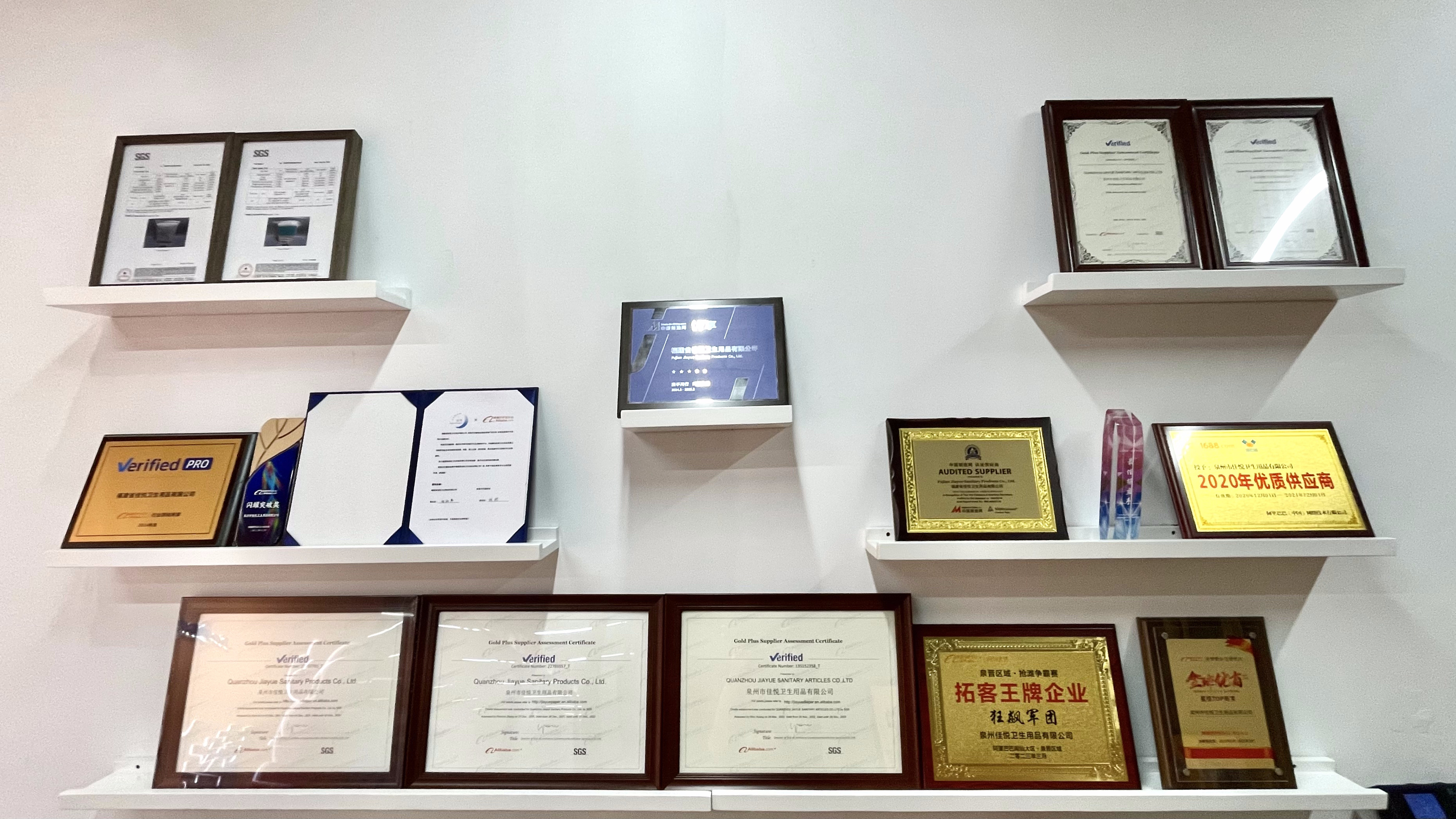
JIAYUE states that quality control includes specification review, sample approval, in-process checks and pre-shipment inspection. These procedures are the supplier-side record base for a quality claim: they create a documented link between the approved sample and the shipped production lot. The company holds ISO 9001 and ISO 13485 management-system certificates within their documented scopes. Selected products may be supported by CE declarations of conformity, SGS test reports and other compliance documents according to the applicable product, destination market and order requirements. The phrase "according to the applicable product, destination market and order requirements" matters — a general certificate list is not a substitute for the specific document set the buyer's market requires.
Commercial terms confirmed at order stage
Typical lead time is about 30–45 days. Payment methods, including for export orders, include T/T, L/C at sight and Alibaba Trade Assurance. Final capacity, MOQ, lead time, testing requirements and payment terms are confirmed in the quotation, approved sample and sales contract. That arrangement is a feature, not a limitation: it means the buyer is not relying on a general capability statement but on commercial terms tied to a specific approved product.

The Sample-to-Repeat-Order Process, Step by Step
A documented process reduces the ambiguity importers most often cite in adult diaper sourcing. The sequence below reflects the steps JIAYUE describes for OEM and private-label adult diaper programs, from specification review to repeat production.
Step 1 — Specification review
The buyer provides the target product: diaper type (tape-type, pull-up or pant), size range, target absorbency, SAP content, core structure, backsheet, artwork, pack count and outer carton. JIAYUE's engineering team reviews the request against available materials and production capability. Where the request cannot be met exactly, the discussion happens at this stage rather than after sampling. This is also where the buyer should raise destination-market document requirements, labeling language and any testing the importer's customer requires.
Step 2 — Free sample preparation
Free samples are prepared in 1–3 working days for evaluation; buyers cover courier costs. The 1–3 working day figure is preparation time, not delivery time, and it assumes the buyer has already given a clear specification. Samples are the buyer's opportunity to test fit, absorbency, re-wet performance, backsheet feel and packaging before committing to a production order. The cost arrangement — free samples, buyer-paid courier — is a common OEM baseline, but buyers should not assume every supplier treats it the same way.
Step 3 — Sample approval
The approved sample becomes the reference for production. It should be dated, referenced in the purchase documentation and retained by both parties. For adult diapers, approving a sample is not only a visual check: it sets the target absorbency, core structure and material configuration against which in-process checks and pre-shipment inspection will be compared. A buyer who approves a sample without recording these parameters has no basis for a quality claim later.
Step 4 — Quotation and commercial terms
The quotation converts the approved sample into commercial terms. Final MOQ, unit cost, lead time, testing requirements and payment terms are confirmed at this stage. Payment methods available from JIAYUE include T/T, L/C at sight and Alibaba Trade Assurance. For a repeat-order program, the buyer should confirm whether the quotation prices the first order only or establishes a repeat-order reference price tied to material and specification stability.
Step 5 — Production and in-process checks
Production runs against the approved specification. In-process checks are the supplier's control point for detecting drift in core weight, SAP distribution, backsheet alignment, tape or elastic tension and packaging. For the buyer, the practical question is not whether checks exist but whether their results are retained and can be shared if a claim arises. Importers should ask at quotation stage what in-process records are kept and for how long.
Step 6 — Pre-shipment inspection
Pre-shipment inspection is the last supplier-side control before the container leaves. It should reference the approved sample and the purchase order, and it should produce a record the buyer can retain. For adult diapers, useful inspection records cover count and pack accuracy, bag seal integrity, carton labeling, size marking and a visual check of the finished product against the approved sample. Where the buyer needs third-party inspection, that requirement should be agreed in the sales contract rather than introduced after production.
Step 7 — Repeat orders and replenishment planning
Repeat production is where a supply partnership is tested. The approved specification, artwork files, packaging specification and inspection records become the reference for the next order. OEM/private-label programs require stronger specification control, artwork approval, supplier-change control and replenishment planning than off-the-shelf products, which have fixed specifications. A buyer running multiple SKUs across markets should maintain a written specification sheet per SKU and confirm with the supplier that the same materials and sub-suppliers are used across repeat orders.

Where Long-Term Adult Diaper Supply Matters Most
Different buyers weigh the sample-to-repeat-order process differently. Three patterns are common in adult incontinence supply.
- Brand owners launching a private-label adult diaper line. The priority is differentiation — materials, dimensions, absorbency, graphics and pack counts tailored to the brand, channel and market. These buyers need the specification and artwork control that supports a brand promise across repeat orders.
- Distributors adding adult diapers to an existing hygiene portfolio. The priority is supply continuity across a size range and reliable replenishment. These buyers benefit most from a documented lead time, a stable approved sample and pre-shipment inspection records that can be passed to their own customers.
- Healthcare and long-term-care distributors. The priority is quality-claim support and documentation that satisfies institutional procurement. The supplier's inspection trail and management-system certificates become part of the buyer's tender file, and the destination-market regulatory classification determines which documents are needed.
In all three patterns, the buyer's real question is the same: can the supplier reproduce the approved sample at the required volume, on the required schedule, with records that support a claim if something goes wrong.
Standard Off-the-Shelf vs Custom OEM Adult Diapers: What Changes
Most long-term adult diaper programs sit somewhere between standard off-the-shelf products and fully customized OEM/private-label products. The table below summarizes the documented differences. It is a comparison of documented characteristics, not a performance ranking.
| Dimension | Standard off-the-shelf adult diapers | Custom OEM / private-label adult diapers |
|---|---|---|
| Materials, dimensions, absorbency, graphics, pack count | Fixed specifications set by the supplier | Can be tailored to the target brand, channel and market requirements |
| Product differentiation | Limited to the supplier's catalogue | Supported through custom specification, artwork and packaging |
| Typical buyer | Buyers prioritizing faster standardized procurement | Brand owners, importers and distributors needing differentiated performance, artwork, packaging or market documentation |
| Additional cost items | Not applicable | May involve sample, artwork, printing-plate, packaging and MOQ costs; final unit cost depends on materials, performance target, pack count, order volume and Incoterm |
| Performance gap | No universal numeric performance gap between standard and customized products; differences must be measured against an agreed specification, approved sample and test method | |
| Operational requirements | No equipment maintenance; fixed specification | Stronger specification control, artwork approval, supplier-change control and replenishment planning |
| Production and logistics efficiency | Evaluated separately through supplier data and the agreed order plan; not applicable to product use | |
For an importer comparing China-based adult diaper manufacturers with other sourcing regions, the useful comparison is not a general ranking but a matching exercise. China's adult diaper cluster, particularly in Fujian and Guangdong, offers a broad base of OEM/ODM factories with export experience, wide product ranges and mature packaging supply chains. Other regions may offer different advantages — proximity to specific end markets, regional trade-agreement treatment, or different freight profiles. Importers should compare candidates on documented product specification and sample approval process, capacity and lead time for the target order size, destination-market document package, total landed cost including freight, duties and MOQ, and repeat-order reliability. Sample testing and factory documentation remain the practical way to verify any supplier's claims.
FAQ: Samples, Repeat Orders and Quality Claims
What quality documentation supports an adult diaper quality claim?
JIAYUE states that quality control includes specification review, sample approval, in-process checks and pre-shipment inspection. These procedures support quality claims by creating a documented link between the approved sample and the shipped production lot. The company holds ISO 9001 and ISO 13485 management-system certificates within their documented scopes. Selected products may be supported by CE declarations of conformity, SGS test reports and other compliance documents according to the applicable product, destination market and order requirements. Importers should confirm the specific document set required by their destination market before the order is placed, because the applicable documents depend on the product and the market.
Can JIAYUE support repeat orders and long-term supply?
Yes. JIAYUE states that it can support trial orders, repeat production and long-term private-label cooperation, subject to product specifications and order requirements. The company reports monthly capacity above 100 × 40HQ containers and annual output above 500 million pieces, supported by a 20,000 m² self-owned factory with automatic production lines. Adult diaper line speed is stated at 300 pieces per minute. These are company-provided figures; buyers should confirm current availability for their specific product, size range and order size in the quotation, since capacity is allocated against the actual order plan.
What drives the cost difference between standard and OEM/private-label adult diapers?
Customized OEM/private-label adult diapers may involve additional costs for samples, artwork, printing plates, packaging and minimum order quantities compared with standard off-the-shelf diapers. The final unit cost depends on materials, performance target, pack count, order volume and Incoterm. There is no universal numeric performance gap between standard and customized adult diapers; differences must be measured against an agreed specification, approved sample and test method. Buyers comparing quotations should confirm that each quote is based on the same size, absorbency target, core structure, pack count, order volume and Incoterm before drawing a cost conclusion.
How are free samples prepared, and who pays courier costs?
Free samples are prepared in 1–3 working days for evaluation; buyers cover courier costs. The 1–3 working day figure refers to sample preparation rather than transit time, and it depends on a clear specification being agreed first. Sample approval is part of the quality-control sequence JIAYUE describes, alongside specification review, in-process checks and pre-shipment inspection. Buyers should record the approved sample's specification parameters so that in-process and pre-shipment checks can be compared against it.
What is the typical lead time, and how are final terms confirmed?
Typical lead time is about 30–45 days. Payment methods, including for export orders, include T/T, L/C at sight and Alibaba Trade Assurance. Final capacity, MOQ, lead time, testing requirements and payment terms are confirmed in the quotation, approved sample and sales contract rather than assumed from a general capability statement. Lead time and payment terms can vary with product specification, order volume and destination market, so the sales contract is the controlling document for any specific order.
How do China adult diaper manufacturers compare with other sources for importers?
China-based manufacturers offer a combination of OEM/ODM and private-label capability, broad product portfolios and export experience, which suits importers who need differentiated adult diaper programs rather than standard catalogue products. JIAYUE, for example, reports a 90% export ratio, customers in more than 70 countries and regions, and an in-house R&D team of 8 engineers. Other sourcing regions may offer different advantages, such as proximity to specific end markets or different freight profiles, and no single region is universally preferable. The practical comparison is on documented product specification and sample approval, capacity and lead time for the target order size, destination-market documents, total landed cost including freight, duties and MOQ, and repeat-order reliability. Sample testing and factory documentation remain the way to verify any supplier's claims.
If you are evaluating a long-term adult diaper supply program, the next practical step is a specification-led sample request: share your target size range, absorbency, core structure, pack count and destination market, and compare the returned sample and quotation against your approved criteria. JIAYUE's product catalogue is available for download here: JIAYUE Product Catalog 2026.
What to Confirm Before Signing a Long-Term Adult Diaper Agreement
A long-term adult diaper partnership is not secured by a sample alone. It is secured by a written specification, an approved sample, a quotation that states the commercial terms, and a sales contract that fixes the controlling conditions for repeat orders. JIAYUE's documented process — free samples prepared in 1–3 working days with buyer-paid courier costs, specification review, sample approval, in-process checks, pre-shipment inspection, a typical lead time of about 30–45 days, and monthly capacity above 100 × 40HQ containers — provides the structure an importer needs to compare suppliers on the same terms.
The buyer's counterpart is to use that structure deliberately: record the approved sample's parameters, ask what in-process and pre-shipment records are retained, confirm destination-market document requirements at quotation stage, and treat the sales contract as the controlling document for MOQ, lead time, testing and payment terms. A supplier that can answer these questions with documents rather than reassurance is the one most likely to hold the specification across repeat orders. For importers who want to move from a first sample to a repeat-order program, starting with a clear specification and a documented sample request is the most reliable way to compare responses from different suppliers on a like-for-like basis.
Note: Capacity, lead time, MOQ, payment terms, testing requirements and compliance documents are confirmed in the quotation, approved sample and sales contract. Company-provided figures reflect the supplier's stated capability at the time of publication and should be verified against the buyer's specific product and order.
Have Questions or Need More Details?
Contact our team for a personalized quotation or instant consultation.
Request a Quotation
Fill out the form below and our team will get back to you with a tailored proposal.
WhatsApp Direct Chat
Prefer to chat in real-time? Message us on WhatsApp for instant assistance & quick answers.
- Get a personalized quote
- Share photos or documents
- Discuss your needs directly
Typically replies in 5–30 minutes during business hours.