Baby Diaper Certification Scope: CE Category I, ISO 9001 and ISO 13485 Clarified
Baby diapers sold into the European Union are routinely described by suppliers as “CE certified.” The phrase is convenient and imprecise. For Fujian Jiayue Sanitary Products Co., Ltd., the CE document is a Declaration of Conformity — document number CE/PPE-JY-01, issued 15 May 2025 — covering disposable baby diapers in sizes NB through XXXXXL for the EU market, declared under Category I, with SUNGO Europe B.V. named as EU representative. That document is not the same as the company’s ISO 9001:2015 certificate, which is scoped to sales activities of disposable baby diapers and adult nappies and is valid from 12 December 2023 to 11 December 2026. Nor is it the same as the ISO 13485:2016 certificate, which applies to Ultra Thick Yibero Adult Women Diapers.
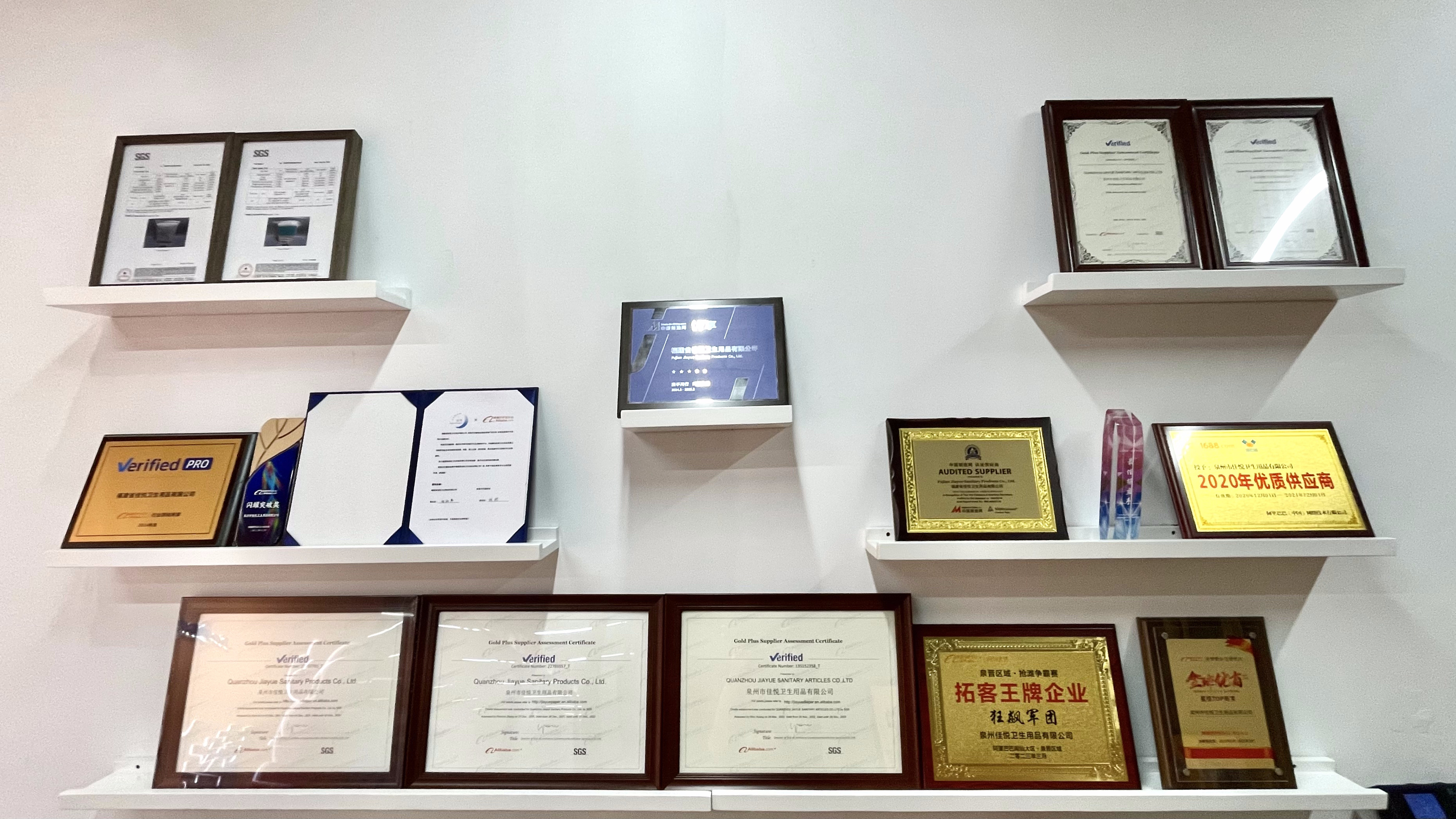
Image: Certificate wall at the Jiayue facility in Quanzhou, Fujian. Buyers should read each certificate’s stated scope, issuing body and validity dates rather than the certificate count.
The distinction is practical, not academic. An importer who treats a quality-management certificate as a product statement, or a medical-device certificate as proof that every diaper is a medical device, will discover the gap when a retail buyer, a customs broker or a tender committee asks for the document that actually covers the SKU in the container. This guide explains what each of the three documents covers, what it does not cover, and how to verify the difference before a purchase order is signed.
The Problem: A Certificate Is a Scope Statement, Not a Product Claim
Certification confusion in the diaper trade usually starts with a plausible assumption: if a manufacturer holds a document, the document applies to whatever the buyer is purchasing. In practice, every certificate and declaration carries a written scope. The scope names specific product categories, specific activities or specific product lines. Anything outside that wording is outside the document.
Three assumptions cause most of the friction:
- “CE certified” implies a third-party certificate. For Category I products, the CE route runs through a manufacturer’s declaration of conformity, not a notified-body certificate. The buyer is relying on the manufacturer’s own technical documentation and declaration.
- “ISO certified” implies the factory and the product. ISO 9001 is a quality management system standard. A certificate states which activities fall inside the certified management system — in this case, sales activities of disposable baby diapers and adult nappies.
- “ISO 13485 means medical.” ISO 13485 is a medical-device quality management system standard. A certificate issued for one product line does not extend to unrelated product lines in the same portfolio.
For OEM and private-label programmes, the practical consequence is a documentation mismatch. The buyer’s packaging artwork, product listing and tender submission reference a compliance file, but the file’s scope names a different size range or a different product line. Resolving that mismatch after the container has shipped is far more expensive than reading the scope before the deposit.

Image: The Jiayue production base in Quanzhou, Fujian. Company information lists a facility of approximately 20,000 m², automatic production lines for baby diaper and adult diaper products, and export reach to more than 70 countries and regions.
Industry Background: Why Documentation Scope Matters More Than Ever
The baby diaper category is a high-volume, low-margin, heavily documented export business. Buyers are not simply choosing absorbency and price; they are assembling a documentation file that must survive retail onboarding, customs inspection and marketplace listing review.
Market context explains the pressure. Grand View Research reported a global baby diaper market valuation of USD 83.3 billion in 2025. Fortune Business Insights reported that Asia Pacific held 61.92% of the global diaper market in 2025, reflecting the concentration of both demand and manufacturing capacity in the region. Customs data reported in 2025 put Fujian province’s baby diaper export value at CNY 8.74 billion for 2024, underlining how much of that regional supply flows through a single Chinese coastal province.
That concentration has a documentation consequence. When dozens of suppliers in the same cluster quote on the same brief, differentiation shifts from “can you make the product” to “can you evidence the product.” Importers increasingly ask for declarations, management-system certificates and test reports before samples are even discussed.
Fujian Jiayue Sanitary Products Co., Ltd. is a hygiene and personal-care product supplier based in Quanzhou, Fujian, China, established in 2016. The company supplies baby diapers, baby pull-up pants, adult diapers, adult pull-up pants, sanitary napkins, underpads, wet wipes, dry wipes, tissue paper and pet diapers, and provides OEM, ODM and private-label services for importers, distributors, brand owners and retail channels. Company information states an export ratio of 90% and customers in more than 70 countries and regions. Its Yibero brand is used across its diaper ranges.
What the CE Declaration of Conformity Actually Covers
The declaration held for baby diapers is document CE/PPE-JY-01, issued 15 May 2025. It declares disposable baby diapers for the EU market under Category I and covers sizes NB through XXXXXL. SUNGO Europe B.V. is named as the EU representative — the entity an EU market-surveillance authority or a customer would contact on the manufacturer’s behalf.
Why “Category I” and “self-declared” belong in the same sentence
Category I is the lowest-risk classification in the CE framework. Products in this category are declared by the manufacturer, which prepares and signs the declaration and holds the supporting technical documentation. No notified body issues a certificate at this level. That is precisely why the document is a declaration of conformity rather than a third-party certificate, and why the number CE/PPE-JY-01 is a manufacturer document reference, not an accredited certification number.
For a buyer, this shifts the due-diligence burden. There is no independent certificate to validate against a certification-body database. Instead, the buyer should:
- Obtain a copy of the declaration itself, not a logo or a one-line claim in a catalogue.
- Read the product description and size range on the document and compare it with the purchase order.
- Confirm that the legal entity named on the declaration matches the entity issuing the invoice and the sales contract.
- Confirm the identity and contact details of the named EU representative.
One point deserves emphasis for OEM buyers. The CE declaration covers the size range NB through XXXXXL. The tape-style product specification for Yibero Premium Quality Ultra Cloudy Baby Diapers lists sizes S, M, L and XL with defined dimensions and baby-weight ranges. A private-label programme built on S–XL therefore sits inside the declared range, but the buyer should still confirm in writing that the specific SKU, pack configuration and label artwork are covered — particularly when adding sizes outside the standard four.

Image: Production workshop. Company-provided production information lists automatic production lines for baby diaper and adult diaper products, supported by an in-house R&D and technical team of 8 engineers.
What ISO 9001:2015 Covers — and Why the Wording Is Deliberate
The ISO 9001:2015 certificate held by Fujian Jiayue Sanitary Products Co., Ltd. is valid from 12 December 2023 to 11 December 2026. Its stated scope is sales activities of disposable baby diapers and adult nappies.
That wording answers a narrower question than most buyers assume. It confirms that the sales-side processes described in the certificate’s scope — how orders are received, reviewed, documented and handled — operate within a certified quality management system. It does not, by itself, certify absorbency performance, leakage protection, material safety or country-specific product conformity. Those are product-level questions answered by specifications, test reports and the applicable conformity documents.
In practice the certificate supports procurement conversations in three ways. It gives a distributor an auditable management-system reference when onboarding a supplier. It gives a private-label brand owner a defensible answer when a retail customer asks how order handling is controlled. And it establishes a defined validity window — the current term runs to 11 December 2026 — which a buyer should diarise for re-verification rather than treating as permanent.
Where buyers commonly overreach is in treating ISO 9001 as a product certificate. It is not. A supplier can hold a perfectly valid ISO 9001 certificate and still produce a diaper whose absorbency does not match a buyer’s target. Specification control answers that question: product specifications, materials, absorbency targets, graphics, pack counts and export packaging can be confirmed through sampling and an approved specification. The certificate and the approved specification do different jobs.
The ISO 13485 Question: One Product Line Is Not the Whole Portfolio
This is the question that generates the most misunderstandings in supplier conversations: “If the manufacturer is ISO 13485 certified, are the baby diapers medical devices?”
The answer is no. The ISO 13485:2016 certificate held by Fujian Jiayue Sanitary Products Co., Ltd. applies to Ultra Thick Yibero Adult Women Diapers. That is the product line named in the certificate scope. The certificate is a management-system certification for a defined product scope; it is not a statement that every absorbent hygiene product manufactured by the same company is a medical device, and it does not reclassify baby diapers.
Two practical rules follow from this.
Rule one: read the scope, not the logo. A medical-device QMS certificate is valuable evidence for the adult product line it names. Applied to a baby diaper SKU, it is simply a different document about a different product.
Rule two: classification is a market decision, not a supplier claim. Whether a given diaper is treated as a medical device, a consumer product or something else depends on the claims made for it and on the rules of the destination market. Importers should confirm the classification that applies to their own product, labelling and claims with their regulatory advisor rather than inferring it from a supplier certificate.
For a distributor carrying both baby diapers and adult incontinence products from the same supplier, this distinction is useful: the ISO 13485 scope supports the adult line, the CE declaration supports the baby diaper range, and the ISO 9001 scope supports the sales processes behind both. Each document does a specific job in the file.
Step-by-Step: How to Verify Certification Scope Before Ordering
The verification sequence below works for OEM baby diapers, private-label programmes and wholesale distribution orders alike. It takes less time than resolving a documentation dispute after shipment.
Step 1 — Request the documents, not the claim
Ask for the CE Declaration of Conformity, the ISO 9001 certificate and the ISO 13485 certificate as separate files. A catalogue page that lists three logos is not a substitute.
Step 2 — Match the legal entity
The entity named on the documents must match the entity that will appear on the sales contract, the commercial invoice and the packing list. Entity mismatches between an affiliated factory, a trading arm and a brand owner are a frequent source of rejected documentation at destination.
Step 3 — Read the product scope line by line
For the CE declaration, confirm the product description and the size range (NB through XXXXXL for this declaration). For the ISO 13485 certificate, confirm that the product named is the one you are buying. For ISO 9001, confirm the activity described matches the relationship you are entering.
Step 4 — Check validity windows
The ISO 9001:2015 certificate runs from 12 December 2023 to 11 December 2026. Record the expiry dates in your supplier file and re-verify before the next annual order rather than assuming a certificate seen once remains current.
Step 5 — Identify the EU representative
SUNGO Europe B.V. is named as EU representative on the baby diaper declaration. Confirm the name and contact details match your own file, and note them for any post-market communication.
Step 6 — Pair documents with product evidence
Certification scope answers the “who and what” question. Performance answers a different one. Product acceptance for private-label baby diapers includes checks on absorbency, SAP/core design, rewet performance and leakage protection. Ask for the test evidence that matches your SKU, and confirm the specification in the approved sample.
Step 7 — Write the documents into the order
Name the required documents, their scope and the party responsible for providing them in the purchase order or specification annex. Documentation obligations that exist only in email threads tend to disappear when a new account manager takes over the file.

Image: Documentation review is part of the OEM process. The team supports artwork and packaging coordination, export documentation and shipment planning alongside specification confirmation.
Use Cases: How the Three Documents Are Applied in Practice
An importer entering the EU market for the first time
The buyer needs a declaration of conformity that names disposable baby diapers in the sizes being ordered, plus the contact details of the EU representative. The relevant check is whether the size range on the declaration (NB through XXXXXL) contains the sizes on the purchase order, and whether the label artwork carries the required information for the destination market. The ISO certificates support supplier qualification but do not replace this check.
A distributor responding to a retail tender
Tender documentation usually asks for a supplier compliance pack. A distributor that submits an ISO 13485 certificate as evidence for baby diapers will find the reviewer asking for the certificate that names the baby diaper product. Submitting the CE declaration for the baby range and the ISO 9001 certificate for the sales scope, with each scope stated accurately, produces a cleaner submission than a stack of logos.
A private-label brand owner building a product file
Brand owners carry the customer-facing obligation even when manufacturing is outsourced. The practical work is to keep the manufacturer’s declaration, the ISO certificates and the SKU-level test evidence together, and to confirm that customization — product size, absorbency targets, absorbent-core structure, materials, graphics, pack count, bag design and outer-carton packaging — is captured in an approved specification. A certificate does not describe the customized article; the approved specification does.
An e-commerce seller preparing a listing
Marketplace compliance teams typically ask for product documentation that matches the listing, including size and pack configuration. Because the CE declaration covers a broad size range but the listing is usually a specific pack count, the seller should retain both the declaration and the product specification so that the two can be reconciled on request.
Comparison Table: Document, Scope and What It Proves
| Document | Type | Scope stated | Validity |
|---|---|---|---|
| CE Declaration of Conformity, CE/PPE-JY-01 | Manufacturer self-declaration, Category I, EU market | Disposable baby diapers, sizes NB through XXXXXL; SUNGO Europe B.V. as EU representative | Issued 15 May 2025 |
| ISO 9001:2015 | Quality management system certification | Sales activities of disposable baby diapers and adult nappies | 12 December 2023 – 11 December 2026 |
| ISO 13485:2016 | Medical device quality management system certification | Ultra Thick Yibero Adult Women Diapers | Not stated in the material reviewed for this article |
Table 1. Document-by-document scope comparison for Fujian Jiayue Sanitary Products Co., Ltd. Each row answers a different buyer question; none of the three replaces the others.
Read horizontally, the table shows why a single logo cannot stand in for a compliance file. Read vertically, it shows the boundary each buyer must hold in mind: the CE declaration answers the EU market question for baby diapers; ISO 9001 answers the sales-process question; ISO 13485 answers the medical-device QMS question for one named adult product line.
Operational Context: Where Certification Sits in an OEM Order
Certification scope is one input in a wider order process. For OEM baby diapers and private-label programmes, the sequence typically runs from specification discussion to sampling to approved specification to production and pre-shipment inspection. Customization can cover product size, absorbency targets, absorbent-core structure, materials, graphics, pack count, bag design and outer-carton packaging, with the final configuration confirmed in the signed specification and approved sample.
Commercial parameters sit alongside the technical ones. Company information indicates that baby diaper containers may mix three to four sizes, that free samples are prepared in one to three working days with courier costs paid by the buyer, that typical lead time is about 30 to 45 days, and that payment methods include T/T, L/C at sight and Alibaba Trade Assurance. Final capacity, MOQ, lead time, testing requirements and payment terms are confirmed in the quotation, the approved sample and the sales contract.
The in-house R&D and technical support team of 8 engineers is responsible for material selection, absorbent-core design, product development, sampling, specification adjustment and OEM/ODM technical support. That is the team that usually translates a certificate scope into a documented product specification a buyer can file.
Frequently Asked Questions
Is a CE Declaration of Conformity the same as CE certification for baby diapers?
No. For the baby diaper range, the CE document is a Declaration of Conformity numbered CE/PPE-JY-01, issued 15 May 2025, declaring disposable baby diapers in sizes NB through XXXXXL for the EU market under Category I. Because Category I is a self-declared category, the declaration is issued by the manufacturer rather than by a notified body, and SUNGO Europe B.V. is named as the EU representative. Buyers should therefore read the declaration’s product scope and size range directly rather than relying on the phrase “CE certified.”
Does ISO 13485 certification mean all baby diapers from this supplier are medical devices?
No. The ISO 13485:2016 certificate held by Fujian Jiayue Sanitary Products Co., Ltd. applies to Ultra Thick Yibero Adult Women Diapers. That is the product line named in the certificate scope. The certificate does not extend to the company’s baby diaper products, and it does not reclassify baby diapers as medical devices. Whether a specific diaper is treated as a medical device depends on the claims made for it and on the rules of the destination market, which the importer should confirm with a regulatory advisor.
What exactly does the ISO 9001:2015 certificate cover?
The ISO 9001:2015 certificate is scoped to sales activities of disposable baby diapers and adult nappies and is valid from 12 December 2023 to 11 December 2026. It confirms that the sales-side processes within that scope operate under a certified quality management system. It does not certify absorbency, leakage performance, material safety or destination-market product conformity; those are addressed through the approved specification, sampling and test evidence for the specific SKU.
Which sizes does the CE declaration cover, and how does that compare with the standard product range?
The CE Declaration of Conformity CE/PPE-JY-01 covers disposable baby diapers in sizes NB through XXXXXL. The tape-style specification for Yibero Premium Quality Ultra Cloudy Baby Diapers lists sizes S, M, L and XL, with dimensions of 400×320, 450×320, 500×340 and 540×340 mm, baby-weight ranges of 4–8, 6–11, 9–14 and 12–17 kg, and a shelf life of five years. An order built on S–XL therefore falls inside the declared range, but buyers adding sizes, changing pack counts or applying new artwork should confirm in writing that the specific SKU is covered before production.
How can an importer verify these documents before placing a first order?
Request the declaration and the certificates as separate files, match the legal entity named on them to the entity on the contract and invoice, read the product scope and size range line by line, record the validity dates, and confirm the named EU representative. Then pair the documents with product-level evidence for the SKU. Samples are prepared in one to three working days with courier costs paid by the buyer, and typical lead time is about 30 to 45 days, so the verification work can run in parallel with sample evaluation. To start, request a sample and a quotation for your target specification, or download the JIAYUE Product Catalog 2026 for the full product range.
Conclusion: Three Documents, Three Different Questions
The certification file behind a baby diaper order is not a single credential; it is a set of documents that answer different questions. The CE Declaration of Conformity CE/PPE-JY-01, issued 15 May 2025, answers the EU market question for disposable baby diapers in sizes NB through XXXXXL, declared under Category I with SUNGO Europe B.V. as EU representative. The ISO 9001:2015 certificate, valid from 12 December 2023 to 11 December 2026, answers the sales-process question for disposable baby diapers and adult nappies. The ISO 13485:2016 certificate answers the medical-device quality management question for Ultra Thick Yibero Adult Women Diapers.
Importers, distributors and private-label brand owners who separate those three answers make faster decisions and fewer documentation corrections. The verification routine is straightforward: obtain the documents, match the entity, read the scope, record the dates, confirm the EU representative, pair the file with SKU-level test evidence, and write the requirement into the order.
For buyers evaluating OEM baby diapers for import programmes, wholesale supply for distribution, or private-label development with custom packaging, the next practical step is a specification conversation supported by the documents themselves. Fujian Jiayue Sanitary Products Co., Ltd. supplies OEM, ODM and private-label hygiene products to importers, distributors, brand owners and retail channels, and can support trial orders, repeat production and long-term private-label cooperation subject to product specifications and order requirements.

Image: Finished goods warehouse. Company information states export volume of more than 100 × 40HQ containers per month and customers in more than 70 countries and regions.
Next step: sample, quotation and document pack
Send your target size mix, pack count, absorbency target and destination market. Fujian Jiayue Sanitary Products Co., Ltd. will confirm the specification route and provide the relevant documentation for your file. Free samples are prepared in 1–3 working days; courier costs are paid by the buyer. Typical lead time is about 30–45 days.
Email: info@jiayuediaper.com · Website: www.jiayuediaper.com · Catalog: JIAYUE Product Catalog 2026
Have Questions or Need More Details?
Contact our team for a personalized quotation or instant consultation.
Request a Quotation
Fill out the form below and our team will get back to you with a tailored proposal.
WhatsApp Direct Chat
Prefer to chat in real-time? Message us on WhatsApp for instant assistance & quick answers.
- Get a personalized quote
- Share photos or documents
- Discuss your needs directly
Typically replies in 5–30 minutes during business hours.