Evaluating an Adult Diaper Supplier's Delivery Capability: Factory, Capacity and QC Checks
Delivery capability is confirmed by three things you can verify before a deposit is paid: the factory the supplier actually owns, the capacity expressed in containers shipped per month, and the quality-control gate that releases each batch. A supplier that answers only one of the three has not demonstrated delivery assurance.
Importers rarely lose an adult diaper order because the sample was poor. They lose it because the shipped container does not match the approved sample, because the production slot moved by three weeks, or because nobody agreed in writing what 'passed inspection' means. Each of those failures is a supplier-evaluation failure, and each can be screened out at the quotation stage.
This guide is written for importers, distributors and private-label brand owners who have moved past initial supplier discovery and are now comparing two or three candidates on delivery reliability. It sets out a five-checkpoint framework, a seven-step verification sequence, and a document trail for each claim. Fujian Jiayue Sanitary Products Co., Ltd. — a hygiene and personal-care manufacturer based in Quanzhou, Fujian, China, established in 2016, whose adult range is marketed under the Yibero brand — is used as a worked example of how each checkpoint should be answered with a verifiable figure rather than an adjective.

Problem definition: why 'capacity' and 'delivery' are different numbers
A production line output figure and a shipping commitment measure different things. Line speed tells you how fast one machine runs when materials are present. Delivery capability tells you whether materials, labour, packaging, inspection and container booking will line up on the date you were promised.
Three failure modes account for most delivery disputes in adult diaper sourcing:
- Capacity quoted as line output. A piece-per-minute figure is converted into an annual tonnage in the sales email, but the buyer never learns how many 40HQ containers the supplier actually loads per month, or how much of that is already committed.
- Quality control described as intent. 'We have strict QC' is not a plan. Without agreed sampling levels and acceptance criteria, pre-shipment inspection produces an opinion rather than a release decision.
- Commercial terms settled last. Payment method, MOQ logic, artwork approval responsibility and re-inspection cost get discussed after the sample is approved, when the buyer has already invested time and holds less leverage.
The corrective is to treat delivery capability as a documentary question: for each checkpoint there is a specific figure, certificate or clause to request, and a specific reason the answer matters.
Industry background: why delivery assurance is harder to secure in 2026
Demand is not the constraint. IMARC Group valued the global adult diaper market at USD 21.9 billion in 2025 and forecasts a compound annual growth rate of 5.8% to 6.0% across 2026–2034. Volume growth of that kind normally invites capacity investment rather than shortage.
The pressure sits on the input side. Expert Market Research estimates raw materials at 60% to 70% of diaper manufacturing operating expense, and recorded a 60% surge in crude oil in the first quarter of 2026 — a direct input into polypropylene nonwovens and superabsorbent polymer. When most of the cost base is petrochemical-linked and moving, suppliers prioritise the customers whose specifications are fully approved and whose payment instruments are clean. Buyers with ambiguous specifications, unsigned artwork or open payment terms move to the back of the schedule.
Two regulatory facts add documentation lead time. Adult incontinence products are classified under HS code 9619.00 for international trade, and the U.S. Food and Drug Administration classifies adult diapers as medical devices when they are intended for incontinence treatment. In both cases the documentation has to exist before the container is booked, not after it has sailed.
The practical conclusion for a 2026 sourcing decision is that delivery capability should be scored on documentation readiness as much as on machine count.
The five-checkpoint delivery framework
Checkpoint 1 — Factory ownership and footprint
A supplier that owns its plant controls its own production calendar. A trading company resells slots on someone else's calendar, and when two customers collide, the reseller chooses. This is the first thing to establish, because every later capacity claim depends on it.
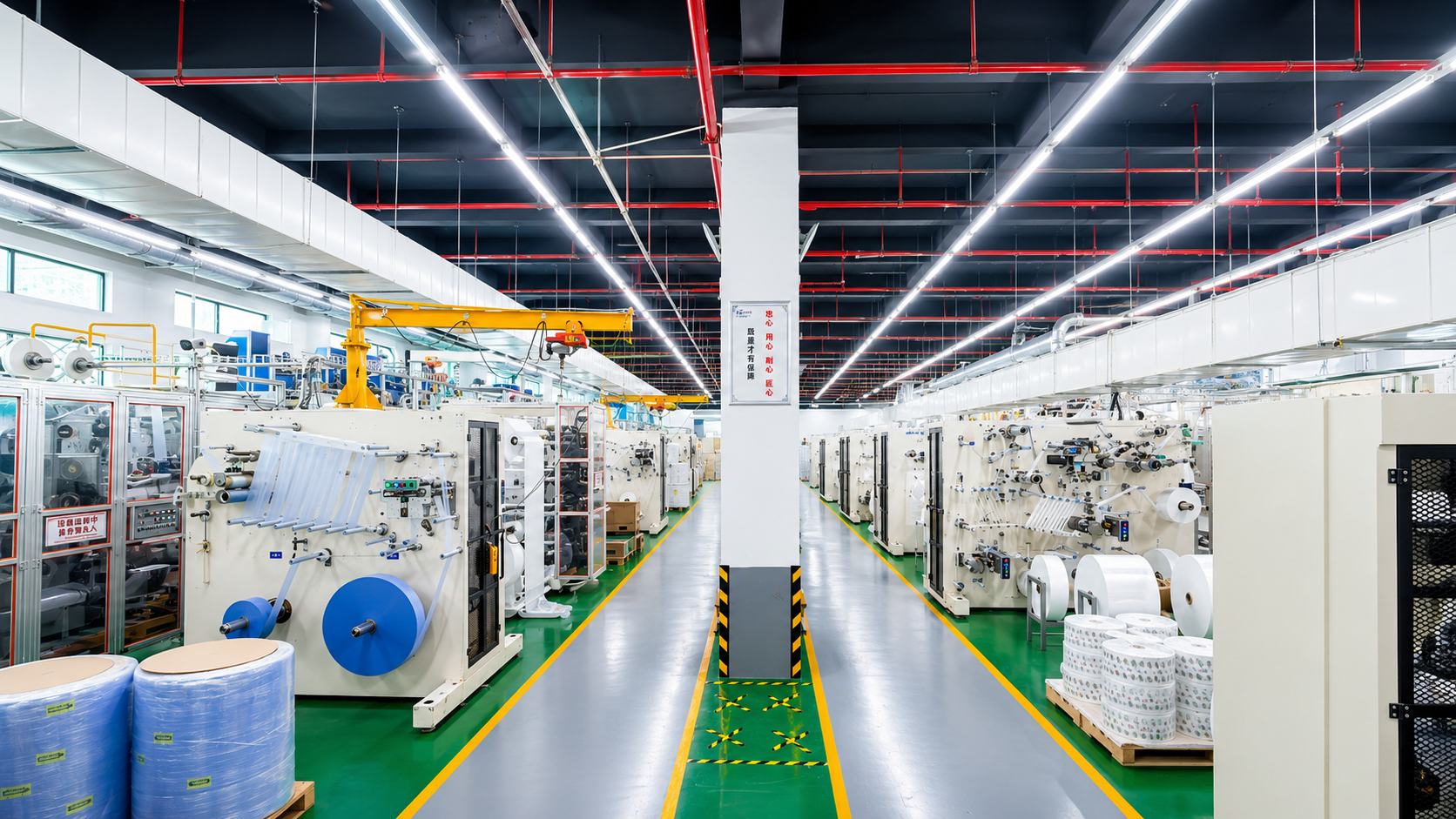
In Jiayue's case, production is supported by a self-owned factory, Quanzhou Jiarun Paper Industry Co., Ltd., operating in a facility covering approximately 20,000 square metres, with approximately 100 staff and an in-house R&D and technical support team of eight engineers responsible for material selection, absorbent-core design, product development, sampling, specification adjustment and OEM/ODM technical support. The company was established in 2016 and reports exports to more than 70 countries, with exports representing about 90% of output.
Ask for: business licence, the factory address that will appear on the audit report, a floor plan showing raw material storage, converting lines, finished goods and the inspection area, and a live video walkthrough rather than a photo pack.
Why it matters: a 20,000 m² footprint is large enough to hold separate raw material and finished goods warehouses, which is what allows a supplier to run a container programme without storing finished cartons in the production aisle.
Checkpoint 2 — Capacity expressed in containers per month
Container throughput is the closest single proxy for delivery capability, because it folds line speed, packaging, labour and loading into one number. Piece counts hide too many variables: the same 40HQ holds a different piece count depending on size, pack count and compression.
Jiayue's company-provided production information states annual output of more than 500 million pieces and monthly shipment of more than 100 × 40HQ containers. Company-provided line data lists adult diaper lines running at 300 pieces per minute and baby diaper lines at 700 pieces per minute. Those three figures should be read together rather than separately: the piece output describes converting capability, the line speed describes the equipment, and the container figure describes what actually leaves the yard.
Ask for: capacity stated separately for adult diapers and adult pull-up pants; current capacity utilisation; the booking lead time at the point of enquiry; and the size and pack-count mix assumed in the container figure.

Checkpoint 3 — Quality control from specification review to pre-shipment inspection
Quality control becomes a delivery issue at exactly one point: when a batch fails inspection after the container has been booked, and the release date moves. That is why the QC plan has to be assessed as a sequence with named gates, not as a certification badge.
Jiayue describes an order-specific QC plan covering specification review, pre-production sample approval, in-process checks and pre-shipment inspection. The company states that test method, sampling level and acceptance criteria must be agreed in the contract. That last sentence carries the commercial weight — it converts QC from a supplier promise into a contractual test that either party can apply.
Ask for: the QC flow document, the in-process checkpoint list, the sampling plan and acceptance criteria in writing, the name and signature authority of the person who signs the pre-shipment report, and confirmation that the approved sample is retained and referenced against production.

Checkpoint 4 — Certification currency, not certification presence
Every serious OEM supplier will list certificates. The evaluation question is whether the certificate number, scope and validity date match the product and the market you are buying for.
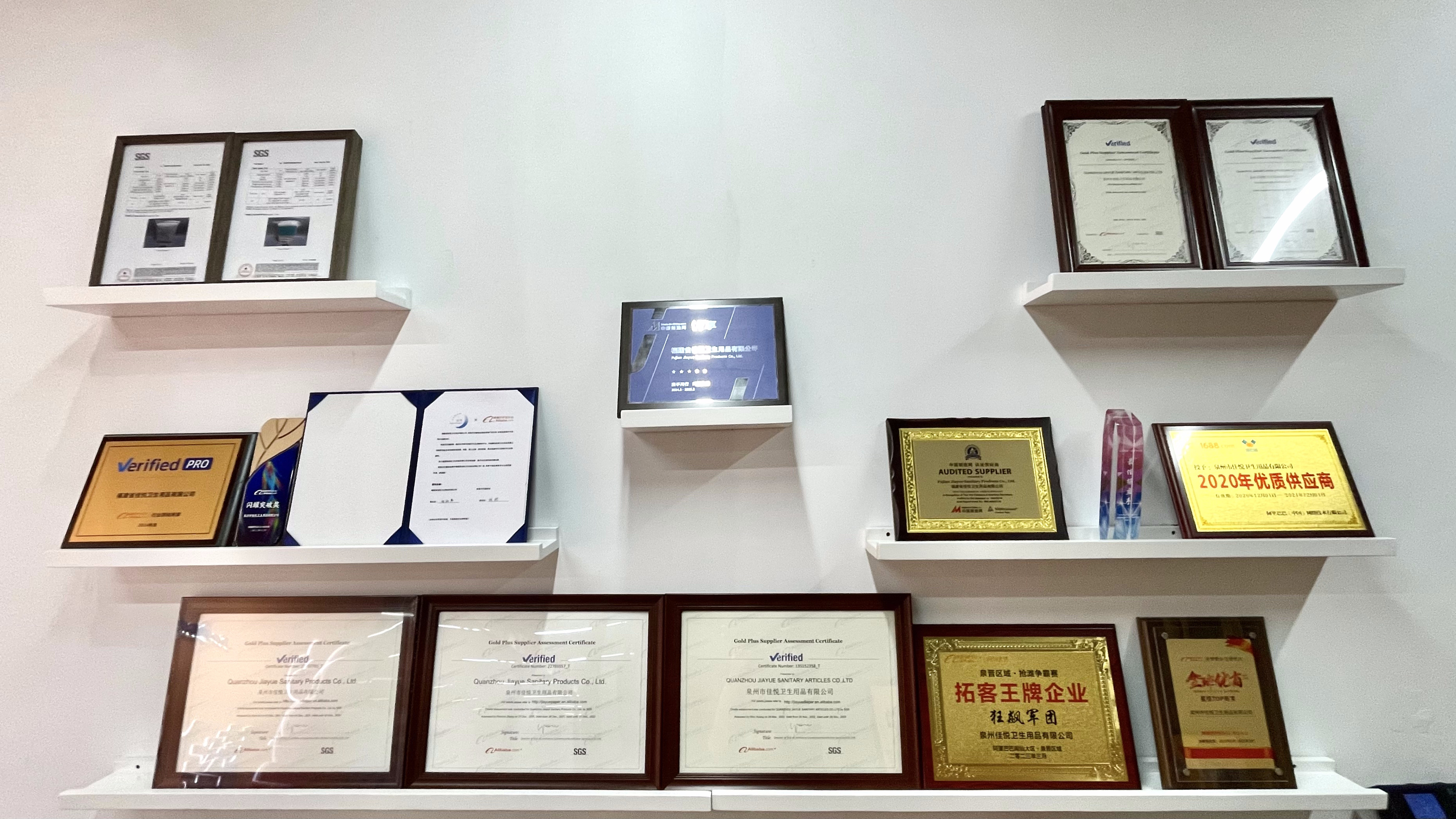
Jiayue holds ISO 9001 Quality Management System certification, certificate number NOA2314690, issued by NOA Testing & Certification Group Ltd. under GB/T 19001-2016 / ISO 9001:2015, valid from 2023-12-12 to 2026-12-11, with a scope covering sales of sanitary products, maternal and infant products and Class I medical devices. The company also holds ISO 13485 Medical Devices Quality Management System certification, certificate number NOA2314356, issued by the same body under GB/T 42061-2022 / ISO 13485:2016, valid from 2023-12-06 to 2026-12-05, covering Class I medical device sales.
For the European Union, the Disposable Adult Diapers / Adult Nappies product carries a CE Declaration of Conformity, reference CE/MDR-Y0999-02, issued on 2022-09-07 with no listed expiry date. It is a self-declaration under the EU route for Class I medical devices, made by Quanzhou Jiayue Sanitary Articles Co., Ltd., with SUNGO Europe B.V. as the EU authorised representative. It is made under Regulation (EU) 2017/745 and classifies the product as Class I under Rule 1, Annex VIII. The declared scope covers tape-style, high-absorbency adult incontinence diapers with GMDN code 11239 and EMDN code Y0999, in sizes S, M, L, XL and XXL, with a length of 70–103 cm and a width of 50–90 cm.
Checkpoint 5 — Commercial and payment checkpoints
Payment method determines how quickly a dispute can be resolved, and therefore how much delivery risk the buyer is carrying. Jiayue accepts T/T, L/C at sight and Alibaba Trade Assurance. Each shifts risk differently: T/T is fastest and offers the least recourse; L/C at sight places document compliance between payment and shipment; Trade Assurance introduces a platform dispute route.
Three further terms should be fixed before sampling closes. Minimum order quantity is not a single number — ready-to-ship products may support a lower MOQ, while OEM order MOQ depends on product, size mix, materials, packaging and customization requirements, and is confirmed in the quotation. Lead time is typically 30–45 days, subject to sample, artwork, packaging and specification approval. And samples are prepared free of charge in 1–3 working days, with the buyer covering courier costs.
Step-by-step verification sequence
Run the checkpoints in this order. Each step produces a document that the next step depends on, so skipping ahead leaves the later answers unverifiable.
- Confirm factory ownership before discussing capacity. Match the legal entity on the business licence to the factory address and to the certificate scopes. If the plant is third-party, downgrade every capacity claim to 'subject to scheduling'.
- Request capacity in containers per month, split by product type. Compare the adult diaper figure against your own 12-month container forecast, not against your piece forecast.
- Ask for current utilisation and booking lead time. A supplier loading more than 100 containers a month with high utilisation can still serve you — but booking lead time, not annual capacity, determines your ship date.
- Convert your forecast into the supplier's unit. Size mix, pack count and compression change container yield. Ask what mix the stated container figure assumes, then re-state it for your own SKUs.
- Write acceptance criteria into the contract. Take the supplier's QC flow and attach your own sampling level, test method and pass/fail thresholds. This is the step that makes pre-shipment inspection enforceable.
- Verify certificate number, scope and expiry. Check the number on the document against the number in the quotation, and check the scope against the specific product and market.
- Close commercial terms before the sample is approved. Payment instrument, MOQ basis, artwork approval owner, re-inspection cost and the consequence of a failed inspection should all be settled while you still have alternative suppliers.
Use cases
EU private-label launch with a tape-style adult diaper
An EU importer launching a private-label tape-style adult diaper needs the declared CE scope to match the product actually ordered. The relevant check is not whether a CE document exists but whether it covers tape-style, high-absorbency adult incontinence products in the sizes being purchased, under GMDN 11239 and EMDN Y0999, with an EU authorised representative named. A product outside that declared scope needs a separate conformity route, and that gap is a delivery risk because it surfaces at customs rather than at sampling.
Distributor scaling from a trial order to repeat containers
A distributor moving from a first container to a monthly programme is testing whether the supplier's stated capacity is available capacity. The useful evidence is the container-per-month figure alongside a booking lead time, plus a shelf-life statement — the adult diaper configuration carries a stated shelf life of 3 years, which sets how much stock a distributor can hold between shipments without ageing inventory in the warehouse.
Long-term care and nursing-home contract supply
A supplier serving nursing homes is buying predictability more than unit price: a missed shipment interrupts resident care. In that scenario the overnight and high-absorbency configurations matter commercially. The published specification for the Ultra Thick Yibero Adult Women Diapers lists SAP content of 18 g for size M, 22 g for size L, 26 g for size XL and 28 g for size XXL, with reference absorbency of 1,800 ml, 2,200 ml, 2,600 ml and 2,800 ml respectively — and states that final performance and packaging are confirmed in the signed specification and approved sample. For a care contract, that final sentence is the delivery control: the approved specification is the reference against which every future batch is released.
Verification matrix: what to ask, what to expect, what it proves
| Checkpoint | Question to the supplier | Evidence to request | Worked example (Jiayue, company-provided) |
|---|---|---|---|
| Factory | Do you own the plant that will run this order? | Business licence, factory address, floor plan, video walkthrough | Self-owned factory, Quanzhou Jiarun Paper Industry Co., Ltd., approximately 20,000 m²; company established 2016 |
| Capacity | How many 40HQ containers do you load per month? | Capacity statement by product line, utilisation, booking lead time | More than 500 million pieces annually; more than 100 × 40HQ containers per month; adult lines at 300 pcs/min |
| Technical depth | Who designs the absorbent core? | R&D headcount and function list | In-house team of 8 engineers covering material selection, core design, sampling and specification adjustment |
| Quality control | What are the gates, and who signs the release? | QC flow, sampling plan, acceptance criteria in the contract | Specification review, pre-production sample approval, in-process checks, pre-shipment inspection |
| Certification | Which product and market does each certificate cover? | Certificate number, issuer, scope, validity date | ISO 9001 NOA2314690 (to 2026-12-11); ISO 13485 NOA2314356 (to 2026-12-05); CE/MDR-Y0999-02 |
| Commercial | Which payment instruments do you accept? | Written terms: MOQ basis, lead time, inspection consequences | T/T, L/C at sight, Alibaba Trade Assurance; typical lead time 30–45 days |
FAQ
Which certificates should an adult diaper supplier provide for EU and international orders?
For international orders, ask for ISO 9001 and ISO 13485 certificates and check the number, issuer, scope and validity date. Jiayue holds ISO 9001 certificate NOA2314690, valid from 2023-12-12 to 2026-12-11, with a scope covering sales of sanitary products, maternal and infant products and Class I medical devices, and ISO 13485 certificate NOA2314356, valid from 2023-12-06 to 2026-12-05, covering Class I medical device sales. Both are issued by NOA Testing & Certification Group Ltd. For the European Union, the Disposable Adult Diapers / Adult Nappies product carries CE Declaration of Conformity CE/MDR-Y0999-02, a Class I self-declaration under Regulation (EU) 2017/745 with SUNGO Europe B.V. as EU authorised representative. Selected products may also be supported by SGS test reports and other compliance documents depending on the product and destination market.
Can a factory of roughly 20,000 m² and 100 staff support high-absorbency and overnight adult diaper programmes at scale?
Footprint and headcount alone do not answer that — the container figure does. Jiayue reports annual output of more than 500 million pieces and monthly shipment of more than 100 × 40HQ containers, with adult diaper lines running at 300 pieces per minute, supported by an in-house team of eight engineers who handle absorbent-core design and specification adjustment. For overnight and high-absorbency programmes, the published configuration lists a fluff pulp and imported SAP core with a blue ADL, a cloth-like breathable backsheet and an elastic waistband, with reference absorbency of 1,800 ml to 2,800 ml across sizes M to XXL. Buyers should confirm the target absorbency against the signed specification and approved sample rather than against a general capability statement.
Which commercial terms affect the delivered cost of an OEM adult diaper order?
Four terms move the delivered cost before the unit price is even discussed. Minimum order quantity is specification-dependent: ready-to-ship products may support a lower MOQ, while OEM order MOQ depends on product, size mix, materials, packaging and customization requirements, and is confirmed in the quotation. Lead time — typically 30–45 days, subject to sample, artwork, packaging and specification approval — determines how much safety stock the buyer must carry. The payment instrument determines financing cost and recourse: Jiayue accepts T/T, L/C at sight and Alibaba Trade Assurance. Finally, the cost of a failed inspection and re-inspection should be allocated in the contract rather than negotiated after the event.
How long does sampling take before a production slot is confirmed?
Samples are prepared free of charge in 1–3 working days, with the buyer covering courier costs. Sampling time is not the constraint; approval time is. The production lead time of approximately 30–45 days runs from the point at which the sample, artwork, packaging and specification are approved, so every week spent revising artwork or pack count adds a week to the ship date. Buyers should plan the approval sequence — specification sign-off, artwork sign-off, approved sample retention — before requesting the production slot.
What lead time should importers plan for OEM adult diaper orders?
Typical production lead time is approximately 30–45 days, counted from approval of the sample, artwork, packaging and specification. Two adjustments are worth planning for. Certificate renewal falls due in late 2026 for both management-system certificates, so shipments scheduled after those dates should be tied to receipt of the renewed documents. And where a private-label programme involves new artwork or a new size mix, the approval loop should be scheduled before the lead-time clock starts rather than inside it. To test this against your own specification, you can request a quotation and sample through Jiayue's official site.
Conclusion: score documentation, not adjectives
Delivery capability in adult diaper sourcing resolves into five verifiable questions: who owns the factory, how many containers leave it per month, which QC gates release each batch, what each certificate actually covers and until when, and which commercial terms govern the order. A supplier that can answer all five with numbers, certificate references and contract clauses is a lower-risk partner than one that answers with assurances, regardless of size.
Fujian Jiayue Sanitary Products Co., Ltd. answers those questions with a self-owned factory of approximately 20,000 m², more than 500 million pieces of annual output, more than 100 × 40HQ containers of monthly shipment capacity, a documented QC sequence ending in pre-shipment inspection, ISO 9001 and ISO 13485 certificates with named numbers and validity dates, and a CE Declaration of Conformity covering tape-style, high-absorbency adult incontinence diapers for the EU market. Those are checkable statements, which is the only kind worth putting in a supplier evaluation.

Next step: check the specification against your own order
Request an adult diaper sample and a quotation with your target size mix, absorbency and pack count, and ask for the certificate copies that apply to your destination market. The full product range, including adult diapers, adult pull-up pants and underpads, is documented in the catalogue.
Download the JIAYUE Product Catalog (PDF) · www.jiayuehygiene.com · Email: info@jiayuediaper.com · WhatsApp: +86 159 8030 8853
Have Questions or Need More Details?
Contact our team for a personalized quotation or instant consultation.
Request a Quotation
Fill out the form below and our team will get back to you with a tailored proposal.
WhatsApp Direct Chat
Prefer to chat in real-time? Message us on WhatsApp for instant assistance & quick answers.
- Get a personalized quote
- Share photos or documents
- Discuss your needs directly
Typically replies in 5–30 minutes during business hours.