Fluff Pulp & SAP Core vs Ultra-Thin SAP Paper Core: Baby Diaper Comparison Guide
Fluff Pulp & SAP Core vs Ultra-Thin SAP Paper Core: Baby Diaper Comparison Guide
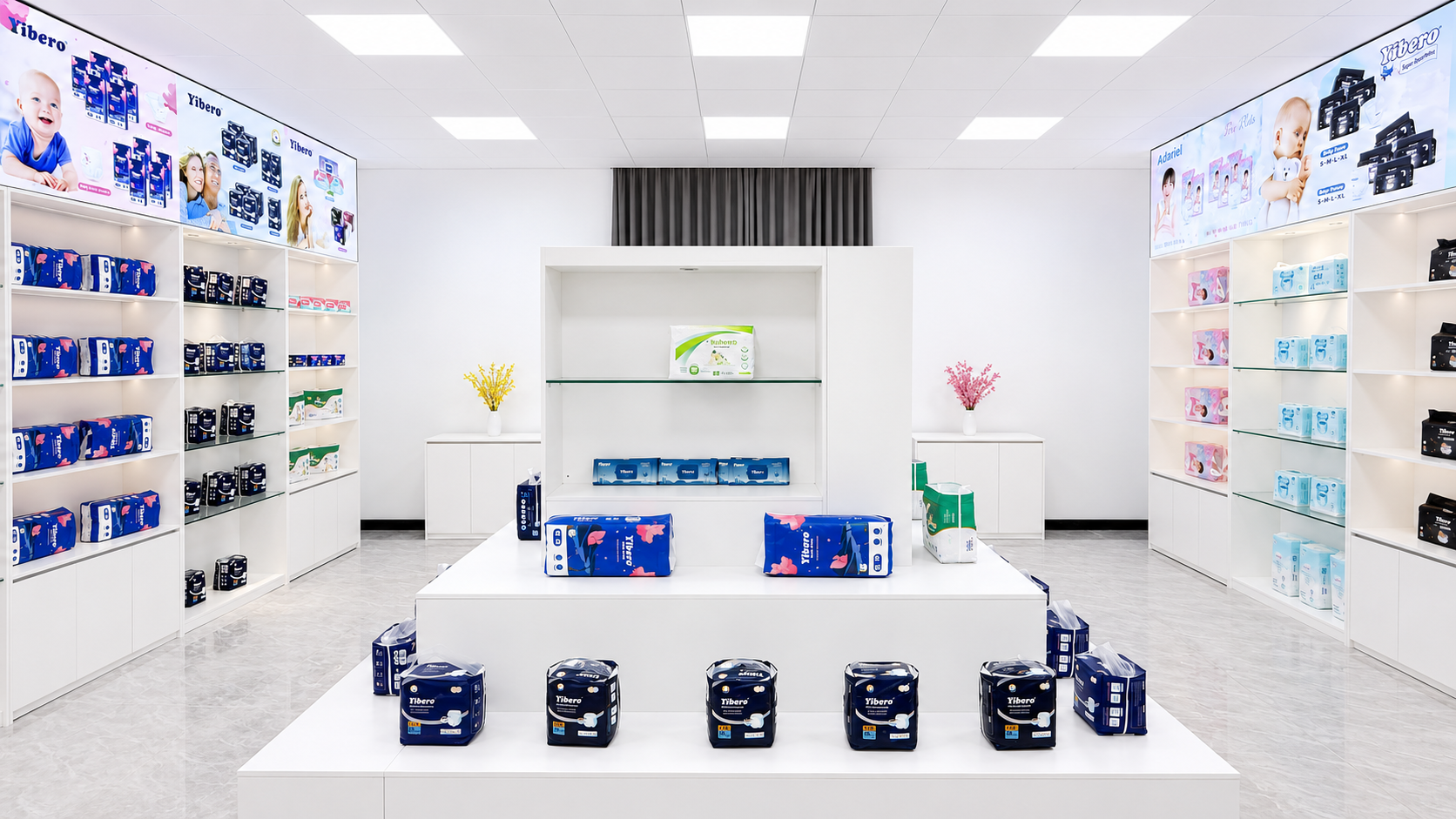
Cover: sample room where fluff pulp & SAP cores and ultra-thin SAP paper cores are reviewed against approved baby diaper samples.
An importer building a private-label baby diaper program reaches one structural question early: should the absorbent core be a fluff pulp & SAP core or an ultra-thin SAP paper core? Both are real production options, not a right-or-wrong choice. Fujian Jiayue Sanitary Products Co., Ltd. — the Quanzhou-based hygiene manufacturer behind the Yibero baby diaper brand and other owned labels — offers both core structures for selected diaper products, and buyers can select a core structure for recurring private-label programs. The decision is therefore a program decision, not a supplier limitation.
The problem is that this decision is often made on an assumption. A common belief is that an ultra-thin core is automatically more absorbent, or that a loftier fluff pulp core is automatically safer against leakage. Neither assumption is supported by the core definition alone. A core structure changes thickness, unit weight, material configuration and the way absorbency is delivered inside the product. It does not, by itself, guarantee a performance result.
Problem Definition: Why Core Structure Is Usually Compared the Wrong Way
Two errors appear repeatedly in importer sourcing spreadsheets. The first is treating thickness as a performance verdict: a thinner diaper is assumed to be more advanced, and a thicker diaper is assumed to be less absorbent. The second is comparing two core structures from different suppliers using different sizes, different samples and different test conditions, then reading the difference as a material advantage.
Both errors ignore how a disposable baby diaper actually works. Liquid passes through the soft topsheet and is distributed into the absorbent core. SAP particles absorb the liquid and swell into a gel, which helps hold moisture inside the core and reduces rewet. Overall performance also depends on SAP distribution, core structure, breathable materials, diaper fit and the height of the 3D leak guards. The core is one variable inside that system, not the whole system.
This is why Jiayue's own published baby diaper configuration is specified at the level of size, dimensions, absorbency target and unit weight rather than at the level of a core name. For the Yibero Premium Quality Ultra Cloudy Baby Diapers configuration in sizes S, M, L and XL, the published reference absorbency is 500 / 600 / 700 / 800 ml, the published unit weights are 26 / 29 / 33 / 35 g, and the baby-weight ranges are 4–8 / 6–11 / 9–14 / 12–17 kg. That configuration uses an imported SAP and fluff-pulp absorbent core with a soft topsheet, nonwoven frontal tape, elastic waistband and cloth-like breathable backsheet. A meaningful comparison has to be made at that same level of detail.
In other words: the correct question is not “which core is better?” but “which core configuration meets the thickness, absorbency, weight and fit requirements of the diaper program I intend to sell?”
Industry Background: What Importers Are Choosing Between in 2026
The commercial context explains why the core decision carries weight. According to Grand View Research, the global baby diaper market was valued at USD 83.3 billion in 2025. Fortune Business Insights data places Asia Pacific at 61.92% of the global diaper market share in 2025, reflecting the region's dominant position in both production and consumption. China remains a central supply base: Xiamen Customs data cited by Jiayue records Fujian province baby diaper export value of CNY 8.74 billion in 2024.
Within the product itself, materials dominate the cost equation. Company-reported data indicates that raw material cost accounts for roughly 78–85% of the ex-factory price of diapers. That figure is why the absorbent core — the material block containing fluff pulp, SAP and carrier layers — is one of the few specification choices that moves both measured performance and unit cost at the same time.
Supplier capability sets the boundaries of what is realistic. Fujian Jiayue Sanitary Products Co., Ltd. was established in 2016 and operates a self-owned factory, Quanzhou Jiarun Paper Industry Co., Ltd., in a facility covering approximately 20,000 square meters, with an in-house R&D and technical support team of 8 engineers covering material selection, absorbent-core design, product development, sampling and specification adjustment. Company-provided information lists automatic production lines running at 700 pcs/min for baby diapers, an export ratio of 90%, customers in more than 70 countries and regions, and shipment volume above 100 × 40HQ containers per month. Those figures are company-reported and should be confirmed against your own order requirements, but they define the scale at which a core structure can be manufactured consistently.
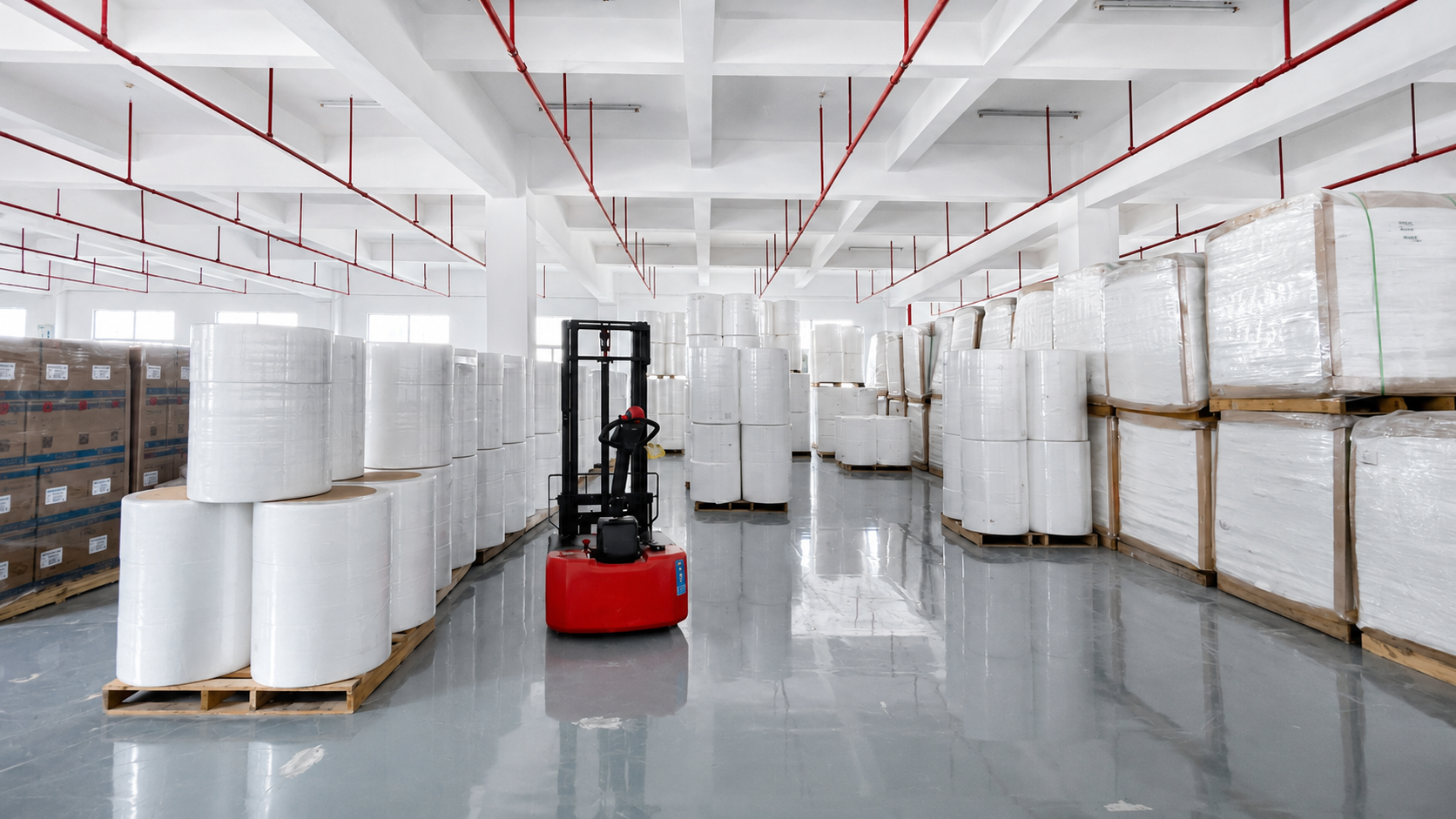
Raw material warehouse: fluff pulp, SAP and SAP paper are stored and issued per approved specification before core production.
Detailed Solution: How the Two Core Structures Actually Differ
Fluff Pulp & SAP Core: Definition and Published Configuration
A fluff pulp & SAP core is an absorbent structure that combines cellulose fluff pulp with superabsorbent polymer. The fluff pulp provides the physical loft and liquid distribution pathway; the SAP absorbs the liquid and retains it as a gel. In the published Yibero Premium Quality Ultra Cloudy Baby Diapers configuration (sizes S, M, L, XL), this core is combined with a soft topsheet, reusable magic tape, nonwoven frontal tape, elastic waistband and cloth-like breathable backsheet, with a shelf life of 5 years under recommended storage conditions.
Published dimensional and performance references for that configuration are:
- Dimensions: 400×320 / 450×320 / 500×340 / 540×340 mm for S / M / L / XL
- Baby-weight ranges: 4–8 / 6–11 / 9–14 / 12–17 kg
- Reference absorbency: 500 / 600 / 700 / 800 ml
- Unit weight: 26 / 29 / 33 / 35 g
These numbers matter because they show the level at which a core specification becomes testable. “Fluff pulp & SAP” on its own is a description; 700 ml reference absorbency at 33 g unit weight in size L is a specification an importer can sample, test and accept.
Ultra-Thin SAP Paper Core: Definition and What Must Be Confirmed
An ultra-thin SAP paper core uses SAP paper as the main absorbent structure instead of relying primarily on a fluff pulp matrix. The structural intent is a thinner core profile. Jiayue offers this core option for selected diaper products, which means an importer can request it within an OEM or private-label program rather than switching suppliers to obtain it.
What an importer should not assume is that the thinner structure comes with a fixed, published performance figure. Thickness, target absorbency and unit weight for an ultra-thin SAP paper core are set by the program brief, the size range, the material list and the core design, and they are confirmed through sampling and an approved specification. The comparison is valid only when both structures are evaluated with the same size, the same test method and the same acceptance criteria.
The Five Dimensions That Decide the Comparison
- Material configuration. What is the core actually made of — fluff pulp plus SAP, SAP paper as the main structure, or a composite core? Which SAP type and distribution are used? Which topsheet, ADL, backsheet and leak-guard materials sit around the core? Material configuration is the input variable that all other dimensions follow from.
- Thickness. Thickness is a measured property of the finished product, not a synonym for absorbency. Confirm measured thickness per size, with the measurement method and tolerance stated in the approved specification.
- Target absorbency. Absorbency should be expressed as a reference value per size, measured with a defined method on a defined sample. The published Yibero S–XL configuration uses 500 / 600 / 700 / 800 ml; an ultra-thin core program should have its own confirmed values at the same level of detail.
- Product weight. Unit weight drives material consumption, freight per container and the tactile impression a consumer has when lifting the pack. The published Yibero S–XL configuration states 26 / 29 / 33 / 35 g per unit; any alternative core structure requires its own confirmed unit weight with tolerance.
- Fit. Fit is determined by cut, tape or pull-up format, elastic waistband, 3D leak guards and backsheet elasticity as much as by the core. A core change can shift stiffness and drape, so fit must be re-trialled across the full size range rather than assumed to carry over.
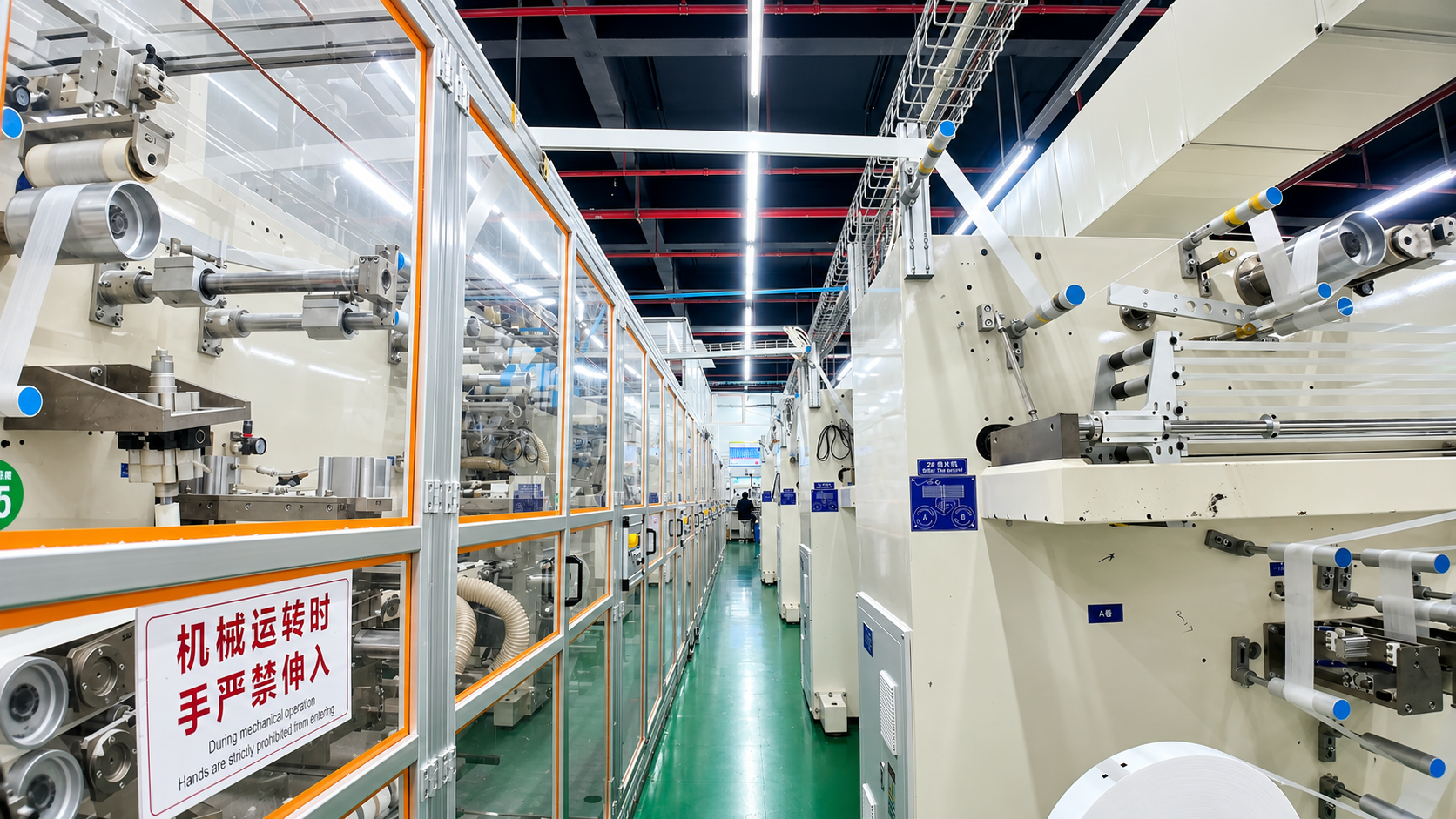
Production line: core structure, format and packaging are converted on the same line, which is why a core change is planned together with the size mix and artwork.
Comparison Table: Fluff Pulp & SAP Core vs Ultra-Thin SAP Paper Core
The table below separates what is verifiable today from what must be confirmed in the approved specification for your own program.
| Evaluation dimension | Fluff pulp & SAP core | Ultra-thin SAP paper core | What to confirm in the approved specification |
|---|---|---|---|
| Material configuration | Cellulose fluff pulp combined with superabsorbent polymer. Used in the published Yibero Premium Quality Ultra Cloudy Baby Diapers configuration together with a soft topsheet, nonwoven frontal tape, elastic waistband and cloth-like breathable backsheet. | SAP paper used as the main absorbent structure. Offered by Jiayue for selected diaper products. | Component-by-component material list, SAP type and SAP distribution inside the core. |
| Thickness | Set by core build and compression; measured on the approved sample, not inferred from the core name. | Thin profile is the structural intent; measured on the approved sample. | Measured thickness per size, with test method and tolerance. |
| Target absorbency | Published reference absorbency for the Yibero S–XL configuration: 500 / 600 / 700 / 800 ml. | No fixed public figure; defined by size and program brief, then confirmed by test. | Reference absorbency per size, test method, sample identity and acceptance criteria. |
| Product weight | Published unit weights for the Yibero S–XL configuration: 26 / 29 / 33 / 35 g. | Set by the material list and core design; confirm per size. | Unit weight with tolerance, measured on the pre-production sample. |
| Fit | Depends on cut, tape or pull-up format, elastic waistband and 3D leak guards as much as on the core. | Same dependency; fit must be re-trialled on the target size range. | Fit trial results across the size range, including the published baby-weight bands 4–8 / 6–11 / 9–14 / 12–17 kg. |
| Cost and program impact | Core material list is one of the largest cost levers; company-reported data indicates raw material cost of roughly 78–85% of ex-factory price. | Same cost logic applies; the thinner structure is a material substitution, not an automatic cost reduction. | Quotation based on identical size mix, pack count, packaging, Incoterm and order volume for both options. |
Step-by-Step Breakdown: Choosing a Core for a Recurring Private-Label Program
For importers in the evaluation-to-execution stage, the core decision is best handled as a sequence rather than a single choice.

Laboratory: absorbency, rewet and material checks are run against the agreed test method and acceptance criteria.
Use Cases: Matching Core Structure to Program Profile
The core structure that fits a program depends on what the program is optimizing for. The profiles below describe decision logic, not performance rankings.
Profile 1 — A published, multi-size retail line
An importer launching a standard S–XL tape-style line with a defined absorbency target can start from a configuration that already has published references — for example the Yibero S–XL configuration at 500–800 ml reference absorbency and 26–35 g unit weight with a fluff pulp & SAP core. The advantage here is documentation: the specification, size bands and material list exist before sampling begins.
Profile 2 — A thin-profile positioning
A brand whose shelf positioning depends on a slim product silhouette would evaluate an ultra-thin SAP paper core and confirm measured thickness, absorbency target and unit weight for each size in its own approved specification. Because no universal performance advantage applies, the thin-profile decision should be validated on a pre-production sample rather than assumed from the core name.
Profile 3 — A pull-up pants program
Pull-up pants add a 360° elastic waist and a different fit mechanism. Because core structure affects stiffness and drape, a pull-up program should trial both core options in the walker size range and confirm fit, leakage protection and comfort before locking the material list.
Profile 4 — A distributor portfolio with mixed sizes
Distributors loading mixed containers need the core structure to stay consistent across sizes. Since baby diaper containers may mix 3–4 sizes, confirming one core structure per program — rather than per size — keeps the specification, the artwork and the reorder process stable across repeat orders.
Frequently Asked Questions
1. Does ISO 13485 certification mean that every baby diaper supplied is certified as a medical device?
No. ISO 13485 is a quality-management-system standard, and the Fujian Jiayue certificate (No. NOA2314356, issued 2023-12-06, valid to 2026-12-05, standard GB/T 42061-2022 / ISO 13485:2016) has a scope limited to Class I medical device sales. It does not by itself classify every baby or adult diaper as a medical device, approve a product for a target market, or prove manufacturing certification. Buyers must verify product classification, intended use, responsible economic operator, required registration or listing, labeling and product-specific test evidence for the destination market. The company also holds ISO 9001 certificate No. NOA2314690 (valid to 2026-12-11), and a CE Declaration of Conformity for baby diapers (CE/PPE-JY-01, issued 2025-05-15) covering sizes NB to XXXXXL under Regulation (EU) 2016/425, Module A. Availability of CE declarations, SGS test reports and other compliance documents depends on the applicable product, destination market and order requirements.
2. Can a China MITM baby diaper manufacturer support custom packaging together with a custom absorbent core?
Yes, where the supplier offers both. Jiayue provides OEM/ODM and private-label supply with customization covering product size and weight, absorbency target, SAP/fluff-pulp or composite core, hot-air or spunbond nonwoven, cloth-like backsheet, tape or pull-up format, 3D leak guards, wetness indicator, waistband, graphics, printed bags and cartons, pack count and size mix. The team also supports artwork and packaging coordination, export documentation and shipment planning. Because fluff pulp & SAP cores and ultra-thin SAP paper cores are both offered for selected diaper products, an importer can choose the core structure and the packaging format within the same program.
3. What determines MOQ and cost when I choose between two core structures?
OEM order MOQ depends on the product, size mix, materials, packaging and customization requirements, while ready-to-ship products may support a lower MOQ; the final MOQ is confirmed in the quotation. Core structure affects cost through the material list, and company-reported data indicates raw material cost accounts for roughly 78–85% of ex-factory price, so a core substitution is a material change rather than a cosmetic one. To make the two options comparable, request quotations on an identical basis: same size mix, pack count, packaging, Incoterm and order volume. Payment options include T/T, L/C at sight and Alibaba Trade Assurance.
4. How should I validate both core structures before placing a bulk order?
Start with samples. Jiayue prepares free samples in 1–3 working days, with the buyer covering courier costs. Test both core options in the same size and compare thickness, absorbency, unit weight and fit against the approved specification and sample, using the same test conditions for each. Then approve a pre-production sample and agree the test method, sampling level and acceptance criteria in the contract before mass production.
5. What is the production lead time, and how do I move from evaluation to a recurring program?
Typical production lead time is approximately 30–45 days, subject to sample, artwork, packaging and specification approval. Monthly production and shipment capacity exceeds 100 × 40HQ containers, and baby diaper containers may mix 3–4 sizes. To move forward, share your market brief, target sizes and packaging direction so the technical team can prepare matched core samples for both options — you can request samples and a quotation here, or review the full range in the JIAYUE Product Catalog 2026.
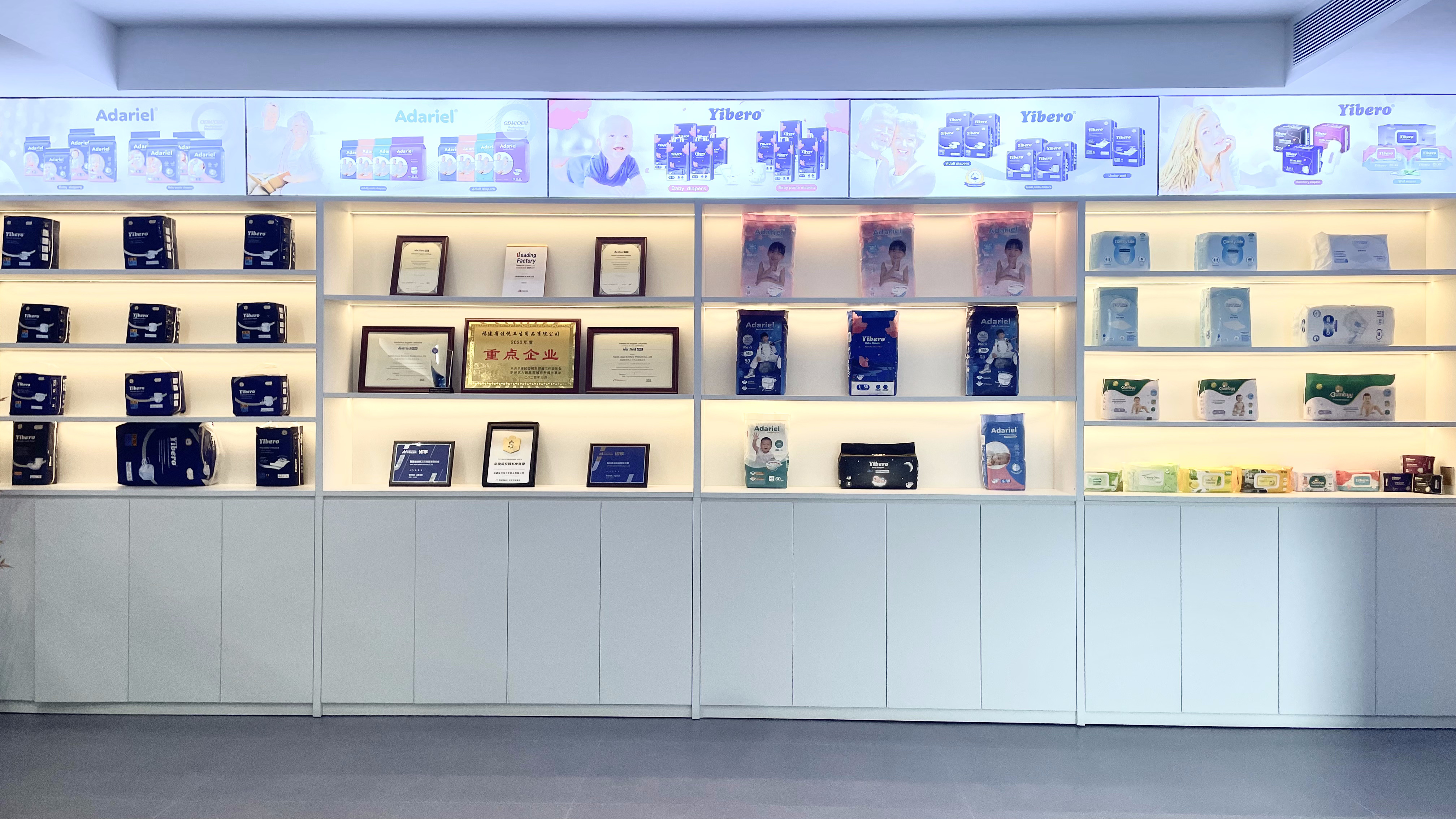
Sample display wall: matched core samples for both structures can be prepared against your size range and packaging direction.
Conclusion: Decide With a Sample, Not an Assumption
Fluff pulp & SAP cores and ultra-thin SAP paper cores are two legitimate ways to build the absorbent structure of a baby diaper, and Jiayue offers both for selected diaper products so that importers can choose a core for recurring private-label programs. What separates them in practice is not a general performance claim but five measurable dimensions: material configuration, thickness, target absorbency, product weight and fit — each of which has to be confirmed for your specific size range, test method and market requirements.
The published Yibero Premium Quality Ultra Cloudy Baby Diapers configuration gives a concrete benchmark on the fluff pulp & SAP side: sizes S–XL, reference absorbency 500 / 600 / 700 / 800 ml, unit weights 26 / 29 / 33 / 35 g, baby-weight bands 4–17 kg and a 5-year shelf life under recommended storage conditions. Use that benchmark to set equivalent targets for an ultra-thin SAP paper core, sample both, and compare results under identical conditions before you commit to a container. Approved specification first, repeat orders second — that sequence is what protects a private-label program over time.
Next Step: Compare Both Cores on Your Own Specification
Send your target market, size range and packaging direction, and Fujian Jiayue Sanitary Products Co., Ltd. will prepare matched samples of both core structures for evaluation. Confirm thickness, target absorbency, unit weight and fit on the same test basis, then approve the specification that fits your program.
Visit www.jiayuediaper.com | Download the JIAYUE Product Catalog 2026
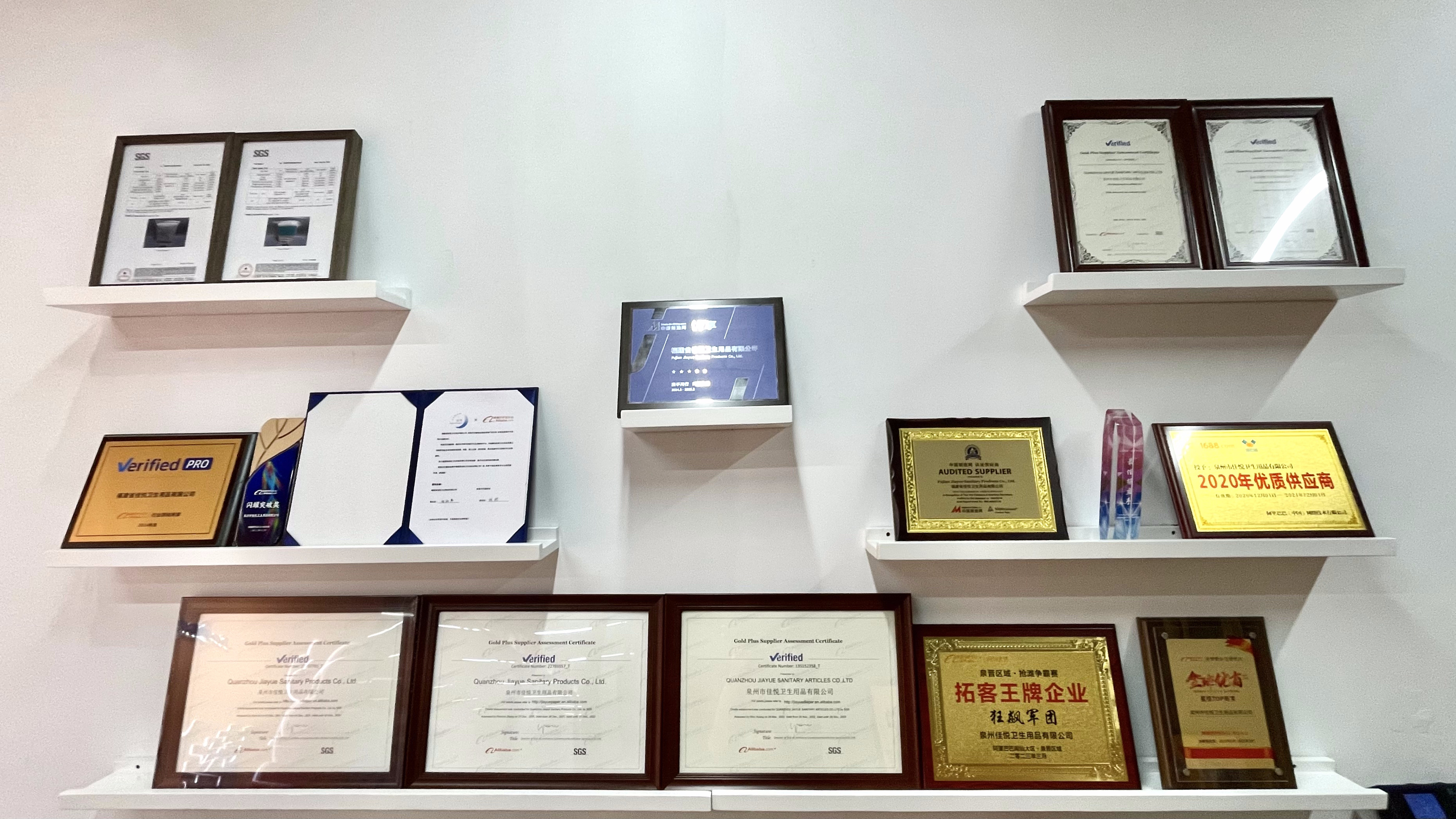
Certificate wall: ISO 9001 (No. NOA2314690) and ISO 13485 (No. NOA2314356) management-system certificates are displayed with their documented scopes.
Contact — Fujian Jiayue Sanitary Products Co., Ltd.
Name: Lena Lin
Email: info@jiayuediaper.com / Lena@jiayuediaper.com
Tel / WhatsApp: +86 159 8030 8853
Address: 3-901-903, Shengrong Square, No. 1110, Dongpu Rd., Tongyuan Community, Chengdong St., Quanzhou, Fujian, China
Website: www.jiayuediaper.com
Have Questions or Need More Details?
Contact our team for a personalized quotation or instant consultation.
Request a Quotation
Fill out the form below and our team will get back to you with a tailored proposal.
WhatsApp Direct Chat
Prefer to chat in real-time? Message us on WhatsApp for instant assistance & quick answers.
- Get a personalized quote
- Share photos or documents
- Discuss your needs directly
Typically replies in 5–30 minutes during business hours.