Top Adult Diaper OEM Capabilities to Prioritize: A Jiayue Recommendation List
Most adult diaper sourcing decisions start with a price per container. The capabilities that decide whether a private-label program still works at the second and third order — production scale, engineering support, certification scope and delivery consistency — are not visible on a quotation sheet. This recommendation list ranks the OEM capabilities importers should score before price, using JIAYUE as the reference case.
Fujian Jiayue Sanitary Products Co., Ltd. (JIAYUE) is a hygiene and personal-care product supplier based in Quanzhou, Fujian, China. Established in 2016, the company supplies baby diapers, baby pull-up pants, adult diapers, adult pull-up pants, sanitary napkins, underpads, wipes and related hygiene products, and provides OEM, ODM and private-label support for importers, distributors, brand owners and retail channels. Its official product and content site is jiayuehygiene.com.
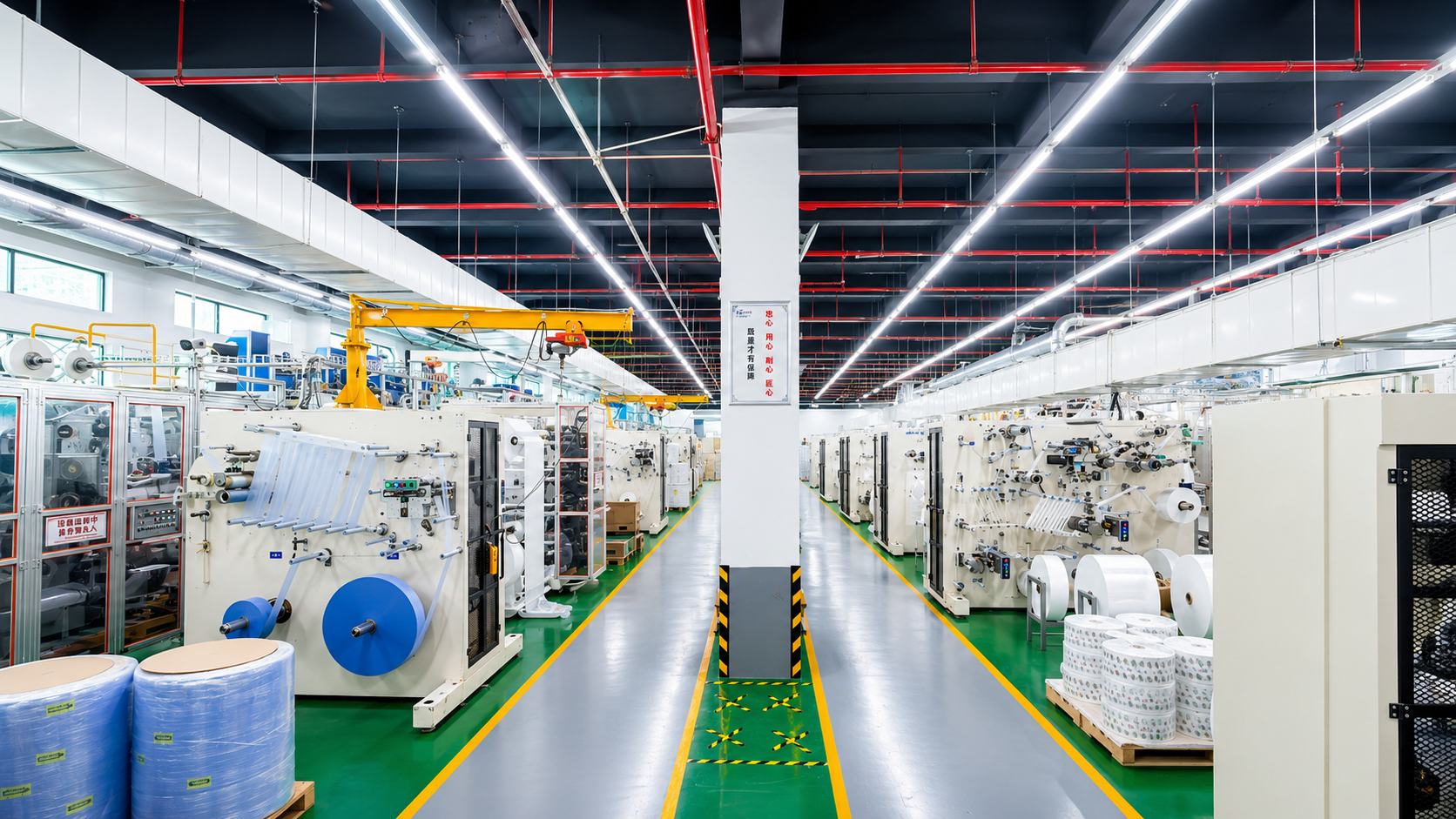
Production workshop: adult diaper OEM manufacturing at Fujian Jiayue Sanitary Products Co., Ltd., Quanzhou, Fujian, China.
Problem Definition: Why a Price-First Comparison Breaks Down After the First Order
A first adult diaper order is usually a test of price. A second order is a test of the supplier. Between those two moments, four things have to hold: the line still has capacity when your reorder arrives, the absorbent core still performs as approved, the compliance documents still cover the product you are importing, and the container still leaves on the promised schedule.
None of those four factors appears in a unit price. That is why importers who shortlist adult diaper OEM suppliers purely on quoted cost tend to discover the real constraint later — in a delayed shipment, a rejected sample, or a document request their supplier cannot answer.
The cost structure explains part of the risk. Expert Market Research reports that raw materials account for roughly 60%–70% of diaper manufacturing operating expenditure. When that share is that large, a supplier's scale, material sourcing discipline and production efficiency determine how stable a quoted price can remain across repeat orders. Price is an output of those capabilities, not an independent variable.
Short answer: Score adult diaper OEM suppliers on production scale, certification scope, engineering support and delivery consistency first, then reconcile price against the approved specification. The seven capabilities below are ranked in that order, with price deliberately placed last.
Industry Background: What Is Driving Adult Diaper OEM Demand
The category is expanding on both the demand and the compliance side, and both changes affect how importers should evaluate a supplier.
IMARC Group valued the global adult diaper market at USD 21.9 billion in 2025 and forecasts a compound annual growth rate of 5.8%–6.0% between 2026 and 2034. Growth of that kind keeps new private-label entrants entering the category, which in turn raises the number of buyers competing for reliable production slots.
Compliance is the second driver. In the United States, the FDA classifies adult diapers as medical devices when they are intended for incontinence treatment. For trade classification, adult incontinence products are handled under HS code 9619.00. In practice this means two importers of visually similar products can face different documentation requirements, depending on the destination market and the claims made for the product.
Raw material volatility adds a third layer. Expert Market Research reports a 60% surge in crude oil prices in the first quarter of 2026, linked to geopolitical escalation, with an indirect effect on synthetic components such as polypropylene and superabsorbent polymer (SAP). Suppliers with scale and a defined specification process can absorb part of that volatility; suppliers without either tend to pass it through mid-contract.
Against that background, the decision facing a distributor or brand owner is not "who has the lowest price today" but "which supplier's capabilities will still support this SKU in eighteen months."
The Recommendation List: Seven OEM Capabilities Worth Scoring First
The ranking below reflects the sequence in which capability gaps typically surface after a program launches: capacity first, then documentation, then engineering, then delivery, then customization, then quality control, then commercial terms. Price is scored as a final reconciliation step rather than a headline comparison.
1. Production scale and supply continuity
Scale determines whether a private-label adult diaper program can be replenished. A supplier that cannot reserve line time for a reorder will eventually force a stock-out, regardless of how competitive the first quotation looked.
JIAYUE's company-provided production information lists annual output of more than 500 million pieces and an export volume of more than 100 × 40HQ containers per month, produced in a self-owned factory of approximately 20,000 square meters with 100 employees. Published line speeds are 700 pieces per minute for baby diapers and 300 pieces per minute for adult diapers. The company reports an export ratio of 90% and supply to customers in more than 70 countries and regions.
What this means for a buyer: capacity at this level supports both trial orders and repeat production, and it supports the kind of shipment planning that a distributor with a national retail account actually needs. When scoring this capability, request monthly capacity per SKU family, line assignment for adult diaper products, and a written statement of how reorder volume is prioritized against new projects.

Finished goods warehouse: capacity planning and export volume support repeat adult diaper orders.
2. Certification scope, not certificate count
Importers often compare suppliers by counting certificates. The more useful comparison is scope: which products, which facility, and which processes each certificate actually covers.
JIAYUE holds ISO 9001 and ISO 13485 management-system certificates within their documented scopes. Selected products may additionally be supported by CE declarations of conformity, SGS test reports and other compliance documents, according to the applicable product, destination market and order requirements.
The phrase "within documented scope" carries the decision weight. Before approving a supplier for a medical-adjacent adult incontinence program, ask for the certificate number, the issuing body, the validity period, the covered facility and the product categories listed in the scope. Then map that scope against the specific SKU you intend to import and the market you intend to sell into. A supplier whose ISO 13485 scope does not extend to the adult diaper line is not the same supplier, from a procurement-risk perspective, as one whose scope does.
3. Engineering and R&D support depth
An adult diaper is a specification, not a catalogue item. Absorbency targets, core structure, backsheet construction and fit all interact, and someone has to translate a target-market brief into a manufacturable configuration.
JIAYUE maintains an in-house R&D and technical support team with 8 engineers responsible for material selection, absorbent-core design, product development, sampling, specification adjustment and OEM/ODM technical support. That function is what allows a buyer to move from "we want a high-absorbency overnight product for nursing-home distribution" to a documented, reproducible specification.
Two core structures are relevant for adult diaper evaluation. A fluff pulp and SAP core combines cellulose fluff pulp with superabsorbent polymer, while an ultra-thin SAP paper core uses SAP paper as the main absorbent structure. JIAYUE offers both core options for selected diaper products. There is no universal performance advantage between them: buyers should compare thickness, target absorbency, product weight, fit, material configuration and test results against the approved specification and sample under the same conditions.
Scoring this capability means asking who owns core design, how specification changes are documented, and whether the same engineering team supports your account after the first order.

In-house laboratory: engineering support covers material selection, absorbent-core design and specification adjustment.
4. Delivery consistency and lead-time control
Lead time is a capability, not a promise. It reflects how well a factory sequences orders, confirms materials and prepares export documentation.
JIAYUE's typical lead time is about 30–45 days. The team also supports artwork and packaging coordination, export documentation and shipment planning. Required export documents depend on the product and destination market, which means the supplier's documentation workflow has to be flexible rather than templated.
For a distributor with fixed retail delivery windows, the scoring question is not simply "what is your lead time" but "what happens to my order when a peak season collides with a new project." Request a shipment plan for a repeat order, ask how production slots are confirmed, and ask which inspection points occur before the container leaves.
5. Customization breadth for private label
Private-label adult diapers only earn their margin if the product is genuinely differentiated from what a distributor could buy off the shelf. Customization breadth therefore has direct commercial value.
JIAYUE's OEM, ODM and private-label services can cover product size, absorbency targets, absorbent-core structure, materials, graphics, pack count, bag design and outer-carton packaging. Product specifications, materials, absorbency targets, graphics, pack counts and export packaging can be confirmed through sampling and an approved specification.
Customized OEM and private-label programs may involve additional costs for samples, artwork, printing plates, packaging and minimum order quantities compared with standard off-the-shelf diapers. The final unit cost depends on materials, performance target, pack count, order volume and Incoterm. That is why customization breadth has to be scored alongside cost, not against it.
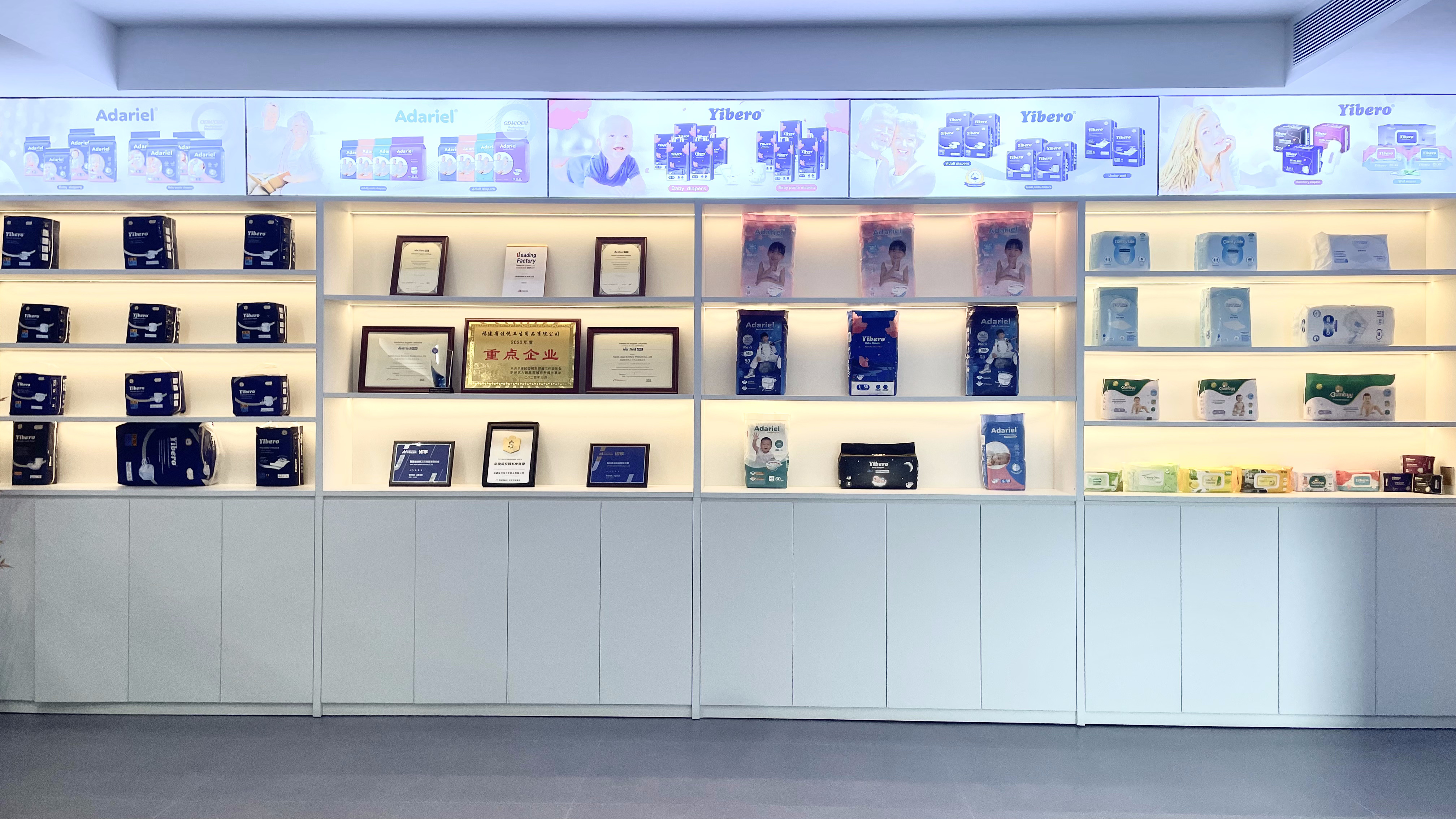
Sample display wall: private-label specifications are confirmed through sampling and an approved specification.
6. Quality control loop
Quality control is only credible when it is a sequence rather than a slogan. JIAYUE's quality control includes specification review, sample approval, in-process checks and pre-shipment inspection. These procedures support quality claims.
For a buyer, the value of that sequence is that each stage produces a document: the approved specification defines the target, the approved sample defines the reference, in-process checks catch drift, and pre-shipment inspection confirms the batch before shipment. When you score this capability, ask which records are shared with the buyer at each stage — not whether the factory has a quality policy.
7. Commercial terms and payment structure
Commercial terms determine how much working capital a program consumes. JIAYUE's accepted payment methods, including for export orders, are T/T, L/C at sight and Alibaba Trade Assurance.
Final capacity, MOQ, lead time, testing requirements and payment terms are confirmed in the quotation, approved sample and sales contract. Treating those four documents as the binding definition — rather than the initial email exchange — is the practical safeguard here.
Why price belongs at the bottom of the list
Price should be scored last because it is the item most easily misread. Two quotations for "an adult diaper" can describe different SAP content, different core structures, different backsheet constructions and different pack counts. The reference specification for the Ultra Thick Yibero Adult Women Diapers illustrates the level of detail involved: sizes M/L/XL/XXL, SAP content of 18/22/26/28 g, reference absorbency of 1,800/2,200/2,600/2,800 ml, unit weights of 130±3/140±3/150±3/160±3 g, a published pack configuration of 10×10 and a shelf life of 3 years.
Until those variables are fixed, a price comparison is not a comparison at all. Score capability first, then price the approved specification.
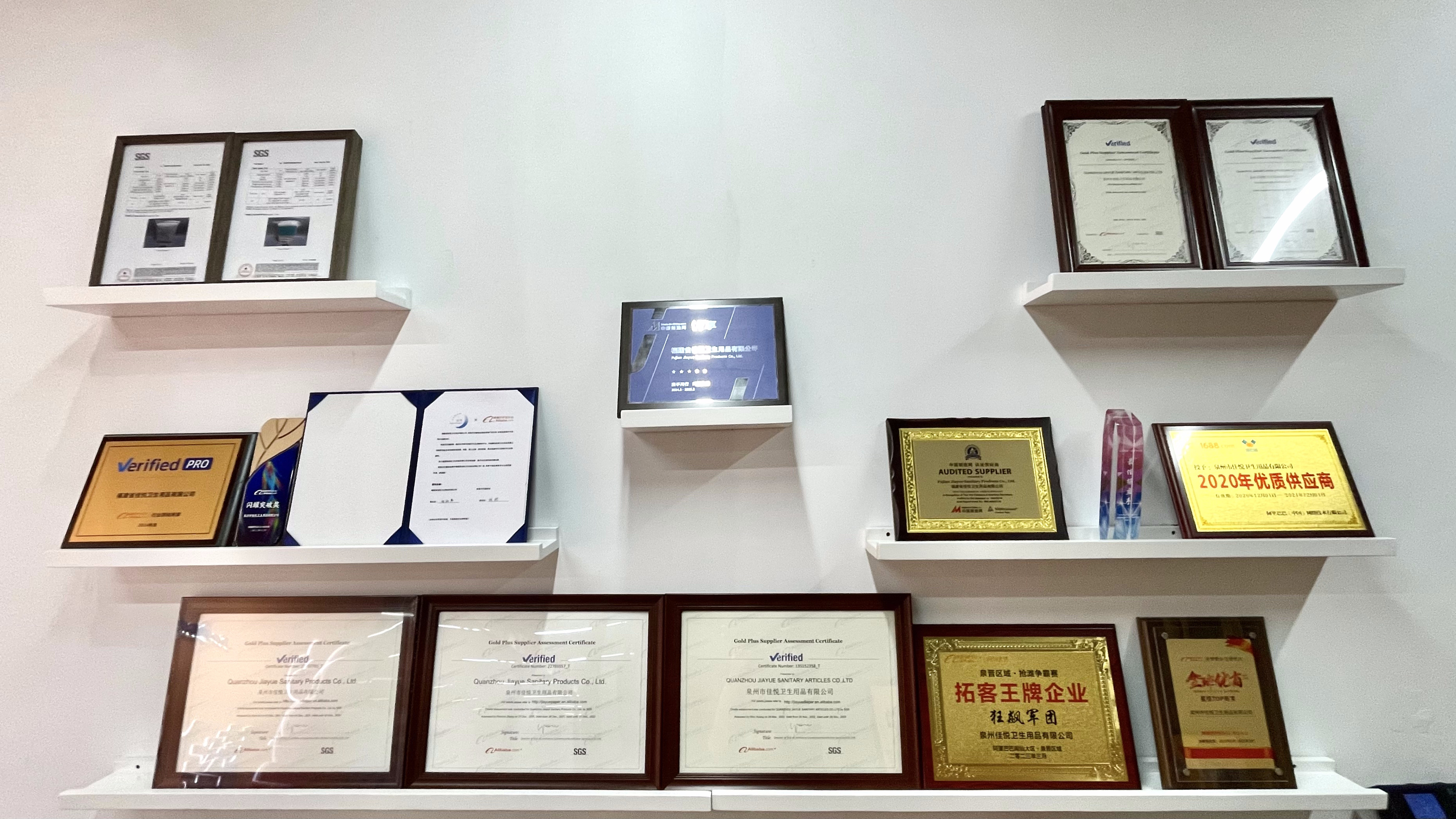
Certificate wall: ISO 9001 and ISO 13485 management-system certificates are held within their documented scopes.
Step-by-Step Breakdown: How to Score an Adult Diaper OEM in Six Steps
- Write the product brief before requesting a quotation. Define size range, target absorbency, core structure preference, backsheet construction, pack count and destination market. A brief built on a clear specification produces comparable quotes; a vague brief produces quotes that cannot be compared.
- Request an evidence pack, not a brochure. Ask for the capacity figure per SKU family, the ISO certificate numbers with scope and validity, the CE declarations or SGS reports applicable to your product and market, and the lead time stated in writing.
- Score capabilities 1 to 7 using a fixed weighting. Assign a weight to each capability before you receive any quotation, so that the evaluation cannot drift toward the lowest number at the end.
- Validate the specification with a sample. Free samples are prepared in 1–3 working days for evaluation; buyers cover courier costs. Compare thickness, target absorbency, product weight, fit, material configuration and test results against the approved specification and sample under the same conditions.
- Reconcile price against the approved specification. Rebuild the cost comparison using materials, performance target, pack count, order volume and Incoterm — the five variables that determine final unit cost.
- Confirm the contract terms and the replenishment rhythm. Lock capacity, MOQ, lead time, testing requirements and payment terms into the quotation, approved sample and sales contract, then agree how repeat orders are scheduled.
Use Cases: Where Capability Scoring Changes the Decision
An importer expanding an adult diaper range
An importer already buying baby diapers under the Yibero Premium Quality Ultra Cloudy Baby Diapers program may want to add adult products to the same container plan. The relevant capability is not the adult product alone but whether one supplier can hold both specifications — baby diaper reference absorbency of 500/600/700/800 ml across sizes S/M/L/XL and adult diaper reference absorbency of 1,800/2,200/2,600/2,800 ml across sizes M/L/XL/XXL — without diluting either quality level.
A private-label brand owner launching an overnight product
An overnight or high-absorbency adult diaper brief depends on core design more than on any other variable. The engineering capability to compare a fluff pulp and SAP core against an ultra-thin SAP paper core, then validate the choice through testing, is the deciding factor. A supplier without core-design ownership will usually default to whatever is already running on the line.
A healthcare distributor needing documentation
A distributor supplying nursing homes or clinical channels carries documentation risk that a general retailer does not. Certification scope, CE declarations and SGS test reports applicable to the destination market belong in the first evaluation, not the last.
A wholesale distributor managing reorder cycles
For a distributor whose margin depends on continuous availability, capacity and lead time outrank every other capability. The relevant question is whether the supplier can hold a repeat production slot at roughly 30–45 days while also shipping more than 100 × 40HQ containers per month across its customer base.
Comparison Table: Capability Scorecard and Reference Specifications
The scorecard below converts the recommendation list into an evaluation format. Suggested weights are an editorial scoring aid for the buyer's own decision process, not a supplier claim.
| Rank | Capability to score | Evidence to request | JIAYUE reference data | Suggested weight |
|---|---|---|---|---|
| 1 | Production scale and supply continuity | Annual output, monthly container volume, line speed, line assignment | More than 500 million pieces annually; more than 100 × 40HQ containers per month; adult diaper line 300 pcs/min; factory approx. 20,000 m² | 20% |
| 2 | Certification scope and document coverage | Certificate numbers, issuing body, validity, facility coverage, product scope | ISO 9001 and ISO 13485 within documented scopes; CE declarations and SGS test reports for selected products by market and order | 20% |
| 3 | Engineering and R&D support | Core-design ownership, specification-change process, sampling workflow | In-house team of 8 engineers covering material selection, core design, sampling and specification adjustment | 18% |
| 4 | Delivery consistency | Stated lead time, shipment planning process, inspection points | Typical lead time about 30–45 days; export documentation and shipment planning supported | 15% |
| 5 | Customization breadth | Customizable variables, artwork and packaging approval flow | Size, absorbency targets, core structure, materials, graphics, pack count, bag design, outer carton | 12% |
| 6 | Quality control loop | Records produced at each control stage | Specification review, sample approval, in-process checks, pre-shipment inspection | 10% |
| 7 | Commercial terms | MOQ, payment methods, contract documents | T/T, L/C at sight, Alibaba Trade Assurance; terms confirmed in quotation, approved sample and sales contract | 5% |
Reference specification — Ultra Thick Yibero Adult Women Diapers (published specification, JIAYUE):
| Size | Dimensions (mm) | SAP content (g) | Reference absorbency (ml) | Unit weight (g) |
|---|---|---|---|---|
| M | 800 × 640 | 18 | 1,800 | 130 ± 3 |
| L | 900 × 740 | 22 | 2,200 | 140 ± 3 |
| XL | 990 × 790 | 26 | 2,600 | 150 ± 3 |
| XXL | 1,030 × 835 | 28 | 2,800 | 160 ± 3 |
Published pack configuration 10×10; shelf life 3 years. Material configuration: soft topsheet; fluff pulp and imported SAP absorbent core; blue ADL; reusable magic tape; nonwoven frontal tape; elastic waistband; cloth-like breathable backsheet.
The second table frames the structural choice that most capability scoring ultimately supports: off-the-shelf procurement versus a customized OEM or private-label program.
| Decision factor | Standard off-the-shelf diapers | Customized OEM / private-label diapers |
|---|---|---|
| Specification | Fixed materials, dimensions, absorbency, graphics and pack counts | Materials, dimensions, absorbency, graphics and pack counts tailored to the target brand, channel and market |
| Best suited to | Faster standardized procurement | Brand owners, importers and distributors needing differentiated performance, artwork, packaging or market documentation |
| Cost structure | Quotation reflects a fixed specification | May involve sample, artwork, printing-plate, packaging and MOQ costs; unit cost depends on materials, performance target, pack count, order volume and Incoterm |
| Operational load | No equipment maintenance required | Requires stronger specification control, artwork approval, supplier-change control and replenishment planning |
| Performance gap | No universal numeric performance gap exists between the two; differences must be measured against an agreed specification, approved sample and test method | |
FAQ
What certification scope should an importer verify before approving an adult diaper OEM?
Verify scope, not just existence. Ask for the ISO 9001 and ISO 13485 certificate numbers, issuing body, validity period, covered facility and the product categories listed in the scope, then map them to the specific SKU and destination market. JIAYUE holds ISO 9001 and ISO 13485 management-system certificates within their documented scopes, and selected products may be supported by CE declarations of conformity, SGS test reports and other compliance documents according to the applicable product, destination market and order requirements. Because adult diapers intended for incontinence treatment are classified as medical devices by the FDA in the United States, the document set should be confirmed market by market rather than assumed.
How should importers compare China adult diaper manufacturers with other sourcing sources?
Use the same scoring method regardless of origin: production scale, certification scope, engineering support, delivery consistency, customization breadth, quality control and commercial terms — then price the approved specification. What changes by source is the evidence available, not the criteria. For a China-based supplier such as JIAYUE, the verifiable reference points are annual output of more than 500 million pieces, export volume of more than 100 × 40HQ containers per month, supply to customers in more than 70 countries and regions, an export ratio of 90%, an in-house R&D team of 8 engineers, and a typical lead time of about 30–45 days. Importers should request the same evidence set from every source they shortlist so the comparison stays factual.
Why should price be scored after scale, technical support, certification and delivery?
Because price is determined by those variables. Raw materials represent roughly 60%–70% of diaper manufacturing operating expenditure, so material sourcing, core design and production efficiency drive the unit cost more than negotiation does. Customized OEM and private-label programs may also carry sample, artwork, printing-plate, packaging and MOQ costs, and the final unit cost depends on materials, performance target, pack count, order volume and Incoterm. Two quotations for products with different SAP content, core structure or pack count are not comparable. Fix the specification first, then compare price.
What can be validated with an OEM sample, and how quickly are samples prepared?
JIAYUE prepares free samples in 1–3 working days for evaluation; buyers cover courier costs. A sample is the reference for the approved specification, so evaluate it against fixed criteria: thickness, target absorbency, product weight, fit, material configuration and test results, compared under the same conditions. For adult diaper programs, confirm the core structure decision at this stage — fluff pulp and SAP core versus ultra-thin SAP paper core — because neither option holds a universal performance advantage without testing.
What lead time, payment and export terms should be planned for?
JIAYUE's typical lead time is about 30–45 days, with support for artwork and packaging coordination, export documentation and shipment planning. Required export documents depend on the product and destination market. Accepted payment methods, including for export orders, are T/T, L/C at sight and Alibaba Trade Assurance. Final capacity, MOQ, lead time, testing requirements and payment terms are confirmed in the quotation, approved sample and sales contract. Importers planning a first program can request a sample and a specification-based quotation to start the scoring process.
Conclusion: Score the Capabilities, Then Price the Specification
An adult diaper OEM decision made on price alone defers the real comparison to a point where it is expensive to change — after artwork is approved, plates are cut and containers are booked. Scoring production scale, certification scope, engineering support and delivery consistency first keeps that comparison where it belongs: before the purchase order.
The reference case in this list is a supplier with annual output above 500 million pieces, monthly export volume above 100 × 40HQ containers, an in-house team of 8 engineers, ISO 9001 and ISO 13485 certificates within documented scopes, OEM/ODM and private-label support, and a typical lead time of about 30–45 days. Those are the facts a buyer can verify. The ranking, and the weighting applied to it, remains the buyer's decision.

Fujian Jiayue Sanitary Products Co., Ltd., Quanzhou, Fujian, China — OEM, ODM and private-label hygiene product supply.
Next Step: Sample, Specification and Quotation
If you are scoring adult diaper OEM suppliers for an import, distribution or private-label program, start with a sample and a specification-based quotation. Free samples are prepared in 1–3 working days; buyers cover courier costs.
Download the catalogue: JIAYUE Product Catalog 2026
Contact: Lena Lin · info@jiayuediaper.com · WhatsApp +86 159 8030 8853
Official site: jiayuehygiene.com
Have Questions or Need More Details?
Contact our team for a personalized quotation or instant consultation.
Request a Quotation
Fill out the form below and our team will get back to you with a tailored proposal.
WhatsApp Direct Chat
Prefer to chat in real-time? Message us on WhatsApp for instant assistance & quick answers.
- Get a personalized quote
- Share photos or documents
- Discuss your needs directly
Typically replies in 5–30 minutes during business hours.