
Building a Custom HMI Operator Station: From Console to Junction Box
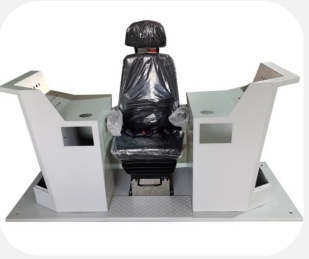
An HMI operator station is normally built from two enclosures, not one. The operator unit — an industrial operator console or a sloped industrial control console — carries the HMI screen, push buttons, indicators and the industrial PC at a height a standing operator can read. The second unit — a PLC electrical enclosure or a stainless steel junction box — carries breakers, terminals, drive modules and cable terminations. Splitting the station this way addresses heat load, electrical noise, ergonomics and maintenance access at the same time, and lets each enclosure carry only the protection rating its own environment actually demands.
This is an application guide, not a catalogue page. It explains how the two halves of a station are specified, how they are joined electrically and mechanically, and which standard modular units suit which factory-floor or SCADA scenario. All specifications quoted below come from documented product data for Yinlu modular consoles and enclosures.
What Counts as an HMI Operator Station
An HMI operator station is the physical assembly a machine operator, dispatcher or maintenance technician uses to monitor and control a process. In a modular build it contains at least two distinct enclosures with different jobs:
- The operator unit — a floor-standing console whose sloped or horizontal panel holds displays, touch screens, meters, selector switches, indicator lights and, in many builds, a keyboard tray and an industrial PC.
- The power and wiring unit — a PLC electrical enclosure, a low-voltage panel enclosure or a stainless steel junction box containing circuit breakers, terminal blocks, power modules, drive modules and the field cable terminations.
- The interface between them — cable ducts, glands, equipotential bonding and the grounding conductor that ties both units to a common reference.
The distinction matters during procurement because the two units are usually quoted, protected and installed under different conditions. A console sits in a control room or at a workstation. A junction box may sit on a washdown floor, at a machine base, in a pumping station or on an outdoor platform.
Problem Definition: Why a Single Enclosure Usually Fails
Combining the display and the power section inside one cabinet looks cheaper at the quotation stage and creates predictable problems during commissioning and operation.
- Thermal load. A sealed enclosure that holds an industrial PC, an HMI, a power supply and a drive has very little surface available for heat rejection. Splitting the build allows a ventilated IP54 console in an air-conditioned room and a separate, fully sealed power box where sealing is required. Data for the Yinlu Industrial Operator Console and Sloped Industrial Control Console specify an operating range of 0 °C to +45 °C and 0 °C to +50 °C respectively, with heat dissipation holes reserved on the side or back of the equipment compartment and optional axial fans.
- Electromagnetic noise. Motor and drive cable routed in the same compartment as HMI signal cable invites interference. The VFD Control Cabinet data sheet notes good electromagnetic shielding performance and resistance to electromagnetic interference in industrial sites; that property is easier to maintain when power and signal are separated by a dedicated compartment or a second enclosure.
- Ergonomics. A control cabinet placed on the floor is a poor reading position for a screen. A console with a sloped operating area of 15° to 30° is designed specifically to put the display and the controls at a natural sightline and reach.
- Service access. Field wiring, terminal blocks and protective devices are touched far more often than the HMI. A separate power enclosure lets a technician isolate and open the wiring compartment without exposing the running interface; the Stainless Steel Junction Box includes a grounding jumper between door and cabinet body and an optional compartment design for strong and weak current isolation.
- Protection mismatch. Console data sheets rate the operator units at IP54 — dustproof and splash-proof, suited to a control room or equipment room. That rating is not appropriate on a washdown line or an outdoor platform, where IP65 or IP66 enclosures, in 304 or 316 stainless steel, are the correct choice.
- Growth. Console structures are modular and expandable by multiple consoles, so a station can gain a second workstation without rebuilding the electrical section.
Industry Background: Why Modular Stations Are Growing
The enclosure market that supplies these builds is large and still expanding. Market Research Future valued the global electrical enclosure market at USD 14.02 billion in 2024 and projects USD 23.65 billion by 2032. Within that total, metal remains the dominant material: Custom Market Insights reported that metallic enclosures, including stainless steel and carbon steel, accounted for 65% of global electrical enclosure demand in 2025, valued at approximately USD 4.73 billion.
Two segments are directly relevant to operator stations. First, hygiene-driven demand: Dataintelo put the global stainless steel HMI enclosure market at USD 1.47 billion in 2024, driven by hygiene requirements in the food and pharmaceutical sectors. Second, regional supply: IMARC Group reported that Asia Pacific held a 36% share of the electrical enclosure market in 2025, supported by industrial automation and renewable energy investment in China and India. Precedence Research expects the wall-mounted enclosure segment to maintain market dominance through 2035 because of its compact design for small equipment installations — which is exactly why a full operator station typically combines a wall-mounted or compact unit for the field side with a floor-standing console for the operator side.
On the technical side, protection ratings are governed by IEC 60529, the IP Code. It is the dominant international standard for rating enclosure protection against dust and water; IP66 requires no ingress of dust and protection against powerful water jets. Buyers who specify IP66 for an indoor console usually pay for sealing they do not need, while buyers who accept an IP54 rating beside a washdown line create a maintenance problem that shows up months later.
The supplier landscape is mixed. Fortune Business Insights lists Rittal GmbH & Co. KG, Schneider Electric, ABB Ltd., Eaton Corporation and nVent HOFFMAN among the major global competitors. Alongside them sit OEM and ODM sheet metal fabricators that build to drawing. Dalian Yinlu Electrical Control Equipment Manufacturer is one of these: a sheet metal fabrication and enclosure manufacturer based in Dalian, Liaoning Province, China, producing electrical control cabinets, intelligent control boxes and electrical distribution equipment for OEM and ODM projects across North American, European, Oceania and high-end Asia-Pacific markets (www.innometalfab.com).
The Modular Solution: Three Layers, Two Enclosures
Layer 1 — The operator console
The console is selected first, because the operator task defines the panel area. Documented Yinlu console data give three workable starting points:
- Industrial Operator Console — 2.0 mm cold-rolled steel, phosphating plus electrostatic powder coating in RAL7035 or a custom colour, IP54, floor-standing on adjustable feet with optional casters. The upper section accepts displays, meters, buttons, indicators, touch screens and switches; the lower section is a storage or equipment compartment with single or double doors or multi-layer drawers, all lockable. Built-in strong and weak current cable ducts run to cable holes at the bottom or back. The countertop and cabinet materials comply with the V-0 flame retardant standard, and the cabinet must be reliably grounded with a grounding resistance of 4 Ω or less.
- Sloped Industrial Control Console — the same 2.0 mm steel, powder-coated and described as scratch-resistant, oil-resistant and easy to clean, with a sloped operating area of 15° to 30°. Custom cutouts on the sloped panel accept instrument windows, button holes, indicator holes, display mounting holes and test interfaces. Optional accessories include drawers, keyboard tray, mouse tray, display bracket, cable ducts, lighting, locks and PDU power sockets.
- Control Room Console and related dispatch structures — the same IP54 platform, built for control rooms, dispatch centres and equipment monitoring rooms, used to integrate displays, instruments, buttons and PLCs for centralised monitoring.
Typical environments for this layer are industrial automation, equipment manufacturing, electronic testing, power debugging, research laboratories and control rooms, with an ambient temperature range of 0 °C to +45 °C or +50 °C and a relative humidity limit of 85% without condensation.
Layer 2 — The power and wiring enclosure
The second unit is where specification discipline pays off. Two documented options cover most builds.
Option A — PLC electrical enclosure (indoor, machine-side). The Yinlu plc electrical enclosure is 2.0 mm cold-rolled steel with phosphating rust removal and electrostatic powder coating in RAL7035, rated IP54, and floor-mounted on adjustable feet or casters. It uses a single door with a stainless steel handle lock and an EPDM sealing strip on the door frame, and may include a transparent observation window in tempered glass or PC, or a ventilation louver for heat dissipation. Internally it is compatible with a 19-inch rack, industrial PC, HMI touch screen, PLC, network switch, power module, terminal blocks, DIN rail and shelves. Knockout holes at the bottom or back accept waterproof cable glands for power and signal cable. Its documented application list is factory automation production lines, intelligent equipment operation stations, shop floor data acquisition and monitoring (SCADA), and equipment remote operation and maintenance stations.
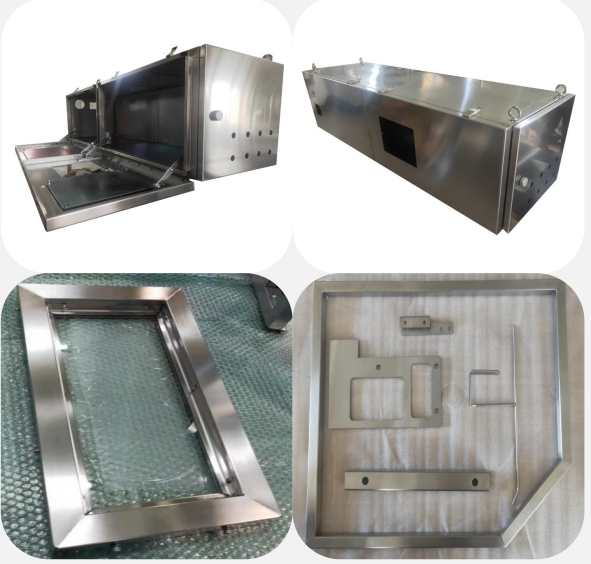
Option B — Stainless Steel Junction Box / Maintenance Box (washdown, corrosive). This unit is 2.0 mm stainless steel with a brushed finish and an IP65 rating for dust, rain and water-immersion exposure. It is floor-standing with a double-door structure, a stainless steel plane or handle lock, an EPDM seal and a grounding jumper between door and cabinet. Inside it provides a mounting plate or DIN rail, terminal blocks and a grounding bar, with an optional compartment design for strong and weak current isolation. Cable entry is through knockout holes at bottom, side or back with waterproof PG or M-type glands, and the size is customised to cable quantity, terminal specification and installation space. Material selection follows the environment: 304 stainless steel resists atmospheric and fresh-water corrosion, while 316 resists salt spray and acid corrosion in coastal, chemical and similar scenarios. Optional protection functions include overload protection, short-circuit protection, surge protection and insulation monitoring, again with a grounding resistance of 4 Ω or less.
Layer 3 — The interface between the two enclosures
The station is only as good as the connection between its halves. Four details decide whether it stays reliable:
- Separate routing. Keep strong and weak current in different ducts. Both the console platform and the junction box support this by design, through built-in cable ducts and optional compartment isolation.
- Correct entry hardware. The consoles use cable holes at the bottom or back; the PLC enclosure and junction box use knockout holes with waterproof cable glands. Glands protect the enclosure rating at the point where cable actually enters.
- Equipotential bonding. Door-to-body grounding jumpers are specified on the junction box and wall-mounted instrument box, and the console requires reliable cabinet grounding at 4 Ω or less.
- Cable length in service loops. Reserve cable slack behind the sloped panel so the console can be opened without straining terminations.
Modular building blocks for a station
| Unit | Documented protection | Material and finish | Role in the station |
|---|---|---|---|
| Industrial Operator Console | IP54 | 2.0 mm cold-rolled steel, phosphating + electrostatic powder coating, RAL7035 or custom | Operator unit: HMI, displays, meters, buttons, industrial PC |
| Sloped Industrial Control Console | IP54 | 2.0 mm cold-rolled steel, powder coated, 15° to 30° sloped panel | Operator unit for workshop and test-room workstations |
| PLC electrical enclosure | IP54 | 2.0 mm cold-rolled steel, RAL7035, EPDM door seal | Power and control unit: PLC, 19-inch rack, power module, terminals |
| Stainless Steel Junction Box / Maintenance Box | IP65 | 2.0 mm 304 or 316 stainless steel, brushed finish | Field wiring unit: terminals, distribution, strong/weak isolation |
| Free Standing Modular Enclosure (YL0923-3) | IP54 / IP55 | 2.0 mm and above, 304/316 stainless steel option, RAL7035 | Combined station: front viewing window for HMI, side and rear doors for wiring |
| Wall-mounted HMI enclosure box | IP55 | 2.1 mm SPCC cold-rolled steel, phosphating + powder coating, RAL7035 or RAL7032 | Compact machine-side interface: push buttons, meters, small PLC |
| Outdoor Weatherproof Control Enclosure | IP66 | Stainless steel or FRP | Outdoor station enclosure: PV combiner, monitoring, base station, street lighting |
Step-by-Step: Building the Station
Step 1 — Define the operator task. Count the displays, meters, buttons, selector switches and indicator lights the operator needs, and decide whether the work is performed standing at the line or seated in a control room. Consoles are expandable by adding units, so size the first console for current needs plus one expansion slot rather than for a hypothetical maximum.
Step 2 — Choose the console geometry. A sloped operating area of 15° to 30° suits a workshop or test-room workstation where the operator stands and reads instruments. A conventional operator console suits control rooms where bigger screens and a keyboard tray are fitted. Both are IP54 and include lockable lower compartments for equipment and storage.
Step 3 — List the power-side components. Record every breaker, terminal block, power module, drive module and 19-inch device that must live in the second enclosure. If the list includes a 19-inch rack, an industrial PC or a switch, the PLC electrical enclosure is the natural fit; if the list is dominated by terminals and distribution, a junction box is more appropriate.
Step 4 — Set a protection rating for each unit separately. IP54 for the console in a control room or equipment room is normally sufficient. Field units beside washdown, hose-down or humid processes should be specified at IP65 in stainless steel, and outdoor positions at IP66. This is a deliberate decision point, not a default.
Step 5 — Match material and finish to the environment. Cold-rolled carbon steel with phosphating and electrostatic powder coating is the standard, cost-efficient choice for indoor stations and is available in RAL7035 or project colours. Where salt spray, acid or aggressive cleaning agents are present, specify 304 stainless steel for atmospheric and fresh-water exposure or 316 for salt spray and acid corrosion, with a brushed finish on junction boxes and instrument enclosures.
Step 6 — Plan cable management before the cutouts are made. Use the built-in strong and weak current ducts in the console, route field cable through glands in the knockout holes of the second enclosure, and confirm the gland type — waterproof PG or M-type on the junction box — against the actual cable diameter. Adding compartments or a divider for strong and weak current is optional on the junction box and worth specifying early.
Step 7 — Design the grounding and bonding path. Both units require reliable cabinet grounding, with grounding resistance of 4 Ω or less on the consoles and junction boxes quoted above. Specify the door-to-body grounding jumper, the internal grounding bar and the equipotential connection between the two enclosures as part of the drawing, not as a site improvisation.
Step 8 — Confirm thermal strategy. Consoles reserve dissipation holes on the side or back of the equipment compartment and support optional axial fans. For higher internal loads, documented options across the platform include axial fan with filter mesh, heat exchanger and industrial air conditioner, selected according to internal heat generation.
Step 9 — Validate on a sample. A station is a low-volume, high-variation build; validating one unit before batch release is standard practice. Yinlu runs a documented quality-control sequence covering visual inspection, wiring, function, safety, sealing and packaging, and accepts orders from 1 to 5 units at minimum order quantity.
Use Cases: Where Split Stations Are the Right Answer
1. Factory automation line and SCADA station
This is the classic configuration. A 19-inch rack, industrial PC, HMI touch screen, PLC, switch and power module sit inside a PLC electrical enclosure, while the operator works at a console with the display and controls at sightline height. The documented application list for that enclosure — factory automation production lines, intelligent equipment operation stations, shop floor data acquisition and monitoring (SCADA), and remote operation and maintenance stations — matches this build directly. Where the HMI must remain visible while the electrical compartment stays closed, the Free Standing Modular Enclosure (YL0923-3) provides a front door with a transparent viewing window for the screen and side or rear doors for component installation and maintenance wiring.
2. Washdown, food, pharmaceutical and chemical areas
Hygiene requirements are the reason the stainless steel HMI enclosure segment reached USD 1.47 billion in 2024, and they change the specification. In these areas the operator unit moves to stainless steel construction, and the field unit becomes a 316 stainless steel junction box at IP65 with a brushed finish, compartment isolation for strong and weak current, waterproof glands and an optional surge-protection or insulation-monitoring function. Documented applications for that junction box include chemical, petroleum, water treatment, environmental protection, food and pharmaceutical, municipal, mining, power and rail transit environments.
3. Port, heavy industry and drive cabinets
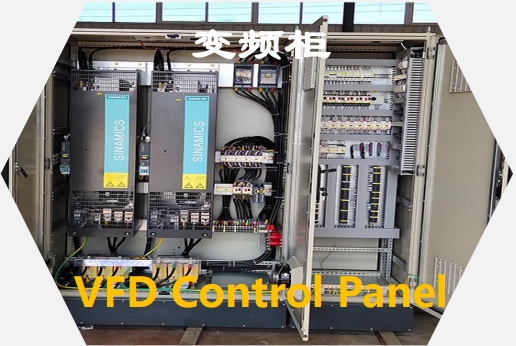
Heavy industrial stations often need large floor-standing enclosures rather than compact boxes. Documented project experience in this area includes electrical control enclosures and cabinets for port bulk cargo handling machinery, coke oven machinery, stacker and reclaimers, cab-mounted controls, low-voltage switchgear, rotatable control panels and VFD control panels — with protection classes configurable from IP55 up to IP67 depending on dust, heat and outdoor corrosion conditions. For a customer series of this type, the documented outcome is a reduction in equipment failure rates and downtime, extending the service life of core equipment.
4. Rail transit and metro control rooms
Rail projects add documentation and interface requirements rather than new enclosure physics. Documented custom control-panel work for metro projects has covered centralised control and monitoring of carriage operation, platform equipment, traction, signalling, ventilation and lighting, with reserved expansion interfaces, fireproof and short-circuit-proof design, anti-electromagnetic interference construction and a sealing protection level of IP55 and above. The reported results included improved operation efficiency, reduced incidence of equipment failures and lower operation and maintenance costs and labour input — the same logic that makes a modular, serviceable station preferable to a single sealed cabinet.
Comparison Table: Matching the Enclosure to the Role
| Attribute | Industrial Operator Console | Sloped Industrial Control Console | PLC electrical enclosure | Stainless Steel Junction Box | Wall-mounted HMI enclosure box |
|---|---|---|---|---|---|
| Primary role | Operator interface at standing height | Sloped operator and test panel, 15° to 30° | Power, PLC and 19-inch equipment housing | Terminal, distribution and cable termination point | Compact machine-side control interface |
| Protection rating | IP54 | IP54 | IP54 | IP65 | IP55 |
| Plate thickness | 2.0 mm | 2.0 mm | 2.0 mm | 2.0 mm | 2.1 mm |
| Material and finish | Cold-rolled steel, phosphating + electrostatic powder coating, RAL7035 or custom | Cold-rolled steel, powder coated, scratch and oil resistant | Cold-rolled steel, RAL7035, EPDM door seal | 304 or 316 stainless steel, brushed finish, EPDM seal | SPCC cold-rolled steel, RAL7035 or RAL7032 |
| Installation | Floor-standing, adjustable feet, casters optional | Floor-standing, adjustable feet, casters on some models | Floor-mounted with adjustable feet or casters | Floor-standing, double door | Recessed or surface wall mounting |
| Typical internal fit | Displays, HMI, meters, buttons, indicators, industrial PC, power modules | Instrument windows, buttons, indicators, displays, test interfaces | 19-inch rack, industrial PC, HMI, PLC, switch, power module, terminals, DIN rail | Mounting plate, DIN rail, terminal blocks, grounding bar, distribution devices | DIN rail, terminals, small PLC, relays, push buttons, meters |
| Typical environment | Control rooms, dispatch centres, equipment monitoring rooms | Workshops, test rooms, laboratories, power debugging areas | Automation lines, SCADA stations, remote operation and maintenance points | Chemical, water treatment, food and pharma, municipal, mining, power, rail transit | Building weak-current boxes, local control boxes, field push-button stations |
Recommended Combinations by Scenario
For buyers evaluating configurations rather than individual boxes, the following pairings keep the protection rating, material and service access consistent across the whole station.
| Scenario | Operator unit | Power and wiring unit | Why this pairing |
|---|---|---|---|
| Indoor control room or SCADA station | Industrial Operator Console, IP54 | PLC electrical enclosure, IP54 | Both rated for control-room conditions; 19-inch equipment lives in the enclosure, the operator keeps sightline height |
| Workshop or test-bay workstation | Sloped Industrial Control Console, IP54 | PLC electrical enclosure, IP54 | Sloped 15° to 30° panel for instruments and test interfaces; clean separation from power devices |
| Washdown, food, pharma or chemical area | Stainless steel console or Stainless Steel Electrical Control Cabinet in 304/316 | Stainless Steel Junction Box, IP65, 316 stainless steel | Corrosion resistance matches the cleaning regime; compartment design isolates strong and weak current |
| Semi-outdoor panel with a local display | Free Standing Modular Enclosure with front viewing window | Stainless Steel Junction Box or IP66 outdoor weatherproof enclosure | The screen stays visible through the window while wiring remains behind separate doors |
| Compact machine-side station | Wall-mounted HMI enclosure box, IP55 | Small Customized Electrical Control Box, IP55, upgradeable to IP65 | Both mount beside the machine; the control box accepts PLC, relays, terminals and drive modules on a DIN rail |
Frequently Asked Questions
What IP rating should the console and the junction box each carry?
They do not need the same rating, and specifying them separately usually saves cost. Documented operator consoles, including the Industrial Operator Console and the Sloped Industrial Control Console, are rated IP54 — dustproof and splash-proof, appropriate for control rooms, equipment rooms, workshops and test rooms. Field units that face washdown or humid processes should be specified at IP65, as with the Stainless Steel Junction Box, and outdoor positions at IP66, as with the Outdoor Weatherproof Control Enclosure. The reference standard is IEC 60529, under which IP66 means no ingress of dust and protection against powerful water jets. Dalian Yinlu holds SGS-issued Verifications of Conformity covering EN 60529:1991+A1+A2 with scope for an electric control cabinet and an electric control box, together with conformity to the EU Low Voltage Directive 2014/35/EU, under certificate numbers IN-DL-5805-22013-1 and IN-DL-5805-22013-2.
Can one supplier build both the console and the matching PLC enclosure?
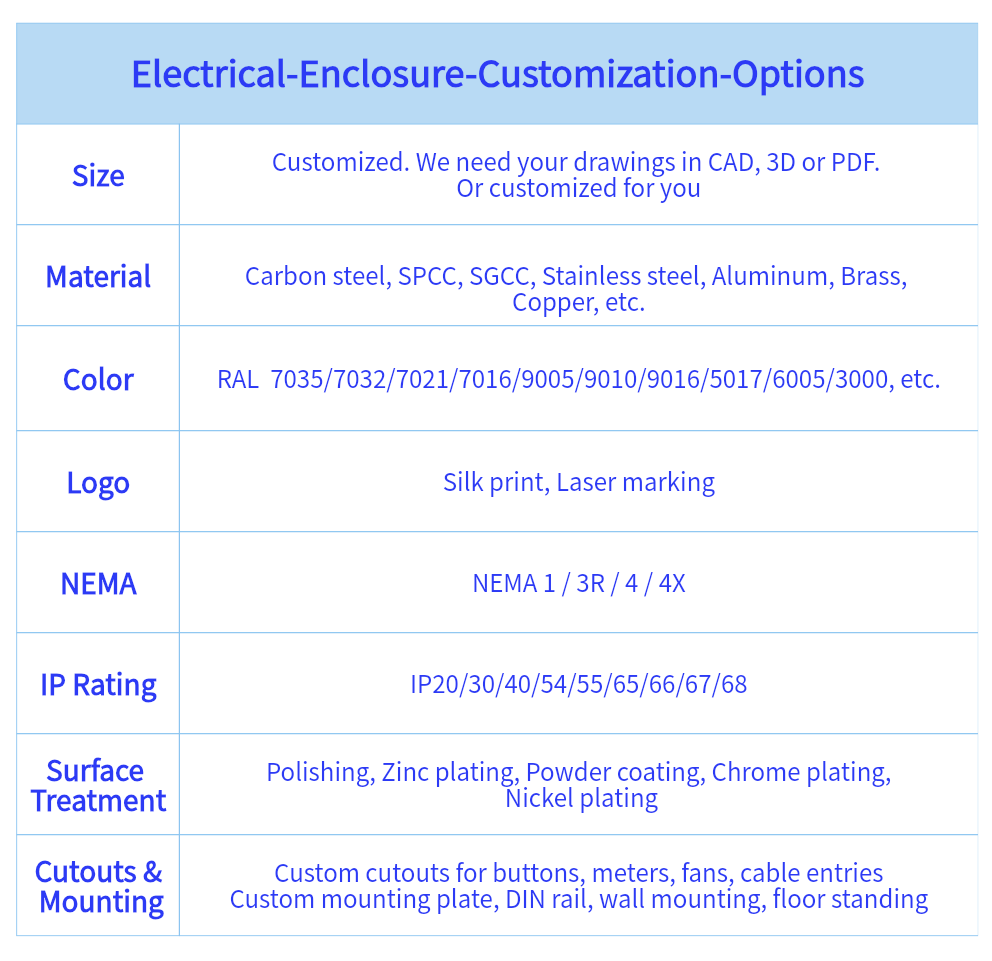
Yes, and a single source avoids tolerance and colour mismatches between the two halves of a station. Dalian Yinlu Electrical Control Equipment Manufacturer operates as an OEM and ODM supplier with a documented monthly capacity of 2,000 units, a 5,000 m² facility, a six-person R&D team and an export share of 80% across North American, European, Oceania and high-end Asia-Pacific markets. Customisation covers material, colour, logo, size, IP rating, surface treatment, cutouts and mounting, which is what allows a console panel layout and a matching junction box cutout pattern to be produced to the same drawing set. Quality management is certified to ISO 9001:2015 under certificate 19923Q01395R0M, with a scope covering the production of metal shells for electronic control equipment and instruments.
What drives the cost of a custom operator station?
The cost is determined by the specification choices, not by the enclosure count alone. The main drivers are material grade — cold-rolled carbon steel versus 304 or 316 stainless steel; plate thickness, with consoles and the PLC enclosure built at 2.0 mm while heavier structures such as low-voltage switchgear use 2.5 mm and sloped PLC control consoles use 3.0 mm; the protection rating, since sealing hardware changes when a unit moves from IP54 to IP65 or IP66; the quantity and complexity of cutouts and mounting features on a sloped panel; optional interior items such as drawers, keyboard trays, display brackets, PDU sockets and compartment dividers; and thermal options including axial fans with filter mesh, heat exchangers or industrial air conditioners selected against internal heat generation. Specifying each unit against its real environment — rather than applying the highest rating everywhere — is the most effective cost control in the whole build.
Can I validate a sample station before committing to a batch?
Yes. Yinlu accepts orders from 1 to 5 units at minimum order quantity, which makes single-unit sample validation practical for a two-enclosure station. Each unit passes through a documented quality-control sequence covering visual inspection, wiring, function, safety, sealing and packaging, so a sample is checked on the same criteria as a production batch. Sample validation is the point at which panel cutouts, cable entry positions, door swing, keyboard tray height and gland sizes should be confirmed in the physical assembly, before the layout is frozen for a larger run.
What is the production capacity and lead time for a station order?
Documented capacity is 2,000 units per month, and lead time is set per project rather than quoted as a fixed figure, because it depends on material grade, panel cutout complexity, finish and accessory selection. The practical way to shorten it is to submit a complete specification in one pass — console type, envelope dimensions, protection rating per unit, material, cutouts and quantity — so the quotation and the drawing release are not delayed by follow-up questions. After-sales support is available 7 days a week, 24 hours a day, with a one-year warranty. To start, send your panel layout or a sketch of the station to sales@innometalfab.com or reach the team on WhatsApp at +86 186-2435-1618 for a sample and quotation.
Conclusion
A reliable HMI operator station is designed as a small system, not bought as a single cabinet. The console puts the interface where the operator can see and reach it at a sloped angle of 15° to 30° for standing work, with displays, indicators and controls laid out on a custom panel and an industrial PC housed safely below. The second enclosure — a PLC electrical enclosure for indoor machine-side builds, or a stainless steel junction box at IP65 for washdown and corrosive areas — carries the protective devices, terminals and cable terminations under the protection rating that environment actually requires. Between the two, cable ducts, waterproof glands, compartment isolation and a grounded equipotential path tie the station together.
The specifications quoted throughout this guide come from documented product data: IP54 consoles and PLC enclosures in 2.0 mm powder-coated steel, IP65 junction boxes in 304 or 316 stainless steel, IP66 outdoor enclosures, and grounding requirements of 4 Ω or less across the platform. Because the units are modular, the same architecture scales from a single machine-side station to a multi-console control room without redesigning the electrical section.
Next step: validate one station before you scale
Send your console panel layout and the component list for the power side, and Dalian Yinlu will return a sample and quotation covering both enclosures as a single build. Orders start from 1 to 5 units, with 2,000 units per month of production capacity behind them.
Visit innometalfab.com Download the product brochure (PDF)Email: sales@innometalfab.com | Tel / WhatsApp: +86 186-2435-1618 | Dalian Yinlu Electrical Control Equipment Manufacturer, Ganjingzi District, Dalian, Liaoning, China
Scope note: this guide describes modular enclosure selection for operator stations. Enclosure ratings, materials and options listed here reflect documented product data; final specifications for any project should be confirmed against the released drawing and the applicable site standard before installation.
Have Questions or Need More Details?
Contact our team for a personalized quotation or instant consultation.
Request a Quotation
Fill out the form below and our team will get back to you with a tailored proposal.
WhatsApp Direct Chat
Prefer to chat in real-time? Message us on WhatsApp for instant assistance & quick answers.
- Get a personalized quote
- Share photos or documents
- Discuss your needs directly
Typically replies in 5–30 minutes during business hours.