
Regional Electrical Enclosure Compliance FAQ: Materials, IP54, and Installation Requirements
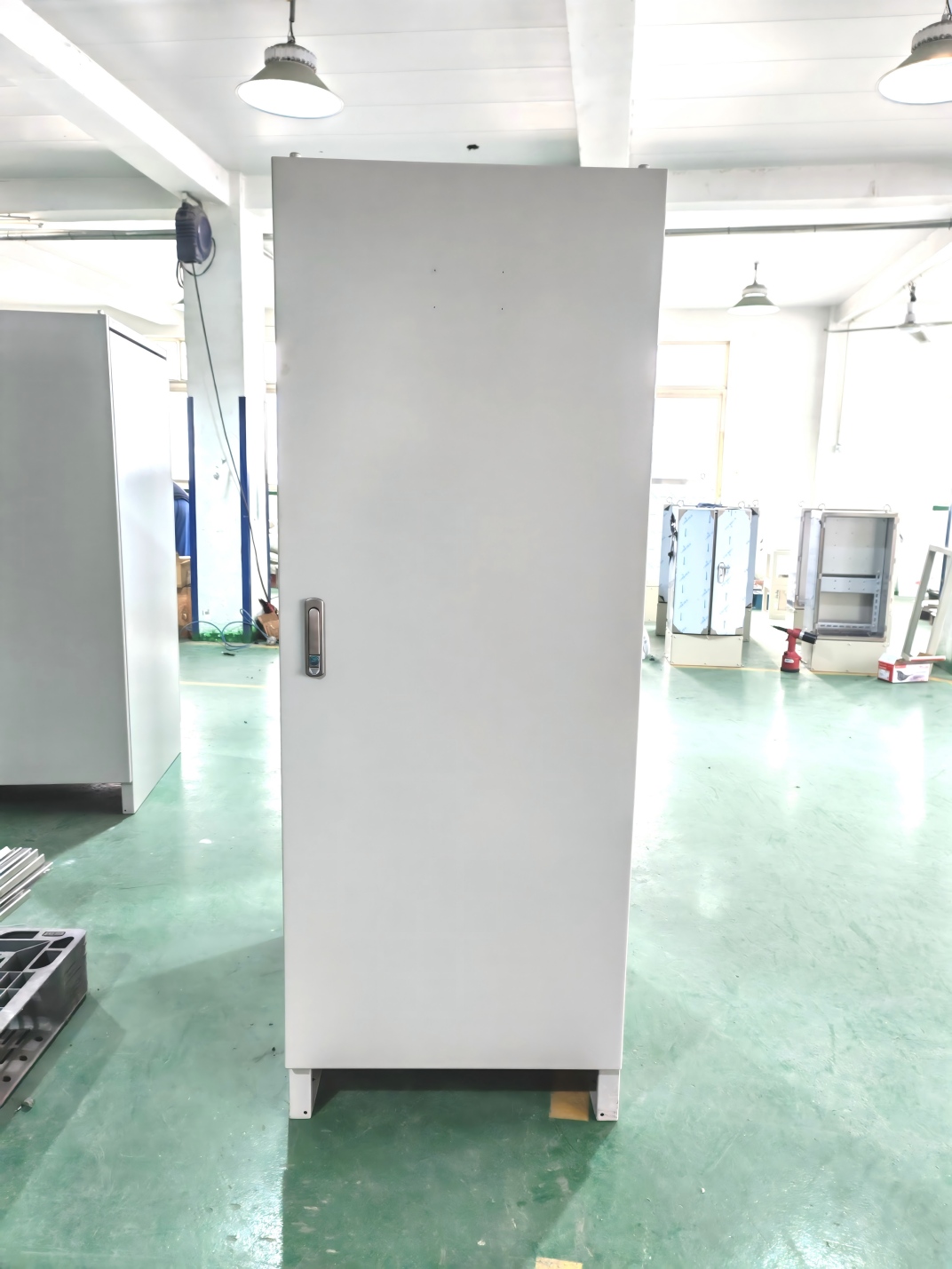
PLC electrical enclosure: 2.0 mm cold rolled steel, phosphating plus electrostatic powder coating in RAL7035, IP54, EPDM door gasket.
Short answer: regional enclosure compliance is decided by five inspectable construction details — material grade, plate thickness, sealing system, surface treatment, and cable entry plus mounting method. A protection rating such as IP54, IP55, IP65 or IP66 describes a tested configuration; on its own it does not tell a reviewer what the cabinet is made of, how the door seals, or how it will be installed.
This FAQ-style guide is written for engineers and buyers in the research and evaluation stage, when one electrical enclosure has to satisfy more than one regional expectation at the same time: an EU buyer working to an IP code under EN 60529, a North American project asking for cold-weather and high-altitude performance, or a coastal or chemical site where salt spray decides the material.
The construction examples below come from the enclosure range of Dalian Yinlu Electrical Control Equipment Manufacturer, a metal enclosure manufacturer based in Dalian, Liaoning Province, China that produces sheet metal fabrications, electrical control cabinets, control boxes and instrument enclosures for industrial, infrastructure and outdoor projects. Where a certification is referenced, the certificate number, the standard and the market are stated — because "certified" without a number, a scope and a market is not a compliance answer.
The Problem: "Compliant" Is Not a Specification
Most enclosure compliance disputes are not about whether a cabinet is well made. They are about whether a specific claim actually covers the model being quoted, in the location where it will be installed. Three gaps appear again and again.
- Certificate scope gap. A supplier may write "CE" or "IP-rated" while the quoted model is not the model named on the certificate. In the Yinlu documentation, for example, the SGS Verification of Conformity records certificate number IN-DL-5805-22013-1 for the DLYL-ES-C electric control cabinet and IN-DL-5805-22013-2 for the DLYL-AE-B electric control box — two different products, two different certificate numbers, both against EN 60529:1991+A1+A2 for the EU market. The certificate number and its product scope are the first lines to compare with the quotation.
- Environment gap. A rating does not describe the environment. IP54 covers dust protection and splash; an outdoor coastal installation with salt spray and acid rain also needs the material question answered, which is why 316 stainless steel is named for coastal and chemical scenarios in the Yinlu range.
- Installation gap. A wall mount enclosure is not specified the same way as a floor standing electrical enclosure on adjustable feet, and the direction of cable entry changes where the sealing risk sits.
The practical rule is simple: match every compliance claim to a model, a certificate, and an installation condition — then to the region.
Industry Background: Why Enclosure Specification Is Tightening
Material grade and installation format are the two specification lines with the largest regional consequences, and metallic enclosures continue to hold the majority of demand.
- The global electrical enclosure market was valued at USD 14.02 billion in 2024 and is projected to reach USD 23.65 billion by 2032 (Market Research Future, Electric Enclosure Market Size, Share, and Trends Analysis 2032).
- Metallic enclosures, including stainless steel and carbon steel, accounted for 65% of global electrical enclosure demand in 2025, valued at approximately USD 4.73 billion (Custom Market Insights, Electric Enclosure Market Size, Share | Industry Report, 2035).
- Asia Pacific dominated the electrical enclosure market in 2025 with a 36% share, supported by industrial automation and renewable energy investment in China and India (IMARC Group, Electrical Enclosure Market).
- The wall-mounted enclosure segment is expected to maintain market dominance through 2035 because of its compact design for small equipment installations (Precedence Research, Electrical Enclosure Market).
- Protection ratings are read against IEC 60529 (IP Code), the dominant international standard for enclosure protection against dust and water; IP66 requires no ingress of dust and protection against powerful water jets (International Electrotechnical Commission).
One caution is worth carrying into any specification meeting: published market values for the same year vary widely between research houses, with 2025 estimates ranging from single-digit billions to above USD 50 billion depending on whether large-scale switchgear infrastructure is counted in the scope. Market numbers should be read with their scope attached. The construction data in the rest of this guide is different in kind: it is model-specific and can be verified line by line.
Material Selection: Cold Rolled Steel vs 304 and 316 Stainless Steel
In the Yinlu range, cold rolled steel with phosphating and electrostatic powder coating covers general industrial and building interiors; 304 stainless steel covers general outdoor and humid service; and 316 stainless steel is specified where salt spray, acid or alkali exposure is expected.
Cold rolled steel with phosphating and electrostatic powder coating
The PLC electrical enclosure is built from 2.0 mm cold rolled steel, finished with phosphating rust removal followed by electrostatic powder coating in RAL7035, and rated IP54. It is a floor-standing enclosure with adjustable feet or casters, a single door with a stainless steel handle lock and an EPDM sealing strip, and it accepts a 19-inch rack, industrial PC, HMI touch screen, PLC, switch, power module, terminal blocks, DIN rail and shelves.
The customized wall-mounted electrical control box follows the same surface route at 1.5 mm thickness, with phosphating treatment plus electrostatic powder coating and a protection grade of IP54 or IP55 depending on configuration. Its material line is recorded as cold rolled steel, with 304 stainless steel available as a customization.
For compliance review, the coating system is the specification line. Phosphating followed by electrostatic powder coating is a two-stage pretreatment-and-finish process, not a colour choice. A datasheet that lists a "powder coated electrical enclosure" without stating the pretreatment stage has not described the corrosion protection at all.
304 stainless steel
304 is the standard material on the wall-mounted instrument box and the multi-meter cupboard, where it resists atmospheric and fresh-water corrosion. It is also the standard body material on the stainless steel electrical control cabinet: plate thickness of at least 2.0 mm, IP54/IP55 for indoor use, wall-mounted, with an EPDM door gasket and stainless steel cable glands.
The stainless steel double-door outdoor cabinet is a floor-mounted IP65 design with a brushed finish. Its stated application set — communication base stations, energy storage power stations, chemical industry and coastal projects — defines the tier 304 sits in: outdoor and humid service, not continuous salt spray.
Inside, a stainless steel enclosure of this tier is specified much like a coated steel counterpart: 19-inch rack, shelves and mounting plates, an internal grounding bar, and compatibility with communication equipment, energy storage batteries, PLCs and frequency converters. The difference is the shell chemistry, not the equipment compatibility.
316 stainless steel
Where the environment includes salt spray, acid or alkali, the specification moves to 316. In the recorded range, 316 stainless steel resists salt spray, acid corrosion and seawater corrosion, and it is named explicitly for coastal and chemical scenarios. The stainless steel double-door outdoor communication / energy storage cabinet uses 316 stainless steel at 2.0 mm with an IP65 rating, an EPDM door gasket, door-to-body grounding bonding and a bottom ventilation louver, and it is applied in 5G/4G communication base stations, energy storage power stations, outdoor photovoltaic systems, chemical industry parks, coastal ports, offshore platforms and sewage treatment plants.
On the stainless steel double-door outdoor cabinet, the ambient temperature range widens from -20°C to +60°C on the standard version to -40°C to +80°C on the 316 version — a useful reminder that material grade and thermal rating often sit in the same specification line.
A heavier-duty example of the same logic is the port crane control cabinet, built in 316L stainless steel. Its IP55 protection is delivered through a double seal plus silicone rubber seal strip, salt spray resistance is stated as 1.5 g in compliance with GB/T 2423.10, and the stated service life is at least 15 years.
Plate thickness as a compliance line
Thickness is asked for in regional reviews because it drives door rigidity, gasket compression and long-term sealing:
- 1.5 mm — customized wall-mounted electrical control box; stainless steel double-door outdoor cabinet.
- 2.0 mm — PLC electrical enclosure; wall-mounted instrument box; stainless steel pedestal box; stainless steel double-door outdoor communication / energy storage cabinet; outdoor weatherproof control enclosure.
- 2.5 mm — low-voltage switchgear / power distribution cabinet.
- 3.0 mm — PLC control console; industrial socket box.
The Canadian White Cabinet uses 1.5 mm to 2.0 mm plate with a 2.0 mm steel plate for frame reinforcement. That single line answers the question "how does a large IP65 cabinet keep its door alignment over years of outdoor exposure?" more usefully than any rating figure.
A note on material naming: general industrial specifications sometimes call for galvanized steel. In the Yinlu range, the recorded constructions are cold rolled steel with phosphating plus powder coating, and 304 or 316 stainless steel. The grade — not the marketing name — is what should appear in the purchase specification.
Protection Ratings and Sealing: How IP54, IP55, IP65 and IP66 Are Built
The IP number states a test outcome. The sealing system determines whether that outcome survives installation, maintenance and on-site cable works.
- IP54 — dust-protected and splash-proof. The PLC electrical enclosure is IP54, described for workshop and equipment-room environments, and can be supplied with an optional transparent observation window (tempered glass or PC panel) or a ventilation louver for heat dissipation.
- IP55 — recorded across wall-mounted instrument boxes, the multi-meter cupboard, the low-voltage switchgear, the stainless steel electrical control cabinet in indoor service, and the port crane control cabinet.
- IP65 — the rating on the stainless steel double-door outdoor cabinet, the stainless steel double-door outdoor communication / energy storage cabinet, the Canadian White Cabinet and the industrial socket box: dust-tight and resistant to heavy rain jetting, suitable for exposed or semi-exposed outdoor installation.
- IP66 — the rating on the outdoor weatherproof control enclosure, a wall-mounted stainless steel design used for outdoor PV combiner boxes, water conservancy and hydrological monitoring, communication base station enclosures, oilfield and mining instrumentation and street light control boxes. IEC 60529 defines IP66 as requiring no ingress of dust and protection against powerful water jets.
The sealing construction behind these ratings is consistent and inspectable:
- EPDM door gasket. An Ethylene Propylene Diene Monomer sealing strip around the door frame is recorded on the PLC electrical enclosure, both stainless steel double-door outdoor cabinets, the wall-mounted electrical control box, the wall-mounted instrument box and the industrial socket box.
- Door-to-body grounding bonding. Recorded on the double-door outdoor cabinets and the instrument boxes, with cabinet grounding resistance specified at ≤4Ω on instrument and control products and an internal grounding bar or copper earthing bar provided.
- Ventilation decisions. A bottom ventilation louver appears on some double-door outdoor models; control cabinets use louvres with optional axial fans, a heat exchanger or an industrial air conditioner. Where condensation is expected, a heater or dehumidifier can be added — the double-door outdoor cabinet is rated to ≤95% relative humidity, non-condensing.
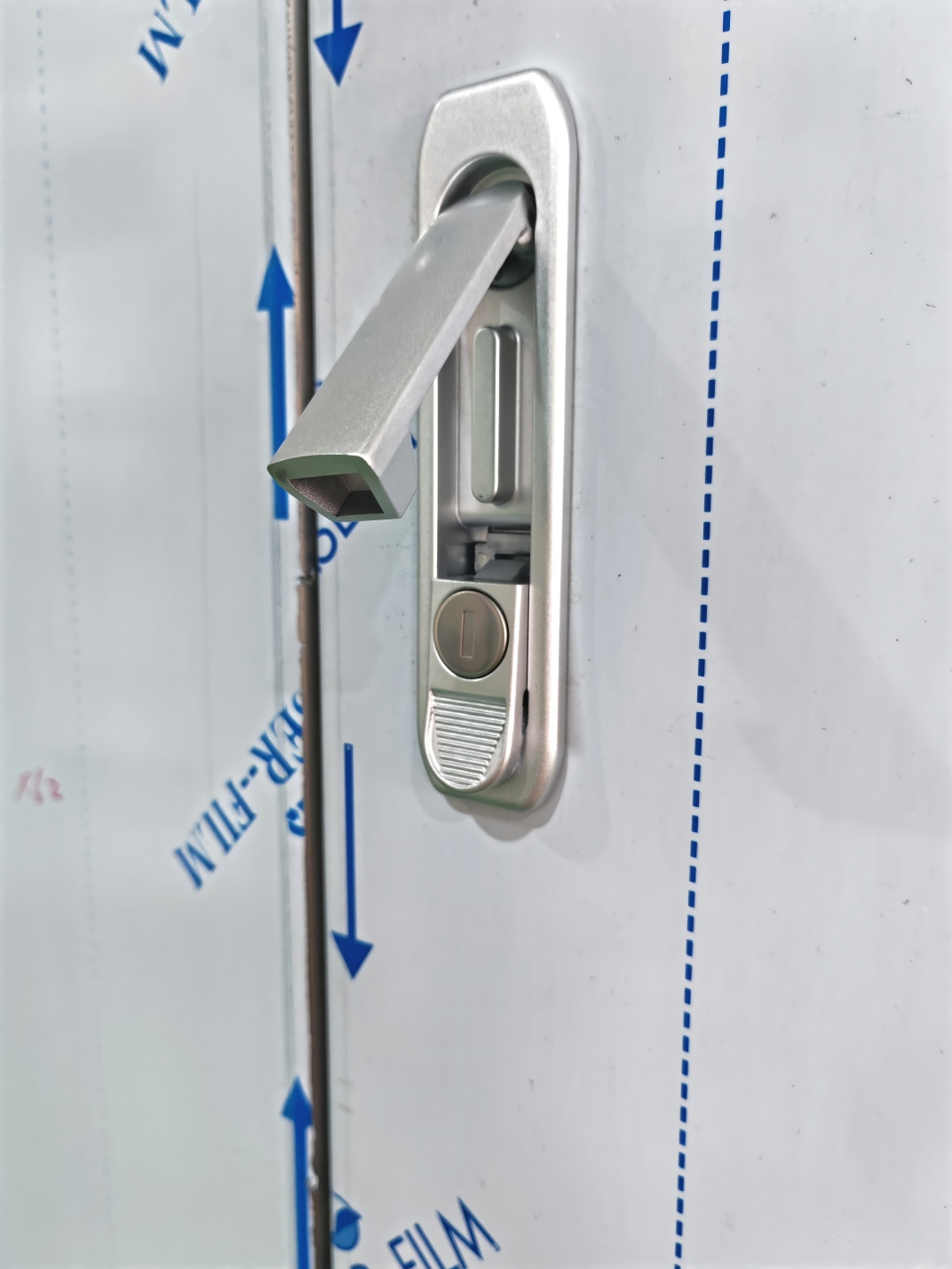
- Lock type as a sealing component. Stainless steel handle locks, flat locks and plane locks appear across the range. A gasket only performs if the lock compresses it evenly, which is why lock type and gasket material belong on the same review line.
Cable Entry, Glanding and Mounting: The Details Reviewers Ask About
Cable entry runs through pre-drilled knockout holes at the bottom, back or side, closed with waterproof cable glands, while mounting is recessed or surface wall mounting for boxes, floor mounting with adjustable feet or casters for floor standing enclosures, and pedestal mounting for instrument boxes.
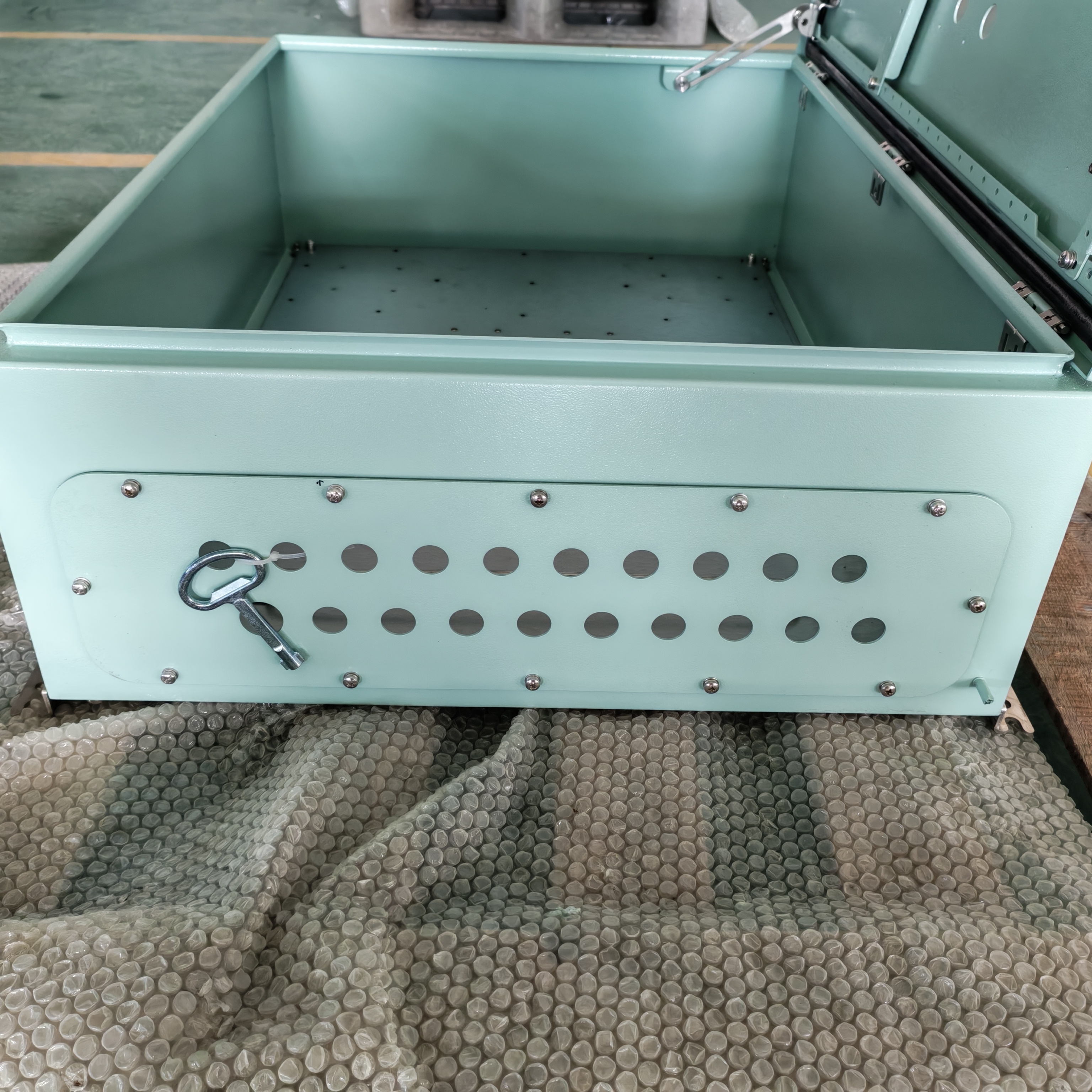
Customized wall-mounted electrical control box: 1.5 mm cold rolled steel, EPDM gasket, multi-size knockout holes at bottom, left and right.
Cable entry, as recorded across the range:
- PLC electrical enclosure — knockout holes at the bottom and back, configurable with waterproof cable glands so power and signal cables enter cleanly.
- Customized wall-mounted electrical control box — multi-size knockout holes at the bottom, left and right, compatible with power or control cables of different diameters, with waterproof cable connectors available.
- Wall-mounted instrument box and multi-meter cupboard — knockout holes at the bottom and side, with waterproof cable glands for cable entry and exit.
- Stainless steel double-door outdoor cabinet — pre-drilled knockout holes at the bottom and back, fitted with stainless steel waterproof cable glands.
- Stainless steel double-door outdoor communication / energy storage cabinet — bottom and back knockouts with stainless steel glands, plus a reserved cable and pipe penetration interface at the top.
- Outdoor weatherproof control enclosure — bottom and back knockouts compatible with waterproof cable glands, supplied together with expansion screws, wall-mounting brackets, cable glands and grounding busbars.
Mounting, as recorded across the range:
- Recessed flush mounting (pre-embedded in the wall) or surface wall mounting, depending on the on-site wall structure, for the customized wall-mounted electrical control box.
- Wall mounting on four pre-drilled back holes fixed with expansion screws or brackets for instrument boxes and the multi-meter cupboard.
- Floor standing with adjustable feet for precise levelling, and casters on some models for mobility, for PLC enclosures and control consoles.
- Floor mounting fixed by foot bolts on a C20 concrete floor for the low-voltage switchgear, with lifting eyes reserved for handling.
- Pedestal floor mounting with a flange base fixed by expansion bolts and a customizable height for the stainless steel pedestal box.
Decision rule: define the cable entry direction and the mounting method before the sheet metal is cut. A knockout placed on the bottom behaves differently when the cable tray is fed from above, and a box specified for recessed mounting cannot simply be re-specified for surface mounting without checking door clearance.
Step-by-Step: A Regional Compliance Review Workflow
- Define the environment and location. Indoor workshop, equipment room, building weak-current well, tunnel, coastal platform, chemical park, energy storage site, cold or high-altitude region. The environment sets every downstream decision.
- Select the material grade. Cold rolled steel with phosphating and powder coating for general industrial and building interiors; 304 stainless steel for general outdoor and humid service; 316 stainless steel for salt spray, acid or alkali exposure.
- Confirm plate thickness and frame design. 1.5 mm, 2.0 mm or ≥2.0 mm for the body, with reinforced frames where large doors are involved.
- Set the protection rating against the real exposure. IP54 for dust and splash in workshops and equipment rooms; IP55 for indoor water-spray tolerance on instrument boxes and switchgear; IP65 for dust-tight outdoor service with heavy rain; IP66 for powerful water jets on the weatherproof outdoor control enclosure.
- Verify the sealing system. EPDM door gasket, lock type, door-to-body grounding bonding, and whether ventilation is a louvre or a filtered fan.
- Verify the surface treatment. Phosphating plus electrostatic powder coating in RAL7035 or another specified colour for coated steel; brushed finish on stainless steel; UV-resistant, anti-aging and acid-rain-proof coating where long-term outdoor exposure is expected.
- Define cable entry and gland type. Knockout position and size, gland material, and whether a top penetration interface is required.
- Define the mounting method. Recessed or surface wall mounting, brackets and expansion screws, floor standing with adjustable feet or casters, or pedestal with a flange base.
- Collect documentation for the destination market. Certificate number, standard, issuing body, market and product scope — attached to the model actually quoted, not to the company name.
Use Cases: Matching Construction to Project Location
Stainless steel double-door outdoor cabinet: floor-mounted, IP65, EPDM gasket, door-to-body grounding bonding, for communication base stations, energy storage, chemical and coastal projects.
Factory automation and SCADA (indoor). The PLC electrical enclosure in 2.0 mm cold rolled steel with an IP54 rating and RAL7035 finish is specified for factory automation production lines, intelligent equipment operation stations, shop-floor data acquisition and monitoring, and equipment remote operation and maintenance stations. The RAL7035 light grey finish keeps the cabinet consistent with control-room and workshop colour schemes.
Rail transit and building services. The customized wall-mounted electrical control box at IP54/IP55 with recessed or surface mounting suits station lighting power distribution, tunnel fan control, auxiliary control for platform screen door systems, protection cabinets for communication and signal equipment, large factory equipment control cabinets, building weak-current well junction boxes and outdoor landscape lighting control cabinets.
Communication base stations and energy storage (outdoor). The stainless steel double-door outdoor cabinet and the 316 stainless steel communication / energy storage cabinet at IP65, both floor-mounted and built around 19-inch rails, are applied in 5G/4G base stations, energy storage power stations, outdoor photovoltaic systems and coastal ports. Their temperature and humidity envelope is stated per model, which matters when batteries are installed inside.
Coastal, chemical and offshore environments. Where salt spray and acid exposure dominate, 316 stainless steel is the recorded material answer, supported in the range by the 316L port crane control cabinet with a double seal, salt spray resistance of 1.5 g to GB/T 2423.10 and a service life of at least 15 years.
Cold and high-altitude regions (North America). The Canadian White Cabinet in RAL9016 or RAL6005 is engineered for high-cold outdoor conditions: IP65, 50 to 100 mm polyurethane foam insulation, thermal conductivity ≤0.024 W/(m·K), an ambient range of -40°C to +60°C, altitude up to 4,000 m, and resistance to Category 12 typhoons and minor earthquakes in line with North American and international standards.
Grid-specific power distribution. The low-voltage switchgear / power distribution cabinet at IP55, 2.5 mm cold rolled steel with phosphating and electrostatic powder coating, is configured for the Kenyan and East African market on an AC 400/415/440 V, 50 Hz, three-phase five-wire system, with T2 copper busbars, tinned for oxidation resistance, and protection compliance to IEC 60439.

Proof document: SGS-CSTC Verification of Conformity for the Yinlu electric control cabinet, certificate number IN-DL-5805-22013-1, against EN 60529:1991+A1+A2, EU market.
Specification Comparison Table
Every line below is a recorded construction fact for the named model, so the table can be used directly as a review checklist against a quotation.
| Model / product | Material & thickness | Protection rating | Installation | Sealing & cable entry | Typical application |
|---|---|---|---|---|---|
| PLC electrical enclosure | Cold rolled steel, 2.0 mm; phosphating rust removal + electrostatic powder coating, RAL7035 | IP54 | Floor standing, adjustable feet or casters | EPDM door gasket, stainless steel handle lock; bottom/back knockouts with waterproof cable glands | Factory automation lines, intelligent equipment stations, SCADA, remote operation and maintenance stations |
| Customized wall-mounted electrical control box | Cold rolled steel, 1.5 mm; 304 stainless steel customizable | IP54 / IP55 customizable | Recessed flush mounting or surface wall mounting | EPDM rubber sealing strip, flat lock; multi-size knockouts at bottom/left/right with waterproof connectors | Rail transit station lighting distribution, tunnel fan control, platform screen door auxiliary control, building weak-current wells |
| Wall-mounted instrument box / multi-meter cupboard | 304 stainless steel standard, 316 stainless steel for corrosion, 2.0 mm, brushed finish | IP55 | Wall mounting on 4 pre-drilled back holes with expansion screws or brackets | EPDM rubber seal, plane/handle lock, door-to-body grounding jumper; bottom/side knockouts with waterproof glands | Chemical, petroleum, water treatment, environmental protection, food and pharma, municipal, mining, power |
| Stainless steel double-door outdoor cabinet | Stainless steel, 1.5 mm, brushed finish | IP65 | Floor mounted | Double door, EPDM gasket, handle lock, door-to-body grounding; bottom/back knockouts with stainless steel glands | Communication base stations, energy storage power stations, chemical industry, coastal projects |
| Stainless steel double-door outdoor communication / energy storage cabinet | 316 stainless steel, 2.0 mm, brushed finish | IP65 | Floor mounted | EPDM gasket, internal grounding bar, bottom ventilation louver; bottom/back knockouts with glands plus top cable/pipe interface | 5G/4G base stations, energy storage power stations, outdoor PV, chemical parks, coastal ports, offshore platforms, sewage treatment |
| Outdoor weatherproof control enclosure | Stainless steel, brushed/polished finish | IP66 | Wall mounted, single door | Bottom/back knockouts compatible with waterproof cable glands; supplied with brackets, glands and grounding busbars | Outdoor PV combiner box, hydrological monitoring, communication base station, oilfield/mining instrumentation, street light control |
| Canadian White Cabinet | 1.5–2.0 mm plate with 2.0 mm frame reinforcement; PU foam insulation 50–100 mm; RAL9016 / RAL6005 | IP65 | Floor mounted on bottom pillars or feet | Double door, EPDM gasket, stainless steel hasp/flat lock; bottom/back knockouts with glands | North American high-cold and high-altitude outdoor projects; -40°C to +60°C; altitude ≤4,000 m |
| Low-voltage switchgear / power distribution cabinet | Cold rolled steel, 2.5 mm; phosphating + electrostatic powder coating, RAL7035 | IP55 | Fixed by foot bolts on C20 concrete floor | Double doors with heavy-duty hinges and MS lever locks, EPDM seal; back/side heat dissipation louvres | Kenyan and East African market, AC 400/415/440 V, 50 Hz, three-phase five-wire; hotels, schools, factories, large supermarkets |
FAQ
1. Which certificates and standards should be verified for an electrical enclosure sold into the EU market?
Ask for three documents, and read the scope line rather than the logo. For the DLYL-ES-C electric control cabinet and the DLYL-AE-B electric control box, SGS-CSTC Standards Technical Services Co., Ltd. issued Verification of Conformity certificates against the EN 60529:1991+A1+A2 standard — certificate numbers IN-DL-5805-22013-1 and IN-DL-5805-22013-2 — for the EU market. Manufacturing is certified to ISO 9001:2015 (GB/T 19001-2016/ISO 9001:2015) under certificate number 19923Q01395R0M, issued by CSHCC.CN, covering the production of metal shells for electronic control equipment and instruments. Separately, the IP code itself is defined by IEC 60529, the dominant international standard buyers reference when they specify IP54, IP55, IP65 or IP66.
2. Can the enclosure be customized to a non-standard cutout layout or mounting arrangement?
Yes. The recorded customization scope covers material, colour, logo, size, IP rating, surface treatment, cutouts and mounting. Examples in the range include the PLC electrical enclosure, compatible with a 19-inch rack, industrial PC, HMI touch screen, PLC, switch, power module, terminal blocks, DIN rail and shelves, and offered with an optional top operation window for a display or keyboard; the wall-mounted control box, offered in recessed flush or surface wall mounting with multi-size knockouts at the bottom, left and right; and instrument enclosures cut for instrument windows, button and indicator holes, meter mounting holes and sensor ports. Production is organised as OEM/ODM with a monthly capacity of 2,000 units.
3. What drives the cost, and what is the minimum order quantity?
The recorded minimum order quantity is 1–5 units. Cost is driven by the specification lines rather than by cabinet size alone: material grade (cold rolled steel with phosphating and powder coating versus 304 or 316 stainless steel), plate thickness (1.5 mm, 2.0 mm, 2.5 mm and 3.0 mm all appear across the range), protection rating, surface treatment, cutout complexity and mounting hardware. A 2.0 mm IP65 stainless steel double-door cabinet and a 1.5 mm IP54 cold rolled steel wall box are not comparable cost structures, which is why the environment should be fixed before the quote is requested.
4. Can a single unit be produced and inspected before a volume order?
The recorded minimum order quantity of 1–5 units allows a configured trial unit to be produced and inspected before a volume commitment. Every unit passes six inspection stages: visual, wiring, function, safety, sealing and packaging. Sealing is inspected as a discrete step, which matters when the specification depends on an EPDM gasket compressed by the door lock and a properly glanded cable entry.
5. What lead time and after-sales support should be planned?
Lead time is recorded as negotiable and is confirmed per order against a monthly capacity of 2,000 units; after-sales support is 7×24 hours online with a one-year warranty. Because cutouts, coating colour and gland configuration each change the production route, the sequence that shortens a schedule is to freeze the material grade, the IP rating and the mounting method first, then request the quotation and the current enclosure catalogue.
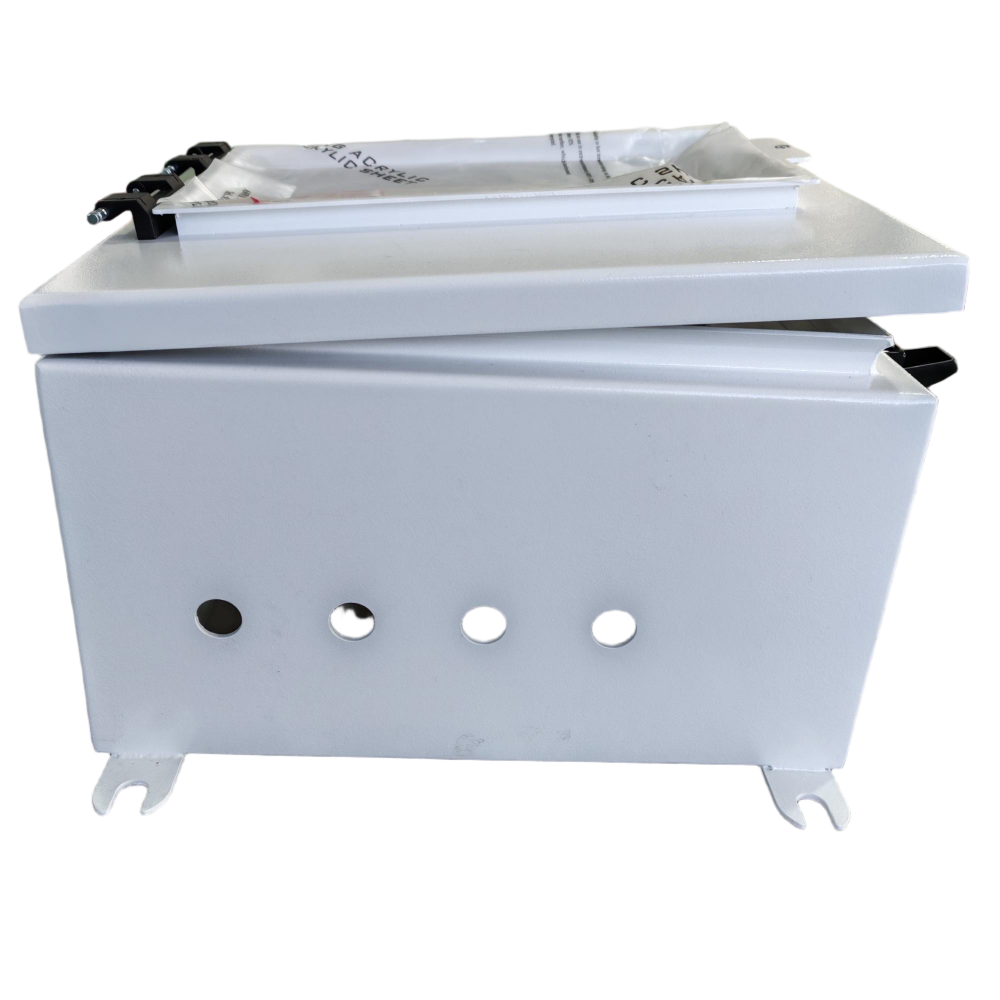
Outdoor weatherproof control enclosure: stainless steel, wall mounted, IP66, with bottom/back knockouts compatible with waterproof cable glands.
Conclusion: Validate the Configuration, Not the Label
Regional compliance questions resolve the same way every time: name the environment, name the material grade and thickness, name the protection rating and the sealing construction behind it, name the cable entry and the mounting method, and attach the certificate number whose scope actually covers the quoted model. On that basis, cold rolled steel with phosphating and electrostatic powder coating answers general industrial and building specifications, 304 stainless steel answers general outdoor and humid service, and 316 stainless steel answers salt spray, acid and seawater exposure. IP54 handles workshop dust and splash, IP55 adds indoor water-spray tolerance, IP65 covers dust-tight outdoor service in heavy rain, and IP66 addresses powerful water jets.
The failure mode to avoid is the on-site deviation: an extra unglazed cutout, an unfiltered louvre or an unfilled knockout removes the tested configuration from its rating, whatever the certificate says.
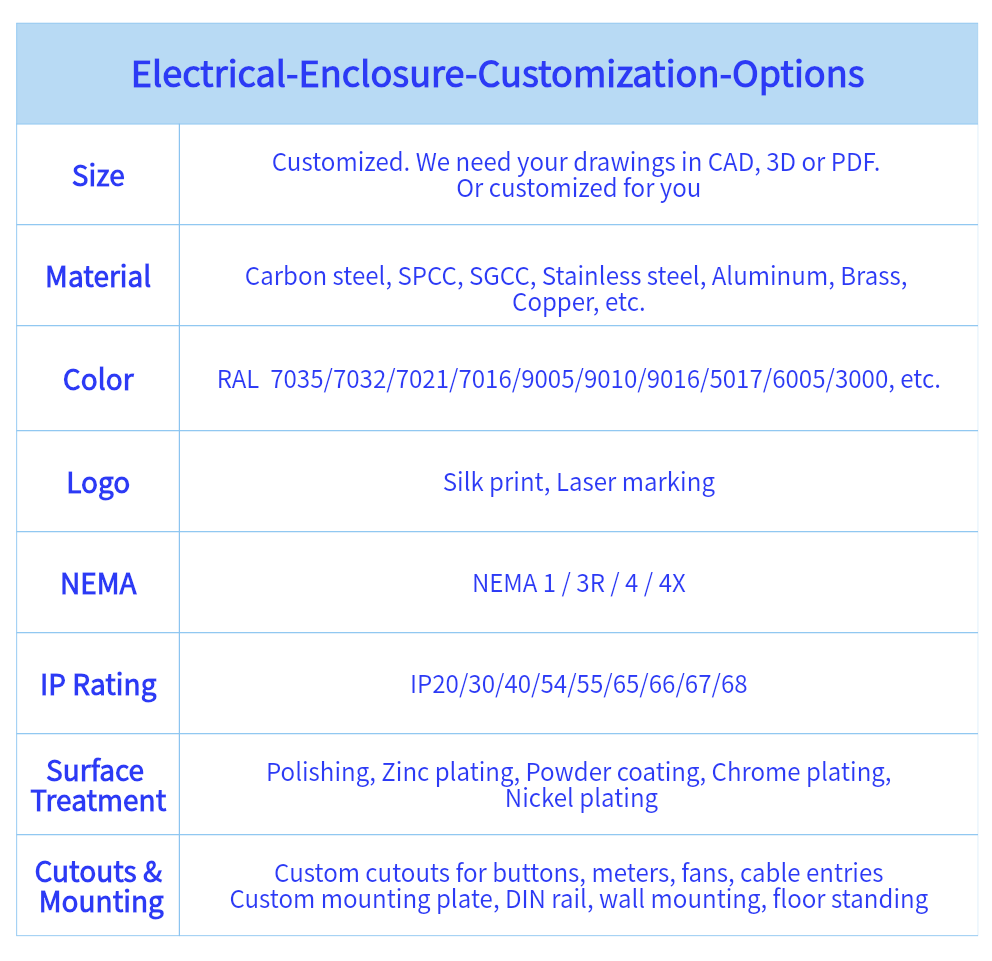
Recorded customization scope: material, colour, logo, size, IP rating, surface treatment, cutouts and mounting.
Next step: confirm the construction details for your region
Send the installation environment, the required protection rating and the mounting method, and the construction details — material grade, plate thickness, gasket, coating system, cable entry and gland type — can be confirmed against the model being quoted. The current enclosure catalogue can be downloaded here: Dalian Yinlu electrical enclosure catalogue (PDF).
Email: Sales@innometalfab.com | WhatsApp: +86 186-2435-1618 | Website: www.innometalfab.com
Dalian Yinlu Electrical Control Equipment Manufacturer — Yangquanzi Village, Gezhenpu Town, Ganjingzi District, Dalian City, Liaoning Province, China. The company operates a 5,000 m² facility with an annual output of 20,000 units and exports approximately 80% of production to North American, European, Oceania and high-end Asia-Pacific markets, supported by OEM and ODM order handling.