
Selecting Material Thickness and Protection Levels for Industrial Enclosures: How 1.5 mm and 2.0 mm Steel Change the Spec
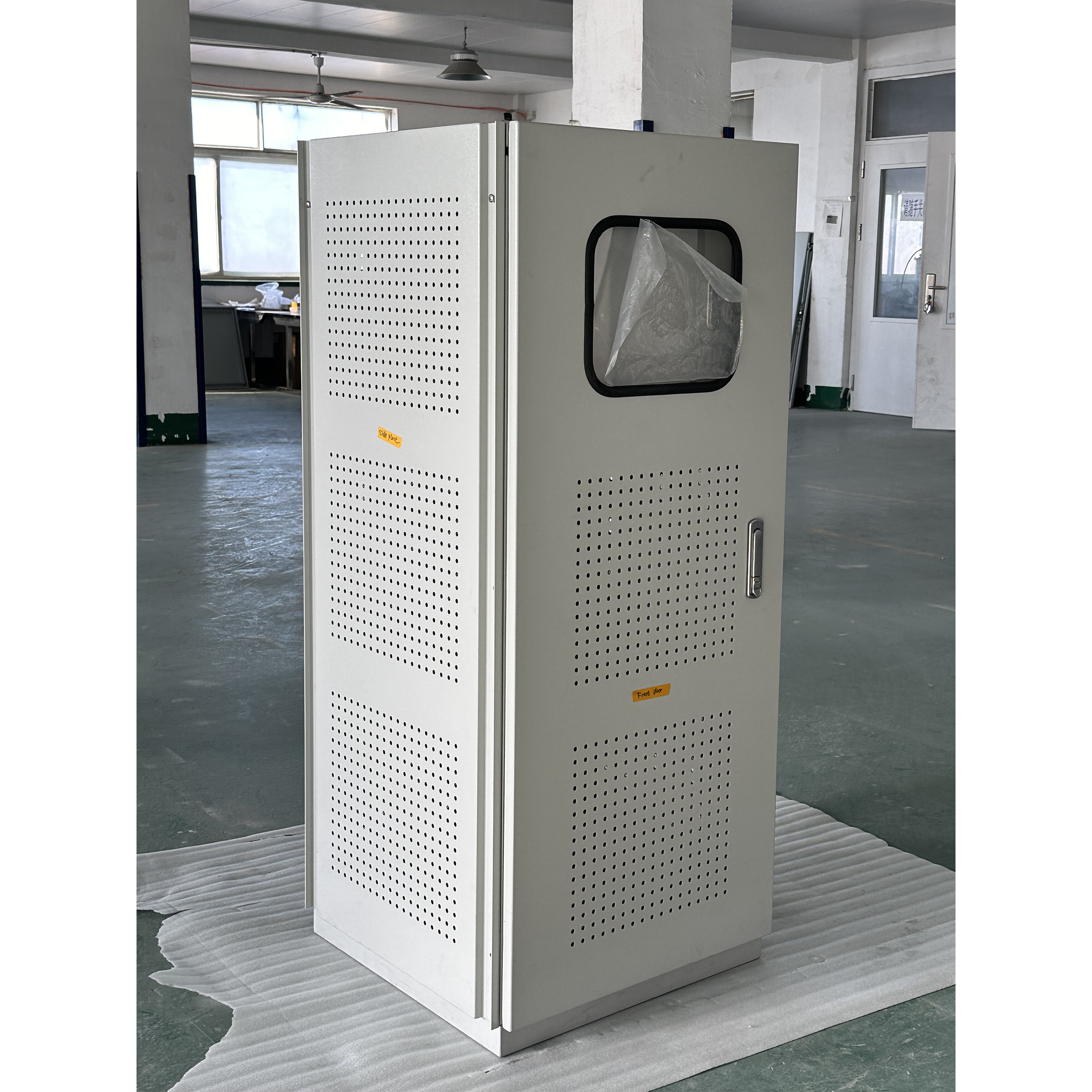
Industrial enclosures after phosphating derusting and electrostatic powder coating in RAL7035 light grey.
Material thickness and protection level are two independent decisions on an industrial enclosure specification, and treating them as one is among the most common sources of rework. In cold-rolled steel enclosures, 1.5 mm and 2.0 mm are the two gauges that cover most industrial work: 1.5 mm serves lighter wall-mounted and recessed boxes, while 2.0 mm is the working default for floor-standing cabinets, outdoor units and any enclosure that carries a 19-inch rack, a VFD or a heavy door. Protection level runs in parallel, with IP54 for indoor workshop and control-room duty, IP55 where splash and washdown are present, and IP65 or IP66 once a cabinet faces rain, water jets or salt spray.
Dalian Yinlu Electrical Control Equipment Manufacturer (Yinlu) is a metal enclosure manufacturer based in Dalian, Liaoning Province, China, established in 1993 and ISO 9001 certified. The company produces custom electrical control cabinets, control consoles, junction boxes and instrument enclosures for markets in North America, Europe, Oceania and the high-end Asia-Pacific region.
This guide explains how gauge and protection level are selected in practice, drawing on specification data from Yinlu enclosure platforms and on third-party market and standards references. It is written for procurement and engineering readers who are still defining the requirement, before choosing a supplier or a model.
What Thickness and Protection Level Actually Control
Plate thickness is a stiffness and load-path decision. The plate has to resist door sag, panel deflection and vibration, and it has to keep the door gasket under enough compression to stay sealed. When a wall-mounted box is under-specified, the usual failure is a door that drops slightly on its hinges, a gasket that no longer meets the frame evenly, and a water path that appears at the top edge or at the cable entry. When an enclosure is over-specified, the cost is unnecessary weight, higher freight, and wall anchors that must be upgraded to carry a cabinet that was never meant to hang.
Protection level is an assembly property, not a plate property. The IP code on an enclosure describes the performance of the complete unit: the door gasket, the compression that hinges and locks maintain, the sealing of cable glands, the treatment of observation windows and the design of any ventilation louvre. IEC 60529 is the international standard behind the IP code, and it defines IP66 as no ingress of dust together with protection against powerful water jets. A plate thickness figure appears nowhere in that definition, which is why thickness and IP rating have to be specified separately and then verified together.
Two further confusions are worth naming. The first is uniform versus mixed gauge. A cabinet can combine 1.5 mm and 2.0 mm plates, with the heavier plate assigned to the frame or door reinforcement, which lets a large door keep its shape without making the entire cabinet heavier. The second is that an IP rating belongs to a design, not to a product family. A wall-mounted box rated IP54 and a floor-standing cabinet with louvred vents are different assemblies, and the rating of one does not transfer to the other.
Industry Background: Why Gauge and Sealing Drive Sourcing
The commercial context supports the technical point. Market Research Future values the global electrical enclosure market at USD 14.02 billion in 2024 and projects USD 23.65 billion by 2032, while Custom Market Insights reports that metallic enclosures, including stainless steel and carbon steel, accounted for 65% of global demand in 2025, worth approximately USD 4.73 billion. Most of the market is therefore still specified in coated carbon steel or stainless steel sheet, which makes sheet gauge a mainstream procurement decision rather than a niche one.
Regional demand concentrates that decision further. IMARC Group puts Asia Pacific at 36% of the 2025 market, supported by industrial automation and renewable energy investment, while Precedence Research expects the wall-mounted enclosure segment to keep its dominant position through 2035 because of its compact design for small equipment installations. That matters here because wall-mounted boxes are also the platforms where 1.5 mm plates remain common.
Customization is the other driver. Custom Market Insights estimates that roughly 18% of enclosure buyers in 2024 required highly customized solutions, a share associated with OEM and ODM demand and with specifications that mix sizes, cutouts, gauges and finishes inside a single order. In hygiene-sensitive environments, Dataintelo reports that the global stainless steel HMI enclosure segment reached USD 1.47 billion in 2024, which pulls specifications toward 304 and 316 stainless surfaces rather than painted carbon steel.
Published market values differ between research houses, mainly because inclusion criteria vary: estimates for the 2025 market range from below USD 10 billion to more than USD 50 billion depending on whether large-scale switchgear infrastructure is counted. The engineering conclusions in this guide do not depend on which estimate is used.
Detailed Solution: Matching Gauge and Sealing to the Installation
Yinlu builds its enclosure platforms around a small number of repeatable sheet gauges. Reading across the range shows where each gauge is used and which protection level is paired with it.
1.5 mm steel: light wall-mounted boxes and smaller outdoor units
At 1.5 mm, plate is used where spans are short and the door is small. The Customized Wall-Mounted Electrical Control Box is built from 1.5 mm cold-rolled steel, with 304 stainless steel available as a material option, and is installed either recessed into a wall opening or surface-mounted, with sturdy mounting holes at the bottom or back. Its protection grade is customizable between IP54 and IP55, and the door frame carries an EPDM rubber sealing strip, which is what allows that rating to be claimed at all. The Stainless Steel Double-Door Outdoor Cabinet also uses a 1.5 mm plate, in stainless steel with a brushed finish, floor-mounted and rated IP65, with the same EPDM door strip and a grounding bond between door and cabinet body.
The most useful 1.5 mm example is a mixed-gauge one. The Canadian White Cabinet, an outdoor communication, energy storage and electrical equipment protection cabinet, uses plates between 1.5 mm and 2.0 mm, with a 2.0 mm steel plate dedicated to frame reinforcement. That combination keeps large surfaces light and cost-effective while giving the structure and door line the rigidity a floor-mounted outdoor installation needs, together with an IP65 rating and a polyurethane insulation layer.
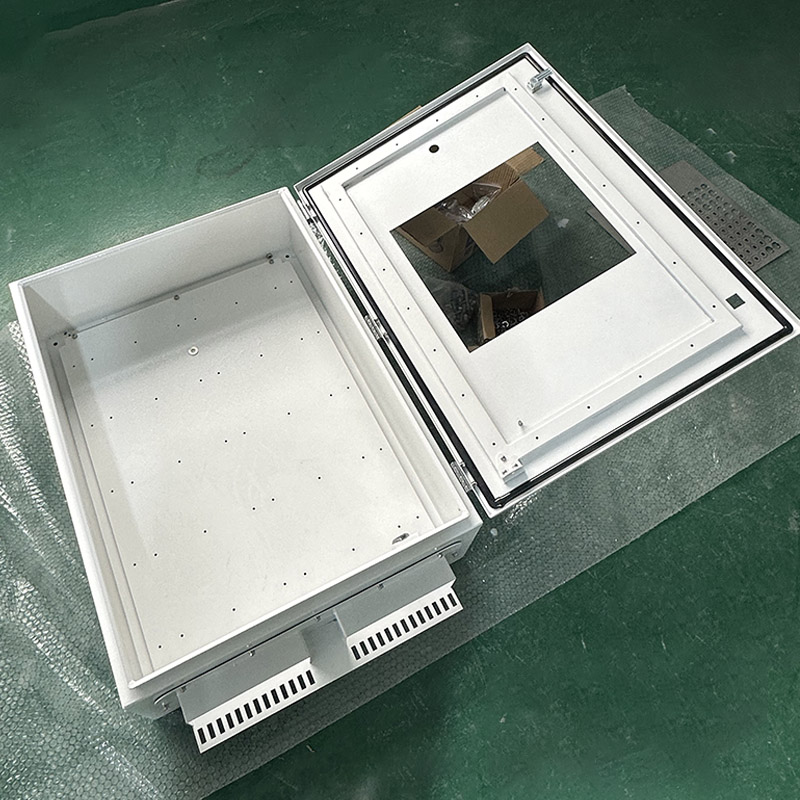
Wall-mounted enclosures rely on door rigidity and an EPDM gasket to hold their protection level.
2.0 mm steel: the floor-standing and outdoor default
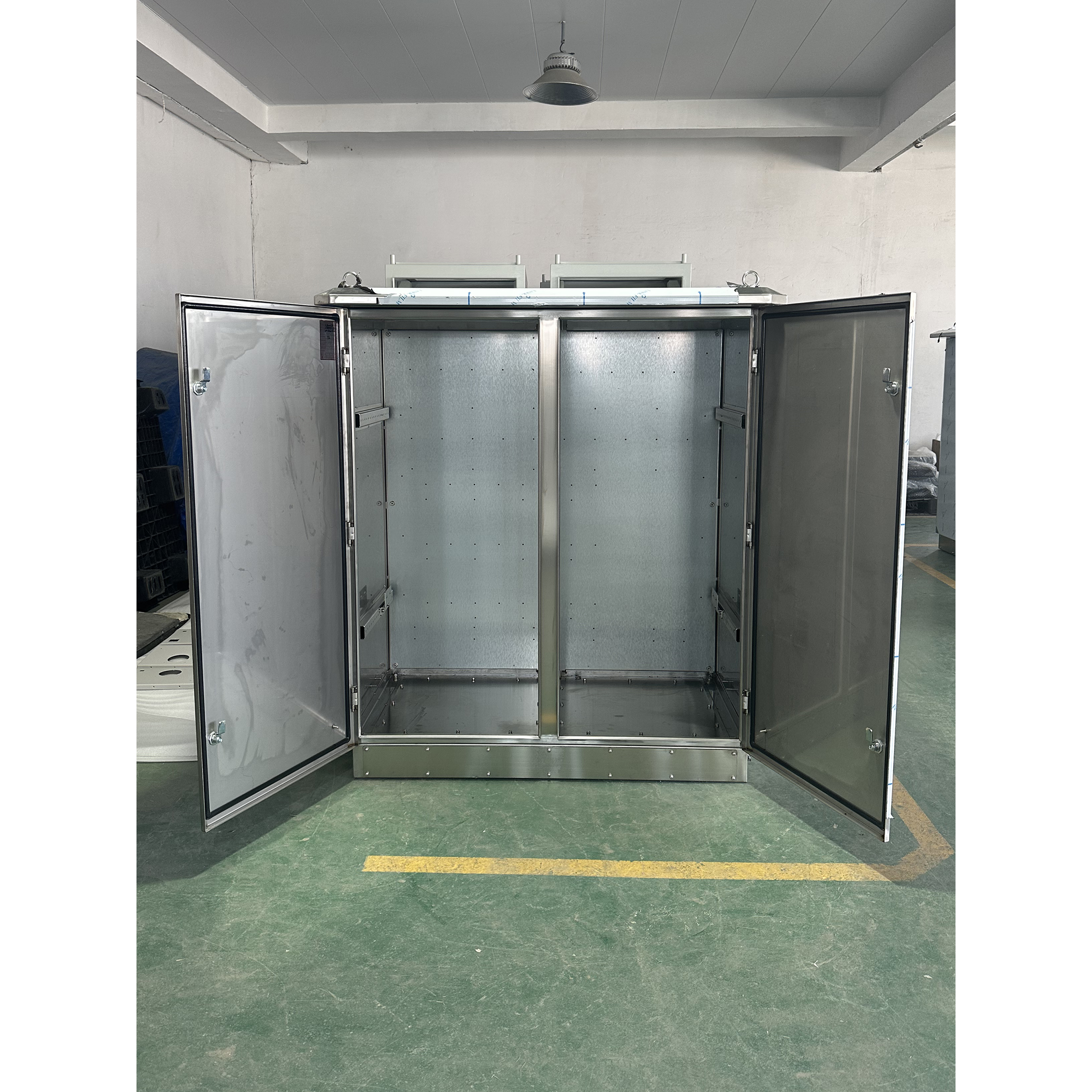
2.0 mm cold-rolled steel is the gauge that appears most often once an enclosure stands on its own. The Rittal-style Free-standing Outdoor Control Cabinet uses a 2.0 mm plate, is mounted directly on outdoor ground, and is rated IP55 or IP65 for complete dust exclusion and resistance to heavy rain jetting. The PLC electrical enclosure uses the same 2.0 mm plate with an IP54 rating for floor-mounted workshop duty, an EPDM door seal, and an optional observation window or ventilation louvre for heat dissipation. In stainless steel, the non-standard custom enclosure uses a 2.0 mm plate with an IP65 rating, internal 19-inch mounting rails and an internal grounding bar.
The same gauge appears on wall-mounted products when the load is higher. The Wall-mounted Instrument Box is built from 2.0 mm plate in 304 stainless steel as standard, with 316 stainless steel available for corrosive or coastal applications, and is rated IP55. The Multi-meter Cupboard follows the same pattern. Thickness here is driven less by the mounting method than by what hangs on the door and inside the cabinet.
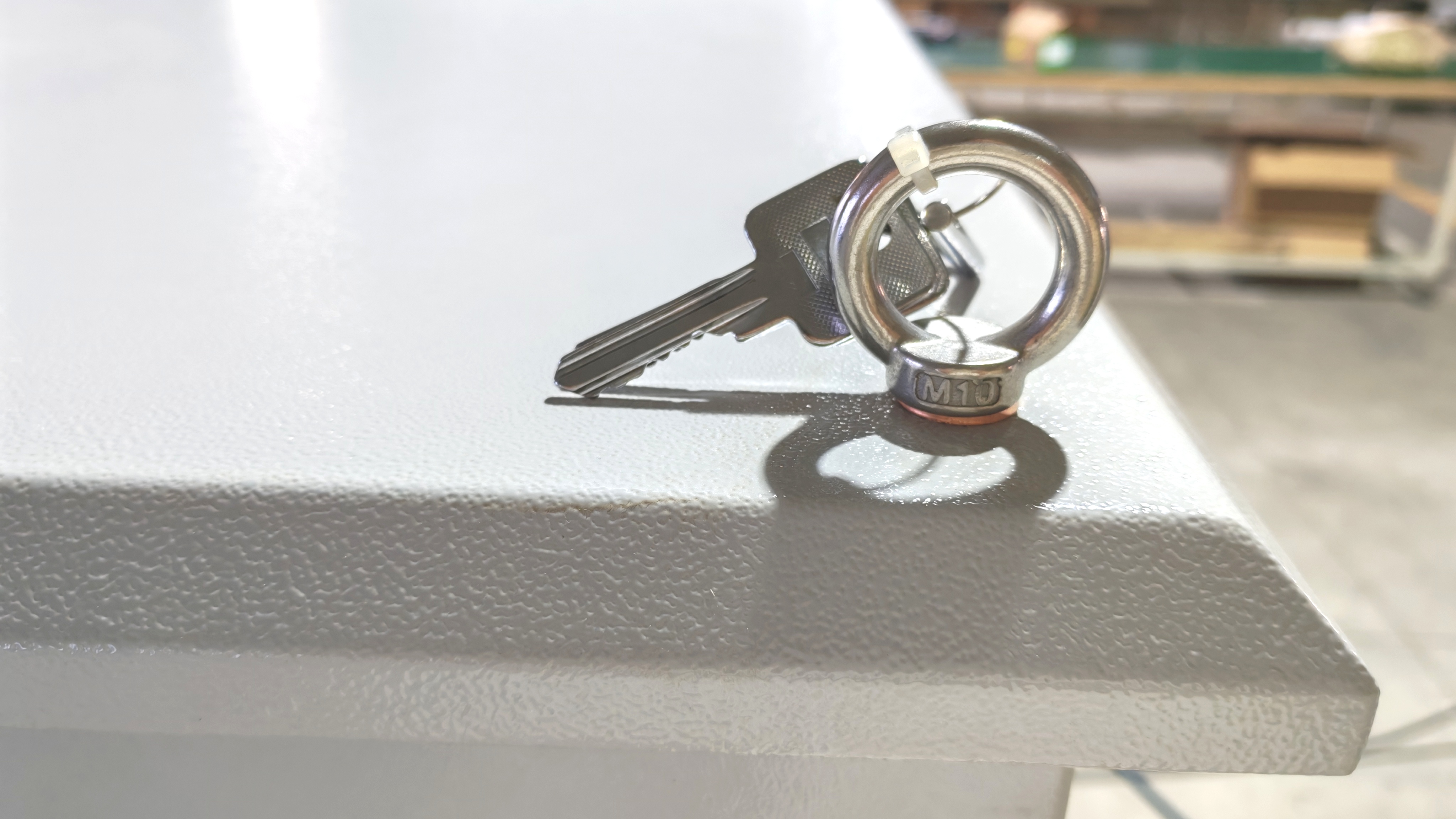
Outdoor telecommunication and energy storage specifications push the gauge in the same direction. Yinlu notes that material thickness for coastal installations, where salt spray resistance matters, and for chemical industrial parks is typically 2.0 mm or above. The Stainless Steel Pedestal box extends the logic to the support structure as well: a 2.0 mm body with a stainless steel square or round pedestal tube of at least 2.0 mm, rated IP55 or IP65, fixed to a flange base with expansion bolts.
Floor-standing outdoor cabinets typically use a 2.0 mm plate with an IP55 or IP65 rating.
Above 2.0 mm: 2.1 mm, 2.5 mm and 3.0 mm platforms
Three other gauges sit above the floor-standing default. The HMI enclosure box and the Small Customized Electrical Control Box use 2.1 mm plate, both rated IP55, with the latter upgradeable to IP65 for outdoor scenarios. The Low-voltage Switchgear and Power Distribution Cabinet steps up to 2.5 mm with an IP55 rating, double doors on heavy-duty hinges and lifting eyes reserved on the top for handling. The Industrial Socket Box uses a 3.0 mm plate with a protection grade selectable between IP44, IP55 and IP67, and the PLC control console uses 3.0 mm cold-rolled steel for a floor-standing console rated IP54. In each case the extra gauge supports a heavier internal load — busbars, industrial sockets, multi-screen workstations — rather than a higher IP number.
Protection levels: what IP54, IP55, IP65 and IP66 each cover
Across the Yinlu range, the protection level is paired with the environment rather than with the gauge. IP54 is specified for dust-proof, splash-proof duty in workshops, test rooms and control rooms, and appears on the PLC electrical enclosure, the Industrial Operator Console and the Control Room Console. IP55 adds water-jet resistance and covers the Wall-mounted Instrument Box, the Multi-meter Cupboard and the Low-voltage Switchgear. IP65 is the outdoor step, described as dust-tight and resistant to heavy rain jetting, and is used on the Rittal-style outdoor control cabinet, the stainless steel non-standard custom enclosure, the outdoor double-door cabinets and the Stainless Steel Junction Box. IP66 appears on the Outdoor Weatherproof Control Enclosure, which is wall-mounted, and under IEC 60529 it means no ingress of dust combined with protection against powerful water jets. Selectable IP44, IP55 and IP67 options exist on the Industrial Socket Box, where IP67 supports immersion-exposed temporary power duty.
Indoor and outdoor versions of the same platform show how the level should be read. The VFD Control Cabinet is rated IP54 or IP55 for indoor use and can be specified at IP65 for outdoor, waterproof and dust-proof duty, with the same 2.0 mm plate in both cases. The protection level changes the gasket, gland and vent specification; it does not change the sheet gauge.
The sealing chain: EPDM strips, locks, glands and vents
Every protection level above IP54 depends on a chain of components rather than on a single feature. The door frame carries an EPDM (Ethylene Propylene Diene Monomer) sealing strip on platforms across the range, including the PLC electrical enclosure, the Customized Wall-Mounted Electrical Control Box, the stainless steel outdoor cabinets and the Stainless Steel Junction Box. The seal only works if the door is held evenly against it, so hinges, plane locks and handle locks are part of the specification, and the door-to-cabinet grounding bond protects personnel as well as electrical continuity — Yinlu specifies reliable cabinet grounding with a grounding resistance of 4 Ω or less on these platforms.
Cable entry is the second half of the chain. Knockout holes are pre-drilled at the bottom, back or side, and waterproof cable glands are fitted to match cable diameter and the required IP level. The third element is heat. Louvred vents and axial fan options solve internal temperature rise but are compatible with lower protection levels, which is why indoor consoles and workshop enclosures carry IP54 or IP55 while sealed outdoor cabinets stay at IP65 or IP66 without vents. If an outdoor cabinet needs both ventilation and sealing, that has to be resolved at specification stage rather than on site.
Phosphating derusting plus electrostatic powder coating
For carbon steel, the standard surface treatment across the Yinlu range is phosphating derusting followed by electrostatic powder coating. The phosphating stage removes rust and prepares the steel surface so that the powder layer bonds properly; the electrostatic coating then provides colour and the first barrier against moisture. RAL7035 light grey is the standard colour on platforms such as the PLC electrical enclosure, the Rittal-style outdoor cabinet and the Low-voltage Switchgear, with scratch-resistant and anti-fingerprint properties on several models. The Canadian White Cabinet uses outdoor weather-resistant powder in Canadian White RAL9016 or dark green RAL6005, with a fluorocarbon coating upgrade available for exposed installations.
Stainless steel platforms use a brushed finish instead of a coating, and the material grade becomes the corrosion decision: 304 stainless steel resists atmospheric and fresh water corrosion, while 316 stainless steel resists salt spray and acid or alkali exposure in coastal and chemical scenarios. Neither coating nor stainless finish replaces the gasket. Both keep the steel sound so the seal can do its job.
Sealing is a chain: EPDM door strip, lock compression, grounding bond and waterproof cable glands.
Step-by-Step: Specifying Thickness and Protection in Six Steps
- Fix the installation method first. Wall-mounted, recessed, floor-standing, pedestal or pole. Wall-mounted products fix through pre-drilled back holes with expansion screws or brackets, while floor-standing cabinets use adjustable feet or casters and stand directly on the floor. This decides the load path before any gauge number is chosen.
- Estimate the load the sheet has to carry. Count the internal components — 19-inch rails, PLC, VFD, batteries, power modules, terminal blocks — and consider door size and opening frequency. A large door carrying heavy instruments is a gauge decision, not a cosmetic one.
- Choose the base gauge. Use 1.5 mm for light wall-mounted and recessed boxes, 2.0 mm for floor-standing, outdoor, pedestal-mounted and rack-carrying enclosures, and 2.1 mm to 3.0 mm where busbars, industrial sockets or multi-screen consoles add weight. Where a large cabinet has to stay light, ask for mixed gauge with a heavier plate on the frame.
- Choose the protection level from the environment. IP54 for dry indoor workshop and control-room duty, IP55 where splash or washdown occurs, IP65 where the cabinet faces rain or heavy jetting, and IP66 where powerful water jets and complete dust exclusion are both required. Confirm against IEC 60529 definitions rather than a model name.
- Verify the whole sealing chain. Check the EPDM gasket on the door frame, the lock and hinge arrangement that maintains compression, the classification of every cable gland, the treatment of observation windows, and whether ventilation is present.
- Specify surface treatment, colour and environmental add-ons. Phosphating plus electrostatic powder coating for carbon steel, brushed finish with 304 or 316 grade for stainless, RAL colour, heater or dehumidifier where condensation is expected, fan and louvre options where heat rises, insulation where temperatures drop, and grounding to 4 Ω or less.
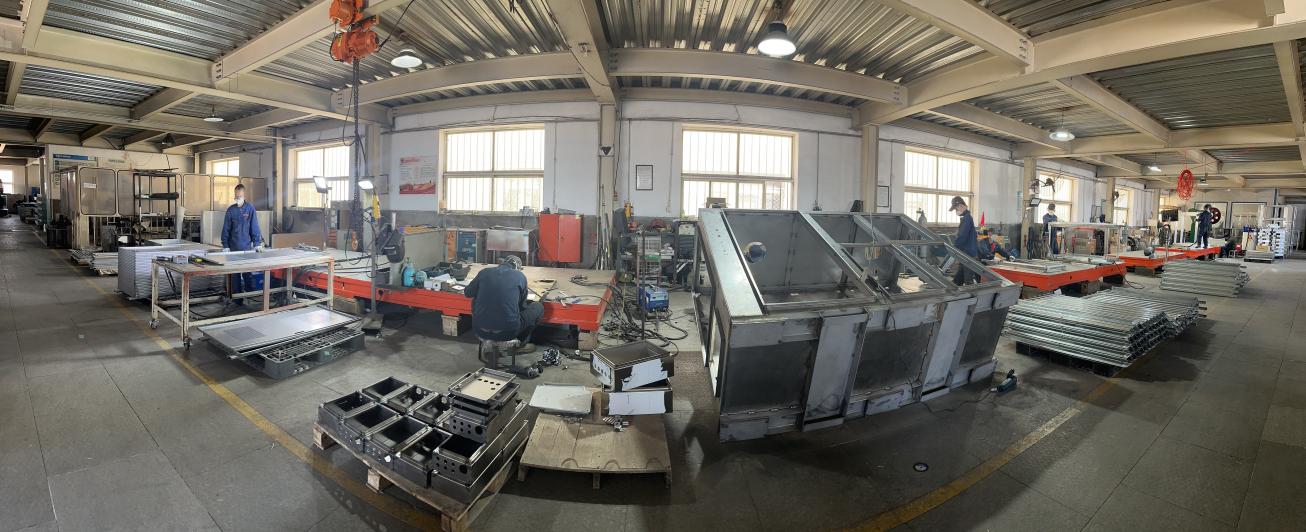
Gauge selection only holds if the frame, door line and weld quality are consistent in production.
Use Cases: Where the Specification Splits
Indoor PLC and automation stations. A floor-mounted PLC electrical enclosure at 2.0 mm with an IP54 rating, an EPDM door seal and cable entry through the bottom or back suits factory automation lines, SCADA stations and remote maintenance stations where dust and incidental splash are the only threats.
Control rooms and dispatch centres. Control and monitoring consoles use 2.0 mm cold-rolled steel at IP54, floor-standing with adjustable feet or casters, and a modular structure with an upper monitoring section and a lower equipment compartment. Where multi-screen splicing and heavier instrument loads are involved, the specification moves to 3.0 mm, as on the PLC control console.
Coastal, chemical and water treatment sites. A 316 stainless steel enclosure at 2.0 mm with an IP65 rating, brushed finish, EPDM strip and internal grounding bar is the standard answer for chemical industry parks, coastal ports, offshore platforms and sewage treatment plants, where salt spray and acid or alkali exposure rule out painted carbon steel.
Cold-climate outdoor telecom and energy storage. The Canadian White Cabinet combines 1.5 mm to 2.0 mm plates with a 2.0 mm reinforced frame, an IP65 rating, polyurethane insulation of 50 to 100 mm, an ambient temperature range of -40 °C to +60 °C and an altitude rating of up to 4000 m — a specification shaped by North American and high-altitude conditions rather than by gauge alone.
Food, pharmaceutical and municipal instrument boxes. Wall-mounted and pedestal instrument enclosures in 304 or 316 stainless steel at 2.0 mm, rated IP55 to IP65, with custom cutouts for instrument windows, button and indicator holes, meter mounting holes and sensor ports, serve cleanroom, water treatment and process monitoring duty.
Comparison Table: Gauge, Mounting Method and Protection Level
| Plate thickness | Example platform | Typical mounting | Protection level | Best fit |
|---|---|---|---|---|
| 1.5 mm cold-rolled steel | Customized Wall-Mounted Electrical Control Box | Recessed or surface wall mount | IP54 / IP55 | Building weak-current boxes, local control boxes, light wall loads |
| 1.5 mm stainless steel | Stainless Steel Double-Door Outdoor Cabinet | Floor-mounted | IP65 | Lighter outdoor cabinets needing UV, anti-aging and acid-rain resistance |
| 1.5 mm to 2.0 mm, with 2.0 mm frame reinforcement | Canadian White Cabinet | Floor-mounted, on pillars or feet | IP65 | Outdoor telecom, energy storage and protection cabinets in cold, high-altitude regions |
| 2.0 mm cold-rolled steel | Rittal-style Free-standing Outdoor Control Cabinet; PLC electrical enclosure; VFD Control Cabinet | Floor-standing | IP54 / IP55 / IP65 | Workshop PLC stations, outdoor control cabinets, drive and distribution cabinets |
| 2.0 mm stainless steel (304 / 316) | Stainless steel non-standard custom enclosure; Stainless Steel Pedestal box; Wall-mounted Instrument Box; Free Standing Modular Enclosure | Floor-mounted, pedestal, wall-mounted | IP55 / IP65 | Coastal, chemical, water treatment, food and pharmaceutical duty |
| 2.1 mm | HMI enclosure box; Small Customized Electrical Control Box | Recessed or surface wall mount, equipment side-mounted | IP55, upgradeable to IP65 | Local operation boxes and instrument protection enclosures |
| 2.5 mm | Low-voltage Switchgear / Power Distribution Cabinet | Floor-mounted on foot bolts | IP55 | High-power distribution with busbar and breaker loads |
| 3.0 mm | Industrial Socket Box; PLC control console | Wall-mounted; floor-standing | IP44 / IP55 / IP67; IP54 | Temporary power distribution and heavy multi-screen consoles |
| Protection level | As specified on Yinlu platforms | Typical application |
|---|---|---|
| IP54 | Dustproof and splash-proof, suitable for workshop, test room and control room environments | Indoor PLC enclosures, operator consoles, control room consoles |
| IP55 | Dustproof and resistant to water jets | Wall-mounted instrument boxes, multi-meter cupboards, low-voltage switchgear |
| IP65 | Dust-tight and resistant to heavy rain jetting, suitable for outdoor exposed or semi-outdoor environments | Outdoor control cabinets, junction boxes, telecommunication and energy storage cabinets |
| IP66 | Per IEC 60529, no ingress of dust and protection against powerful water jets | Outdoor weatherproof control enclosures, wall-mounted stainless steel units |
| IP67 | Optional grade on the Industrial Socket Box for water immersion exposure | Temporary power distribution on construction sites and outdoor maintenance work |
FAQ: Material Thickness and Protection Levels
Does a higher IP rating require thicker steel?
Not directly. IEC 60529 defines the IP code by an enclosure's resistance to dust and water ingress, and that performance comes from the gasket, the door compression maintained by hinges and locks, and the sealing of cable entries and windows — none of which are defined by sheet gauge. In practice the two are correlated because outdoor and heavy-duty platforms tend to use 2.0 mm plate or heavier, as on the Rittal-style Free-standing Outdoor Control Cabinet at 2.0 mm with IP55 or IP65, while light wall-mounted boxes can be built at 1.5 mm and still reach IP54 or IP55, as with the Customized Wall-Mounted Electrical Control Box.
What is the practical difference between 1.5 mm and 2.0 mm enclosure steel?
1.5 mm plate is used for short spans and smaller doors on wall-mounted and recessed boxes, and for large flat surfaces where a reinforced frame carries the structure — the Canadian White Cabinet, for example, combines 1.5 mm to 2.0 mm plates with a 2.0 mm plate for frame reinforcement. 2.0 mm is the default for floor-standing, outdoor, pedestal and rack-mounted enclosures, including the PLC electrical enclosure, the non-standard stainless steel custom enclosure and the Wall-mounted Instrument Box. The heavier gauge resists door sag and vibration better and holds gasket compression longer under repeated opening.
Which protection level should be specified for indoor versus outdoor installation?
IP54 covers indoor workshop, test room and control room conditions where dust and splash protection is sufficient, and appears on Yinlu's PLC electrical enclosures and operator consoles. IP55 is used where water jets or washdown are possible, on instrument boxes, multi-meter cupboards and switchgear. IP65 is the outdoor level, dust-tight and resistant to heavy rain jetting, on outdoor control cabinets, junction boxes and telecommunication or energy storage cabinets. IP66, defined under IEC 60529 as no ingress of dust plus protection against powerful water jets, is used for exposed outdoor duty such as the Outdoor Weatherproof Control Enclosure. The same platform can be specified at two levels depending on location: the VFD Control Cabinet is IP54 or IP55 indoors and IP65 outdoors.
Why do enclosure specifications list phosphating derusting and electrostatic powder coating instead of simply powder coated?
Because the phosphating stage is what makes the coating durable. Phosphating derusts the steel and prepares the surface so the electrostatic powder layer bonds properly, after which the coating provides colour and the first moisture barrier. RAL7035 light grey is the standard colour across much of the range, with outdoor weather-resistant powders in Canadian White RAL9016 or dark green RAL6005 on the Canadian White Cabinet and a fluorocarbon upgrade available. Stainless steel platforms use a brushed finish instead, and the grade choice — 304 for atmospheric and fresh water exposure, 316 for salt spray and acid or alkali conditions — replaces the coating decision.
Can material thickness, protection level and surface finish be customized for a specific project?
Yes. Yinlu manufactures and customizes metal enclosures — electrical control boxes, cabinets, operation panels and non-standard housings — and lists material, logo, size, colour, accessories and protection rating among the customizable variables. Custom work typically covers plate gauge, 304 or 316 stainless selection, IP54 through IP67 rating, RAL colour, cutouts for instrument windows, buttons and meters, mounting method and internal configuration such as 19-inch rails or DIN rails. For projects where gauge and sealing chain must be confirmed before ordering, the sales team can be reached at Sales@innometalfab.com or +86 186-2435-1618, and the full product brochure is available for download.
Conclusion
The rule of thumb is short. Choose the mounting method first, then the gauge that carries the load it creates, then the protection level that matches the environment, and finally verify that the gasket, glands, locks and vents can collectively deliver that level. 1.5 mm remains the right plate for light wall-mounted and recessed boxes, 2.0 mm is the standard for floor-standing and outdoor cabinets, and grades above 2.0 mm belong with busbars, industrial sockets and heavy consoles. Phosphating plus electrostatic powder coating, EPDM door seals and grounding at 4 Ω or less are the details that make the specification hold up after installation.
For projects where thickness, protection level, colour and cutouts have to be confirmed against a specific enclosure platform, Yinlu can review the requirement and propose a matching configuration. The company works with OEM and ODM orders and produces metal enclosures for industrial automation, power distribution, outdoor communication and energy storage applications. Write to Sales@innometalfab.com or call +86 186-2435-1618, or review the full catalogue at innometalfab.com.
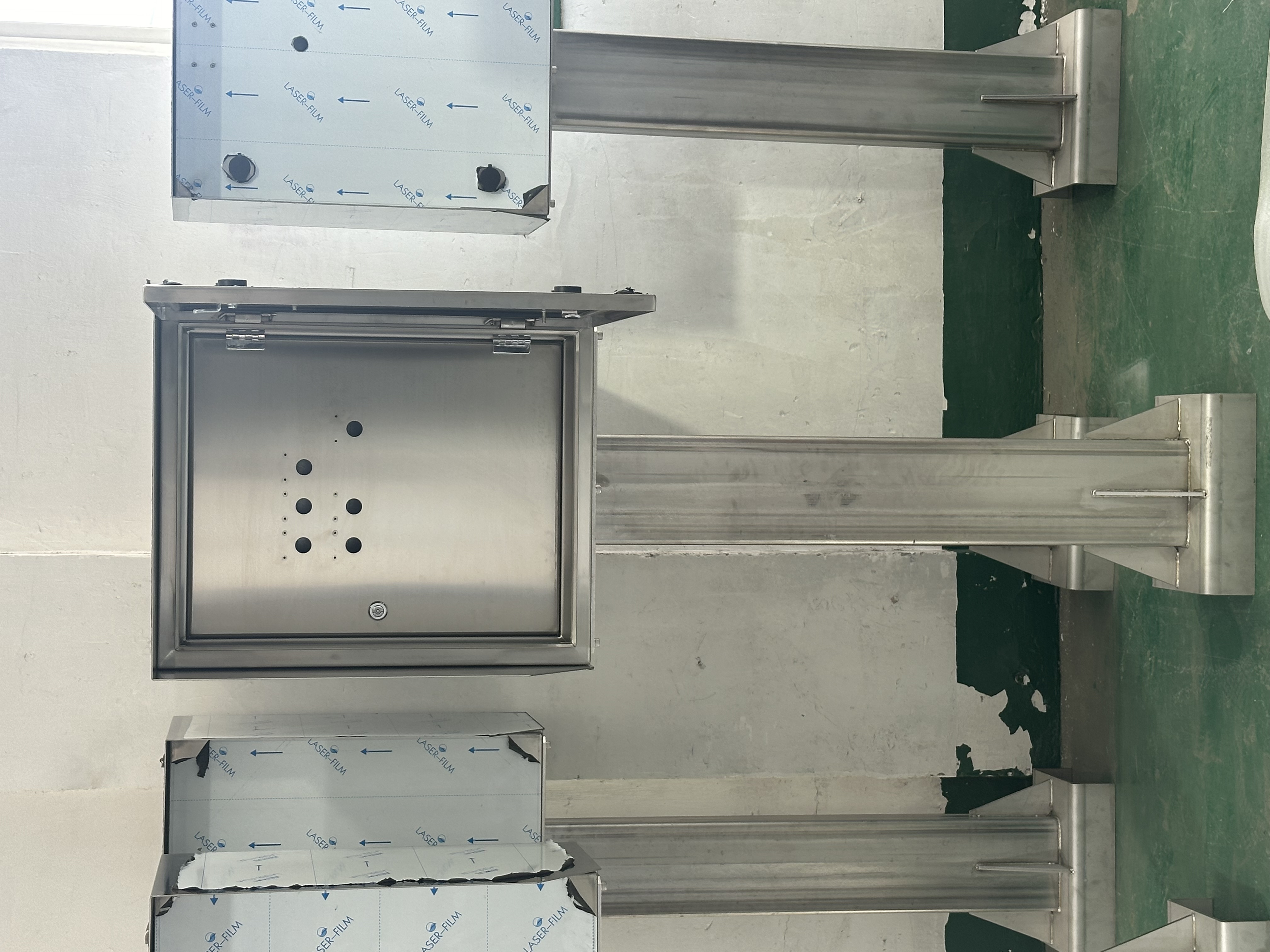
Pedestal, wall-mounted and floor-standing platforms can be configured to a project's gauge and protection level.
Next step: download the Yinlu product brochure with full enclosure specifications — https://cdn.socialarks.com/sbsp/24683/0/2026/0414/69dde990af82d.pdf