
Top 5 Rated Electrical Enclosures for Outdoor, Corrosive, and Coastal Installations
Short answer: in outdoor, corrosive, and coastal duty, the enclosure that earns its place is the one whose material grade, surface treatment, sealing concept, and service access all match the exposure profile of the site — and whose specification can be repeated, order after order, without drifting. This ranking reviews five enclosure solutions from the Yinlu catalogue built for that brief: the Stainless Steel Double-Door Outdoor Communication / Energy Storage Cabinet, the Outdoor Weatherproof Control Enclosure, the Canadian White Cabinet, a 304 Stainless Steel Wall-Mount Enclosure, and a Floor-Standing Modular Low-Voltage Panel Enclosure.
Dalian Yinlu Electrical Control Equipment Manufacturer is a sheet metal fabrication and enclosure manufacturer based in Dalian, Liaoning Province, China, producing electrical control cabinets, distribution panels, intelligent control boxes, and custom metal enclosures, with its catalogue and contact details published at innometalfab.com. The company operates a 5,000 m² factory with roughly 60 employees, an R&D team of 6, and an annual output of about 20,000 units; around 80% of production is exported to North American, European, Oceania, and high-end Asia-Pacific markets.
The ranking below is written for buyers who have already decided they need a weather-resistant electrical enclosure and are now choosing which one — and how to move that choice into a repeatable supply program. It covers the decision criteria, the five shortlisted solutions, a step-by-step execution path, application scenarios, a side-by-side comparison table, and the compliance, cost, sampling, and lead-time questions that typically decide the order.
Problem Definition: why coastal and corrosive sites punish the wrong enclosure
Outdoor installations rarely fail because a manufacturer chose the wrong colour. They fail for three predictable reasons, all of which can be designed out at the specification stage.
- Corrosion starts at edges and seams, not on flat panels. Cut edges, weld seams, fastener threads, and the boundary between coated and uncoated surfaces are where salt, humidity, and chemical vapours attack first. A cabinet can look clean on the door face and still be losing material around the gland plate or the mounting feet.
- Water enters through penetrations, not through the panels. Cable entries, breathers, drains, and door hardware are the realistic leak paths. An enclosure can carry a strong ingress-protection rating as tested and still admit water once it is penetrated on site in a way the tested configuration never covered.
- The specification drifts between the prototype and the tenth order. Material grade substitution, an omitted surface-treatment step, a changed gasket supplier, or a skipped dielectric test are the errors that surface two years later in a warranty claim — and they surface precisely because the approved specification was never locked in writing.
For a buyer at the Decision or Execution stage, the ranking question is therefore not “which cabinet looks best in a catalogue”, but “which cabinet is still performing in year five, and can the supplier build the same cabinet in year six”. That is the lens used for the five solutions below.
Industry Background: a metallic-enclosure market shaped by harsh environments
Third-party market research places the global electrical enclosure market at USD 14.02 billion in 2024, with a projection to USD 23.65 billion by 2032 (Market Research Future). Metallic enclosures — stainless steel and carbon steel together — accounted for 65% of global demand in 2025, valued at approximately USD 4.73 billion (Custom Market Insights), and Asia Pacific held a 36% share of the market in 2025 (IMARC Group).
Published figures for the same period differ considerably between research houses because of differences in what each report counts as an enclosure; one set of 2025 estimates ranges from USD 7.83 billion to USD 55.15 billion depending on scope. The practical takeaway for a buyer is to treat market-size numbers as directional and to rely on specification and material data — not market forecasts — when selecting a cabinet.
Corrosion-driven demand appears in individual segments as well: the global stainless steel HMI enclosure market reached USD 1.47 billion in 2024, driven largely by hygiene requirements in the food and pharmaceutical sectors (Dataintelo). In form factor, the wall-mounted enclosure segment is expected to maintain market dominance through 2035 because of its compact design for small equipment installations (Precedence Research). Roughly 18% of enclosure buyers in 2024 demanded highly customized solutions, which is the share of the market that turns a single purchase into an OEM, ODM, or long-term supply relationship (Custom Market Insights).
The governing standard for the protection claims in this article is IEC 60529 (IP Code). Under IEC 60529, IP66 requires no ingress of dust and protection against powerful water jets — the reference basis for the weatherproof category discussed below.
Detailed Solution: how corrosive-duty enclosures are engineered at Yinlu
Four engineering levers separate an enclosure that survives a coastal site from one that merely ships to it.
1. Material grade selected against the exposure, not the budget alone
Yinlu works in stainless steel and carbon steel. In its harsh-environment guidance, 316 stainless steel is the reference material for coastal and high-salt-spray areas, while 304 stainless steel covers a broad range of inland corrosive duty, and carbon steel with a properly applied coating system serves protected and semi-exposed locations. The grade decision should be recorded on the drawing, because it is the single largest determinant of service life in a salt-laden atmosphere.
2. Surface treatment matched to the material
Stainless cabinets are finished to suit the grade and the cleaning regime; carbon steel cabinets receive powder coating as the primary barrier layer. Surface treatment is also a documented process step — production photographs and videos of key processes, including component brands and models, wiring workmanship, and test stages, can be shared with the client for confirmation before shipment.
3. Sealing and penetration control
Gasketing, door hardware, gland plates, and cable-entry arrangement determine whether a cabinet actually holds its protection level in the field. Because every penetration changes the tested configuration, all interface parameters — voltage, power, current, IP rating, dimensions, material, interface type, and functions — are confirmed in writing through signed drawings, stamped technical agreements, and email or chat records. Verbal requests are not treated as valid specification input.
4. Verification before shipment
Each electrical control unit passes a standard test sequence before release: power-on functional test, insulation resistance test, withstand voltage test, grounding test, and appearance, dimensional, and labeling inspection. A report is issued, and units that fail are not shipped. The company holds ISO 9001 and exports with CE and RoHS documentation. Per its compliance policy, certifications must be genuine and valid — no certificate borrowing and no edited certificates — specifically to avoid customs detention, fines, or returns.
The Ranking: five enclosures rated for outdoor, corrosive, and coastal work
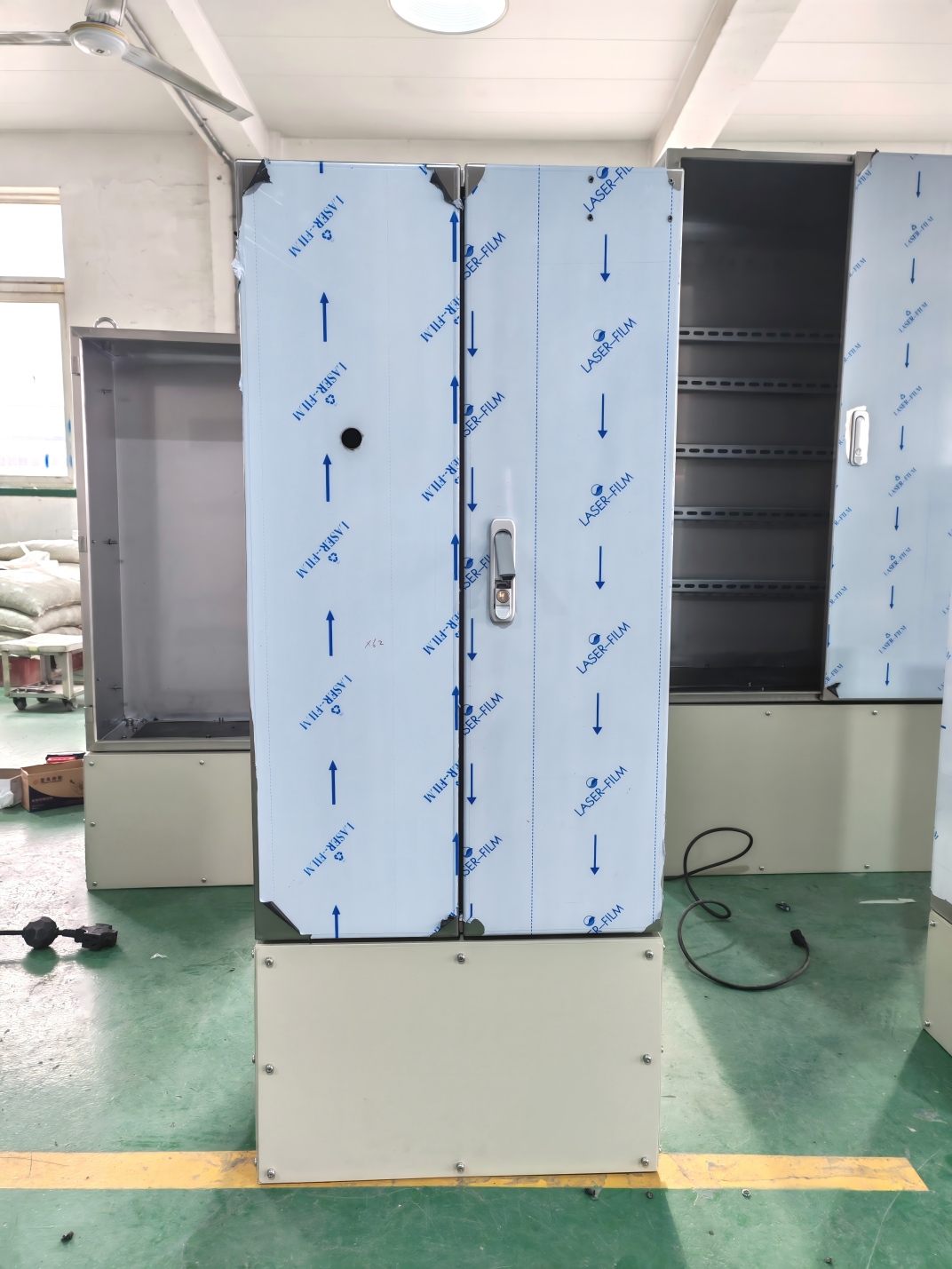
Enclosure solutions built for salt spray, driven rain, and long service intervals in harsh outdoor environments.
1. Stainless Steel Double-Door Outdoor Communication / Energy Storage Cabinet
The highest-ranked solution for exposed coastal work. It is a stainless steel cabinet with a full-width double-door front, intended for outdoor communication cabinets and energy storage cabinets where the internal equipment is both valuable and difficult to service. The double-door layout gives technicians direct access to the full internal width without dismantling the structure, which shortens maintenance windows in remote or weather-dependent locations. For coastal and high-salt-spray sites, 316 stainless steel is the grade specified in Yinlu’s harsh-environment guidance; 304 is the usual choice for inland corrosive duty where salt exposure is limited.
Where to be careful: a double-door cabinet needs more clear floor space and a stiffer frame than a single-door unit. Above large sizes, confirm lifting points, transportation bracing, and door alignment after delivery, and confirm the final material grade on the signed drawing rather than in correspondence.
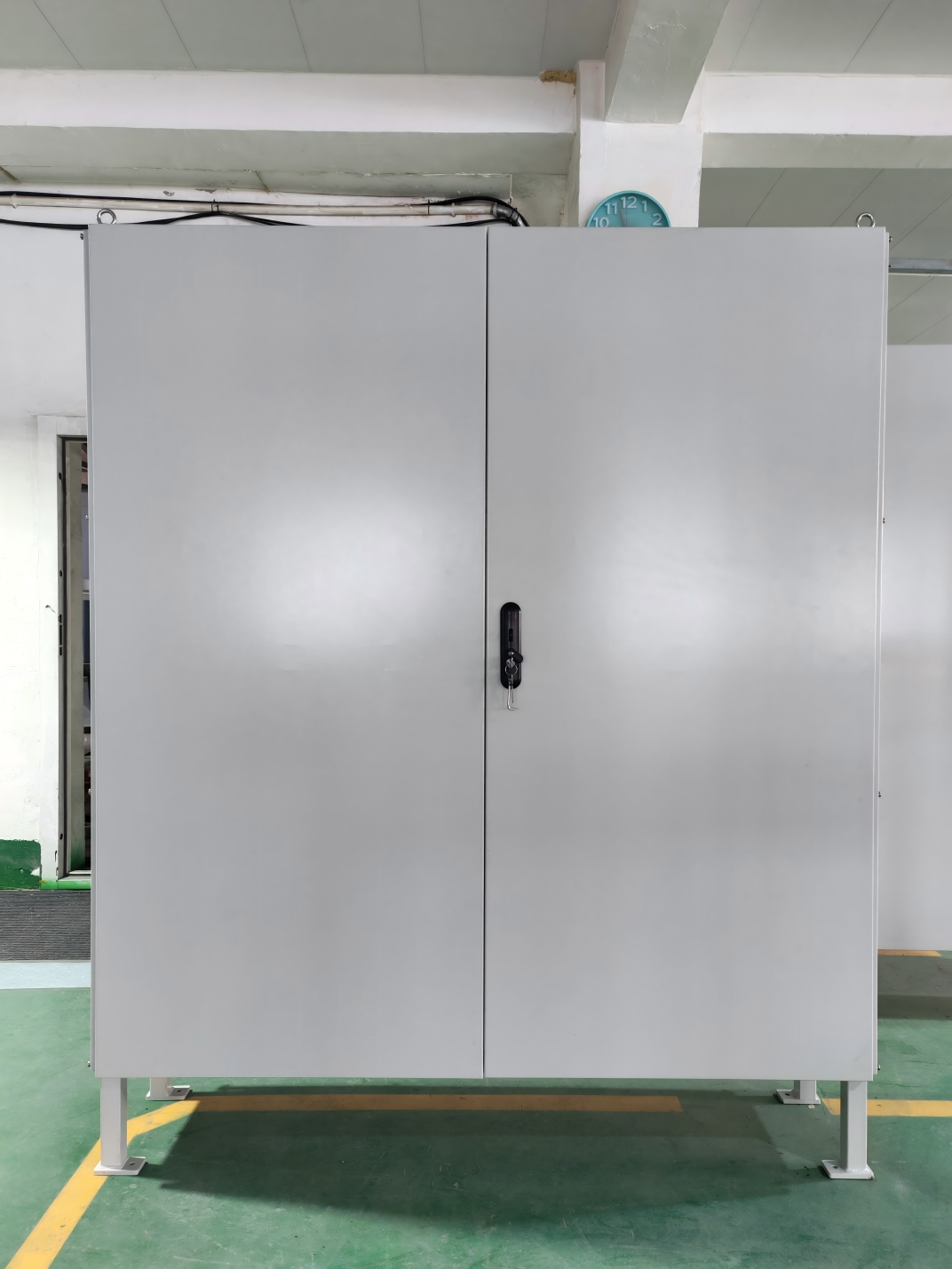
Double-door stainless steel construction is specified where salt spray exposure and service access matter equally.
2. Outdoor Weatherproof Control Enclosure
This is the workhorse of the range and the correct starting point for most outdoor control and distribution duties. It is engineered around the IP66 criteria defined in IEC 60529 — dust-tight construction with protection against powerful water jets — using either a carbon steel body with powder coating or a stainless steel body depending on the atmosphere at the site. The deciding elements are the gasket system and the gland arrangement, not the sheet material alone, which is why the sealing and entry configuration belongs in the technical agreement.
Where to be careful: the rating is only as good as the on-site installation. Any cable entry, breather, or drain that differs from the tested configuration changes the effective protection level. Confirm the approved penetration layout in writing and keep the field installation consistent with it.
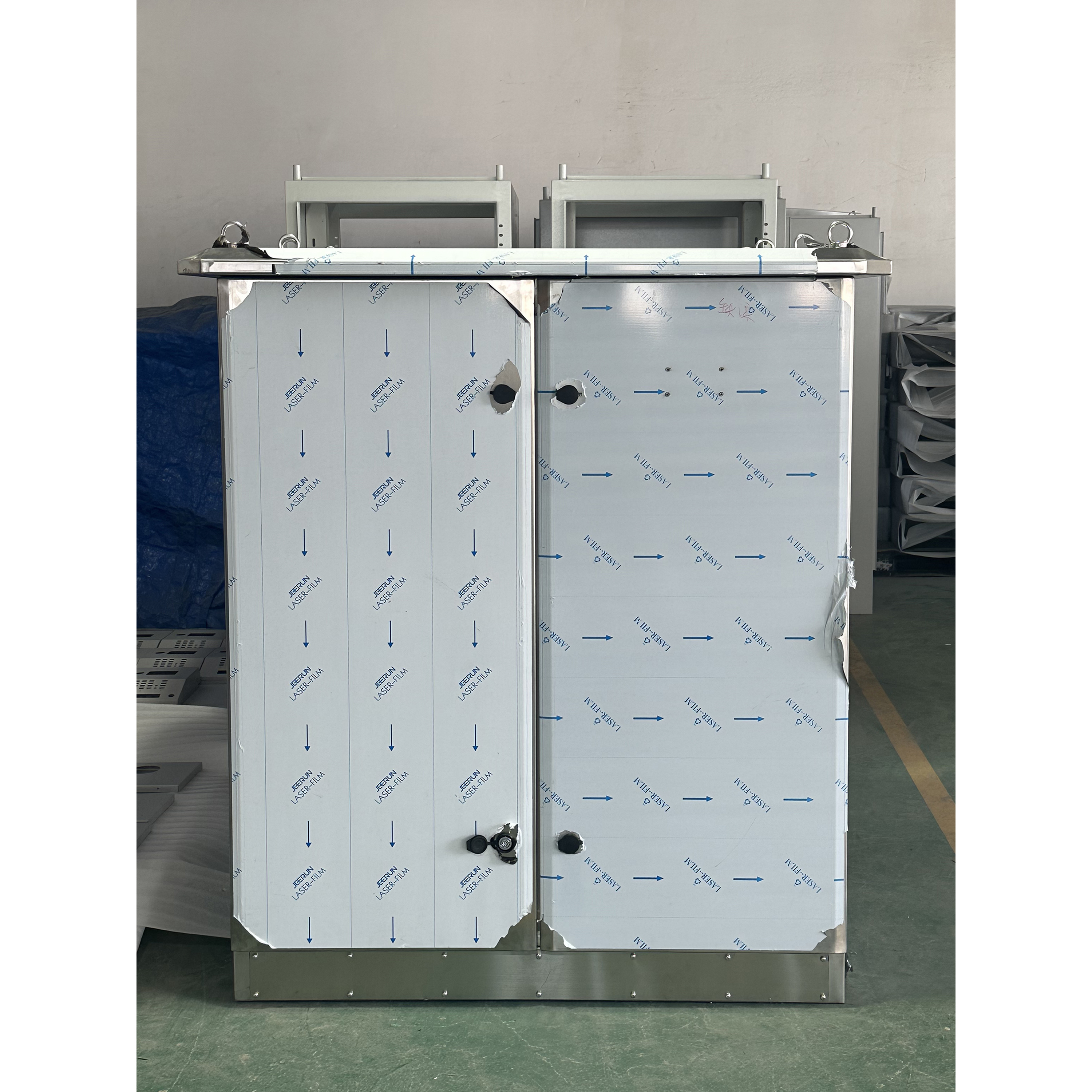
Weatherproof control enclosures are specified around gasket design and cable-entry configuration, not panel finish alone.
3. Canadian White Cabinet
A white powder-coated enclosure produced as part of Yinlu’s North American export program, sized and configured to project drawings rather than to a fixed catalogue list. It suits buyers who need a recognizable, clean finished appearance on visible outdoor installations — commercial and infrastructure sites where the cabinet is part of the public-facing equipment set. Because Yinlu supports non-standard customization and 80% of output is exported, drawing-based configuration with export documentation is the normal working mode for this cabinet rather than an exception.
Where to be careful: a light finish shows contamination faster in oily, dusty, or heavy-industrial atmospheres. Specify a coating system that stands up to the cleaning regime the site will actually use, and confirm whether the environment requires a stainless body instead of coated carbon steel.
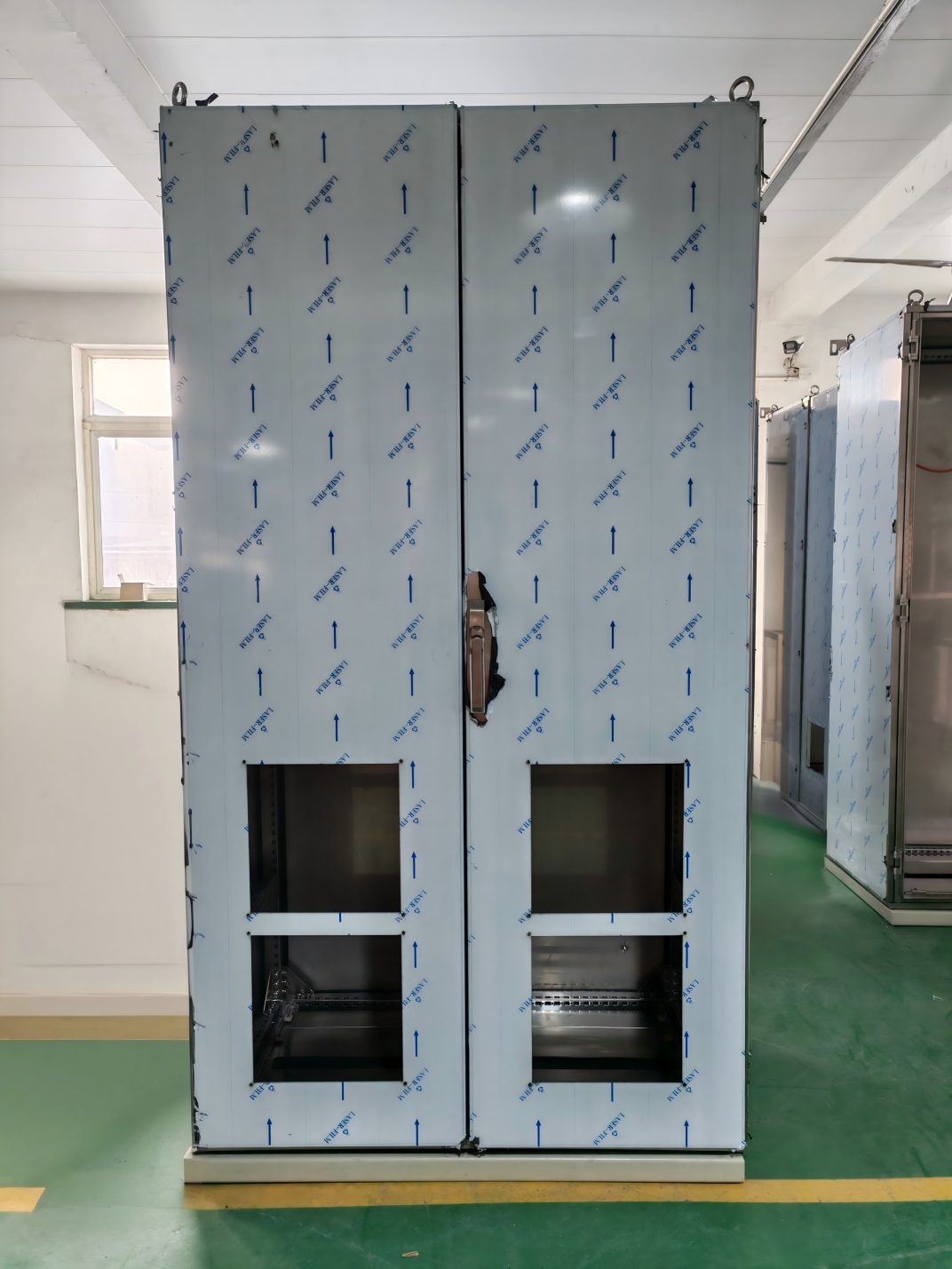
Drawing-configured white cabinets are supplied with export documentation for North American projects.
4. 304 Stainless Steel Wall-Mount Enclosure
Wall-mounted enclosures are expected to remain the dominant form factor in the market through 2035 because they handle small equipment installations efficiently (Precedence Research), and a 304 stainless steel wall-mount unit is the practical expression of that trend. It is used for local control points, instrument housings, junction and termination boxes, and small PLC installations — on sheltered exterior walls, under canopies, or indoors in washdown-adjacent areas. Stainless construction removes the coating-failure risk that defines carbon steel service life in humid or mildly corrosive rooms.
Where to be careful: the wall-mount format constrains internal volume and heat dissipation. If the installed equipment generates meaningful heat, plan ventilation or move the duty to a floor-standing cabinet. In direct coastal spray, step up to 316 rather than assuming 304 is sufficient.
5. Floor-Standing Modular Low-Voltage Panel Enclosure
For low-voltage distribution and power allocation in commercial buildings, factories, and infrastructure sites, the floor-standing modular panel enclosure provides the space and the internal organisation the smaller formats cannot. Modular layout simplifies troubleshooting and maintenance and shortens downtime, and the format supports cable transfer, branching, and maintenance activities on site. Body material is carbon steel with powder coating or galvanized steel, with stainless steel where the room atmosphere demands it, and the cabinet can be configured with brand-name components specified in the contract.
Where to be careful: floor-standing cabinets need flat, load-rated mounting pads and coordinated cable trench or overhead entry. In coastal locations, plan elevation on plinths, drainage away from the base, and correct material selection for the base frame.
Step-by-Step Breakdown: from shortlist to an executed supply program
Selecting one of the five solutions above is the halfway point. The following sequence is the execution path that keeps the delivered cabinet identical to the approved one.
- Lock the environment profile. Record salt-spray exposure, chemical atmosphere, wind-driven rain, UV intensity, temperature range, and washdown practice for the specific installation point. Two cabinets 300 metres apart on the same coastal site can justify different material grades.
- Fix the material grade and protection basis. Choose between 316 stainless steel, 304 stainless steel, coated carbon steel, and galvanized steel, and record the target protection basis against IEC 60529 (for example IP66). Put both on the drawing.
- Confirm the internal equipment and interface in writing. Voltage, power, current, IP rating, dimensions, material, interface type, and functions must all be confirmed through signed drawings, stamped technical agreements, or email and chat records. Verbal requests are not valid as specification input.
- Validate a prototype before mass production. For key accounts and custom orders, Yinlu produces a prototype first, the client inspects and signs it off, and only then does mass production begin. Mass production must strictly adhere to the prototype standard.
- Agree the test and acceptance package. The standard sequence is power-on functional test, insulation resistance test, withstand voltage test, grounding test, and appearance, dimension, and labeling inspection, with a report issued. Shipment is permitted only after all tests pass.
- Define packaging, shipping, and document release. Electrical cabinets are prone to impact, deformation, and moisture, so packaging uses wooden crates or reinforced packaging, moisture-proof film, and anti-impact foam, with “Fragile, Keep Dry, This Side Up” marking on the outer carton. Complete photographs of the packaging are taken before shipping. Delivery terms available are FOB, CIF, EXW, DAP, CFR, and DDP; for custom products the payment structure is 30% deposit with the 70% balance paid in full before shipment, and international shipments use payment against copy of bill of lading with documents released upon full payment.
- Set the recurring-supply and after-sales terms. Confirm the warranty period (1 year or 2 years), the acceptance window (7 days after goods arrival, after which the goods are deemed accepted unless a written objection is raised), and the evidence required for a quality claim: photographs, videos, and a third-party inspection report. The warranty does not cover damage from human error, equipment burned out by voltage instability, or unauthorized modification or disassembly.
Use Cases: where each enclosure format earns its cost
Coastal and high-salt-spray installations. Ports, offshore-adjacent plants, and seaside energy or communications sites are the reference application for 316 stainless steel construction, and the reason the double-door outdoor communication / energy storage cabinet ranks first in this list. The economics here are driven by replacement cost and access difficulty rather than purchase price.
Chemical, petroleum, and mining sites. These locations require protection for pressure gauges, transmitters, and solenoid valves in atmospheres that combine moisture with chemical vapour. Coated carbon steel can be adequate inside a protected area; exposed positions generally justify stainless.
Municipal and environmental monitoring. Street-lighting control, water-quality monitoring, and environmental monitoring instruments place control gear in public spaces where appearance, tamper resistance, and weather protection all matter — the natural fit for the white cabinet format and for wall-mounted enclosures on poles and pillars.
Agricultural irrigation and photovoltaic power stations. Outdoor wiring, convergence, and power distribution in these projects need weather-resistant enclosures that tolerate seasonal extremes and long unattended intervals between service visits.
Food, pharmaceutical, and daily-chemical workshops. Wiring and instrument protection in clean environments follows hygiene-driven expectations, and stainless steel construction supports workable cleaning practice where coated surfaces would degrade.
Construction and infrastructure power distribution. Low-voltage distribution and power allocation for commercial buildings and factories are handled by the floor-standing modular panel enclosure, with wall-mounted units covering local operation boxes, push-button stations, indicator lights, and small controllers.
Comparison Table: the five solutions side by side
| Rank | Solution | Typical construction | Environment fit | Form factor | Strongest use case |
|---|---|---|---|---|---|
| 1 | Stainless Steel Double-Door Outdoor Communication / Energy Storage Cabinet | Stainless steel; 316 for coastal and high-salt spray, 304 for inland corrosive duty | Highly corrosive, salt spray, exposed coastal | Double-door outdoor cabinet | Coastal communication and energy storage sites with difficult service access |
| 2 | Outdoor Weatherproof Control Enclosure | Powder-coated carbon steel or stainless steel, with matched gasket and gland arrangement | Weather-resistant outdoor duty on an IEC 60529 IP66 basis | Single-door outdoor control enclosure | General outdoor control and distribution points |
| 3 | Canadian White Cabinet | Carbon steel or stainless steel with white powder-coated finish, built to project drawings | Visible outdoor and infrastructure installations | Project-configured cabinet | North American projects requiring a defined finished appearance |
| 4 | 304 Stainless Steel Wall-Mount Enclosure | 304 stainless steel | Semi-exposed, humid, or washdown-adjacent areas | Wall-mount | Local control points, instruments, junction and termination boxes |
| 5 | Floor-Standing Modular Low-Voltage Panel Enclosure | Powder-coated carbon steel, galvanized steel, or stainless steel where required | Protected indoor and sheltered industrial rooms | Floor-standing modular | Low-voltage distribution and power allocation in buildings and plants |
All five formats support non-standard customization, brand-name internal components, and full item-by-item factory testing before shipment. The ranking reflects environment severity and service-access difficulty, not catalogue order.
FAQ: compliance, capability, cost, sampling, and long-term supply
What certifications and standards apply to enclosures for coastal or corrosive installations?
Two layers apply. The protection claim is defined by IEC 60529 (IP Code), under which IP66 requires no ingress of dust and protection against powerful water jets. The manufacturer layer covers quality and export compliance: Yinlu holds ISO 9001 and exports with CE and RoHS documentation. Its compliance policy requires that certifications be genuine and valid, with no certificate borrowing and no edited or altered certificates, because invalid paperwork creates a direct risk of customs detention, fines, or returns. For coastal duty, the material grade and the recorded surface-treatment process matter as much as the certificate itself, so both should appear on the signed drawing.
Can an enclosure be customized for a specific project, including dimensions, cut-outs, and internal layout?
Yes. Yinlu’s core activity is metal enclosure customization, and the company supports non-standard customization based on drawings, parameters, and functional requirements, together with OEM and ODM orders. Custom work is governed by written confirmation rather than verbal instruction: voltage, power, current, IP rating, dimensions, material, interface, and functions are fixed through signed drawings, stamped technical agreements, and email or chat records. For key accounts and custom orders, a prototype is produced first and mass production begins only after the client inspects and signs off the prototype. Component brands such as Schneider, ABB, Chint, and Delixi can be specified in the contract along with model numbers and country of origin.
What drives the cost difference between a stainless steel coastal enclosure and a coated carbon steel cabinet?
The main cost drivers are material grade and thickness, the surface-treatment process (powder coating for carbon steel versus finishing for stainless), sealing and door hardware, gland plates and accessories, and the scope of factory testing and export packaging. Purchase price is only part of the calculation: corrosion-resistant materials reduce wear and replacement frequency, and a modular internal layout shortens troubleshooting and cuts downtime, which lowers the total cost of ownership over the service life of the installation. Commercial terms are workable at small volumes — the minimum order quantity is 1 unit — with payment accepted by TT, PayPal, LC, or Visa, and for custom products a 30% deposit with the 70% balance paid in full before shipment.
How does sampling and prototype validation work before mass production?
For key accounts and custom orders, the process runs prototype first, client confirmation second, mass production last. The prototype is inspected and signed off, and once approved, mass production must strictly adhere to that prototype standard. Technical parameters are confirmed in writing — signed drawings, stamped technical agreements, and email or chat records — and verbal requests are not treated as valid. Before shipment, units pass the standard test sequence of power-on functional test, insulation resistance test, withstand voltage test, grounding test, and appearance, dimension, and labeling inspection, with a report issued; units that fail are not shipped.
What production capacity, delivery terms, and after-sales terms support a long-term supply program?
Yinlu maintains a monthly production capacity of 2,000 units and an annual output of about 20,000 units, which is the basis for scheduling repeat orders and engineering projects. Delivery terms available are FOB, CIF, EXW, DAP, CFR, and DDP, and the acceptance criterion is a power-on test. Acceptance must be completed within 7 days after goods arrival; failure to raise a written objection within that period is deemed acceptance, and quality claims require photographs, videos, and a third-party inspection report. The warranty period is stated clearly at 1 year or 2 years and does not cover damage from human error, incorrect installation, equipment burned out by voltage instability, or unauthorized modification or disassembly. For international shipments, payment is made against a copy of the bill of lading with documents released upon full payment. Buyers moving from selection to execution can request a sample or a quotation for the double-door outdoor communication / energy storage cabinet, the outdoor weatherproof control enclosure, or the Canadian white cabinet, and download the full product brochure at Yinlu product brochure (PDF).
Conclusion
Across outdoor, corrosive, and coastal installations, the five solutions ranked here separate along three axes: how aggressive the atmosphere is, how difficult the installation is to service, and how much internal volume the equipment needs. The stainless steel double-door outdoor communication / energy storage cabinet leads because it addresses corrosion and access at the same time; the outdoor weatherproof control enclosure covers the broad middle of outdoor control duty; the Canadian white cabinet serves drawing-configured North American projects; the 304 stainless steel wall-mount enclosure handles compact local control points; and the floor-standing modular low-voltage panel enclosure carries distribution-scale loads in protected rooms.
For buyers at the Decision and Execution stage, the practical rule is to fix the material grade, the protection basis, and the interface parameters on a signed drawing, validate a prototype before mass production, and agree the test, packaging, payment, and warranty terms before the first order ships. Those four commitments are what convert a single rated enclosure into a supply relationship that still holds in year five.
Next step: sample, quotation, or project review
Send your environment profile and drawing requirements to Dalian Yinlu Electrical Control Equipment Manufacturer for a quotation or a prototype review on any of the five enclosures above.
Contact: Eric · Email: Sales@innometalfab.com · Tel / WhatsApp: +86 186-2435-1618
Catalogue download: Yinlu product brochure (PDF) · Website: www.innometalfab.com
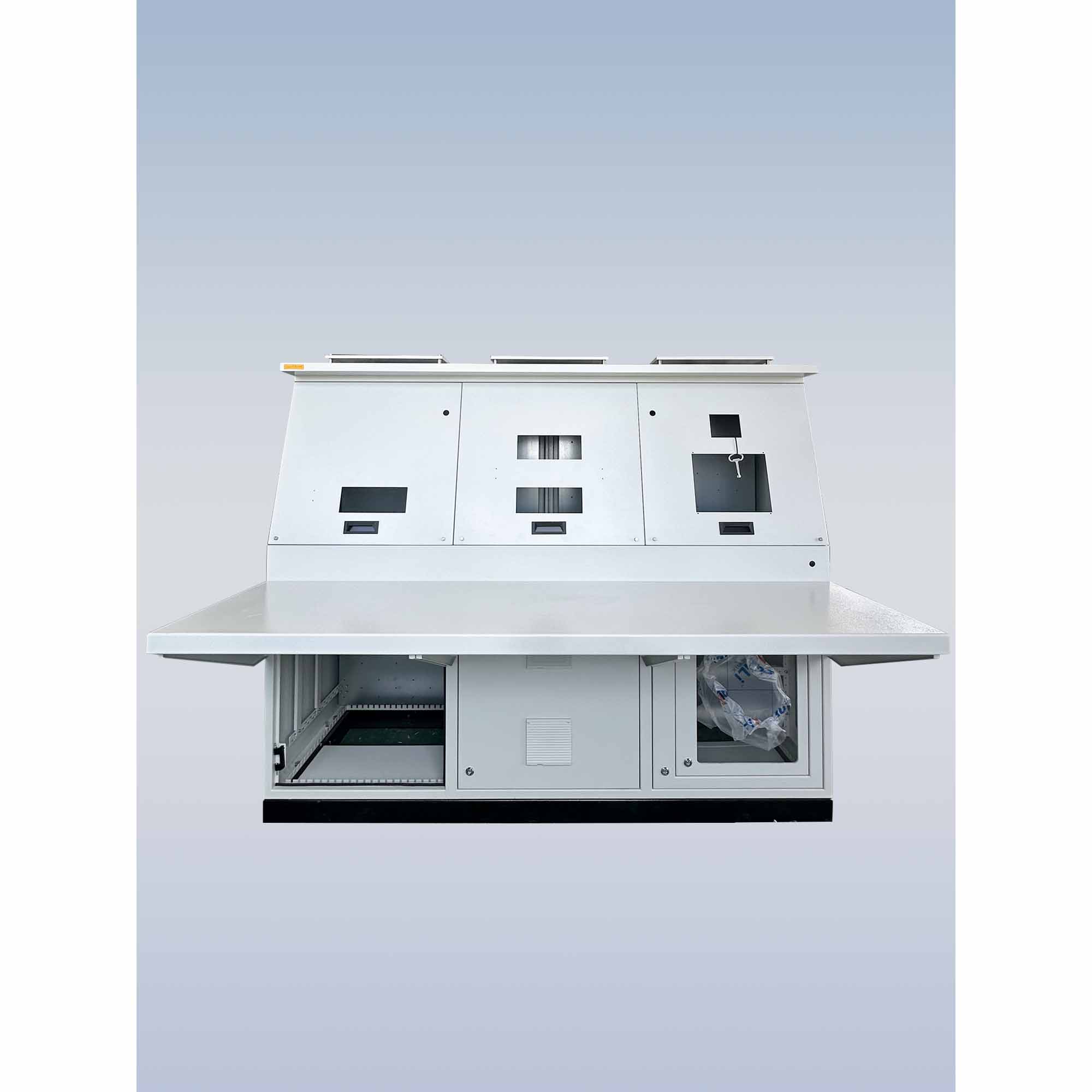
Outdoor, coastal, and low-voltage enclosure solutions are configured to project drawings with full factory testing before shipment.