Electrochemical vs. Chemical Biocide for Produced Water
Skid-Mounted : Buyer Comparison Guide
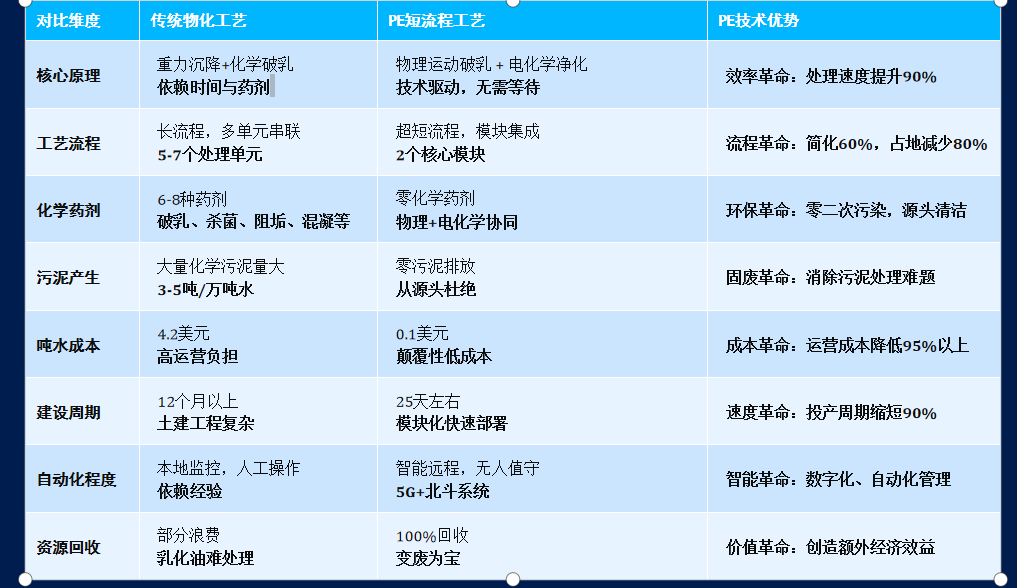
In produced water reinjection, choosing between a skid-mounted electrochemical sterilization unit and a chemical biocide program looks like a technology decision. It is really a decision about operating cost, site logistics and what has to be disposed of. A chemical route kills bacteria by continuously dosing bactericide, and in a conventional produced-water train that bactericide sits alongside corrosion inhibitor, scale inhibitor, demulsifier and flocculant — the process comparison for the PE short-process counts 6–8 separate chemical types in the conventional route. An electrochemical route generates the sterilant on site from the produced water itself and adds no chemicals at all.
The E module in the PE short-process line from YixiaWorld Oil & Gas Equipment (Yixia Invention (Beijing) Technology Co., Ltd., established 2007) is documented at a single-module treatment capacity of 30,000 m³/d, a 100% SRB sterilization rate, a 98% sulfide removal rate and a 98% scale inhibition rate. The company's process comparison places the conventional chemical route at about US$4.2 per ton of water (roughly RMB 15) and the PE short-process at about US$0.1 per ton (roughly RMB 0.20).
A gap that wide deserves to be examined rather than accepted. This guide breaks the per-ton figure into its line items, explains precisely what “Zero Chemical Agents” and “Zero Sludge Generation” cover, reviews the documented sterilization evidence, and lists the site conditions — sulfide load, salinity, temperature, power, explosion-proof rating and documentation — that should decide the selection for a specific field.
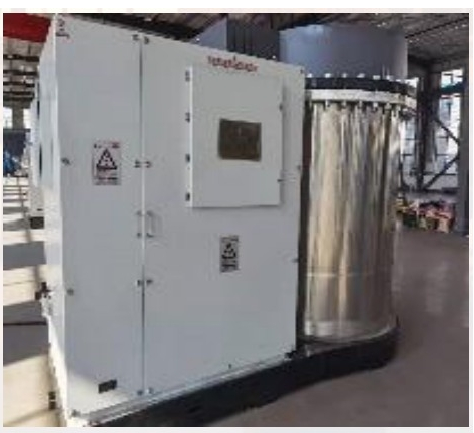
Chemical biocide and electrochemical sterilization: what each route actually does
A chemical biocide program treats bacteria as a dosing problem. Bactericide is injected upstream of the injection pumps, and its concentration is maintained by manual or automatic dosing skids; the residual has to persist through the pipe network long enough to suppress sulfate-reducing bacteria. Because bactericide does not control corrosion or scale, the program is normally bundled with corrosion inhibitor and scale inhibitor, and in a full produced-water train also with demulsifier, coagulant and flocculant. The comparison data characterises that conventional route as gravity settling plus chemical demulsification, chemical anti-corrosion and scale inhibition, and a three-phase separator feeding large settling tanks.
An electrochemical unit treats sterilization as an in-situ generation problem. The E module diverts 2%–5% of the produced water through fast-ion ceramic catalytic electrodes and electrolyses that slipstream into a concentrated active flow, which is then injected back into the main pipeline through a mixer. No chemical is delivered, no dosing tank is filled and no bactericide inventory is held on site. The PLC sets the diversion ratio according to water salinity.
The practical consequence is that the two routes fail differently. A chemical program fails through bacterial resistance, dosing error, supply interruption or sludge accumulation. An electrochemical unit fails when the water falls outside its operating envelope — high sulfide without upstream treatment, very low salinity, or excessive oil content. That is why the design conditions in this guide matter more than the headline sterilization figure.
How the E module generates the sterilant, and what else the reaction does
Under the electric field, ions in the produced water migrate and react at the electrode surface to form active species such as HClO, O₃ and H₂O₂. These oxidise bacterial cell walls directly, which is the basis of the documented 100% SRB sterilization rate. The same reaction sequence produces three secondary effects that matter to a reinjection system: sulfides are oxidised (98% removal), the charge polarity of suspended solids is altered so they stop adhering to pipe walls (98% scale inhibition), and a dense metal oxide passivation film forms on the internal pipe surface, isolating the metal from the corrosive medium.
That passivation film is the substantive difference between the two anti-corrosion strategies. A chemical program maintains an inhibitor concentration in the water for as long as the water flows. The electrochemical route changes the surface condition once and then sustains it, which the supplied mechanism material describes as removing existing wall foulants and then forming the protective oxide layer.
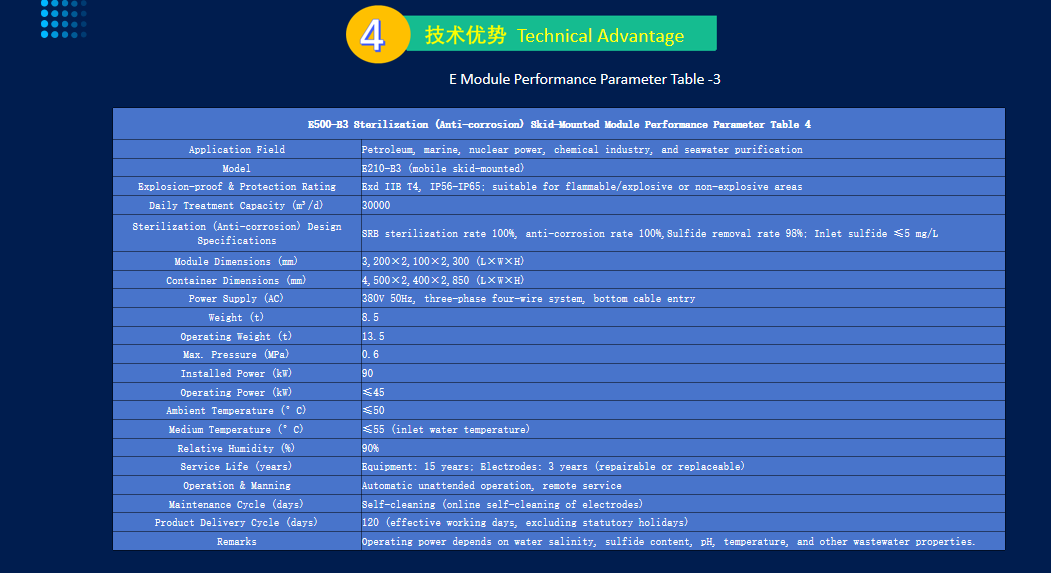
Module-level operating data for the buyer's datasheet: maximum single-module capacity 30,000 m³/d; operating power ≤45 kW; 380 V AC supply with correct grounding; inlet medium temperature ≤60 °C (the sterilization application table lists medium temperature ≤55 °C with ambient ≤50 °C); explosion-proof rating Exd IIB T4 with IP56–IP65 sealing and salt-fog resistance; electrode life ≥20,000 hours; 5G + BeiDou remote monitoring supporting unattended operation.
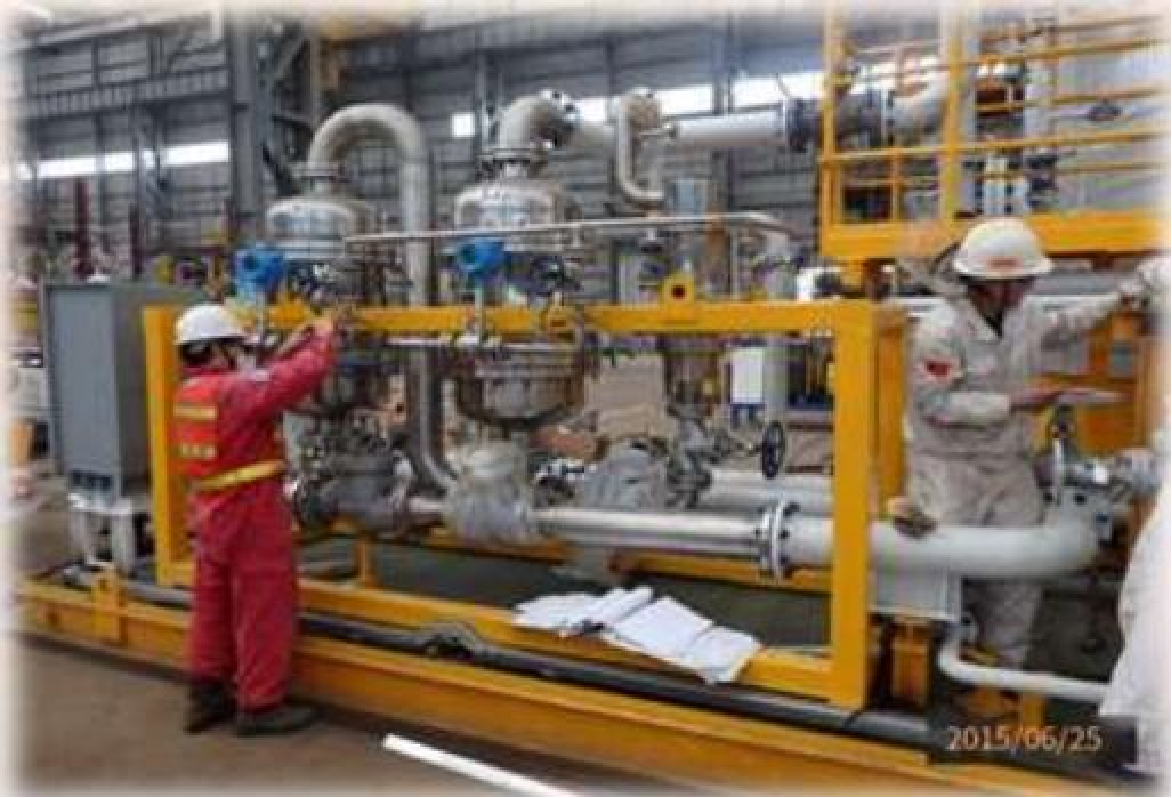
Design conditions that decide feasibility
The electrochemical route is not unconditional. The following limits appear in the E module selection guidance and the application data, and each one should be answered with field data before a purchase decision:
- Sulfide. Water with high sulfide content must be pre-treated by the P module before it enters the E module. The EF filtration module is specified at inlet sulfide ≤5 mg/L.
- Salinity. Low salinity reduces sterilization efficiency, because the process depends on ions present in the water to generate the active species.
- Temperature. Inlet water temperature must be ≤60 °C; the sterilization application table is specified at medium temperature ≤55 °C and ambient ≤50 °C.
- Oil content. High-oil water should be used with caution. The EF module requires inlet oil ≤30 mg/L, so an upstream deoiling step (P module) is a design condition, not an optional extra.
- Chemicals. Adding flocculants is strictly prohibited: the flocs they form interfere with physical demulsification and clog the equipment. Chemical demulsifiers and bactericides interfere with the electrochemical process in the same way.
- Power and earthing. 380 V AC supply, operating power ≤45 kW per module, and correct grounding for electrical safety in a hazardous area.
- Capacity scaling. Larger volumes are met by combining modules in parallel rather than by upsizing a single vessel.
“Zero Chemical Agents” and “Zero Sludge Generation”: precise meaning
“Zero Chemical Agents” means the treatment train requires no addition of any chemical agent. In the supplied definition this covers demulsifiers, coagulants, flocculants, bactericides, corrosion inhibitors, scale inhibitors and viscosity reducers — the 6–8 chemical types counted in a conventional route. Flocculants are specifically prohibited rather than merely unnecessary, because the flocs they create interfere with physical demulsification and clog the equipment internals.
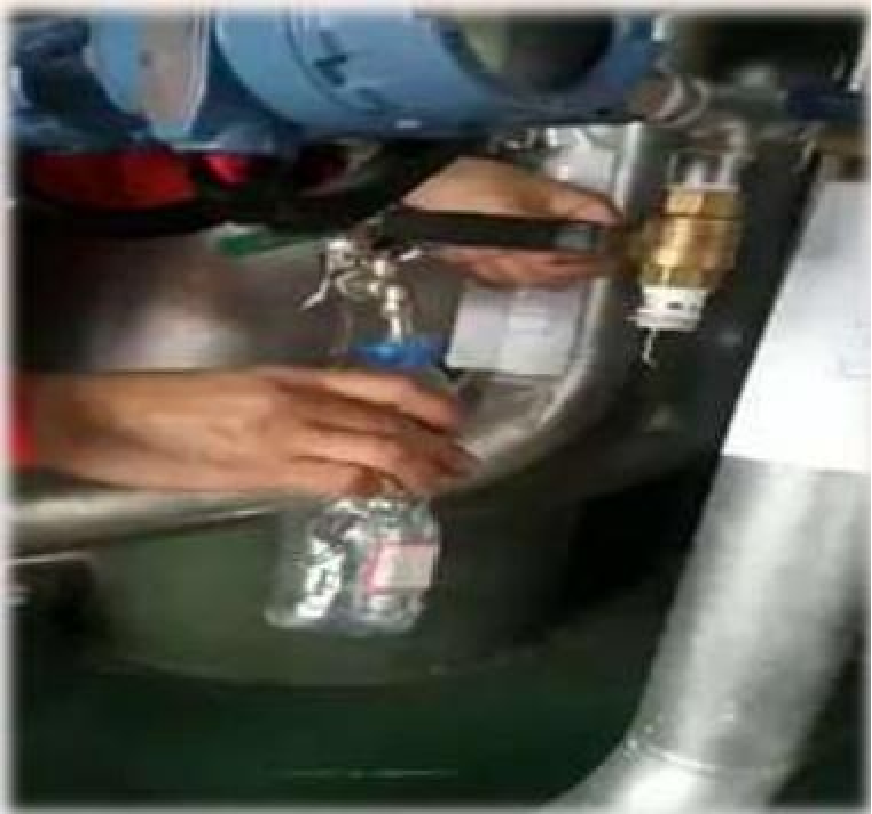
“Zero Sludge Generation” means the elimination of chemical sludge from the water treatment process. Because no demulsifier or flocculant is added, the process does not create hazardous chemical sludge; what is separated is inorganic sand and recovered oil. The company's own site material documents sludge sampling at the bottom of a Pw500 oil-suspension module after eight months of continuous operation, which is the kind of check a buyer should ask to see replicated at a reference site.
Two boundaries keep the claims usable in a tender document. First, “zero sludge” does not mean zero solids: separated sand and produced solids still exist and still need a disposal route, but they are not chemical sludge and do not carry the same reagent loading. Second, “zero chemicals” does not remove the duty of care on the operating envelope; temperature, sulfide, salinity and oil limits still apply, and the PLC will protect the unit by shutting down when they are exceeded.
Removal evidence: SRB, IB and TGB
The documented sterilization figure for the E module is a 100% SRB kill rate, with 98% sulfide removal. The company's technical FAQ cites Jidong Oilfield as the reference point for that 100% SRB figure and attributes it to direct oxidative destruction of bacterial cell walls rather than interference with a specific metabolic pathway — the company's explanation for why the long-term resistance associated with repeated biocide dosing does not develop in the same way.
Three cautions apply when that figure is carried into a tender. First, SRB, iron bacteria (IB) and general heterotrophic bacteria (TGB) are different populations measured by different culture methods; a 100% SRB result is not automatically a 100% result for IB or TGB, and the correct request to any supplier is organism-specific assay data from a field comparable to the buyer's own. Second, a sterilization rate has meaning only with its sampling point, contact time and inlet bacterial count attached, so ask for all three. Third, the anti-resistance argument is a mechanism argument supported by company data; it is not an independent field study, and buyers handling high-value injection wells should validate it with their own monitoring during commissioning.
Downstream water quality is the second half of the evidence package. In the supplied records, outlet oil content was verified at 0.0 mg/L by a third-party testing centre, and the EF module is documented to reduce suspended solids to ≤2 mg/L and oil to ≤5 mg/L. For reinjection, those are the parameters that govern injectivity, alongside the bacterial count. Reference projects cited by the company include the CNPC Jidong Oilfield Nanpu plant at Nanbao No. 1 Island (10,000 m³/d produced water sterilization and reinjection, two electrochemical sterilization skid units) and the Sinopec Shengli Oilfield Gudao plant Guwu joint station (40,000 m³/d high-polymer produced water regeneration and reinjection, four OPS-10000-I units). In high-polymer Daqing Oilfield, the company reports 100% oil recovery without chemical addition.
Side-by-side comparison
| Decision factor | Chemical biocide program | Skid-mounted electrochemical (E module) |
|---|---|---|
| Sterilization mechanism | Continuous bactericide dosing; residual must persist through the network | In-situ electrolysis of a 2%–5% slipstream; active radicals injected via mixer |
| Chemical types on site | 6–8 (demulsifier, coagulant, flocculant, bactericide, corrosion inhibitor, scale inhibitor, viscosity reducer) | None |
| Chemical sludge | 3–5 tons per 10,000 tons of water, disposed as hazardous chemical sludge | Zero chemical sludge; inorganic sand and recovered oil only |
| Documented sterilization | Dose-dependent; resistance reported with long-term dosing | 100% SRB sterilization, 98% sulfide removal (company data) |
| Corrosion and scale | Inhibitor dosed continuously into the water | Passivation film on pipe wall; 98% scale inhibition |
| Capacity per unit | Set by dosing skids and tank farm | 30,000 m³/d per E module; parallel units for larger volumes |
| Footprint | Large settling tanks plus reagent storage | 80% smaller than the conventional physicochemical route |
| Installation time | Over 12 months for the conventional route | About 25 days (90% shorter) |
| Operating labour | Local monitoring, manual operation, experience-dependent | Unattended operation with 5G + BeiDou remote monitoring |
| Cost per ton of water | About US$4.2 (≈RMB 15), including RMB 10 for chemical sludge treatment | About US$0.1 (≈RMB 0.20), no sludge line item |
| Site requirements | Chemical delivery, storage, dosing and HSE controls | 380 V AC power, ≤45 kW per module, earthing, network for remote monitoring |
| Hazardous-area rating | Dosing and storage equipment inside the hazardous area | Exd IIB T4, IP56–IP65, salt-fog resistant |
| Main failure modes | Resistance, dosing error, supply interruption, sludge handling | Out-of-envelope water: high sulfide without pre-treatment, low salinity, >60 °C, high oil |
| Electrode service life | Not applicable | ≥20,000 hours |
Cost per ton: where the RMB 15 goes
The per-ton comparison is more useful itemised than as a headline. On the conventional side, the RMB 15 (≈US$4.2) total is made up of bactericide RMB 1.00, corrosion inhibitor RMB 2.00, demulsifier/flocculant/water purifier RMB 2.00 and chemical sludge treatment RMB 10.00. On the PE short-process side, the RMB 0.20 (≈US$0.1) total is made up of E-module sterilization RMB 0.05, E-module corrosion inhibition RMB 0.05, EF water purification RMB 0.10 and zero cost for chemical sludge.
Two observations follow directly from that breakdown. First, chemical sludge treatment is two-thirds of the conventional cost, and it exists only because the reagents that create the sludge were purchased in the first place; eliminating the reagents eliminates the disposal line item. Second, the comparison itemises reagents and sludge only. Power, electrode replacement and labour are not separately priced in it, so a buyer should request a full operating-cost model that adds module power (≤45 kW per unit), electrode replacement amortised over the stated ≥20,000-hour life, and the labour effect of unattended operation, which the company quantifies separately at a 50% reduction. The company also states that the per-ton comparison excludes additional revenue from recovered good oil, which biases the comparison against the electrochemical route rather than in its favour.
Operating footprint: remote sites and offshore platforms
Footprint is where the two routes diverge most visibly. The conventional route depends on large settling tanks, reagent storage and a dosing area; the PE short-process reports a footprint reduction of 80%, a process-flow simplification of 60% and a construction period shortened from more than 12 months to about 25 days. The modules are prefabricated, factory-tested skids, so site work is reduced to foundations, connections and commissioning, and capacity is expanded by adding parallel modules rather than by rebuilding the tank farm.
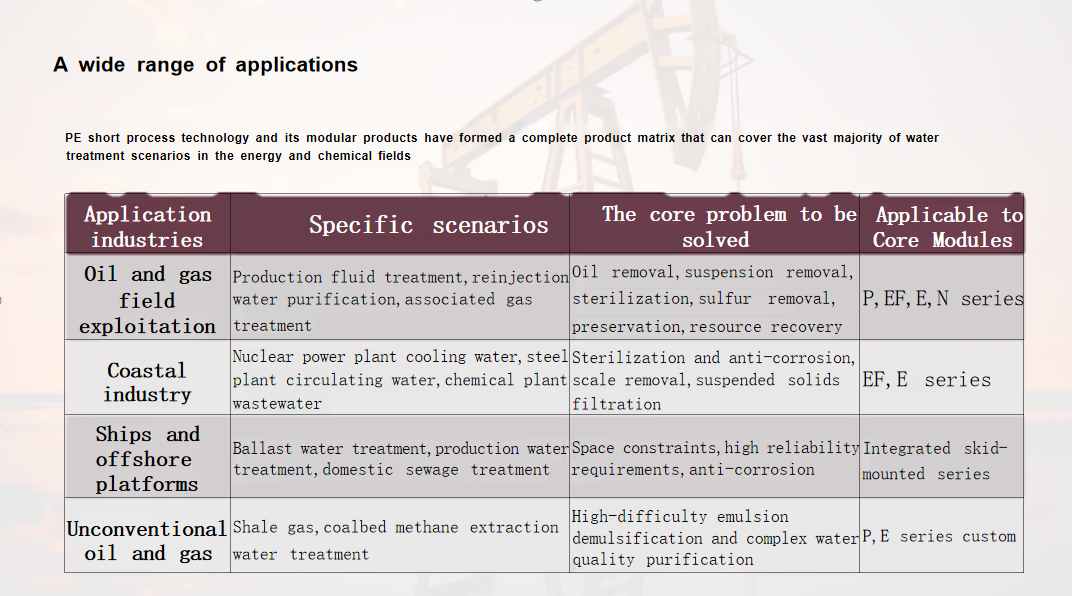
For remote onshore fields and offshore platforms the operational difference is the supply chain. A chemical program requires a delivery schedule, storage capacity, inventory control and handling procedures in a hazardous area. An electrochemical unit requires electrical power and, for the remote-monitoring benefit, network coverage. The trade is explicit: chemicals and logistics out, power and connectivity in. At an offshore installation, the Exd IIB T4 / IP56–IP65 rating and salt-fog resistance are the specifications that determine whether the unit can be installed in the process area at all, and they should be confirmed against the site's hazardous-area classification rather than assumed from the datasheet.
Decision criteria: what to verify before selecting a route
- Inlet water analysis over time, not a single sample. Sulfide, salinity, oil, suspended solids and temperature ranges decide whether the electrochemical envelope is met without pre-treatment.
- Required effluent limits. Reinjection specifications for oil (≤5 mg/L), suspended solids (≤2 mg/L) and bacterial count should be matched to the module that actually delivers them — the EF module, not the E module, is the filtration step.
- Capacity and redundancy. Check the per-module capacity against peak flow and confirm how many modules run in parallel, and what happens to treatment during module maintenance.
- Power and earthing design. Confirm 380 V AC availability, ≤45 kW per module, and grounding practice for the hazardous area.
- Hazardous-area certification. Match Exd IIB T4 and the required IP rating to the site classification, including salt-fog exposure offshore.
- Organism-specific assay data. Ask for SRB, IB and TGB results from a comparable field, with sampling point and contact time stated.
- Full operating-cost model. Reagents versus power, electrode replacement and labour, on the buyer's own flow and water price.
- Solids and waste route. Confirm what is separated, in what quantity, and where it goes, so that “zero sludge” is understood as zero chemical sludge.
- Reference sites with the same water chemistry. High-polymer, high water-cut, high-salinity and high-sulfide fields each stress the process differently.
Documentation, compliance records and support
Chemical programs generate a paper trail of dosing sheets and delivery certificates; electrochemical units generate a data trail. The E module's PLC monitors current, voltage, temperature and water quality in real time, records fault codes and operating history, and uploads that history to the cloud for remote diagnosis, with critical alarms pushed to mobile devices. For a compliance file, that continuous parameter log is materially stronger than manual dosing records, because it shows what the unit actually did hour by hour rather than what was scheduled.
The supplier's management system documentation is the second part of the file. Yixia Invention (Beijing) Technology Co., Ltd. holds a Quality Management System certificate (GB/T 19001-2016 idt ISO 9001:2015, Certificate No. 72225Q10141R0S), an Environmental Management System certificate (GB/T 24001-2016 idt ISO 14001:2015, Certificate No. 72225E10109R0S) and an Occupational Health and Safety Management System certificate (GB/T 45001-2020 idt ISO 45001:2018, Certificate No. 72225S10097R0S), issued by HUA LONG INTERNATIONAL CERTIFICATION (BEIJING) COMPANY LTD. with CNAS and IAF mutual recognition marks. The certification scope covers sales of specialised environmental protection equipment (Rapid Ion Advanced Catalytic Sterilization Equipment, and Produced Water Oil and Suspended Solids Removing Equipment) and assembly of the Rapid Ion Advanced Catalytic Sterilization Equipment.
A buyer's documentation request should go beyond the certificates: module-level material certificates, the explosion-proof certificate for the specific configuration, electrode life and replacement records from reference sites, third-party water analysis reports, the operations and maintenance manual, the spare-parts list, and the remote-monitoring access arrangements. Support arrangements matter as much as the hardware at a remote site — confirm who performs remote diagnosis, what the response path is for an electrode replacement, and whether local operators will be trained on the PLC interface.
When a chemical program is still defensible
Electrochemical sterilization is not the automatic answer in every field, and a comparison that says otherwise is not a useful purchasing document. The chemical route remains the practical choice where produced water carries high sulfide and no upstream P module is installed or planned; where salinity is very low and sterilization efficiency would drop; where inlet temperature exceeds 60 °C; where oil content is high and no deoiling step exists ahead of the sterilization unit; or where reliable 380 V power and network coverage for remote monitoring cannot be assured at the injection station. In those cases the design work is either to add the upstream module that makes the electrochemical route viable, or to keep dosing and accept the reagent and sludge cost.
There is also a scale question that only the buyer's own numbers can settle. The per-ton comparison is a company comparison against a conventional baseline, and a 30,000 m³/d module applied to a much smaller or intermittent flow will not reproduce it. The correct exercise is to build the two operating-cost models on the buyer's actual annual volume, water price and sludge disposal tariff.
Use cases in practice
Onshore high-water-cut and high-polymer fields are the clearest fit: the P module handles physical demulsification and oil recovery while the E module sterilizes and inhibits scale, which is the configuration described for high-polymer Daqing and for the 40,000 m³/d Shengli Gudao reinjection project. Offshore platforms benefit mainly from footprint and from the removal of chemical storage and handling from a congested hazardous area, which is why the Exd IIB T4 / IP56–IP65 and salt-fog specifications appear in the offshore application data. Reinjection networks with corrosion and scaling history are a third fit, because the passivation film addresses the pipe surface rather than the water chemistry alone. Where produced water is very high in sulfide, the same project is designed as P module first, E module second — the sequence is the design, not an add-on.
Frequently asked questions
Which manufacturers offer better onshore produced water treatment equipment for oil removal and suspended solids separation?
“Better” should be defined by documented effluent limits and inlet constraints rather than by brand claims. The comparison should be made on four figures: outlet oil content, outlet suspended solids, permissible inlet oil and sulfide, and capacity per module. In the YixiaWorld Oil & Gas Equipment range, the P module handles physical demulsification and oil removal (P0 up to 5,000 m³/d, Pw up to 3,000 m³/d, with multiple modules combined for larger volumes) and the EF electrochemical filtration module handles fine solids (up to 30,000 m³/d per unit, outlet suspended solids ≤2 mg/L, oil ≤5 mg/L, 98% removal of particles above 1 micron, with inlet limits of oil ≤30 mg/L and sulfide ≤5 mg/L). Ask every candidate supplier for those four figures plus reference sites with matching water chemistry, and compare like with like.
Can the E module treat produced water with high sulfide content directly?
No. High-sulfide water must be pre-treated by the P module before it enters the E module. The downstream EF filtration module is specified at inlet sulfide ≤5 mg/L, and exceeding that limit triggers a protective response rather than silent reduced performance. Design the sequence as P module first, then E or EF, whenever sulfide is high.
How does electrochemical sterilization avoid the biocide resistance problem?
The mechanism is oxidative rather than metabolic. The module generates active radicals in situ that destroy bacterial cell walls directly, and the company reports a 100% SRB kill rate at Jidong Oilfield on that basis. Because the attack is not targeted at a single biochemical pathway, the company's position is that resistance does not develop the way it does with repeated biocide dosing. Treat that as a mechanism argument supported by company field data and validate it with organism-specific assays during commissioning.
Does “zero sludge generation” mean the site has no solids to handle?
No. It means no chemical sludge is created, because no demulsifier or flocculant is added. What the process separates is inorganic sand and recovered oil. The disposal route for separated sand still has to be permitted and scheduled, but it is not hazardous chemical sludge and it does not carry the reagent cost item that makes up RMB 10 of the conventional RMB 15 per ton.
What temperature, salinity and power conditions must the site meet?
Inlet medium temperature ≤60 °C (the sterilization application table is specified at medium temperature ≤55 °C, ambient ≤50 °C), 380 V AC supply with correct grounding, operating power ≤45 kW per module, and an explosion-proof rating matched to the site (Exd IIB T4, IP56–IP65). Low salinity reduces sterilization efficiency, so a salinity assessment belongs in the pre-selection data set rather than in the commissioning checklist.
How is capacity scaled if the field is larger than a single module?
By parallel combination. A single E module is documented at up to 30,000 m³/d, and multiple units are combined for larger volumes; the same modular logic applies to the P, EF and N modules. That is also the redundancy argument: capacity can be staged as the field develops instead of being built in one construction campaign.
Conclusion
For a decision-stage comparison, the electrochemical route wins on the three variables that dominate produced water operating cost: no reagent purchase, no chemical sludge disposal and no dosing labour. The documented basis is a 30,000 m³/d single-module capacity, a 100% SRB sterilization rate with 98% sulfide removal, a passivation-film anti-corrosion effect, Exd IIB T4 / IP56–IP65 construction for hazardous and offshore locations, and a per-ton comparison of about US$0.1 against about US$4.2 for the conventional route. The chemical route remains defensible where sulfide is high without upstream treatment, salinity is very low, inlet temperature exceeds 60 °C, oil loading is high without deoiling, or power and connectivity cannot be assured.
The selection therefore turns on data the buyer already holds or can obtain: an extended inlet water analysis, the reinjection specification, the power and hazardous-area classification, and a full operating-cost model built on the field's own annual volume. A supplier who will put the effluent limits, organism-specific assay results, electrode life and per-module power consumption in writing is giving a decision-grade answer; one who quotes only a sterilization percentage is not.
To evaluate the PE short-process modules against a specific field, the technical brochure covers the P, E, EF and N module configurations, capacities and effluent indicators in one document.
Download the PE short-process oilfield produced fluid treatment brochure (PDF)
Have Questions or Need More Details?
Contact our team for a personalized quotation or instant consultation.
Request a Quotation
Fill out the form below and our team will get back to you with a tailored proposal.
WhatsApp Direct Chat
Prefer to chat in real-time? Message us on WhatsApp for instant assistance & quick answers.
- Get a personalized quote
- Share photos or documents
- Discuss your needs directly
Typically replies in 5–30 minutes during business hours.