N-Module, E-Module or Pw500? Comparing Short-Process Skid Options for Remote Oil & Gas Sites
N-Module, E-Module or Pw500? Comparing Short-Process Skid Options for Remote Oil & Gas Sites
Remote oil and gas sites usually present two problems at the same time: gas with no pipeline to reach, and water with nowhere safe to go. The N-Module, the E-Module and the Pw500 sit in the same modular short-process family, but each one is built for a different duty. Comparing them by tonnage, footprint or unit price alone leads to the wrong purchase; comparing them by stream, inlet envelope and site constraint leads to the right one.
Short answer. Choose the N-Module when the problem is associated gas or shale gas that is being flared or stranded. Choose the E-Module when the problem is bacteria, sulfide, scale and pipeline corrosion in water that must be reinjected. Choose the Pw500/P500 when the problem is emulsified oil and suspended solids in oily wastewater. On most remote sites the correct answer is a combination of two or three units in a fixed sequence, not a single skid.
YixiaWorld Oil & Gas Equipment is the oil and gas equipment brand of Yixia Invention (Beijing) Technology Co., Ltd., a company established in 2007 that builds modular produced-water and natural-gas treatment skids on its PE short-process technology.
Why these three skids cannot be compared like for like
A skid is defined by two things: what it accepts at the inlet and what it guarantees at the outlet. Judged on that basis, the three options barely overlap. The N-Module is measured in standard cubic metres of gas per day and its output is judged by CO₂ and H₂S content. The E-Module is measured in cubic metres of water per day and its output is judged by sterilization rate, sulfide removal and scale inhibition. The Pw500 is measured in cubic metres of wastewater per day and its output is judged by residual oil and suspended solids.
That difference matters commercially. A buyer who compares 100,000 Sm³/d of gas capacity with 30,000 m³/d of water capacity is comparing two unrelated duties. The real question is which stream is costing the site money today: flared gas with no route to market, reinjection water that is blinding wells and corroding pipework, or oily wastewater that cannot meet disposal or reinjection specification.
Treat the comparison as a portfolio decision. First identify the stream; second fix the outlet specification required by the receiving system; third check whether each unit's verified inlet envelope accepts the actual site conditions; fourth confirm size, footprint and hazardous-area rating. Only then does price per unit become meaningful.
What "short-process" changes at a remote site
The conventional route for oily produced fluid is long: three-phase separation, gravity settling in large tanks, chemical demulsification, filtration and chemical biocide dosing. It works, but it depends on a chemical supply chain, generates chemical sludge, needs a large plot and requires continuous manned attendance — three things a remote or offshore location provides badly.
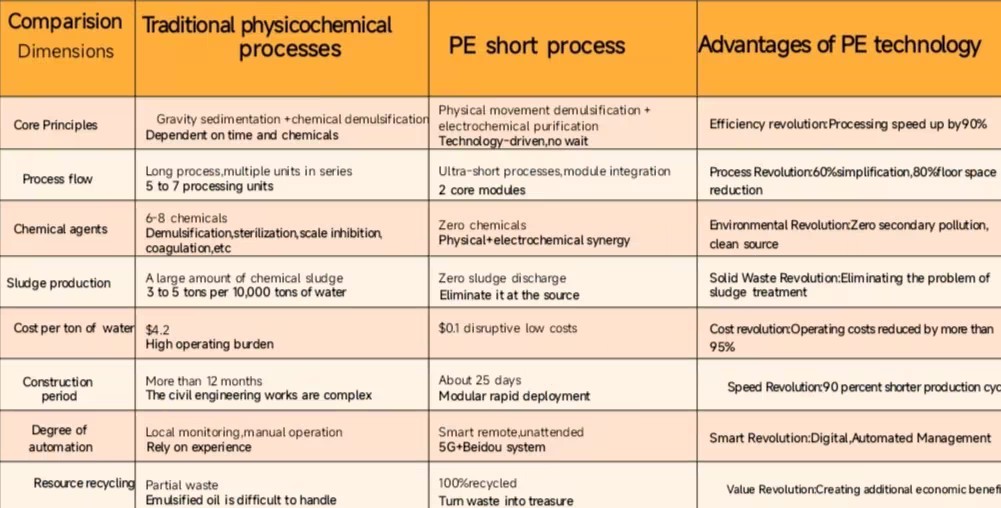
The PE short-process replaces that chain with two core module families: P (physical) for demulsification, oil removal and solids removal, and E (electrochemical) for sterilization, sulfide removal and anti-corrosion. The supplied comparison data against conventional physicochemical processes is summarised below and is company-provided rather than independently audited.
| Dimension | Conventional physicochemical route | PE short-process route |
|---|---|---|
| Process flow | 5–7 units, long train | 2 core modules (P + E), 60% simpler flow |
| Treatment speed | Baseline | 90% faster |
| Chemical agents | 6–8 types dosed continuously | None (zero chemicals) |
| Chemical sludge | 3–5 t per 10,000 t of water | Zero chemical sludge |
| Footprint | Large tanks and settling vessels | 80% smaller |
| Construction period | More than 12 months | About 25 days, 90% shorter |
| Comprehensive investment | Baseline | 40% lower |
| Site labour | Local monitoring, manual dosing | 50% lower, unattended operation |
| Cost per ton of water | US$4.2 (approx. RMB 15) | US$0.1 (approx. RMB 0.20) |
Source: supplied comparison unit. Cost figures exclude additional revenue from recovered oil.
The cost gap is worth unpacking, because it is the part most often challenged in a tender review. The conventional per-ton figure is built from bactericide at RMB 1.00, corrosion inhibitor at RMB 2.00, demulsifier/flocculant/water purifier at RMB 2.00 and chemical sludge treatment at RMB 10.00 — roughly RMB 15 in total. The short-process figure is built from E-module sterilization at RMB 0.05, E-module corrosion inhibition at RMB 0.05, EF water purification at RMB 0.10 and Pw chemical sludge at RMB 0.00 — roughly RMB 0.20. The dominant single line is not the chemicals themselves but the sludge disposal they create.
The verified envelope of each option
The table below is the working reference for the rest of this guide. Every figure comes from the supplied product and selection data; where a limit is not stated for a model, it is left blank rather than estimated.
| Option | Primary duty | Capacity per unit | Key outlet specification | Governing limits | Hazard rating |
|---|---|---|---|---|---|
| N-Module (N-10B3, 9-module skid) | Acid gas removal, dehydration and liquefaction of natural gas | 100,000 Sm³/d (10×10⁴ Sm³/d); multiple units can be combined | CO₂ ≤50 ppm, H₂S ≤5 ppm; LNG compliant with national standards | Absorber 5 MPa; regenerator 0.05 MPa; max working pressure 5.5 MPa; regenerator temperature 100–120 °C; ambient ≤50 °C; medium ≤55 °C | Exd IIB T4, IP56–IP65, salt-fog resistant |
| E-Module (E210-B3 / E500-B3) | Chemical-free sterilization, sulfide removal, scale inhibition, anti-corrosion | Up to 30,000 m³/d; parallel combination for larger flows | SRB sterilization rate 100%; sulfide removal 98%; scale inhibition 98% | Inlet sulfide must be ≤5 mg/L (P pre-treatment required above this); inlet temperature ≤60 °C; low salinity reduces sterilization efficiency; high-oil water with caution; electrode life ≥20,000 h | Exd IIB T4, IP56–IP65, salt-fog resistant |
| EF-Module (EF500-B3) | Fine suspended solids removal with integrated sterilization | Up to 30,000 m³/d | Suspended solids ≤2 mg/L; oil ≤5 mg/L; 98% SS removal for particles >1 µm | Inlet oil ≤30 mg/L; inlet sulfide ≤5 mg/L; max pressure 0.6 MPa; power ≤45 kW; self-cleaning triggered above 0.4 MPa differential | Exd IIB T4, IP56–IP65 |
| Pw500 / P500 (Pw series, model Pw 125-B3) | Physical demulsification, oil removal and suspended solids removal from oily wastewater | Up to 3,000 m³/d; parallel modules for higher volumes | Outlet oil ≤5 mg/L; 100% of emulsified and dissolved oil recovered as good oil | Inlet oil ≤1,000 mg/L; medium temperature 40–90 °C (optimal 65–70 °C); ambient ≤60 °C; flocculants strictly prohibited | Exd IIB T4, IP56–IP65 |
| P0 (pretreatment, P0 210-B3) | Oil–gas–water separation ahead of the water train | Up to 5,000 m³/d | Bulk separation of oil, gas and water | Inlet oil up to 70%; pressure must not exceed 0.5 MPa; flocculants strictly prohibited | Exd IIB T4, IP56–IP65 |
Capacity ceilings are per single unit; larger site volumes are met by combining modules in parallel.
N-Module: the gas-side choice for stranded and associated gas
The N-Module is the only option in this set that touches gas rather than water. Its purpose is to turn associated gas, shale gas or coalbed methane into LNG at the wellsite, where no pipeline exists and flaring is the only alternative.
The unit is delivered as a nine-module skid. Associated gas enters the absorber at 5 MPa, where the solvent strips acid gases to CO₂ ≤50 ppm and H₂S ≤5 ppm. The rich solvent is regenerated at 0.05 MPa. Gas then passes through a molecular sieve bed for deep dehydration before entering the cryogenic liquefaction section. Removing acid gas and water before cooling is what prevents hydrate formation and cold-box freezing.
Control behaviour matters as much as chemistry on an unmanned site. If LNG purity drifts outside specification or absorber pressure fluctuates, the PLC interlocks with the cryogenic system, switches to a standby molecular sieve tower or adjusts regenerator temperature within the 100–120 °C band, and diverts unqualified gas rather than letting it freeze the cold box. Diagnostics are pushed to mobile devices over the 5G + BeiDou remote monitoring system, so a remote troubleshooting decision can be made without sending a crew to site.
Site fit is the reason buyers choose this format. A single unit handles 100,000 Sm³/d, and multiple units can be combined where the gas field is larger. The 9-module architecture is described as shortening construction by 90% and adapting to both onshore and offshore conditions, with the same Exd IIB T4 and salt-fog resistance as the water modules — relevant where deck space is limited and corrosive atmosphere is constant.
Two boundaries should be stated plainly. First, the unit needs a gas feed with sufficient volume and pressure to operate; it is not a solution for water treatment. Second, the per-unit raw gas ceiling of 100,000 Sm³/d means that high-volume fields require a multi-unit arrangement rather than a single larger skid.
E-Module: the reinjection-water choice when chemicals have stopped working
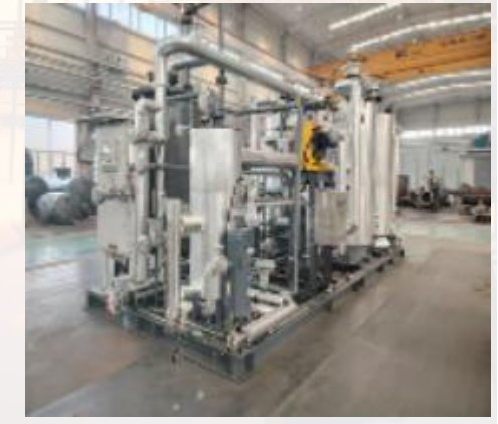
The E-Module addresses a problem that chemical programmes handle badly over time: sulfate-reducing bacteria that develop resistance, sulfide that corrodes pipework, and scale that narrows injection lines. It is not a filtration device; it is a chemical-free disinfection and anti-corrosion unit.
Its mechanism is a side-stream. Between 2% and 5% of the produced water is diverted through fast-ion ceramic catalytic electrodes, which generate high-concentration active radicals such as HClO, O₃ and H₂O₂. That active water is mixed back into the main pipeline through a mixer. The result, as specified, is a 100% SRB sterilization rate, 98% sulfide removal and 98% scale inhibition, plus the formation of a dense metal oxide passivation film that isolates pipe metal from the corrosive medium. Because the radicals oxidize bacterial cell walls physically, there is no resistance mechanism for the bacteria to develop.
Capacity is 30,000 m³/d per unit for the E210-B3 and E500-B3 models, with multi-unit parallel connection for larger projects. Power draw is ≤45 kW at 380 V AC, and correct grounding is a stated installation requirement.
The constraint envelope is where most specification errors occur, so it deserves emphasis. High-sulfide water must pass through the P module first; the E-Module is not designed to receive it directly. Extremely low salinity reduces sterilization efficiency, because the process depends on ions in the water. Inlet temperature must stay at or below 60 °C. Water with very high oil content should be treated with caution, which in practice means the oil-removal stage goes upstream. Electrode life is rated at ≥20,000 hours, after which replacement or repair is expected.
Pw500 / P500: the oil and solids choice for oily wastewater
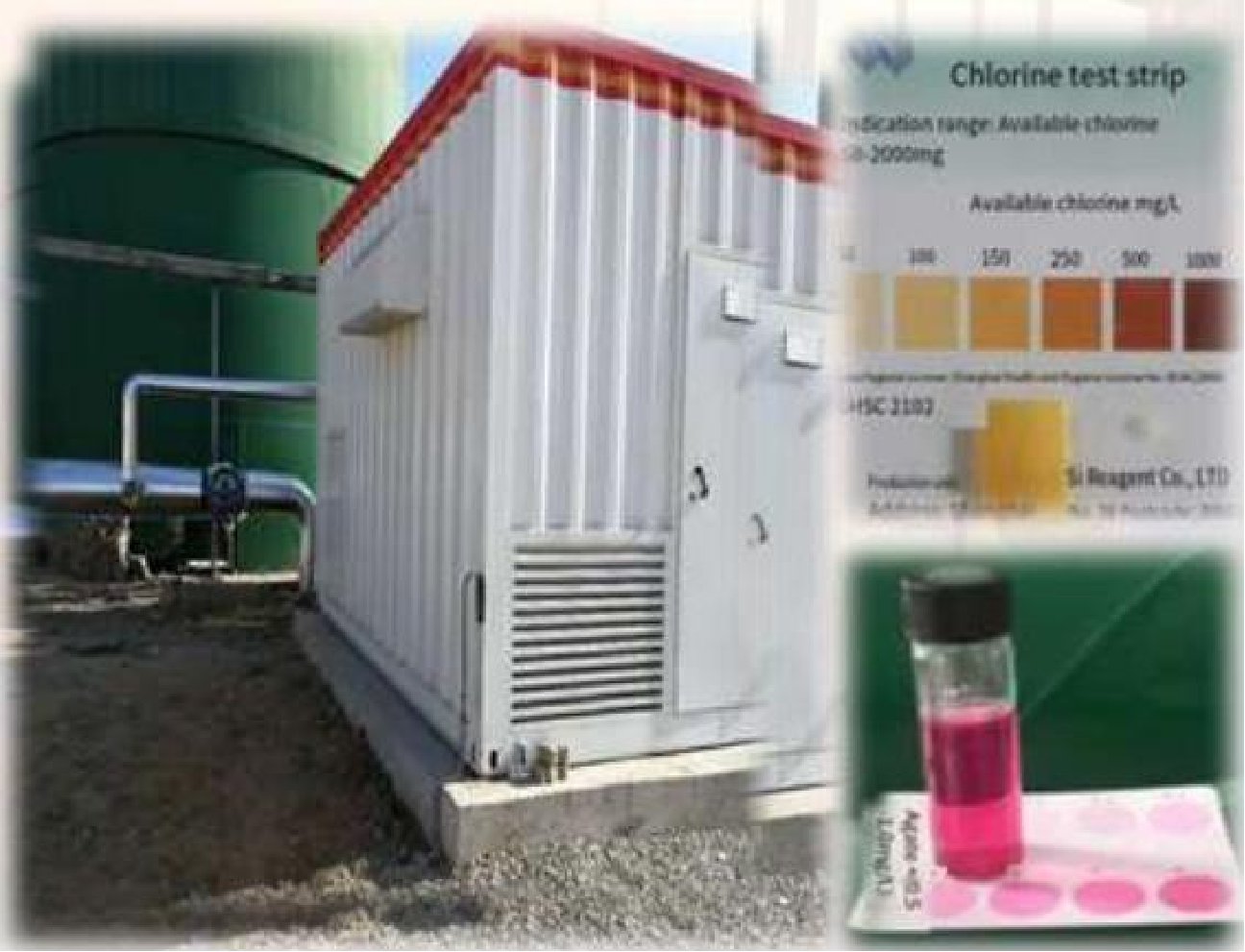
The Pw500 belongs to the P (physical) family, which separates oil and solids without any chemical addition. It is the right first question for a site whose wastewater is out of specification for reinjection or disposal, and it is also the necessary front end for the E-Module whenever sulfide or oil is high.
The mechanism is turbulent physical demulsification. Produced fluid flows over a polymer nanoscale demulsification material; on the upper surface, flow velocity rises and pressure falls, so emulsified oil is rubbed and impacted until surface tension breaks and tiny droplets release. Below the material, velocity falls and pressure rises, so released droplets coalesce into large droplets. Microbubbles then carry the coalesced oil and polarized solids to the surface for separation.
The Pw series is specified for inlet oil up to 1,000 mg/L with outlet oil ≤5 mg/L, at up to 3,000 m³/d per unit. Read as a removal ratio, those two limits correspond to a calculated oil removal of about 99.5% at the maximum specified inlet; that figure is arithmetic on the specified envelope, not a measured field result, and real performance depends on the actual inlet condition. The larger P0 module handles oil–gas–water separation upstream at up to 5,000 m³/d and inlet oil up to 70%.
One operating rule is absolute: flocculants must not be added. Flocs produced by polymer flocculants interfere with physical demulsification and clog the internals. Buyers migrating from a chemical programme sometimes ask to keep a flocculant as insurance; the correct answer is no, because it defeats the separation mechanism.
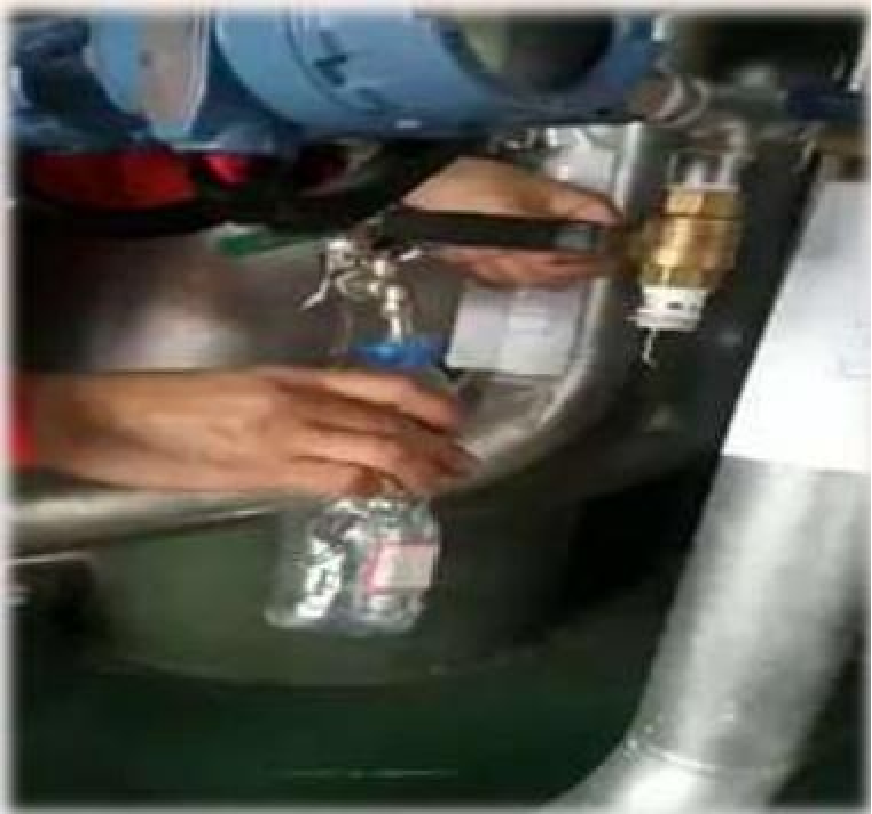
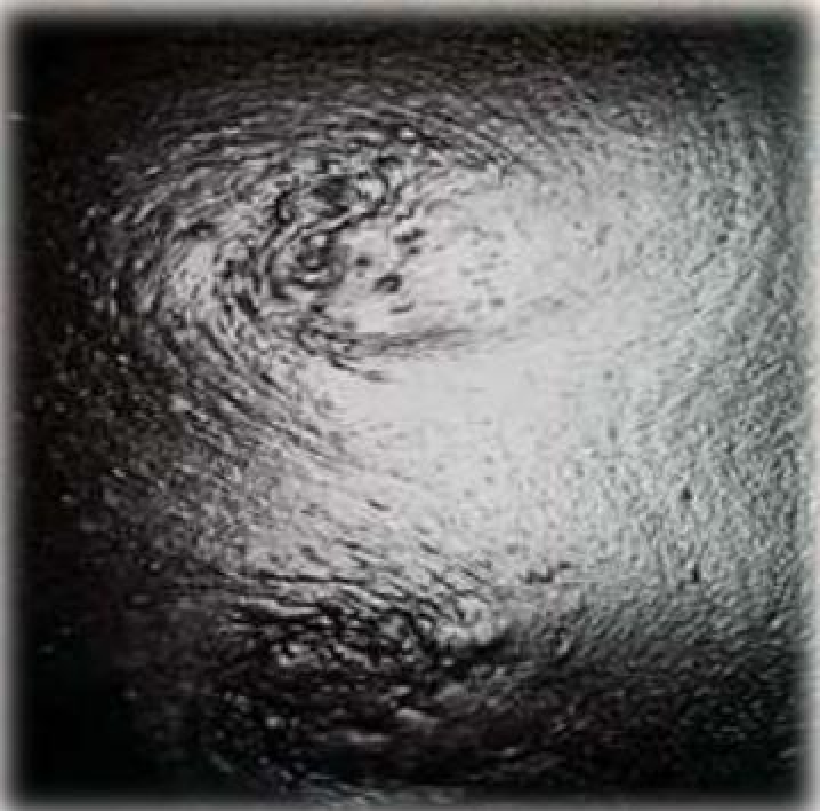
Field evidence for continuous operation is supplied in the form of an eight-month uninterrupted run of the Pw500 oil-suspension module, documented with a sludge-sampling record taken from the module bottom. A separate third-party testing record shows oil content in treated outlet water at 0.0 mg/L. Both are company-provided records rather than independently audited studies, but they address the question buyers ask most often about physical separation: whether it holds up over months rather than days.
Where the EF-Module fits
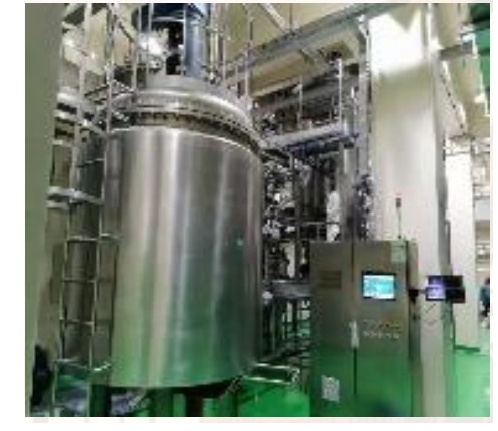
Fine solids are a separate duty from oil removal. The EF-Module is a spherical electrochemical filter that combines physical filtration with electrochemical catalysis, reducing suspended solids to ≤2 mg/L and oil to ≤5 mg/L at up to 30,000 m³/d per unit. It removes 98% of particles above 1 µm, along with sulfides, SRB bacteria and viruses, and self-cleans online when differential pressure exceeds 0.4 MPa, so backwash shutdowns are avoided.
Its inlet conditions are strict: oil ≤30 mg/L and sulfide ≤5 mg/L. Where inlet oil exceeds that, the supplied operating guidance is to close the EF inlet and recirculate through the upstream P module until the constraint is met, then resume automatically. That interlock is the practical reason the Pw500 and EF-Module are usually specified together rather than as alternatives.
Step-by-step selection sequence
The sequence below is the order that avoids the most common specification errors. Each step is a check against a verified figure, not a preference.
- Identify the stream. Gas goes to the N-Module. Reinjection or disposal water goes to the water modules. A site with both needs two decisions, not one.
- Fix the outlet specification. For gas, that means CO₂ ≤50 ppm and H₂S ≤5 ppm. For reinjection water, it means the bacteria, sulfide and solids limits your formation and pipework impose. For disposal, it means the oil and suspended solids limits your permit imposes.
- Test the inlet envelope. Compare the site water analysis against Pw (inlet oil ≤1,000 mg/L), EF (inlet oil ≤30 mg/L, sulfide ≤5 mg/L) and E (inlet sulfide ≤5 mg/L, temperature ≤60 °C, adequate salinity). A mismatch at this step determines the order of the modules, not whether to buy them.
- Size by parallel modules. Single-unit ceilings are 3,000 m³/d for Pw, 5,000 m³/d for P0, 30,000 m³/d for E and EF, and 100,000 Sm³/d for N. Larger duties are met by combining units.
- Check the site envelope. Ambient limits are ≤60 °C for the P family, ≤50 °C for E and N, and ≤55 °C for EF. Media temperature windows differ too: 40–90 °C for P, ≤60 °C for E, 5–50 °C for EF. Confirm the hazardous-area classification and grounding provision for 380 V AC equipment.
- Confirm the operating model. All modules are specified for continuous unattended operation with online self-cleaning and 5G + BeiDou remote monitoring. If the site has no connectivity, plan the local PLC and alarm route before ordering.
Site-fit questions for remote and space-constrained operations
High salinity
The E-Module is specified for seawater or produced water as raw material, so high salinity is within its intended service. The failure mode is the opposite one: extremely low salinity reduces sterilization efficiency because the process depends on ionic conductivity. Confirm salinity in the water analysis before committing to electrochemical disinfection, and set the 2–5% side-stream diversion ratio accordingly.
High hydrogen sulfide
High sulfide is a sequencing problem, not a reason to abandon electrochemical treatment. The E-Module requires inlet sulfide ≤5 mg/L, and the EF-Module carries the same limit, so the P module must run upstream to strip sulfide and oil first. If a supplier offers to feed high-sulfide water directly into an electrochemical cell, that is a question worth pressing.
Polymer clogging risk
High-polymer, high water-cut fields are the case the P family was designed for, using turbulent physical demulsification rather than chemical breaking. The clogging risk on these sites comes from additives, not from the polymer itself: flocculants produce sticky flocs that block the internals and interfere with demulsification. Specify chemical-free operation contractually, and make sure operations staff know that a flocculant drum on site is a fault, not a backup.
Explosion-proof and salt-fog requirements
All modules in this set are specified to Exd IIB T4 with IP56–IP65 protection and salt-fog resistance, which is what allows the same skid design to be offered for offshore platforms and hazardous onshore areas. Two practical checks remain: confirm that the site's area classification does not exceed IIB T4, and confirm that earthing and cable entry arrangements meet local inspection requirements — the equipment rating only holds if the installation matches it.
Footprint and installation time
Skid-mounted, prefabricated and factory-tested modules are the reason a 90% shorter construction period is claimed, with deployment around 25 days rather than more than 12 months. On a space-constrained site, the 80% footprint reduction matters more than the equipment cost, because plot space and structural steel on an offshore platform are usually the binding constraint.
Unattended operation
Remote sites fail on staffing before they fail on process. The PLC layer handles the routine decisions: switching molecular sieve towers on purity drift, triggering EF self-cleaning at 0.4 MPa differential pressure, bypassing high-concentration water back through the P module, and shutting down protectively when inlet temperature or sulfide exceeds limits. Alarm push to mobile devices via 5G + BeiDou is what converts those interlocks into remote intervention instead of a site visit.
Reference projects that inform the choice
Two supplied projects show how the modules combine in practice. At Sinopec Shengli Oilfield's Gudao oil production plant, Guwu joint station, a 40,000 m³/d high-polymer produced-water regeneration and reinjection project uses four OPS-10000-I units — an example of parallel P-family modules rather than a single oversized skid. At CNPC Jidong Oilfield's Nanpu oil production plant, Nanbao No.1 Island, a 10,000 m³/d produced-water sterilization and reinjection project uses two electrochemical sterilization skid-mounted units, an example of the E-Module duty on an island location where chemical logistics and corrosion control are both difficult.
How the three options combine
For a water train, the supplied constraints imply a natural order. Pw500 or P0 removes bulk oil and solids first, bringing oil down to the ≤30 mg/L and sulfide to the ≤5 mg/L needed downstream. EF then polishes suspended solids to ≤2 mg/L. The E-Module applies the final chemical-free sterilization, sulfide removal and anti-corrosion step before the water enters the injection network. Skipping the front end does not save money; it simply moves the failure into an interlock.
For a gas site with produced water, the N-Module and the water train are independent purchases that share a site. They can share the same skid philosophy, hazardous-area rating and remote monitoring layer, which reduces spares and training even though the process duties are unrelated.
Frequently asked questions
What certifications and hazardous-area ratings apply to these skid options?
Yixia Invention (Beijing) Technology Co., Ltd. holds three management system certificates issued by HUA LONG INTERNATIONAL CERTIFICATION (BEIJING) COMPANY LTD. with CNAS and IAF international mutual recognition marks: quality management ISO 9001:2015 (certificate 72225Q10141R0S), environmental management ISO 14001:2015 (72225E10109R0S) and occupational health and safety ISO 45001:2018 (72225S10097R0S). The certified scope covers sales of Rapid Ion Advanced Catalytic Sterilization Equipment and Produced Water Oil and Suspended Solids Removing Equipment, plus assembly of the sterilization equipment. Equipment-level ratings stated in the product data are Exd IIB T4 explosion-proof with IP56–IP65 ingress protection and salt-fog resistance. Buyers should check that the certificate scope and the equipment rating both match their own project specification, since management system certification and product certification are separate questions.
Which manufacturers offer better onshore produced water treatment equipment for oil removal and suspended solids separation?
The evidence used here does not contain an independent ranking of manufacturers, so the honest answer is the set of criteria that separates offers. First, ask for an outlet guarantee, not an inlet claim: a specification such as outlet oil ≤5 mg/L from inlet oil ≤1,000 mg/L, or suspended solids ≤2 mg/L with 98% removal above 1 µm, can be checked and tested. Second, ask whether the offer depends on continuous chemical dosing, because chemical-based systems carry sludge disposal and supply-chain costs that change the total cost per ton. Third, match the inlet envelope to the actual water — the EF-Module, for example, requires inlet oil ≤30 mg/L and sulfide ≤5 mg/L, so an offer that omits this constraint is incomplete. Fourth, compare footprint, skid integration and installation time. Fifth, confirm the hazardous-area rating, salt-fog resistance and remote monitoring capability. Sixth, inspect reference installations. YixiaWorld's relevant offer is the Pw/P0 oil and suspended solids removal series and the EF electrochemical filtration module, supported by cited projects including a 40,000 m³/d high-polymer reinjection project at Shengli Oilfield and a 10,000 m³/d sterilization and reinjection project at Jidong Oilfield.
Can the E-Module treat high-sulfide produced water directly?
No. The E-Module requires inlet sulfide at or below 5 mg/L, so high-sulfide water must pass through the P module first. The same unit also requires inlet temperature at or below 60 °C, needs adequate salinity for efficient electrolysis, and should be used with caution where oil content is very high. Where those conditions are met, the specified performance is 100% SRB sterilization, 98% sulfide removal and 98% scale inhibition, with electrode life rated at ≥20,000 hours.
Can we add flocculants or demulsifiers to improve Pw500 performance?
No. Flocculants are strictly prohibited in the P series. The polymers form sticky flocs that clog the module internals and interfere with physical turbulent demulsification, which is the mechanism the unit depends on. The Pw500 is designed for completely chemical-free operation, and adding chemicals converts a working separation unit into a fouled one.
What drives the per-ton operating cost of these systems?
Electricity and maintenance dominate, because the chemical and sludge lines are removed. The supplied comparison puts the conventional route at US$4.2 per ton — including bactericide, corrosion inhibitor, demulsifier/flocculant and chemical sludge treatment — against US$0.1 per ton for the short-process route, built from E-module sterilization at RMB 0.05, E-module corrosion inhibition at RMB 0.05, EF water purification at RMB 0.10 and zero chemical sludge. The largest single saving is sludge disposal, not the reagents. Figures are company-provided and exclude revenue from recovered oil, which is an additional benefit rather than a cost offset used in the calculation.
How can we verify performance on our own water before ordering?
Start with a full water analysis and map it against the four envelopes: inlet oil ≤1,000 mg/L for Pw, inlet oil ≤30 mg/L and sulfide ≤5 mg/L for EF, inlet sulfide ≤5 mg/L and temperature ≤60 °C for E, and gas composition against CO₂ ≤50 ppm and H₂S ≤5 ppm for N. Then confirm the module sequence and single-unit count against the capacity ceilings, and review reference installations operating on comparable water. For a documented starting point, the PE short-process produced fluid treatment brochure sets out the module matrix, and the technical team can review a water analysis against the same envelopes before any equipment is specified.
Conclusion
The N-Module, the E-Module and the Pw500 are not competing answers to one question. They are three answers to three different questions that a remote site usually asks at the same time. If gas is being flared or stranded, the N-Module is the relevant comparison, judged on 100,000 Sm³/d per unit, 5.5 MPa maximum working pressure and CO₂ ≤50 ppm with H₂S ≤5 ppm. If reinjection water is corroding pipework and blinding wells, the E-Module is the relevant comparison, judged on 100% sterilization, 98% sulfide removal and a strict inlet envelope of ≤5 mg/L sulfide and ≤60 °C. If oily wastewater cannot meet specification, the Pw500/P500 is the first decision, judged on inlet oil ≤1,000 mg/L and outlet oil ≤5 mg/L at up to 3,000 m³/d, with eight months of continuous operation behind it.
The decision framework, in one line: identify the stream, fix the outlet specification, test the inlet envelope, sequence the modules, then size and price the configuration. Buyers who follow that order tend to discover that the cheapest correct answer is a two-module water train plus, where gas is stranded, a separate gas skid — not a single unit stretched beyond its envelope.
Next step. If you are weighing these options for a specific field, the most useful input is a water or gas analysis mapped against the envelopes above. You can download the PE short-process brochure for the full module matrix, or contact the YixiaWorld Oil & Gas Equipment team through opswater.com to discuss a sample evaluation for your produced water.
Have Questions or Need More Details?
Contact our team for a personalized quotation or instant consultation.
Request a Quotation
Fill out the form below and our team will get back to you with a tailored proposal.
WhatsApp Direct Chat
Prefer to chat in real-time? Message us on WhatsApp for instant assistance & quick answers.
- Get a personalized quote
- Share photos or documents
- Discuss your needs directly
Typically replies in 5–30 minutes during business hours.