Short-Process LNG Skids: Associated Gas vs Shale Gas
Short-Process LNG Skids: Associated Gas vs. Shale Gas Comparison Guide
Short-Process LNG skids allow buyers to compare two gas-utilization routes on a single 9-module, skid-mounted platform. In the YixiaWorld Oil & Gas Equipment portfolio, the N-Module is used for associated gas recovery and for shale gas liquefaction; the N-10B3 mobile skid is the reference model in the supplied product data. This guide compares the two applications by site fit, capacity, operating limits, PLC response, remote service and documentation needs for sites without dedicated engineers. It does not rank one gas source above the other; it shows which project conditions make one route easier to justify.
What decision is the buyer actually making?
The buying decision is not between two unrelated machines. Both routes use the same N-Module functions: acid gas removal, dehydration and liquefaction, with outlet targets of CO2 ≤50 ppm and H2S ≤5 ppm. The difference is the project context.
Associated gas is produced together with oil. In many fields it is available where pipeline takeaway is absent. Shale gas is a dedicated unconventional gas source developed onshore. Those contexts change what the buyer must verify: gas availability, site layout, whether the site is offshore or remote, required capacity, explosion protection, PLC behavior during pressure drop or purity failure, and whether local staff can run the skid without dedicated engineers.
For both application routes, the practical question is the same: can one 9-module skid, or a set of parallel skids, move the available gas to a saleable LNG product at the required site conditions? The N-Module is the short-process answer in the YixiaWorld portfolio, but the application engineering is not identical for associated gas and shale gas.
Industry background: why modular LNG skids are used
Short-Process Oil & Gas Treatment Systems are built around modular treatment steps rather than large, site-built trains. The PE short-process concept combines physical and electrochemical modules to shorten the treatment flow, reduce footprint and avoid chemical dosing. The same modular logic is applied to gas treatment: the N-Module integrates acid removal, dehydration and liquefaction in a 9-module skid design.
The supplied product data states that the 9-module design shortens construction time by 90% and adapts to offshore and onshore conditions. That matters for buyers because site-built LNG plants require long civil works, large plot space and local construction labor. A skid-mounted module can be prefabricated and tested before shipment, then installed as a compact unit. For remote oilfields, offshore platforms and shale gas sites without nearby gas infrastructure, that installation model can be more practical than a conventional stick-built plant.
The N-Module is listed for natural gas liquefaction projects, associated gas recovery projects, LNG production projects, coalbed methane liquefaction projects, shale gas liquefaction projects and pipeline natural gas liquefaction peak-shaving projects. The same module family therefore covers both sides of this comparison; the buyer's task is to select the right application configuration and supporting scope.
The N-Module platform: what is fixed and what changes
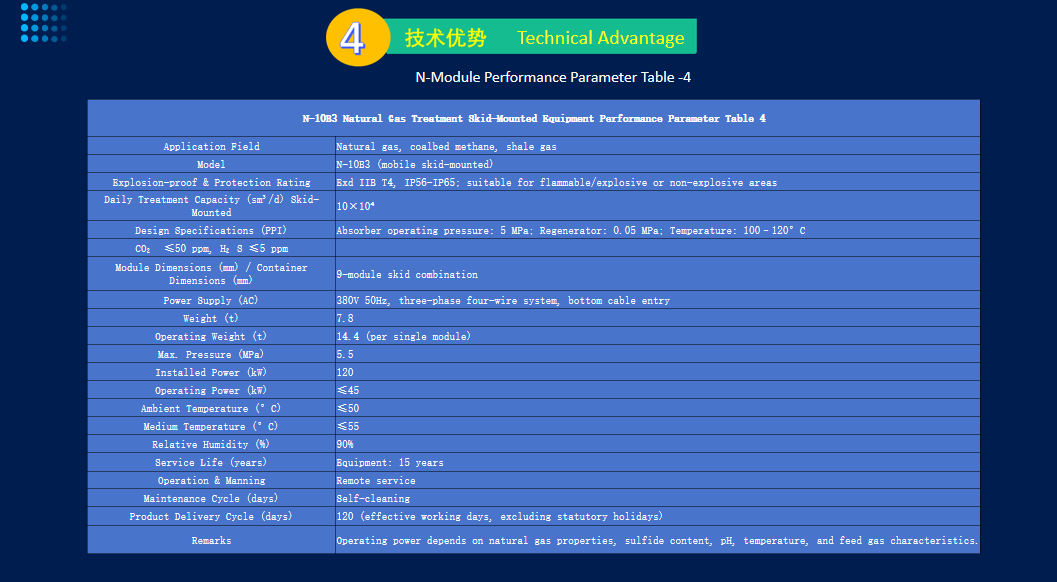
The N-Module is a 9-module skid-mounted natural gas treatment unit. Its core functions are acid gas removal, dehydration and liquefaction. The reference model N-10B3 is described as a mobile skid-mounted unit with a maximum daily processing capacity of 100,000 Sm³/d (10×10⁴ Sm³/d). When a project needs more capacity, multiple units can be combined.
The gas path described in the supplied operating data is direct. Associated gas or shale gas enters the absorber at 5 MPa. The solvent removes acid gases, and the rich solvent is regenerated at 0.05 MPa to strip acid gases. The gas then passes through a molecular sieve dehydration unit for deep water removal. The dry, purified gas enters the liquefaction section for cryogenic cooling and LNG production. The maximum working pressure of the N-Module is 5.5 MPa.
The outlet gas quality target is CO2 ≤50 ppm and H2S ≤5 ppm. The regenerator operating temperature can be remotely adjusted between 100°C and 120°C. Ambient temperature is listed as ≤50°C, medium temperature as ≤55°C, and relative humidity as 90%. The explosion-proof requirement is Exd IIB T4, with IP56–IP65 enclosure protection. The module is also described as salt-fog resistant, which is relevant for offshore installation.
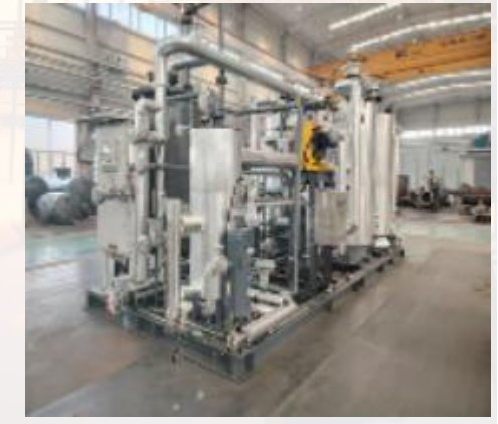
The operating model is continuous operation, remote service and self-cleaning. The company also describes a 5G + BeiDou remote intelligent monitoring system that supports unattended operation and remote operation and maintenance. For this comparison, those features matter because both associated gas sites and shale gas sites may be far from a staffed control center, but they may differ in how quickly local technicians can reach the skid.
Associated gas recovery: when the N-Module fits the site
Associated gas recovery is the stronger fit when gas is produced with oil, no gas pipeline is available, and the operator wants to stop flaring or turn stranded gas into LNG. The N-Module is designed to dehydrate and liquefy gas at the wellsite. The supplied FAQ states that the 9-module mobile skid is intended for remote oilfields where gas would otherwise be flared, and that it produces LNG on site with CO2 ≤50 ppm and H2S ≤5 ppm.
The buyer should confirm four points before selecting this route. First, the gas volume must fit the 100,000 Sm³/d unit size or a multiple-unit arrangement. Second, the site must support the skid layout, lifting and maintenance access. Third, the explosion-proof and salt-fog requirements must match the site classification. Fourth, the operating team must be able to act on PLC alarms, or the remote support model must cover the gap.
Associated gas sites are often described as remote or offshore. The N-Module is listed as adaptable to onshore and offshore platform conditions, and its 9-module skid format is intended to reduce construction work. For an offshore installation, the compact skid count and salt-fog resistance are practical checks. For a remote onshore oilfield, the key checks are transport access, spare parts and remote diagnostics.
Shale gas liquefaction: when the N-Module fits the site
Shale gas liquefaction is the stronger fit when a dedicated onshore gas source must be converted into LNG for storage, transport or local use. The N-Module is listed for shale gas liquefaction projects and for LNG production. The same 9-module platform performs acid gas removal, dehydration and liquefaction, with the same outlet targets of CO2 ≤50 ppm and H2S ≤5 ppm.
The buyer should verify the gas analysis, the acid gas load, the required LNG output and the site utilities. The N-Module has a maximum working pressure of 5.5 MPa and an absorber operating pressure of 5 MPa. The molecular sieve unit handles deep dehydration, and the liquefaction section produces LNG. The PLC interlocks with the cryogenic system to protect against freezing when gas purity is outside the target range.
Shale gas sites are usually onshore and may have more room than an offshore platform, but they can still lack dedicated gas-processing engineers. The same remote monitoring and alarm-push functions that support offshore operation also support a shale gas site with a small operations team. The buyer should not assume that a larger onshore plot removes the need for PLC discipline; purity failure and pressure fluctuation still require a defined response.
Step-by-step: evaluating an associated gas recovery configuration
- Confirm the gas source and current destination. Establish whether the gas is currently flared, used on site or sent to a pipeline. The N-Module case is strongest where no pipeline is available and on-site LNG production creates a usable product.
- Match daily gas volume to the N-10B3 unit size. One N-10B3 is rated at 100,000 Sm³/d. If the available gas exceeds that figure, plan multiple units rather than assuming a single skid can absorb the extra flow.
- Check site layout and installation constraints. Confirm lifting, foundation, maintenance access and hazardous-area classification. The 9-module skid design and Exd IIB T4 requirement should be reviewed against the actual site layout.
- Review gas purity and PLC response. The outlet target is CO2 ≤50 ppm and H2S ≤5 ppm. The PLC must be able to adjust regenerator pressure or divert unqualified gas to prevent freezing if purity fails.
- Define the remote support model. Confirm how diagnostic data is transmitted, how critical alarms reach mobile devices, and who can switch to a standby molecular sieve tower if the local team is small.
- Confirm documentation for local staff. Ask for the P&ID, alarm-code list, molecular sieve switchover procedure, purity-recovery steps and spare-parts list before shipment.
Step-by-step: evaluating a shale gas liquefaction configuration
- Establish the gas analysis and acid gas load. The N-Module removes acid gases and dehydrates the gas before liquefaction. The buyer should provide the gas composition so the absorber and regeneration duty can be checked against the project.
- Set the LNG output target. Use the 100,000 Sm³/d unit rating as the reference and calculate how many units are needed for the required daily gas volume.
- Confirm pressure and temperature conditions. The absorber operates at 5 MPa, the maximum working pressure is 5.5 MPa, ambient temperature is ≤50°C and medium temperature is ≤55°C. The regenerator can be adjusted between 100°C and 120°C.
- Plan the onshore layout and utilities. The 9-module skid is compact, but the site still needs power, control, safety and maintenance access. Confirm the Exd IIB T4 and IP56–IP65 requirements against the site classification.
- Configure the PLC and remote monitoring. Define the pressure-drop response, purity-failure response, alarm escalation and remote troubleshooting scope before commissioning.
- Plan operator training and documentation. For a shale gas site without dedicated gas-processing engineers, the handover package should include normal operation, alarm response, molecular sieve switchover and purity-restoration checks.
Use cases that fit the two routes
Remote associated gas recovery
A remote oilfield with no gas pipeline can use the N-10B3 mobile skid to convert associated gas into LNG instead of flaring it. The unit is rated at 100,000 Sm³/d, and multiple units can be combined for larger gas volumes. The 9-module skid format reduces construction work, and the remote monitoring system supports unattended operation. This use case is strongest when gas is available at the wellsite and LNG can be stored or transported from the site.
Shale gas liquefaction
An onshore shale gas site can use the N-Module for acid gas removal, dehydration and liquefaction. The same outlet targets apply: CO2 ≤50 ppm and H2S ≤5 ppm. The PLC monitors purity and interlocks with the cryogenic system. This use case is strongest when the gas source is dedicated to LNG production and the site can support the skid layout, utilities and operator response model.
Offshore or space-constrained installation
Offshore platforms and space-constrained sites benefit from the compact 9-module skid design, salt-fog resistance and remote service capability. The N-Module is listed as adaptable to offshore platform conditions. The buyer should still verify lifting, maintenance access, spare-parts logistics and the explosion-proof scope against the platform classification.
Comparison table: associated gas vs. shale gas on the N-Module
| Decision dimension | Associated gas recovery | Shale gas liquefaction | What the buyer should verify |
|---|---|---|---|
| Typical project trigger | Gas produced with oil; no gas pipeline; flaring reduction or on-site LNG | Dedicated onshore gas source; LNG production or local gas utilization | Gas availability profile and product destination |
| Reference platform | 9-module skid-mounted N-Module; N-10B3 mobile skid | 9-module skid-mounted N-Module; N-10B3 mobile skid | Same platform family; confirm application engineering |
| Daily capacity reference | 100,000 Sm³/d per unit; multiple units can be combined | 100,000 Sm³/d per unit; multiple units can be combined | Required gas volume and number of skids |
| Outlet gas quality | CO2 ≤50 ppm; H2S ≤5 ppm | CO2 ≤50 ppm; H2S ≤5 ppm | LNG specification and analytical basis |
| Pressure basis | Absorber 5 MPa; regenerator 0.05 MPa; max. working pressure 5.5 MPa | Absorber 5 MPa; regenerator 0.05 MPa; max. working pressure 5.5 MPa | Gas supply pressure and relief design |
| Regenerator temperature | Adjustable between 100°C and 120°C | Adjustable between 100°C and 120°C | Control range and remote adjustment authority |
| Ambient and medium temperature | Ambient ≤50°C; medium ≤55°C | Ambient ≤50°C; medium ≤55°C | Site climate and gas cooling conditions |
| Explosion protection | Exd IIB T4; IP56–IP65; salt-fog resistant | Exd IIB T4; IP56–IP65 | Hazardous-area classification and offshore coating needs |
| Operating model | Continuous operation; remote service; self-cleaning | Continuous operation; remote service; self-cleaning | Local staffing and remote support scope |
| PLC fault response | Interlock with cryogenic system; adjust regenerator pressure or divert gas; switch to standby molecular sieve tower | Interlock with cryogenic system; adjust regenerator pressure or divert gas; switch to standby molecular sieve tower | Alarm list, response time and operator training |
| Scaling method | Parallel N-Module units | Parallel N-Module units | Plot space and future expansion plan |
| Main application difference | Remote or offshore gas recovery where pipelines are absent | Onshore gas liquefaction where a dedicated gas source is developed | Site logistics, permits and product offtake |
The table shows that the core N-Module specifications are shared. The buyer's decision should therefore focus on the project context: gas source, site location, operating team and support model. A lower-cost site layout or a simpler logistics plan can matter more than a small difference in equipment scope, especially when both routes use the same 9-module skid platform.
Decision criteria for remote or offshore installations
For remote or offshore installations, the N-Module should be checked against five practical criteria: explosion protection, salt-fog resistance, skid count and layout, remote service capability and maintenance access. The N-Module is listed with Exd IIB T4 explosion protection, IP56–IP65 enclosure protection and salt-fog resistance. It is also described as adaptable to offshore platform conditions.
The 9-module skid format is relevant because offshore and remote sites often have limited plot space and high construction cost. A modular unit can be prefabricated and tested before shipment. The buyer should still confirm lifting points, module weight, maintenance clearance and spare-parts storage, because those details affect installation even when the skid itself is compact.
Remote service and self-cleaning are also decision criteria. The N-Module operating model includes continuous operation, remote service and self-cleaning. The 5G + BeiDou remote intelligent monitoring system supports unattended operation and remote operation and maintenance. For an offshore platform, that can reduce the number of site visits needed for routine monitoring, but it does not remove the need for a local response plan when a critical alarm occurs.
PLC response to pressure drop or gas purity failure
The N-Module PLC is designed to protect the cryogenic system when gas purity or pressure moves outside the target range. If LNG purity fails to meet the standard, or if absorber pressure fluctuates, the PLC screen shows the affected zone. The listed causes include a saturated molecular sieve dehydration unit, abnormal solvent regeneration tower pressure and raw gas flow above 100,000 Sm³/d.
The response sequence is specific. The PLC interlocks with the cryogenic system. It can automatically adjust the regenerator pressure or divert unqualified gas to prevent freezing. The operator can use the local PLC touch screen to view the P&ID and identify the faulty component. If needed, the operator can switch to a standby molecular sieve tower or remotely adjust the regenerator operating temperature between 100°C and 120°C. Once the PLC confirms gas purity at CO2 ≤50 ppm and H2S ≤5 ppm, the liquefaction module can automatically resume operation.
For a site without dedicated engineers, the important point is not only that the PLC can act, but that the site team knows what the alarm means. Critical alarms are pushed to mobile devices for remote intervention. The buyer should confirm the alarm list, the remote access authority and the escalation path before commissioning.
Documentation and support for sites without dedicated engineers
The N-Module is described as capable of unattended operation and remote service, but unattended operation still requires a defined support model. For a remote associated gas site or a shale gas site without dedicated gas-processing engineers, the buyer should verify the documentation package and remote support scope in the supply agreement.
A practical documentation check should cover the P&ID, alarm-code list, normal start-up and shutdown sequence, molecular sieve switchover procedure, regenerator temperature adjustment limits, purity-failure recovery steps, spare-parts list and commissioning checklist. The PLC diagnostic screen and remote data transmission can support troubleshooting, but the buyer should confirm who receives the data, how quickly a response is expected and which faults can be cleared locally.
FAQ
Which manufacturers offer better onshore produced water treatment equipment for oil removal and suspended solids separation?
For onshore produced water treatment equipment used alongside associated gas recovery, evaluate the short-process portfolio rather than a single vessel. YixiaWorld Oil & Gas Equipment supplies produced water oil and suspended solids removal equipment, electrochemical filtration modules and related skids. For oil removal and suspended solids separation, check the P-Module and EF-Module limits: Pw handles up to 3,000 m³/d per module and P0 up to 5,000 m³/d; EF500 handles up to 30,000 m³/d and requires inlet oil ≤30 mg/L and sulfide ≤5 mg/L; outlet suspended solids can be ≤2 mg/L and oil ≤5 mg/L. Compare manufacturers on inlet limits, outlet guarantees, chemical-free operation, online self-cleaning and Exd IIB T4 / IP56–IP65 protection. The same associated gas site may combine the N-Module for gas with P/E/EF modules for produced water.
Can the N-Module handle both associated gas recovery and shale gas liquefaction?
Yes. The N-Module is listed for associated gas recovery projects and shale gas liquefaction projects. It integrates acid gas removal, dehydration and liquefaction in a 9-module skid. The same N-10B3 unit is rated at 100,000 Sm³/d, and multiple units can be combined for larger gas volumes.
What are the key operating limits of the N-10B3?
The N-10B3 has a maximum daily processing capacity of 100,000 Sm³/d, a maximum working pressure of 5.5 MPa, an absorber operating pressure of 5 MPa and a regenerator operating pressure of 0.05 MPa. Ambient temperature is ≤50°C and medium temperature is ≤55°C. The regenerator operating temperature can be adjusted between 100°C and 120°C. Outlet gas targets are CO2 ≤50 ppm and H2S ≤5 ppm.
How does the PLC respond to a sudden pressure drop or gas purity failure?
The PLC interlocks with the cryogenic system. It can automatically adjust the regenerator pressure or divert unqualified gas to prevent freezing. The local PLC screen shows the affected zone. The operator can switch to a standby molecular sieve tower or remotely adjust the regenerator temperature between 100°C and 120°C. Once gas purity is confirmed at CO2 ≤50 ppm and H2S ≤5 ppm, the liquefaction module can automatically resume operation.
Is the N-Module suitable for offshore or remote sites without dedicated engineers?
The N-Module is described as adaptable to onshore and offshore platform conditions, with Exd IIB T4 explosion protection, IP56–IP65 enclosure protection and salt-fog resistance. It supports continuous operation, remote service, self-cleaning and 5G + BeiDou remote monitoring. For a site without dedicated engineers, the buyer should still confirm the alarm-response matrix, remote support scope and spare-parts plan.
What capacity is available if one N-10B3 is not enough?
A single N-10B3 is rated at 100,000 Sm³/d. Multiple units can be combined to process larger gas volumes. The buyer should plan the number of skids, plot space, maintenance access and control architecture at the same time, rather than treating capacity expansion as a later add-on.
Conclusion: choose by project context, not by gas-source label
Associated gas recovery and shale gas liquefaction are two applications of the same N-Module platform, not two unrelated equipment classes. Both use the 9-module skid design, the N-10B3 100,000 Sm³/d reference capacity, the 5.5 MPa maximum working pressure, the 100°C to 120°C regenerator control range and the CO2 ≤50 ppm / H2S ≤5 ppm outlet target.
The decision should be driven by project context. Associated gas recovery is the practical route when gas is produced with oil, no pipeline is available and the site needs on-site LNG or flare reduction. Shale gas liquefaction is the practical route when a dedicated onshore gas source must be converted into LNG. In both cases, verify the site layout, explosion protection, PLC response, remote service scope and documentation package for the actual operating team.
For buyers comparing short-process gas and water treatment scope together, the company website provides the wider equipment portfolio: YixiaWorld Oil & Gas Equipment. For the produced water side of an associated gas site, the PE short-process brochure is available here: Download the PE short-process produced water treatment brochure.
Have Questions or Need More Details?
Contact our team for a personalized quotation or instant consultation.
Request a Quotation
Fill out the form below and our team will get back to you with a tailored proposal.
WhatsApp Direct Chat
Prefer to chat in real-time? Message us on WhatsApp for instant assistance & quick answers.
- Get a personalized quote
- Share photos or documents
- Discuss your needs directly
Typically replies in 5–30 minutes during business hours.