
Electrophoretic Coating Application Guide by Project Type
Electrophoretic Coating Application Guide: Matching E-Coating Specs to Automotive, Bicycle and Electronics Projects

Most electrophoretic coating projects are specified in the wrong order. A team picks a colour, copies a film thickness from an older drawing, and only discovers at first-article inspection that the salt spray target, the substrate or the cavity depth needed to drive the specification from the start.
The working rule is simple: match the e-coating specification to three inputs — the service environment (salt spray hours, temperature window, UV exposure), the substrate (carbon steel, alloy steel, aluminium alloy, magnesium alloy or zinc alloy), and the geometry (cavity depth, edge sharpness, threads and mating faces). Colour, film build and coating grade then follow from those three inputs, not the other way round.
This guide is written for buyers, project engineers and sourcing teams at the decision stage: people who already know they want electrophoretic deposition and now need to translate a part into a specification, a sample request and a set of acceptance criteria. It maps seven application sectors, five substrate families and four finish configurations to the conditions each one actually suits, and it separates what a supplier can prove from what a supplier can only claim.
What “Matching a Specification” Actually Means
A matched specification is one where every requirement in the purchase order traces to a service condition, and every service condition is covered by a test the supplier can run and report. When that link breaks, the failure usually appears in one of three forms.
- Under-specified corrosion protection. The part passes appearance inspection and fails in the field at cut edges, weld seams or cavity walls, because the specified salt spray duration was inherited from an indoor application.
- Over-specified cost and lead time. A high salt spray grade and a thick film are applied to a hidden internal bracket that never sees humidity, adding process time and material without changing the outcome.
- Mismatched substrate and pretreatment. Aluminium or magnesium is treated with a steel-oriented process assumption, and the result is poor adhesion or early blistering rather than a corrosion-rate problem.
The third case is the one buyers underestimate. Electrophoretic coating covers complex and irregular parts, dead corners, inner walls and edges when the pretreatment stage is built for that metal. On lines where pretreatment is treated as a generic rinse sequence, common defects reappear: exposed base at corners, thin coating in the inner cavity, sagging and pinholes. Those are process-control symptoms, not coating-chemistry symptoms, and they are why a specification should name the substrate and the geometry explicitly rather than only the colour and the thickness.
Where Electrophoretic Coating Sits in a Metal Parts Programme
Electrophoretic coating — also written as e-coating, ED coating or electrophoretic deposition — is a wet immersion process. The workpiece is fully submerged in a water-based paint bath, a direct current field drives charged paint particles onto the part, and a high-temperature cure converts the deposited layer into a continuous film. Because deposition depends on current flow rather than line of sight, the coating reaches internal cavities and sharp edges that spray methods struggle to cover.
That process description is the reason e-coating occupies a specific place in a parts programme. ISO 22553-1:2019, the vocabulary standard for electro-deposition coatings, defines the terminology and states applicability to automotive industries and other general industrial applications, with examples that include chiller units, consumer products, radiators, aerospace and agriculture. In other words, the technology is standardised across sectors — but the standard defines terms, not a universal performance level.
Performance levels are set commercially. Reported automotive benchmarks for premium specifications sit at film builds of roughly 18 to 25 micrometres with salt spray test targets of 720 to 1,000 hours. Cathodic epoxy remains the dominant technology type in the global electrocoating market according to Stratview Research market analysis. For a buyer, those two reference points explain why the same process can be quoted at very different performance levels: film build, resin system and pretreatment depth are the variables, and each is a line decision rather than a chemistry default.
Five Levers That Define an E-Coating Specification
Nearly every e-coating RFQ can be reduced to five levers. Fixing them in the right sequence prevents the rework loop described above.
1. Colour: black, white or custom
Black electrophoretic coating and white electrophoretic coating are the two standard finishes, with colour electrophoretic coating available where the part is visible to the end user. Colour is largely an appearance and inspection decision: black hides minor surface variation on structural and internal parts, white makes contamination and handling damage immediately visible on housings and covers, and custom colours are matched against an approved sample using a spectrophotometer so that batch-to-batch agreement is measured rather than judged by eye.
2. Film thickness
The standard range in most industrial specifications is 15 to 25 micrometres. Thinner films save material and preserve tight tolerances but reduce the corrosion barrier and increase the risk of thin coverage in cavities; thicker films improve the barrier but can interfere with threads, bores and mating faces. Automotive benchmarks reported for premium specifications sit at 18 to 25 micrometres, which is a useful sanity check when a drawing quotes a single nominal figure without a tolerance band.
3. Resin system and charge type
Epoxy resin electrophoretic coating is the default choice for corrosion resistance, and cathodic epoxy is the dominant technology type in the market. UV-resistant electrophoretic coating and corrosion-resistant electrophoretic coating grades exist for parts that face sunlight or aggressive exposure. Anodic and cationic systems differ in how deposition is driven and in the substrate families they suit; the correct choice is a function of the metal and the environment, not a preference.
4. Salt-spray grade
Standard grades and High Salt Spray Electrophoresis are separate specification lines, not marketing tiers of the same product. A high salt spray grade is specified where the part sees road de-icing salt, coastal humidity or repeated condensation. Yongxin Industrial specifies its high salt spray electrophoresis grade above 1,000 hours of neutral salt spray (NSS) testing; because salt spray results are only meaningful with the test method, film build and substrate attached, the RFQ should always name the standard — ASTM B117 or ISO 9227 — and require the report.
5. Substrate pretreatment
Pretreatment carries more of the outcome than buyers expect. A complete phosphating pretreatment process, run ahead of deposition, is what converts a coating into a corrosion system. Where pretreatment is skipped or shortened, the coating may still look correct on the rack and fail at the first humidity cycle.
Substrate by Substrate: What Changes on the Line
The substrate determines pretreatment chemistry, the risk profile and, in some cases, the coating family. The table below summarises how the specification shifts across the five metal families a project is likely to use.
| Substrate | What the coating must handle | Specification note |
|---|---|---|
| Carbon steel | Flash rust between machining and coating; edge exposure on stamped parts | Phosphating pretreatment plus a 15–25 µm epoxy film is the standard route; cut edges are the first inspection point |
| Alloy steel | Higher hardness and tighter tolerances; heat-treated or machined surfaces | Confirm which surfaces are coating-critical and which are masked before quoting; film build must sit inside the tolerance band |
| Aluminium alloy | Natural oxide layer that interferes with adhesion if not removed | Pretreatment must be matched to aluminium, not borrowed from a steel line; adhesion testing is the release criterion |
| Magnesium alloy | High corrosion activity in the base metal if the barrier is breached | Requires substrate-specific validation. In a peer-reviewed study on AZ91D magnesium alloy, a cathodic electrodeposition epoxy coating was evaluated with ASTM B117 salt spray and immersion testing over 240 hours, and reported a corrosion rate of 1.65 mm/year versus 4.01 mm/year for an aluminium powder-coated specimen and 45.87 mm/year for the as-cast condition — within that study only |
| Zinc alloy (die-cast) | Complex die-cast geometry, thin walls and internal features | Zinc alloy electrophoretic coating is specified where die-cast parts need a uniform barrier without filling fine detail |
| Stamped and precision machined parts | Sheared edges, burrs, threads and bores | Deburring and masking decisions belong in the specification, not in the supplier’s discretion |
The magnesium example is worth reading carefully. The corrosion-rate figures come from one published study on one alloy with one coating system and one test protocol; they show that the coated condition outperformed the comparison specimens under those conditions. They do not establish that every magnesium part will behave the same way, which is precisely why magnesium should trigger a sample-and-test step rather than a specification copied from a steel project.
Geometry Complexity: Why Immersion Changes the Answer
Geometry is where electrophoretic coating separates from dry spray methods. Powder coating is a dry electrostatic spray process and is limited by the Faraday cage effect: powder is repelled from deep recesses and accumulates unevenly on complex structures, so internal and corner coverage is less effective. E-coating relies on immersion and electrical deposition, which reaches deep holes, internal cavities and sharp edges.
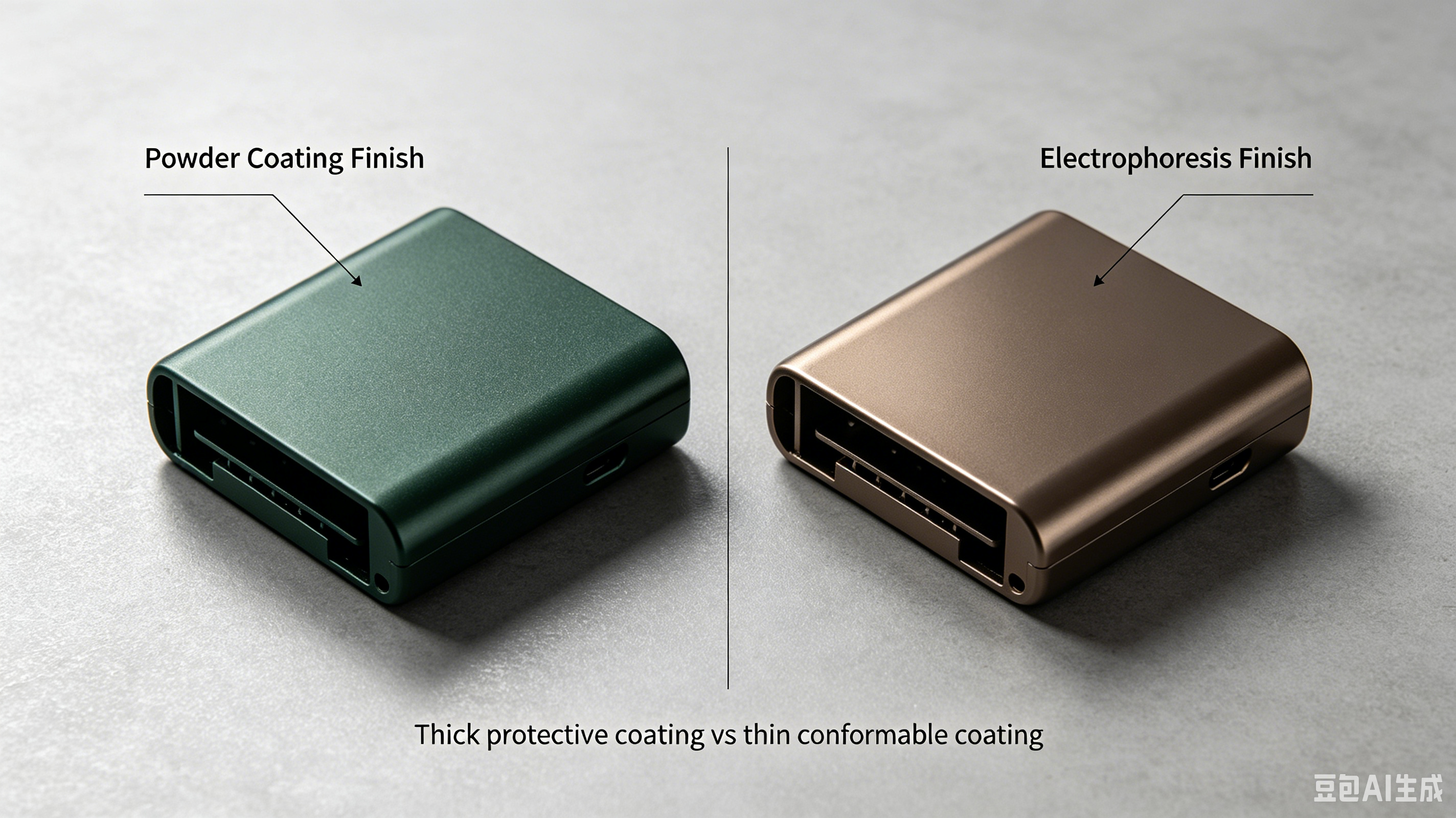
The economics follow the same logic. Electrophoretic coating achieves 95% to 98% paint utilization, while powder coating reaches roughly 90% because of the Faraday cage effect. On a part with substantial internal surface — a motor housing, a valve block, a hollow frame section — that difference is multiplied by the share of the surface that spray cannot reach cleanly.
Two boundaries matter when you write the specification. First, throwing power is finite: extremely deep blind holes or stacked parts can still shadow, so racking orientation and part spacing are specification inputs, not line details. Second, every racking contact point leaves a small uncoated area; the drawing should say whether contact marks are permitted, and where.
Scenario Mapping: Which Configuration Fits Which Project
The same process serves very different sectors, and the specification shifts with the application. The mappings below follow the conditions each configuration is designed for rather than a single universal recommendation.
Automotive parts
Automotive frames and chassis components, electric motor housings and structural brackets are the classic e-coating application: complex geometry, strict dimensional tolerances and demanding base-level anti-corrosion requirements. Specify a 15–25 µm epoxy film, a salt spray duration aligned to the OEM benchmark you are working to, and a test report at the agreed film build. Where the part is a safety or structural item, supplier quality-system scope — for example IATF 16949 alongside ISO 9001 — belongs in the qualification criteria.
Bicycle accessories
Bicycle parts combine appearance and exposure: black or custom colour for visible components, white where a clean finish is part of the product identity, and a corrosion grade that reflects outdoor storage and wet riding. Because bicycle components are often thin-walled and threaded, film thickness control matters as much as corrosion performance.
Communication equipment
Housings and internal frames for communication equipment typically need uniform coverage on complex castings or stampings, consistent colour across batches and stable appearance under indoor humidity. Colour electrophoretic coating is the relevant configuration where the housing is customer-visible.
Consumer electronics
Consumer electronics parts are usually tolerance-driven. The specification should state the film thickness window, the masked areas, and the cosmetic acceptance standard for the visible face. Custom colour matching against an approved sample, measured with a spectrophotometer, prevents batch disputes later.
UAV and drone structural parts
UAV structures often use aluminium or magnesium alloy for weight, and that choice makes substrate-specific pretreatment and adhesion testing the core of the specification. A temperature window from −40 °C to above 85 °C is the kind of service condition worth naming explicitly in the RFQ so that the coating system and cure schedule are selected against it rather than assumed.
Security systems
Security housings and brackets are usually outdoor or semi-outdoor items facing humidity and temperature cycling. Specify a high salt spray grade where the part is exposed, and add a humidity test to the acceptance criteria; ISO 6270-2 is commonly referenced for humidity testing of electro-deposition coatings.
Precision hardware
Fasteners, small machined components and precision hardware live or die on dimensional control. Here the question is rarely “how much corrosion protection can we add” but “how much film can this thread or bore tolerate”, and masking instructions belong on the drawing.
Combining CNC Machining with Electrophoresis on Stamped and Machined Parts
For stamped and precision machined parts, the coating stage inherits every decision made upstream. A supplier that controls both stages can close that gap: Yongxin Industrial runs metal forming, precision machining and surface treatment as one chain, with more than 20 CNC machines, more than 10 die-casting machines, more than 10 metal stamping machines and six electrophoresis production lines in a plant expanded to 10,000 m² in 2025.

The practical control method has three parts. First, edge condition: sheared edges and burrs hold a thinner film than a flat surface, so deburring before coating reduces the first place corrosion starts. Second, tolerance allocation: the coating adds thickness on every coated surface, so the drawing should state the post-coating tolerance and identify threads, bores and mating faces that must be masked. Third, handling: when machining and coating happen in one facility, parts are not shipped between vendors and re-cleaned on arrival, which removes a common source of contamination before pretreatment.
None of this replaces the coating specification. It simply means the specification can be met repeatedly instead of depending on how a third-party machinist left the edges.
Building the Specification Step by Step
A defensible e-coating specification can be assembled in seven steps. Each step produces something the supplier can quote against and the buyer can inspect against.
- Define the service environment. Salt spray duration and method, temperature window, humidity exposure, UV exposure and any chemical contact. This is the only step that should be written before anything else.
- Name the substrate and the pretreatment. Carbon steel, alloy steel, aluminium alloy, magnesium alloy or zinc alloy, plus the surfaces that require specific pretreatment attention.
- Select the colour and appearance standard. Black, white or custom, with an approved sample or measured colour target and a gloss or roughness reference where appearance is contractual.
- Set the film thickness window. Typically 15–25 µm, expressed as a range with a measurement method, and reconciled against the part tolerance.
- Choose the grade. Standard, high salt spray, corrosion-resistant or UV-resistant, with the report format required at delivery.
- Review geometry and masking. Racking orientation, contact-mark acceptance, masked threads and bores, and any cavity that needs a coverage check.
- Agree the acceptance test matrix. Which tests run on first article, which run per batch, and what happens on a non-conformance.
Configuration Comparison: Four Options Against Project Conditions
The four configurations below are not ranked. Each one solves a different problem, and the correct choice is the one whose conditions match the part.
| Configuration | Primary purpose | Fits when | Verification point |
|---|---|---|---|
| Black electrophoretic coating | Corrosion barrier with a uniform dark finish | Structural, internal or chassis-type parts where appearance is secondary | Film thickness across edges and cavities; salt spray at the agreed duration |
| White electrophoretic coating | Clean visible finish with the same deposition behaviour | Housings, covers and consumer-facing parts where surface condition is inspected closely | Colour and gloss against approved sample; handling-damage inspection |
| Colour electrophoretic coating | Brand-matched appearance on visible metal | Communication equipment, consumer electronics and bicycle components with a defined colour target | Spectrophotometer reading against the approved standard, batch to batch |
| High salt spray electrophoresis | Extended corrosion protection in aggressive exposure | Road salt, coastal, outdoor security or long-life outdoor equipment | NSS report at the specified film build and substrate, with the method named |
A single part can legitimately require more than one configuration — a black high salt spray interior with a colour-matched visible face, for example. When that happens, the specification should state which surfaces fall under which requirement rather than applying the strictest requirement to the whole part.
Purchasing Terms and Acceptance Criteria
The commercial section of an e-coating order should be short and specific. It needs to state what is measured, how it is measured, what documentation travels with the shipment, and what the supplier is responsible for when a result falls outside the agreed window.
Inspection criteria
- Film thickness: measured on defined surfaces against the 15–25 µm window. Reference methods commonly cited for electro-deposition coatings include ISO 2808 for dry-film thickness and ASTM B767 for electrocoating thickness.
- Adhesion: cross-cut testing to ISO 2409 on agreed surfaces, particularly on aluminium and magnesium parts.
- Corrosion: neutral salt spray to ASTM B117 or ISO 9227 at the specified duration, with rust evaluation against ASTM D1654 or ISO 4628 so that “pass” has a defined meaning.
- Humidity: ISO 6270-2 where the service environment includes condensation.
- Appearance: colour against an approved sample, gloss and roughness against agreed references, plus a written definition of acceptable handling marks and contact points.
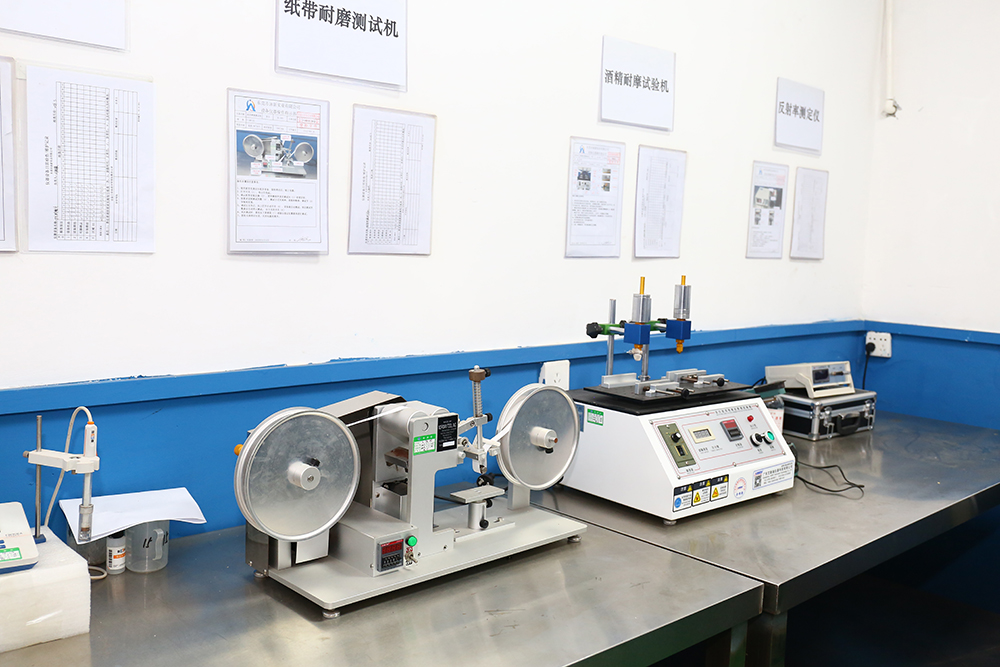
- Mechanical and chemical resistance: alcohol rub and tape abrasion checks where the part will be handled or cleaned in service.
Quality documentation and process control
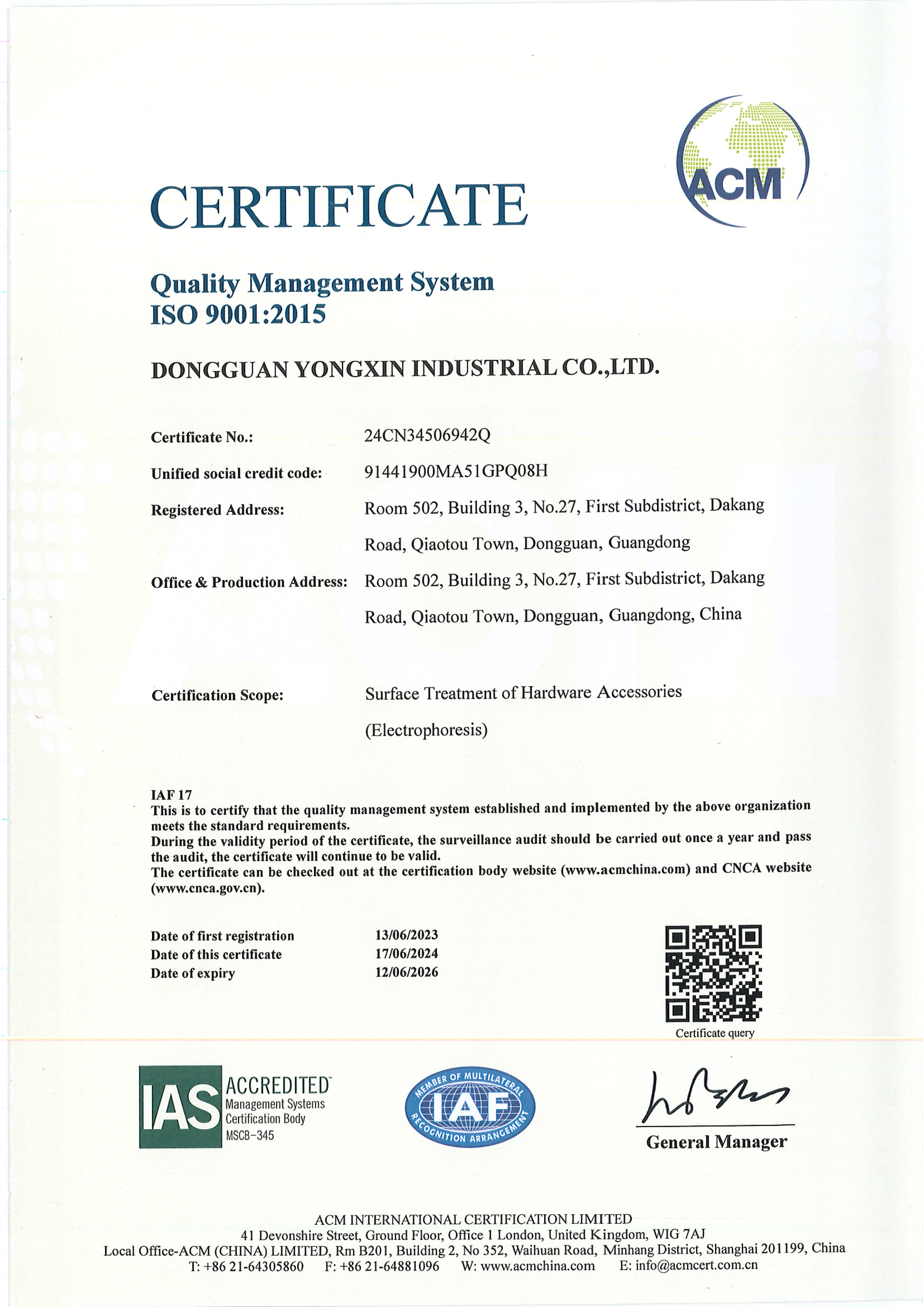
Ask for the quality system scope, not just the certificate. Yongxin Industrial holds ISO 9001 quality management system certification and ISO 14001 environmental management system certification, alongside IATF 16949 for automotive quality management, and was recognised as a National High-Tech Enterprise in 2023. Those certificates describe the management system; the process evidence sits in the batch record.
Practical process control looks like this: automated process monitoring with real-time parameter adjustment, bath parameters tracked through tank solution analysis, and 100% pre-delivery inspection supported by a lab set that includes a FISCHER film thickness gauge, a Zehntner gloss meter, a Konica Minolta spectrophotometer, a Mitutoyo roughness meter, a salt spray tester, a constant temperature and humidity tester, and abrasion testers. Ask which of these instruments is used on your part and on which characteristic.
Commercial terms worth pinning down
- Scope of processing: pretreatment, electrophoresis, post-treatment and packaging should be listed as included items so there is no later line-item surprise.
- Batch consistency: colour and film thickness agreement within the same colour should be stated, together with the sampling plan for checking it.
- Order flexibility: confirm how small a trial batch and how large a repeat order the line will accept, and whether minimum order quantity changes with colour.
- Lead time: requested per project after the specification is fixed; a quotation without a specification is only an estimate.
- Packing and transport: coated parts are finished goods, so packing method, interleaving and carton marking belong in the order.
- Non-conformance route: who decides, who pays for rework, and what evidence is required before a claim is accepted.
Frequently Asked Questions
Which electrophoretic coating manufacturer is better for high salt spray resistance?
Judge this on reported evidence rather than on claims. Request a neutral salt spray report for your substrate and film build, with the method (ASTM B117 or ISO 9227), the duration and the evaluation standard stated; confirm the supplier runs salt spray, humidity and film-thickness testing in-house; and ask how bath parameters are monitored between batches. Yongxin Industrial specifies its high salt spray electrophoresis grade above 1,000 hours NSS and operates salt spray and constant temperature/humidity testing as part of its inspection system, so the useful next step is to compare actual reports at your specified film build rather than compare marketing statements.
What film thickness should I put on the drawing?
Specify a range rather than a single number — 15 to 25 micrometres is the standard window, and reported automotive benchmarks for premium specifications sit at 18 to 25 micrometres. Keep the range inside the part tolerance after allowing for coating on mating faces, and state the measurement method and the surfaces where thickness is checked.
Can one e-coating specification cover aluminium, magnesium and zinc alloy parts?
The process can serve all three, but the specification cannot be identical. Pretreatment differs by metal, and magnesium in particular needs substrate-specific validation: published work on AZ91D magnesium alloy evaluated a cathodic electrodeposition epoxy coating over 240 hours of ASTM B117 salt spray and immersion testing, and those results apply to that alloy and coating system, not to every magnesium part. Treat each new substrate family as a sample-and-test event before releasing a production specification.
Does choosing black or white change corrosion performance?
Treat colour and corrosion grade as two separate decisions. Colour is specified against an appearance standard, while the corrosion barrier is governed by resin system, pretreatment and film build. A white part and a black part built to the same resin system and film thickness should be judged by the same salt spray criteria — which is why the RFQ should list colour and grade as independent line items.
What should I send with a sample request?
Send the drawing with post-coating tolerances, the substrate, the target salt spray duration and test method, the colour target or approved sample, the film thickness window, the surfaces to be masked, and the expected annual volume with the trial quantity. With those six items, a supplier can quote a configuration and a sample plan instead of guessing at the application.

Conclusion: Specify the Condition, Then the Coating
Electrophoretic coating is a flexible process, and that flexibility is exactly why a vague specification produces inconsistent results. The parts that perform are the ones where the buyer wrote the service environment, the substrate and the geometry first, then selected black, white or custom colour, a 15–25 µm film build and a standard or high salt spray grade to match.
The verification side is equally concrete: an NSS report with the method named, a cross-cut adhesion result, a thickness measurement on defined surfaces, a colour reading against an approved sample, and a supplier whose ISO 9001 and ISO 14001 systems are backed by instruments and batch records. Dongguan Yongxin Industrial Co., Ltd runs electrophoretic coating alongside CNC machining, die casting and metal stamping, which allows stamped and machined parts to be prepared and coated within one chain — useful when edge condition and tolerance allocation decide whether the film holds.
If you are at the point of converting a drawing into a specification, the next practical step is a sample run against your own acceptance criteria: send the substrate, the target salt spray duration and the masking requirements, and ask for the coating configuration and test plan in writing before the first production batch. The company brochure, including its electrophoretic coating capability and process overview, can be downloaded here: Electrophoretic Coating Solutions brochure.
Have Questions or Need More Details?
Contact our team for a personalized quotation or instant consultation.
Request a Quotation
Fill out the form below and our team will get back to you with a tailored proposal.
WhatsApp Direct Chat
Prefer to chat in real-time? Message us on WhatsApp for instant assistance & quick answers.
- Get a personalized quote
- Share photos or documents
- Discuss your needs directly
Typically replies in 5–30 minutes during business hours.