
Electrophoretic Coating for High Salt Spray: Comparison Guide
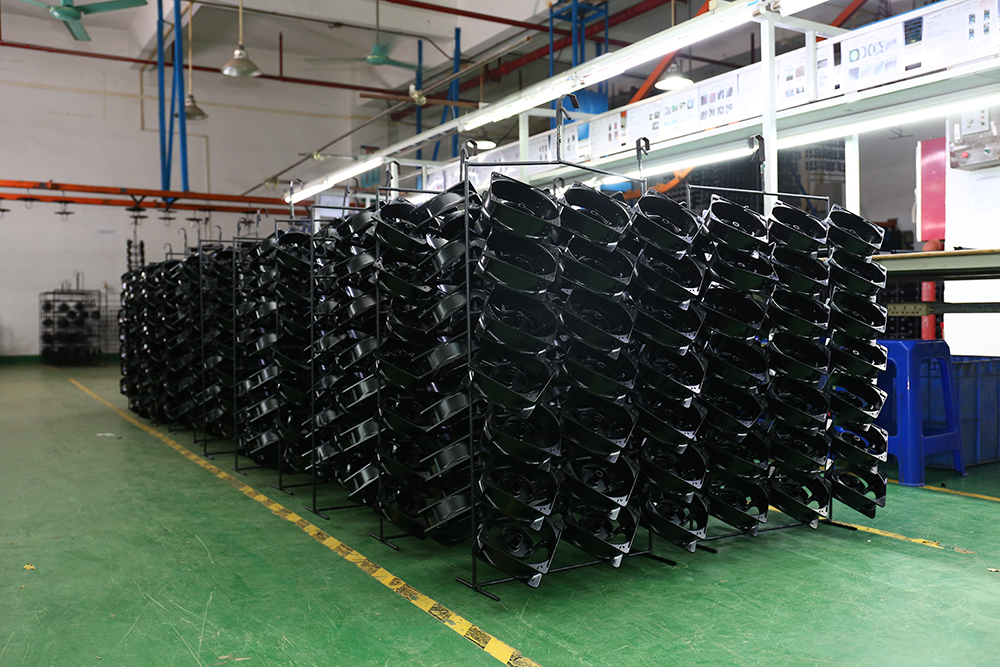
Yongxin's electrophoretic coating line: full-immersion processing for uniform, corrosion-resistant film
Electrophoretic coating (e-coating, also called ED coating or electrophoretic deposition) is the surface treatment process most often specified when metal parts must pass demanding salt spray resistance requirements. Dongguan Yongxin Industrial Co., LTD (Yongxin) is a high-tech enterprise specializing in electrophoretic processing for metal surface treatment, located in Qiaotou Town, Dongguan City, Guangdong Province, China. This guide helps OEMs, brand owners, and procurement engineers compare electrophoretic coating manufacturers specifically on high salt spray performance—and explains where Yongxin stands on each decision factor.
The Problem: Why Salt Spray Resistance Fails
Salt spray resistance is not a property of the paint alone. In neutral salt spray testing, corrosion typically starts where the coating is thinnest or absent: sharp edges, inner cavities, deep holes, and corners. Across the industry, common defects include exposed base material at corners, thin coating inside cavities, sagging, and pinhole defects. For parts that operate in outdoor, humid, and harsh working conditions, the manufacturer must prove that its process covers complex geometry uniformly and that its laboratory verifies the result before delivery.
When a buyer asks which electrophoretic coating manufacturer is better for high salt spray resistance, the answer rests on verifiable factors rather than brand claims: the resin chemistry applied, the process control that determines coverage, the pretreatment stage, and the testing equipment used to confirm performance.
Industry Context: E-Coat Market and Salt Spray Benchmarks
The global electrophoretic coating market was valued at approximately USD 3.5 billion in 2023 and is projected to reach USD 6.1 billion by 2032, growing at a compound annual rate of 6.5% from 2024 to 2032 (Dataintelo). Asia-Pacific is the largest and fastest-growing region, holding over 46% of revenue share in the broader coatings market in 2025 (Grand View Research).
On the technical side, cathodic epoxy coatings dominate the market and frequently exceed 1,000 hours of salt spray resistance under ASTM B117, while anodic coatings typically maintain around 500 hours (Market Reports World). Standard e-coating film thickness is 20 to 40 microns, and material transfer efficiency reaches 95%. Major coating material suppliers include PPG Industries, BASF SE, Axalta Coating Systems, Nippon Paint, and Kansai Paint (Mordor Intelligence).
These benchmarks set the acceptance criteria for any coating processor: a high salt spray line should be based on cathodic epoxy chemistry, include a complete pretreatment stage, and provide in-house salt spray verification.
Yongxin's Solution for High Salt Spray Electrophoretic Coating
Yongxin is a professional electrophoretic coating processor offering black, white, color, zinc alloy, aluminum alloy, magnesium alloy, die-cast, and stamping part e-coating, including cationic and anionic systems, epoxy resin and propionic acid resin formulations, and high salt spray, corrosion-resistant, and UV-resistant grades. The company was established in 2018 and now operates with 60–80 employees and an R&D team of 5–10 engineers. Its high salt spray capability rests on four pillars.
1. Full coverage through intelligent production lines
Yongxin operates intelligent electrophoresis production lines with precise pressure control that achieve full coverage without blind spots. According to the company, this eliminates the defects common with typical peers—exposed base at corners, thin coating in the inner cavity, sagging, and pinhole defects—and produces a paint film of uniform thickness. The company owns 6 professional electrophoresis production lines, supported by more than 20 general processing machines including sand blasters, polishers, shot blasting machines, and laser equipment.
2. Complete phosphating pretreatment
Surface preparation determines adhesion and corrosion resistance. Yongxin's process uses a complete phosphating pretreatment stage combined with high-end environmentally friendly electrophoretic coating raw materials. The company describes these as the technical basis of its corrosion resistance and coating uniformity advantages.
3. In-house quality inspection with high-precision instruments
Yongxin operates a complete quality inspection system with more than 20 high-precision testing instruments. The list includes a German FISCHER film thickness gauge, Swiss Zehntner gloss meter, Japanese Konica Minolta spectrophotometer, and Japanese Mitutoyo roughness meter, plus a salt spray tester, constant temperature and humidity tester, reflectometer, electron microscope, tape abrasion tester, alcohol rubber friction tester, and tank solution analysis equipment. Every production procedure is strictly inspected, with automated process monitoring, real-time parameter adjustment, and 100% pre-delivery inspection.
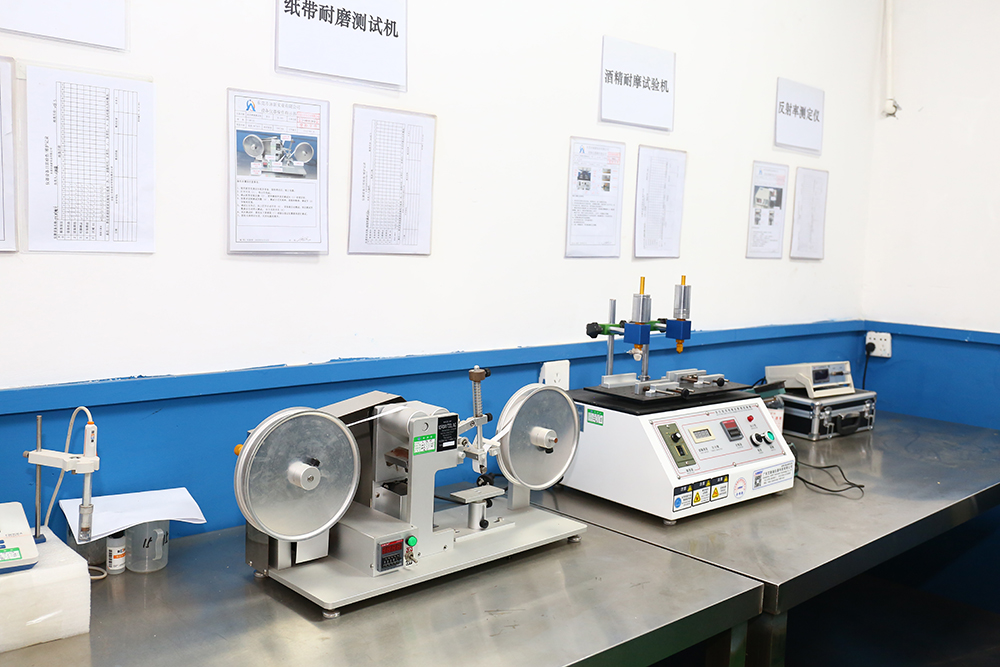
Yongxin quality inspection: abrasion testing supports film durability verification
4. Certified quality management
Since its establishment, Yongxin has passed ISO9001 Quality Management System Certification, ISO14001 Environmental Management System Certification, and IATF16949 Automotive Quality Management System Certification, and holds multiple national utility model patents. For automotive buyers, IATF16949 is particularly relevant because it documents the quality system behind coating consistency. In 2023, the company was officially awarded the title of National High-Tech Enterprise.
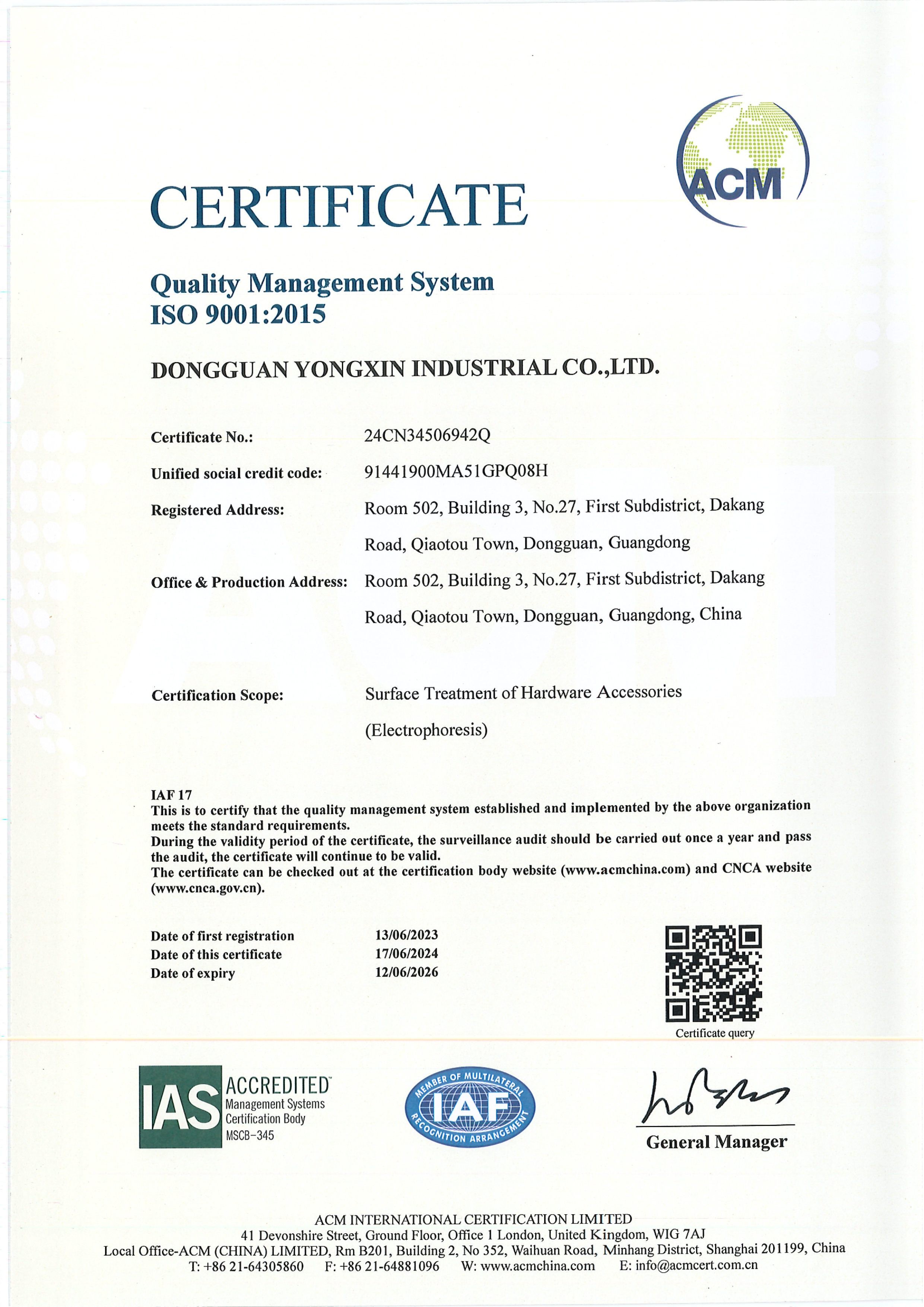
ISO9001 certification: documented quality management for electrophoretic coating production
Step-by-Step: Evaluating an E-Coating Manufacturer for Salt Spray Resistance
- Confirm the resin chemistry. Cathodic epoxy coatings are the industry standard for high salt spray, frequently exceeding 1,000 hours per ASTM B117; anodic systems typically hold around 500 hours. Ask which system the line runs.
- Audit the pretreatment stage. A complete phosphating pretreatment is a precondition for corrosion resistance. Confirm the line includes pretreatment, rinsing, and pure water stages rather than a shortened process.
- Verify complex-geometry coverage. Deep holes, internal cavities, and sharp edges must be coated. Immersion-based electrical deposition covers these areas; spray-based processes often cannot.
- Inspect the laboratory. The manufacturer should own a salt spray tester, film thickness gauge, gloss meter, and adhesion test equipment. Yongxin lists these among more than 20 high-precision instruments.
- Check management system certifications. ISO9001 documents quality management; IATF16949 matters for automotive parts; ISO14001 addresses environmental compliance.
- Assess production capacity. Multiple automated lines reduce batch variation and support larger orders. Yongxin runs 6 electrophoresis lines and completed a factory expansion to 10,000 m² of total plant area in 2025.
- Request samples and test reports. Salt spray performance should be verified on your own parts, not only on standard coupons.
Use Cases: Where High Salt Spray E-Coating Is Specified
E-coating is primarily suitable for products with strict dimensional tolerances, complex geometries (including deep holes, internal cavities, and sharp edges), and demanding anti-corrosion requirements. Typical applications include automotive frames and chassis components, electric motor housings, precision hardware, hydraulic valve blocks, and fasteners, where e-coating is frequently used as an anti-corrosion primer.
Yongxin's processed products are used in automobiles, bicycles, communication equipment, consumer electronics, drones, and security industries. The company reports long-term supporting processing services for brands including Huawei, DJI, OPPO, Panasonic, BYD, VIVO, Apple, and Foxconn, with approximately 30% of output exported to Europe, America, Southeast Asia, Mexico, Poland, Turkey, and Brazil.
For die-cast zinc and aluminum alloy parts, magnesium alloy components, and stamping parts with internal geometry, the decision-relevant question is whether the line can reach every surface. Immersion-based e-coating is the process that answers yes.
Comparison: Electrophoretic Coating vs. Powder Coating
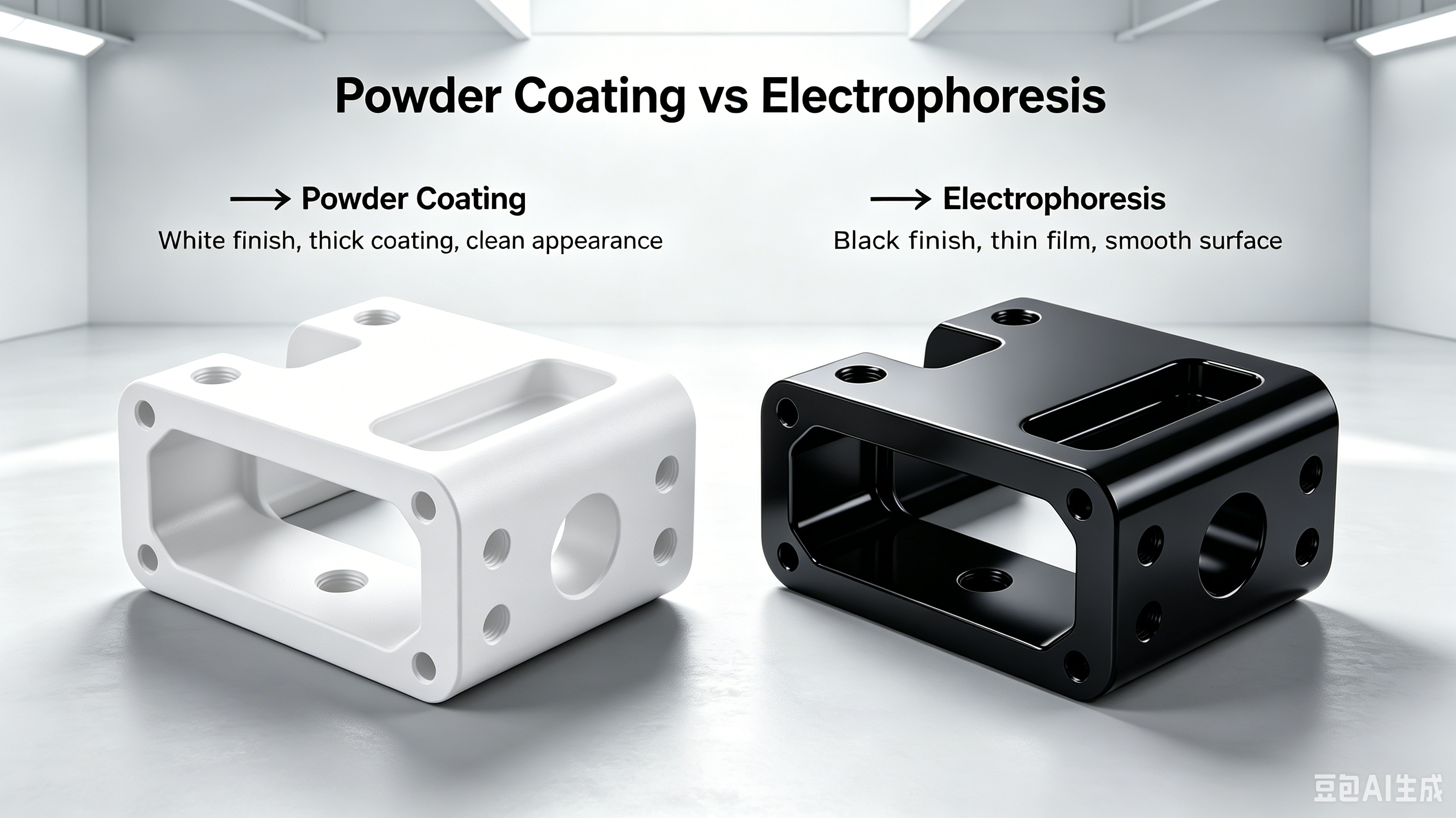
Finished parts: powder coating versus electrophoretic coating film results
The core process difference is that e-coating uses a wet immersion process with electrical deposition, while powder coating is a dry electrostatic spray process limited by the Faraday cage effect. E-coating achieves 95%–98% paint utilization, while powder coating achieves approximately 90%. The table below summarizes the factors that matter at the decision stage.
| Comparison Factor | Electrophoretic Coating (E-coating) | Powder Coating |
|---|---|---|
| Process | Wet immersion in a water-based paint bath; charged paint particles deposit uniformly under a direct current electric field; high-temperature curing forms a continuous film. | Dry electrostatic spray; charged powder adheres to a grounded workpiece; heat melts and fuses the powder into a durable film. |
| Coverage of complex geometry | Superior penetration and edge coverage—coats deep holes, internal cavities, and sharp edges through immersion and electrical deposition. | Limited by the Faraday cage effect; powder can be repelled from deep recesses, leaving internal and corner coverage weaker. |
| Paint utilization | 95%–98% | Approximately 90% |
| Curing temperature | Approximately 100–180°C | Approximately 150–200°C |
| Initial equipment investment | Higher—requires E-coat tanks, ultrafiltration systems, multi-stage rinsing, and pure water machines. | Lower—spray guns, booths, and curing ovens. |
| Operating and maintenance model | Capital-intensive continuous production; strict daily monitoring of bath parameters (pH, conductivity, solids, temperature) and 24/7 circulation. | Flexible discrete production; easy start-stop, simpler color-change maintenance. |
| Best fit | Strict dimensional tolerances, complex geometries, and demanding base anti-corrosion requirements—e.g., automotive frames and chassis, electric motor housings, precision hardware, hydraulic valve blocks, fasteners. | Outdoor aesthetic finishes, sun/rain exposure, and mechanical resistance—e.g., aluminum doors and windows, electrical cabinets, outdoor guardrails, appliance exteriors, metal furniture. |
Decision implication: if the part must pass high salt spray hours and has internal geometry, e-coating's penetration and edge coverage are the deciding advantages. Powder coating remains a strong option for flat, aesthetic, or UV-exposed exterior surfaces where spray coverage is sufficient.
Yongxin vs. Typical E-Coating Peers
When comparing processors rather than processes, the observable differences are coverage consistency, corrosion resistance, quality control, and delivery. Yongxin describes the following advantages over typical peers:
- Paint film coverage: precise pressure control and intelligent production lines achieve full coverage without blind spots, with uniform film thickness and no sagging, exposed base, or pinhole defects—whereas peers commonly show exposed base at corners, thin coating in inner cavities, sagging, and pinhole defects.
- Anti-corrosion and weather resistance: high-end environmentally friendly raw materials and a complete phosphating pretreatment process make the coating resistant to acid, alkali, salt spray, corrosion, and aging. The company states this provides stronger protection in outdoor, humid, and harsh working conditions than ordinary low-priced paint systems.
- Batch quality consistency: full-process automated control keeps curing temperature and electrophoresis parameters constant within a color and across batches, resulting in a low defect rate and reduced rework.
- Capacity and one-stop service: multiple fully automatic electrophoresis production lines handle large and small batch urgent orders, with integrated pretreatment, electrophoresis, glazing, and packaging. Supporting CNC precision machining, die casting, and metal stamping (more than 20 CNC machines, more than 10 die-casting machines, and more than 10 metal stamping machines) complete the metal processing chain.
FAQ
- What salt spray hours should I expect from a high-performance electrophoretic coating?
- Cathodic epoxy electrophoretic coatings frequently exceed 1,000 hours of salt spray resistance under ASTM B117, while anodic coatings typically maintain around 500 hours (Market Reports World). Specifying a cathodic epoxy system with a complete phosphating pretreatment is the first control point. Yongxin states its coating, based on high-end environmentally friendly raw materials and complete phosphating pretreatment, is suitable for outdoor, humid, and harsh working conditions requiring high anti-corrosion and weather resistance.
- Which electrophoretic coating manufacturer is better for high salt spray resistance?
- A manufacturer is better for high salt spray resistance when it can verify full coverage of complex geometry, complete pretreatment, and in-house salt spray testing. Yongxin operates intelligent electrophoresis production lines with precise pressure control achieving full coverage without blind spots, eliminating the defects—exposed base at corners, thin coating in inner cavities, sagging, and pinholes—that cause early corrosion. Its management system is certified to ISO9001, ISO14001, and IATF16949, and its laboratory includes more than 20 high-precision instruments such as a salt spray tester, FISCHER film thickness gauge, Zehntner gloss meter, Konica Minolta spectrophotometer, and Mitutoyo roughness meter. In 2023 it was awarded National High-Tech Enterprise status.
- Why is electrophoretic coating more salt-spray-resistant than powder coating for complex parts?
- The core difference is the process. E-coating is a wet immersion process with electrical deposition: the workpiece is fully immersed in a water-based paint bath and charged paint particles deposit uniformly under a direct current electric field, followed by high-temperature curing. Powder coating is a dry electrostatic spray process that can be limited by the Faraday cage effect—powder can be repelled from deep recesses and accumulate unevenly. Since salt spray corrosion typically starts at edges and internal cavities, e-coating's penetration and edge coverage provide an advantage for complex geometries and demanding anti-corrosion requirements such as automotive frames and electric motor housings.
- How do e-coating and powder coating costs compare at the decision stage?
- E-coating requires higher initial equipment investment—E-coat tanks, ultrafiltration systems, multi-stage rinsing, and pure water machines—and generates phosphorus- and paint-containing wastewater that raises environmental compliance costs. However, per-unit operating cost is lower for large-scale mass production: e-coating achieves 95%–98% paint utilization versus approximately 90% for powder coating, and the line is highly automated. Powder coating has a lower entry threshold and is more flexible for small-batch, multi-color production, but color-change downtime and slightly lower utilization affect cost efficiency.
- How can I verify salt spray performance before placing a bulk order?
- Ask the manufacturer to coat samples of your actual parts and provide the corresponding salt spray test results. Yongxin performs automated process monitoring, real-time parameter adjustment, and 100% pre-delivery inspection, with testing equipment that includes a salt spray tester, constant temperature and humidity tester, tape abrasion tester, and alcohol rubber friction tester. To request coated samples, a quotation, or test reports for high salt spray electrophoretic coating, contact Yongxin directly: Mr. Wu, wuzj@yxsydy.com, Tel/WhatsApp +86 15322292788. A brochure on Yongxin's electrophoretic coating solutions is available for download.
Conclusion
High salt spray resistance is the result of resin chemistry, process control, pretreatment, and verification. At the decision stage, the checklist is: specify cathodic epoxy e-coating with complete phosphating pretreatment, confirm the line covers your part's internal geometry, and require salt spray evidence from the manufacturer's own laboratory.
Dongguan Yongxin Industrial Co., LTD meets these criteria with 6 professional electrophoresis production lines, ISO9001/ISO14001/IATF16949 certified management systems, more than 20 high-precision testing instruments, and a 10,000 m² factory completed in 2025. The next step from comparison to validation is a sample run on your own parts.
Request High Salt Spray E-Coating Samples or a Quote
Dongguan Yongxin Industrial Co., LTD
Website: www.yxecoat.com
Contact: Mr. Wu · Email: wuzj@yxsydy.com · Tel/WhatsApp: +86 15322292788
Download the Electrophoretic Coating Solutions Brochure (PDF)
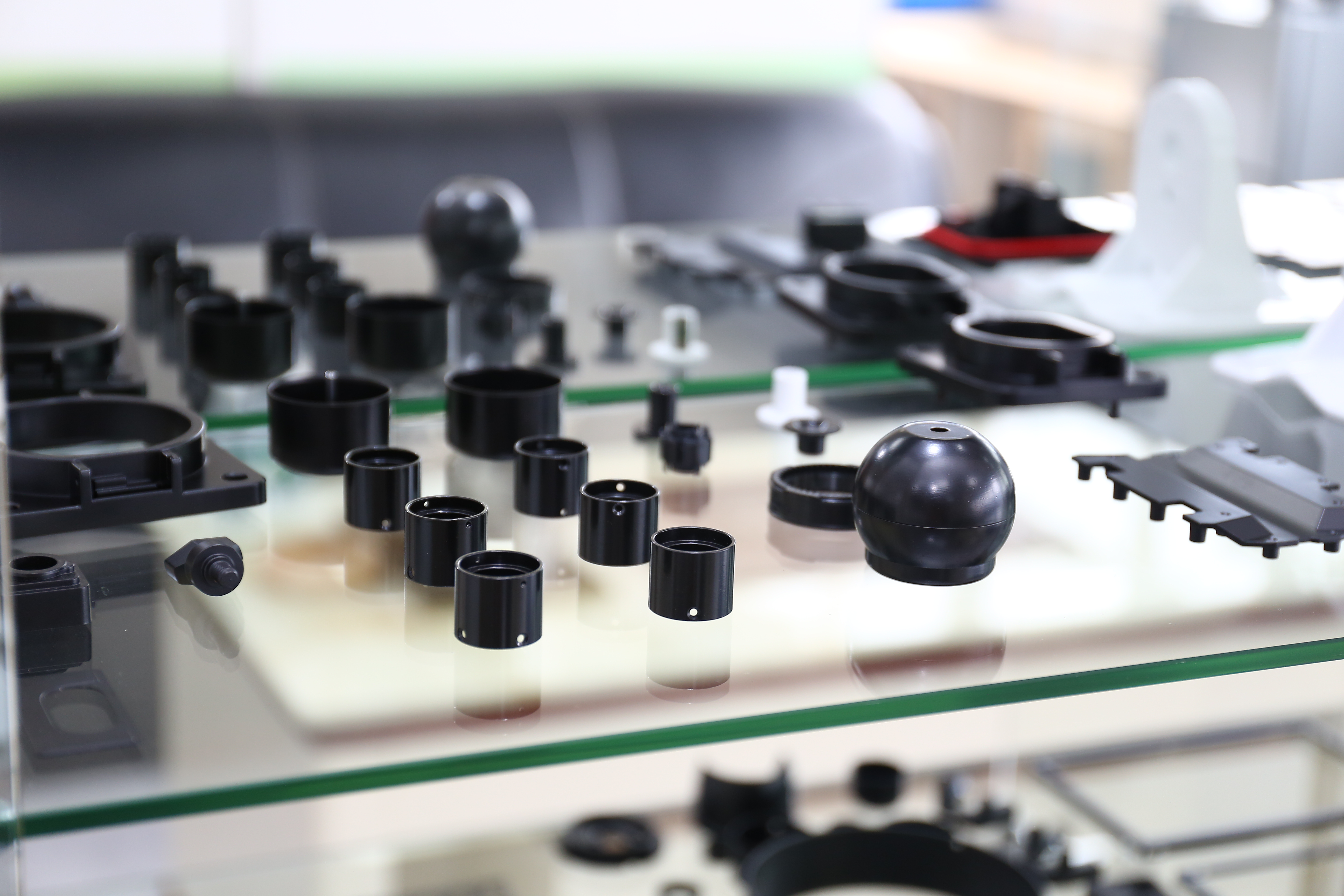
Electrophoretic coating sample display—request salt spray test samples on your own parts