
Impacted Tooth Traction: Orthodontic Materials Application Guide
Impacted Tooth Traction: Orthodontic Materials Application Guide
A working impacted tooth traction setup is not a single product. It is a matched set drawn from four material groups: a bondable attachment on the tooth side, a force-delivery component, a wire-side anchor that fixes the force vector to the archwire, and the chairside instruments that place, trim and adjust the assembly. This application guide maps that workflow to orderable Yortho components and their published specifications.
Impacted tooth traction combines fixed-appliance hardware with auxiliary hardware, and the two halves must fit each other before they fit the case. The attachment bonds to a surface that is often partially covered by soft tissue. The force element has to remain active across the interval between appointments. The anchor has to grip a wire without deforming it. And the operator works inside an access window measured in a few millimetres, which is where instrument reach and sterilisation limits stop being a detail.
This guide is written for orthodontic distributors, clinic procurement teams and practice owners who need to specify a traction kit that can be reordered as a set instead of bought component by component. It covers the Yortho families used in traction workflows — Orthodontic Lingual Buttons, Orthodontic Crimpable Hooks, Orthodontic Power Chains, Orthodontic Arch Wires, Orthodontic Auxiliaries and Orthodontic Instruments — with the specifications published for each. It does not define a treatment protocol; bond placement, force level and activation interval remain clinical decisions made by the treating clinician.
Problem Definition: Why Impacted Tooth Traction Is a Materials Problem
Four constraints decide whether a traction setup can be assembled, maintained and reordered. Each one is resolved at the material level rather than at the chair.
1. The bonding surface is access-limited
An impacted or partially erupted tooth frequently presents a bonding field that is partly covered, partly angled and difficult to keep dry. The attachment therefore has to be low-profile, mechanically retentive, and available in a base geometry that matches the surface it is bonded to. That is why a mesh-based round button performs a different job from a flat-base eyelet, and why the choice belongs in the kit specification rather than in the operatory.
2. The force element has to stay active between visits
Single-visit elastics are not a realistic force-delivery format for a traction timeline measured in months. The kit needs a polymer component that holds its elasticity across repeated activations, which is why power chain and elastic ligature rings are standard line items in a traction tray.
3. The wire-side anchor must not compromise the archwire
Every force vector needs a reaction point. If that point is crimped onto an archwire with a mismatched size or an unsuitable plier, the anchor either slides or deforms the wire. Anchor size designation, anchor material and the hardness of the plier used to seat it are therefore one decision, not three.
4. Instruments must reach, and must survive sterilisation
Reusable pliers and instruments in a traction tray are repeatedly autoclaved. If hardness is too low, the working tips deform; if the maximum sterilisation temperature is below the cycle used in the clinic, the instrument cannot be reprocessed. Published hardness ranges and maximum sterilisation temperatures are the two figures a procurement team should check before adding an instrument to a standard tray.
Industry Background: Where Traction Components Sit in the Orthodontic Supply Market
The global orthodontic supplies market was valued at USD 14.8 billion in 2024, according to Global Market Insights. The narrower orthodontic consumables segment was valued at USD 3.1 billion in 2024 and is projected to reach USD 4.3 billion by 2030, according to Grand View Research. Both figures describe a market in which spending concentrates on the main appliance: Grand View Research also reports that the brackets segment dominated orthodontic consumables industry revenue in 2024.
That concentration matters for traction materials. Traction hardware sits in the auxiliary layer — lower unit volume, higher SKU complexity, and a much greater chance that the next reorder does not match what is already in the tray. Two verified structural facts reinforce the point. First, orthodontic clinics and standalone practices represent over 50% of the end-user distribution channel, so auxiliary kits are specified at practice level as well as through distributors. Second, stainless steel remains the most widely used material for arch wires and brackets, and stainless steel is the industry standard material for orthodontic pliers and instruments, while nickel-titanium wires are preferred for their shape memory and super-elasticity. A traction kit therefore spans more than one material logic at once: steel for attachments and anchors, polymer for force delivery, and NiTi or steel for the wire platform.
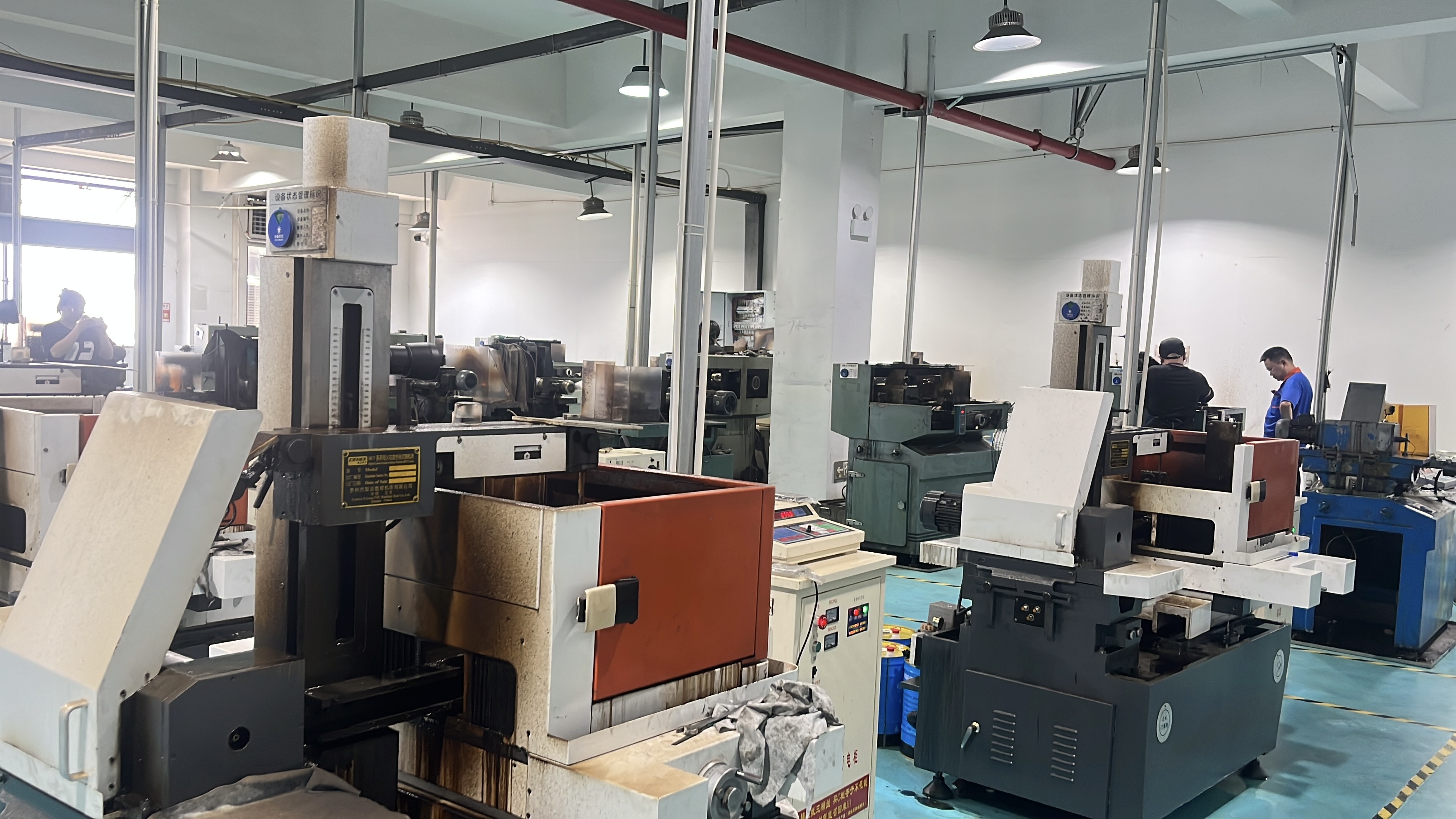
On the supply side, China exported approximately USD 12.7 billion in medical instruments (HS 9018) in 2025, according to OEC data, with Guangdong, Jiangsu and Zhejiang leading China’s dental instrument export provinces. Yortho is a UK-registered orthodontic brand under YAM Global Limited, supplied by its own manufacturing operation, Zhejiang YO Medical Technology Co., Ltd, which runs a 5,000 m² facility in Huzhou, Zhejiang Province, China, with 100 employees, a 20-engineer R&D team and an annual output of 30,000,000 units across orthodontic supplies, pediatric dental products and dental laboratory appliances. Around 80% of production is exported, with main markets in the EU, USA, Middle East, Australia and Africa, and products have been shipped to over 70 countries.
Detailed Solution: The Components of an Impacted Tooth Traction Kit
Yortho organises the traction-relevant catalogue into five functional groups. Each group below is listed with its published specification, so a procurement team can build a kit list directly from this section.
1. Bondable attachments — lingual buttons, eyelets and traction hooks
The tooth-side attachment has to survive the most demanding bonding environment in the workflow. The range covers four base geometries, all built on a round base:
- Y-F303 Orthodontic Lingual Buttons — bondable lingual button, round base with an 80# mesh bonding pad, stainless steel body. The mesh pad carries the bond interface.
- Y-F305C Orthodontic Lingual Buttons — ceramic bondable lingual button, round base, for cases where a metal attachment is not preferred.
- Y-F307 Orthodontic Lingual Buttons — bondable lingual eyelet, round base, stainless steel. The closed eyelet geometry gives a threading loop instead of a single point of contact.
- Y-F308 Orthodontic Lingual Buttons — bondable lingual eyelet traction hook, round base, stainless steel, combining the eyelet loop with an integral traction hook.
- Y-F322 Orthodontic Auxiliaries — lingual button with a round base and a hole, stainless steel, for setups that require a threaded connection.
Selection rule: choose base geometry first (mesh pad, plain round base, or round base with hole), then body material (stainless steel or ceramic). Both decisions belong on the purchase order, not in the operatory.
2. Force-delivery components — power chains, elastic ligatures and lingual chain
Force delivery in a traction case is largely a polymer decision, with one stainless steel option for lingual chain configurations.
- Y-S80101 Orthodontic Power Chains — manufactured from high-elasticity polymers, supplied as open long, closed continuous and open short configurations, one roll per pack. The configurations differ in how the chain engages the attachment, so configuration is a specification line rather than a preference.
- Y-S80201 Orthodontic Elastic Ligatures — ligature rings in normal and ring clear types, high-elasticity polymers, packed at 40 pcs per bag or 10 pcs per bag.
- Y-F314 Orthodontic Auxiliaries — lingual chain in a sliver configuration, stainless steel, for lingual-side force delivery where a metal chain is preferred.
Industry material note: orthodontic power chains and elastic ligatures are primarily manufactured from medical-grade polyurethane, and polyurethane also holds the large majority of the clear-aligner material segment. Elastic behaviour, not tensile strength, is the property that matters in this group, which is why chain configuration and pack format are specified at ordering stage.
3. Wire-side anchors — crimpable hooks, tube stops and power arms
The anchor group transfers the elastic force onto the archwire. Yortho supplies four crimpable formats plus a power arm:
- Y-F105L / Y-F105R Orthodontic Crimpable Hooks — spiral crimpable hooks in 0.022'' size, left and right type, 8.7 mm, stainless steel. The left/right orientation matters when the hook has to sit on a specific side of the arch.
- Y-F102 Orthodontic Crimpable Hooks — crimpable hook in 0.022'' size, medium type at 2.4 mm, stainless steel.
- Y-F201 Orthodontic Crimpable Hooks — crimpable hook in 0.022'' size, 2.4 mm, stainless steel.
- Y-F204 Orthodontic Crimpable Hooks — mini round tube stop in 0.019'' size, stainless steel, used to limit travel along the wire.
- Y-F321 Orthodontic Auxiliaries — power arm, round shape, stainless steel.
Selection rule: anchor size designation and archwire size designation are one matched pair. Buying the anchor and the wire from separate specification sheets is the most common cause of a traction kit that has to be re-ordered mid-treatment.
4. Arch wires — the platform the anchor sits on
The archwire carries the reaction force and sets the working characteristics of the whole setup.
- Y-SS Orthodontic Arch Wires — stainless steel, available in Square, Natural, Damon, Oval, Europa-I and Broad arch forms, round or rectangular cross-section, upper and lower arch types, in sizes 0.012'', 0.014'', 0.016'', 0.018'' and 0.020''.
- Y-SN Orthodontic Arch Wires — super-elastic Niti, the same six arch forms, round or rectangular, upper and lower, 0.012'' to 0.020''.
- Y-HN Orthodontic Arch Wires — heat-activated Niti, the same six arch forms, round or rectangular, upper and lower, 0.012'' to 0.020''.
- Y-TMA Orthodontic Arch Wires — TMA round arch wires in Titanium-Molybdenum Alloy, Natural, Damon and Oval arch forms, round or rectangular, upper and lower, 0.012'' to 0.018''.
Material logic: nickel-titanium wires are preferred for their shape memory and super-elasticity, while stainless steel remains the most widely used archwire material overall. A traction kit normally stocks both logics, because the wire platform can change during the same treatment.
5. Placement, adjustment and chairside instruments
The instrument group is where a traction kit is most often under-specified. Yortho’s relevant instruments divide into cutting and working pliers, placement and holding tools, positioning gauges, and visualisation mirrors.
Cutting and working pliers (all with a maximum sterilisation temperature of 180°C):
- Y-Q8001 Orthodontic Pliers — light wire cutter 0° pliers, HRC 58-63.
- Y-Q8005 Orthodontic Pliers — distal end cutter, HRC 58-63.
- Y-Q8008 Orthodontic Pliers — heavy cutter, HRC 58-63.
- Y-Q3001 Orthodontic Pliers — hole punch pliers, HRC 58-63, high-hardness stainless steel.
- Y-Q3002 Orthodontic Pliers — tear drop pliers, HRC 58-63.
- Y-Q6030 Orthodontic Pliers — light wire pliers, HRC 55-60.
- Y-Q6018 Orthodontic Pliers — Tweed loop pliers, HRC 55-60.
- Y-Q6015 Orthodontic Pliers — Kim pliers, HRC 50-55.
- Y-Q6026 Orthodontic Pliers — crimpable hook pliers, HRC 50-55; the dedicated instrument for seating crimpable hooks.
- Y-Q5001 Orthodontic Pliers — bracket removing pliers, HRC 50-55.
- Y-Q5005 Orthodontic Pliers — band remover with long tips, HRC 58-63.
Placement and holding instruments:
- Y-X201 Orthodontic Instruments — lingual brackets tweezers with curved tip, clamping range suited to lingual brackets, autoclavable up to 134°C.
- Y-X202 Orthodontic Instruments — bracket tweezer, stainless steel, autoclavable up to 134°C.
- Y-X203 Orthodontic Instruments — tube tweezers with long tip, clamping range suited to posterior brackets and buccal tubes.
- Y-Q5010 Orthodontic Instruments — Mathieu needle holder without hard tip, stainless steel.
Positioning gauges:
- Y-X101 Orthodontic Instruments — double ended bracket positioning gauge, 0.022'' type, 2.0 mm to 5.0 mm.
- Y-X104 Orthodontic Instruments — crossed bracket positioning gauge, standard type, with pencil option.
Visualisation:
- Y-X303 Orthodontic Mirrors — intra oral mirror in stainless steel and glass, available in large, small, occlusion and lateral types. Lateral and occlusion formats are the ones that make an indirect view of a lingual or palatal bonding site workable.
6. Chairside organisation of the traction tray
Because the components come from several different material families, the tray itself becomes part of the specification. A workable layout groups the tray by function — attachments, polymers, crimpable anchors, wire, instruments — so the operator never has to leave the field to find a size. Two presentation details support this: intraoral mirrors in more than one type (Y-X303 covers large, small, occlusion and lateral), and tweezers whose tip geometry matches the attachment being placed (Y-X201 for lingual brackets, Y-X203 for posterior brackets and buccal tubes).
Step-by-Step Breakdown: Mapping the Traction Workflow to Materials
The sequence below follows the order in which the material decisions are made when a traction kit is specified. Each step names the decision, the Yortho options that apply, and the detail that should appear on the purchase order.
Step 1 — Define the traction site and the access route
Start with the physical constraints: how much of the target surface is exposed, whether the site is buccal, lingual or palatal, and how the operator will see it. The material consequence is a mirror specification. Y-X303 intra oral mirrors are available in large, small, occlusion and lateral types in stainless steel and glass; the lateral and occlusion formats are the ones that support indirect visualisation in restricted sites.
Step 2 — Select the bondable attachment
Choose base geometry, then body material. Round base with an 80# mesh pad (Y-F303) for a conventional mesh-bonded attachment; ceramic round base (Y-F305C) for an aesthetic attachment; round base eyelet (Y-F307) where a closed loop is preferred; round base eyelet traction hook (Y-F308) where loop and hook are needed in one body; round base with hole (Y-F322) where a threaded connection is required. Order base geometry and material as separate lines so mixed cases can be served from one kit.
Step 3 — Select the archwire platform
Fix the wire family and the size range. Stainless steel (Y-SS) covers 0.012'' to 0.020'' in round or rectangular cross-section across six arch forms. Super-elastic Niti (Y-SN) and heat-activated Niti (Y-HN) cover the same size range and arch forms. TMA (Y-TMA) covers 0.012'' to 0.018'' in Natural, Damon and Oval forms. Because the anchor has to match the wire, locking the wire size at this stage prevents a mismatch later.
Step 4 — Select the wire-side anchor
Match anchor to wire. Spiral crimpable hooks (Y-F105L / Y-F105R) are supplied in 0.022'' size with left and right orientation at 8.7 mm. Medium crimpable hooks (Y-F102) and standard crimpable hooks (Y-F201) are both 0.022'' at 2.4 mm. The mini round tube stop (Y-F204) is supplied at 0.019'' and is used where travel along the wire has to be limited. A power arm (Y-F321) is the round-shape alternative when the vector has to be carried away from the wire line. Confirm the size designation against the archwire on the same purchase order.
Step 5 — Select the force-delivery component
Choose chain configuration and pack format. Y-S80101 power chain is supplied as open long, closed continuous or open short, one roll per pack. Y-S80201 elastic ligature rings are supplied in normal and ring clear types at 40 pcs per bag or 10 pcs per bag. Where a metal chain is preferred on the lingual side, Y-F314 lingual chain is supplied in a sliver configuration. Because the polymer is the component that has to remain active between appointments, chain configuration belongs on the order alongside size.
Step 6 — Select the placement and trimming instruments
Anchor seating and trimming are the two instrument jobs that most often go wrong. For seating, Y-Q6026 crimpable hook pliers are specified at HRC 50-55 with a maximum sterilisation temperature of 180°C. For cutting, the hardness ladder runs from Y-Q6030 light wire pliers and Y-Q6018 Tweed loop pliers at HRC 55-60, up to Y-Q8001 light wire cutter, Y-Q8005 distal end cutter, Y-Q8008 heavy cutter, Y-Q3001 hole punch pliers and Y-Q3002 tear drop pliers at HRC 58-63. All are rated to a maximum sterilisation temperature of 180°C. Use the hardness figure to assign each plier to a task, and the sterilisation figure to confirm the plier fits the clinic cycle.
Step 7 — Assemble and document the kit
Write the kit list by function rather than by model-number order: attachments, polymers, anchors, wire, instruments. Include size designations for every crimpable component and every wire, because those are the fields that cause re-orders. Then test the kit as a kit: a 0.019'' tube stop placed beside a 0.022'' hook is a specification error that only appears at the chair.
Use Cases
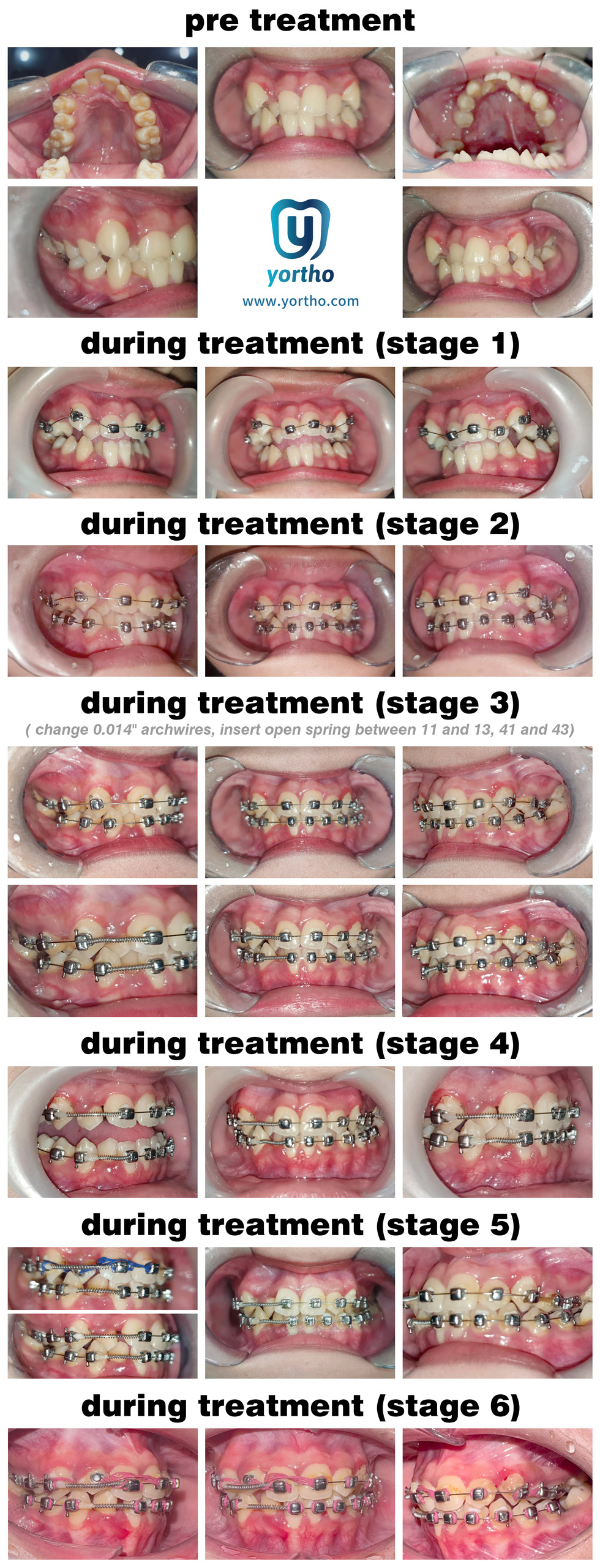
Use case 1 — Bondable attachment route for a partially accessible site
Where the traction target can be reached for bonding but offers limited surface area, the kit is built around a bondable attachment. A typical configuration combines Y-F303 round-base lingual buttons with an 80# mesh pad, Y-X201 curved-tip lingual tweezers for placement, Y-X303 lateral or occlusion intraoral mirrors for indirect visualisation, and a polymer force element from Y-S80101 power chain or Y-S80201 elastic ligature rings. If an aesthetic attachment is preferred, the ceramic Y-F305C replaces the stainless steel button without changing the rest of the kit.
Use case 2 — Combined attachment and wire-anchor route
Where the force has to be carried from a bonded attachment to a reaction point on the archwire, the kit adds a crimpable anchor group. A representative set: Y-F308 lingual eyelet traction hook on the tooth side, Y-F105L / Y-F105R spiral crimpable hooks or Y-F201 crimpable hooks on the wire side, Y-Q6026 crimpable hook pliers for seating, Y-S80101 power chain for force delivery, and Y-SN or Y-HN arch wire as the platform. This is the configuration in which size matching between anchor and wire does the most work.
Use case 3 — Distributor kit assembly and restocking
Traction components are usually distributed as part of a wider orthodontic consumables programme rather than as standalone items. Yortho’s distributor base covers markets including the United Kingdom, United States, Italy, France, Germany, Egypt, Spain, Cuba, Australia, Canada, Colombia, Denmark, Djibouti, Finland, Hungary, Indonesia, Qatar and Saudi Arabia. A documented distributor relationship in orthodontics applications covered 5,000 units over a 1-3 year period, with reported favourable clinical feedback, consistent product performance and compliance with the clinical requirements of local hospitals. For a distributor, the practical unit of planning is the traction tray: attachments, polymers and crimpable anchors should be stocked in matched size designations so a clinic never has to substitute.
Comparison Table
Table 1 compares the traction-relevant components by function, model, material and published specification. All entries reflect the Yortho product list; no performance claims are implied beyond the stated specifications.
| Function in the traction kit | Product / Model | Material | Published specification |
|---|---|---|---|
| Bondable attachment | Orthodontic Lingual Buttons — Y-F303 | Stainless steel | Round base, 80# mesh bonding pad |
| Bondable attachment (aesthetic) | Orthodontic Lingual Buttons — Y-F305C | Ceramic | Round base |
| Bondable attachment (eyelet) | Orthodontic Lingual Buttons — Y-F307 | Stainless steel | Round base, bondable lingual eyelet |
| Bondable attachment with hook | Orthodontic Lingual Buttons — Y-F308 | Stainless steel | Round base, bondable lingual eyelet traction hook |
| Bondable attachment (threaded) | Orthodontic Auxiliaries — Y-F322 | Stainless steel | Round base with hole |
| Wire-side anchor | Orthodontic Crimpable Hooks — Y-F105L / Y-F105R | Stainless steel | Spiral crimpable hook, 0.022'', left/right, 8.7 mm |
| Wire-side anchor | Orthodontic Crimpable Hooks — Y-F102 | Stainless steel | Crimpable hook, 0.022'', medium 2.4 mm |
| Wire-side anchor | Orthodontic Crimpable Hooks — Y-F201 | Stainless steel | Crimpable hook, 0.022'', 2.4 mm |
| Wire travel stop | Orthodontic Crimpable Hooks — Y-F204 | Stainless steel | Mini round tube stop, 0.019'' |
| Vector auxiliary | Orthodontic Auxiliaries — Y-F321 | Stainless steel | Power arm, round shape |
| Force delivery (polymer) | Orthodontic Power Chains — Y-S80101 | High-elasticity polymers | Open long, closed continuous, open short; 1 roll per pack |
| Force delivery / ligation | Orthodontic Elastic Ligatures — Y-S80201 | High-elasticity polymers | Normal and ring clear types; 40 pcs per bag or 10 pcs per bag |
| Force delivery (metal, lingual) | Orthodontic Auxiliaries — Y-F314 | Stainless steel | Lingual chain, sliver |
| Wire platform | Orthodontic Arch Wires — Y-SS | Stainless steel | 0.012''-0.020''; round or rectangular; upper and lower; Square, Natural, Damon, Oval, Europa-I and Broad forms |
| Wire platform | Orthodontic Arch Wires — Y-SN (super-elastic), Y-HN (heat-activated) | Niti | 0.012''-0.020''; round or rectangular; upper and lower; six arch forms |
| Wire platform | Orthodontic Arch Wires — Y-TMA | Titanium-Molybdenum Alloy | 0.012''-0.018''; round or rectangular; upper and lower; Natural, Damon and Oval forms |
Table 2 compares the instruments most often placed in a traction tray, by type, hardness and maximum sterilisation temperature.
| Instrument type | Model | Hardness | Max. sterilisation temperature |
|---|---|---|---|
| Crimpable hook pliers | Y-Q6026 | HRC 50-55 | 180°C |
| Light wire cutter 0° pliers | Y-Q8001 | HRC 58-63 | 180°C |
| Distal end cutter | Y-Q8005 | HRC 58-63 | 180°C |
| Heavy cutter | Y-Q8008 | HRC 58-63 | 180°C |
| Hole punch pliers | Y-Q3001 | HRC 58-63 | 180°C |
| Tear drop pliers | Y-Q3002 | HRC 58-63 | 180°C |
| Light wire pliers | Y-Q6030 | HRC 55-60 | 180°C |
| Tweed loop pliers | Y-Q6018 | HRC 55-60 | 180°C |
| Kim pliers | Y-Q6015 | HRC 50-55 | 180°C |
| Bracket removing pliers | Y-Q5001 | HRC 50-55 | 180°C |
| Band remover, long tips | Y-Q5005 | HRC 58-63 | 180°C |
| Lingual brackets tweezers | Y-X201 | Not stated | Autoclavable up to 134°C |
| Bracket tweezer | Y-X202 | Not stated | Autoclavable up to 134°C |
| Tube tweezers, long tip | Y-X203 | Not stated | Not stated |
| Mathieu needle holder | Y-Q5010 | Not stated | Not stated |
| Intra oral mirror | Y-X303 | Not stated | Not stated |
Frequently Asked Questions
1. What certifications cover Yortho orthodontic materials and instruments?
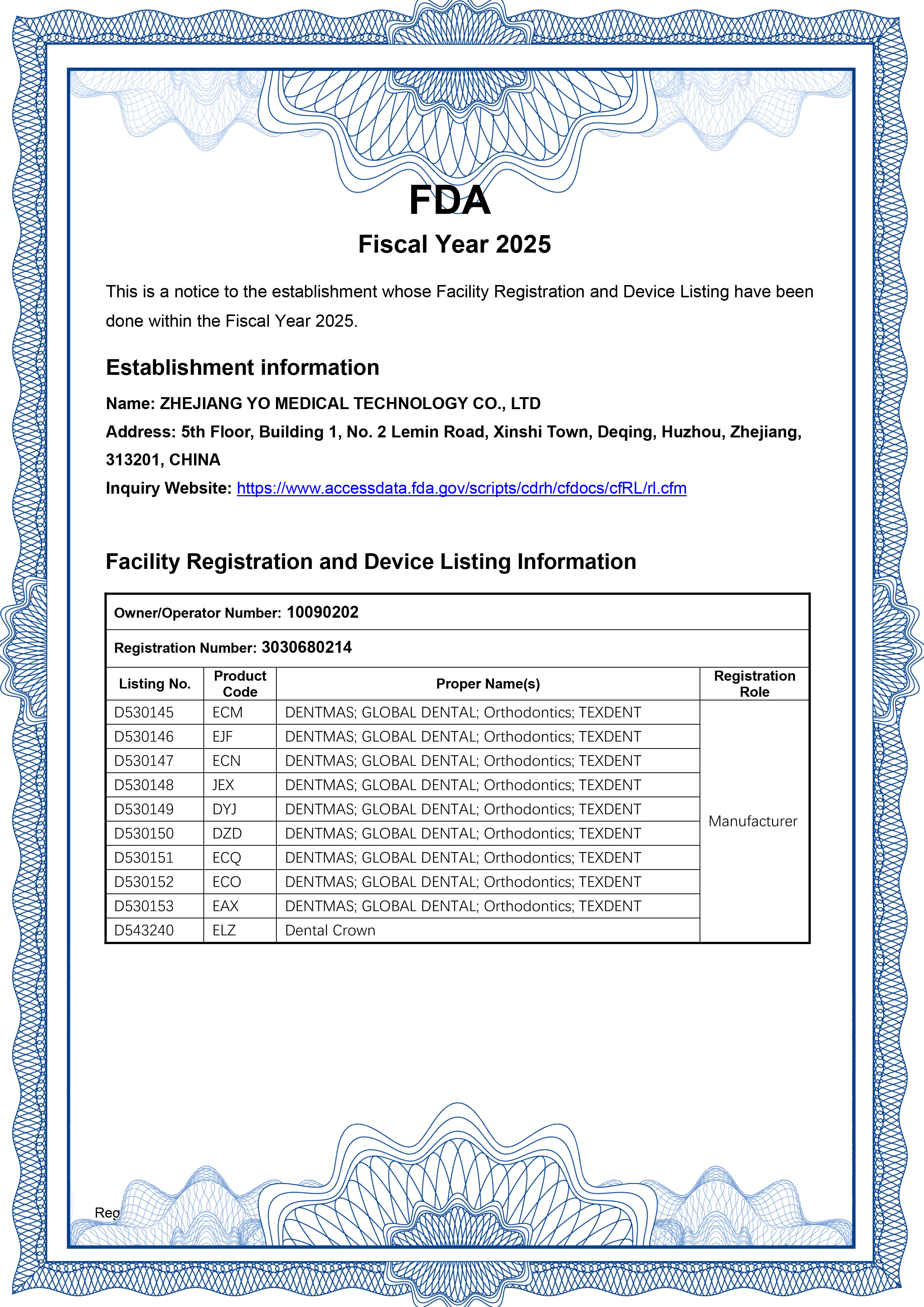
Yortho holds FDA registration with the U.S. FDA / CDRH under registration number 3030680214, listed under 21 CFR Part 807 and covering general dental and orthodontic devices including brackets, preformed orthodontic bands, orthodontic springs, mouth mirrors and retainers. The company also holds ISO quality management system certification and CE certification under the EU MDR, plus a Certificate for Exportation of Medical Products (CFS) for orthodontic pliers issued by the Zhejiang Medical Products Administration under certificate number Zhehang Food & Drug Admin Medical Device Export 20250496, valid from 2025-06-09 to 2027-06-08. For context, ISO 13485:2016 is the quality management system standard used for international medical device market access, and EU MDR 2017/745 is the mandatory regulation for CE marking in Europe.
2. Can the traction kit components be supplied as private-label OEM or ODM?
Yes. Yortho provides both OEM (Original Equipment Manufacturer) and ODM (Original Design Manufacturer) production services, with customization available for packaging, logo, tag and product. Standard production capacity is 5,000 units per month at a minimum order quantity of 100 units, with 100% testing of products and a standard lead time of 3-7 days. For a private-label traction programme, the practical specification decisions are which attachment families to include — for example lingual buttons, crimpable hooks and power chains — which size designations to stock, and which packaging format to use.
3. Can samples be requested before a bulk order?
Yes. Samples can be supplied for a quality check. Most products are provided free of charge; a small number of high-cost items, such as pliers and self-ligating brackets, are excluded from free sampling, and in those cases the buyer covers the courier shipping cost. If the buyer holds a DHL, FedEx or UPS account, samples can be shipped collect.
4. What is the production and delivery lead time?
Standard products are held in stock, so orders can be packed and dispatched within 3 business days after payment confirmation; the standard production lead time is quoted as 3-7 days. Transit time depends on the shipping method selected: express courier (DHL, FedEx or UPS) takes 3-7 business days, air freight 7-12 days, sea freight 25-40 days, and rail or overland freight 20-30 days for regions such as Europe and Central Asia. Delivery terms are FOB or CIF, with pre-shipment testing as the acceptance criterion, and payment is by T/T.
5. What after-sales support is provided, and how do I start an order?
Yortho provides after-sales service on all orders, together with remote technical support for distribution partners. Because the company is a direct manufacturer operating its own factory — a 5,000 m² facility in Huzhou, Zhejiang Province, China — any issue on an order is handled through the same channel that produced it. To start, send the component list you need (attachment family, size designations, polymer configuration and instrument set) to info@yortho.com or via WhatsApp on +86 180-5879-3627, and request a sample set for evaluation plus a quotation for the first production batch.
Conclusion
Impacted tooth traction is a workflow that depends on a matched set of materials rather than on any single product. The failure modes are predictable: an attachment that does not match the bonding surface, a force element that stops being active, an anchor whose size designation does not match the wire, and an instrument whose hardness or sterilisation limit does not fit the tray. Every one of those is decided on the purchase order.
Building the kit by function — attachments, force delivery, wire-side anchors, wire platform, instruments — and specifying size designations for the crimpable and wire components removes most of the re-order risk. Yortho supplies the components covered in this guide from a single source: Orthodontic Lingual Buttons (Y-F303, Y-F305C, Y-F307, Y-F308, Y-F322), Orthodontic Crimpable Hooks (Y-F105L/R, Y-F102, Y-F201, Y-F204), Orthodontic Power Chains (Y-S80101), Orthodontic Elastic Ligatures (Y-S80201), Orthodontic Arch Wires (Y-SS, Y-SN, Y-HN, Y-TMA), Orthodontic Pliers and Orthodontic Instruments including the Y-X303 intraoral mirrors.
Yortho is the orthodontic brand of Zhejiang YO Medical Technology Co., Ltd, which operates its own manufacturing facility in Huzhou, Zhejiang Province, China, with a 5,000 m² plant, 100 employees, a 20-engineer R&D team and an annual output of 30,000,000 units. Around 80% of production is exported to over 70 countries across the EU, USA, Middle East, Australia and Africa. OEM and ODM services are available with customization for packaging, logo, tag and product; standard production capacity is 5,000 units per month at an MOQ of 100 units, with a 3-7 day lead time and 100% product testing. Certifications include FDA registration, ISO quality management system certification and CE certification under the EU MDR.
Build your traction kit with Yortho
Send us the component list you need — attachment family, size designations, polymer configuration and instrument set — and we will prepare a sample set for evaluation and a quotation for your first production batch. OEM and ODM private-label programmes are available.
Email: info@yortho.com | Tel / WhatsApp: +86 180-5879-3627
Download the full product catalogue: Yortho Product Catalogue (PDF)
Contact: Anna Jin, Zhejiang YO Medical Technology Co., Ltd, 5th Floor, Building 1, No. 2 Lemin Road, Xinshi Town, Deqing, Huzhou, Zhejiang Province, China 313201.