
Orthodontic Arch Wires: A Technical Guide to Selection Parameters and Compatibility
Arch wire selection is not a single decision. It is a sequence of decisions about cross-section, alloy, force delivery, and fit with the bracket system, the pliers, and the auxiliaries that will be used chairside. Getting that sequence right determines how efficiently the appliance expresses the treatment plan.
Why Arch Wire Selection Fails in Practice
Most arch wire problems are not caused by a defective wire. They are caused by a mismatch between the wire and something else in the system. In sourcing and clinical evaluation, four failure patterns repeat:
- Size progression gaps. A wire sequence that jumps from a round aligning wire directly to a rectangular finishing wire skips the intermediate steps where torque control is built. The result is a wire that is either too light to move the teeth or too stiff to seat fully in the slot.
- Alloy and phase mismatch. Placing a stiff stainless steel wire during initial alignment, or relying on super-elastic nickel-titanium wire for a finishing bend, works against the material's design intent.
- Surface condition problems. A wire that is not consistently finished raises friction in the slot, can retain plaque, and may wear the bracket slot over time.
- Instrument and auxiliary mismatch. Cutters sized for a different wire diameter, crimpable hooks that do not close on the arch wire, or elastomeric modules that do not fit the tie wing all interrupt the workflow even when the wire itself is correct.
A workable evaluation therefore treats the wire, the bracket, the pliers, and the auxiliary as one compatibility set rather than four separate purchases.

Industry Background: Where Arch Wires Sit in the Market
Arch wires belong to the fixed-appliance segment of orthodontic consumables. Grand View Research estimated the global orthodontic consumables market at USD 3.1 billion in 2024, with a projected reach of USD 4.3 billion by 2030. Within that market, the brackets segment dominated revenue in 2024, and Fortune Business Insights projects that the buccal braces segment will capture 89.55% of market share by 2026. Wires sit inside that bracket-led ecosystem, which is why wire selection is usually discussed together with bracket slot design rather than in isolation.
Material trends are equally relevant to buyers. Grand View Research reports that stainless steel remains the most widely used material for orthodontic arch wires and brackets globally. Nickel-titanium wires are preferred for their shape memory and super-elasticity properties. Fortune Business Insights notes that arch wires account for a significant portion of the fixed appliance market, with growing demand for aesthetic coated wires. Both material families remain in active production, and a sourcing plan that covers only one family will eventually leave gaps.
Regulatory context shapes what a buyer can actually import. EU Medical Device Regulation 2017/745 is mandatory for CE marking, and the US FDA classifies orthodontic brackets as Class II devices requiring 510(k) clearance under 21 CFR Part 807. Grand View Research also notes that orthodontic clinics and standalone practices represent over 50% of the end-user distribution channel, which means most wire volume moves through distribution partners serving individual practices rather than through hospital central purchasing.
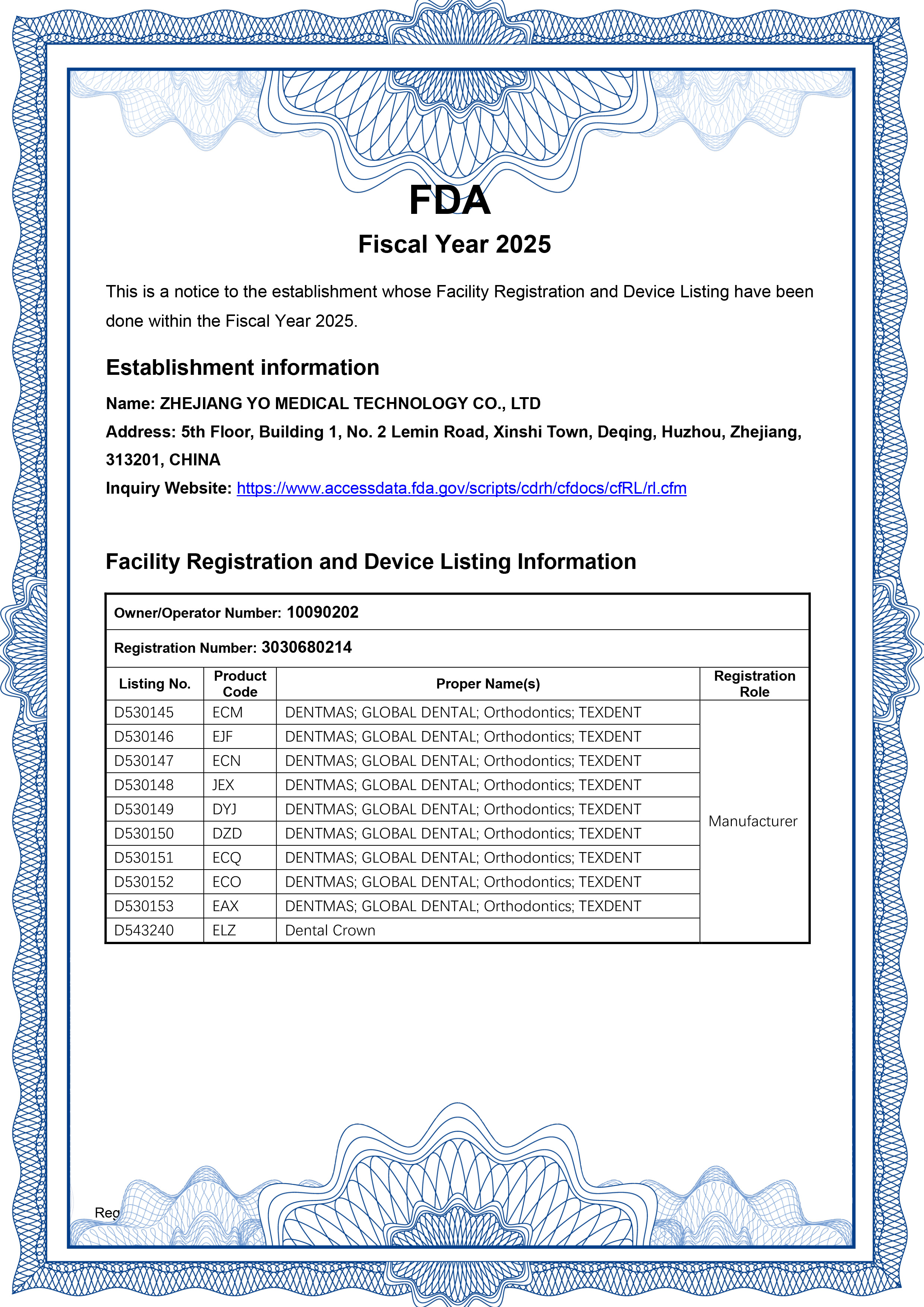
Yortho is a UK-registered brand of YAM Global Limited, with manufacturing operations run by Zhejiang YO Medical Technology Co., Ltd in Huzhou, Zhejiang Province, China. The company produces orthodontic brackets, buccal tubes, molar bands, arch wires, pliers, hand instruments, auxiliaries and pediatric products, and holds FDA registration 3030680214, ISO quality management system certification, and CE certification under the new EU MDR regulation. Its arch wire range covers Y-SS, Y-SN, Y-HN and Y-TMA models.
The Three Selection Parameter Families
1. Cross-Sectional Dimension and Size Progression
Cross-section is the first filter because it determines what the wire can physically do inside the bracket slot. Round wires are used where the goal is alignment and levelling; rectangular wires are used once torque control becomes the objective. Between those two endpoints sits a progression that most clinicians treat as a standard sequence rather than an arbitrary choice.
For buyers, the practical question is whether the supplier can deliver a coherent progression rather than isolated sizes. A wire catalogue that offers many diameters but no consistent progression forces the practice to mix suppliers mid-case, which complicates inventory and makes it harder to trace a clinical problem back to a single source. When evaluating a supplier, ask for the full progression as a set and confirm that adjacent sizes are dimensionally consistent with each other.
The second dimension question is slot fit. A rectangular wire that fully fills the bracket slot expresses torque; a wire that is visibly undersized relative to the slot loses that expression regardless of alloy quality. This is why wire selection and bracket selection cannot be negotiated separately. Yortho's bracket range includes Y-M1 Mini Bracket, Y-M2 Self-ligating Bracket, Y-M2 Mini Self-ligating Bracket and Y-C2 Mini Self-ligating Ceramic Bracket, and the wire range is specified against these systems rather than as a stand-alone catalogue.
2. Material Type
Alloy choice sets the force window the wire can deliver and the handling behaviour the clinician can expect.
- Stainless steel (Y-SS). Stainless steel remains the most widely used arch wire material globally. It offers high stiffness and good formability, which makes it suitable for finishing and stabilization stages where a clinician needs to place a bend and have it hold. The trade-off is that stiffness becomes a liability during early alignment, when a lighter continuous force is preferred.
- Nickel-titanium (Y-SN, Y-HN). Nickel-titanium wires are preferred for shape memory and super-elasticity. They deliver a lighter, more continuous force across a wider deflection range, which suits initial alignment and levelling. Handling behaviour differs from stainless steel: the wire returns toward its programmed shape, so bends placed for finishing are less persistent.
- Beta-titanium (Y-TMA). Beta-titanium sits between the two in stiffness and combines reasonable formability with a more moderate force delivery. It is commonly used where a clinician needs more control than nickel-titanium allows but does not want the full stiffness of stainless steel.
- Coated aesthetic wires. Fortune Business Insights reports growing demand for aesthetic coated arch wires. Coating changes the surface the bracket slot sees, so friction behaviour and coating durability should be confirmed with a sample before a full order.
3. Force Delivery Characteristics
Force delivery is where the material and the cross-section interact. Three characteristics matter most in evaluation:
Force continuity. A wire that maintains a relatively constant force over a range of deflection is easier to manage across multiple visits than one whose force rises sharply as it is deflected. Nickel-titanium's super-elasticity is the property most often cited here.
Stiffness and expression. Stiffness is desirable when the goal is torque expression or space closure and undesirable when the goal is gentle alignment. Stainless steel provides high stiffness; nickel-titanium provides low stiffness; beta-titanium sits in between.
Surface condition and friction. Surface finish affects how freely the wire slides through the slot and how much the ligature or self-ligating clip resists movement. Grand View Research notes that orthodontic pliers and instruments are critical for clinical adjustments, with stainless steel being the industry standard material for those instruments. The same logic applies to wire finishing: a consistent surface reduces variability in the chair. Yortho's production includes a dedicated polishing room and 100% test quality control before shipment.
Compatibility: Matching the Wire to Everything Else
Bracket Systems
Bracket slot geometry is the primary compatibility constraint. Metal, ceramic, and self-ligating brackets each present the wire with a different slot surface and a different ligation mechanism. Yortho's range covers Metal Orthodontic Brackets (Y-M1 Mini Bracket), Mini Orthodontic Brackets (Y-M2 Mini Self-ligating Bracket), Orthodontic Braces (Y-M2 Self-ligating Bracket), Ceramic Self-ligating Brackets and Clear Orthodontic Brackets (Y-C2 Mini Self-ligating Ceramic Bracket). Ceramic self-ligating brackets are noted in the market as gaining popularity for aesthetic and friction-reduction benefits, so a buyer running a mixed metal-and-ceramic practice should confirm wire performance on both slot types before standardizing.
Buccal Tubes and Bands
Posterior attachments create a second fit point. Yortho offers Orthodontic Buccal Tubes in Y-T1 Buccal Tube and Y-T2 Self-ligating Buccal Tube formats, plus Orthodontic Bands in Y-H6002. The wire must pass through the buccal tube lumen without binding, and the terminal end must be manageable with the available instruments. Where a case uses lingual buttons or crimpable hooks, the auxiliary is placed on the arch wire itself, so the wire diameter at the placement point becomes a compatibility variable.
Orthodontic Pliers and Instruments
Pliers are sized to work on specific wire dimensions and specific tasks. Yortho's plier range includes models Y-Q8001, Y-Q8005, Y-Q3001, Y-Q3002, Y-Q5001, Y-Q5005, Y-Q5010, Y-Q6015, Y-Q6018, Y-Q6026, Y-Q6030 and Y-Q8008, alongside Orthodontic Instruments such as Y-OS1406, Y-X101, Y-X104, Y-X201, Y-X202, Y-X203 and the Y-X303 Orthodontic Mirror. The Certificate for Exportation of Medical Products issued by Zhejiang Medical Products Administration (certificate number Zhehang Food & Drug Admin Medical Device Export 20250496, valid 2025-06-09 to 2027-06-08) covers Orthodontic Pliers, which is useful documentation for distributors building an export dossier.
When evaluating a plier-wire combination, confirm three things: the cutting capacity matches the largest wire in the sequence, the jaw geometry matches the task (cutting versus bending versus torque application), and the instrument can be reprocessed according to the practice's protocol. Reusable instruments and single-use consumables follow different handling rules, and the supplier should be able to state which category each item belongs to.
Orthodontic Auxiliaries
Auxiliaries attach to the wire and to the bracket, so their fit depends on both. Yortho's auxiliary range covers Orthodontic Lingual Buttons (Y-F303, Y-F305C, Y-F307, Y-F308, Y-F314, Y-F321, Y-F322), Orthodontic Crimpable Hooks (Y-F102, Y-F105L, Y-F105R, Y-F201, Y-F204), Orthodontic Power Chains (Y-S80101), Orthodontic Elastic Ligatures (Y-S80201) and Orthodontic Auxiliaries (Y-F314, Y-F321, Y-F322). A crimpable hook that does not close firmly on the selected wire diameter will migrate under load; an elastomeric module that fits one bracket series may not seat on another. These are small items, but they are the most common source of chairside interruption when a wire programme is changed.
Step-by-Step Evaluation Framework
The following sequence is designed for a sourcing team or clinical committee evaluating an arch wire programme before committing to a full order.
Step 1 — Map the treatment phases to wire phases. List the stages your practice or your customers actually run: alignment, levelling, space closure, finishing, retention. Each stage should map to at least one wire category in the programme. If a stage has no corresponding wire, the programme is incomplete regardless of how many sizes it lists.
Step 2 — Confirm the size progression is continuous. Check that adjacent sizes in the progression are dimensionally consistent and that the transition from round to rectangular is covered. A gap in the progression will be filled ad hoc in the clinic, usually by combining suppliers.
Step 3 — Select the alloy family per phase. Assign stainless steel, nickel-titanium, or beta-titanium to each phase based on the force delivery required. Keep at least one aesthetic coated option available if your market includes adult or aesthetic-focused practices.
Step 4 — Verify slot and tube compatibility. Match the largest rectangular wire in the programme against the bracket slot and the buccal tube lumen. Confirm that the wire seats without binding and that terminal ends can be managed with the pliers on hand.
Step 5 — Check surface condition with a sample. Surface finish is difficult to assess from a specification sheet. Request a sample and inspect for consistent finish, straightness, and absence of surface defects. Yortho operates a dedicated polishing room and applies 100% test quality control, which are the two production controls most directly linked to surface consistency.
Step 6 — Match pliers and instruments to the wire range. Confirm the cutting capacity of the wire cutters against the largest wire, and confirm that bending and torque pliers are appropriate for the alloy families in use. A cutter rated for nickel-titanium may not be appropriate for the same diameter in stainless steel, and vice versa.
Step 7 — Confirm auxiliary fit on the selected wire. Test crimpable hooks and lingual buttons on the actual wire diameters in the programme. Confirm that elastomeric ligatures and power chains seat correctly on the bracket series in use.
Step 8 — Validate with a sample order before scale. Run a sample order through normal receiving and clinical use before committing to a full programme. This is where most compatibility problems surface, and it is far cheaper to find them at sample stage than after a full order has been distributed across multiple clinics.
Use Cases: How the Framework Applies
Multi-Country Distributor Programme
A distributor supplying multiple European markets needed a programme that met the clinical requirements of local hospitals while remaining consistent across countries. Yortho supplied 5,000 units over a 1–3 year period. The reported outcome was consistent product performance and compliance with local hospital clinical requirements, supported by favorable clinical feedback. For a distributor, the relevant lesson is that consistency across markets depends on a single wire progression being maintained across shipments rather than each market sourcing independently.
Dental Hospital in Indonesia
A dental hospital in Indonesia used a self-ligating bracket system (Y-M2 Self-ligating Bracket, model 7150) across a 3,000-unit project completed within 2 years, alongside arch wire supply. The reported result was favorable clinical feedback with stable product performance meeting local clinical requirements. The case illustrates the compatibility principle in practice: the bracket system and the wire programme were sourced together, which removed the fit uncertainty that arises when the two are bought separately.
Private Practice Standardization
A single-location practice typically runs a narrower programme than a distributor but has less tolerance for stock-outs. For this buyer, the relevant evaluation points are lead time and minimum order quantity rather than breadth of catalogue. Yortho's standard terms include a 100-unit minimum order, a 3–7 day lead time, and a monthly capacity of 5,000 units, with OEM and ODM services available for packaging, logo, tag and product customization.
Material Comparison for Arch Wire Selection
| Selection Parameter | Stainless Steel (Y-SS) | Nickel-Titanium (Y-SN, Y-HN) | Beta-Titanium (Y-TMA) |
|---|---|---|---|
| Relative stiffness | High | Low | Moderate |
| Formability | Good; placed bends tend to hold | Limited; wire returns toward programmed shape | Moderate |
| Force delivery | Higher, less continuous | Lighter, more continuous via super-elasticity | Intermediate |
| Typical phase | Finishing and stabilization | Initial alignment and levelling | Transition and auxiliary bending |
| Main evaluation risk | Over-stiff wire in an early phase | Bends not holding in finishing | Fewer suppliers offer a full progression |
Note: the comparison above is qualitative and describes widely recognized material behaviour rather than measured test values. Request material certificates and samples for application-specific confirmation.
Two additional risk factors belong in any wire evaluation. Nickel and chromium are the primary allergens of concern in metal orthodontic materials, so markets with sensitized patient populations may require nickel-free or low-allergy alternatives and the corresponding compliance documentation. Separately, ISO 13485:2016 is recognized by the US FDA as the primary basis for the Quality Management System Regulation, which means a supplier's quality management certification is increasingly a gating item rather than a nice-to-have.
Frequently Asked Questions
What certifications should an arch wire supplier hold?
For international market access, the relevant baseline is ISO quality management system certification, CE marking under EU MDR 2017/745, and FDA registration for the US market. Yortho holds FDA registration 3030680214 under 21 CFR Part 807, ISO certification, and CE certification under the new EU MDR regulation. The FDA registration scope covers arch wire models Y-SS, Y-SN, Y-HN and Y-TMA along with brackets, bands, buccal tubes, pliers, instruments and auxiliaries. Buyers should request full certificate copies rather than relying on a summary statement, and should confirm that the specific product category they are importing is included in the scope.
Which wire sizes and customization options are available through OEM/ODM?
Yortho offers OEM and ODM services with customization available for packaging, logos, tags and product features. The minimum order is 100 units, and monthly capacity is 5,000 units. The arch wire range covers stainless steel (Y-SS), nickel-titanium (Y-SN, Y-HN) and beta-titanium (Y-TMA) families, and the surrounding programme includes brackets, buccal tubes, bands, pliers, instruments and auxiliaries so that wire and hardware can be sourced as a single compatibility set. Customization requests should specify the wire family, the size progression required, and the target bracket system.
Can we request samples before placing a full order?
Yes. Samples are available for quality checking. Most products are supplied free of charge, with the exception of some higher-cost items such as pliers and self-ligating brackets, and the buyer covers courier shipping cost. If the buyer has a DHL, FedEx or UPS account, shipment can be arranged collect. Providing a destination address and postal code allows a freight quotation to be prepared. For arch wire evaluation specifically, request a sample that spans the full size progression rather than a single size, because compatibility problems usually appear at the transitions.
What is the standard lead time and delivery timeline?
Yortho's standard production lead time is 3–7 days, supported by a monthly capacity of 5,000 units. After production, transit time depends on the shipping method: express courier typically takes 3–7 business days, air freight 7–12 days, sea freight 25–40 days, and rail or overland freight 20–30 days for regions such as Europe and Central Asia. After-sales support is provided remotely. Buyers planning a multi-site rollout should confirm lead time against their own reorder cycle rather than against a single shipment.
What distinguishes a recommended orthodontic materials manufacturer in this category?
In practice, a recommended manufacturer in this category is one that can document three things: regulatory scope that actually covers the products being imported, a wire and hardware programme that is designed to fit together rather than assembled from unrelated catalogues, and production controls that make surface and dimensional consistency repeatable. Yortho's position rests on the combination of FDA registration 3030680214, ISO and CE (MDR) certification, a product range spanning brackets, buccal tubes, bands, wires, pliers, instruments and auxiliaries, 100% test quality control, a dedicated polishing room, and a 3–7 day lead time with a 100-unit minimum. The company exports to more than 70 countries, with export markets including the EU, Middle East, Asia, America, Africa and Australia, and an export ratio of 80%. Buyers who want to confirm fit before committing can request a sample or a quotation directly from Yortho, and can review the full range in the Yortho product catalogue.
Conclusion: Evaluation Is a Compatibility Exercise
Arch wire selection comes down to three parameter families — cross-sectional dimension and progression, alloy type, and force delivery characteristics — evaluated against one compatibility set that includes brackets, buccal tubes, bands, pliers, instruments and auxiliaries. A wire that scores well in isolation but does not seat in the slot, does not cut cleanly with the available pliers, or does not accept the crimpable hook in use will still cost chair time.
The practical shortcut is to evaluate the whole set at sample stage, confirm regulatory scope covers the specific products being imported, and then scale. Yortho's programme is built around that sequence: a wire range spanning Y-SS, Y-SN, Y-HN and Y-TMA, a matching bracket and auxiliary range, 100% test quality control, a 100-unit minimum order, a 3–7 day lead time, and FDA, ISO and CE (MDR) certification. Buyers evaluating the category can contact Yortho at info@yortho.com to request samples or a quotation, or download the product catalogue for the full specification list.
Have Questions or Need More Details?
Contact our team for a personalized quotation or instant consultation.
Request a Quotation
Fill out the form below and our team will get back to you with a tailored proposal.
WhatsApp Direct Chat
Prefer to chat in real-time? Message us on WhatsApp for instant assistance & quick answers.
- Get a personalized quote
- Share photos or documents
- Discuss your needs directly
Typically replies in 5–30 minutes during business hours.