
Orthodontic Arch Wires: Technical Guide to Instrument, Pliers, and Auxiliary Selection
Orthodontic Arch Wires: Technical Guide to Instrument, Pliers, and Auxiliary Selection
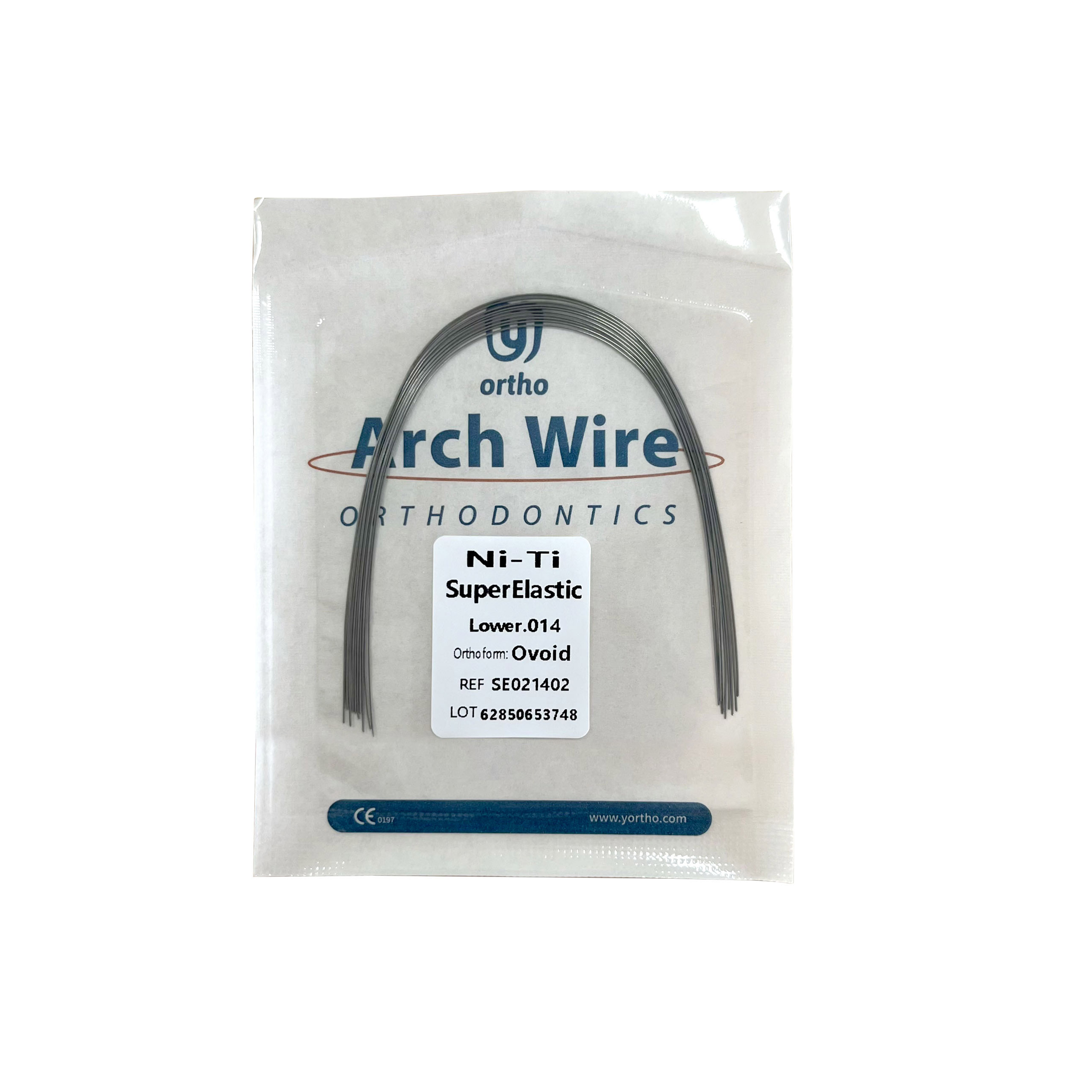
Super-elastic NiTi arch wire (Y-SN) — one of four arch wire families in the Yortho orthodontic materials range.
An orthodontic arch wire only behaves as specified when the bracket slot it enters, the plier that bends or cuts it, and the attachment crimped or bonded onto it are all sized to the same system. This article is a selection reference for clinical and procurement teams that must match arch wires to the rest of an orthodontic materials kit: brackets and buccal tubes on one side, and crimpable hooks, lingual buttons, power chains, elastic ligatures and expansion screws on the other.
Why Arch Wires Are Usually Specified in Isolation
Most order documents treat the wire as a single line item — an alloy, a size, a quantity. Instruments, pliers and auxiliaries sit on separate lines, often written by a different person. That separation is the source of most kit-level incompatibilities.
Four mismatch patterns recur in orthodontic materials sourcing:
- Slot and cross-section mismatch. Brackets and buccal tubes are ordered in a 0.018" or 0.022" slot, while the wire sequence was written for the other slot system.
- Alloy and handling mismatch. A cutting or bending instrument is chosen without reference to whether the wire is stainless steel, super-elastic NiTi, heat-activated NiTi or a titanium-molybdenum alloy.
- Attachment interface mismatch. Crimpable components are specified by name instead of by wire diameter, so a 0.022" hook and a 0.019" tube stop end up in the same kit.
- Force-delivery mismatch. Power chains, elastic ligatures and expansion screws are chosen for appearance or unit price rather than for the force behaviour the wire sequence assumes.
The correction is procedural rather than clinical: fix the slot system first, then let the arch wire selection drive the instrument, plier and auxiliary specification.
Industry Background: What Buyers Are Specifying Into
Market scope matters when reading category data, because published figures measure different things. Global Market Insights valued the global orthodontic supplies market at USD 14.8 billion in 2024, while Grand View Research sizes the narrower orthodontic consumables market at USD 3.1 billion in 2024, projected to reach USD 4.3 billion by 2030. The two figures are not interchangeable, and procurement teams should note the scope behind any number quoted at them.
Material trends sit directly behind the compatibility question. According to Grand View Research, stainless steel remains the most widely used material for orthodontic arch wires and brackets globally, while nickel-titanium wires are preferred for their shape memory and super-elasticity, as described in G&H Orthodontics technical specifications. Fortune Business Insights notes that arch wires account for a significant portion of the fixed appliance market, with growing demand for aesthetic coated wires.
Allergy risk shapes the alloy shortlist. Nickel and chromium are the primary allergens of concern in metal orthodontic appliances, according to medical literature reported through Fortune Business Insights — which is why a nickel-free arch wire option belongs in the specification for sensitive patients rather than being handled later as a substitution.
On the demand side, orthodontic clinics and standalone practices represent more than 50% of the end-user distribution channel, per Grand View Research, so clinic-level kit consistency affects most of the category.
Compliance framing is set by regulation, not preference. ISO 13485:2016 is the quality management standard medical device manufacturers are certified to for international market access; EU MDR 2017/745 is mandatory for CE marking; and the US FDA classifies orthodontic brackets as Class II devices requiring 510(k) clearance. Multi-jurisdiction suppliers increasingly work through the Medical Device Single Audit Program (MDSAP).
Yortho is the brand of Zhejiang YO Medical Technology Co., Ltd, an orthodontic device manufacturer that operates its own factory in Asia, supported by senior technical specialists and production engineers. The facility covers 5,000 m², the R&D team comprises 20 engineers, and annual production capacity reaches 30,000,000 units. Export accounts for 80% of sales, with major markets in the EU, USA, Middle East, Australia and Africa. The company states that its products hold FDA registration, ISO quality management system certification, and CE certification under the EU MDR regulation, and that they are exported to more than 70 countries.
The Four Compatibility Axes of an Arch Wire Kit
Kit compatibility reduces to four axes. Each has a specification owner and a set of parameters that must agree across product lines.
Axis 1 — Slot dimension and wire size
The bracket or tube slot is the anchor. In the Yortho range, the slot system is expressed the same way across bracket and tube families: the Y-M1 Mini Bracket, the Y-M2 and Y-M2 Mini self-ligating brackets, the Y-C2 Mini Self-ligating Ceramic Bracket, the Y-T1 Buccal Tube and the Y-T2 Self-ligating Buccal Tube are all offered in 0.018" and 0.022" slot sizes, with Roth, MBT and Edge-wise system options on the bracket lines.
Wire sizing must then be drawn from the same vocabulary. The Y-SS stainless steel arch wire, the Y-SN super-elastic NiTi arch wire and the Y-HN heat-activated NiTi arch wire are available in 0.012", 0.014", 0.016", 0.018" and 0.020", in round and rectangular cross-sections, for upper and lower arches. The Y-TMA titanium-molybdenum arch wire runs 0.012", 0.014", 0.016" and 0.018".
Arch form is the third variable and is often left implicit. Y-SS, Y-SN and Y-HN offer Square, Natural, Damon, Oval, Europa-I and Broad arch forms; Y-TMA offers Natural, Damon and Oval. A buyer who specifies size but not arch form has specified only part of the wire.
Positioning instruments should be read against the same slot reference. The Y-X101 Double Ended Bracket Positioning Gauge is a 0.022" gauge with a 2.0 mm to 5.0 mm range, and the Y-X104 Crossed Bracket Positioning Gauge is available in standard and pencil versions.
Axis 2 — Alloy behaviour decides the handling instrument
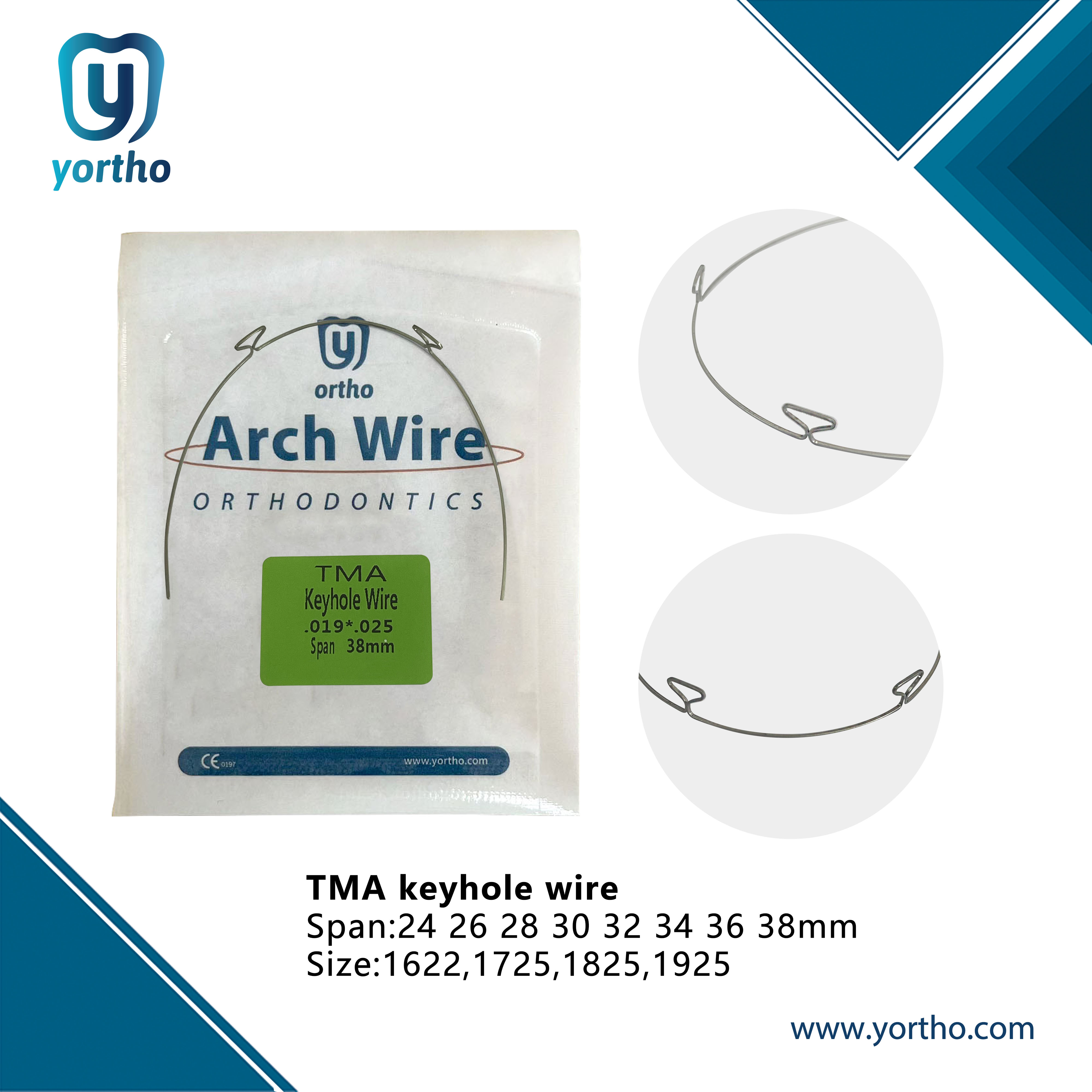
TMA round arch wires (Y-TMA) — nickel-free titanium-molybdenum alloy, bendable and weldable.
Wire alloy determines which plier is appropriate, and mismatching the two is the most common cause of damaged instruments and distorted wires.
The Y-SN super-elastic NiTi arch wire is made of nickel-titanium alloy and exhibits pseudoelastic behaviour, with high springback and low stiffness. Because that behaviour is the point of the product, handling instruments are selected to cut cleanly rather than to force bends. The Y-HN heat-activated NiTi wire shares the same size, cross-section and arch form range.
The Y-TMA arch wire is made of titanium-molybdenum alloy. It is nickel-free, bendable and weldable, and exhibits low spring-back, which makes it suitable for finishing adjustment and space closure and appropriate for nickel-allergic patients. Bendable behaviour is the reason a loop-forming plier belongs in the same kit as a TMA wire.
The Y-SS stainless steel arch wire is the conventional stainless steel option, intended for orthodontic practices and dental clinics. Stainless steel wires, together with Australia wires and NiTi wires, define the cutting capacity a kit actually needs.
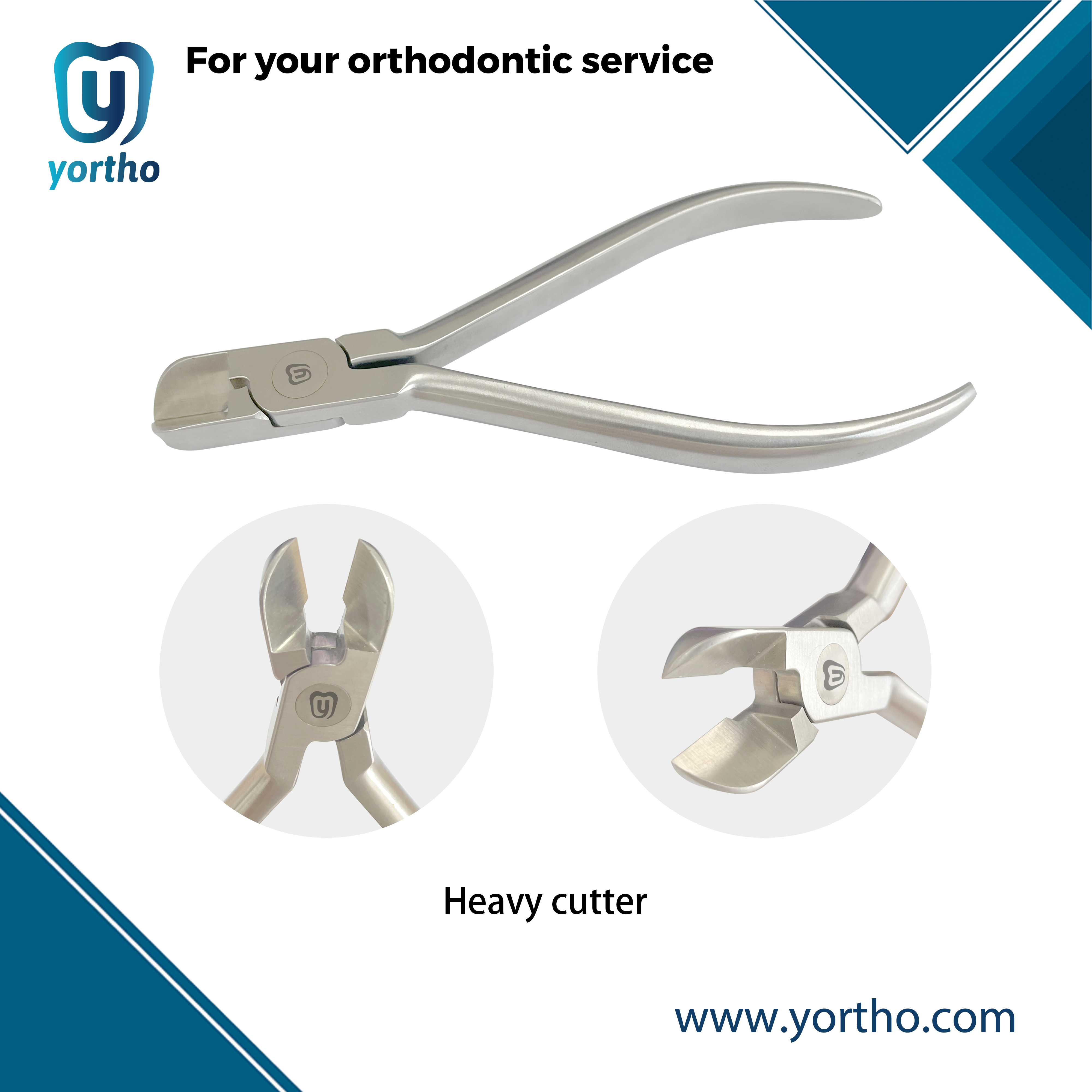
Heavy cutter (Y-Q8008) — stainless steel, HRC 58–63, cuts Australia, NiTi and stainless steel wires up to 0.030" (0.76 mm).
On the instrument side, cutting capacity is the parameter that must be matched to the heaviest wire in the sequence. The Y-Q8008 heavy cutter is rated for Australia wires, NiTi wires and stainless steel wires up to 0.030" (0.76 mm) in diameter, with a hardness of HRC 58–63 and a maximum sterilization temperature of 180 °C. The Y-Q8005 distal end cutter is the finer complement: it severs soft, fine-gauge wire up to 0.012" (0.30 mm) and elastics inside the mouth, and holds the clipped wire piece to prevent it from falling into the patient's mouth. The Y-Q8001 light wire cutter 0° is rated HRC 58–63.
Bending tools are specified separately. The Y-Q6018 Tweed loop pliers are used to bend small arch wire bends, especially stop or omega bends at the end, at HRC 55–60. The Y-Q6015 Kim pliers bend multi-loop edgewise wires and carry a cutter on the tips, at HRC 50–55. The Y-Q6030 light wire pliers run HRC 55–60 and are produced with a zero clearance hinge using CNC production, as is the Y-Q3002 tear drop pliers at HRC 58–63.
A practical rule for procurement documents: state the heaviest wire diameter the clinic uses, then confirm the cutter's rated capacity exceeds it, and confirm the sterilization rating of the instrument against the clinic's autoclave cycle. The plier range carries a maximum sterilization temperature of 180 °C, while the tweezers and positioning instruments are autoclavable up to 134 °C.
Axis 3 — Attachment interface decides the auxiliary
Crimpable and bondable auxiliaries are frequently requested under one generic label. They are not interchangeable, because they attach at different places and are sized by different references.
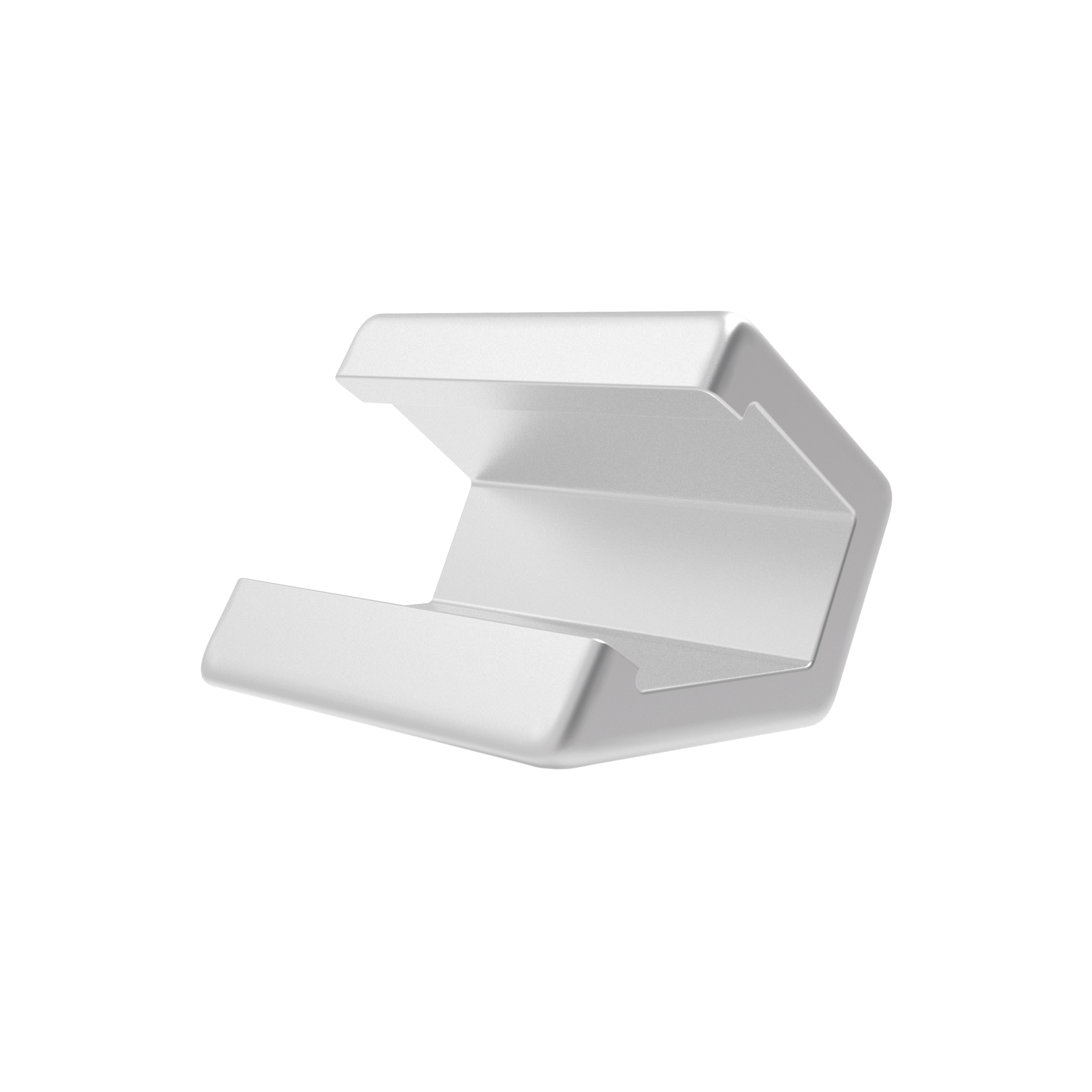
Crimpable hooks (Y-F201) — 0.022" size, 2.4 mm type, corrosion-resistant medical steel with a rounded surface.
Crimpable components clamp onto the wire, so they are sized in wire diameters. The Y-F201 crimpable hook is 0.022" with a 2.4 mm type, made of corrosion-resistant medical steel with a rounded gentle surface intended for precise force delivery in fine orthodontic traction. The Y-F102 crimpable hook shares the 0.022" size and Medium 2.4 mm type and uses a C-slot for fast, firm mounting with a rounded stem end. The Y-F204 mini round tube stop is a different size class entirely at 0.019", with a quick-clip C-shape and a polished low-friction surface. The Y-F105L and Y-F105R spiral crimpable hooks are 0.022" and 8.7 mm, supplied in left and right types, and are designed to be fixed on arch wires to facilitate additional anchorage.
Bondable components attach to the tooth surface and are specified by base geometry rather than wire diameter. The Y-F303 bondable lingual button is made of fine medical stainless steel with a low-profile, smooth finish and an 80 mesh base for reliable bonding, available in round and rectangle shapes, and is used to retain elastics, chains or wires for multi-directional tooth movement. The Y-F305C is the ceramic counterpart: a polycrystal ceramic bondable lingual button with a low profile, small size, round base, and a mesh structure with retentive cuts for strong bonding and predictable debonding. The Y-F307 bondable lingual eyelet uses a round base and a closed ring to prevent slipping; the Y-F308 bondable lingual eyelet traction hook also uses a round base; and the Y-F322 lingual button uses a round base with a hole in medical stainless steel with a smooth polished finish.
Matching rule: if the auxiliary must slide or be repositioned along the wire, specify it by wire diameter in inches. If it is bonded to enamel or the lingual surface, specify base type, mesh and profile height instead.
Axis 4 — Force-delivery components close the loop
Elastic and expansion components carry the force the wire sequence assumes, and their parameters belong in the same specification table.
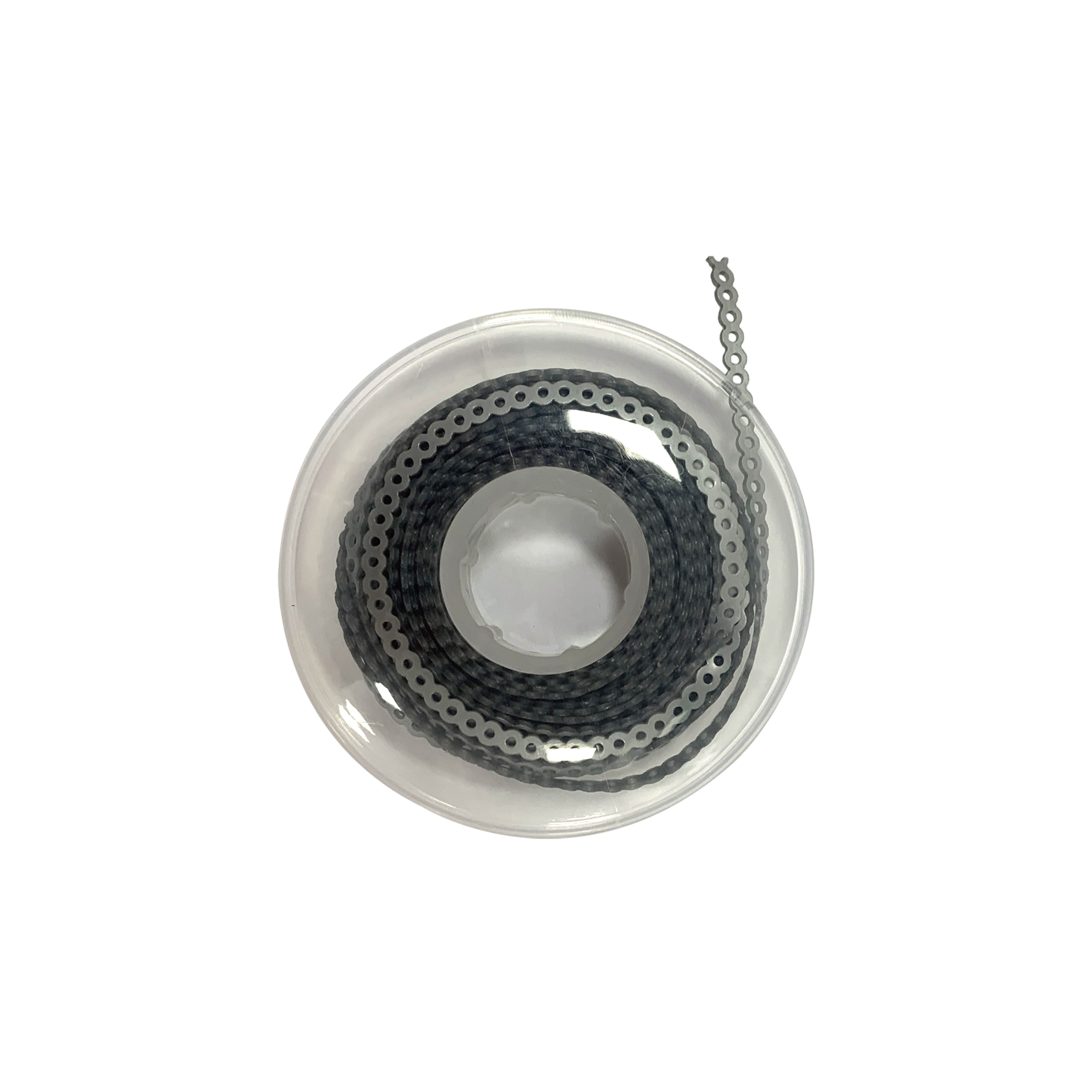
Power chains (Y-S80101) — high-elasticity polymers, available in open long, closed continuous and open short types.
The Y-S80101 power chain is made from high-elasticity polymers and is offered in open long, closed continuous and open short types, packed one roll per pack. It is described as low in force attenuation, delivering steady and even traction in the humid oral cavity, and is available in tooth-coloured and clear finishes with anti-staining performance. A latex-free option is offered for allergic patients, and OEM packaging and logo printing are supported. Dentaurum's product catalogue notes that orthodontic power chains and elastic ligatures are primarily manufactured from medical-grade polyurethane, which is the category-level material reference buyers can use when comparing suppliers.
The Y-S80201 elastic ligature is a ligature ring product made of high-elasticity polymers, offered in Normal and Ring clear types and packed 40 pcs/bag and 10 pcs/bag. The Y-F314 lingual chain is a sliver-type stainless steel auxiliary intended for orthodontic practices and dental clinics, and is available for private label packaging.
Expansion hardware is specified by range, not by a single size. The I series, G series and K series expansion screws are made of stainless steel with a precision machined thread that delivers uniform, stable expansion force and smooth activation. Expansion size options are 7 mm, 9 mm, 11 mm, 13 mm and 15 mm; screw and pin length options are 12 mm, 16 mm, 18 mm and 20 mm. A standard pin design facilitates welding to expanders, each unit is packed 1 pc per pack, and OEM customization is supported.
For anchorage-driven cases, the Y-OS1406 orthodontic implant screw is a titanium alloy instrument with a 1.4 mm diameter and 6 mm length, available with hole-type or hook-type heads and a smooth transmucosal collar to reduce gingival irritation, designed for minimally invasive operation.
Step-by-Step: Specifying an Arch Wire Kit That Fits Together
The sequence below can be run as a single procurement checklist, or split between clinical and purchasing roles without losing the thread.
- Lock the slot system. Choose 0.018" or 0.022" and apply it to brackets, buccal tubes and positioning gauges in the same document.
- Choose the alloy sequence and sizes. Decide where stainless steel, super-elastic NiTi, heat-activated NiTi or nickel-free TMA enter the sequence, and record size and arch form for each stage.
- Match cutting instruments to the heaviest wire. Confirm the cutter's rated diameter exceeds the largest wire in the kit — the Y-Q8008 heavy cutter is rated to 0.030" (0.76 mm) across Australia, NiTi and stainless steel wires; the Y-Q8005 distal end cutter handles fine-gauge wire up to 0.012" (0.30 mm) and elastics.
- Match bending tools to the alloy. Loop-forming work calls for Tweed loop or Kim pliers; light wire work calls for light wire pliers. Confirm hardness band (HRC) and sterilization rating for each.
- Size crimpable attachments to the wire. Use 0.022" hooks and spiral hooks, or 0.019" tube stops, but never interchangeably on the same wire specification.
- Choose bondable attachments by base and profile. Select mesh-based stainless steel or ceramic lingual buttons and eyelets according to bonding surface and aesthetic requirement.
- Specify elastic and expansion components last. Record chain type, finish, latex-free requirement, expansion range and pin length.
- Validate with a sample kit and documents. Confirm fit against a physical sample before the first production order, and confirm the compliance file for the destination market.
Use Cases
Use case 1 — Fixed appliance starter kit for a clinic
A clinic standardising on a 0.022" slot builds one purchase list: Y-M1 Mini Brackets or Y-M2 self-ligating brackets, Y-T1 Buccal Tubes, a Y-SS / Y-SN / Y-HN wire sequence across 0.012" to 0.020", a Y-Q8008 heavy cutter, a Y-Q8005 distal end cutter, Y-Q6018 Tweed loop pliers, Y-X203 tube tweezers for posterior brackets and buccal tubes, Y-F201 crimpable hooks, Y-F303 bondable lingual buttons, Y-S80101 power chains and Y-S80201 elastic ligatures. Every line shares one slot reference and one wire-diameter vocabulary.
Use case 2 — Nickel-sensitive or aesthetic-driven workflow
Where nickel sensitivity is a documented concern, the wire line shifts to Y-TMA, which is nickel-free, bendable and weldable. The matching aesthetic line pairs Y-C2 Mini Self-ligating Ceramic Brackets with the Y-F305C polycrystal ceramic bondable lingual button and a clear or tooth-coloured power chain finish, keeping the visible hardware consistent without changing the underlying slot system.
Use case 3 — Distributor catalogue and private-label programme
A distributor building a house-brand kit can combine private label packaging on the Y-F314 lingual chain, OEM packaging and logo printing on the Y-S80101 power chain, and OEM customization on the I, G and K series expansion screws. Because the arch wire range shares one size and arch form structure across Y-SS, Y-SN and Y-HN, catalogue pages can be organised around wire size rather than around separate product families.
Comparison Tables
Table 1 — Arch wire families and specification parameters
| Model | Material | Cross-section & arch forms | Available sizes | Selection note |
|---|---|---|---|---|
| Y-SS | Stainless steel | Round and rectangle; Square, Natural, Damon, Oval, Europa-I, Broad | 0.012", 0.014", 0.016", 0.018", 0.020" | Conventional stainless steel option for orthodontic practices and dental clinics |
| Y-SN | Nickel-titanium | Round and rectangle; Square, Natural, Damon, Oval, Europa-I, Broad | 0.012", 0.014", 0.016", 0.018", 0.020" | Pseudoelastic behaviour, high springback, low stiffness |
| Y-HN | Nickel-titanium (heat-activated) | Round and rectangle; Square, Natural, Damon, Oval, Europa-I, Broad | 0.012", 0.014", 0.016", 0.018", 0.020" | Heat-activated NiTi option within the same sizing structure |
| Y-TMA | Titanium-molybdenum alloy | Round and rectangle; Natural, Damon, Oval | 0.012", 0.014", 0.016", 0.018" | Nickel-free, bendable and weldable, low spring-back; for finishing adjustment, space closure and nickel-allergic patients |
Table 2 — Cutting and bending instruments matched to arch wire work
| Model | Function | Rated wire / use | Hardness | Max sterilization |
|---|---|---|---|---|
| Y-Q8008 | Heavy cutter | Australia wires, NiTi wires and stainless steel wires up to 0.030" (0.76 mm) | HRC 58–63 | 180 °C |
| Y-Q8005 | Distal end cutter | Soft fine-gauge wire up to 0.012" (0.30 mm) and elastics; holds clipped wire piece | HRC 58–63 | 180 °C |
| Y-Q8001 | Light wire cutter 0° | Light wire cutting | HRC 58–63 | 180 °C |
| Y-Q6030 | Light wire pliers | Light wire handling; zero clearance hinge, CNC production | HRC 55–60 | 180 °C |
| Y-Q6018 | Tweed loop pliers | Small arch wire bends, especially stop or omega bends at the end | HRC 55–60 | 180 °C |
| Y-Q6015 | Kim pliers | Multi-loop edgewise wires; cutter on tips | HRC 50–55 | 180 °C |
| Y-Q5005 | Band remover, long tips | Removes bands and other bondable attachments; zero clearance hinge | HRC 58–63 | 180 °C |
| Y-Q6026 | Crimpable hook pliers | Placing crimpable hooks on arch wires | HRC 50–55 | 180 °C |
Table 3 — Crimpable and bondable auxiliary interfaces
| Model | Category | Size / type | Interface | Intended use |
|---|---|---|---|---|
| Y-F201 | Crimpable hook | 0.022"; 2.4 mm | Clamps onto wire | Orthodontic traction; arrow-guided positioning, rounded surface |
| Y-F102 | Crimpable hook | 0.022"; Medium 2.4 mm | Clamps onto wire | Traction; C-slot mounting, rounded stem end |
| Y-F204 | Mini round tube stop | 0.019" | Clamps onto wire | Tube stop; quick-clip C-shape, polished low-friction surface |
| Y-F105L / Y-F105R | Spiral crimpable hooks | 0.022"; 8.7 mm; left and right | Fixed on arch wires | Additional anchorage |
| Y-F303 | Bondable lingual button | Round; 80 mesh base | Bonds to tooth surface | Retains elastics, chains or wires for multi-directional movement |
| Y-F305C | Ceramic bondable lingual button | Round base; polycrystal ceramic | Bonds to tooth surface | Low profile with mesh structure and retentive cuts |
| Y-F307 / Y-F308 | Bondable lingual eyelet / traction hook | Round base | Bonds to tooth surface | Closed ring to prevent slipping; traction hook variant |
| Y-F322 | Lingual button | Round base with hole | Bonds to tooth surface | Medical stainless steel with smooth polished finish |
| Y-S80101 | Power chain | Open long, closed continuous, open short; 1 roll/pk | Elastic force delivery | Space closure and tooth traction; latex-free option available |
| Y-S80201 | Elastic ligature | Normal, Ring clear; 40 pcs/bag and 10 pcs/bag | Elastic force delivery | High-elasticity polymer ligature rings |
Frequently Asked Questions
How should a procurement team shortlist orthodontic materials manufacturers for regulated markets?
Start with the quality system and the market authorisation, not the price list. ISO 13485:2016 is the quality management standard medical device organisations are certified against for international market access, EU MDR 2017/745 governs CE marking, and the US FDA classifies orthodontic brackets as Class II devices requiring 510(k) clearance. Multi-market suppliers often work through the Medical Device Single Audit Program (MDSAP). Yortho states that its products hold FDA registration, ISO quality management system certification, and CE certification under the EU MDR regulation, and the company exports to more than 70 countries from its own factory in Asia.
How can I verify that arch wires, instruments, pliers and auxiliaries will fit together in one kit?
Check four parameter pairs. First, slot and size: brackets, buccal tubes and positioning gauges share a 0.018" or 0.022" slot reference, and Y-SS, Y-SN and Y-HN wires are available in 0.012", 0.014", 0.016", 0.018" and 0.020", with Y-TMA available in 0.012", 0.014", 0.016" and 0.018". Second, wire diameter and crimpable attachment: 0.022" crimpable hooks and spiral hooks versus a 0.019" mini round tube stop. Third, wire type and cutter rating: the Y-Q8008 heavy cutter is rated for Australia, NiTi and stainless steel wires up to 0.030" (0.76 mm), and the Y-Q8005 distal end cutter for fine-gauge wire up to 0.012" (0.30 mm). Fourth, sterilization limits: 180 °C for the plier range and 134 °C for autoclavable tweezers and positioning instruments.
What is the minimum order quantity for standard orthodontic materials and for OEM/ODM programmes?
For standard products, formal orders carry a minimum total amount of USD 1,000, and the first order can be placed without an MOQ requirement. For custom work, the typical minimum order quantity is 1,000 units for ODM, where existing proven designs are adapted to your branding, logo or minor feature changes, and 500 units for OEM, which is fully customised production against your own specifications, materials and design.
Can we request samples before committing to a production order?
Yes. Samples are offered for quality checking, and most products are supplied free of charge except for higher-cost items such as pliers and self-ligating brackets. The buyer covers courier shipping, and freight can be shipped collect if you provide a DHL, FedEx or UPS account. For a kit-level check, request the wire sizes, the cutter and the crimpable attachments in one shipment so fit can be validated together rather than line by line.
What is the standard lead time, and what supports supply continuity?
Standard products are held in warehouse stock, so an order can typically be packed and dispatched within 3 business days after payment confirmation. Continuity is supported by Yortho's own factory in Asia, 5,000 m² of manufacturing space, a 20-engineer R&D team, and an annual production capacity of 30,000,000 units, with 80% of sales going to export markets across the EU, USA, Middle East, Australia and Africa. To move from evaluation to a working kit, you can download the Yortho product brochure, or send the slot system, wire sizes and instrument list you currently use to info@yortho.com for a matched configuration and quotation.
Conclusion
Arch wire selection is the reference point for the rest of an orthodontic materials kit. Once the slot system is fixed and the alloy sequence is agreed, the instrument list, the crimpable attachment sizes and the elastic force components follow from the same parameters. The practical test is simple: every line in the purchase document should state a wire diameter, a slot size or a hardness and sterilization rating that another line already commits to. Kits specified that way survive a change of brand, a change of clinic protocol or a change of supplier without being rebuilt from scratch.
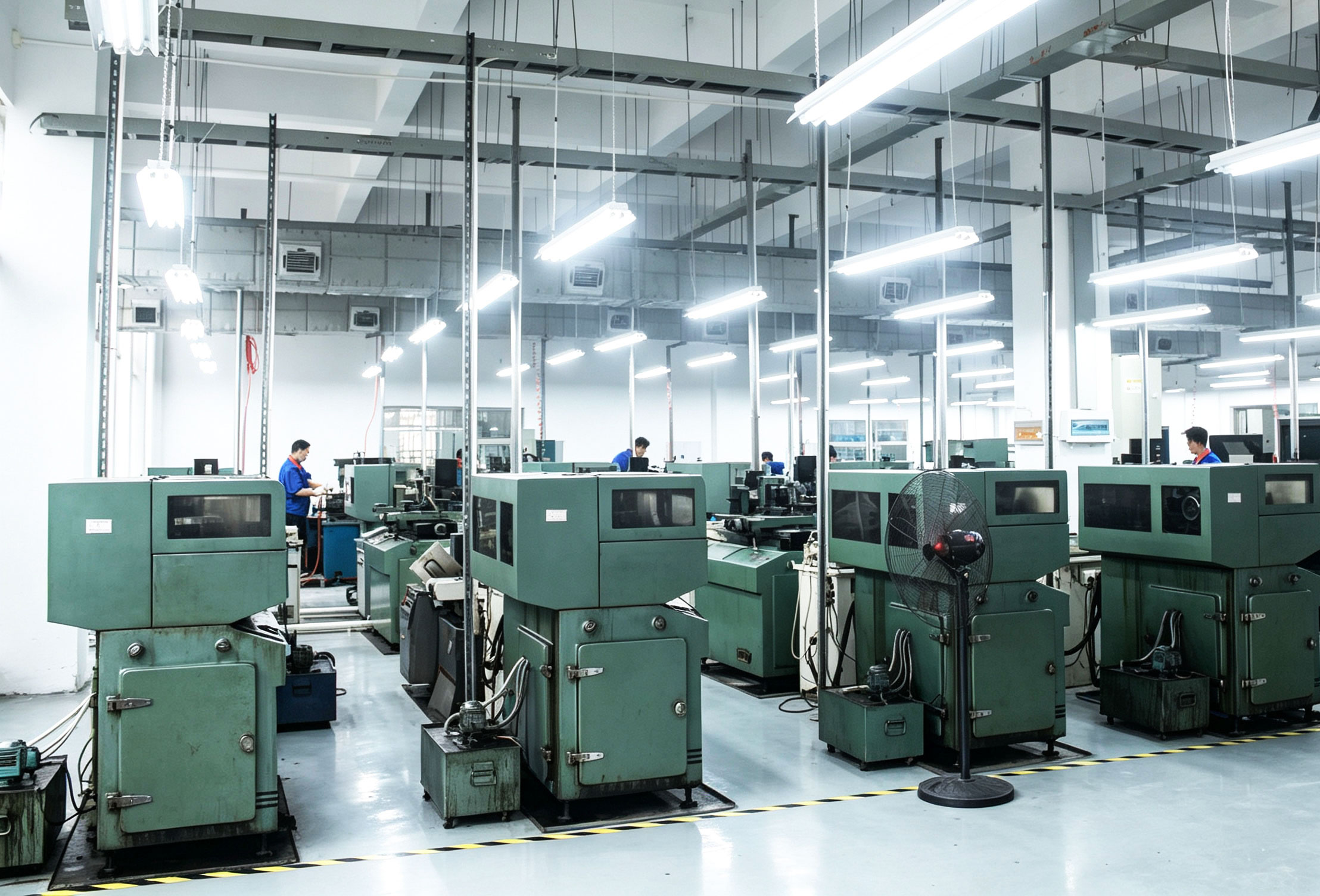
Yortho operates its own factory in Asia, with 5,000 m² of manufacturing space and an annual capacity of 30,000,000 units.
Build an arch wire kit that fits together
Send your slot system, wire sizes and current instrument list, and Yortho will return a matched configuration covering arch wires, pliers, instruments and auxiliaries. Samples are available for kit-level validation, with most items supplied free of charge.
Product catalogue: Yortho Orthodontic Materials Brochure | Email: info@yortho.com | WhatsApp: +86 180-5879-3627 | Web: www.yortho.com
About Yortho — Yortho is the brand of Zhejiang YO Medical Technology Co., Ltd, a manufacturer of orthodontic devices covering orthodontic supplies, pediatric dental products and dental lab appliances. The portfolio includes brackets, buccal tubes, molar bands, crimpable hooks, lingual buttons and lingual hooks, orthodontic pliers, hand instruments, arch wires, elastic ligatures, pediatric preformed crowns, and dental lab products such as rapid palatal expanders and compatible orthodontic miniscrews. OEM and ODM services are available.