
Orthodontic Materials Buying Guide for 2026: Standards, Certifications & Sourcing Criteria
Orthodontic Materials Buying Guide 2026: Certification, Material & Supplier Standards
Orthodontic materials buyers — distributors, clinic procurement leads, and dental laboratory managers — often ask the same question: what makes an orthodontic bracket, arch wire, or plier acceptable for regulated markets? The practical answer has three parts: the product must meet material and dimensional specifications, the manufacturer must provide traceable compliance documentation, and the supplier must maintain consistent clinical-grade quality across every batch.
Yortho, an orthodontic device manufacturer with factory operations in Huzhou, Zhejiang, China, and an official UK brand under YAM Global Limited, publishes this guide for procurement teams evaluating metal orthodontic brackets, ceramic self-ligating brackets, orthodontic buccal tubes, orthodontic bands, arch wires, pliers, auxiliaries, and related consumables.
Why the Orthodontic Materials Market Is Growing
The global orthodontic supplies market was valued at USD 14.8 billion in 2024, according to Global Market Insights. A more conservative estimate from Grand View Research places the global orthodontic consumables market at USD 3.1 billion in 2024, with a projection of USD 4.3 billion by 2030. The variation reflects different definitions: consumables-only data excludes aligners and equipment, while broader supplies data includes full treatment systems.
For procurement, the relevant takeaway is not the exact dollar figure but the direction: demand for brackets, arch wires, ligatures, and instruments is expanding, and the brackets segment led orthodontic consumables revenue in 2024. North America dominated the orthodontic market with roughly 38.4% share in 2025, while Asia-Pacific is widely reported as the fastest-growing supply region. Buyers are adding new suppliers or increasing purchase volumes from Asian manufacturing bases — which makes material verification and compliance screening more critical.
What Counts as Compliance-Ready Orthodontic Materials
Compliance-ready orthodontic materials are products that can be imported, cleared by customs, and clinically used in the destination country without regulatory obstruction. This requires medical-grade materials, stable manufacturing processes, and documentation that matches the product category.
Material Standards That Recur in This Category
- Stainless steel is the most widely used material for orthodontic brackets, buccal tubes, molar bands, expansion screws, lingual buttons, and most instruments. Its corrosion resistance and sterilization compatibility make it a clinical baseline.
- Nickel-titanium (NiTi) alloy is the standard for super-elastic and heat-activated arch wires. NiTi wires deliver light continuous forces and high springback, reducing the frequency of archwire changes.
- Titanium-molybdenum alloy (TMA) is used for finishing wires; it is bendable, weldable, nickel-free, and suited for patients with nickel allergy.
- Aluminum oxide (Al₂O₃) is used in ceramic brackets, available in polycrystalline or monocrystalline forms, and valued for aesthetics and mechanical strength.
- High-elasticity polymers appear in elastic ligatures and power chains; polyurethane is a common industry material for this category.
Key Certifications Buyers Request
For the US market, orthodontic brackets are FDA-classified as Class II medical devices, subject to 21 CFR Part 807 registration. Yortho products are registered with the U.S. FDA/CDRH under registration number 3030680214; the registration scope covers metal brackets, self-ligating brackets, buccal tubes, bands, arch wires, elastic ligatures, power chains, pliers, instruments, face masks, mirrors, expansion screws, kids crowns, crimpable hooks, lingual buttons, auxiliaries, and mini implants.
For the EU market, the Medical Device Regulation (MDR 2017/745) is the framework for CE marking. Yortho reports CE certification under the new EU MDR.
For quality management, ISO 13485:2016 is the recognized standard for medical device quality systems; the U.S. FDA also explicitly recognizes ISO 13485:2016 as the basis for its updated Quality Management System Regulation.
For export of medical products from China, the Certificate for Exportation of Medical Products (CFS) is issued by provincial authorities. Yortho's orthodontic pliers hold CFS number Zhehang Food & Drug Admin Medical Device Export 20250496, issued by the Zhejiang Medical Products Administration, valid through 2027-06-08.
Procurement note: Always verify that certification documents match the product name and model you are importing. A single FDA registration number may cover many products, but customs classification can vary by category, material, and intended use. Ask the supplier for PDF certificates and check the expiry date.
How to Evaluate Orthodontic Products by Category
Buyers do not evaluate all orthodontic materials the same way. The table below summarizes the categories, typical material inputs, and the main evaluation criteria used in clinical procurement.
| Category | Typical Materials | Primary Evaluation Criteria |
|---|---|---|
| Metal orthodontic brackets | 17-4 and 304 stainless steel; mesh bonding base | Slot precision, torque/tip values, base adhesion, system compatibility, hook options, debonding risk |
| Ceramic self-ligating brackets | Al₂O₃ (poly/monocrystalline) | Aesthetic transparency, sliding mechanics, base bonding strength, fracture resistance |
| Orthodontic buccal tubes | Stainless steel | Slot size (0.018"/0.022"), torque type, system compatibility, weld precision |
| Orthodontic bands | Medical-grade stainless steel | Fit accuracy, surface finish, system compatibility, band thickness |
| Arch wires | NiTi, TMA, stainless steel | Force delivery profile, springback, form (natural, Damon, oval, etc.), size range |
| Elastic ligatures / power chains | High-elasticity polymers | Force decay rate, tear resistance, color stability, loop uniformity |
| Instruments / pliers | Stainless steel | Hardness (HRC), hinge precision, sterilization tolerance, ergonomics |
| Auxiliaries (crimpable hooks, lingual buttons, power arms) | Stainless steel | Finish, clamping security, traction control, mucosal comfort |
Product-Level Specification Examples
Model-level specifications allow buyers to compare offerings and plan SKU coverage. The following are examples from Yortho's catalog:
Metal Brackets: Y-M1 Mini Bracket
- Material: 17-4 and 304 stainless steel
- System: Roth, MBT, Edge-wise
- Slot sizes: 0.018" and 0.022"
- Options: with or without hooks
- Packaging: complete sets of 20 pieces per set
- Design features: step design to reduce friction; low-profile to reduce mucosal irritation; standardized torque, tip, in/out and width parameters; mesh bonding base
- FDA registration: 3030680214, 21 CFR Part 807
Self-Ligating Brackets: Y-M2 Mini Self-Ligating Bracket / Y-M2 Self-Ligating Bracket
- Material: 17-4 and 304 stainless steel
- System: Roth, MBT, Edge-wise
- Slot sizes: 18 or 22
- Options: with or without hooks
- Design features: similar design to Damon Q2; compact mini profile; streamlined contour; low-friction slot
- Packaging: 20 pieces per set
Ceramic Self-Ligating Brackets: Y-C2 Mini Self-Ligating Ceramic Bracket
- Material: polycrystalline or monocrystalline aluminum oxide (Al₂O₃)
- System: Roth, MBT, Edge-wise
- Slot sizes: 18 or 22
- Options: with or without hook
- Design features: monoblock injection molding; ultra-smooth surface; optimized base for mechanical bonding strength
Arch Wires
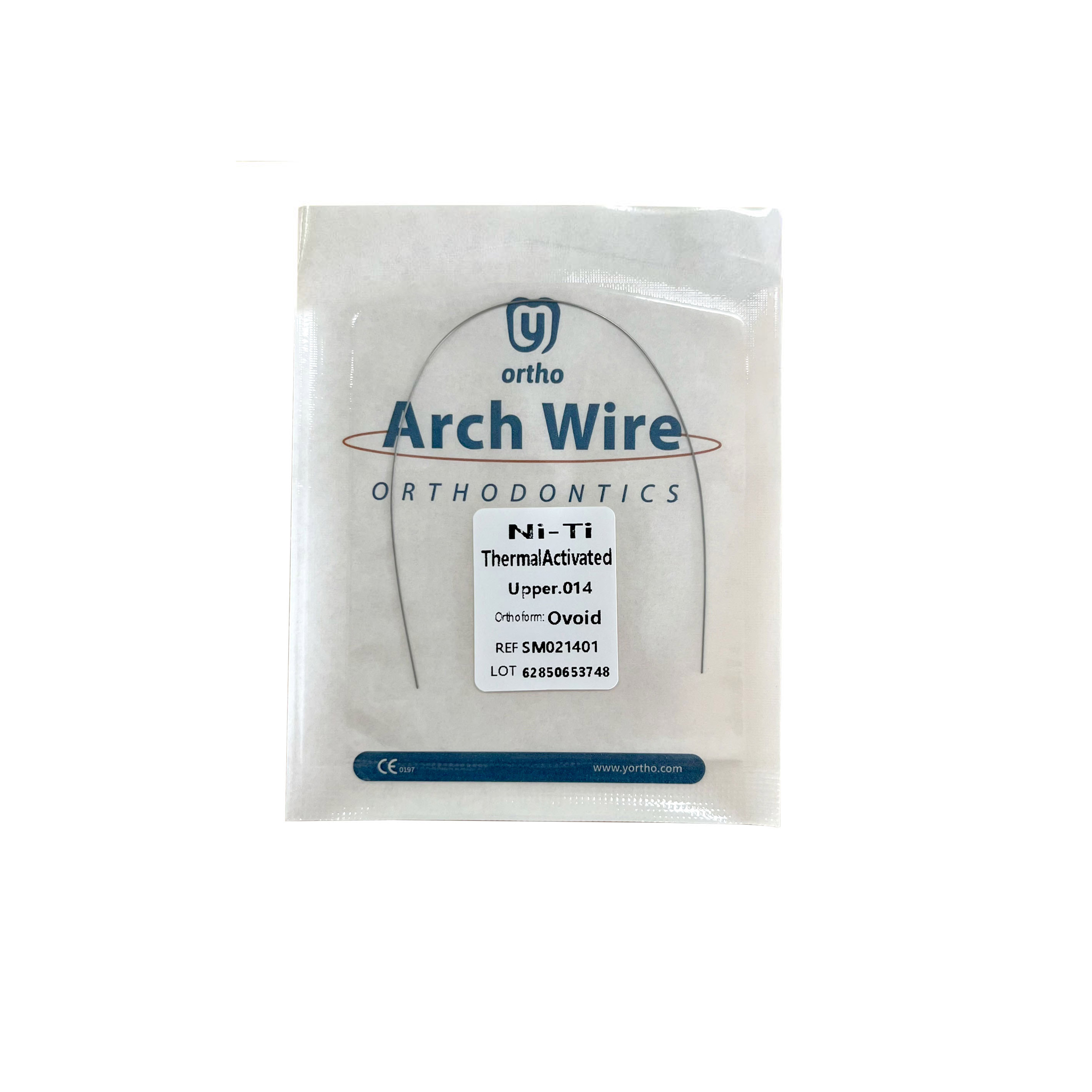
Y-HN Heat-activated NiTi arch wire: NiTi material; low stiffness, high springback, pseudoelastic behavior; available in upper and lower arch types; sizes 0.012"–0.020"; arch forms include Square, Natural, Damon, Oval, Europa-I, and Broad; round and rectangle cross-sections; designed to exert light continuous forces.
Y-TMA Round Arch Wire: titanium-molybdenum alloy; nickel-free; bendable and weldable; low spring-back; sizes 0.012"–0.018"; arch forms Natural, Damon, Oval; suitable for nickel-allergic patients; OEM available.
Y-SS Stainless Steel Arch Wire: stainless steel; sizes 0.012"–0.020"; upper/lower arch types; round and rectangle cross-sections.
Buccal Tubes
Y-T1 Buccal Tube (metal, Roth/MBT, low/high torque, slot 18/22) and Y-T2 Self-ligating Buccal Tube (metal self-ligating, same system options) are registered under the FDA number 3030680214.
Orthodontic Pliers and Instruments
- Y-Q6030 Light Wire Pliers: stainless steel; HRC 55–60; max sterilization temperature 180°C; zero-clearance hinge; CNC production; patented technology.
- Y-Q6015 Kim Pliers: stainless steel; HRC 50–55; max sterilization 180°C; zero-clearance hinge; for bending multi-loop edgewise wires, with cutter on tips.
- Y-Q5010 Mathieu Needle Holder (without hard tip): medical-grade stainless steel; heat-treated; precision serrated jaws; multi-position lock; ergonomic handle; autoclavable.
- Y-X101 Double-Ended Bracket Positioning Gauge: stainless steel; 0.022", 2.0–5.0 mm scale.
- Y-X104 Crossed Bracket Positioning Gauge: stainless steel; pencil-type; for bracket height measurement.
- Y-X202 Bracket Tweezer: stainless steel; autoclavable up to 134°C.
- Y-X203 Tube Tweezers (long tip): stainless steel; curved reverse tip for posterior brackets and buccal tubes.
- Orthodontic pliers carry CFS number Zhehang Food & Drug Admin Medical Device Export 20250496.
Expansion Screws
G, I, and K series expansion screws are made of stainless steel, with precision machined threads, expansion sizes 7–15 mm, screw/pin lengths 12–20 mm, packed 1 pc/pack, and support OEM customization.
Elastic Ligatures and Power Chains
Y-S80201 ligature rings are made of high-elasticity polymers, offered in clear and colored versions, packaged 40 pcs/bag or 10 pcs/bag, with low force decay and high tear resistance. Y-S80101 power chains are available in open long, closed continuous, and open short forms, packed 1 roll/pk.
Orthodontic Bands and Kids Crowns
Y-H6002 is a 1st Molar plain rough band made of medical-grade stainless steel, compatible with Roth/MBT/edge-wise systems, available in low or high torque, and under FDA registration. Kids Crown is a pediatric preformed crown system made of stainless steel, with upper/lower D-type and E-type options.
Auxiliaries
- Y-F102 Crimpable Hook (0.022", medium 2.4 mm, stainless steel)
- Y-F204 Mini Round Tube Stop (0.019", stainless steel)
- Y-F303 Bondable Lingual Button (round, 80# mesh base, stainless steel)
- Y-F321 Power Arm (round shape, stainless steel)
- Y-F314 Lingual Chain (silver, stainless steel)
Face Masks and Mini Implants
The Y-OS1406 Orthodontic Implant Screw is made of biocompatible medical titanium alloy, with a self-tapping thread design, 1.4 mm diameter, and 6 mm length. Face masks include the Universal (orange, sizes large/small, stainless steel + ABS, for pediatric anterior crossbite and maxillary forward growth) and the Adaptable Class III Mask (multiple colors, standard/small sizes).
Clinical and Procurement Use Cases
Use Case 1: Dental Hospital Stocking Self-Ligating Systems
A dental hospital in Indonesia ordered 3,000 units of Yortho orthodontic products, with a particular focus on self-ligating brackets. After two years of use, the hospital reported good clinical feedback, stable product performance, and noted that self-ligating brackets significantly shortened overall treatment duration. This case illustrates why institutional buyers often prioritize self-ligating systems: fewer ligature changes and lower friction can reduce chair time.
Use Case 2: Distributors Consolidating Multi-Category Procurement
Distributors in the UK, US, Italy, France, Germany, Egypt, and other markets have placed orders of approximately 5,000 units over 1–3 year cycles across Yortho's bracket, tube, band, plier, and auxiliary lines. Reported outcomes include favorable clinical feedback and consistent product performance, with the main commercial driver being quality at a cost-effective price point. For distribution businesses, consolidating multiple SKUs with one manufacturer reduces logistics and quality-control complexity.
Use Case 3: Nickel-Allergy Patient Care
For patients with known nickel sensitivity, TMA arch wires offer a nickel-free option during the finishing phase. A buyer supporting orthodontists who treat allergy-prone patients would combine TMA wires with appropriate stainless steel or ceramic brackets, and should verify nickel content claims through material documentation.
Step-by-Step Supplier Evaluation Checklist
- Verify legal manufacturing status. Confirm whether the supplier operates its own factory or relies on third-party production. Direct manufacturers can usually provide tighter quality control and faster response on specification changes.
- Request certification documents. For US: FDA registration number and applicable device listing. For EU: CE under MDR 2017/745. For China export: CFS. For quality systems: ISO 13485 or equivalent.
- Check the product material claims. Stainless steel type (e.g., 17-4, 304), NiTi versus TMA versus SS arch wires, Al₂O₃-based ceramics, polymer types for elastics.
- Compare dimensions and configurations. Slot sizes (0.018" vs 0.022"), hook presence, Roth/MBT/Edge-wise systems, torque options, arch forms, wire sizes, and expansion screw dimensions.
- Review the physical finishing. For brackets: base mesh design, edge smoothness, slot precision. For pliers: hardness, hinge tolerance, polishing. For molds and tubes: weld precision.
- Ask about packaging and shelf readiness. Standard pack sizes such as 20 pcs/set for brackets, spool packaging for ligatures, and 1 pc/pack for expansion screws affect inventory planning.
- Confirm customization capability. OEM/ODM services for packaging, logo, tag, and product-level changes. Typical MOQ policies may differ between standard products, ODM, and OEM.
- Test a sample order before bulk commitment. A sample order allows direct assessment of product finishing, documentation, and logistics performance.
- Establish lead-time and shipping expectations. Standard product lead times and transit times vary by method; express courier is typically 3–7 business days, air freight 7–12 days, sea freight 25–40 days, and rail/overland 20–30 days for certain regions.
- Clarify after-sales responsibilities. Confirm that the supplier provides remote support and problem resolution aligned with your market's clinical requirements.
Global Orthodontic Materials: Market Context
The global orthodontics market is projected to grow from USD 7.65 billion in 2024 to USD 38.21 billion by 2034, according to Polaris Market Research. China's orthodontic supplies market alone was estimated at USD 713.25 million in 2024. Stainless steel remains the dominant material for arch wires and brackets; NiTi wires are preferred for shape memory and super-elasticity; ceramic self-ligating brackets are gaining popularity for aesthetics and reduced friction. The prevalence of malocclusion is reported to affect 39–93% of adolescents globally, providing a structural demand base for fixed appliances.
Risks Buyers Should Manage
- Documentation mismatch: A certificate may cover the manufacturer but not all SKUs. Check product names and model numbers.
- Material substitution: Suppliers may propose alternative materials without updating certification. Require material declaration per batch.
- Customs delays: Import duties and taxes are the buyer's responsibility under FOB or CIF terms; courier services such as DHL or FedEx usually handle customs documentation.
- Clinical compatibility: A bracket system may look compatible with Roth/MBT but differ in torque values. Request torque/tip values before large orders.
- Sterilization tolerance: Instruments and pliers should tolerate repeated high-temperature sterilization; verify stated maximum temperatures and hardness.
FAQ
Do orthodontic materials need ISO 13485 certification?
ISO 13485:2016 is the international quality management system standard for medical devices and is widely required or recognized for international market access. The U.S. FDA also recognizes ISO 13485:2016 as the primary basis for its Quality Management System Regulation. Buyers should ask suppliers for ISO certification and check whether it covers the specific product families being purchased.
What certifications does Yortho hold for orthodontic brackets and related products?
Yortho products are registered with the U.S. FDA/CDRH under registration number 3030680214, covering metal brackets, self-ligating brackets, ceramic brackets, buccal tubes, bands, arch wires, pliers, instruments, auxiliaries, elastic ligatures, power chains, kids crowns, face masks, mirrors, expansions, and related devices. Yortho also reports CE certification under the EU MDR. Orthodontic pliers hold CFS number Zhehang Food & Drug Admin Medical Device Export 20250496, issued by the Zhejiang Medical Products Administration.
Which orthodontic materials does Yortho manufacture?
Yortho's portfolio covers orthodontic supplies, pediatric dental products, and dental lab appliances. The orthodontic range includes metal brackets, mini brackets, self-ligating brackets, ceramic self-ligating brackets, buccal tubes, molar bands, arch wires (stainless steel, NiTi super-elastic, heat-activated NiTi, TMA), elastic ligatures, power chains, expansion screws, face masks, crimpable hooks, lingual buttons, lingual chains, composite bundants, pliers, and instruments. Pediatric products include kids crowns and pediatric bands. The company also supplies orthodontic implant screws, RPE expanders, and MISPA molar distalization systems.
What are the typical MOQ and payment terms?
For standard products, the formal-order MOQ is USD 1,000 in total order value, and first orders may be placed without MOQ. OEM/ODM MOQs are commonly 500 units for OEM and 1,000 units for ODM. Payment is typically 100% T/T in advance; for orders over USD 10,000, 30% deposit to start production and 70% balance before shipment are accepted. Small sample orders can sometimes be paid via PayPal or Alipay.
Can I request samples before placing an order?
Yes. Yortho sends samples for quality checks; most samples are free, except higher-cost items such as pliers and self-ligating brackets. The buyer covers courier shipping; freight collect is accepted if the buyer has a DHL, FedEx, or UPS account.
What is the standard lead time for orthodontic material orders?
Standard products in stock can be packed and dispatched within 3 business days after payment confirmation. Customized products depend on the specification, with OEM/ODM lead times based on material preparation and machine setup. Clients can contact Yortho with the destination country and postal code for precise shipping and customs information.
Is Yortho a manufacturer or a trading company?
Yortho operates its own factory in Huzhou, Zhejiang Province, China, with production experience of over 15 years in orthodontic manufacturing. The company reports a 5,000 m² facility, around 100 employees, an annual output of 30 million units, and an R&D team of about 20 engineers. About 80% of products are exported to the EU, USA, Middle East, Australia, and Africa. As a direct manufacturer, it offers competitive pricing, strict quality control, and OEM/ODM customization.
Which global markets does Yortho export to?
Yortho exports to over 70 countries, including the United States, the United Kingdom, France, Germany, Italy, Greece, Russia, Saudi Arabia, and Egypt. Main markets are the EU, USA, Middle East, Australia, and Africa.
Building a Resilient Orthodontic Materials Supply Chain
The most durable procurement strategy for orthodontic materials combines regulatory verification, product-level specification matching, and supplier capacity assessment. A manufacturer that can document FDA registration, CE under MDR, ISO 13485-style quality systems, and export certificates such as CFS reduces the risk of customs rejection and clinical performance failures.
Yortho's production model is designed for long-term partnerships: a 5,000 m² factory, approximately 100 employees, 20 engineers in R&D, annual output of 30 million units, 80% export ratio, and OEM/ODM support. Buyers who want to validate the products firsthand can request samples, speak with the export team at info@yortho.com or +86 180-5879-3627, or download the company brochure below.
Download Yortho Orthodontic Materials Brochure
Full product line overview, specifications, and company capability information.
Download PDF Brochure