Top Orthodontic Pliers and Hand Instruments: A Chairside Ranking for Clinical Efficiency
Top Orthodontic Pliers and Hand Instruments: A Chairside Ranking for Clinical Efficiency
Chairside efficiency in fixed appliance treatment is decided less by which bracket is bonded than by which hand instruments are within reach. This ranking orders the orthodontic pliers and hand instruments that do the most work in a normal clinical day — trimming ligature and arch wire, removing bands, bending loops, crimping hooks and inspecting the mouth — and explains, for each position, the procedure fit, the handling requirement and the instrument pairing that earn it a permanent place in the setup.
Four request categories are covered together because they are normally bought together: Orthodontic Pliers, Orthodontic Instruments, Orthodontic Mirrors and Orthodontic Crimpable Hooks. The order below is an editorial, workflow-based ranking. It reflects how often an instrument is picked up during a standard fixed-appliance appointment, and how much treatment flow suffers when it is missing. It is not a price list and it is not a catalogue dump.
Yortho is the orthodontic device brand of Zhejiang YO Medical Technology Co., Ltd, a manufacturer based in Deqing, Huzhou, Zhejiang, China, producing brackets, buccal tubes, molar bands, pliers, hand instruments, accessories, pediatric preformed crowns, elastic ligatures and arch wires, with OEM and ODM services available. Yortho model numbers are used below as concrete reference points for each rank, because a ranking without a part number is only a suggestion.
The Ranking at a Glance
- Light wire cutter, 0° — Y-Q8001
- Heavy cutter — Y-Q8008
- Band remover, long tips — Y-Q5005
- Tweed loop pliers — Y-Q6018
- Light wire pliers — Y-Q6030
- Kim pliers — Y-Q6015
- Crimpable hook pliers, plus the hooks themselves — Y-Q6026 with Y-F204, Y-F102, Y-F201 and Y-F105L / Y-F105R
- Placement tweezers — Y-X202, Y-X203, Y-X201
- Mathieu needle holder — Y-Q5010
- Intraoral mirror — Y-X303
Problem Definition: Why a Catalogue Does Not Build a Chairside Setup
Most instrument sets are assembled in one of two ways: by price tier, or by copying a kit list from another clinic. Both approaches produce the same failure pattern. The tray ends up holding several instruments that are rarely opened, while the one geometry or hardness grade that a specific procedure needs is missing — a cutter that cannot reach a posterior segment, a plier that distorts a soft wire, or a crimping instrument whose jaws will not hold a small-diameter stop.
The practical question is therefore not what instruments exist on the market. It is, for this step of this appointment, what must the instrument do, what does it pair with, and what must it not be used for. A cutter engineered to sever fine ligature wire is not the tool that sections a 0.030 inch nickel-titanium archwire, and a plier built at HRC 50–55 does not perform the same role as a cutter built at HRC 58–63. Ranking instruments by clinical workload forces those distinctions to the surface.
Reprocessing adds a second constraint that is often overlooked in purchasing. In orthodontic practice, single-use consumables and reusable instruments coexist: elastic ligatures are single-use, while pliers and tweezers are reusable and must survive repeated high-temperature sterilization. An instrument specification has to be read together with its maximum sterilization temperature, not separately from it.
Industry Background: Why Hand Instruments Are a Separate Purchase Decision
Hand instruments sit inside a fast-expanding market. Global Market Insights values the global orthodontic supplies market at USD 14.8 billion in 2024. Grand View Research sizes the narrower orthodontic consumables segment at USD 3.1 billion in 2024 and projects USD 4.3 billion by 2030. The gap between those figures reflects scope rather than disagreement, since one counts broader supply categories and the other counts consumables only.
Where the instruments are actually chosen matters commercially. Grand View Research reports that orthodontic clinics and standalone practices represent over 50% of the end-user distribution channel, which means chairside decisions carry more aggregate weight than the unit price of a single plier suggests. The same source notes that stainless steel remains the most widely used material for orthodontic arch wires and brackets globally, and that orthodontic pliers and instruments are critical for clinical adjustments, with stainless steel as the industry-standard instrument material.
What has changed around those instruments is the compliance layer. ISO 13485:2016 is the quality-system standard medical device manufacturers must be certified to for international market access, and it is now explicitly recognized by the US FDA as the primary basis for its Quality Management System Regulation. In the EU, MDR 2017/745 is mandatory for orthodontic devices to carry CE marking, and the FDA classifies orthodontic brackets as Class II devices requiring 510(k) clearance. For instruments that repeatedly contact oral tissue, biocompatibility and nickel-free or low-allergy material requirements apply in some markets.
The supplier landscape is mixed. Dentaurum in Germany is reported as one of the oldest manufacturers of orthodontic materials, known for high-quality stainless steel alloys; G&H Orthodontics manufactures in the United States and exports to more than 90 countries; and full-line players such as 3M Unitek, Ormco and Dentsply Sirona's GAC division compete largely on bracket, wire and elastic platforms. Hand instruments are a different purchase altogether: lower unit value, higher replacement frequency, and far more sensitive to geometry and hardness than to brand name.
Detailed Solution: Ten Instruments Ranked by Chairside Workload
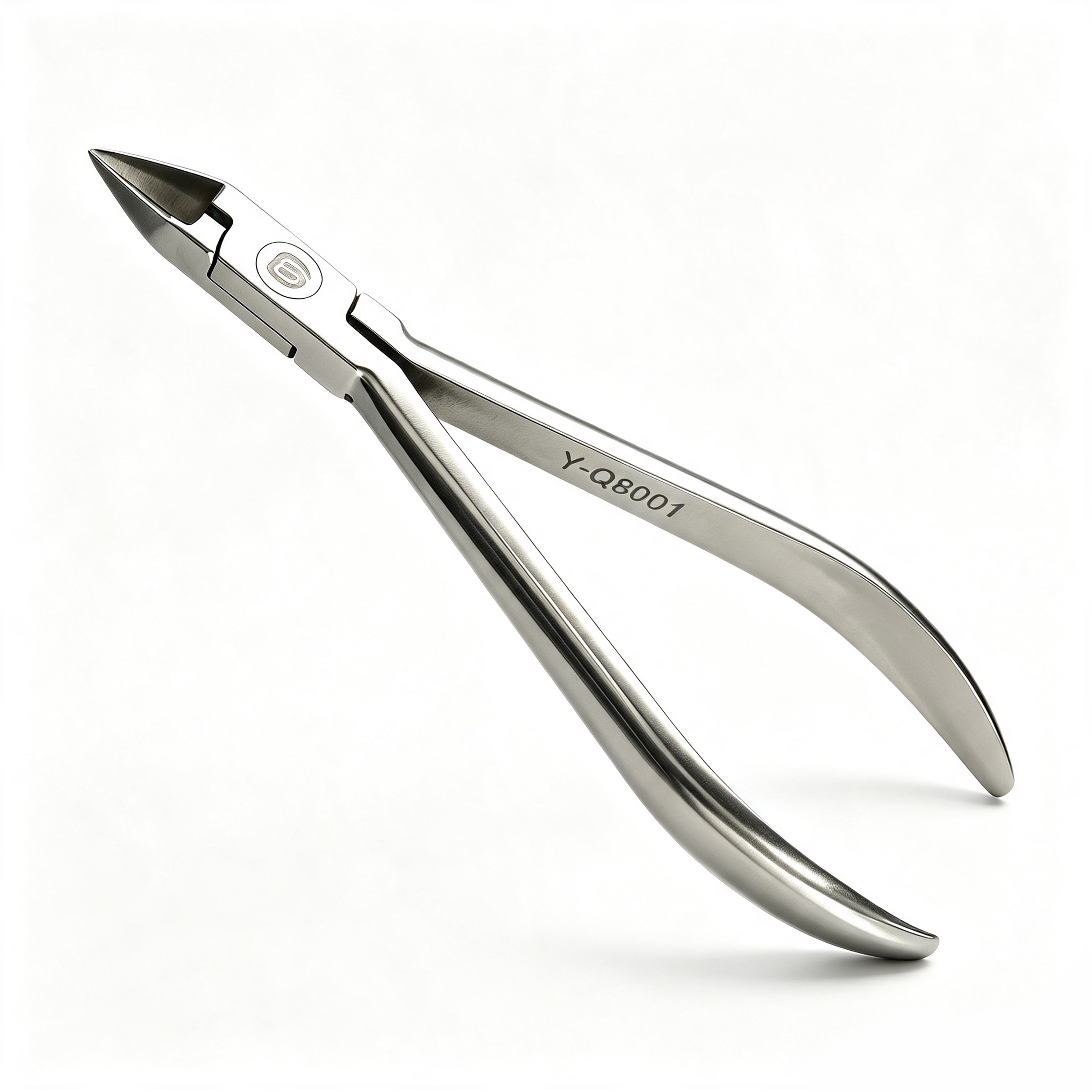
Rank 1 — Light wire cutter, 0°: Y-Q8001
This is the instrument a clinician reaches for most often, which is why it takes the first position. Yortho describes the Y-Q8001 as a precision hand instrument designed to sever soft, fine-gauge wires up to 0.012 inch (0.30 mm) and elastics inside the mouth. The tips are slim and tapered and the cutting edges hardened, so the cutter can enter tight posterior spaces, and the specification states CE and FDA registration compliance with 21 CFR Part 807. Hardness is listed at HRC 58–63 with a maximum sterilization temperature of 180 °C.
Why it earns the slot: almost every adjustment appointment ends with a ligature tie or elastomeric chain being trimmed. Pairing: it is used alongside the placement tweezers in rank 8 and the band remover in rank 3, and with consumables such as ligature rings and power chains. Limit: it is not a heavy-wire instrument; sectioning nickel-titanium or stainless steel archwire belongs to the next rank.
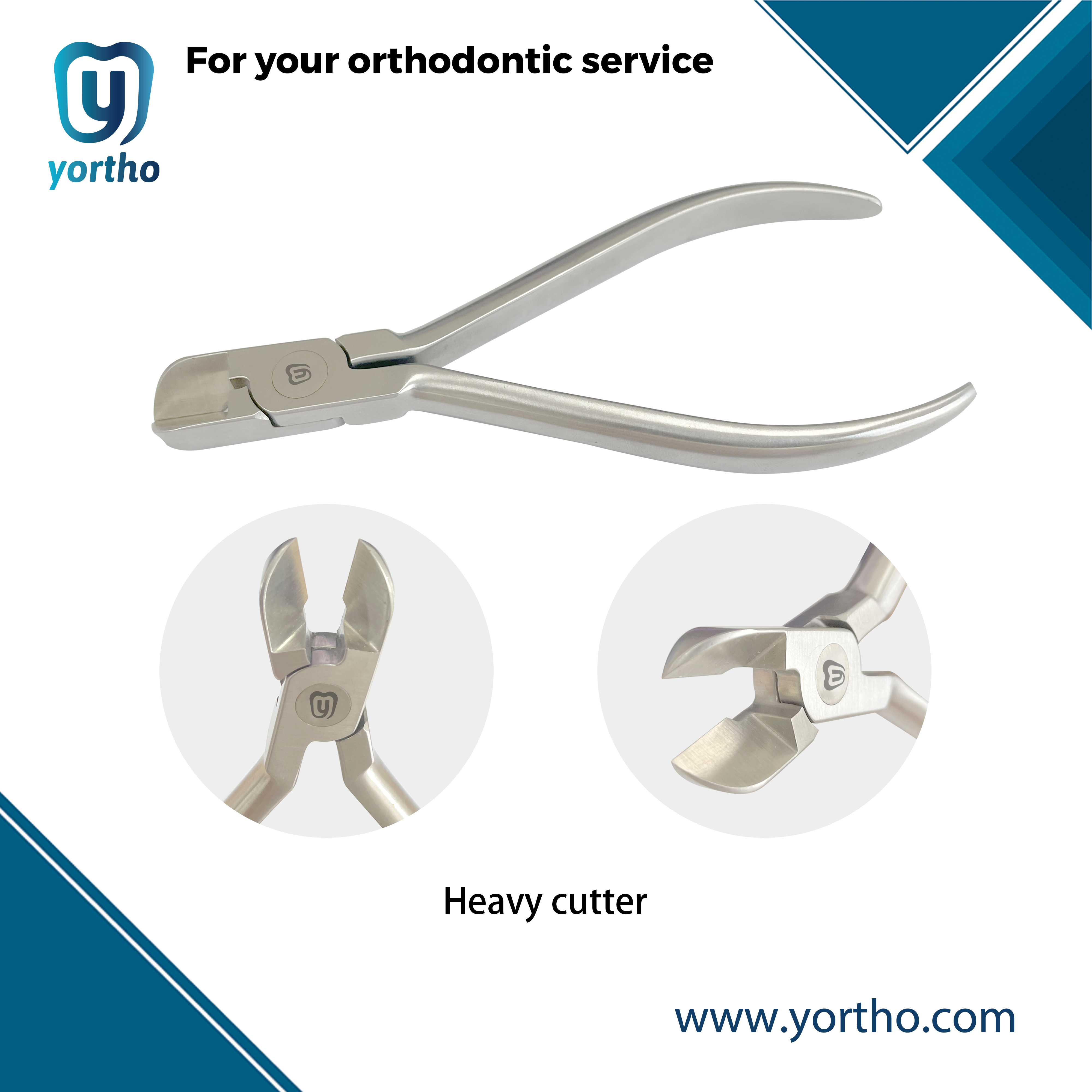
Rank 2 — Heavy cutter: Y-Q8008
The heavy cutter is the second most frequently used plier because archwire changes are built into fixed appliance treatment. Yortho specifies the Y-Q8008 for cutting Australia wire, NiTi wire and stainless steel wire up to 0.030 inch (0.76 mm), with a cutting edge produced by a new technology. Like the rank 1 cutter it is stainless steel at HRC 58–63 with a maximum sterilization temperature of 180 °C.
Why it earns the slot: it covers the wire range the light wire cutter cannot, so the two together define the cutting capability of the tray. Pairing: a distal end cutter (Y-Q8005, also HRC 58–63) is the complement for trimming archwire ends intraorally. Limit: the stated maximum diameter of 0.030 inch is a boundary, not a target — cutting beyond the specified range is a common cause of jaw damage.
Rank 3 — Band remover, long tips: Y-Q5005
Band removal is low-frequency in a single appointment but high-impact when the right instrument is absent, which is why this plier ranks above several everyday benders. Yortho lists the Y-Q5005 as a tool for removing bands and other bondable attachments. It is built from medical stainless steel, made by CNC production, and uses a patented special technology with a zero-clearance hinge designed to keep the jaws consistently aligned. Hardness is HRC 58–63 and the maximum sterilization temperature is 180 °C.
Why it earns the slot: it is the instrument that protects the enamel and the patient experience during debonding and band replacement. Pairing: it pairs with bracket removing pliers (Y-Q5001, HRC 50–55) for bonded attachments. Limit: long tips improve posterior access but reduce leverage, so the clinician's grip matters more than on a short-beak instrument.
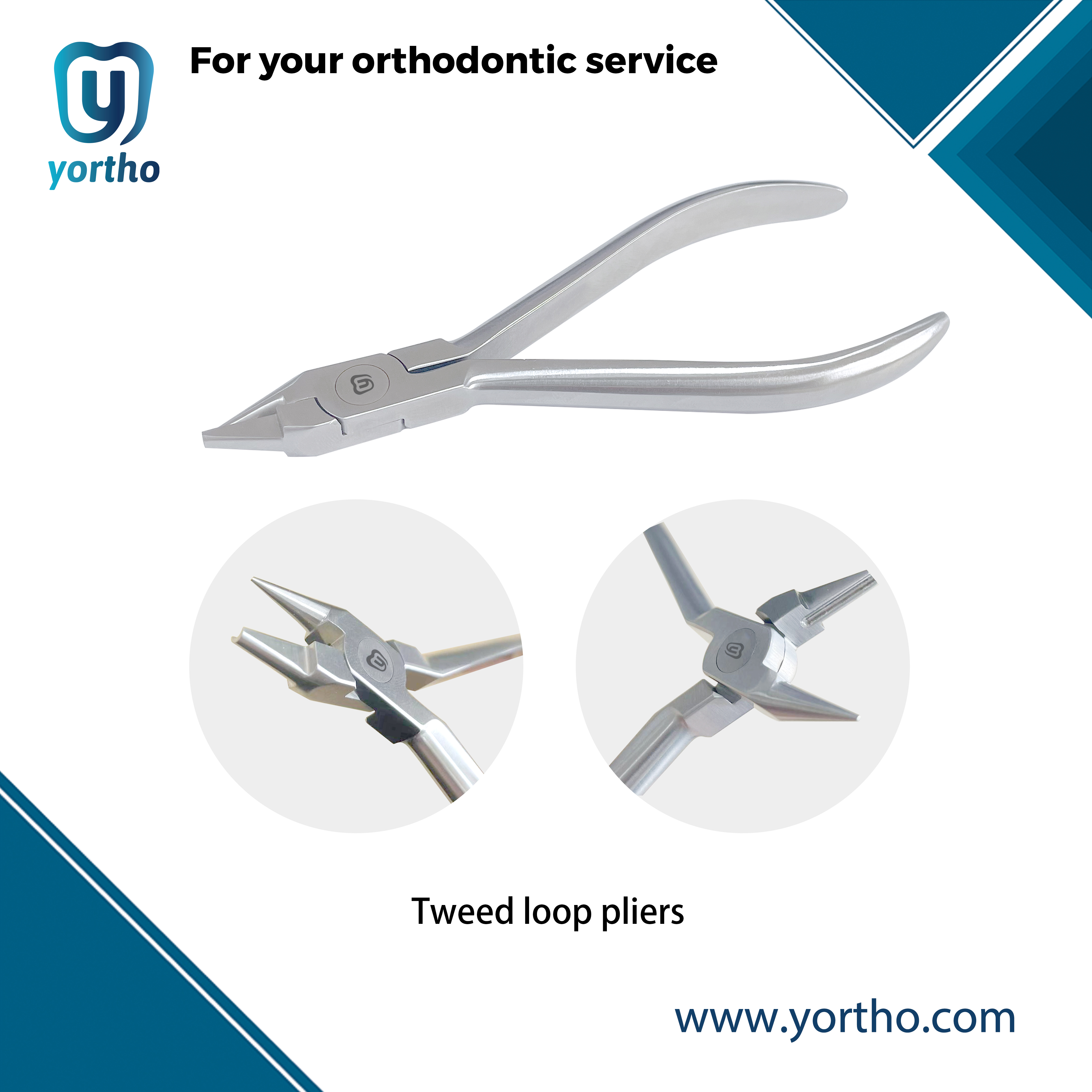
Rank 4 — Tweed loop pliers: Y-Q6018
This is the first of the forming instruments in the ranking and the one most associated with finishing work. Yortho specifies the Y-Q6018 for bending small archwire bends, especially stop or omega bends at the end of the archwire. It is stainless steel at HRC 55–60 with a maximum sterilization temperature of 180 °C.
Why it earns the slot: stop and omega bends are needed to control archwire position and prevent unwanted movement of the arch. Pairing: it works as a set with the light wire pliers in rank 5, one for the bend and one for the fine adjustment around it.
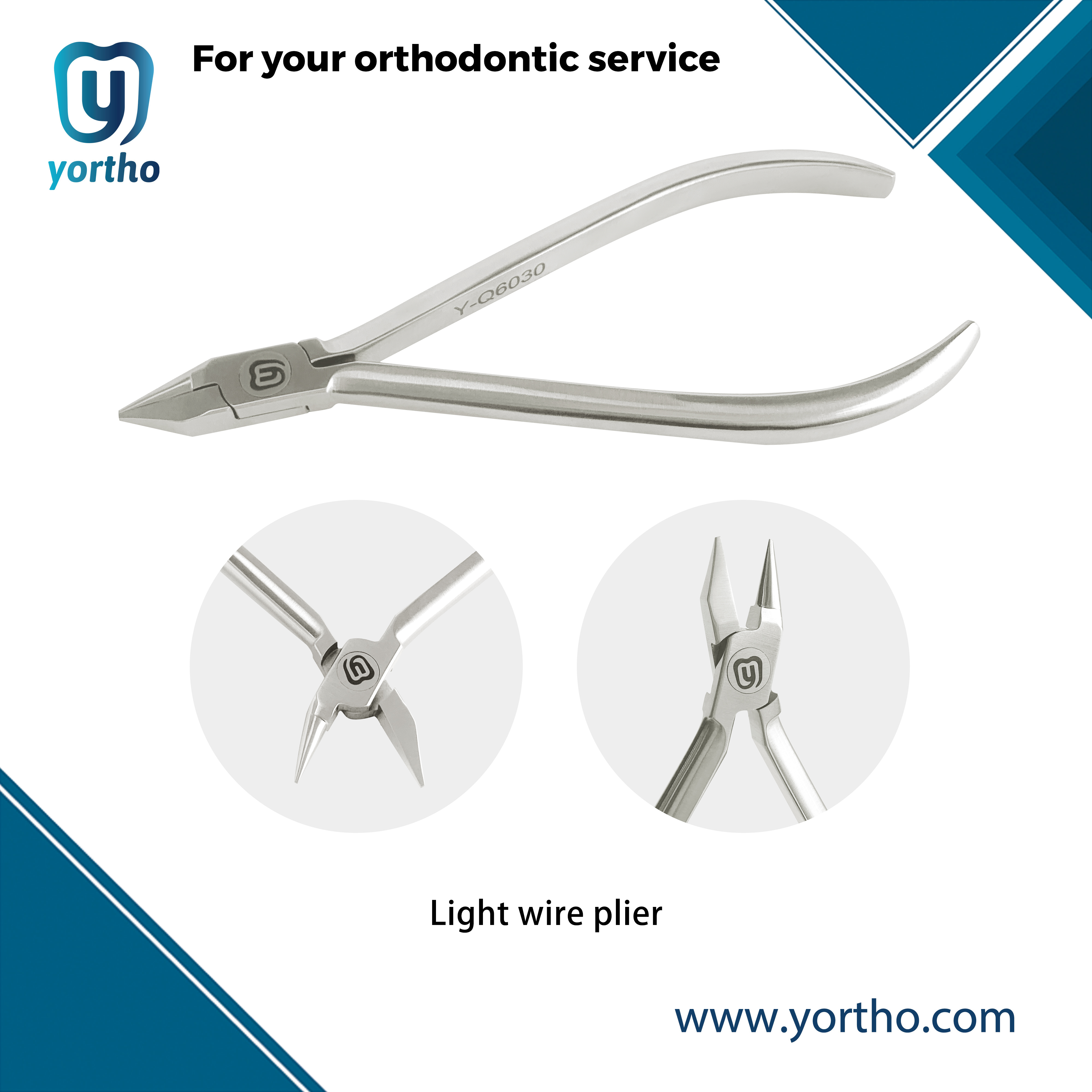
Rank 5 — Light wire pliers: Y-Q6030
Where the Tweed plier creates defined bends, a light wire plier handles the finer manipulation of thin wire. The Y-Q6030 is stainless steel at HRC 55–60, autoclavable to a maximum sterilization temperature of 180 °C, and shares the zero-clearance hinge design used across the Yortho plier range.
Why it earns the slot: it is the general-purpose forming instrument that fills the gap between dedicated loop bending and cutting. Limit: its 55–60 HRC band suits forming, not abrasion resistance against heavy wire.
Rank 6 — Kim pliers: Y-Q6015
The Kim plier is more specialised, and that is exactly why it holds rank 6 rather than a higher position. Yortho specifies the Y-Q6015 for bending multi-loop edgewise wires, with a cutter built into the tips. Hardness is HRC 50–55 and the maximum sterilization temperature is 180 °C.
Why it earns the slot: when a multi-loop edgewise technique is part of the treatment philosophy, no other instrument substitutes for it. Limit: at HRC 50–55 it sits at the lower end of the hardness range in this ranking, and it should be reserved for its intended wire type rather than used as a general cutter.
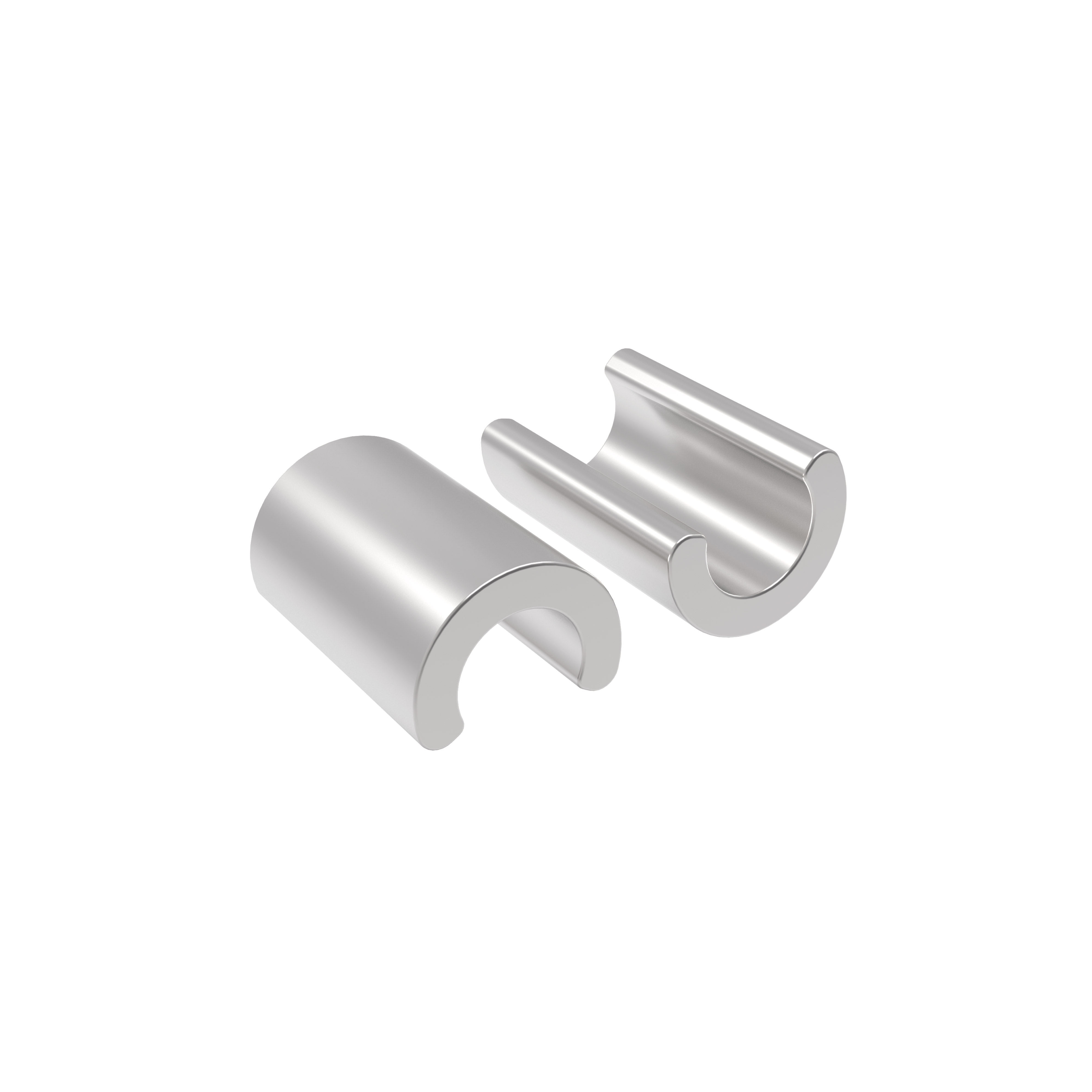
Rank 7 — Crimpable hook pliers plus crimpable hooks: Y-Q6026 with Y-F204, Y-F102, Y-F201, Y-F105L / Y-F105R
Crimpable hooks belong in the ranking as a paired unit, because the hook is only as reliable as the instrument that seats it. On the tool side, Yortho lists the Y-Q6026 crimpable hook plier at HRC 50–55 with a maximum sterilization temperature of 180 °C. On the attachment side, the range covers the Y-F204 mini round tube stop at 0.019 inch with a quick-clip C-shape for mounting; the Y-F102 crimpable hook at 0.022 inch in a medium 2.4 mm type; the Y-F201 crimpable hook at 0.022 inch and 2.4 mm; and the Y-F105L and Y-F105R spiral crimpable hooks at 0.022 inch in left and right 8.7 mm versions. The stated aim of the Y-F204 design is a polished low-friction surface with firm anti-slip clamping to assist traction and root control.
Why it earns the slot: hooks are added mid-treatment, not at bonding, so they must be crimped chairside without deforming the archwire. Pairing: hooks and stops are used with elastic chain, coil springs and the auxiliary attachment range, and the 0.019 inch and 0.022 inch sizes map to the corresponding archwire dimensions.
Rank 8 — Placement tweezers: Y-X202, Y-X203 and Y-X201
This rank covers the Orthodontic Instruments category that transfers brackets, tubes and attachments to the tooth. Yortho lists three distinct geometries: the Y-X202 bracket tweezer; the Y-X201 lingual brackets tweezer with a curved tip, sized for lingual brackets; and the Y-X203 tube tweezer with a long tip, with a clamping range suited to posterior brackets and buccal tubes. All three are stainless steel and autoclavable up to 134 °C.
Why it earns the slot: indirect bonding and posterior tube placement fail more often from poor transfer control than from adhesive selection. Pairing: the Y-X101 double-ended bracket positioning gauge (0.022 inch, 2.0–5.0 mm) and the Y-X104 crossed bracket positioning gauge sit in the same layer of the tray.
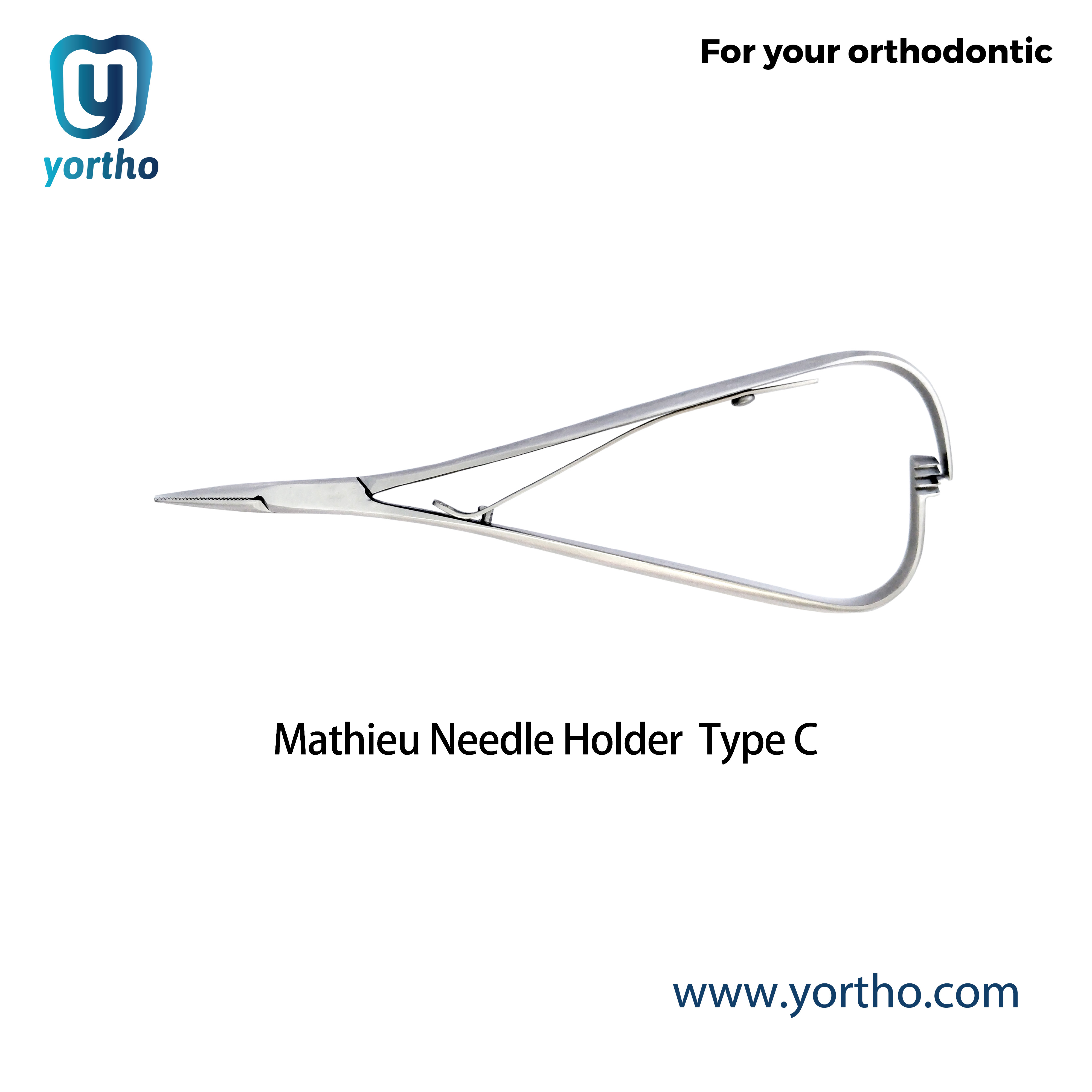
Rank 9 — Mathieu needle holder: Y-Q5010
A needle holder is not the first instrument clinicians associate with orthodontics, but it earns a place because ligature wire and sutures both need controlled gripping. Yortho specifies the Y-Q5010 as a Mathieu needle holder without a hard tip, in stainless steel. Its stated handling features include a slim, fine beak for access to the posterior molar area, precision serrated jaws that hold suture needles and ligature wires without slipping or deforming the wire, a multi-position lock for one-hand operation, and a balanced handle intended to reduce hand fatigue over long clinical sessions.
Why it earns the slot: wire ligation still appears in most fixed appliance protocols, and a slipping grip wastes chair time. Limit: the without-hard-tip version is a distinct specification from hardened-tip variants; substitution changes the instrument's behaviour.
Rank 10 — Intraoral mirror: Y-X303
The last rank is inspection, and it is placed last only because it is not a force-applying instrument, not because it is optional. Yortho lists the Y-X303 as an intraoral mirror in stainless steel and glass, available in large, small, occlusion and lateral types. The type options matter because anterior and posterior segments need different viewing angles, and a mirror that cannot deliver the posterior view reduces the value of every other instrument in the tray.
Also in the tray: procedure-specific instruments
Four further Yortho models sit outside the top ten because they are procedure-triggered rather than daily: the Y-Q8005 distal end cutter (HRC 58–63), the Y-Q3001 hole punch pliers (HRC 58–63), the Y-Q3002 tear drop pliers (HRC 58–63) and the Y-Q5001 bracket removing pliers (HRC 50–55). All are listed at a maximum sterilization temperature of 180 °C.
Limits and Trade-offs Behind the Ranking
- Hardness is not a quality ranking. Instruments at HRC 50–55 and instruments at HRC 58–63 are engineered for different tasks. Forming pliers trade abrasion resistance for edge geometry and toughness; cutters trade flexibility for edge retention.
- Sterilization envelopes differ by product family. The plier range is specified with a maximum sterilization temperature of 180 °C, while the tweezers are specified as autoclavable up to 134 °C. Exceeding a stated limit risks altering the heat treatment of the steel.
- Geometry always costs something. Long tips and fine beaks buy posterior access and give up leverage; short, heavy jaws buy force and give up reach.
- Mirror types are not interchangeable. Large, small, occlusion and lateral geometries serve different views, and substituting one for another changes what the clinician can see.
- This ranking assumes a fixed-appliance workflow using reusable stainless steel instruments. A fully digital or aligner-only practice would weight the same list differently.
Step-by-Step: Building Your Own Chairside Ranking
- Count procedures, not products. List the appointment types your practice actually runs in a week, then count how many times each instrument is used per appointment. The highest count belongs at the top of your tray, not the middle.
- Assign a wire range to each cutter. Separate fine-gauge work (up to 0.012 inch / 0.30 mm for the Y-Q8001) from heavy work (up to 0.030 inch / 0.76 mm for the Y-Q8008) so no instrument is pushed beyond its stated range.
- Match hardness to the wire. Use HRC 58–63 cutters for repeated wire sectioning and keep HRC 50–55 instruments for forming and crimping tasks such as the Y-Q6015 and Y-Q6026.
- Check hinge and jaw behaviour. A zero-clearance hinge, as listed across the Yortho plier range, keeps the jaws aligned over repeated sterilization cycles and repeated use.
- Confirm the sterilization path. Verify the maximum sterilization temperature of every reusable item and the autoclavability of every tweezer before the tray is built, not after it fails.
- Verify pairing before ordering. Crimpable hooks must match archwire dimensions (0.019 inch and 0.022 inch options), tweezers must match the attachment type (lingual brackets with Y-X201, posterior tubes with Y-X203), and consumables such as ligature rings and power chains must arrive with the same order.
- Validate with a sample. Test the two or three highest-frequency instruments in real appointments before committing to a full kit, because jaw feel and handle balance are personal to the operator.
Use Cases: How the Ranking Shifts by Practice Type
High-volume fixed appliance clinic. Cutting and removal dominate. The practical core is the Y-Q8001, the Y-Q8008, the Y-Q5005 band remover and a pair of Y-X202 tweezers. A distributor case covering 5,000 units delivered across multiple countries over a one-to-three year period reported consistent product performance and compliance with local hospital clinical requirements, which is the pattern this profile of clinic is looking for.
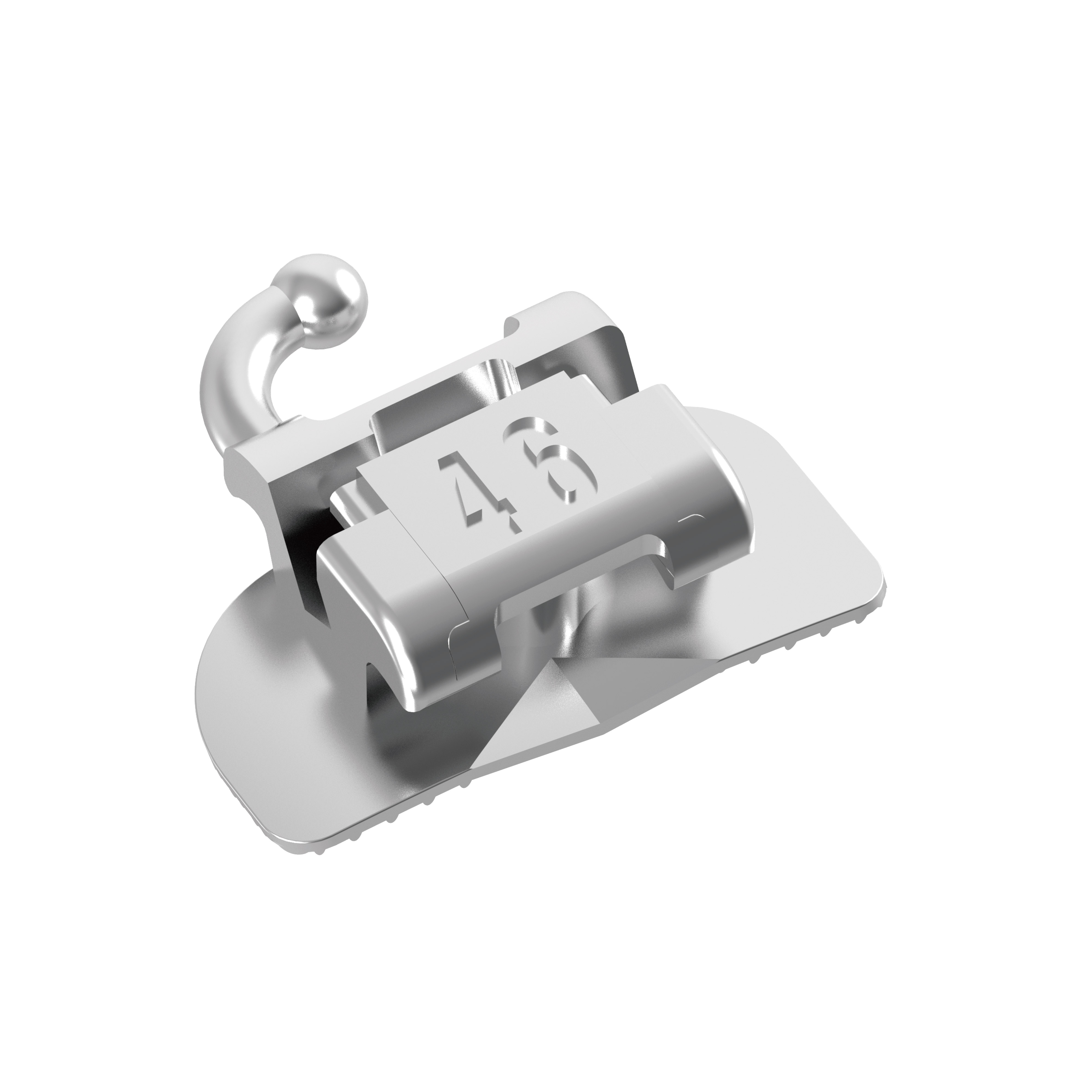
Lingual and esthetic practice. Placement control moves up the ranking. The Y-X201 lingual brackets tweezer with its curved tip and lingual-bracket clamping range becomes a daily instrument, and the attachment layer expands to include bondable lingual buttons such as the Y-F322 and the ceramic bondable version Y-F305C, which uses a round base with retentive cuts and a mesh structure for bond strength, plus the Y-F321 power arm with its long-stem hook for traction.
Pediatric orthodontic clinic. The instrument mix shifts toward smaller working ends and crown-and-band work. Yortho's pediatric range includes preformed Kids Crowns in upper D-type, lower D-type, upper E-type and lower E-type systems, with supporting instruments listed as crown and band contouring pliers, band crimping pliers and crown trimming scissors. Early Class III cases add the Adaptable Class III face mask, listed in standard and small types with stainless steel and ABS construction.
Distributor building instrument kits. Here the ranking becomes a kit definition. A kit assembled from the top four ranks plus crimpable hooks covers the majority of routine procedures, while procedure-specific models such as the Y-Q8005 and Y-Q3001 are added as options. A dental hospital project in Indonesia using self-ligating brackets reported that treatment duration was shortened, which is the type of clinical feedback distributors rely on when justifying an upgraded kit. Yortho states that its products have been exported to over 70 countries, with OEM and ODM customization available for packaging, logo, tag and product.
Comparison Table: Ranked Orthodontic Pliers and Hand Instruments
| Rank | Instrument | Yortho model | Primary chairside job | Hardness (HRC) | Max. sterilization temp. | Material |
|---|---|---|---|---|---|---|
| 1 | Light wire cutter, 0° | Y-Q8001 | Sever fine wire up to 0.012 inch (0.30 mm) and elastics intraorally | 58–63 | 180 °C | Stainless steel |
| 2 | Heavy cutter | Y-Q8008 | Cut Australia wire, NiTi and stainless steel up to 0.030 inch (0.76 mm) | 58–63 | 180 °C | Stainless steel |
| 3 | Band remover, long tips | Y-Q5005 | Remove bands and other bondable attachments | 58–63 | 180 °C | Stainless steel |
| 4 | Tweed loop pliers | Y-Q6018 | Bend stop and omega bends at the archwire end | 55–60 | 180 °C | Stainless steel |
| 5 | Light wire pliers | Y-Q6030 | Fine wire forming and adjustment | 55–60 | 180 °C | Stainless steel |
| 6 | Kim pliers | Y-Q6015 | Bend multi-loop edgewise wires; cutter on tips | 50–55 | 180 °C | Stainless steel |
| 7 | Crimpable hook pliers | Y-Q6026 | Seat and crimp crimpable hooks and tube stops | 50–55 | 180 °C | Stainless steel |
| 7 | Crimpable hooks and stops | Y-F204 (0.019 inch); Y-F102, Y-F201 (0.022 inch); Y-F105L / Y-F105R (0.022 inch, L/R 8.7 mm) | Add traction points mid-treatment without deforming the archwire | — | — | Stainless steel |
| 8 | Bracket, lingual and tube tweezers | Y-X202; Y-X201 (curved tip); Y-X203 (long tip) | Hold and place brackets, lingual brackets and posterior tubes | — | Autoclavable up to 134 °C | Stainless steel |
| 9 | Mathieu needle holder | Y-Q5010 (without hard tip) | Grip suture needles and ligature wires | — | — | Stainless steel |
| 10 | Intraoral mirror | Y-X303 (large, small, occlusion, lateral) | Intraoral inspection of anterior and posterior segments | — | — | Stainless steel, glass |
All specifications above are as listed in Yortho product data. A dash indicates that the parameter is not stated in the source specification and is therefore not reported here.
FAQ
Are Yortho orthodontic instruments compliant for import into regulated markets?
Yortho states that it holds ISO quality management system certification, CE certification under the new EU MDR regulation and FDA registration, and that its Y-Q8001 light wire cutter specification is CE and FDA registration compliant with 21 CFR Part 807. Instruments are intended for clinical and dental clinic environments operating under disinfection and sterilization conditions, and for some markets biocompatibility and nickel-free or low-allergy material requirements apply, with compliance certification documents supplied for that purpose. Because documentation requirements differ by destination, buyers should confirm the exact certificate set their own customs and regulator require before shipment.
Does Yortho supply orthodontic instruments and materials for pediatric orthodontic clinics?
Yes. The pediatric portfolio includes preformed Kids Crowns in upper D-type, lower D-type, upper E-type and lower E-type systems, and the supporting instruments listed for that work are crown and band contouring pliers, band crimping pliers and crown trimming scissors. Early interceptive cases can be supported with the Adaptable Class III face mask in standard and small types, and with crimpable hooks such as the 0.019 inch Y-F204 mini round tube stop for traction points. Customization for pediatric ranges follows the same OEM and ODM route as the adult line.
What order size is required to buy orthodontic pliers and instruments?
Yortho operates a flexible policy on standard products: the minimum order quantity for a formal order is USD 1,000 in total value, while a first order carries no MOQ requirement. For fully custom production, the stated minimums are 500 units for OEM and 1,000 units for ODM, which covers material preparation and machine setup. Buyers who are still assessing a market can therefore start with a small standard-product order and scale into customization afterwards.
Can I test pliers and hand instruments before placing a bulk order?
Samples are available for quality checks. Most products are sent free of charge, with the exception of some higher-cost items such as pliers and self-ligating brackets, and the buyer covers courier shipping in all cases. If you have a DHL, FedEx or UPS account, the shipment can be sent freight collect; otherwise Yortho will obtain a courier quotation once a delivery address and postcode are provided. Testing the highest-frequency instruments from ranks 1, 2 and 3 in real appointments is the fastest way to confirm jaw feel and handle balance before committing to a full kit.
How quickly can a plier and instrument order ship?
Standard products are held in stock, so orders are typically packed and dispatched within three business days after payment confirmation. Transit time then depends on the shipping method: express courier takes 3–7 business days, air freight 7–12 days, rail or overland freight 20–30 days for regions such as Europe and Central Asia, and sea freight 25–40 days for large bulk orders. Share your destination country and postcode to receive a precise routing recommendation — and if you want the full instrument and attachment range in one document, the Yortho product catalogue is available for download at Yortho product catalogue.
Conclusion: The Tray Should Follow the Procedure
A ranking of orthodontic pliers and hand instruments is only useful if it changes what sits on the tray. The starting point is procedure frequency: cutting fine wire and elastics comes first, heavy-wire sectioning second, band removal third, and forming, crimping, placement and inspection follow in the order in which a treatment sequence calls for them. Hardness bands and sterilization limits then decide which instrument is allowed to perform which job.
Read together, the specifications in this article show why the categories are bought as a set rather than one by one. A crimpable hook is only as good as the pliers that crimp it; a 0.022 inch hook is only correct when it matches the archwire dimension; a tweezer is only useful if its tip geometry fits lingual brackets or posterior tubes; and a cutter is only durable if it is kept inside its stated wire range. That is the difference between a rank-ordered chairside setup and a catalogue list.
Next Step: Validate the Top Three Ranks in Your Own Clinic
If you are evaluating orthodontic pliers and hand instruments for a new practice, a clinic upgrade or a distributor kit, start with the instruments that carry the most chairside workload. Yortho supplies pliers, hand instruments, mirrors, crimpable hooks and the matching attachments from its own factory, with OEM and ODM customization, and offers samples for quality validation before a bulk commitment.
Request a sample or quotation: www.yortho.com | Email: info@yortho.com | WhatsApp: +86 180-5879-3627
Download the full range, including plier specifications and attachment sizes, from the Yortho product catalogue.