
Top Orthodontic Pliers for Efficient Practice: A 2026 Ranking
Top Orthodontic Pliers for Efficient Practice: A 2026 Ranking
The most useful orthodontic plier is not the most expensive one on the tray. It is the instrument that is picked up first during a working appointment and still cuts, holds or forms cleanly after repeated sterilisation cycles. This 2026 ranking orders twelve plier and instrument types by that standard — how much chairside work each one carries across a complete fixed-appliance sequence, from bonding through mechanics, finishing and debonding.
This is a functional ranking, not a brand ranking. Every entry is compared on the same four verifiable dimensions: the procedure it serves, its material, its specified hardness window, and its maximum sterilisation temperature — using the specifications published for the Yortho orthodontic pliers range. Yortho is a UK orthodontic brand belonging to YAM Global Limited, with in-house manufacturing through Zhejiang YO Medical Technology Co., Ltd in Huzhou, Zhejiang, China, supplying orthodontic supplies, pediatric dental products and dental lab appliances to more than 70 countries.
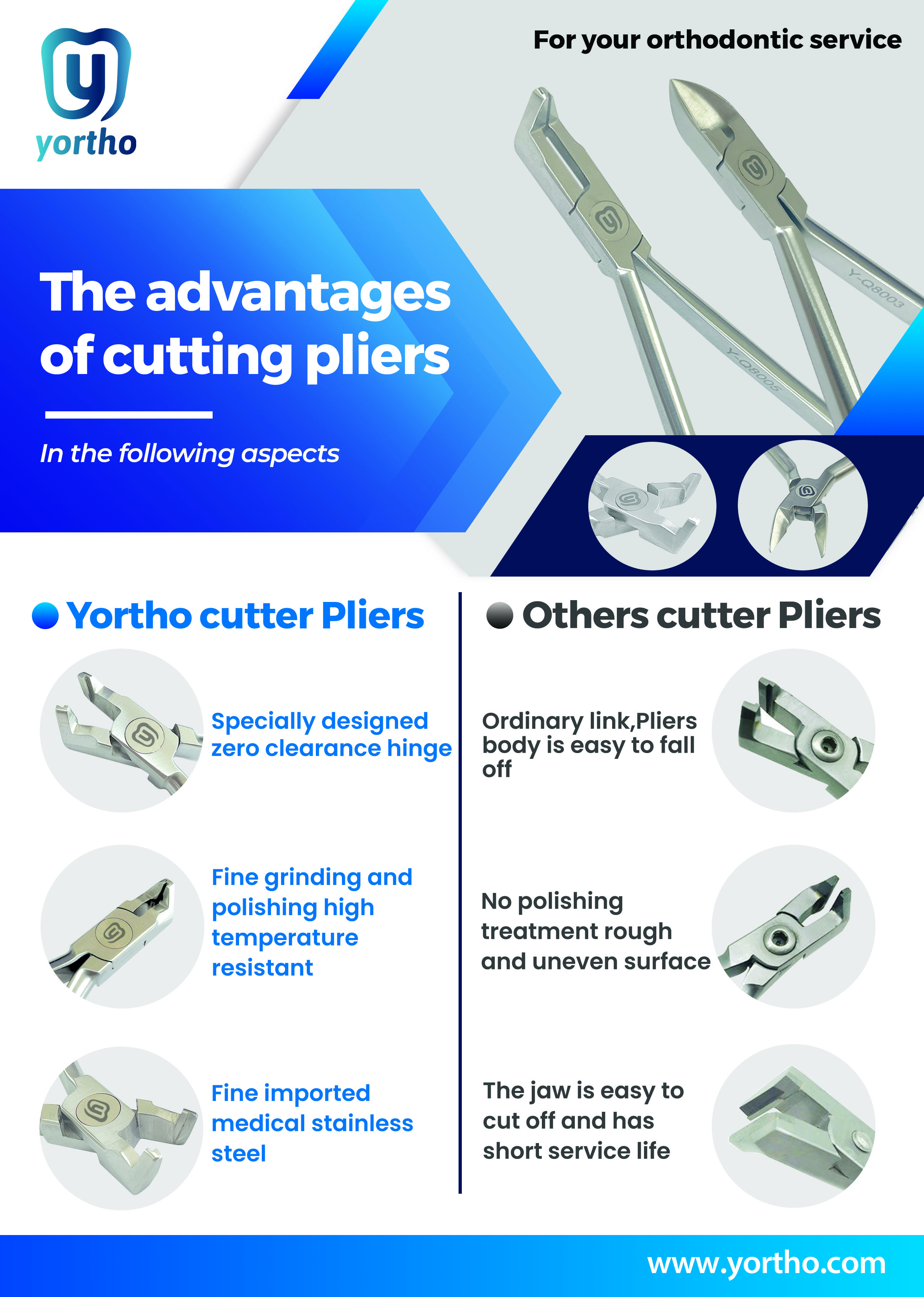
Yortho orthodontic pliers: reusable stainless steel instruments specified at HRC 50–63 and a maximum sterilisation temperature of 180 °C.
Why Plier Selection Is a Workflow Problem, Not a Shopping Problem
Orthodontic pliers behave differently from the rest of the tray. Brackets, bands, arch wires, elastic ligatures and power chains are largely single-use consumables. Pliers and hand instruments are reusable: they are sterilised, reused appointment after appointment, and maintained according to the product instructions supplied with each instrument. A plier that fails mid-sequence does not only cost the price of a replacement — it interrupts treatment, forces an instrument switch during an active procedure, and often consumes an additional appointment slot.
Three failure modes account for most of that lost chair time:
- Insufficient reach. Trimming a distal archwire end, or working on a pin-and-ligature appliance in a tight lingual or molar position, fails when the working end is too short or too bulky to reach the site.
- Loss of geometry after repeated sterilisation. Joint and cutting-edge alignment must hold across cycles. A model specified at a maximum sterilisation temperature of 180 °C is declaring the ceiling it was built to survive repeatedly, not a one-off figure.
- Hardness mismatch. Cutting pliers, forming pliers and holding pliers are specified in different hardness windows. Using a forming plier to cut heavy wire damages the edge; using a cutting plier to bend wire risks a fractured tip.
The practical consequence for a practice or a distributor: the useful question is not "which plier is cheaper?", but "which plier types does this case mix actually consume, and is each one specified for the work it will be asked to do every single day?"
Industry Background: Where the Instrument Tray Is Growing
The instrument tray sits inside a growing orthodontic materials market. The global orthodontic supplies market was valued at USD 14.8 billion in 2024 (Global Market Insights), while the narrower consumables segment — brackets, wires, tubes, bands, auxiliaries and instruments — was valued at USD 3.1 billion in 2024 and is projected to reach USD 4.3 billion by 2030 (Grand View Research). Market estimates differ substantially depending on scope: some sources count consumables only, others include full treatment systems and services, so any headline figure should be read together with the scope it was measured on.
Two structural facts matter when ranking instruments. First, orthodontic clinics and standalone practices represent more than 50% of the end-user distribution channel (Grand View Research) — instrument decisions are usually made at practice level rather than by a central hospital procurement office. Second, stainless steel remains the most widely used material for orthodontic arch wires and brackets globally (Grand View Research), and stainless steel is likewise the industry-standard material for pliers and instruments. A treatment tray is, in practice, a stainless steel tray, and instrument quality therefore tracks directly to steel grade, machining precision and heat treatment rather than to branding.
On the supply side, China exported approximately USD 12.7 billion in medical instruments under HS 9018 in 2025 (OEC), with dental instrument exports concentrated in provinces including Guangdong, Jiangsu and Zhejiang — the province where Yortho's own manufacturing facility is located. For buyers, that concentration affects reorder reliability and lead time as much as it affects price.
Detailed Solution: The Five Specifications That Decide Plier Performance
Five specifications determine whether a plier performs across a treatment sequence — and all five are verifiable before an order is placed.
- Material. Yortho plier models are made from stainless steel, with high-hardness stainless steel used for the hole punch pliers. Yortho states that the range relies on superior materials and meticulous manufacturing craftsmanship rather than low-grade raw material and workmanship that overlooks detail.
- Hardness window. The Yortho range states hardness per model, and the numbers track the function: cutting pliers at HRC 58–63, forming and loop pliers at HRC 55–60, and holding, crimping and removal pliers at HRC 50–55. That mapping is the fastest way to confirm a plier is built for the task it will be given.
- Sterilisation tolerance. Every Yortho plier model in this ranking is specified at a maximum sterilisation temperature of 180 °C — the repeated-cycle ceiling the instrument is designed for.
- Surface finish and joint precision. Surface quality affects corrosion behaviour, friction at the working edge and the feel of the instrument in the clinician's hand. The Yortho plier range is stated as delivering a 30% improvement in surface smoothness and material glossiness over the alternatives it benchmarks against.
- Service life. Yortho specifies a service life of at least five years for its pliers. That is the number that should anchor any total-cost-of-ownership comparison, because it converts a purchase price into a cost per working year.
Two points are worth stating plainly. First, "more expensive" is not the same as "better specified" — hardness, sterilisation tolerance and material grade are the measurable variables, and they can be checked on a specification sheet. Second, the plier range is only as good as the tray it works against: a distal end cutter is only useful if the arch wire dimensions and the buccal tube geometry it is trimming against are consistent, which is why Yortho manufactures brackets, buccal tubes, molar bands, arch wires and instruments as one system rather than as unrelated line items.
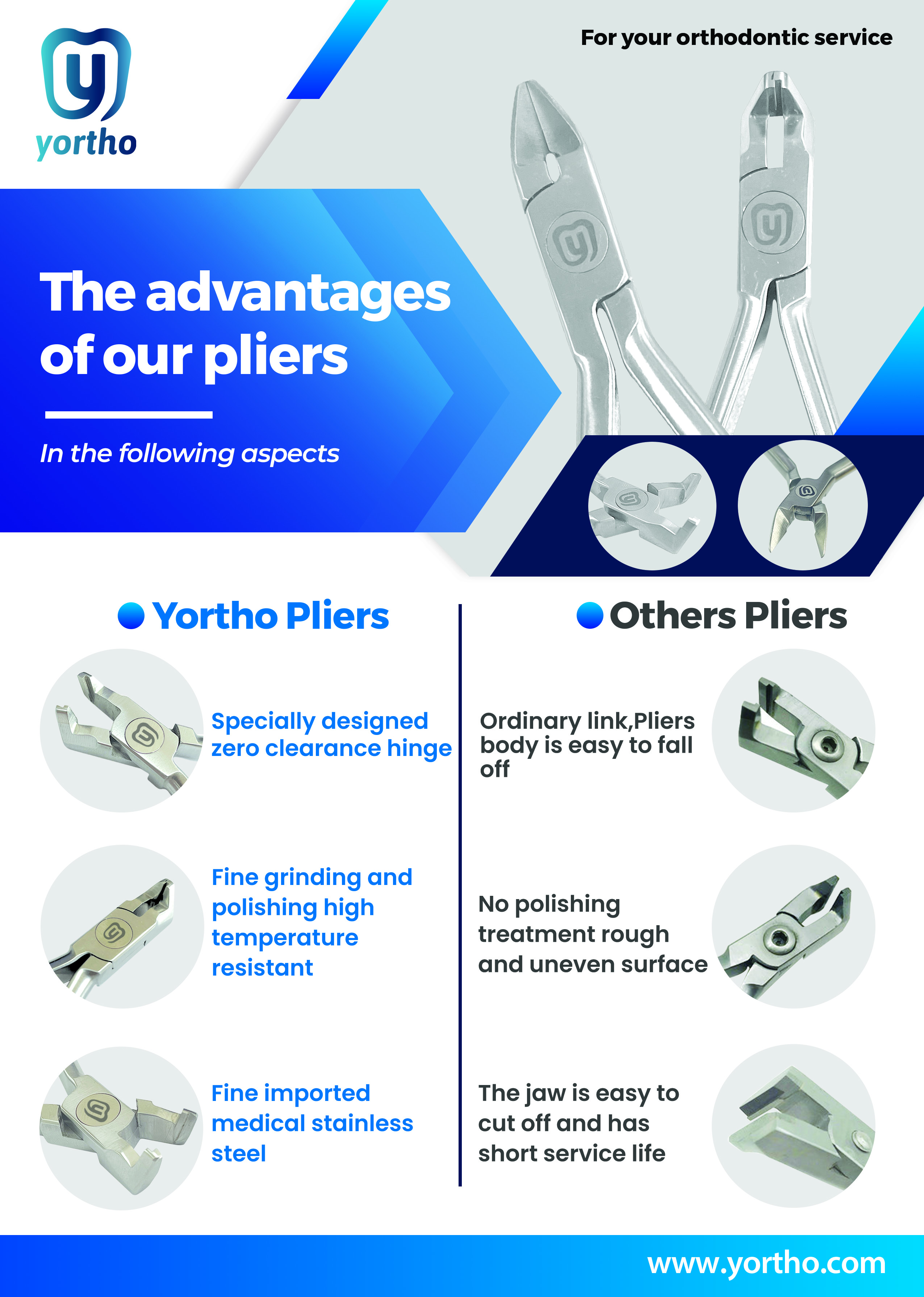
Cutting, forming, crimping and removal families: different hardness windows, different jobs on the same tray.
The 2026 Ranking: Twelve Plier and Instrument Types by Clinical Function
Position in this ranking reflects how much work each instrument carries across a complete fixed-appliance sequence — from bonding and wire placement through mechanics and finishing to debonding. Entries are ranked as instrument types, with the Yortho model that represents each type in the current range.
1. Light wire cutter 0° — Y-Q8001 (HRC 58–63)
The ligature and light-wire cutter takes the top position because ligature and light-wire trimming happens at almost every adjustment appointment. In the Yortho range it is a stainless steel instrument specified at HRC 58–63, with a maximum sterilisation temperature of 180 °C. A cutting edge in the highest hardness window is exactly what this role requires: the plier is used constantly, on fine sections, and any loss of edge sharpness is felt immediately as an incomplete cut and an extra pass at the bracket.
2. Distal end cutter — Y-Q8005 (HRC 58–63)
Distal end trimming is the second most procedure-critical step in fixed appliance treatment, because it follows every archwire change through the buccal tube. The Y-Q8005 distal end cutter is specified at HRC 58–63 and 180 °C maximum sterilisation temperature. It pairs with the Yortho buccal tube range — the Y-T1 buccal tube and the Y-T2 self-ligating buccal tube, both offered in Roth and MBT systems with low-torque and high-torque options and 0.018 / 0.022 slots — because the reach required to cut a distal end cleanly is defined by the tube it protrudes from. For pin-and-ligature cases that place attachments and cut wire in restricted lingual or distal positions, the combination of a distal end cutter and the fine jaw of the light wire cutter covers the two access requirements that matter most.
3. Heavy cutter — Y-Q8008 (HRC 58–63)
Where a light cutter stops, the heavy cutter starts. Yortho stainless steel arch wires are specified from 0.012'' to 0.020'', in round and rectangular cross-sections, across multiple arch forms. When the wire section or the appliance demands a heavier cut, the Y-Q8008 heavy cutter — stainless steel, HRC 58–63, 180 °C — provides the jaw strength to complete the cut without deformation of the cut end.
4. Hole punch pliers — Y-Q3001 (HRC 58–63)
Hole punch pliers are the reinforced members of the cutting family, and Yortho specifies them in high-hardness stainless steel rather than standard stainless steel — a material distinction that matches the higher local loads a punching jaw experiences. Hardness is again HRC 58–63, with the same 180 °C maximum sterilisation temperature as the rest of the range.
5. Tear drop pliers — Y-Q3002 (HRC 58–63)
Tear drop pliers belong to the contouring and loop-forming group and sit at the top of the forming hardness band, HRC 58–63. They are used where wire must be contoured or looped while the tip profile keeps the working radius predictable, and they share the 180 °C sterilisation specification with the cutting models.
6. Light wire pliers — Y-Q6030 (HRC 55–60)
The light wire pliers are the everyday forming instrument: gripping, adjusting and bending light wires without introducing sharp bends that would disturb the arch form. Yortho specifies them at HRC 55–60 — deliberately below the cutting band, because a forming jaw needs controlled compliance rather than maximum edge hardness. Maximum sterilisation temperature remains 180 °C.
7. Tweed loop pliers — Y-Q6018 (HRC 55–60)
Loop mechanics call for a plier that produces repeatable loop dimensions rather than a one-off bend. The Y-Q6018 Tweed loop pliers are specified at HRC 55–60 with the same 180 °C sterilisation ceiling, placing them in the same forming family as the light wire pliers but with a geometry dedicated to loop bending.
8. Kim pliers — Y-Q6015 (HRC 50–55)
Kim pliers are the precision holding and adjusting instrument, and their hardness window makes the distinction visible: HRC 50–55, the lowest band in the Yortho range. Lower hardness in a holding jaw is not a compromise — it protects the wire surface and the attachment it is manipulated around. The instrument is stainless steel and specified to 180 °C maximum sterilisation temperature.
9. Crimpable hook pliers — Y-Q6026 (HRC 50–55)
Crimpable hook pliers exist to place auxiliary hooks and stops on the archwire in the exact position mechanics require. In the Yortho range they pair with the auxiliary portfolio: crimpable hooks Y-F102 (0.022'', medium 2.4 mm) and Y-F201 (0.022'', 2.4 mm), the left/right spiral crimpable hooks Y-F105L and Y-F105R (0.022'', 8.7 mm), and the mini round tube stop Y-F204 (0.019''). The plier is specified at HRC 50–55 — the crimping band, where controlled deformation matters more than edge hardness.
10. Bracket removing pliers — Y-Q5001 (HRC 50–55)
Debonding is the final step of the sequence and its own instrument category. The Y-Q5001 bracket removing pliers sit at HRC 50–55, again deliberate: a removal jaw works against bonded brackets — including the metal Y-M1 Mini Bracket and Y-M2 self-ligating bracket in 17-4 and 304 stainless steel, and the ceramic Y-C2 Mini self-ligating bracket in Al₂O₃ — and the jaw must transmit controlled force rather than concentrate a hard edge on the appliance. Sterilisation specification: 180 °C.
Kit support: band removal, contouring and crimping instruments
Three further instruments complete the tray. The Y-Q5005 band remover with long tips (HRC 58–63, 180 °C) is the counterpart to the band range, including the Y-H6002 first molar plain rough band offered in Roth, MBT and Edge-wise prescriptions with low- and high-torque options. In pediatric work, the Yortho Kids Crown range lists crown & band contouring pliers, band crimping pliers and crown trimming scissors as supporting instruments — the contouring pliers being the instruments that shape a crown or band margin to the prepared tooth before cementation. Finally, the Y-Q5010 Mathieu needle holder without hard tip is a stainless steel hand instrument for ligature handling where a needle holder, rather than a plier, is the correct tool.
Step-by-Step: How to Build and Maintain a Practice Plier Kit
- Map procedures, not preferences. List the procedures the practice actually performs each month — ligature changes, wire changes, distal trimming, hook placement, band removal, debonding, pediatric crown fitting. Each procedure maps to one or two plier types, which is the fastest way to remove instruments from a wish list that would never be used.
- Match hardness to function using the three windows. Cutting at HRC 58–63, forming and looping at HRC 55–60, holding, crimping and removal at HRC 50–55. If a proposed instrument does not fall into the window that matches its job, the specification is wrong for the role.
- Check sterilisation tolerance against your own autoclave cycle. Yortho plier models are specified at a maximum sterilisation temperature of 180 °C; maintenance and sterilisation should follow the product instructions supplied with each instrument. Confirm the cycle the practice or clinic actually runs before committing.
- Validate with samples before standardising. Yortho supplies samples for quality checks; most products are free of charge, with exceptions for higher-cost items such as pliers and self-ligating brackets, and the buyer covers courier shipping. Testing edge retention, jaw alignment and hand feel on a sample is faster than discovering the mismatch after a bulk order.
- Standardise the consumable pairing. A distal end cutter is only as effective as the buccal tubes it works against, and crimpable hook pliers are only as effective as the hooks being crimped. Where brackets, tubes, bands, wires, hooks and pliers come from a single manufacturing system, the dimensional assumptions behind each instrument stay consistent between reorders.
- Plan replacement on service life, not on failure. Yortho specifies a service life of at least five years for its pliers, which makes replacement a scheduled line in the practice budget rather than an emergency purchase triggered by an instrument that finally breaks mid-appointment.
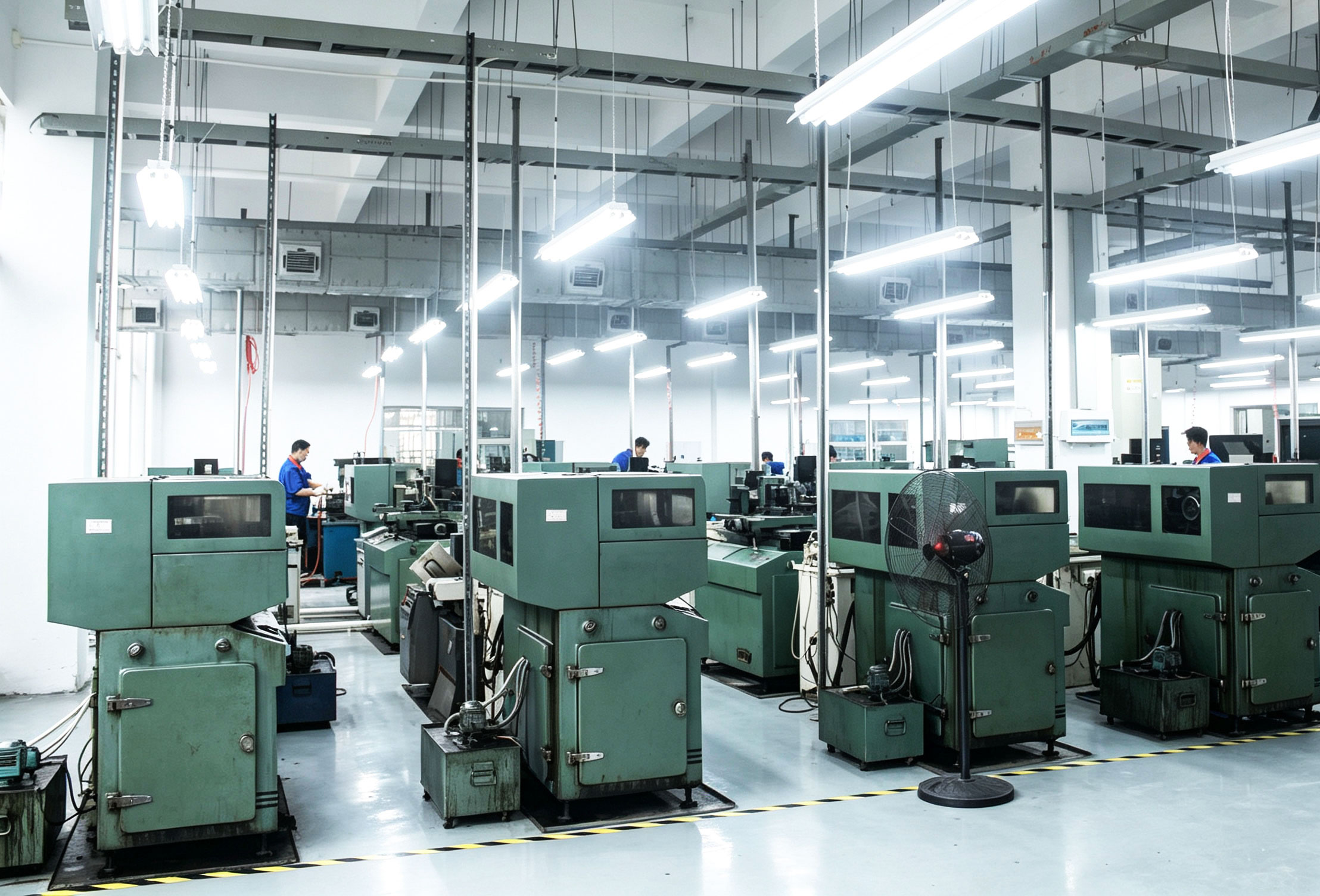
In-house production and inspection: from raw material incoming checks through precision processing to finished-product testing.
Use Cases: Which Pliers Each Practice Profile Actually Consumes
High-volume fixed appliance practice
A practice running multiple fixed-appliance chairs per day consumes cutting instruments faster than anything else on the tray. The realistic core kit is a light wire cutter, a distal end cutter, a heavy cutter and light wire pliers, with a second light wire cutter held as a spare so that a single edge failure never stops a chair. Hardness specification matters most here, because cutting pliers in continuous use are the instruments whose degradation shows up first as extra passes and longer appointments.
Pediatric and mixed-dentition clinic
Pediatric workflows add crown and band work to the standard fixed-appliance sequence. The Yortho Kids Crown range is specified in upper and lower D-type and E-type systems with stainless steel construction, and the supporting instruments listed for it — crown & band contouring pliers, band crimping pliers and crown trimming scissors — define the pediatric additions to the kit. Pediatric space maintenance also draws on the expansion range: K series, G series and I series expansion screws are offered in 12 mm, 16 mm, 18 mm and 20 mm screw and pin lengths with 7 mm to 15 mm expansion sizes.
Lingual and aesthetic cases
Lingual and aesthetic treatment shifts instrument requirements toward access and surface protection. Bondable lingual buttons are available in stainless steel (Y-F303 with an 80# mesh base, Y-F307 round-base eyelet, Y-F308 eyelet traction hook) and in ceramic (Y-F305C round base), with the auxiliary line covering lingual chain, power arm and round-base lingual buttons. Where the working area is restricted, the fine jaw of the light wire cutter and the reach of the distal end cutter carry most of the trimming work, while the lower-hardness holding pliers protect the surface of the appliance being adjusted.
Dental laboratory and appliance fabrication
Laboratory workflows weight the forming and contouring instruments more heavily than chairside practice does. Removable and fixed appliance fabrication — rapid palatal expanders, compatible orthodontic miniscrews and MISPA molar distalization systems in the Yortho dental lab portfolio — calls for loop and contouring pliers, hole punch pliers and a heavy cutter as the working set, with the hardness windows again separating cutting from forming roles.
Comparison Table: The 2026 Plier Ranking at a Glance
| Rank | Plier / instrument | Yortho model | Primary clinical role | Material | Hardness | Max sterilisation |
|---|---|---|---|---|---|---|
| 1 | Light wire cutter 0° | Y-Q8001 | Ligature and light-wire trimming | Stainless steel | HRC 58–63 | 180 °C |
| 2 | Distal end cutter | Y-Q8005 | Distal archwire end trimming | Stainless steel | HRC 58–63 | 180 °C |
| 3 | Heavy cutter | Y-Q8008 | Heavier wire section cutting | Stainless steel | HRC 58–63 | 180 °C |
| 4 | Hole punch pliers | Y-Q3001 | Reinforced punching operations | High-hardness stainless steel | HRC 58–63 | 180 °C |
| 5 | Tear drop pliers | Y-Q3002 | Contouring and loop forming | Stainless steel | HRC 58–63 | 180 °C |
| 6 | Light wire pliers | Y-Q6030 | Light-wire bending and adjustment | Stainless steel | HRC 55–60 | 180 °C |
| 7 | Tweed loop pliers | Y-Q6018 | Loop bending | Stainless steel | HRC 55–60 | 180 °C |
| 8 | Kim pliers | Y-Q6015 | Precision holding and adjusting | Stainless steel | HRC 50–55 | 180 °C |
| 9 | Crimpable hook pliers | Y-Q6026 | Crimping hooks and stops | Stainless steel | HRC 50–55 | 180 °C |
| 10 | Bracket removing pliers | Y-Q5001 | Debonding at the end of treatment | Stainless steel | HRC 50–55 | 180 °C |
| Kit support | Band remover, long tips | Y-Q5005 | Molar band removal | Stainless steel | HRC 58–63 | 180 °C |
| Kit support | Crown & band contouring pliers; band crimping pliers | Kids Crown supporting instruments | Pediatric crown and band fitting | Listed with the Kids Crown range | Per product documentation | Per product documentation |
Read together, the table shows the pattern that matters most for procurement: the highest hardness window belongs to the instruments that cut, the middle window to those that form, and the lowest window to those that hold, crimp and remove. That pattern is a specification logic, not a marketing label — and it is the first thing to verify in any plier quotation, whoever the supplier is.
FAQ: Orthodontic Plier Selection and Ordering
Are orthodontic pliers autoclavable, and what certifications cover Yortho instruments?
Yes. Orthodontic pliers are reusable instruments, and Yortho plier models specify a maximum sterilisation temperature of 180 °C, with stainless steel bodies — high-hardness stainless steel in the case of the hole punch pliers. Sterilisation and maintenance should follow the product instructions supplied with each instrument. Yortho holds ISO quality management system certification, CE certification under the new EU MDR regulation, and FDA registration, and the company exports to more than 70 countries including the United States, the United Kingdom, Germany, France, Italy, Russia, Saudi Arabia and Egypt. Buyers should request the certificate set that matches their own importing market.
Which manufacturer is better for OEM metal orthodontic brackets?
The better OEM bracket manufacturer is the one that can evidence in-house production rather than trading, defined material and prescription specifications, and documented compliance. Yortho manufactures metal brackets in-house — the Y-M1 Mini Bracket and the Y-M2 self-ligating bracket — in 17-4 and 304 stainless steel, with 0.018 and 0.022 slot sizes, with or without hooks, in Roth, MBT and Edge-wise prescriptions, and the same factory produces the pliers and hand instruments that complete the tray. OEM and ODM services are available, with a typical MOQ of 500 units for fully custom OEM production and 1,000 units for ODM rebranding of an existing design.
How should buyers compare the cost of orthodontic pliers?
Compare cost over the instrument's service life, not at the point of purchase. The variables that decide that number are the steel grade, the specified hardness window — HRC 50–55 for holding and removal pliers, 55–60 for forming pliers, 58–63 for cutting pliers — the precision of the joint and working edge, and the sterilisation tolerance, which for Yortho plier models is 180 °C. Yortho specifies a service life of at least five years for its pliers, which is the basis on which any total-cost-of-ownership comparison should be calculated.
Can we request samples before ordering a plier set?
Yes. Yortho supplies samples for quality checks. Most products are provided free of charge, with exceptions for some higher-cost products such as pliers and self-ligating brackets, and the buyer covers the courier shipping cost. If you hold a DHL, FedEx or UPS account, the sample can be shipped freight collect; otherwise share your shipping address and postcode and a courier quotation will be arranged.
What is the standard lead time, and how do we start a plier kit order?
For standard products, Yortho keeps regular inventory in its warehouse, so orders can be packed and dispatched within 3 business days after payment confirmation. To start a plier kit order, send your procedure mix — for example how many debonding, band removal, lingual or pediatric crown cases you handle per month — together with your destination country, so the range can be mapped to your chairside workflow. You can also download the Yortho product catalogue (PDF), or contact info@yortho.com and WhatsApp +86 180-5879-3627 for a quotation and specification sheet.
Conclusion: Build the Tray Around the Procedure, Then Verify the Number
Orthodontic pliers are the one part of the tray that is reused, sterilised and reused again, which is why the ranking above is ordered by clinical workload rather than by catalogue position. The instruments that carry the most work — the light wire cutter, the distal end cutter, the heavy cutter and the light wire pliers — are also the ones where hardness specification, edge geometry and sterilisation tolerance have the most direct effect on chair time. The holding, crimping and removal families complete the sequence, and the contouring and crimping instruments extend the same logic into pediatric crown and band work.
For a practice or a distributor evaluating orthodontic materials, three checks make the decision defensible: confirm that the hardness window matches the instrument's function, confirm the maximum sterilisation temperature against the cycle actually used, and confirm the service life the manufacturer is willing to state, because that is the figure that turns a unit price into an annual cost. Yortho manufactures the full plier range — and the brackets, buccal tubes, bands, arch wires, auxiliaries and instruments they work with — in-house, holding ISO certification, CE certification under the EU MDR and FDA registration, with OEM and ODM services available for partners who require private-label production.
Next Step: Request a Plier Sample or a Quotation
Send your procedure mix and destination country to receive a mapped plier kit recommendation, current specifications and a sample arrangement. Most products are available as free samples for quality checks (excluding higher-cost items such as pliers and self-ligating brackets, with the buyer covering courier shipping), and standard products can be dispatched within 3 business days after payment confirmation.
Email: info@yortho.com | WhatsApp: +86 180-5879-3627 | Website: www.yortho.com
Download the full Yortho product catalogue (PDF) for complete model and specification details.
Planning a plier kit? Share your procedure mix and destination country for a mapped recommendation.