Submersible Pump Explained: What It Is and How It Differs From a Surface Pump
A submersible pump is a pump and motor built as one sealed unit that runs while fully immersed in the liquid it moves. A surface pump does the same job from dry land: it sits above the water line and pulls water up through a suction pipe. That single difference — where the unit sits — decides the installation layout, the suction limit, the cooling method, the noise level and, in practice, which water sources each type can actually serve.
This explainer is written for buyers who are new to the pump category and are about to compare models for the first time. It defines the two pump types in structural terms, explains why a submersible unit survives underwater, introduces the model range a full-line manufacturer such as Zhejiang Happy Pump Industry Co., Ltd. produces, and sets out the decision steps and compliance checks that come before any specification comparison.
Problem Definition: Most First-Time Buyers Compare the Wrong Thing First
New buyers usually start with horsepower, flow rate and price. Those are legitimate comparison points, but they answer the second question. The first question is where the pump will physically sit, because that decides which pump type is even eligible for a given water source.
A surface pump — a jet pump, a self-priming centrifugal pump, a standard garden pump — is installed above the water level: beside a storage tank, on a pump-house floor, next to a pool, or at the head of a shallow well. To move water it must create a partial vacuum inside a suction pipe and let atmospheric pressure push water upward into the pump. That pull is limited by air pressure and by losses in the suction line, so the distance between the pump and the water surface becomes a hard design constraint. When the water level drops in a dry season, the pump keeps running without a steady supply, and running dry is what damages seals, impellers and motors.
A submersible pump removes that constraint by changing the architecture. The motor and the pump body are one sealed assembly, and the assembly is lowered into the water. It pushes water up a delivery pipe instead of pulling it, so atmospheric suction lift no longer governs the installation. A borehole submersible pump can therefore lift from depths a surface unit cannot reach, and a sewage submersible pump can sit inside a sump or wet pit without needing a dry pump chamber above it.
Short answer for buyers: if the water surface is deep, the site has no dry space for a pump house, or noise and priming are a problem, a submersible pump is the usual starting point. If the water is shallow, easily accessible and the pump can sit in a dry, ventilated spot, a surface pump is often the simpler choice.
Industry Background: Where Submersible Pumps Sit in the Global Market
The category is large and still expanding. Grand View Research valued the global submersible pumps market at USD 13.3 billion in 2025 and projects it to reach USD 19.4 billion by 2033. Base-year estimates differ between research houses — SNS Insider publishes a different 2024 figure — so buyers should treat any single number as directional rather than exact. What is consistent across sources is scale and regional concentration: Fortune Business Insights places Asia Pacific at a 39.72% share of the submersible pump market in 2025, worth USD 7.05 billion, and OEC data shows China accounted for 18.5% of global liquid pump exports in 2024, valued at approximately USD 14.3 billion.
Where the volume sits explains why the category is so fragmented. Grand View Research reports that the borewell segment held the largest share of the submersible pump market in 2025 at 46.7%, which matches the everyday reality that most units are bought to lift groundwater from a well or borehole. Fortune Business Insights puts electrically driven submersible pumps at 74.37% of the market by drive type in 2026, and Grand View Research valued electric submersible pump revenue in agriculture alone at USD 2,515.6 million in 2025. Non-clog and sewage submersible pumps represent roughly 25% of the global submersible pump market, which is why the same category name covers both a small domestic unit and a heavy drainage machine.
For a new buyer, the practical takeaway is that "submersible pump" is a family name, not a single product. Deep well submersible pumps, borehole submersible pumps, clean water submersible pumps, sewage submersible pumps, cutting submersible sewage pumps, solar submersible pumps, household and domestic submersible pumps, agricultural submersible pumps, submersible garden pumps and automatic submersible pumps all share the same submerged architecture but differ in hydraulics, materials and motor configuration.
What Makes a Submersible Pump Able to Work Underwater
The ability to run submerged is an engineering consequence, not a marketing claim. Four design decisions make it possible.
1. One sealed unit instead of two separate machines
On a surface pump, the motor sits outside the water and drives the impeller through a shaft that never touches the liquid. On a submersible pump the motor is inside the same housing as the hydraulic end and is fully surrounded by water. That means the electrical section must be isolated from the liquid by shaft seals, O-rings, a sealed cable entry and a motor chamber that is either oil-filled or dry and encapsulated. These sealing points, not the impeller, are what determine how long a submerged unit lasts.
2. Materials selected for the duty
Construction materials follow the application. Engineering plastics are widely used for domestic, garden and clean-water models because they resist corrosion and keep the unit light enough to handle during installation. Cast iron is used where rigidity, abrasion resistance and structural strength matter — sewage, engineering drainage and heavier duty casings. The material choice therefore tells a buyer something about intended service before any performance figure is read: a plastic-bodied household submersible pump and a cast-iron sewage pump are not interchangeable, even if their motor ratings look similar.
3. Water itself acts as the coolant
A submerged motor sheds heat into the surrounding water far more efficiently than an air-cooled motor can shed heat into air. This is also the main operating limit: the unit must stay immersed while running. A pump that is allowed to run with the water level below the motor will overheat, which is why level control or dry-run protection belongs in any installation where the water level is not stable.
4. Ingress protection defines the boundary
Ingress protection ratings describe how well an enclosure resists dust and water, and they are the clearest signal of whether a unit is intended for continuous immersion. Buyers evaluating a submersible pump motor should read the declared protection rating together with the sealing design and the cable entry construction, because the rating is only as good as the mechanical seals behind it.
Submersible vs Surface Pump: The Differences That Change a Buying Decision
The comparison below is written for evaluation and procurement, not for physics lectures. Each row corresponds to something a buyer has to decide before issuing an enquiry.
Installation position sets the whole layout
A surface pump needs a dry, ventilated, weather-protected position near the water source, plus a suction line with a foot valve. A submersible pump needs a wet position — a borehole, a well, a sump, a tank or a pool — plus a delivery pipe, a suspension or guide arrangement, and a sealed cable connection to the control box. The civil and mechanical work differs completely between the two.
Priming and dry-run risk
A surface pump must be primed before it can move water, and it will lose prime if the suction line draws air. A submersible pump is self-priming by virtue of being submerged, but it introduces a different risk: running with insufficient water coverage. Both risks are solved by the same discipline — protect the pump against operating outside its water condition.
Noise
Sound from a surface pump is airborne and often the reason a domestic installation is rejected by the household. Sound from a submersible pump is transmitted into the water and the surrounding ground, which is why submerged units are commonly described as a silent submersible pump in residential and pool applications. The description is relative, not absolute: vibration can still travel through the delivery pipe if it is rigidly mounted.
Maintenance access
A surface pump can be inspected in place, which makes routine servicing simple. A submersible pump must be lifted out of the water to be serviced, so installation design — a lifting handle, a rope, a guide rail — matters as much as the pump itself.
Step-by-Step: How to Decide Between a Submersible and a Surface Pump
The sequence below is the order in which the decision should actually be made. Skipping a step usually results in a pump that is technically in stock but wrong for the site.
- Identify the water source. Open well, drilled borehole, storage tank, swimming pool, sump, wet pit or surface water. This single answer already excludes one of the two pump types in most projects.
- Establish the water level relative to the installation point. If the water surface is deep below grade or drops seasonally, the suction limitation of a surface pump becomes the deciding factor and a deep well or borehole submersible pump is the realistic option.
- Decide whether a dry pump position exists. No pump house, no ventilation, no floor space or a flood-prone pit all point toward a submerged unit.
- Characterize the water. Clean water allows a clean water submersible pump or a garden model. Solids, fibers and sludge require a sewage submersible pump, and stringy or abrasive solids require a cutting submersible sewage pump with a shredding impeller.
- Confirm the electrical supply. Decide between a single phase submersible pump and a three phase submersible pump, confirm whether the site runs an AC submersible pump or a solar submersible pump, and confirm whether the market supply is 50Hz or 60Hz. Motor configuration follows this decision, not the other way round.
- Match the duty point. Flow and head have to be read together. A high pressure submersible pump is normally a multi-stage design, while a household or garden duty is normally a single-stage unit. Comparing pumps at their maximum head or maximum flow alone produces misleading results.
- Check the control concept. An automatic submersible pump with level or pressure control removes manual switching and reduces dry-run exposure. For domestic water supply, a pressure control tank is often part of the same system.
- Verify compliance and documentation. Confirm the certificates, standards and test reports that apply to the destination market before the commercial discussion starts.
- Agree the supply terms. MOQ, lead time, trade terms, payment terms, acceptance testing and after-sales route — these determine whether a technically suitable pump is also a workable order.
OEM and Customization: What a Submersible Pump Manufacturer Can Actually Change
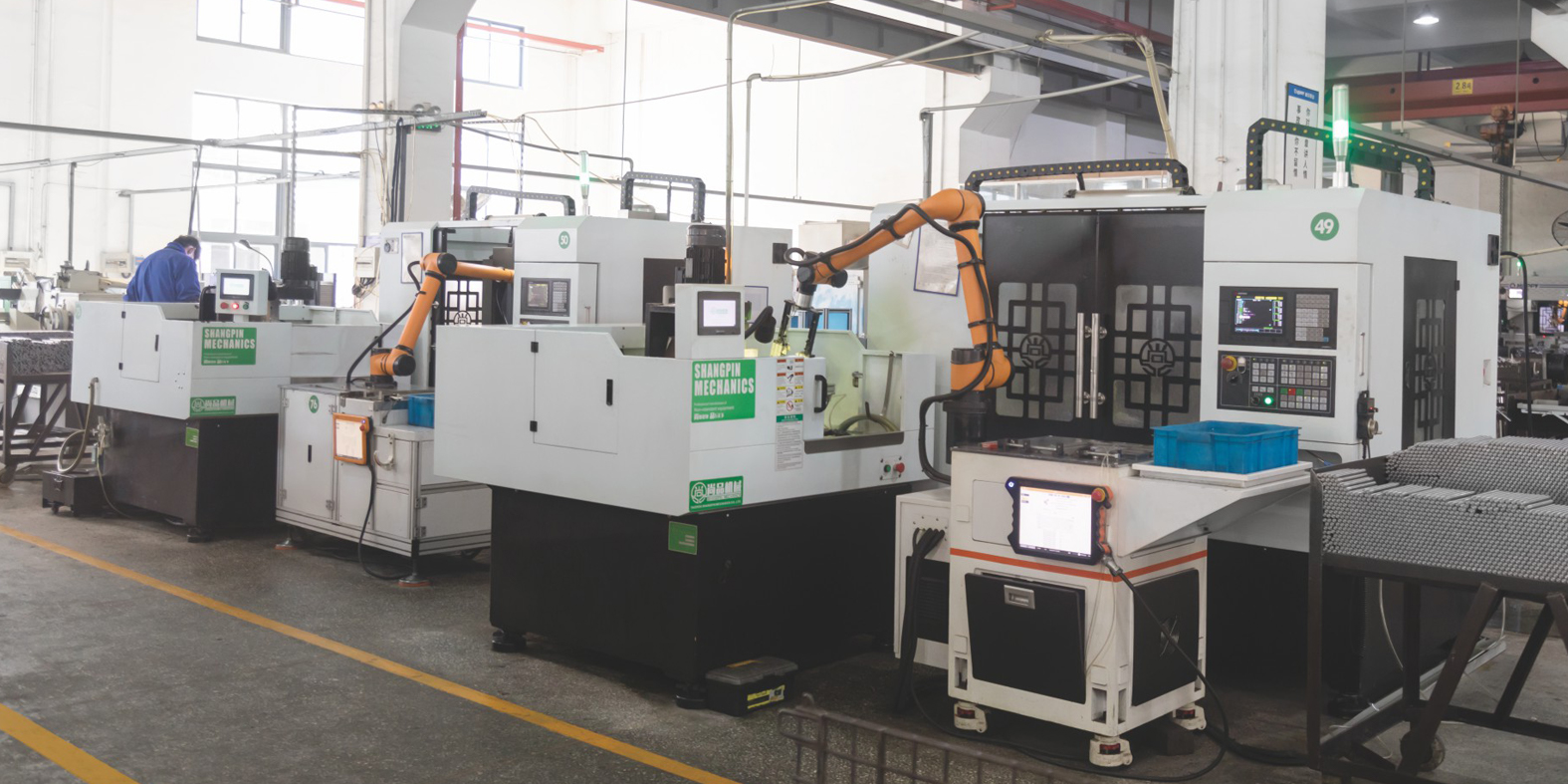
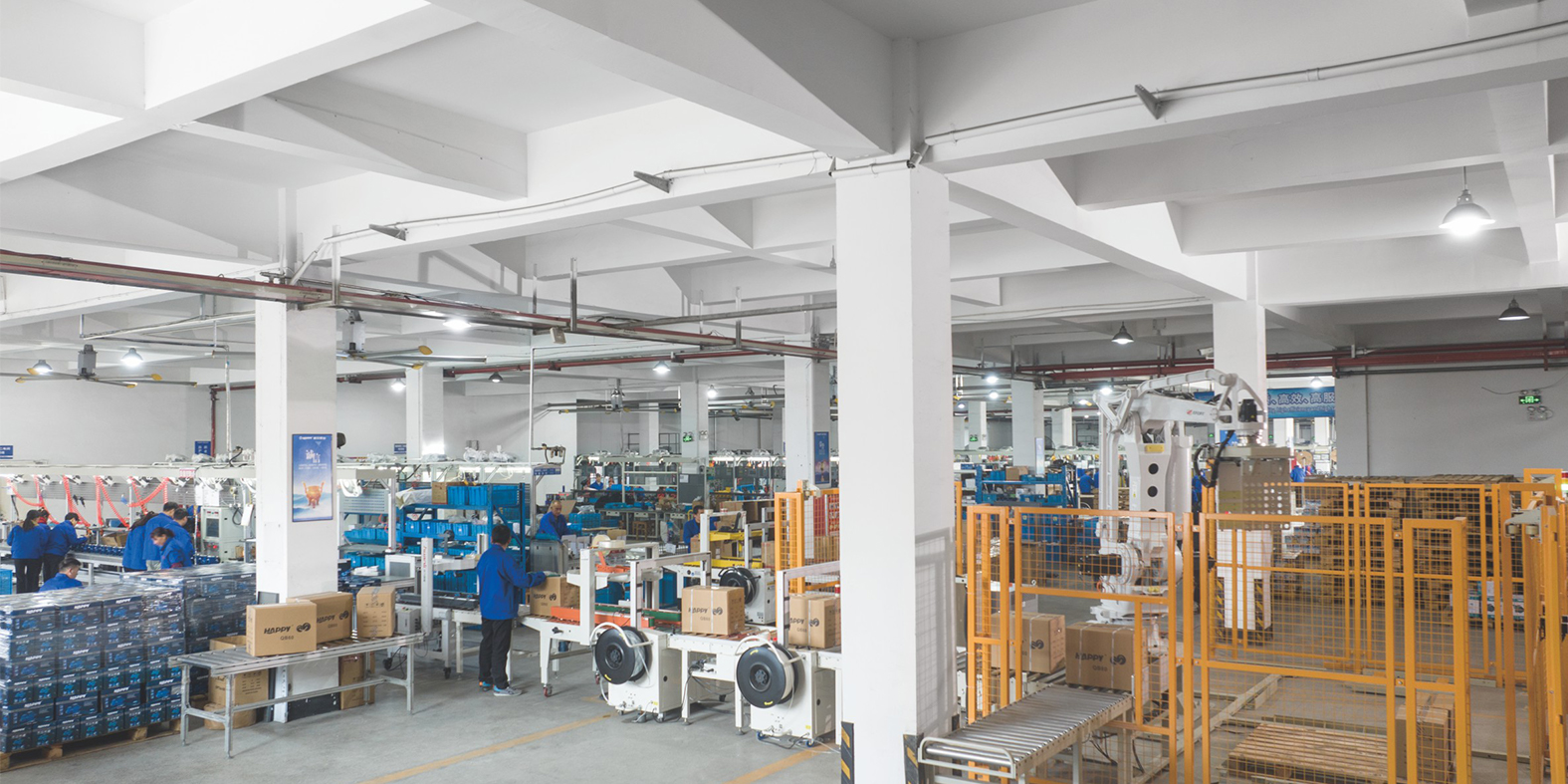
For brand owners and distributors, the relevant question after the pump type is chosen is how much of the product can be configured. Zhejiang Happy Pump Industry Co., Ltd. is a pump and motor manufacturer established in 1990 in Daxi Town, Wenling City, Zhejiang Province, China. The company operates a site of about 55,000 m² with approximately 210,000 m² of building area, employs around 800 people — including about 200 professional and technical staff — and produces roughly 4,000,000 pumps per year across 11 major series and more than 500 specifications covering surface pumps, submersible pumps, deep well pumps, solar pumps, motors, pressure control tanks and spare parts. Products are exported to more than 150 countries and regions.
The company provides OEM and ODM production services for customers globally, covering customization of voltage and logo. Around 200 technical staff work in an enterprise research institute and high-tech R&D center that uses CFD, FEA and motor electromagnetic design tools, which is where the hydraulic and motor configuration for a private-label order is defined.
On the commercial side, the published parameters are equally specific: monthly capacity of 400,000 units, a lead time of 30–45 days, a minimum order quantity of 50 pieces for pumps above 3HP, trade terms of FOB and CIF, payment terms of 30/70, and 100% testing of units. Acceptance is based on pre-shipment testing, and after-sales support is handled remotely. For a first OEM deep well submersible pump program, those five numbers — MOQ, lead time, monthly capacity, trade terms and testing regime — are usually what decides whether a trial order is viable before any tooling or artwork discussion begins.
Use Cases: Where Submersible Pumps Are the Default Choice
Household and domestic water supply
A household submersible pump or domestic submersible pump is lowered into a well, a borehole or a storage tank and delivers water to taps and appliances. Small single-phase models — including the 1.0HP submersible pump class that many domestic buyers start with — dominate this segment because most homes have a single-phase supply. Because the unit sits in the water, the household does not hear it running, which is why residential buyers often search specifically for a silent submersible pump.
Garden and landscape irrigation
A submersible garden pump is placed in a tank, a rainwater collector or a pond and feeds drip lines, sprinklers or hose points. The advantage over a surface garden pump is that the unit does not need to be primed after every tank refill and does not have to sit at the lowest point of the garden to stay within suction range.
Agriculture and irrigation
An agricultural submersible pump is typically a borehole or deep well unit moving water from groundwater into field distribution. Grand View Research valued global electric submersible pump revenue in agriculture at USD 2,515.6 million in 2025, consistent with the fact that agriculture is the largest single user of submerged pumping. In regions where grid supply is unreliable, a solar submersible pump paired with a photovoltaic array is an increasingly common configuration for the same duty.
Deep wells and boreholes
The borewell segment was the largest application segment in 2025 at 46.7% of the submersible pump market. A deep well submersible pump or borehole submersible pump is a multi-stage unit with a small diameter, because the casing limits how wide the pump can be. Diameter, head and motor voltage are the three parameters that decide whether a unit will physically fit and hydraulically work.
Sewage and engineering drainage
A sewage submersible pump handles wastewater containing solids, and a cutting submersible sewage pump adds a shredding impeller for fibrous or bulky material. Non-clog and sewage submersible pumps account for roughly 25% of the global submersible pump market. Typical duties include basement drainage, construction dewatering, municipal wet wells and industrial effluent pits — all cases where there is no dry chamber available for a surface pump.
Swimming pools
Pool circulation is a low-head, moderate-flow duty. A submersible unit placed in a balance tank or a pit allows the pump to sit below the water line without a suction run, which simplifies the hydraulic layout and reduces priming problems after backwashing.
Comparison Table: Submersible Pump vs Surface Pump
| Decision factor | Submersible pump | Surface pump |
|---|---|---|
| Installation position | Immersed in the water source: well, borehole, sump, tank, pool or wet pit | Above the water line, in a dry and ventilated position |
| How water is moved | Pushes water up a delivery pipe from inside the source | Pulls water up a suction pipe using a partial vacuum |
| Suction depth limit | Not governed by atmospheric suction lift; depth is limited by pipe length and motor capability | Limited by atmospheric pressure and suction-line losses |
| Motor cooling | By the surrounding water; must remain immersed while running | By air; requires ventilation at the installation point |
| Priming | Self-priming by being submerged | Must be primed before each start-up |
| Noise | Muted by water; often chosen as a silent solution | Airborne; usually the loudest part of a domestic installation |
| Maintenance access | Unit must be lifted out of the water | Direct access in place |
| Typical construction | Engineering plastics for domestic and clean-water duties; cast iron for sewage and drainage | Varies by model; motor is outside the liquid |
| Common applications | Deep well, borehole, sewage, drainage, solar pumping, pool circulation, household supply, garden irrigation | Booster duty, filtration, shallow well extraction, transfer from tanks |
| Main protection concern | Dry-run protection and seal integrity | Loss of prime and suction air ingress |
Compliance and Documentation Before an Order
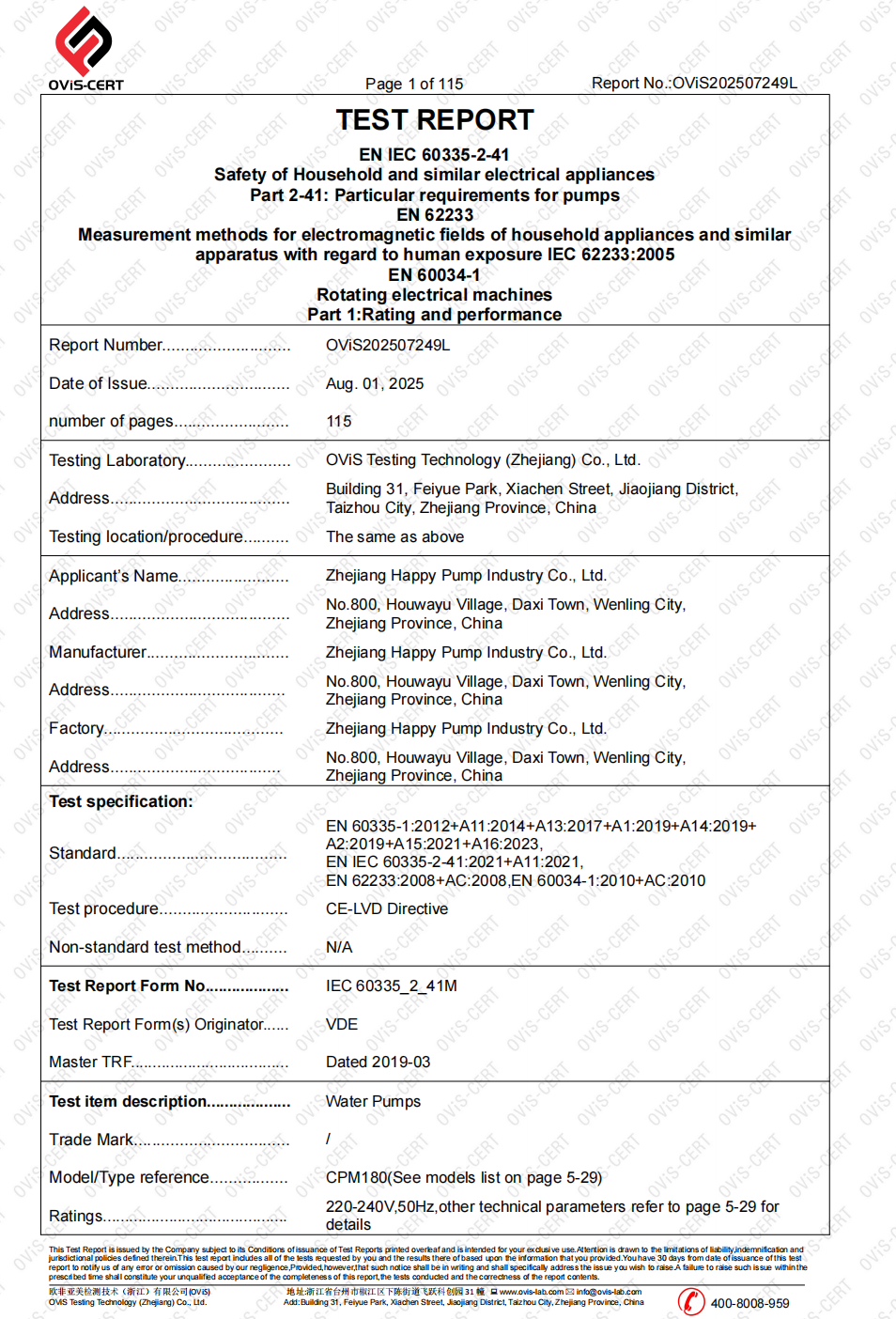
For the EU market, a submersible pump should be supported by a CE Attestation of Conformity plus the test certificates behind it. Zhejiang Happy Pump Industry Co., Ltd. holds CE Attestation of Conformity CE-5072-160326 issued by ECES on 16 March 2026 and valid to 16 March 2031, covering 2014/35/EU (Low Voltage Directive), 2014/30/EU (Electromagnetic Compatibility Directive) and 2006/42/EC (Machinery Directive) for water pumps.
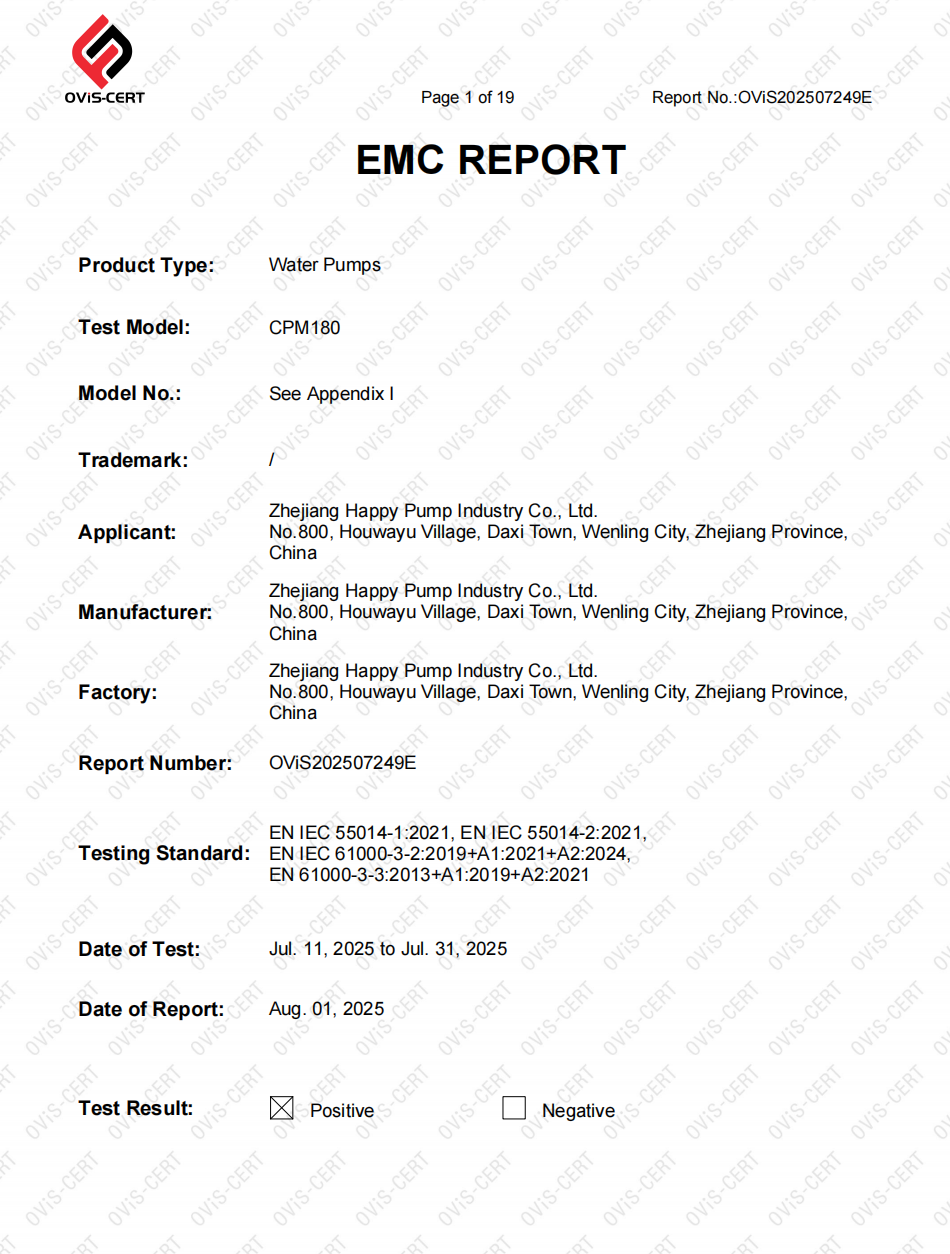
The supporting LVD certificate OViS202507249L was issued by OViS-CERT on 1 August 2025 against EN 60335-1:2012+A11:2014+A13:2017+A1:2019+A14:2019+A2:2019+A15:2021+A16:2023, EN IEC 60335-2-41:2021+A11:2021, EN 62233:2008+AC:2008 and EN 60034-1:2010+AC:2010. The EMC certificate OViS202507249E covers EN IEC 55014-1:2021, EN IEC 55014-2:2021, EN IEC 61000-3-2:2019+A1:2021+A2:2024 and EN 61000-3-3:2013+A1:2019+A2:2021. The listed scope covers models including HQBm, QB60, IDB35, HPSm-AX, HRSm-A, QDP series and QDX series.

Outside the EU, IEC 60335-2-41:2024 is the international safety reference for electric submersible pumps used in household and agricultural applications, and single-phase household pumps up to 250V fall within its scope. For North America, UL 778 is the primary safety standard for motor-operated water pumps. Buyers importing into either region should confirm which standard the supplier's test documentation references before the first shipment, because a certificate for the wrong market does not transfer.
Frequently Asked Questions
What certifications should a submersible pump carry for the EU market?
A CE Attestation of Conformity plus the underlying LVD and EMC test certificates. Zhejiang Happy Pump Industry Co., Ltd. holds CE Attestation of Conformity CE-5072-160326 issued by ECES on 16 March 2026 and valid to 16 March 2031, covering 2014/35/EU, 2014/30/EU and 2006/42/EC. The supporting LVD certificate is OViS202507249L (OViS-CERT, 1 August 2025) against EN 60335-1, EN IEC 60335-2-41, EN 62233 and EN 60034-1, and the EMC certificate is OViS202507249E against EN IEC 55014-1, EN IEC 55014-2, EN IEC 61000-3-2 and EN IEC 61000-3-3. Globally, IEC 60335-2-41:2024 is the safety reference for household and agricultural submersible pumps, and UL 778 is the reference for the North American market.
Can a Chinese OEM deep well submersible pump manufacturer customize voltage and branding?
Yes, where the manufacturer runs an OEM/ODM program. Zhejiang Happy Pump Industry Co., Ltd. provides OEM and ODM production services to global customers, with customization of voltage and logo. Around 200 professional and technical staff work in an enterprise research institute and high-tech R&D center that uses CFD, FEA and motor electromagnetic design tools, which is where hydraulic and motor configuration is defined for a private-label order. The product range covers 11 major series and more than 500 specifications, spanning surface pumps, submersible pumps, deep well pumps, solar pumps, motors, pressure control tanks and spare parts, with submersible models including HQBm, QDX, QDP, HPSm-AX and HRSm-A series.
What is the minimum order quantity, and how are orders paid and shipped?
For pumps above 3HP, the minimum order quantity is 50 pieces. Trade terms offered are FOB and CIF, and payment terms are 30/70. Acceptance is based on pre-shipment testing rather than on arrival inspection alone, so the test stage is the point at which a buyer confirms that the delivered specification matches the order.
How long is the lead time, and how is quality verified before shipment?
Lead time is 30–45 days, against a monthly capacity of 400,000 units, and every unit is 100% tested. Reference case material from the manufacturer describes typical use across domestic and household water supply, garden irrigation, agricultural irrigation, sewage and engineering drainage, pool circulation, and solar water pumping systems, with normal service life of around 10 years under a one-year warranty and remote after-sales support. Buyers who want to check a specific configuration can request the current catalogue, confirm the applicable certificates for their market, and place a trial order through www.happypump.com.
Conclusion: Start With Position, Then Compare Specifications
The distinction between a submersible pump and a surface pump is architectural rather than cosmetic. A submersible unit carries its motor into the water, uses the surrounding liquid for cooling and pushes water upward, which removes the suction limit that constrains every surface pump. A surface pump keeps the motor dry and accessible, which makes it simpler to service but ties it to a water level it can physically reach.
Once that decision is made, the rest of the evaluation becomes ordinary procurement work: match the hydraulics to the duty point, choose materials that fit the water condition, confirm the motor configuration for the market supply, verify certificates against the destination standard, and agree MOQ, lead time and testing terms. Buyers who begin with the installation position usually avoid the most expensive mistake in the category — purchasing a technically sound pump that cannot be installed at the site it was bought for.

Next Step: Check the Range or Request a Quote
Zhejiang Happy Pump Industry Co., Ltd. — Dayangcheng Industrial Zone, Daxi, Wenling, Zhejiang, China / No. 318, West Xingpan Road, Daxi, Wenling, Zhejiang, China.
- Download the 2026 product catalogue: HAPPY Pump catalogue (PDF)
- Product range and company information: www.happypump.com
- Send an enquiry: admin@happypump.com or guan@happypump.com
- WhatsApp: +86-13758679190 · Tel: +86-576-86331608
When you send an enquiry, include the water source type, the water level, the required flow and head, the supply voltage and phase, and the destination market. That information is enough to shortlist a submersible pump model and confirm the certificates that apply.
Have Questions or Need More Details?
Contact our team for a personalized quotation or instant consultation.
Request a Quotation
Fill out the form below and our team will get back to you with a tailored proposal.
WhatsApp Direct Chat
Prefer to chat in real-time? Message us on WhatsApp for instant assistance & quick answers.
- Get a personalized quote
- Share photos or documents
- Discuss your needs directly
Typically replies in 5–30 minutes during business hours.