Submersible Pump Specifications and Certifications: A Buyer Verification Guide
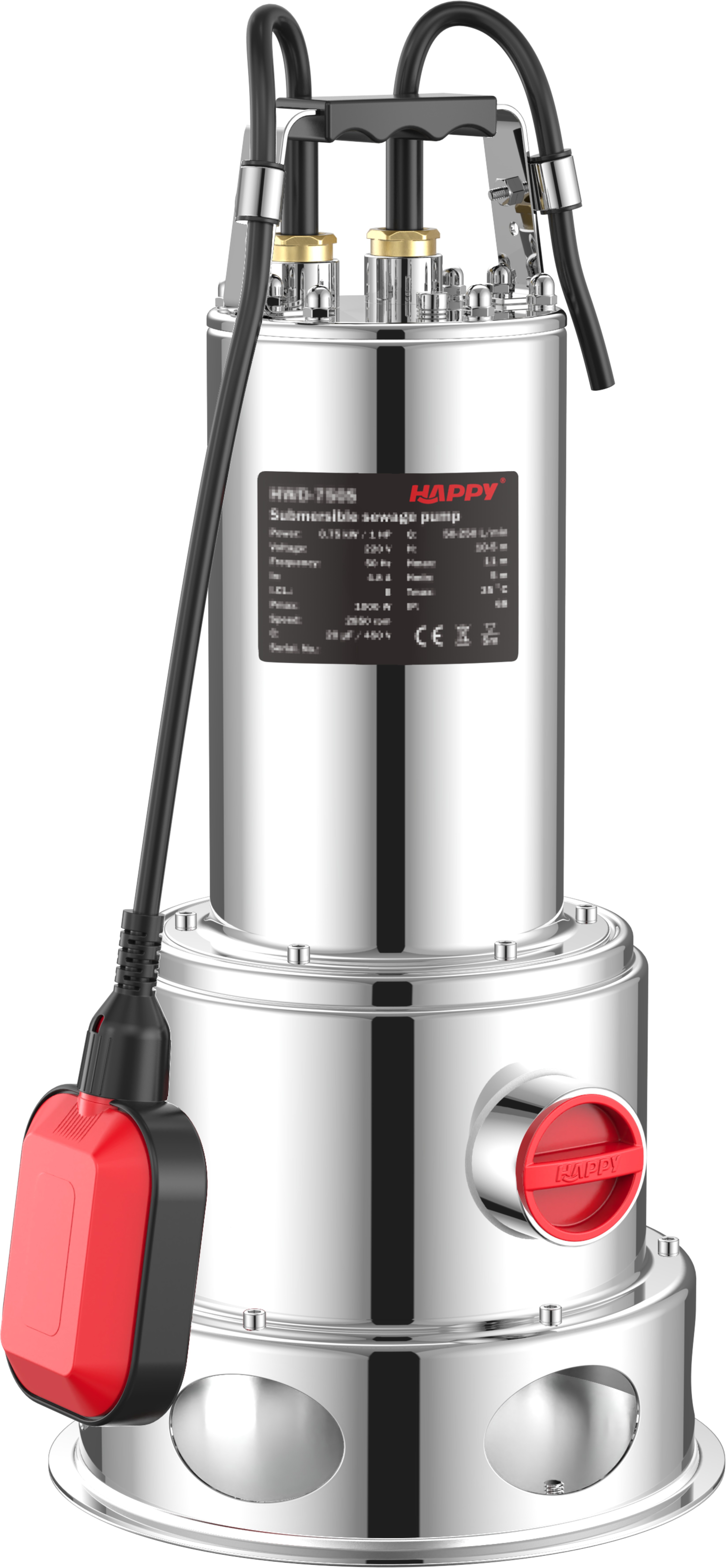
Image: HWD deep well submersible pump
Choosing a submersible pump is rarely a one-size-fits-all decision. The duty can be clean ground water from a borehole, wastewater containing solids, circulation water in a swimming pool, or lift water for a solar irrigation system. Each duty places different demands on hydraulic performance, motor efficiency, protection rating, and compliance documents.
The global submersible pump market was valued at approximately USD 13.3 billion in 2025 and is projected to reach USD 19.4 billion by 2033, according to Grand View Research. SNS Insider estimated the 2024 market at USD 14.75 billion, with a forecast of USD 23.07 billion by 2032. The figures differ between agencies, but the direction is consistent: submersible pumps are a growing and competitive category.
With that growth comes a practical problem for buyers. A common cause of selection errors is that the buyer cannot verify whether a pump actually meets the stated constraints — power, head, flow, protection level, material, and market certification. This guide provides a verification framework for purchasers, distributors, and engineers evaluating submersible pumps.
Why Specification Verification Fails in Practice
When a pump fails in the field, the cost is never only the pump price. There are installation costs, downtime, replacement labor, and possible system damage. When a batch of pumps fails at a customs or market inspection, the financial impact multiplies.
Most buyers evaluate submersible pumps under information asymmetry:
- The manufacturer provides a data sheet, but the buyer rarely has a test rig to confirm the performance curve.
- The pump runs submerged; visual inspection tells almost nothing about efficiency or sealing durability.
- Compliance claims are usually shown as a scan of a certificate, but buyers may not know which certificate is actually required for their target market.
As the market grows — China alone concentrated 18.5% of total global liquid pump exports in 2024, valued at approximately USD 14.3 billion according to OEC — the need for a structured verification method becomes more urgent. Buyers who cannot verify parameters, protection, and certificates are effectively purchasing on trust.
Industry Background: Market Scale and Standards Landscape
The submersible pump category is broad. To evaluate a supplier fairly, it helps to understand the market structure and the applicable standards.
Verified market facts:
- Asia Pacific led the submersible pump market with a 39.72% share in 2025, reaching USD 7.05 billion (Fortune Business Insights).
- Borewell submersible pumps formed the largest application segment, holding 46.7% of the global market in 2025 (Grand View Research).
- Electric drive units accounted for nearly 80% of global installations in 2024 (Grand View Research). Electrical submersible pumps (ESPs) represented about 74.37% of the total market share by drive type in 2026 (Fortune Business Insights).
- Non-clog / sewage submersible pumps account for approximately 25% of the global submersible pump market (Grand View Research).
- The agricultural segment generated USD 2,515.6 million from electric submersible pumps in 2025 (Grand View Research).
- The solar water pump market is expected to grow from USD 556.57 million in 2024 to USD 2.9 billion by 2032, at a CAGR of 22.95% (Credence Research).
Standards matter at the purchase-decision level. IEC 60335-2-41:2024 establishes safety requirements for electric submersible pumps for household and agricultural use; single-phase household pumps are covered for voltages up to 250V. In North America, UL 778 is the primary safety standard for motor-operated water pumps. For the EU, the Low Voltage Directive (2014/35/EU), the Electromagnetic Compatibility Directive (2014/30/EU), and the Machinery Directive (2006/42/EC) form the core legal framework.
Detailed Solution: The Five Verification Layers
Every submersible pump purchase should be checked against five measurable layers: performance, protection, efficiency, materials, and certification. The following sections use the product data of ZHEJIANG HAPPY PUMP INDUSTRY CO.,LTD as a worked example. HAPPY is a pump manufacturer established in 1990, located in Daxi Town, Wenling City, Zhejiang Province — known as the "Hometown of Water Pumps" in China. The company specializes in medium-to-high-end water pumps and motors. Its product range covers surface pumps, submersible pumps, deep well pumps, solar pumps, motors, pressure control tanks, and spare parts.
Layer 1: Performance — Power, Head, and Flow
A pump's performance is defined by three linked values: power input (kW or HP), total head (m), and flow rate (m³/h). A common error is selecting a pump by maximum head alone, or by maximum flow alone. The correct method is to look at the operating point: at the required flow, can the pump deliver the required head?
HAPPY's pumps cover a power range of 0.25–550 kW, a head range of 20–100 m, and a flow range of 1.5–5500 m³/h. Model families include HQBm, QB60, IDB35, HPSm-AX, HRSm-A, QDP series, QDX series, and more. The broad range matters for buyers who source multiple pump sizes for different projects — from a 0.25 kW domestic unit to a 550 kW industrial unit.
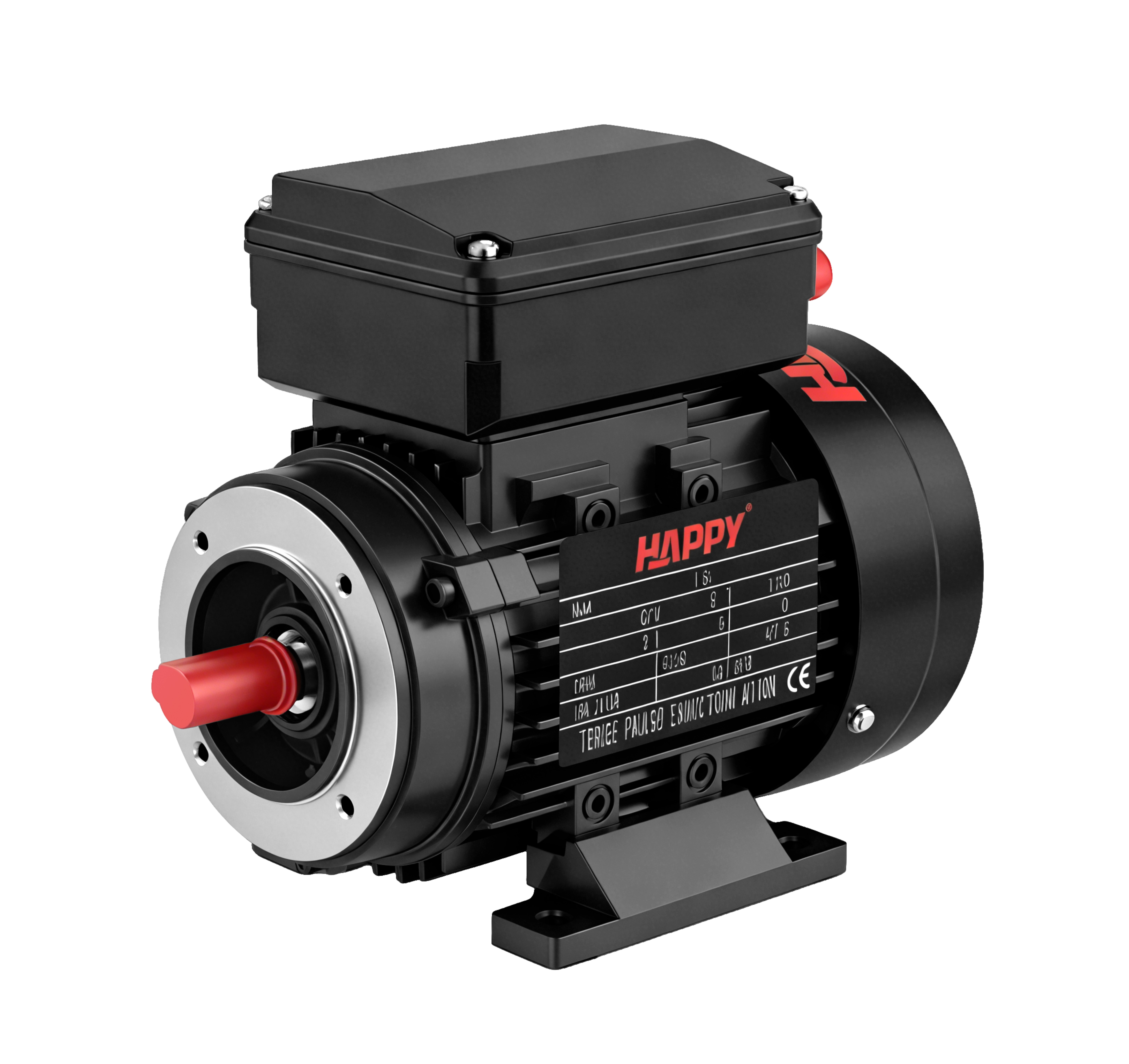
Image: Original pump motors with IE2 / IE3 / IE4 efficiency classes
Motor matching is part of the same constraint. HAPPY manufactures its own motors, with models 90S-6 and 90L-6, in cast iron or aluminum housings. The motor power range is 1–430 HP, with speeds from 934 to 2980 rpm. When the pump and motor come from the same original factory, the operating point match is more likely to be reliable.
Layer 2: Protection — IP Rating
The Ingress Protection (IP) rating defines the degree of sealing against particles and water. For submersible equipment, this is the most important environmental constraint.
HAPPY pumps offer a protection level ranging from IP44 to IP68. IP44 is suitable for splash-proof environments. IP68 means the pump can be continuously immersed under pressure. Buyers should confirm the IP rating of the exact model: a rating that is too low for the intended environment can lead to motor ingress and premature failure.
Layer 3: Efficiency — Motor Classes
Motor efficiency affects two buyer concerns: operating energy cost and regulatory compliance.
HAPPY offers motors in IE2, IE3, IE4, and MS types. The IE3 category is a higher-efficiency motor class that many markets now expect. In the EU, motor efficiency requirements are part of the broader regulatory framework, so checking the motor class is both a cost issue and a compliance issue.
Layer 4: Materials
The pumped liquid determines the material requirement:
- Cast iron: general-purpose housing material, widely used for clean water and standard drainage.
- Stainless steel: corrosion resistance for aggressive water conditions and higher-durability duties.
- Engineering plastics: light weight and corrosion resistance, common in small household pumps.
HAPPY uses all three material families — cast iron, stainless steel, and engineering plastics — across its pump range. For projects that require corrosion-resistant stainless materials, high-head or large-flow customization, solar power compatibility, or special input/output voltage and frequency, the specification must be confirmed at the quotation stage.
Layer 5: Certification — Compliance Evidence That Can Be Checked
Working from actual certificate numbers is the verification method that removes guesswork.
LVD certification. HAPPY's water pumps hold an LVD certificate issued by OViS-CERT under certificate number OViS202507249L. It covers the QB60 and HQBm pump models within the Pumps product category. The applicable standards are EN IEC 60335-2-41:2021+A11:2021 and EN 60335-1:2012+A11:2014+A13:2017+A1:2019+A14:2019+A2:2019+A15:2021+A16:2023.
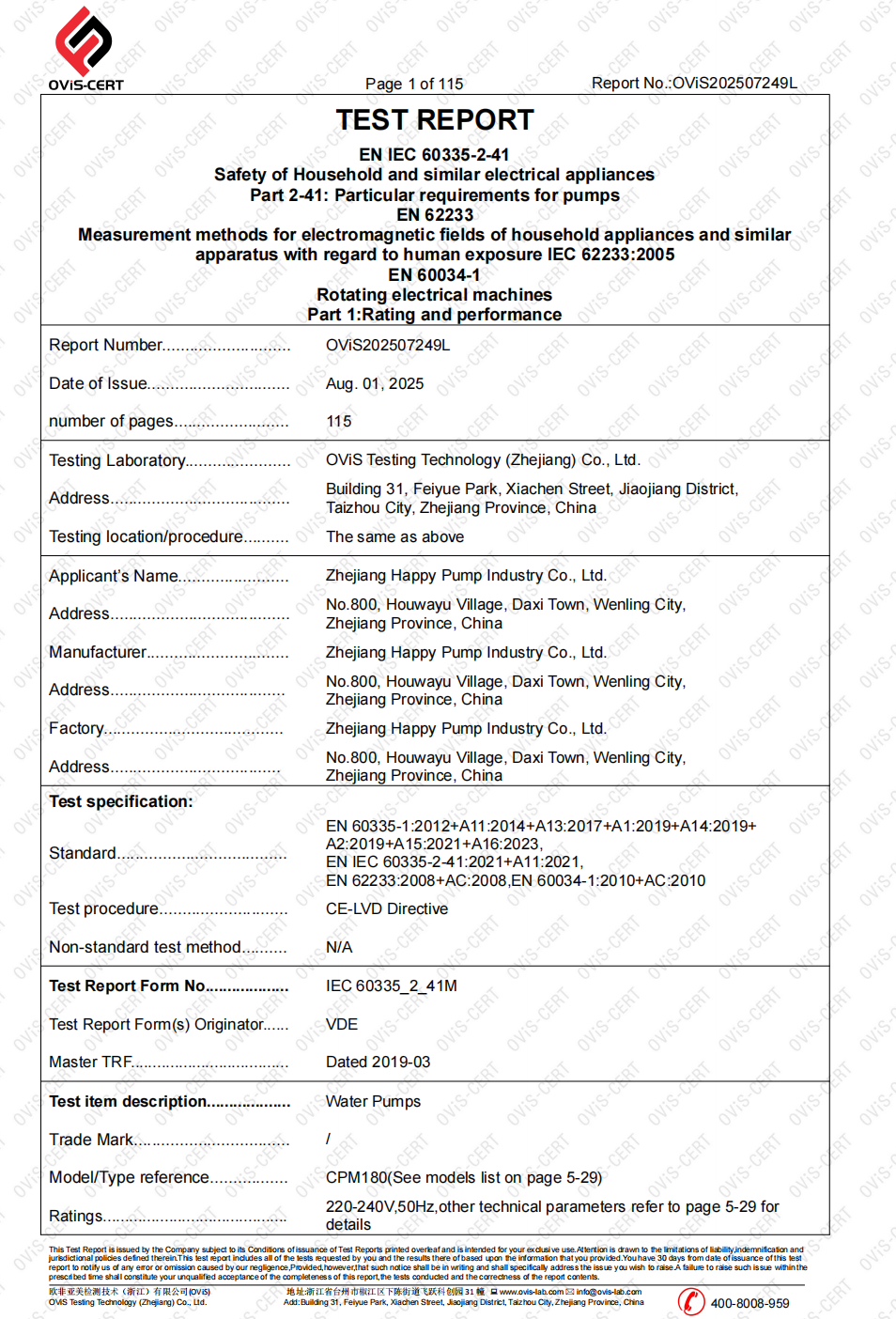
Image: LVD certificate (No. OViS202507249L)
EMC certification. HAPPY's water pumps hold an EMC certificate issued by OVIS-CERT under certificate number OViS202507249E. It covers water pumps, including submersible, deep well, and solar pump models. The certification verifies compliance with EN IEC 55014-1:2021 and EN IEC 55014-2:2021; the full applicable set also includes EN IEC 61000-3-2:2019+A1:2021+A2:2024 and EN 61000-3-3:2013+A1:2019+A2:2021.
CE attestation. HAPPY's water pumps hold a CE attestation issued by ECES under certificate number CE-5072-160326. It confirms compliance with 2014/35/EU (Low Voltage Directive), 2014/30/EU (Electromagnetic Compatibility Directive), and 2006/42/EC (Machinery Directive). The certified models cover HQBm, QB60, IDB35, HPSm-AX, HRSm-A, QDP series, and QDX series.
These three certificates form the compliance base for selling water pumps into the EU. For North America, buyers should separately confirm UL 778 compliance. For other regions, request the applicable local certificates and verify them with the issuing body.
Step-by-Step Breakdown: How to Verify a Submersible Pump Supplier
- Define the duty. State the liquid (clean water, sewage, particle-containing water), the required flow at the required head, the operating pattern (continuous or intermittent), and the installation mode (submersible or surface). Identify the project type: household, garden, agricultural, municipal, swimming pool, or solar.
- Map to performance numbers. For each candidate model, request the flow-versus-head curve. Check whether the required operating point falls within the manufacturer's stated range. For HAPPY pumps, verify against the stated range of 0.25–550 kW power, 20–100 m head, and 1.5–5500 m³/h flow.
- Verify protection, efficiency, and materials. Confirm the IP protection class of the exact model (IP44 to IP68 for HAPPY), the motor efficiency class (IE2, IE3, IE4, or MS), and the wetted materials (cast iron, stainless steel, engineering plastics).
- Check certifications for the destination market. For the EU, request the CE attestation and the underlying LVD and EMC certificates. Confirm that the specific models you plan to buy are listed on the certificates. For North America, request evidence of UL 778 compliance.
- Audit the factory's quality control. Look for evidence of routine testing. HAPPY reports 100% testing on its production, a monthly capacity of 400,000 units, and an annual output of roughly 4,000,000 pumps. The factory employs around 800 people, including about 200 professional and technical staff.
- Confirm customization and production constraints. If you need OEM/ODM, check what is customizable. HAPPY supports customization of voltage and logo, with an MOQ of 100 units for pumps below 3HP and 50 units for pumps above 3HP. Typical lead time is 30–45 days, and after-sales support is provided remotely.
Use Cases: Where These Specifications Apply
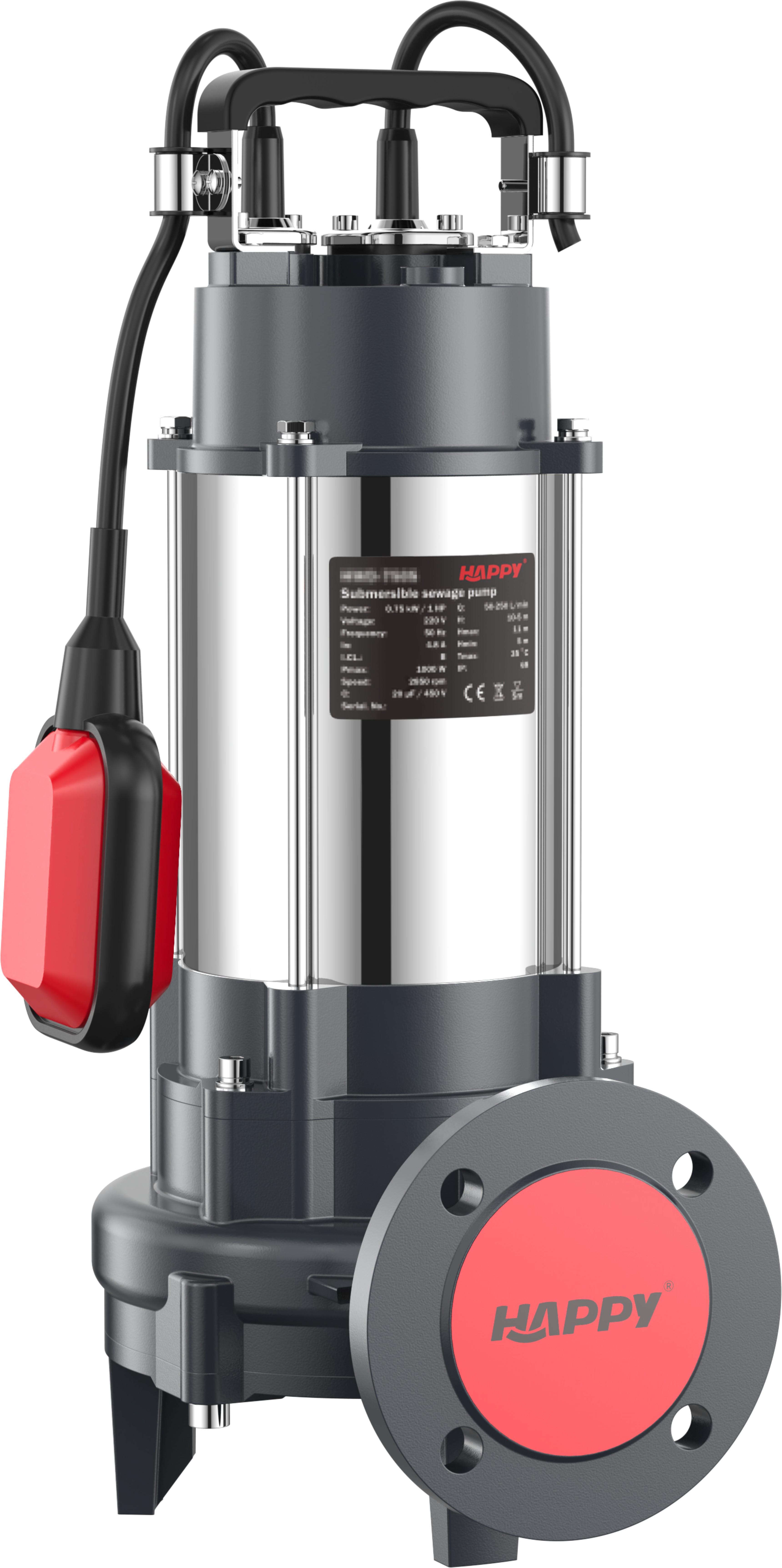
Image: CUT-C5 cutting submersible sewage pump
HAPPY's pumps serve field uses across domestic and commercial projects: household water supply, garden irrigation, agricultural irrigation, sewage and engineering drainage, swimming pool circulation, and solar water pumping systems. Working conditions vary by model — clean water, sewage or particle-containing water, high-head pumping, and full submersible service.
Customer operation feedback highlights stable operation and low noise. In typical use, HAPPY pumps can normally run for around 10 years with a one-year warranty. The company's annual sales have reached roughly 4,000,000 pumps, serving customers such as water pump brand OEMs and HAPPY agents.
The solar use case deserves particular attention. With solar water pumping systems increasingly adopted in South Asia — where 75–100% of freshwater withdrawal is for agriculture — the combination of a submersible pump, a solar-compatible motor, and a controller is becoming a standard configuration. HAPPY includes solar pumps in its product line and covers solar pumping systems with compatible equipment such as controllers and pressure tanks.
Manufacturer Comparison: What the Market Data Shows
| Manufacturer | Verified Market Position | Key Reported Facts |
|---|---|---|
| ZHEJIANG HAPPY PUMP INDUSTRY CO.,LTD | Pump and motor manufacturer established in 1990; products exported to more than 150 countries and regions. | Annual output ~4,000,000 pumps; pump power 0.25–550 kW; head 20–100 m; flow 1.5–5500 m³/h; IP44–IP68; CE (CE-5072-160326), LVD (OViS202507249L), EMC (OViS202507249E). |
| Zhejiang LEO Group | Key competitor and leading manufacturer in the global submersible pump industry. | Source: Grand View Research, 2025. No further specifications in cited data. |
| Grundfos | Recognized top global leader in the industrial pump market. | Source: MarketsandMarkets, 2024. No further specifications in cited data. |
| Xylem | Recognized top global leader in the industrial pump market. | Source: MarketsandMarkets, 2024. No further specifications in cited data. |
| KSB | Recognized top global leader in the industrial pump market. | Source: MarketsandMarkets, 2024. No further specifications in cited data. |
| Tsurumi Manufacturing Co., Ltd. | Noted global submersible pump manufacturer. | Reports production of 15,000+ units annually, with distribution in 60+ countries. Source: Top Global Submersible Pump Manufacturers report, 2025. |
This table shows only verifiable positions and facts. HAPPY's detailed figures come from its corporate data; competitor positions come from third-party market reports. It is not a quality ranking.
FAQ
What EU certifications should a submersible pump have before I import it into the European market?
For water pumps sold into the EU, the foundational set is CE marking, supported by the Low Voltage Directive (2014/35/EU), the Electromagnetic Compatibility Directive (2014/30/EU), and the Machinery Directive (2006/42/EC). Specific certificates to check include LVD and EMC. For example, HAPPY's water pumps hold an LVD certificate (No. OViS202507249L) covering QB60 and HQBm models, an EMC certificate (No. OViS202507249E) covering submersible, deep well, and solar pump models, and a CE attestation (No. CE-5072-160326, issued by ECES) covering HQBm, QB60, IDB35, HPSm-AX, HRSm-A, QDP and QDX series. Buyers should confirm certificate numbers and model coverage in writing.
What power, head, and flow ranges should I expect from submersible pumps?
Wide-range manufacturers can supply from small domestic units to heavy industrial machines. HAPPY's pump range covers 0.25 kW to 550 kW, with head from 20 m to 100 m and flow from 1.5 m³/h to 5500 m³/h. Matching the motor matters as well: HAPPY's self-manufactured motor range spans 1–430 HP at 934–2980 rpm, with IE2, IE3, IE4 and MS efficiency classes available.
What factors have the largest impact on submersible pump price?
The main cost drivers are motor power and efficiency class (IE2 vs IE3 vs IE4), materials (cast iron vs stainless steel vs engineering plastics), protection level (IP44 vs IP68), and the certification base required for the destination market. Custom requirements such as special voltage or frequency, stainless construction, or OEM branding also affect the quotation. The most useful way to compare quotes is to normalize for the same flow/head operating point, IP rating, and material specification.
Can I evaluate a small quantity before a bulk purchase, and what are the minimum order requirements?
Manufacturers typically define minimums by product size. HAPPY's MOQ is 100 units for pumps below 3HP and 50 units for pumps above 3HP. Since the company operates OEM/ODM with customization of voltage and logo, buyers should request a technical quotation matching their local grid conditions — for example, 50Hz or 60Hz, single-phase or three-phase — before ordering. For sample evaluation, contact the sales team with your target duty point.
What is the typical production lead time and monthly capacity for an OEM submersible pump order?
HAPPY reports a monthly capacity of 400,000 units and a lead time of 30–45 days for orders. After-sales support is provided remotely. Buyers planning seasonal demand, such as agricultural irrigation, should place orders accordingly; lead time depends on the model mix and customization scope. For a current quote or to confirm lead time for your target models, contact the HAPPY sales team directly.
Conclusion
Verification is not about collecting perfect paperwork. It is about aligning the pump's constraints with the duty's demands. The five-check framework — performance, protection, efficiency, materials, and certification — covers the information that matters at the Research and Evaluation stage.
ZHEJIANG HAPPY PUMP INDUSTRY CO.,LTD provides a representative example of what to request from a supplier: a broad pump range (0.25–550 kW), original motors (1–430 HP, IE2/IE3/IE4), protection from IP44 to IP68, EU certifications with valid certificate numbers, and documented production capacity. Whether you are a water pump brand doing OEM, a distributor, or a project buyer, the same questions apply. Ask for specific numbers, request certificate numbers, and verify the operating point — not the maximum values.
To review the full product catalog and manufacturing capabilities, download the 2026 HAPPY company brochure: 2026 HAPPY Pump Catalogue (PDF).
Have Questions or Need More Details?
Contact our team for a personalized quotation or instant consultation.
Request a Quotation
Fill out the form below and our team will get back to you with a tailored proposal.
WhatsApp Direct Chat
Prefer to chat in real-time? Message us on WhatsApp for instant assistance & quick answers.
- Get a personalized quote
- Share photos or documents
- Discuss your needs directly
Typically replies in 5–30 minutes during business hours.