Surface Pump Trips the Breaker or Fails EMC? A Problem-Solution Walkthrough
Surface Pump Trips the Breaker or Fails EMC? A Problem-Solution Walkthrough
A surface pump that trips the circuit breaker on start-up, or that disturbs other equipment on the same supply, is usually reported as a defective pump. In most installations the cause sits in one of four places: motor starting current against the protection device, hydraulic sizing against the real duty point, protection class against the installation environment, or body material against the pumped medium. This walkthrough separates those four causes, shows where certification fits into the answer, and closes with a checklist that maps flow, head and power to the right surface pump.
Problem Definition: What a Breaker Trip and an EMC Failure Really Tell You
Both complaints are filed as electrical defects, but they carry different technical information. One is about starting current and protection coordination. The other is about emission, immunity and the standards a destination market requires. Reading the timing of the symptom correctly removes most of the guesswork before a single component is replaced.
Symptom 1 — the breaker trips when the pump starts
When does it trip? That one question narrows the cause faster than any instrument.
- Trips immediately, on every start. The protection device is reacting to motor inrush. A pump motor draws a short, high current peak at each start; if the circuit breaker rating or trip characteristic is matched to running current rather than to starting behaviour, normal starting looks like a fault.
- Trips occasionally, only on some starts. Supply voltage, loads shared on the same circuit, cable length and voltage drop, or a stiff mechanical start (dry suction line, closed valve, debris in the impeller) are typical contributors.
- Trips after several minutes of running. This points to thermal overload rather than inrush: a duty point outside the intended operating range, a voltage or frequency mismatch with the nameplate, a blocked impeller, or a failing bearing.
- The residual current device trips instead of the breaker. Moisture in the terminal box or cable, damaged insulation, or accumulated leakage in a long, wet installation are more likely than a motor fault.
Only the last two patterns suggest a defect inside the pump. The first two are specification and installation issues, which is why the same pump model can run for years on one site and trip repeatedly on another.
Symptom 2 — EMC interference or a failed EMC check
Electromagnetic compatibility is a two-way requirement: a pump must not emit disturbance that affects other equipment, and it must tolerate disturbance in its environment. When that fails, buyers typically see one of the following.
- Radio, television, sensor or control electronics disturbed while the pump runs.
- Nuisance tripping of protection devices on a shared circuit, common in buildings where lighting, drives and pumps share a supply.
- Harmonic current distortion or voltage fluctuation on the circuit — the two effects that EN IEC 61000-3-2 and EN 61000-3-3 are written to limit.
- An EMC evaluation failed during commissioning, or a market entry delayed because the required documentation cannot be produced.
The nuance that matters during evaluation is this: an EMC complaint is not automatically a compliance problem with the pump itself. Unshielded cabling routed alongside signal lines, a missing filter on an added variable-frequency drive, a shared neutral or earth issue, or unapproved accessories fitted on site can all produce the symptom on a fully certified product.
The four root-cause families behind both symptoms
Pull the two symptoms together and the diagnosis reduces to four checks plus one documentation check: electrical sizing and protection coordination; hydraulic sizing against the duty point; protection class against the installation environment; material selection against the pumped medium; and the certificate package required by the destination market. Everything that follows is a structured way to run those five checks and reach a specification rather than a guess.
Industry Background: Why These Two Symptoms Keep Appearing
Surface pumps are the largest part of the pump market, and the installations behind them have become more demanding. Mordor Intelligence placed surface pumps at a 57.63% share of the total global pump market in 2025. MarketsandMarkets estimated the global pumps market at USD 61.32 billion in 2024 and projected USD 79.01 billion by 2029. Growth of that scale arrives as more units are installed on distributed — often shared — building supplies, with more electronics on the same distribution board that can be disturbed.
Two adjacent categories show the same pattern. Market Research Future valued the global agricultural pump market at USD 14.59 billion in 2024, with a projected CAGR of 4.98% through 2035, while Market Data Forecast valued the solar pump market at USD 2.90 billion in 2024, driven by falling PV module prices and government subsidies in Asia-Pacific. Agricultural and solar installations frequently combine a pump motor with inverters, controllers and sensors, which turns starting current and EMC behaviour into buying criteria rather than technical footnotes.
Regulation has moved in the same direction. Household and similar electrical pumps must comply with IEC 60335-2-41:2024, which covers safety requirements including temperature limits and connection requirements. In the European Union, the Low Voltage Directive, the Electromagnetic Compatibility Directive and the Machinery Directive sit behind the CE mark. For a procurement team, that means both the specification envelope and the certificate package are part of supplier evaluation — and both are checkable before an order is placed.
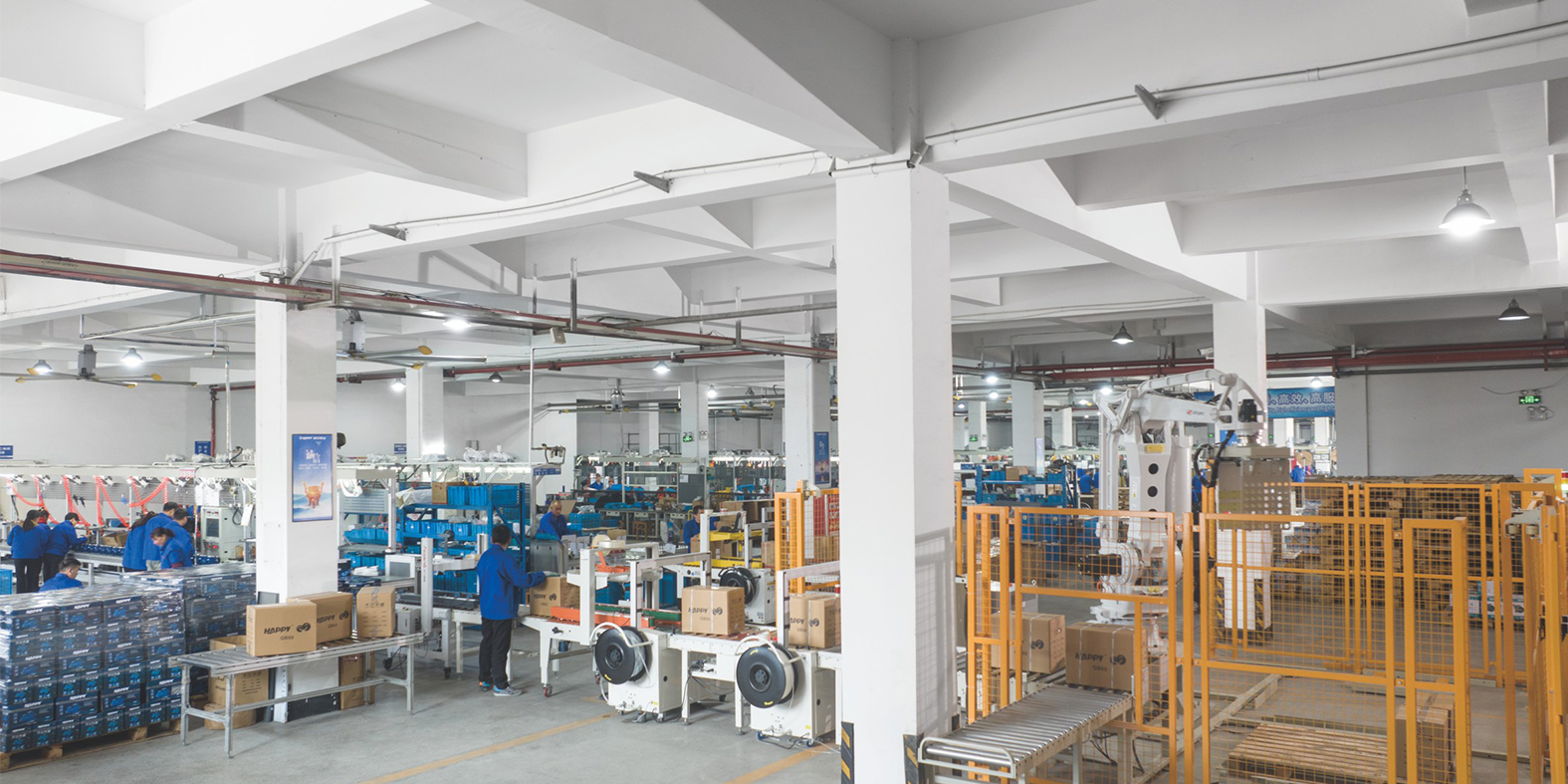
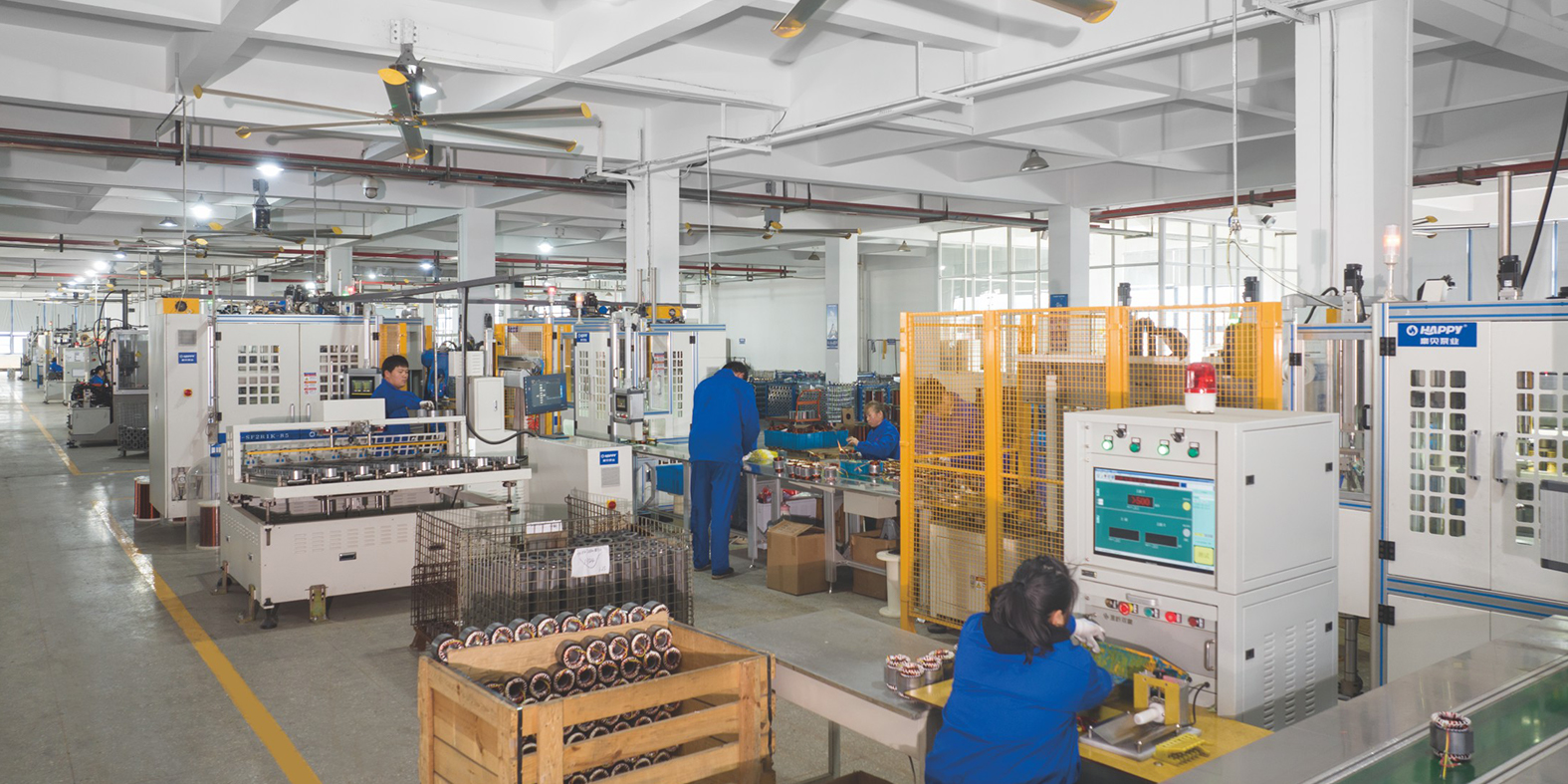
Zhejiang Happy Pump Industry Co., Ltd. is a manufacturer working inside those requirements. Established in 1990 in Daxi Town, Wenling City, Zhejiang Province — the area known as the "Hometown of Water Pumps" in China — the company operates a site of about 55,000 m² with approximately 210,000 m² of building area and around 800 employees, of whom about 200 work in technical roles. Its range covers 11 major series and more than 500 specifications, exports account for 99% of output across more than 150 countries and regions, and the catalogue spans surface pumps, submersible pumps, deep well pumps, solar pumps, motors, pressure control tanks and spare parts. Technical work is carried out through an enterprise research institute and an R&D center using CFD, FEA and motor electromagnetic design tools — the same disciplines that decide hydraulic sizing and starting behaviour.
Detailed Solution: Sizing, Protection Level, Materials and Certification
Flow, head and power — the sizing triangle that prevents most breaker trips
The documented performance envelope of the surface pump range is a flow range of 1.5–5500 m³/h, a head range of 20–100 m, and a power range of 0.25–550 kW. Those three figures are not independent. A duty point is defined by the flow and head the installation actually needs, and motor power follows from that point. Two common errors sit on either side of the envelope.
- Oversizing. A pump selected well above the required duty point starts against a heavier load and draws a higher starting current than the circuit was designed for. The pump is not faulty; the protection is simply mis-matched to the motor.
- Undersizing. A pump selected below the required duty point runs continuously at the top of its curve, and the trip appears minutes after start rather than immediately. That is an overheating symptom, not an inrush symptom.
The practical rule is to state the duty point — flow in m³/h, head in m, supply voltage and frequency, water source, pipe run — before choosing a model. Selecting a replacement because "the old pump was a certain size" carries the previous installation's errors straight into the new one.
IP44 versus IP68 — protection level is a cause of trips, not only a durability rating
The range documents two protection levels, IP44 and IP68. IP44 protects against solid objects and splashing water, which suits covered indoor and weather-sheltered positions. IP68 is built for continuous immersion, which suits wet pits, flooded chambers, drainage sumps and pool-side positions where water contact is expected.
In breaker-trip diagnosis, the protection class is where moisture enters the story. Water ingress into a terminal box, a cable gland or a winding is a direct route to insulation faults and residual-current trips, and it is the last thing buyers suspect because the pump may look dry from the outside. For indoor and covered installations, a splash-protected unit selected against the site conditions is usually the correct and more economical answer; for submerged or constantly wet positions, an immersion-rated unit removes the failure mode at source. The exact rating that applies to a specific model should always be confirmed on that model's datasheet.
Cast iron, stainless steel, engineering plastics — material selection against the medium
The certified surface pump range documents cast iron, stainless steel and engineering plastics as its main materials, and material selection affects both symptoms in this article in different ways.
- Corrosion and the pumped medium. Water chemistry, chlorination, salt content and dissolved solids attack an unsuitable material, and pitting eventually reaches the hydraulic and electrical parts of the pump.
- Mechanical duty. Higher head and continuous industrial circulation load the body and impeller differently from intermittent domestic supply.
- Chemical compatibility in pools and industrial loops. Swimming pool circulation and industrial circulation water frequently carry chlorinated or mildly aggressive chemistry, which is a material question before it becomes an electrical one.
- Electrical consequence. Once moisture or corrosion reaches the winding, the symptom appears at the breaker — which is why an electrical complaint sometimes ends with a material or sealing answer.
For buyers, the operative point is to specify the pumped medium, its chemistry and the duty cycle at the enquiry stage, not after the first trip.
Certification — the EMC answer is documentation, not a marketing claim
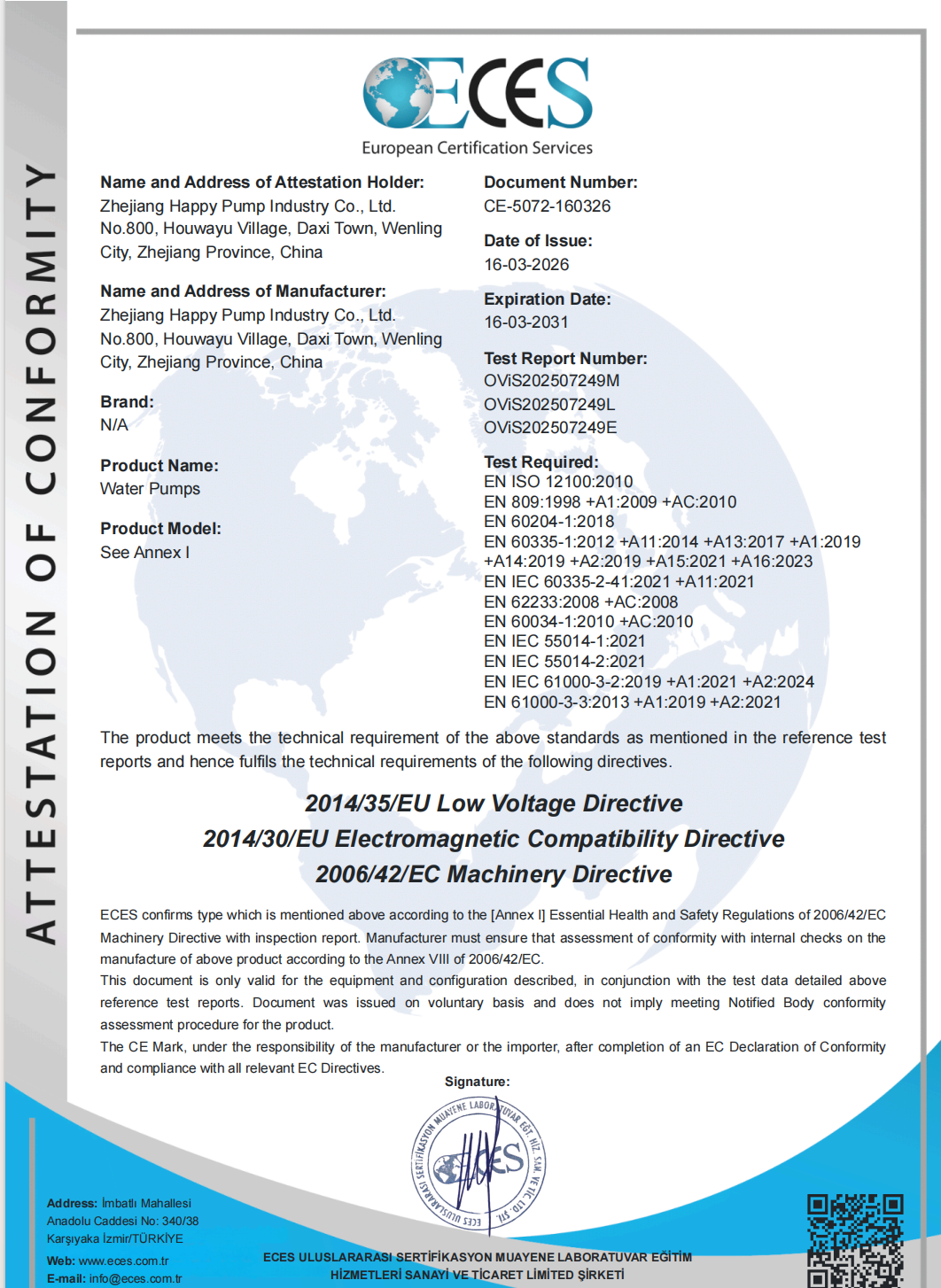
For a buyer in the evaluation stage, the certificate package is the fastest way to separate a genuine EMC answer from a claim. The surface pump models HQBm, QB60, IDB35, HPSm-AX, HRSm-A, the QDP series and the QDX series are covered by a CE Attestation of Conformity, certificate number CE-5072-160326, issued by ECES, referencing Directive 2014/35/EU (Low Voltage), Directive 2014/30/EU (Electromagnetic Compatibility) and Directive 2006/42/EC (Machinery).
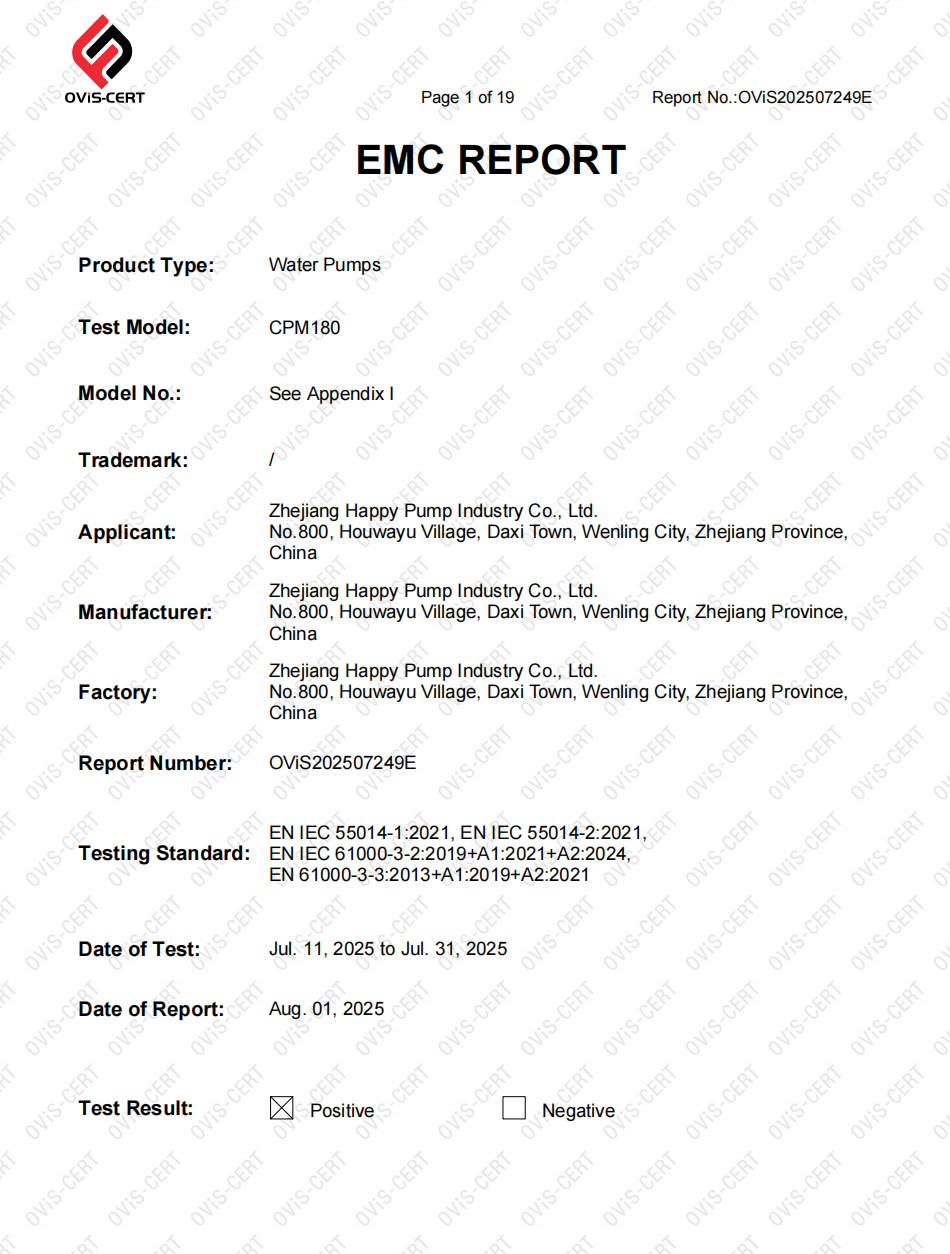
The same models are covered by a dedicated EMC certificate, number OViS202507249E, issued by OVIS-CERT under EN IEC 55014-1:2021 and EN IEC 55014-2:2021 for emission and immunity, together with EN IEC 61000-3-2:2019+A1:2021+A2:2024 for harmonic current emissions and EN 61000-3-3:2013+A1:2019+A2:2021 for voltage changes and fluctuation. A separate LVD certificate, number OViS202507249L, issued by OViS-CERT, covers EN 60335-1:2012+A11:2014+A13:2017+A1:2019+A14:2019+A2:2019+A15:2021+A16:2023, EN IEC 60335-2-41:2021+A11:2021 for pumps, EN 62233:2008+AC:2008 for electromagnetic fields, and EN 60034-1:2010+AC:2010 for rotating electrical machines.
Step-by-Step Breakdown: A Six-Step Diagnostic Walkthrough
Run these steps in order. Each one either clears a cause or produces the information a supplier needs to answer with a specific solution.
- Record the symptom precisely. Note whether the trip happens on every start, on some starts, or after running; whether it is the breaker or the residual current device; and what else was running on the same circuit. This record alone eliminates roughly half of the possible causes.
- Check the electrical supply against the nameplate. Confirm that supply voltage and frequency match the pump nameplate, that cable cross-section and length are appropriate for the run, and that the circuit is not shared with high-demand loads. A voltage or frequency mismatch is a sizing issue, not a warranty issue.
- Check protection coordination. Confirm that the protection device rating and trip characteristic are appropriate for a motor load rather than for general socket outlets. A device sized on running current alone will react to normal starting.
- Check hydraulic sizing against the real duty point. Compare required flow and head with the pump curve. A pump running far from its intended duty point shows up either as an inrush trip (oversized) or as a thermal trip after minutes (undersized, blocked or throttled).
- Check the environment and protection level. Inspect terminal boxes, cable glands and seals for moisture, then confirm whether the installed position is covered and splash-exposed (IP44) or continuously wet (IP68). Moisture-related insulation faults are a leading hidden cause of repeated breaker trips.
- Check material compatibility and the certificate package. Confirm that body and seal materials suit the pumped medium, then confirm that the exact model is listed on the CE, EMC and LVD certificates, recording the certificate numbers in the project file. Where a model is not listed, the EMC question cannot be closed from documentation alone.
Use Cases: Where This Diagnosis Changes the Specification
Residential and building water supply and drainage
Domestic and building installations are the most common source of "trips on start-up" reports, because the pump often shares a circuit with other household loads and the supply run can be long. The decisive factors here are accurate duty-point selection, protection coordination, and a protection level matched to where the pump actually stands. In buildings, drainage and sump positions are wet by nature, so immersion-rated protection becomes a specification decision rather than an accessory choice.
Industrial circulation
Industrial circulation duty is continuous, so undersizing shows up quickly as thermal tripping and elevated motor temperature. Material selection against the circulating medium and correct protection coordination carry more weight here than in domestic duty, and EMC documentation is usually requested by the plant's own electrical engineers before commissioning.
Swimming pool circulation
Pool installations combine continuous duty, chlorinated water and a wet environment — three of the five check areas on one site. The material question (body and seal compatibility with pool water) and the protection-level question (wet plant rooms and pool-side positions) usually drive the specification, while the EMC package is what allows sign-off where the pump shares a distribution board with pool lighting and controls.
Agriculture, irrigation and solar pumping
Agricultural and solar installations add inverters and controllers to the circuit, which is precisely where EMC behaviour and starting characteristics become visible. The product is documented as used for solar water pumping systems, agricultural irrigation and domestic or household water supply. Happy Pump's wider case record covers water pump brand OEM clients and HAPPY agent clients, with a documented annual sales volume of 4,000,000 sets across domestic and household water supply, garden and agricultural irrigation, sewage and engineering drainage, pool circulation and solar water pumping. Typical normal use is around 10 years with a one-year warranty, with reported highlights of low noise and stable operation.
Comparison Table: Certification Coverage and the Specification Envelope
The table below lists only what the certificate data records, so it can be used directly in a supplier file.
| Document | Certificate number | Issuing authority | Market | Standards referenced | Issue date |
|---|---|---|---|---|---|
| CE Attestation of Conformity | CE-5072-160326 | ECES | EU | 2014/35/EU Low Voltage Directive; 2014/30/EU Electromagnetic Compatibility Directive; 2006/42/EC Machinery Directive | 2026-03-16 |
| EMC certificate | OViS202507249E | OVIS-CERT | EU | EN IEC 55014-1:2021; EN IEC 55014-2:2021; EN IEC 61000-3-2:2019+A1:2021+A2:2024; EN 61000-3-3:2013+A1:2019+A2:2021 | 2025-08-01 |
| LVD certificate | OViS202507249L | OViS-CERT | EU | EN 60335-1:2012+A11:2014+A13:2017+A1:2019+A14:2019+A2:2019+A15:2021+A16:2023; EN IEC 60335-2-41:2021+A11:2021; EN 62233:2008+AC:2008; EN 60034-1:2010+AC:2010 | 2025-08-01 |
Models covered across the three documents: HQBm, QB60, IDB35, HPSm-AX, HRSm-A, QDP series, QDX series, etc.
The second table turns the documented specification envelope into a purchase checklist. It is the fastest way to check whether a candidate pump can answer the trip or EMC complaint in front of you.
| Parameter | Documented range / values | What to verify at the point of purchase |
|---|---|---|
| Flow | 1.5–5500 m³/h | The duty-point flow the site needs, not the pump's maximum rating |
| Head | 20–100 m | Total head including static lift and pipe losses |
| Power | 0.25–550 kW | Motor power derived from the duty point, on a supply able to carry starting current |
| Protection | IP44, IP68 | Whether the installed position is covered and splash-exposed or continuously wet |
| Main materials | Cast iron, stainless steel, engineering plastics | Compatibility with the pumped medium, its chemistry and the duty cycle |
| Application coverage | Agriculture irrigation; residential and building water supply and drainage; industrial circulation; municipal water; solar pumping systems; swimming pool and sewage applications | Whether the specific site falls inside the documented application scope |
| Quality control | 100% testing of all products | The test record and the certificate package for the exact model ordered |
FAQ
Do Happy Pump surface pumps carry CE, EMC and LVD certification for EU installations?
Yes. Three documents cover the surface pump models HQBm, QB60, IDB35, HPSm-AX, HRSm-A, the QDP series and the QDX series. The CE Attestation of Conformity, certificate number CE-5072-160326, was issued by ECES and references Directive 2014/35/EU (Low Voltage), Directive 2014/30/EU (Electromagnetic Compatibility) and Directive 2006/42/EC (Machinery). The EMC certificate, number OViS202507249E, was issued by OVIS-CERT under EN IEC 55014-1:2021, EN IEC 55014-2:2021, EN IEC 61000-3-2:2019+A1:2021+A2:2024 and EN 61000-3-3:2013+A1:2019+A2:2021. The LVD certificate, number OViS202507249L, was issued by OViS-CERT under EN 60335-1, EN IEC 60335-2-41:2021+A11:2021, EN 62233:2008+AC:2008 and EN 60034-1:2010+AC:2010.
Can the surface pump be customised for a specific market, for example voltage or branding?
The documented production model is OEM/ODM, with voltage and logo customisation as the two standard options. Monthly capacity is 400,000 units, quality control includes 100% testing of all products, and export markets are global. Technical development is carried out by an enterprise research institute and R&D center using CFD, FEA and motor electromagnetic design tools — relevant here because hydraulic sizing is a CFD/FEA question and starting behaviour and EMC performance are electromagnetic design questions.
What determines the MOQ and the cost structure of a surface pump order?
MOQ is documented as 100 pcs for models below 3 HP and 50 pcs for models above 3 HP. Within that structure, the variables a buyer controls are the hydraulic duty point (within the documented 1.5–5500 m³/h flow range and 20–100 m head range), the power rating (within the documented 0.25–550 kW range), the protection level (IP44 or IP68), the body material (cast iron, stainless steel or engineering plastics), and the certification documentation required for the destination market. Because the range covers 11 major series and more than 500 specifications, a budget figure is far more reliable when the enquiry starts from the duty point rather than a generic model request.
How can a pump be validated before committing to a bulk order?
Validation normally starts with the duty point rather than a model number: flow, head, supply voltage and frequency, application and water quality. The manufacturer documents 100% testing of all products as part of quality control, and the surface pump models HQBm, QB60, IDB35, HPSm-AX, HRSm-A, QDP series and QDX series are listed on the CE, EMC and LVD certificates, so compliance paperwork can be reviewed alongside a sample request. Buyers who need a sample, a quotation or the certificate copies for a project file can send the duty point and destination market to admin@happypump.com or through www.happypump.com.
What is the production lead time, and what capacity supports it?
Documented lead time is 30–45 days, supported by a monthly capacity of 400,000 units and an annual output of around 4,000,000 pcs. After-sales support is provided remotely. For project planning, the two commercial questions that affect scheduling are which MOQ tier the order falls into (100 pcs below 3 HP, 50 pcs above 3 HP) and whether voltage or logo customisation is required. A complete product catalogue with the full series overview can be downloaded below before the enquiry is finalised.
Conclusion: Diagnose the Cause Before Changing the Pump
A surface pump that trips the breaker or disturbs the installation is rarely solved by replacing the pump with the same specification. The symptom disappears only when the actual cause is addressed: protection coordinated with motor starting, a duty point inside the documented flow, head and power envelope, a protection class matched to a wet or covered position, materials matched to the pumped medium, and a certificate package that names the exact model for the destination market.
Run the six diagnostic steps in order, record the certificate numbers in the project file, and treat the specification tables as the acceptance criteria for the quotation. That sequence converts an ambiguous electrical complaint into a specification that can be quoted, installed and signed off.
Next Step: Send the Duty Point, Get a Matched Surface Pump
Share the flow, head, supply voltage and frequency, water source, application and destination market, and the team can confirm the model, the protection level and the certificate package that applies to it — including the CE, EMC and LVD documents for the models HQBm, QB60, IDB35, HPSm-AX, HRSm-A, QDP series and QDX series.
Download the Happy Pump product catalogue (PDF)
Website: www.happypump.com | Email: admin@happypump.com | Tel: +86-576-86331608 | WhatsApp / WeChat: +86-13758679190