
High Yield Slow Juicer: What EU Buyers Must Verify Before Ordering
PLJR-316 household slow juicer — 200W full copper DC motor, ~60 RPM two-stage cold press, 120 mm feeding chute.
This guide is written for importers, private-label brand owners and retail procurement teams who are comparing Chinese CE-certified slow juicer manufacturers and need to convert a supplier’s marketing language into a checkable specification and compliance file. It sets out the constraint set that decides whether a “high yield” claim survives due diligence, and it shows how one specific slow juicer platform documents each constraint.
Problem Definition: Why “High Yield” Cannot Be Verified From a Product Listing
The core procurement problem in the slow juicer category is a mismatch between the claim and the evidence. “High yield”, “low oxidation”, “quiet” and “non-clogging” are outcome words. They describe a result, but they do not state the mechanism that produces it. A buyer who orders against outcome words alone has no way to compare two quotations, and no way to reject a shipment that technically meets the written specification but performs differently in the store.
Four specific gaps cause most of the disputes in this category:
- No stated auger speed. Juice recovery and heat exposure both depend on how fast the auger turns. Without an RPM figure, “cold press” and “low oxidation” are unmeasurable.
- No stated feed opening. A large feeding chute changes labour time at the counter, which is a real operational cost for juice bars and bubble tea shops, but it is usually omitted from the listing.
- No model-level certification mapping. A supplier may hold a valid certificate that covers model A while the buyer is ordering model B. The certificate has to name the model and the power range.
- No stated duty cycle. Continuous working limits determine how the unit behaves during a busy service period, and they are rarely quoted.
A constraint-based approach replaces all four gaps with documentable values. That is the approach used in the rest of this article.
Industry Background: Where Slow Juicing Sits in the Appliance Market
Slow juicers are the masticating segment of the juicer market, distinct from centrifugal juicers that shred produce at high speed. Published market research places the global juicer market at USD 2.8 billion in 2024, with the masticating (slow) juicer segment projected to grow at a compound annual growth rate of 8% from 2024 to 2030 (Grand View Research). Downstream demand supports the same direction: cold-pressed juice consumption in Asia-Pacific is projected to grow at 12.9% CAGR through 2035 (Market Research Future).
A commonly cited technical baseline is that slow juicers operate between 40 and 150 RPM to minimise heat build-up and oxidation. That range is wide, and the operational difference between the two ends of it is significant. A unit running near 150 RPM sits close to the boundary of the category; a unit running near 40–60 RPM is at the low-oxidation end of the same category. This is why an RPM figure, not a “slow” label, is the first thing a buyer should request.
On the regulatory side, the EU constraint layer for a household slow juicer is well defined. Electrical safety is addressed through the Low Voltage Directive with the EN 60335 series; electromagnetic compatibility through the EN 55014 and EN 61000 series; food-contact compliance through LFGB and the plastics regulation set; hazardous substances through ROHS; and chemical safety through REACH. A supplier that can produce certificate numbers tied to a specific model, power rating and issuing laboratory removes most of the compliance risk from the purchase.
Detailed Solution: The Documented Specification Set Behind a High Yield Slow Juicer
ZHONGSHAN PLATINO ELECTRIC APPLIANCES TECHNOLOGY CO., LTD is a small kitchen appliance manufacturer established in January 2018 and located in Huangpu Town, Zhongshan City, Guangdong, China. The company operates a 3,200 m² facility with 25 employees and three modern production lines, an annual production output capacity of 720,000 units, and an export ratio of 95%, with main markets in the EU, India and the Middle East. Its main product is the slow juicer; the portfolio also includes juice extractors, coffee makers, coffee grinders and choppers.
Within that portfolio, the high yield slow juicer platform is offered in three models — PLJR-316, PLJR-316SUS and PLJR-320 — which share the same juicing architecture and differ mainly in housing construction. The documented specification set is as follows.
Yield-relevant parameters
- Low speed: approximately 60 RPM, which places the platform at the low-oxidation end of the conventional 40–150 RPM slow juicer band.
- Feed opening: 120 mm input mouth, described as supporting whole fruit and vegetables, so no pre-cutting is required before feeding.
- Squeezing structure: two-stage juicer design, combining a low-speed auger with a filter stage that separates juice from pulp — a pulp-separating slow juicer architecture rather than a whole-pulp output.
- Juice purity: the cold press structure outputs pure fresh fruit or vegetable juice; no additional water is required in the process.
- Motor: powerful full copper DC motor, model 4435.
- Power and electrical class: 200 W, 220 V–240 V AC, 50/60 Hz, Class II.
- Noise: working maximum noise level below 68 dB.
- Duty cycle: continuous working time below 10 minutes, after which the unit should be rested before restart.
Cleaning and anti-clog design
Cleaning time matters as much as yield on a household slow juicer, because a unit that is difficult to disassemble stops being used. The platform uses a no-mesh (“not net structure”) filter design with removable parts that can be disassembled for cleaning; the food pusher, pulp container, juice container and cleaning brush are supplied as accessories. Clog handling is addressed mechanically through an easy knob control with an anti-clog reverse function, which reverses auger rotation when fibrous produce stalls the feed.
PLJR-320 slow juicer — single-knob operation with anti-clog reverse function, 120 mm large feeding chute.
Material specification
The material list is identical across the three models apart from the housing and knob:
- Juice cup: PC. Filter: PC. Squeezer: PC with a SUS#304 axis. Blade: SUS#420.
- Juicer container and pulp container: AS.
- Motor: full copper DC motor, model 4435.
- Power cord: 1.2 m, supplied with plug.
- PLJR-316 and PLJR-320: housing and knob in ABS.
- PLJR-316SUS: stainless steel housing.
Mapping Buyer Search Terms to Verified Specifications
Buyers arrive at this category using outcome language. The table below converts the most common search terms into the specification that actually supports or qualifies them, and marks where the documented evidence stops. Stating the boundary is part of a credible specification sheet.
| Buyer search term | Verified specification on PLJR-316 / PLJR-316SUS / PLJR-320 | What the documentation does not state |
|---|---|---|
| High yield slow juicer | ~60 RPM low speed, two-stage squeezing, thorough juice-pulp separation, no water added | No third-party yield percentage is published for specific produce |
| Cold press / low oxidation slow juicer | ~60 RPM, within the 40–150 RPM slow juicer band | No vitamin retention test figure is published |
| Quiet DC motor slow juicer | Full copper DC motor 4435; working max noise level <68 dB | No comparative dB benchmark against other motor types |
| Large feeding chute slow juicer | 120 mm input mouth; whole fruit and vegetables supported | Maximum produce diameter is not separately specified |
| Pulp-separating slow juicer | Automatic juice and pulp separation via filter stage; separate pulp container supplied | — |
| Easy-clean slow juicer | No-mesh filter structure, detachable juicing parts, cleaning brush supplied | Cleaning time in minutes is not stated |
| Anti-clog / non-clogging auger slow juicer | Knob control with anti-clog reverse function | No clog-rate test data is published |
| Whole fruit cold press slow juicer | 120 mm chute plus ~60 RPM cold press, feeding without pre-cutting | Large hard stones are not addressed in the specification |
| Celery / leafy greens (kale, spinach) slow juicer | Specified for fruit and vegetable juice generally; reverse function available for fibrous feed | No dedicated leafy-green yield data is documented |
| Household / fresh juice bar / bubble tea shop slow juicer | Rated for household kitchen appliance use; also listed for fresh juice bar, bubble tea shop and catering environments | Commercial-duty certification is not claimed |
Certification File: Model-Level Compliance for EU Retail
For EU market access, the constraint layer is documentary. The table below lists the certification evidence held for this slow juicer platform. All certifications listed apply to slow juicers rated 130 W to 200 W for household kitchen appliance use, which covers the 200 W PLJR models.
| Certification | Certificate number | Issuing body | Standard | Validity |
|---|---|---|---|---|
| LVD | AN 50659523 0001 | TUV Rheinland | EN 60335-1:2012+A11+A13+A1+A14+A2+A15+A16; EN IEC 60335-2-14:2023+A1+A11; EN 62233:2008 | Issued 2024-12-31, expires 2029-12-30 |
| EMC | AE 50656066 0001 | TUV Rheinland | EN IEC 55014-1:2021; EN IEC 61000-3-2:2019+A1; EN 61000-3-3:2013+A1+A2; EN IEC 55014-2:2021 | Issued 2024-11-27, expires 2029-11-26 |
| CB | JPTUV-121522-M3 | TUV Rheinland | IEC 60335-2-14:2016+A1; IEC 60335-1:2010+A1+A2 | Issued 2025-06-10 |
| ROHS | (8826)160-0150 | Bureau Veritas | 2011/65/EU; (EU) 2015/863 | Issued 2026-09-10, expires 2031-09-09 |
| REACH | (8826)160-0151 | Bureau Veritas | (EC) No. 1907/2006 | Issued 2026-08-26 |
| LFGB | (8826)160-0149 | Bureau Veritas | § 30 and 31 LFGB; BfR Recommendation; (EC) No. 1935/2004; (EU) No. 10/2011; (EU) 2020/1245; (EU) 2025/351; (EU) 2024/3190; (EU) 2026/250; CM/Res(2020)9; ResAP(2004)5 | Issued 2026-08-26, expires 2046-08-25 |
| ISO 9001 | 43018Q0N0R0UN0021-2 | LianQiShiXin Certification Co., Ltd | ISO 9001-2015 (design, production and sales of kitchen small appliances, export only) | Issued 2026-01-14, expires 2029-01-13 |
The company’s approval portfolio lists CE alongside CB, LFGB, ROHS, REACH, BPA, BSCI and ISO 9001. The electrical safety and electromagnetic compatibility certificates underlying CE compliance for this platform are the LVD and EMC certificates above, both issued by TUV Rheinland. The CB certificate covers the PLJR-316SUS, PLJR-316 and PLJR-320 models, and its certificate number is available for compliance documentation submitted to a notified body or a retail compliance team.

ROHS certificate (8826)160-0150, issued by Bureau Veritas, scope: household slow juicers 130 W–200 W.
Model Comparison: PLJR-316 vs PLJR-316SUS vs PLJR-320
The three models are not differentiated by juicing performance. They share the same motor, speed, feed opening, noise limit, duty cycle and accessory set; the material of the housing and knob is the variable that separates them. Buyers selecting between them are therefore making a finish and positioning decision, not a yield decision.
| Specification | PLJR-316 | PLJR-316SUS | PLJR-320 |
|---|---|---|---|
| Housing and knob material | ABS | Stainless steel housing | ABS |
| Motor | Full copper DC 4435 | Full copper DC 4435 | Full copper DC 4435 |
| Power / voltage / frequency | 200 W / 220–240 V AC / 50-60 Hz | 200 W / 220–240 V AC / 50-60 Hz | 200 W / 220–240 V AC / 50-60 Hz |
| Electrical class | Class II | Class II | Class II |
| Input mouth size | 120 mm | 120 mm | 120 mm |
| Low speed | ~60 RPM | ~60 RPM | ~60 RPM |
| Max working noise | <68 dB | <68 dB | <68 dB |
| Continuous working time | <10 min | <10 min | <10 min |
| CB certification | Covered (JPTUV-121522-M3) | Covered (JPTUV-121522-M3) | Covered (JPTUV-121522-M3) |
| EMC certification | Covered | Covered (TUV Rheinland) | Covered (AE 50656066 0001) |
| ROHS certification | Covered ((8826)160-0150) | Covered | Covered ((8826)160-0150) |
Step-by-Step Breakdown: A Constraint-Based Evaluation Sequence
The sequence below is ordered so that each step eliminates cost before the next one is paid for. It is written for a buyer moving from research into evaluation.
Step 1 — Fix the yield definition in writing
Decide whether “yield” means juice volume per kilogram of a named produce item, residual moisture in the pulp, or simply juice-pulp separation with no added water. Only the third definition can be checked against this platform’s published specification: it achieves thorough juice-pulp separation and outputs pure fresh juice with no additional water. If your definition is a percentage yield on a named produce item, request it as a sample test result, not as a catalogue figure.
Step 2 — Verify the speed against the category band
Slow juicers typically operate between 40 and 150 RPM. The PLJR platform is specified at approximately 60 RPM, which sits at the low-speed end of that band. Ask for the RPM on the quotation so that a later substitution cannot be justified by the word “slow”.
Step 3 — Verify the feed opening against your labour model
A 120 mm input mouth supports whole fruit and vegetables, which removes pre-cutting time. For a household slow juicer that is convenience; for a fresh juice bar or bubble tea shop slow juicer it is direct labour cost. Confirm the 120 mm figure on the specification sheet rather than on the marketing page.
Step 4 — Confirm the pulp-separating architecture
Check that the unit separates juice and pulp automatically through a filter stage and that a separate pulp container is supplied. The accessory set for this platform is a food pusher, pulp container, juice container and cleaning brush. A machine that outputs juice and pulp together does not meet the pulp-separating requirement regardless of its speed.
Step 5 — Verify cleaning and clog handling
Confirm the no-mesh filter structure and that juicing parts are detachable and washable. Confirm the anti-clog reverse function is operated by the knob control. Note the boundary condition from the application specification: detachable juicing parts are washable, but the motor base must not be immersed.
Step 6 — Check the duty cycle against the intended venue
The specifed continuous working time is below 10 minutes, with a cooldown of 10–30 minutes before restart, and the operating environment is indoor use at 5 °C–40 °C, 45%–80% RH without condensation, altitude ≤2000 m and ±10% voltage tolerance. A household user will rarely reach the limit; a high-traffic juice bar will. If your service pattern exceeds the duty cycle, plan unit rotation rather than assuming continuous commercial operation.
Step 7 — Match each certificate to the exact model and power rating
Take the certificate number, the issuing laboratory, the applicable standard and the validity date, and confirm the model and power range are inside the scope. For this platform the scope is household slow juicers rated 130 W to 200 W. Confirm that the certificate has not expired: the LVD and EMC certificates run to 2029, the ROHS certificate to 2031, the LFGB certificate to 2046 and the ISO 9001 certificate to 2029.
Step 8 — Confirm commercial terms before committing tooling
The minimum order quantity is 500 units, production lead time is 35–40 days, and monthly capacity is 60,000 units. OEM and ODM production modes are both supported, with customization available on housing colour, knob colour, logo printing and packaging. Quality control consists of 100% production online testing plus third-party inspection. After-sales support is 1% free-of-charge spare parts and a one-year warranty on the whole unit.
Step 9 — Validate on a sample, then scale
Run your own produce through a sample unit and record yield, noise and cleaning time under your conditions. The manufacturer operates a dedicated research, testing and product safety laboratory using advanced electronic testing equipment, and products are designed in-house with certificates obtained through TUV and SGS. Use the sample result as the acceptance baseline in the purchase order.
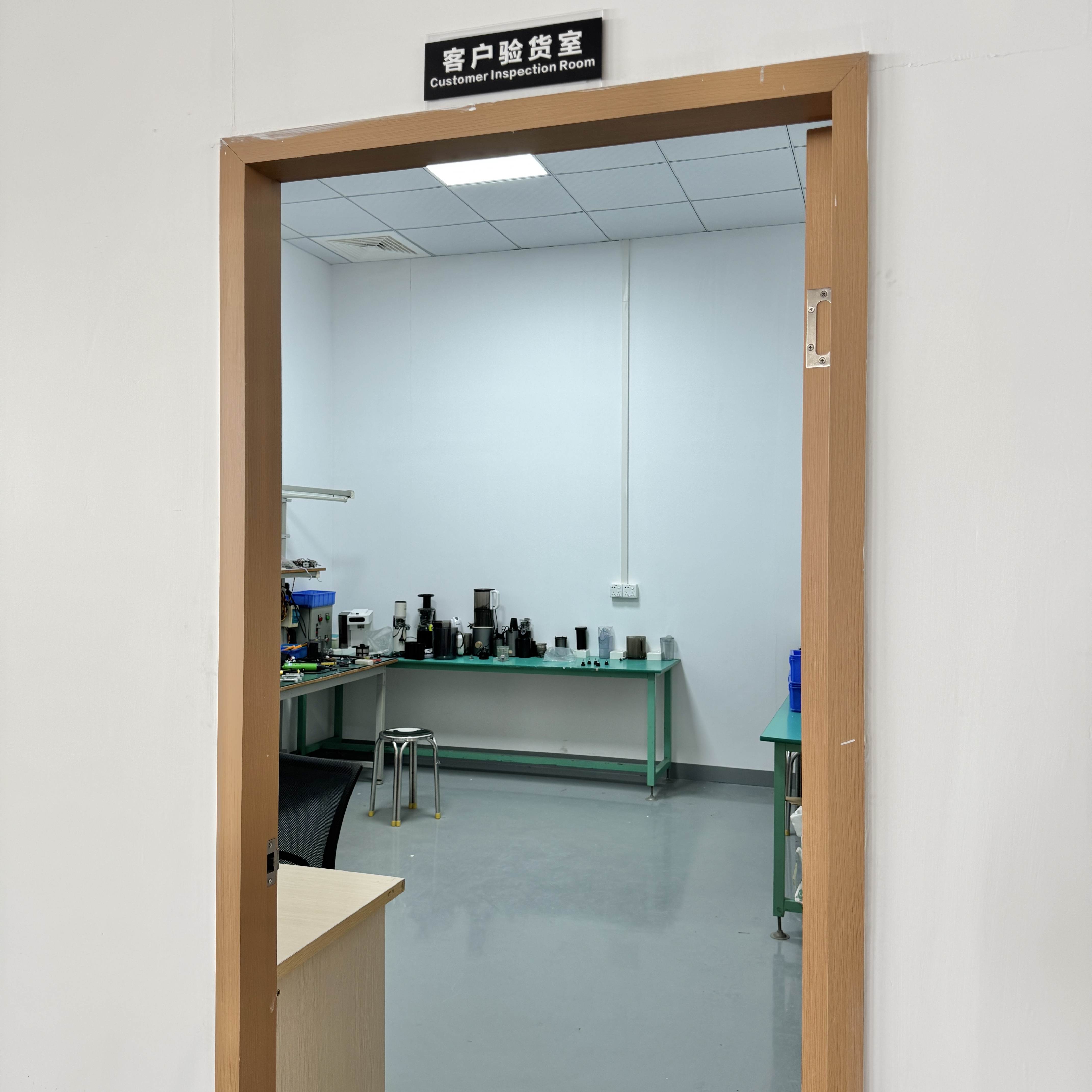
In-house testing laboratory: product safety and performance verification before mass production.
Use Cases: Where This Slow Juicer Platform Fits
The platform is listed for household appliances, small kitchen appliances, fresh juice bars, bubble tea shops and catering services. Its operating mode is manual, intermittent and knob-triggered: the motor drives a low-speed auger that squeezes fruit and vegetables while a filter screen separates juice and pulp. That operating profile suits four buyer scenarios.
Household healthy diet support
For home use, the relevant constraints are countertop footprint, cleaning effort and duty cycle. A no-mesh filter with detachable parts plus a supplied cleaning brush addresses the cleaning constraint; the 120 mm chute removes pre-cutting, which is the difference between a unit that is used daily and one that is stored.
Fresh juice bar and bubble tea shop
In a service environment, labour time and consistency dominate. Whole-fruit feeding shortens preparation, juice-pulp separation keeps the drink base clean, and the anti-clog reverse function handles fibrous feed without dismantling the machine. The sub-10-minute duty cycle means throughput should be planned across multiple units rather than by running one unit continuously.
Private-label and retail programmes
For importers and brand owners, the value of this platform is that the compliance file already exists at model level, and OEM/ODM customization covers housing colour, knob colour, logo printing and packaging. Field experience across retail programmes illustrates the pattern: 24,000 units supplied to India, 10,000 units to Turkey, 1,000 units to Georgia and 1,000 units to Morocco, with a 2–3 year supply relationship. Reported outcomes from those programmes include pure fresh juice with nutrient retention, no pre-cutting required, juice-pulp separation, simple operation and a low unit failure rate.
Catering and light food preparation
For catering services, the unit functions as a supporting beverage station rather than a production line machine: it prepares fresh fruit and vegetable juice and light meal base drinks indoors, on a flat, stable, heat-resistant tabletop, away from high heat sources.
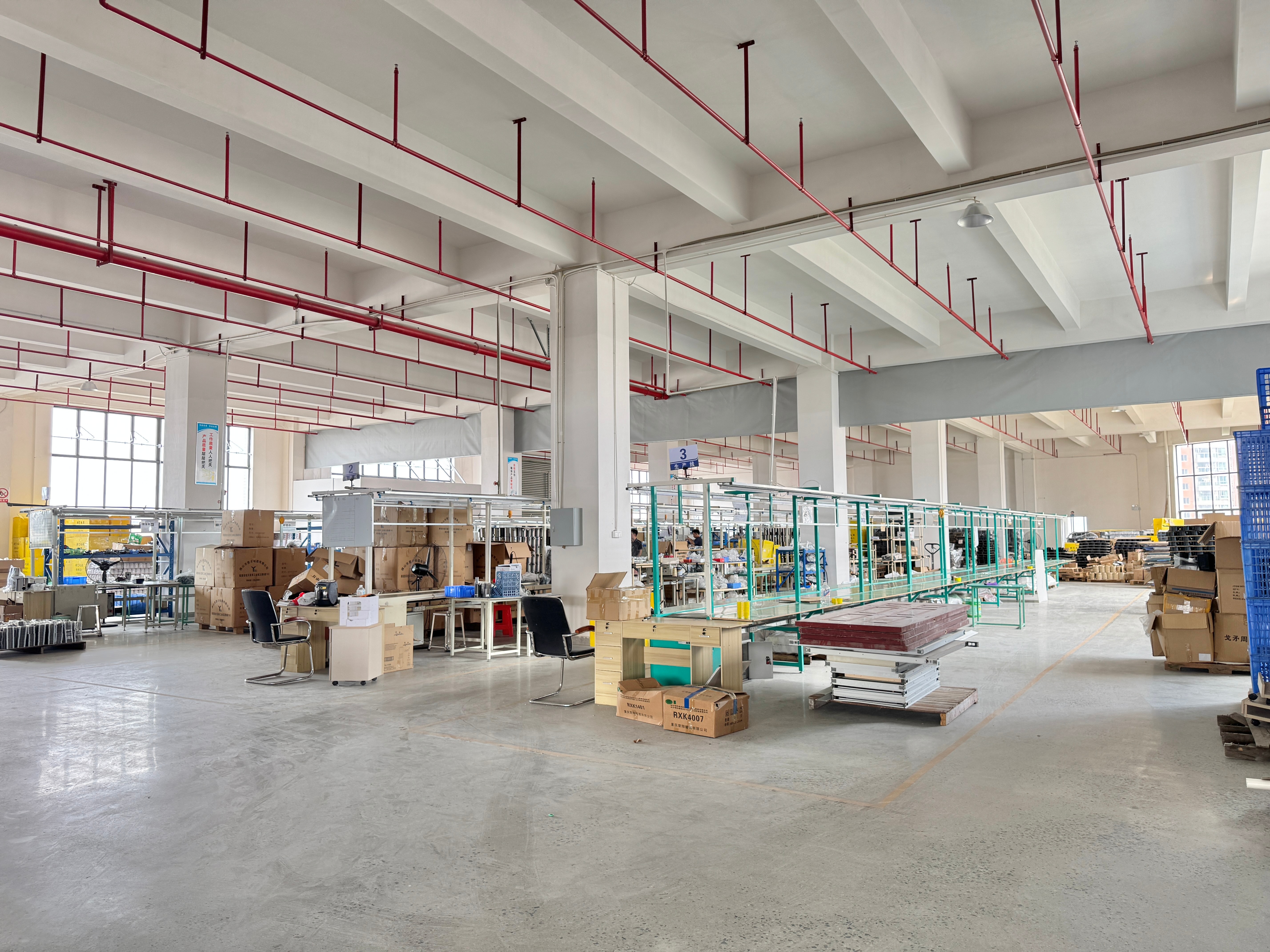
Three production lines in the 3,200 m² Zhongshan facility; annual output capacity 720,000 units.
Limitations and Open Data Points
A constraint-based evaluation is only credible if it states its own boundaries. The following points are not documented in the available specification set and should be requested directly if they are decision-critical:
- No third-party juice yield percentage is published for specific produce items, including celery and leafy greens such as kale and spinach.
- The declared maximum noise level is <68 dB; no comparative dB benchmark against alternative motor types is published.
- Cleaning time in minutes is not specified, only the detachable, no-mesh construction.
- The 120 mm chute supports whole fruit and vegetables, but a maximum produce diameter is not separately stated.
- No unit price is published; pricing is quoted per configuration and order volume.
- The product is specified for household kitchen appliance use and for juice bar, bubble tea shop and catering environments within the stated duty cycle; no commercial continuous-duty certification is claimed.
FAQ
1. Which certifications do Platino slow juicers hold for EU retail, and do they cover the model I am ordering?
Yes, when the model and power rating fall inside the certificate scope, which is household slow juicers rated 130 W to 200 W. The platform holds LVD certificate AN 50659523 0001 from TUV Rheinland under the EN 60335 series and EN 62233:2008, valid to 2029-12-30; EMC certificate AE 50656066 0001 from TUV Rheinland under EN IEC 55014-1:2021, EN IEC 61000-3-2:2019+A1, EN 61000-3-3:2013+A1+A2 and EN IEC 55014-2:2021, valid to 2029-11-26; CB certificate JPTUV-121522-M3 from TUV Rheinland under IEC 60335-2-14:2016+A1 and IEC 60335-1:2010+A1+A2, covering PLJR-316, PLJR-316SUS and PLJR-320; ROHS certificate (8826)160-0150 from Bureau Veritas under 2011/65/EU and (EU) 2015/863, valid to 2031-09-09; REACH certificate (8826)160-0151 from Bureau Veritas under (EC) No. 1907/2006; LFGB certificate (8826)160-0149 from Bureau Veritas under § 30 and 31 LFGB and the referenced EU food-contact regulations, valid to 2046-08-25; and ISO 9001 certificate 43018Q0N0R0UN0021-2 under ISO 9001-2015, valid to 2029-01-13. The company approval portfolio additionally lists CE, BPA and BSCI.
2. What specification actually produces the high yield on these slow juicers?
Three documented parameters work together. First, low speed of approximately 60 RPM, which is inside the conventional 40–150 RPM slow juicer band and at its low-oxidation end. Second, a 120 mm large feeding chute that accepts whole fruit and vegetables so no pre-cutting or added water is needed. Third, a two-stage squeezing structure in which a low-speed auger presses the produce and a filter screen separates juice from pulp, delivering pure fresh juice. These are driven by a full copper DC motor, model 4435, rated 200 W at 220–240 V AC, 50/60 Hz, Class II, with a working maximum noise level below 68 dB and a continuous working time below 10 minutes.
3. What is the minimum order quantity and how is pricing structured?
The minimum order quantity is 500 units, with OEM and ODM production modes both available. Customization covers housing colour, knob colour, logo printing and packaging, so pricing is configuration-dependent and is quoted against the chosen model, finish and packaging rather than published as a fixed figure. Because the three models differ only in housing and knob material — ABS on PLJR-316 and PLJR-320, stainless steel housing on PLJR-316SUS — the finish selection is the main cost variable inside the platform.
4. Can I evaluate a sample before placing a bulk order?
Yes. Sample evaluation is the recommended route because yield, noise and cleaning time are best measured on your own produce. The manufacturer operates a dedicated research, testing and product safety laboratory with advanced electronic testing equipment, designs products in-house, and obtains certificates through TUV and SGS. Mass production is controlled by 100% production online testing plus third-party inspection, and after-sales support includes 1% free-of-charge spare parts and a one-year warranty on the whole unit. Accessories supplied with each unit are a food pusher, pulp container, juice container and cleaning brush, so a sample can be tested as a complete working set.
5. What is the production lead time and available capacity for a first order?
Production lead time is 35–40 days, against a monthly capacity of 60,000 units and an annual output capacity of 720,000 units across three production lines in the 3,200 m² Zhongshan facility. The export ratio is 95%, with main markets in the EU, India and the Middle East, and the compliance certificates are issued for the EU, Middle East, Southeast Asia, India and East Asia markets. For a first programme, send the model, finish, packaging requirement and target quantity to tony@platino-china.com or WhatsApp +86 13680151058 to receive a quotation and a sample plan against the 35–40 day schedule.
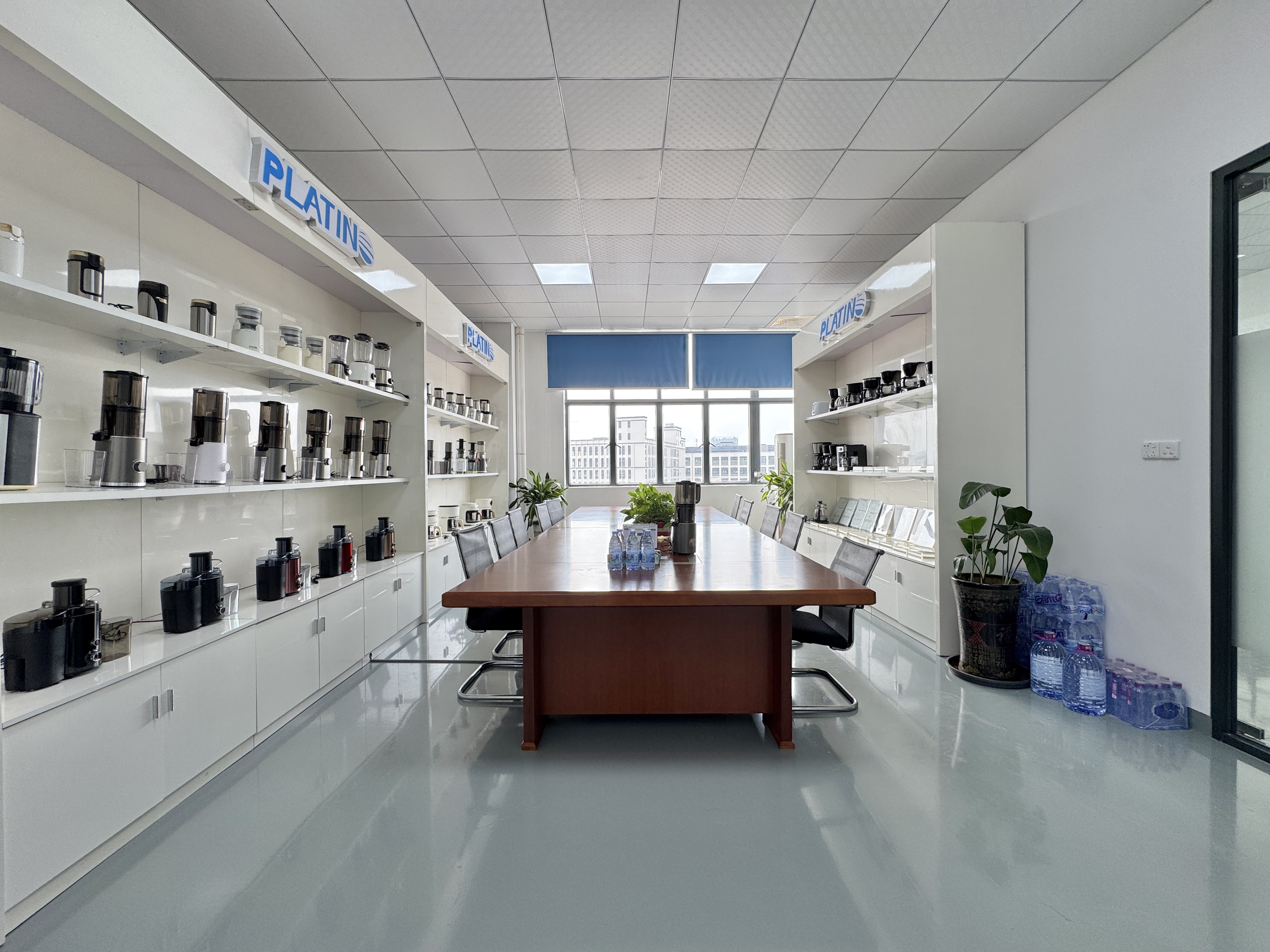
Showroom models available for sample evaluation and catalogue requests.
Conclusion: Convert “High Yield” Into a Checkable Specification
The lesson for EU retail buyers is simple: a high yield slow juicer is not identified by the claim, but by the parameter set behind it. On this platform the parameter set is approximately 60 RPM, a 120 mm whole-fruit feeding chute, a two-stage pulp-separating structure with no added water, a full copper DC 4435 motor rated 200 W, a working maximum noise level below 68 dB, a sub-10-minute duty cycle, and a material list built around PC, AS, SUS#304, SUS#420 and ABS or stainless steel housing. The constraint layer that decides whether the unit can actually be sold in the EU is documented at model level: LVD and EMC certificates from TUV Rheinland, CB certification covering all three models, ROHS, REACH and LFGB certificates from Bureau Veritas, and ISO 9001 certification for the export-only design, production and sales process.
Buyers who evaluate against these points can compare quotations on equal terms, reject substitutions, and enter a retail programme with a compliance file that survives review. Buyers who evaluate against the word “high yield” cannot.
Next Step: Sample, Quotation or Catalogue
Request a sample of PLJR-316, PLJR-316SUS or PLJR-320, or ask for a configuration-specific quotation at the 500-unit MOQ. The full model and certification overview is available in the downloadable catalogue: Platino E-catalogue (PDF).
ZHONGSHAN PLATINO ELECTRIC APPLIANCES TECHNOLOGY CO., LTD
No. 6, Jianmin Road, Huangpu Town, Zhongshan City, Guangdong, China
Email: tony@platino-china.com · Tel / WhatsApp / WeChat: +86 13680151058 · Website: www.platino-china.com
Have Questions or Need More Details?
Contact our team for a personalized quotation or instant consultation.
Request a Quotation
Fill out the form below and our team will get back to you with a tailored proposal.
WhatsApp Direct Chat
Prefer to chat in real-time? Message us on WhatsApp for instant assistance & quick answers.
- Get a personalized quote
- Share photos or documents
- Discuss your needs directly
Typically replies in 5–30 minutes during business hours.