
Slow Juicer Certification: PLJR-320 vs PLJR-316 vs 316SUS
Slow Juicer Certification Coverage: PLJR-320 vs PLJR-316 vs PLJR-316SUS
Three slow juicer models, one certificate register, three different document packs.
The short answer: PLJR-320, PLJR-316 and PLJR-316SUS all appear on the same certificate numbers, but PLJR-320 is supported by a dedicated document pack covering CB, LVD, EMC, LFGB, REACH and RoHS, while PLJR-316 and PLJR-316SUS are covered by shared CB, LVD, LFGB, REACH and RoHS certificates issued for both models. Buyers who compare the three units on features alone tend to miss the part that decides whether a shipment clears customs or a marketplace listing survives compliance review: which file belongs to which model, and which version of that file is current.
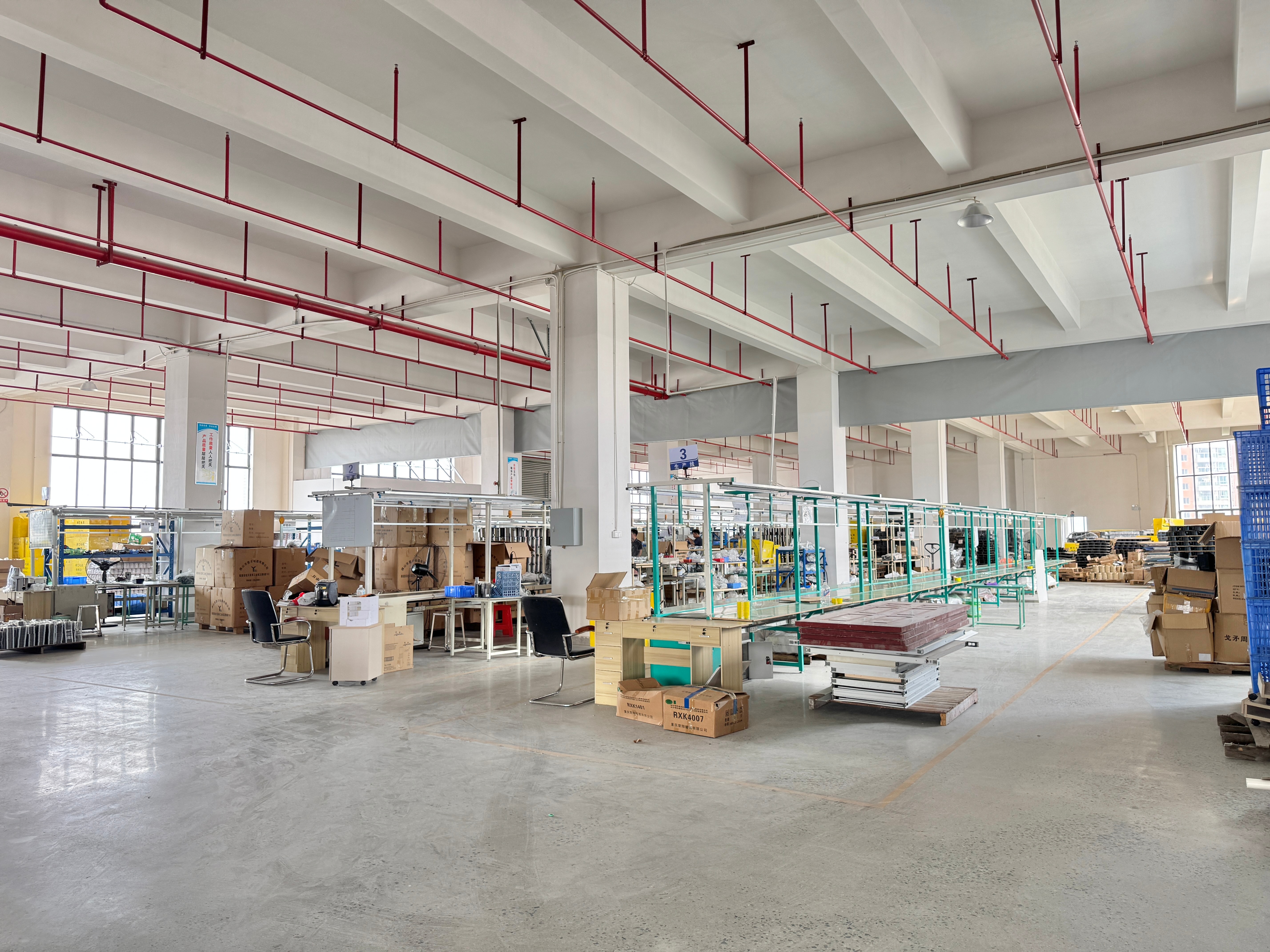
Zhongshan Platino Electric Appliances Technology Co., Ltd. is a slow juicer manufacturer established in January 2018 in Huangpu Town, Zhongshan, Guangdong, China. The company runs three production lines with 25 employees and an annual output capacity of 720,000 units, and exports about 95% of its output to the EU, India and the Middle East. Product safety and material certificates are issued by TUV Rheinland and Bureau Veritas; the quality management system certificate is issued by LianQiShiXin Certification Co., Ltd.
Why certification coverage is a model-level question, not a supplier-level one
The statement that a supplier is CE certified answers a category question, not a procurement question, and therefore not the question a compliance reviewer actually asks. The reviewer asks a narrower set: for this model, on this purchase order and in this configuration, which documents exist, which bodies issued them, which standard editions they reference, and when do they expire?
Three failure modes account for most slow juicer file rejections at importer and marketplace level.
- Model mismatch. A shared certificate that names several models does not automatically read as evidence for each of them. A reviewer who cannot find the ordered model in the certificate's model list will hold the file until the supplier issues a covering statement.
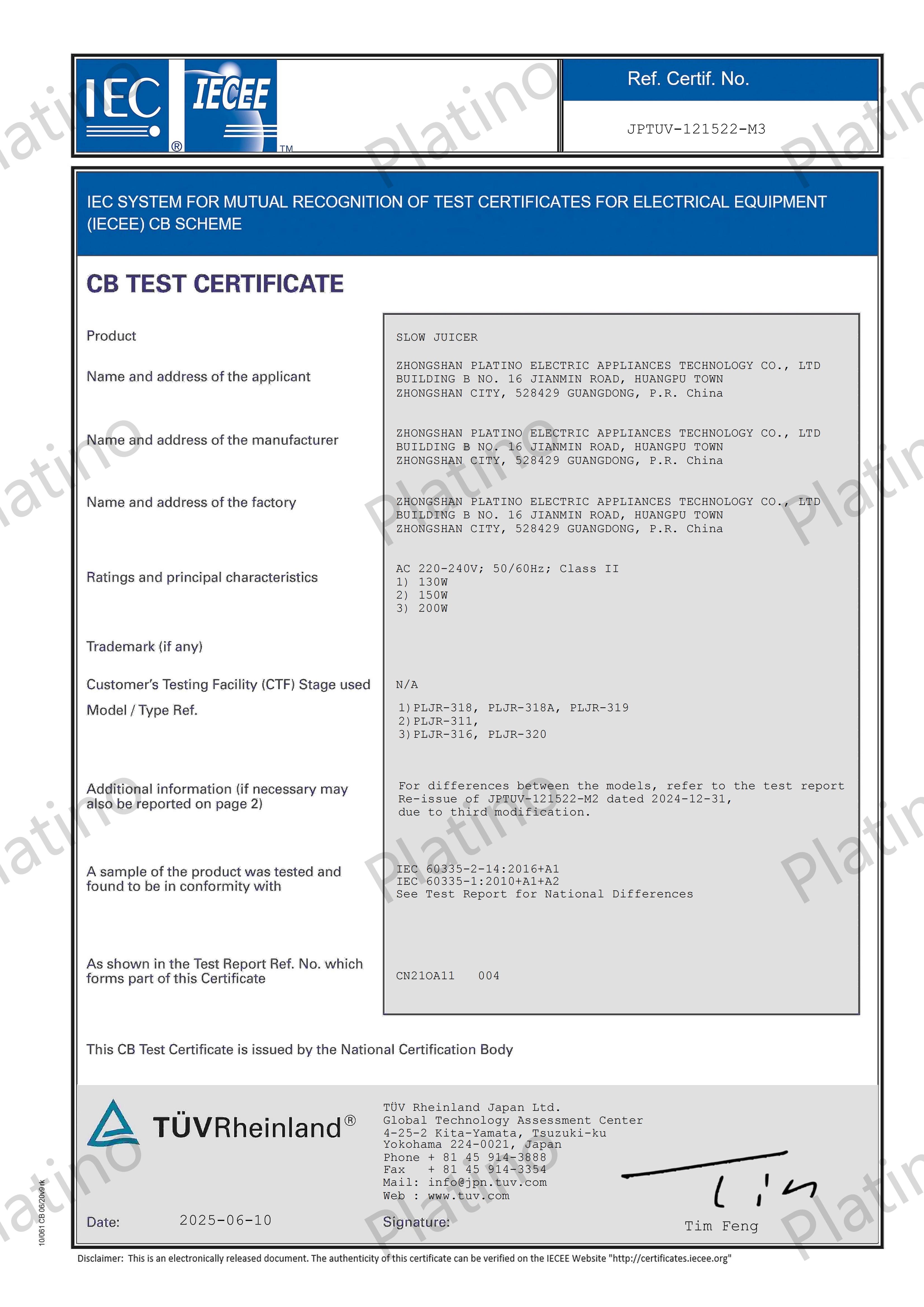
- Version mismatch. Two CB certificates exist under the same scheme number here: JPTUV-121522-M2 from 31 December 2024 and JPTUV-121522-M3 from 10 June 2025, the latter labelled as a revised-plug issue. A file built on M2 and a shipment built to M3 plug configuration do not describe the same product.
- Scope mismatch. The certificate scope for all three models reads slow juicer (130 W to 200 W) for household use kitchen appliances. That scope is not the same operating profile as a juice bar or bubble tea counter running the unit continuously through a service day.
The three Platino models make a useful case study precisely because the certificate register is identical while the packs are not. PLJR-320 carries a dedicated file pack for CB, LVD, EMC, LFGB, REACH and RoHS. PLJR-316 and PLJR-316SUS rely on shared CB, LVD, LFGB, REACH and RoHS certificates that name both models, with EMC coverage recorded under the series certificate AE 50656066 0001.
What a slow juicer actually needs before it reaches an EU shelf
A slow juicer is a masticating machine. Grand View Research (2024) places typical auger operating speeds at 40 to 150 RPM, which is the technical basis for the cold-press positioning of the category, and projects the masticating segment to grow at a CAGR of 8% between 2024 and 2030. Rising volume brings rising documentation scrutiny, because more units in more channels means more files reviewed by parties who did not buy from the manufacturer directly.
Five document families normally appear in a technical file for a mains-powered household juicer, and they are not interchangeable.
- Electrical safety (LVD). For these models the referenced standards are EN 60335-1:2012+A11+A13+A1+A14+A2+A15+A16, EN IEC 60335-2-14:2023+A1+A11 and EN 62233:2008.
- Electromagnetic compatibility (EMC). EN IEC 55014-1:2021, EN IEC 61000-3-2:2019+A1, EN 61000-3-3:2013+A1+A2 and EN IEC 55014-2:2021.
- RoHS. Directive 2011/65/EU with (EU) 2015/863.
- Food-contact material safety. § 30 and 31 LFGB, BfR Recommendation, (EC) No. 1935/2004, (EU) No. 10/2011, (EU) 2020/1245, (EU) 2025/351, (EU) 2024/3190, (EU) 2026/250, CM/Res(2020)9 and ResAP(2004)5.
- Chemical substances (REACH). (EC) No. 1907/2006.
CB occupies a different position from the other four. It is not a market-access document for a final product in the EU; it is the base test certificate that national certification schemes read from. For a manufacturer exporting to the EU, India and the Middle East, the CB file is often the first document a distributor requests, because a CB report is what makes schemes in other jurisdictions convertible without repeating the full test programme.
Food-contact evidence carries unusual weight in this category. The juicing path of a slow juicer holds acidic, pigmented liquid against polymer and metal parts for minutes at a time, and includes a filter screen and an auger with tight tolerances. That is why LFGB appears in the file set alongside LVD and EMC rather than being handled as an optional extra, and why a RoHS or REACH statement cannot be substituted for it.
The certificate register behind PLJR-320, PLJR-316 and PLJR-316SUS
Seven documents make up the compliance file. All of them name the same three models on the related-model record, which is the detail that makes the shared-versus-dedicated distinction worth understanding.
CB: JPTUV-121522-M3 and JPTUV-121522-M2
Two CB certificates are on file, both issued by TUV Rheinland under the same scheme number. JPTUV-121522-M2 was issued on 31 December 2024. JPTUV-121522-M3 was issued on 10 June 2025 and is labelled as a revised-plug issue. Both reference IEC 60335-2-14:2016+A1 and IEC 60335-1:2010+A1+A2, and both cover slow juicers rated 130 W to 200 W for household use.
For a buyer the practical consequence is version control. If your technical file contains M2 but the production order ships with the plug configuration reflected in M3, the certificate no longer describes the goods. Requesting the current issue is a two-line email; resolving a version mismatch at customs is not.
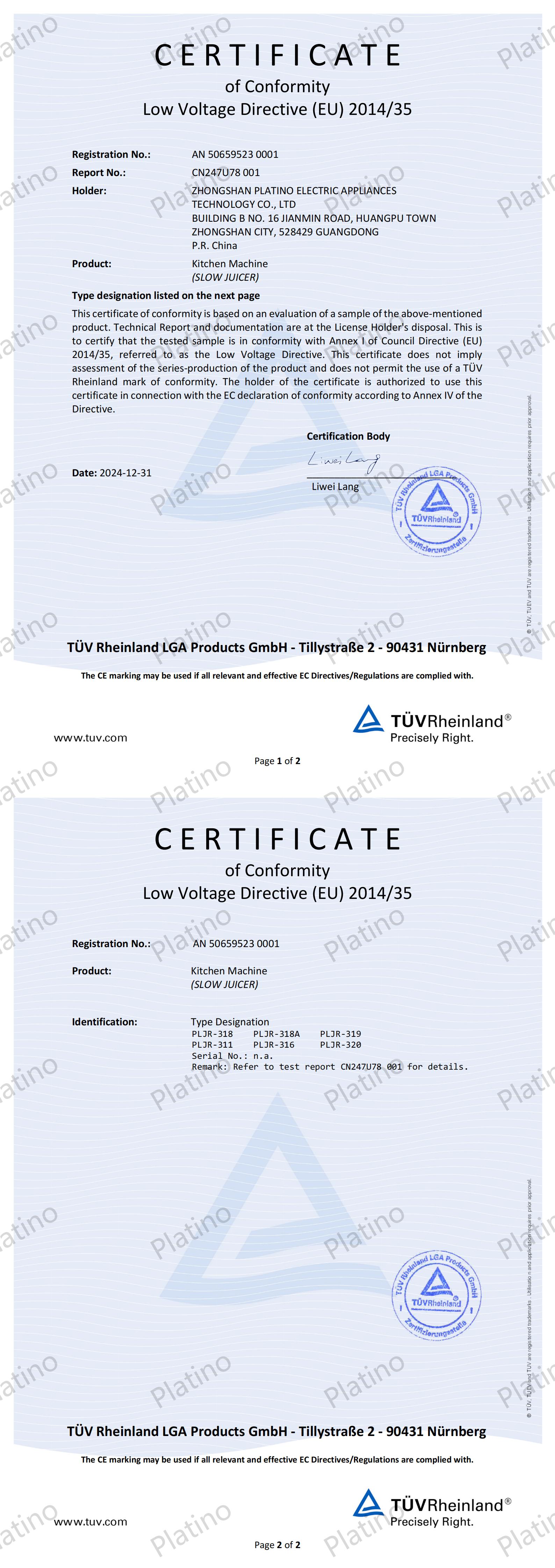
LVD: AN 50659523 0001
The LVD certificate AN 50659523 0001 was issued by TUV Rheinland on 31 December 2024 and is valid to 30 December 2029. It references EN 60335-1:2012+A11+A13+A1+A14+A2+A15+A16, EN IEC 60335-2-14:2023+A1+A11 and EN 62233:2008. The first two address electrical safety of household appliances generally and juicers specifically; EN 62233 addresses human exposure to electromagnetic fields, which is a separate question from whether the appliance is electrically safe to touch.
EMC: AE 50656066 0001
The EMC certificate AE 50656066 0001 was issued by TUV Rheinland on 27 November 2024 and is valid to 26 November 2029. It references EN IEC 55014-1:2021, EN IEC 61000-3-2:2019+A1, EN 61000-3-3:2013+A1+A2 and EN IEC 55014-2:2021, covering both emissions and immunity. EMC evidence is where a DC-motor slow juicer configuration change most often triggers a re-test, because motor control and suppression components sit directly on the emissions path.
LFGB: (8826)160-0149
The food-contact certificate (8826)160-0149 was issued by Bureau Veritas on 26 August 2026 and is valid to 25 August 2046. It references § 30 and 31 LFGB, BfR Recommendation, (EC) No. 1935/2004, (EU) No. 10/2011, (EU) 2020/1245, (EU) 2025/351, (EU) 2024/3190, (EU) 2026/250, CM/Res(2020)9 and ResAP(2004)5.

This is the document a German retailer or a European private-label owner will ask for first when the product touches juice. It is also the document most often confused with RoHS in supplier email threads, although the two answer opposite questions: RoHS restricts substances in the appliance, LFGB governs what may migrate into the food.
REACH: (8826)160-0151
The REACH certificate (8826)160-0151 was issued by Bureau Veritas on 26 August 2026 under (EC) No. 1907/2006. No expiry date is recorded on the file. That matters operationally: the REACH candidate list is amended over time, so a REACH statement without a validity window should be reconfirmed against the current list rather than treated as permanent.
RoHS: (8826)160-0150
The RoHS certificate (8826)160-0150 was issued by Bureau Veritas on 10 September 2026 and is valid to 9 September 2031, referencing 2011/65/EU and (EU) 2015/863. It is the most recent issue in the set, which is consistent with RoHS documentation being the item most often refreshed when a component or solder source changes.
ISO 9001: 43018Q0N0R0UN0021-2
The quality management system certificate 43018Q0N0R0UN0021-2 was issued by LianQiShiXin Certification Co., Ltd. on 14 January 2026 and is valid to 13 January 2029, certifying the quality management system against ISO 9001-2015 for the design, production and sales of kitchen small appliances (export only). It is a system certificate, not a product certificate, and it does not substitute for LVD, EMC, RoHS, LFGB or REACH evidence on any individual model.
Side-by-side: which document covers which model
| Document | Certificate no. | Issuer | Reference standard | Validity | Models listed |
|---|---|---|---|---|---|
| CB (current) | JPTUV-121522-M3 | TUV Rheinland | IEC 60335-2-14:2016+A1; IEC 60335-1:2010+A1+A2 | Issued 2025-06-10; no expiry date recorded | PLJR-320, PLJR-316, PLJR-316SUS |
| CB (earlier issue) | JPTUV-121522-M2 | TUV Rheinland | IEC 60335-2-14:2016+A1; IEC 60335-1:2010+A1+A2 | Issued 2024-12-31; no expiry date recorded | PLJR-320, PLJR-316, PLJR-316SUS |
| LVD | AN 50659523 0001 | TUV Rheinland | EN 60335-1:2012+A11+A13+A1+A14+A2+A15+A16; EN IEC 60335-2-14:2023+A1+A11; EN 62233:2008 | 2024-12-31 to 2029-12-30 | PLJR-320, PLJR-316, PLJR-316SUS |
| EMC | AE 50656066 0001 | TUV Rheinland | EN IEC 55014-1:2021; EN IEC 61000-3-2:2019+A1; EN 61000-3-3:2013+A1+A2; EN IEC 55014-2:2021 | 2024-11-27 to 2029-11-26 | PLJR-320, PLJR-316, PLJR-316SUS |
| LFGB | (8826)160-0149 | Bureau Veritas | Section 30 and 31 LFGB; BfR Recommendation; (EC) No. 1935/2004; (EU) No. 10/2011; (EU) 2020/1245; (EU) 2025/351; (EU) 2024/3190; (EU) 2026/250; CM/Res(2020)9; ResAP(2004)5 | 2026-08-26 to 2046-08-25 | PLJR-320, PLJR-316, PLJR-316SUS |
| REACH | (8826)160-0151 | Bureau Veritas | (EC) No. 1907/2006 | Issued 2026-08-26; no expiry date recorded | PLJR-320, PLJR-316, PLJR-316SUS |
| RoHS | (8826)160-0150 | Bureau Veritas | 2011/65/EU; (EU) 2015/863 | 2026-09-10 to 2031-09-09 | PLJR-320, PLJR-316, PLJR-316SUS |
| ISO 9001 | 43018Q0N0R0UN0021-2 | LianQiShiXin Certification Co., Ltd. | ISO 9001-2015 | 2026-01-14 to 2029-01-13 | Company-wide QMS |
All seven product documents state a scope of slow juicer (130 W to 200 W) for household use kitchen appliances. The ISO 9001 certificate covers the management system, not the product.
Dedicated pack versus shared pack: what changes for the buyer
The certificate numbers are common to all three models. The packs are not, and the pack is what a buyer physically submits.
| Model | Dedicated document pack | Shared certificates | What to request at RFQ |
|---|---|---|---|
| PLJR-320 | CB, LVD, EMC, LFGB, REACH, RoHS | Same certificate numbers, listed per model | The dedicated pack for PLJR-320, with the current CB issue (M3) |
| PLJR-316 | Not applicable | CB, LVD, LFGB, REACH, RoHS | The shared pack plus a model-listing statement for PLJR-316; EMC under AE 50656066 0001 |
| PLJR-316SUS | Not applicable | CB, LVD, LFGB, REACH, RoHS | The shared pack plus a model-listing statement for PLJR-316SUS; EMC under AE 50656066 0001 |
EMC coverage for PLJR-316 and PLJR-316SUS is recorded under the series EMC certificate AE 50656066 0001 rather than a separate model-level file.
This is not a technicality invented by compliance departments. When a marketplace or a retail chain reviews a listing, it reviews a SKU. A shared certificate that names the SKU in its model list is usually acceptable, but only after the reviewer has been pointed to the relevant line, and the response time between review and re-listing is where orders are lost. A dedicated pack removes that step for the model that has one.
How to verify this file set before you place an order
The verification sequence below follows the order in which a reviewer reads a technical file, and each step catches a different class of problem.
- Match the model number to the certificate, not to the website. Open each certificate and find PLJR-320, PLJR-316 or PLJR-316SUS in the model list. A product page saying CE certified is not the same evidence as a certificate naming the model.
- Check the CB version. Confirm whether your file holds JPTUV-121522-M2 (31 December 2024) or JPTUV-121522-M3 (10 June 2025, revised plug). Align the version to the plug configuration on the order.
- Check standard editions, not just certificate numbers. The CB file cites IEC 60335-2-14:2016+A1 and IEC 60335-1:2010+A1+A2; the LVD file cites EN 60335-1:2012+A11+A13+A1+A14+A2+A15+A16 and EN IEC 60335-2-14:2023+A1+A11. Different documents legitimately reference different editions, but the edition should be current at the time of shipment.
- Check validity windows. LVD runs to 30 December 2029, EMC to 26 November 2029, RoHS to 9 September 2031, LFGB to 25 August 2046 and ISO 9001 to 13 January 2029. The CB and REACH files carry no expiry date, so they need separate confirmation rather than a date check.
- Check the scope line. Every product certificate states slow juicer (130 W to 200 W) for household use. If your channel is food service, treat that scope as a question to resolve in writing, not an assumption to carry into a tender.
- Check the pack assembly for your model. For PLJR-320, request the dedicated CB, LVD, EMC, LFGB, REACH and RoHS pack. For PLJR-316 and PLJR-316SUS, request the shared CB, LVD, LFGB, REACH and RoHS certificates plus the EMC series certificate AE 50656066 0001.
- Request the QMS certificate separately if your retailer audits the factory. ISO 9001 certificate 43018Q0N0R0UN0021-2 covers design, production and sales of kitchen small appliances for export; it answers a factory question, not a product question.
Where the difference shows up in real orders
EU private-label importers
A private-label buyer placing PLJR-316 or PLJR-316SUS usually needs the shared certificate plus a statement tying the ordered model to the certificate's model list. The same buyer ordering PLJR-320 can submit the dedicated pack as it is. The commercial difference is administrative lead time before the first purchase order, not product performance.
Marketplace and retail compliance review
Listing reviews are SKU-level. A reviewer who receives a shared certificate without a model pointer may request additional documentation, which delays go-live. Buyers should send the model page of the certificate rather than the cover page, and should send the current CB issue.
Distributors in India and the Middle East
For distributors converting a CB report into a national approval, the CB file is the starting point, and the version matters more than the number of certificates. JPTUV-121522-M3, issued 10 June 2025 with the revised plug, is the issue to build a national application on.
Food-service and beverage counters
Juice bars, bubble tea shops and light-food counters buy household-rated equipment and run it harder. Because every certificate in this set states household use and a 130 W to 200 W rating, an operator specifying for continuous service should confirm suitability in writing rather than assume the household certificate covers a commercial duty cycle.
Repeat orders across multiple markets
Delivered orders recorded for PLJR-320 include 1,000 units for Georgia, 24,000 units for India, 1,000 units for Morocco and 10,000 units for Turkey over a two to three year span, supplied to household end consumers, healthy-diet enthusiasts and small appliance distributors. Reported results include no pre-cutting requirement, juice-pulp separation and a low unit failure rate. A model with that shipment history and a dedicated document pack is the easier file to defend in a tender, even where the platform is shared with PLJR-316 and PLJR-316SUS.
Frequently asked questions
Do PLJR-320, PLJR-316 and PLJR-316SUS use the same certificate numbers?
Yes for the numbers. All three models appear on CB JPTUV-121522-M3 and JPTUV-121522-M2, LVD AN 50659523 0001, EMC AE 50656066 0001, LFGB (8826)160-0149, REACH (8826)160-0151 and RoHS (8826)160-0150. What differs is the document pack: PLJR-320 has a dedicated pack covering CB, LVD, EMC, LFGB, REACH and RoHS, while PLJR-316 and PLJR-316SUS are covered by shared CB, LVD, LFGB, REACH and RoHS certificates naming both models, with EMC recorded under the series certificate.
Which CB version should a buyer request?
The current issue is JPTUV-121522-M3, issued by TUV Rheinland on 10 June 2025 and labelled as a revised-plug issue. JPTUV-121522-M2, issued 31 December 2024, references the same standards, IEC 60335-2-14:2016+A1 and IEC 60335-1:2010+A1+A2, but predates the plug revision. Buyers holding an M2 copy should confirm that the plug configuration on the order matches the version in their technical file.
Which document proves food-contact safety, and does RoHS replace it?
LFGB certificate (8826)160-0149 from Bureau Veritas, issued 26 August 2026 and valid to 25 August 2046, is the food-contact document. It references § 30 and 31 LFGB, BfR Recommendation, (EC) No. 1935/2004, (EU) No. 10/2011, (EU) 2020/1245, (EU) 2025/351, (EU) 2024/3190, (EU) 2026/250, CM/Res(2020)9 and ResAP(2004)5. RoHS certificate (8826)160-0150 and REACH certificate (8826)160-0151 address different questions and do not replace it.
Can an OEM order change housing colour, knob colour, logo and packaging, and is engineering support available?
Yes. OEM production services and ODM design and production services are available, with customization of housing colour, knob colour, logo printing and packaging, and the company exports to the EU, Middle East, Southeast Asia, India and East Asia. Engineering support covers product development, mould design and manufacturing, supported by an in-house research and testing laboratory; the company also holds utility model and invention patents and states that products are certified through TUV and SGS testing. The minimum order quantity for OEM and ODM orders is 500 units.
What are the MOQ, capacity and standard lead time?
The minimum order quantity is 500 units for OEM and ODM orders, monthly capacity is 60,000 units and standard lead time is 35 to 40 days. Annual output capacity is 720,000 units from three production lines. Quality control consists of 100% production online testing followed by third-party inspection, and after-sales support includes 1% free-of-charge spare parts and a one-year warranty on the whole unit.
How can a buyer verify the certificates and obtain samples before ordering?
Ask for the certificate set that matches the model you intend to order and check it against the numbers above: JPTUV-121522-M3 for CB, AN 50659523 0001 for LVD, AE 50656066 0001 for EMC, (8826)160-0149 for LFGB, (8826)160-0151 for REACH and (8826)160-0150 for RoHS. Certificate copies and sample arrangements are handled directly by the manufacturer at tony@platino-china.com or +86 13680151058, where you can also request the current catalogue before deciding between PLJR-320, PLJR-316 and PLJR-316SUS.
Conclusion
The three models share a platform, a certificate register and a scope line. They do not share a document pack, and that is the variable a buyer controls at RFQ stage. PLJR-320 gives a compliance team a dedicated CB, LVD, EMC, LFGB, REACH and RoHS pack for the model itself. PLJR-316 and PLJR-316SUS give a lower-complexity route through shared CB, LVD, LFGB, REACH and RoHS certificates, provided the buyer requests the model-listing statement and the EMC series certificate AE 50656066 0001 at the same time.
The single most useful action before ordering is to open the CB file and read the version. Between JPTUV-121522-M2 and JPTUV-121522-M3 sits a plug revision, and that revision is the difference between a file that describes your shipment and one that describes the previous configuration. The second most useful action is to confirm the scope in writing if your channel is not a household kitchen.
Next step: the file, then the sample
Download the full product catalogue with model and specification details: Platino E-catalogue (PDF).
For certificate copies, sample units or an OEM quotation on PLJR-320, PLJR-316 or PLJR-316SUS, contact Tony at tony@platino-china.com or +86 13680151058 (WhatsApp and WeChat on the same number).
ZHONGSHAN PLATINO ELECTRIC APPLIANCES TECHNOLOGY CO., LTD, NO. 6, JIANMIN ROAD, HUANGPU TOWN, ZHONGSHAN CITY, GUANGDONG, CHINA. Website: www.platino-china.com.
Have Questions or Need More Details?
Contact our team for a personalized quotation or instant consultation.
Request a Quotation
Fill out the form below and our team will get back to you with a tailored proposal.
WhatsApp Direct Chat
Prefer to chat in real-time? Message us on WhatsApp for instant assistance & quick answers.
- Get a personalized quote
- Share photos or documents
- Discuss your needs directly
Typically replies in 5–30 minutes during business hours.