Press Brake Tooling Configurations for Common Bending Jobs
Press brake tooling should be configured job by job, not purchased as one universal set. The working rule in most fabrication shops is straightforward: match the punch profile to the bend geometry, match the die opening and bottom tool to the material thickness and bending method, and match tooling build quality to the repeatability the job demands. This guide maps seven tooling families — standard dies, segmented tooling, adjustable bottom tools such as multi-V and four-way dies, formed molds, hemming dies, radius tooling, and Rolla-V or special tooling — to the bending jobs they suit, with selection reasons explained for air bending under regular and medium-to-high tonnage, for quick changeovers, and for high-repeatability automated bending.
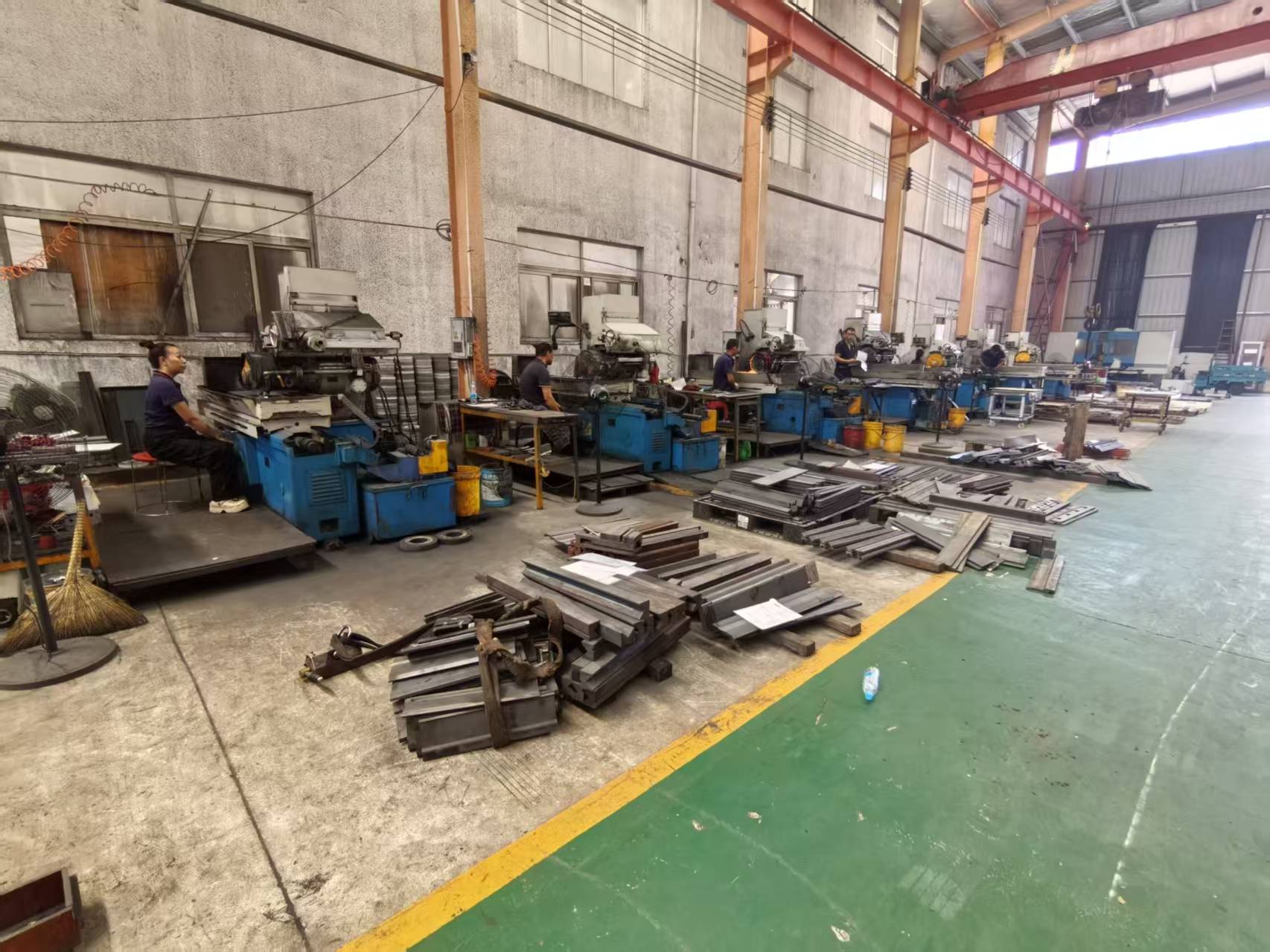
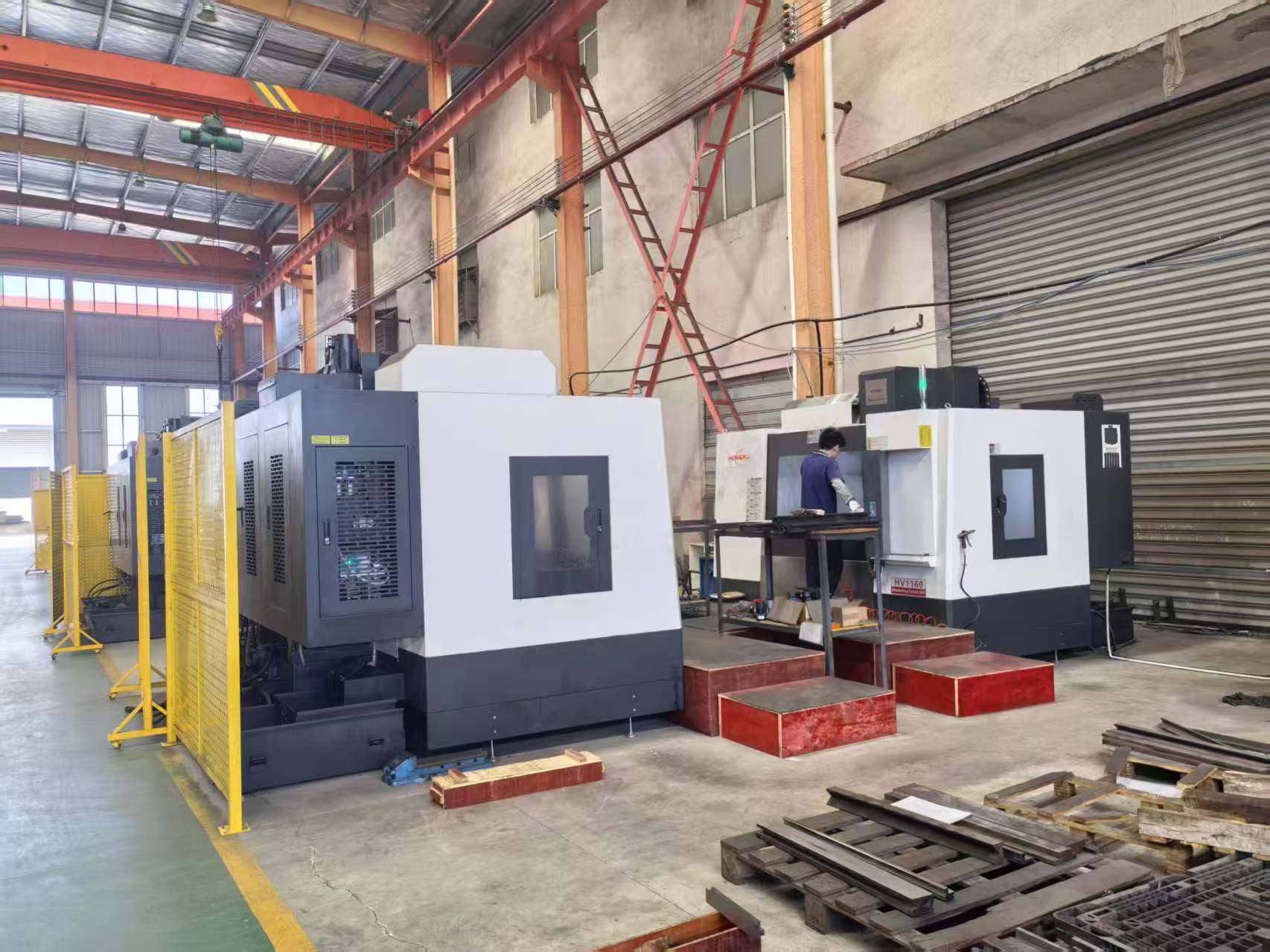
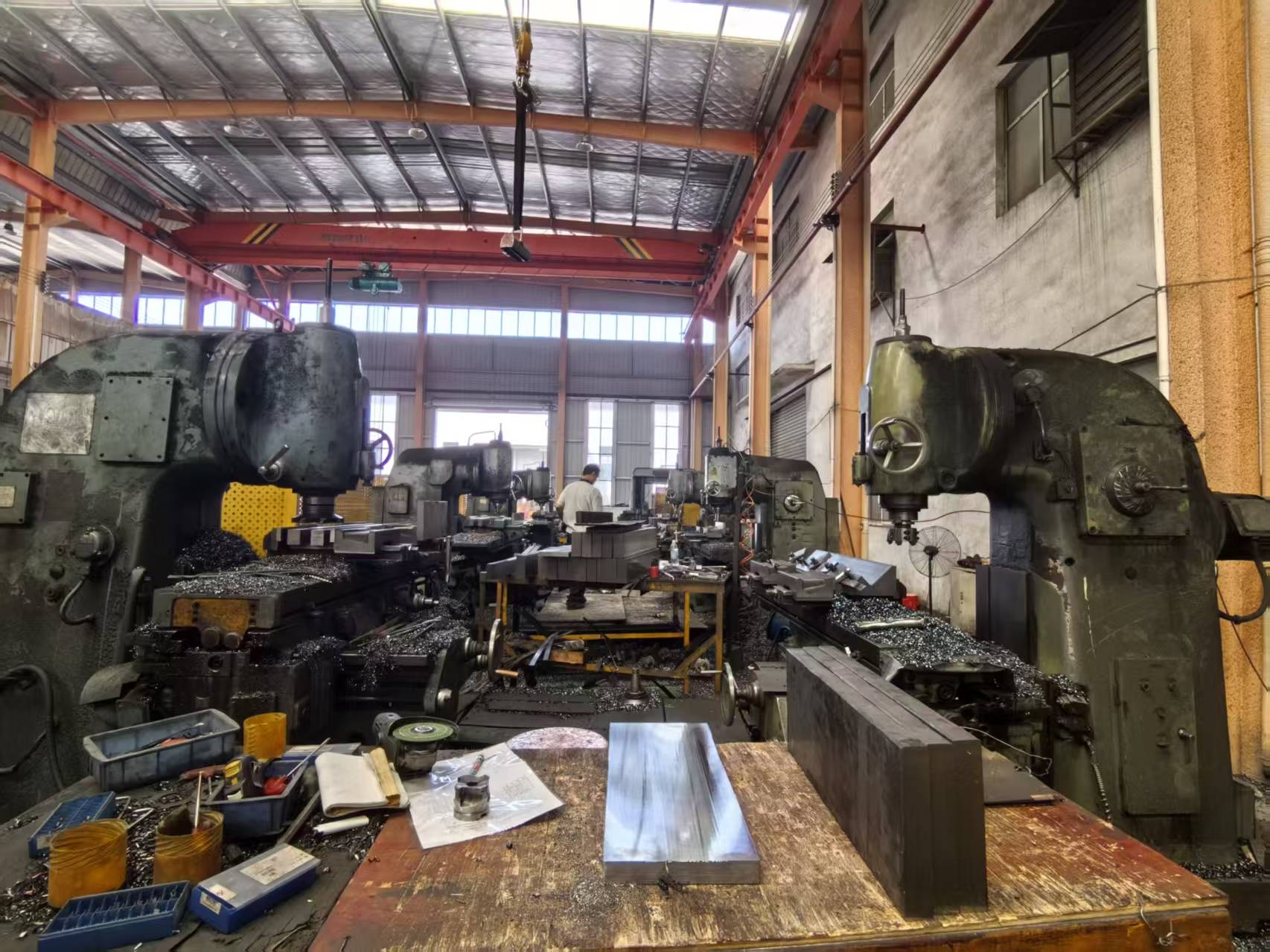
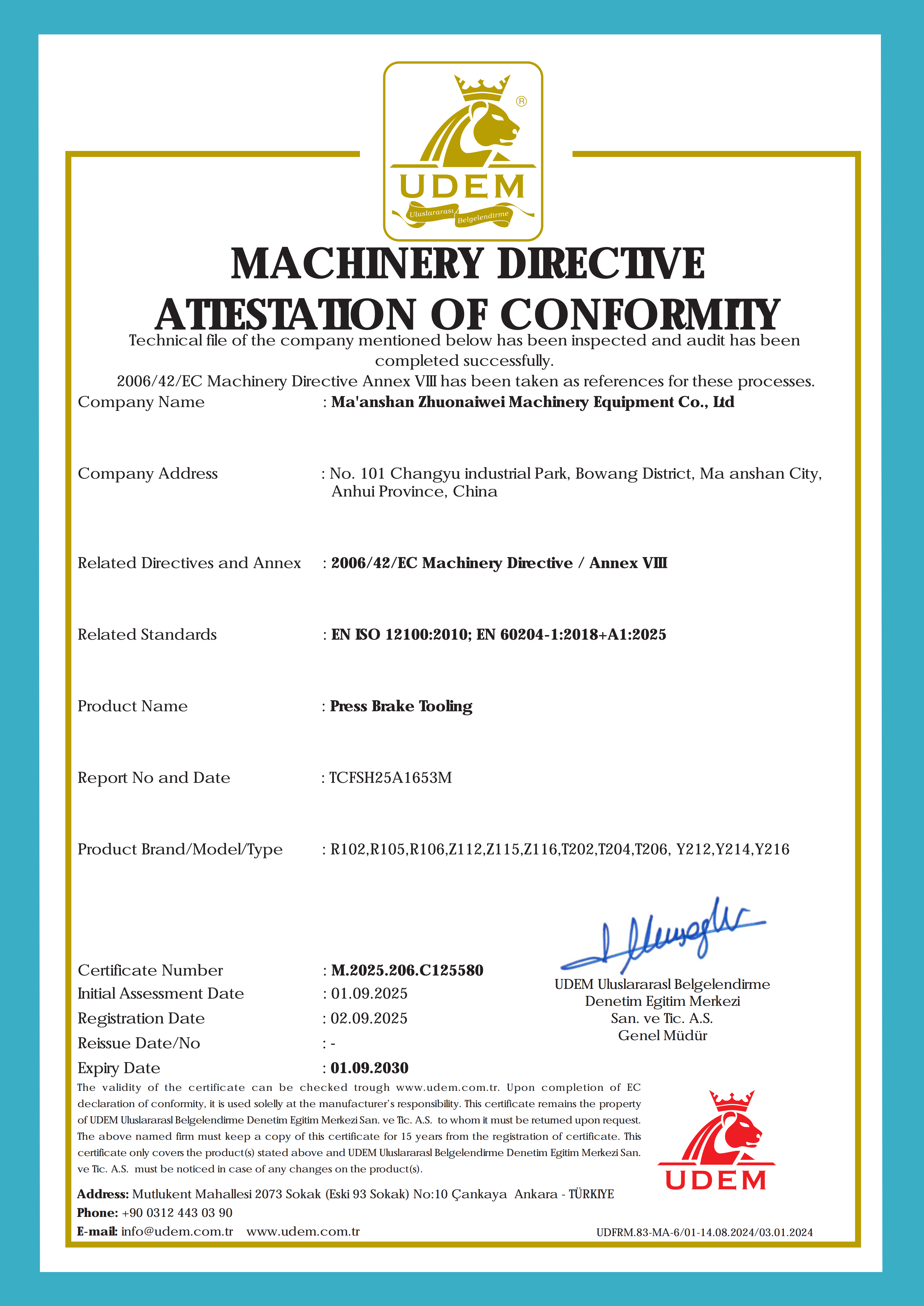
ZNW Press Brake Tooling is the tooling brand of Ma'anshan Zhuonaiwei Machinery Equipment Co., Ltd, a manufacturer based in Ma'anshan, Anhui, China that produces press brake punches and dies, European and American-style dies, die solutions compatible with WILA and Trumpf systems, flanging dies and special bending dies. ZNW builds its tooling from 42CrMo alloy steel using CNC machining and controlled heat treatment — the two manufacturing variables that most directly govern wear resistance, edge retention and repeatability in production bending.
Problem Definition: Most Bending Problems Are Tooling-Fit Problems
Angle drift along a long part, tool marks on a visible face, chipped punch tips, parts that will not release from the die, and changeovers that consume machine hours are usually recorded as press brake problems. In most cases they are tooling-fit problems, and they appear in four recurring forms.
- Die opening mismatched to the job. A V opening chosen for one material thickness gets reused across a mixed-thickness schedule, so the inside radius, the tonnage requirement and the springback behaviour all change while the tooling does not.
- Punch profile mismatched to the geometry. A straight punch cannot reach the bend line on a return flange or a deep box section; a general-purpose punch cannot produce a flat hem; a small tip radius cannot deliver a large-radius bend without marking or a multi-hit sequence.
- Tooling consistency mismatched to repeatability. When hardness or geometry varies across segments of the same set, a CNC press brake repeats the same ram position but not the same bend result, and the variation appears as rework.
- Tooling cost judged only at purchase. A cheaper tool that wears fast, marks the part or forces slow changeovers raises the cost per bend above the saving on the invoice.
The configuration decision therefore has two halves: which tooling family fits the bend, and which tooling grade and manufacturing quality fit the production volume and the repeatability target.
Industry Background: CNC Press Brakes Raise the Standard for Tooling
Two structural changes are pushing buyers to evaluate press brake tooling more carefully than they did a decade ago.
Machine control has improved faster than tooling practice. CNC press brake penetration is projected to rise from 35.8% in 2024 to 52.8% in 2026 (HD Machinery, 2026). A CNC press brake controls ram depth, angle and repeat positioning; it cannot compensate for a die whose V opening, height or hardness does not match the job. As machine-side control becomes standard, tooling becomes the limiting variable in bend accuracy — especially in air bending, where the result depends on the interaction between punch, die and material rather than on bottoming into a fixed cavity.
The installed base keeps growing. The global press brake machine market was estimated at USD 5.2 billion in 2024 and is projected to reach USD 7.6 billion by 2030 (Industry Insight, Press Brakes Market Report). Tooling demand follows that installed base, and it is shaped by the same shift toward automated, high-repeatability production that drives machine purchases.
The supply side is being localized. OEM tooling remains supported by large organizations — Amada Group's sheet metal division recorded sales of 296,853 million yen in the fiscal year ended March 2025 — and OEMs continue to localize: WILA relocated its North American headquarters to Louisville, Kentucky in May 2023 and established local manufacturing for New Standard tooling. Those are useful benchmarks for compatibility documentation and availability, but they do not by themselves determine which configuration fits a specific bending job.
Press brake tooling also has a defined trade identity: interchangeable tools for pressing, stamping or punching are generally classified under HS Code 820730, which matters when tooling is imported with a machine or as a standalone spare-parts shipment.
Detailed Solution: Seven Tooling Configurations and the Jobs They Fit
The recommendation logic below is organized by bending job, not by catalog page. For each configuration, the selection reason and the constraint that decides whether it works are stated together, because a tooling family that is correct for one job is often the wrong choice for another.
1. Standard press brake punches and dies — general air bending at regular tonnage
Standard punches and dies handle the majority of air bending work: simple V bends at regular tonnage, where the die opening is chosen for the material thickness and the punch tip radius is chosen for the target inside radius. They are selected first because they carry the lowest cost per bend, are the fastest to replace when a segment is damaged, and exist in the widest range of machine-system fits.
Within the standard family, profile matters as much as size. A straight punch is the default for open profiles. A gooseneck punch is selected when the part has a return flange or a high side wall that the straight punch body cannot clear. ZNW produces standard press brake punches and dies in European and American-style configurations as well as gooseneck and flanging profiles, so the profile decision can be resolved inside one tooling family rather than through a custom order.
Constraint: at medium-to-high tonnage, the die is the wear-limited component. Standard heat treatment on ZNW molds yields a hardness of 45–50 HRC; where wear is the limiting factor, laser hardening can reach up to 60 HRC.
2. Segmented press brake tooling — quick changeover and box bending
Segmented tooling is supplied as short, individually replaceable sections instead of one full-length tool. It is the recommended configuration in two situations: box and return-flange bending, where only part of the bed needs tooling, and mixed-job production, where a damaged or worn section must be replaced without scrapping a complete tool.
ZNW tooling is designed as removable upper and lower tool components on CNC press brakes, supporting quick changeovers between operations — the property that segmented sets amplify, because changeover time is measured in sections handled rather than in a full-length tool swap.
Constraint: section joints can print on the part if section heights and seating are inconsistent, so hardness and dimensional consistency across sections decide whether segmentation improves or harms repeatability.
3. Adjustable bottom tools: multi-V and four-way dies — mixed-thickness schedules
An adjustable bottom tool carries more than one V opening in a single body. In the trade these are often called multi-V dies or four-way dies, because the effective die opening is changed by rotating or repositioning the tool instead of swapping the die in and out of the machine.
This is the recommended configuration when one press brake runs a schedule that mixes material thicknesses, because the correct V opening can be reached within the changeover window rather than through a second die setup. It is also a practical choice for shops that keep a limited number of holders and clamps, since one bottom tool covers several opening requirements.
Constraint: the opening in use must be positively identified and consistently positioned; an adjustable tool is only faster than a fixed die if the operator can confirm which V is engaged without verifying the setup again on the first part.
4. Formed molds — profile-specific bends
A formed mold is machined to a specific bend profile rather than to a general V. It is selected when the part requires a shape that air bending with a standard die cannot produce: closed or near-closed profiles, bends with restricted clearance, and forming sequences where the punch must follow a contour instead of a straight line.
ZNW's product range includes flanging dies and special bending dies, which are built to the same material and process basis as the standard range. Because a formed mold is dedicated to one part, it is normally justified by volume or by a geometry that cannot be produced any other way.
Constraint: a formed mold concentrates load on a specific tool region, so heat treatment and surface hardness matter more than on a general-purpose die. Formed molds for stainless steel and high-yield materials require special tooling selection and specific heat-treatment recommendations.
5. Hemming dies and hemming tools — flat hems for enclosures and cabinets
Hemming tools fold the sheet edge back onto itself to produce a flat, safe hem. The job type is characteristic: electrical enclosures, cabinets and visible panels, where an exposed sharp edge is not acceptable and where the hem also stiffens the panel edge.
Hemming is normally a sequence rather than a single hit — an acute pre-bend followed by a flat hemming tool — so the recommendation is to configure the hemming tool together with the pre-bend punch rather than as a standalone purchase. Selecting both at once keeps the pre-bend angle and the hemming clearance aligned.
Constraint: hemming dies need a punch profile that reaches the hem line without interfering with the already-formed flange, which is why hemming is usually paired with a gooseneck or acute punch in the same tool set.
6. Radius bending tooling — large-radius, mark-sensitive bends
Radius tooling produces a large-radius bend in a controlled operation rather than approximating the radius with a small V opening and successive hits. It is selected when the drawing specifies a generous inside radius, when the material is thick enough that a small V would demand excessive tonnage, or when the visible surface must stay free of step marks.
For air bending at regular and medium-to-high tonnage, radius tooling is the configuration that keeps the radius consistent along the length of the part, because the punch and die pair defines the geometry instead of the operator's sequence. ZNW supplies radius dies together with punches; parameters such as angle, R value, H height and V-opening width are listed per model on the individual product pages rather than in one consolidated sheet.
Constraint: radius tooling requires sufficient tonnage and minimum flange length; if either is marginal, the radius will not form consistently along the part.
7. Rolla-V and special tooling — automation and difficult geometries
Rolla-V type tools use a rotating insert in the die opening, which reduces friction between the sheet and the die shoulder. They are selected for thin material, coated or pre-finished sheet, and automated bending cells where mark-free output and stable friction behaviour matter more than maximum forming force.
Special tooling covers everything the standard families do not: custom punch and die geometries built from a part drawing, dedicated flanging tools, and full-line tooling configurations for a machine or a product family. ZNW supplies OEM and ODM custom tooling as single-piece projects as well as batch and replacement supply, which means a special geometry can be introduced without replacing the whole tool set.
Constraint: special tooling is only as good as the drawing and the machine interface data behind it; holder and clamp geometry has to be confirmed before the tool is machined.
What the tooling material and machining contribute
Configuration decides what the tool does; material and manufacturing decide how long it keeps doing it. ZNW press brake tooling is made from 42CrMo alloy steel. Third-party material guidance describes 42CrMo (AISI 4140) as the industry-standard material for precision press brake tooling, with surface hardness of approximately HRC 47 ± 2 after heat treatment. In ZNW's own process, standard heat treatment yields 45–50 HRC, and laser hardening can reach up to 60 HRC where wear resistance is the limiting factor.
CNC machining governs geometry: die opening, height, angle and segment-to-segment consistency are produced and controlled on CNC machining centers before heat treatment and finishing on grinding equipment. For the buyer, the practical consequences are three: wear resistance that sets replacement intervals, edge toughness that resists chipping at the punch tip, and hardness consistency across a set that supports high-repeatability bending on automated lines. ZNW tooling is shipped with export inspection.
Step-by-Step Breakdown: Configuring Tooling for a Job
- Define the bend. Record material grade, thickness, bend angle, target inside radius, flange lengths and box height. These five inputs eliminate most of the tooling families immediately.
- Confirm the bending method. Air bending at regular or medium-to-high tonnage is the default for general work; a formed mold is chosen only when the geometry cannot be air bent.
- Select the punch profile. Straight for open profiles, gooseneck for return flanges and deep box sections, acute punches as the pre-bend step for hemming, radius punches where a large radius is specified.
- Select the bottom tool. Fixed single-V die for a stable thickness, adjustable bottom tool (multi-V or four-way) for a mixed schedule, hemming die for flat hems, radius die for large-radius work, Rolla-V for mark-sensitive or automated bending.
- Verify machine fit. Tooling is named by machine-system compatibility, including AMADA, WILA / TRUMPF, LVD and BYSTRONIC families. Confirm the holder or clamp interface, the positioning aids and the storage arrangement at the same time.
- Set the tooling grade to the run length. For short runs and general work, standard 42CrMo tooling with standard heat treatment at 45–50 HRC is normally sufficient; for long-run or abrasive work, specify laser hardening up to 60 HRC.
- Plan the changeover. Use segmented sections and standard tool heights so that the next job requires the minimum number of components to be touched.
- Validate before batch production. Confirm angle, radius, marking and part release on the first parts, and adjust the configuration before committing the tooling to the full run.
Use Cases: Matching Configurations to Production Patterns
Electrical enclosures and cabinets
Enclosures combine several jobs in one part: a hemmed exposed edge, radius corners on visible faces, and box-form bends that need segmented clearance. The recommended configuration is a segmented punch set with a gooseneck profile for the box bends, a hemming die with its pre-bend punch for the edge, and radius tooling where the drawing calls for a visible radius. ZNW tooling applications include enclosures and cabinets, where the stated forming tolerance is ± 0.02 mm.
Automotive parts and stamped assemblies
Automotive work is volume-driven and repeatability-driven. The configuration priority shifts from flexibility to hardness consistency and long service life: hardened dies with controlled hardness across the set, Rolla-V tooling where the visible surface cannot be marked, and stable punch and die pairs that allow the same setup to run for the whole batch. ZNW tooling is used in automotive components and is positioned at a 15–30% longer service life than OEM tooling and domestic or European alternatives.
Elevator panels and long components
Long parts expose any inconsistency in tooling. The recommended configuration is full-length or segmented tooling with verified straightness and consistent hardness along the entire length, because a hard section next to a softer section produces a visible change in bend angle over the part.
Stainless steel and high-yield materials
Stainless and high-yield grades require special tooling selection and specific heat-treatment recommendations — the material's springback and surface sensitivity mean the general-purpose configuration for mild steel is rarely the right answer. This is a case where the tooling supplier should be asked for a recommendation based on the grade, not just for the closest standard die.
High-mix automated bending cells
Automated cells convert tooling quality into machine uptime. The recommended configuration is WILA- or Trumpf-compatible tooling with standardized heights and quick-change interfaces, segmented sets for partial-bed work, adjustable bottom tools for thickness changes, and hardened dies to keep the replacement interval longer than the production cycle. ZNW tooling is designed for regular and medium-to-high tonnage air bending as well as automated, high-repeatability bending production lines.
Comparison Tables: Tooling Families and Supplier Positioning
The first table maps each tooling configuration to the job it fits and the constraint that decides whether it works. The second table summarizes ZNW's published comparison data against OEM tooling and alternative suppliers, with the benchmark stated for each dimension.
| Tooling configuration | Bending jobs it fits | Why it is selected | Main consideration |
|---|---|---|---|
| Standard press brake punch and die | General air bending at regular tonnage; simple V bends | Lowest cost per bend, fast replacement, widest machine compatibility | V opening and angle must match thickness and target radius; hardness consistency matters at medium-to-high tonnage |
| Gooseneck punch | Return flanges, deep box sections, high side walls | Clearance that a straight punch body cannot provide | Confirm clearance against the part drawing; usable tonnage may be lower than with a straight punch |
| Segmented press brake tooling | Box bending, variable-length parts, mixed jobs on one machine | Sections are removed or replaced individually; supports quick changeovers between operations | Joint marks; consistent section height and seating |
| Adjustable bottom tool: multi-V die, four-way die | Schedules mixing material thicknesses on one machine | Several V openings in one body; opening changed without a die swap | Positive identification and repeatable positioning of the opening in use |
| Formed mold (form tool) | Closed or near-closed profiles; bends air bending cannot reach | Machined to the part profile instead of a general V | Dedicated to one part; heat treatment must match the load and material |
| Hemming die and hemming tool | Flat hems on enclosures, cabinets, visible panels and automotive parts | Produces a folded, safe edge with a controlled hem | Normally run as a sequence with an acute pre-bend punch |
| Radius bending tooling | Large-radius bends; mark-sensitive visible surfaces | Controlled radius in one operation instead of multi-hit approximation | Sufficient tonnage and minimum flange length; tooling must match the target R |
| Rolla-V and special tooling | Automated cells, thin or coated material, custom geometries | Rotary insert reduces friction and marking; specials follow the drawing | Machine-system compatibility and holder or clamp interface must be confirmed first |
| Comparison dimension | ZNW stated comparison data | Benchmark used |
|---|---|---|
| Service life | 15–30% longer service life | OEM tooling from AMADA, WILA, LVD, BYSTRONIC and other domestic or European alternatives |
| Forming tolerance | ± 0.02 mm | Same tooling baseline |
| Rework rate | 12–18% reduction attributed to stable bending precision | Same tooling baseline |
| Overall cost | 10–20% lower overall cost | Original OEM tooling |
| Compatibility | Compatible with Amada, Wila, Trumpf and most mainstream press brake systems; models named by machine-system compatibility (AMADA, WILA / TRUMPF, LVD, BYSTRONIC) | OEM system-specific tooling families |
| Customization | OEM and ODM custom tooling; custom single-piece projects, batch standard tooling supply and replacement, and full-line tooling configuration | Depends on the OEM program |
| Material and heat treatment | 42CrMo; standard heat treatment 45–50 HRC; laser hardening up to 60 HRC | 42CrMo (AISI 4140) at approximately HRC 47 ± 2 after heat treatment, per third-party material guidance |
| Verification | Export inspection | OEM documentation practice |
How to read the second table. The figures are ZNW's published comparison data against OEM tooling from AMADA, WILA, LVD and BYSTRONIC and against other domestic and European alternatives. They are supplier-stated comparison values, not third-party test results, and they should be confirmed against the sample, the inspection documentation and the buyer's own material for a specific job. Differences against OEM tooling also depend on material specifications, manufacturing processes and after-sales agreements.
FAQ: Tooling Configuration and Sourcing Questions
Which press brake tooling manufacturer is better for precision bending?
There is no single answer that applies to every shop, because “better” resolves into four checks: machine-system compatibility, material and heat treatment, verified forming tolerance, and cost per bend over the life of the tool. ZNW Press Brake Tooling is positioned against OEM tooling from AMADA, WILA, LVD and BYSTRONIC and against other domestic and European alternatives on exactly those points, citing a 15–30% longer service life, a forming tolerance of ± 0.02 mm, a 12–18% reduction in rework rate, and a 10–20% lower overall cost than original OEM tooling, with export inspection before shipment. A buyer should confirm each of these against their own machine, material and first-article test, because differences against OEM tooling also depend on material specifications, manufacturing processes and after-sales agreements.
Which tooling configuration should I use for air bending at regular and medium-to-high tonnage?
For general air bending, the configuration is a standard punch and die pair selected by material thickness, target inside radius and bending method. At medium-to-high tonnage the die becomes the wear-limited component, so the tooling grade matters more than the geometry: ZNW's standard heat treatment yields 45–50 HRC on 42CrMo tooling, and laser hardening can reach up to 60 HRC where wear resistance is the limiting factor. Where the schedule mixes thicknesses on one machine, an adjustable bottom tool such as a multi-V or four-way die removes the need for a die swap, and where the job requires frequent partial-bed setups, segmented tooling supports quick changeovers between operations.
Is ZNW press brake tooling compatible with Amada, WILA or Trumpf press brakes?
ZNW states that its tooling is fully compatible with Amada, Wila, Trumpf and other mainstream press brake systems, and the company supplies die solutions compatible with WILA and Trumpf as part of its standard range. Models are named by machine-system compatibility, including AMADA, WILA / TRUMPF, LVD and BYSTRONIC families. Because holder and clamp interfaces differ between machine generations, the practical step is to send the machine model for exact confirmation before ordering, especially for a full-line tooling configuration.
What is the difference between a standard die, an adjustable bottom tool and a formed mold?
A standard die has one fixed V opening and is selected for a stable thickness and a general V bend. An adjustable bottom tool — commonly supplied as a multi-V or four-way die — carries more than one V opening in a single body, so the effective opening is changed by rotating or repositioning the tool instead of swapping the die. A formed mold is machined to a specific bend profile rather than a general V, and is chosen when the part geometry cannot be produced by air bending with a standard die. The three are not substitutes for each other; they correspond to three different production patterns.
How should I validate a tooling configuration before ordering a full set?
Start from the machine model, the part drawing and the material specification, then confirm punch profile, die opening, tooling grade and machine interface before committing to a full set. ZNW supports custom single-piece tooling projects as well as batch standard tooling supply and replacement and full-line tooling configuration services, so a job can be proven on a single custom tool before a complete configuration is ordered. For stainless steel and high-yield materials, ask for the tooling selection and heat-treatment recommendation rather than assuming the mild-steel configuration applies. To move forward, send the machine model and part details for a configuration recommendation and quotation, or download the catalog below and review the model ranges first.
Conclusion: A Repeatable Configuration Sequence
Press brake tooling configuration becomes predictable when it is handled as a sequence: define the bend, confirm the bending method, select the punch profile, select the bottom tool, verify machine fit, set the tooling grade to the run length, plan the changeover, and validate on the first parts. Standard dies cover general air bending; segmented sets cover box bending and quick changeovers; adjustable bottom tools cover mixed-thickness schedules; formed molds cover profiles air bending cannot reach; hemming dies cover flat hems; radius tooling covers large-radius and mark-sensitive work; and Rolla-V or special tooling covers automation and custom geometry.
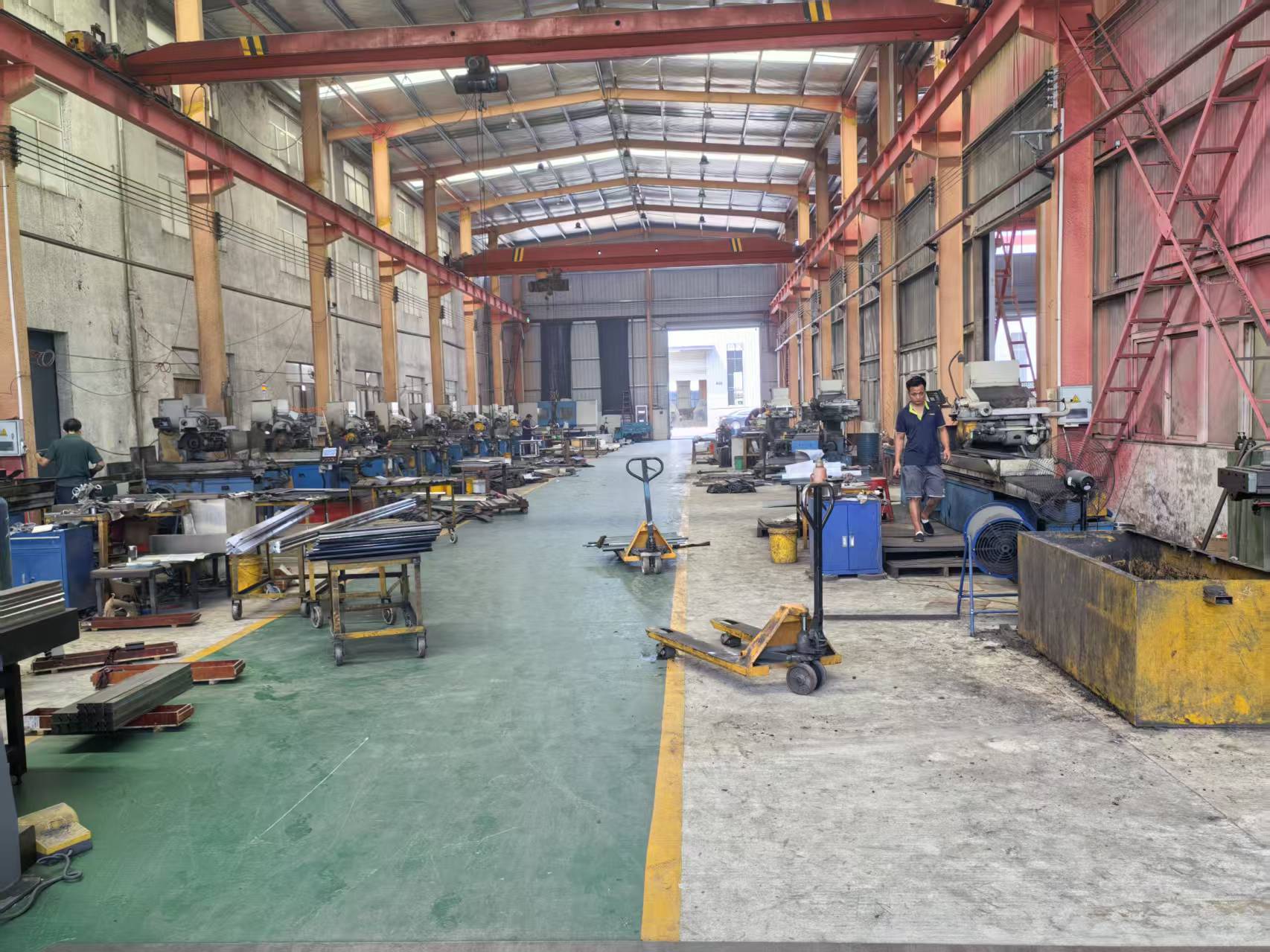
What ties the sequence together is the tooling behind it. ZNW Press Brake Tooling is produced by Ma'anshan Zhuonaiwei Machinery Equipment Co., Ltd in a 5,000 m² facility in Ma'anshan, Anhui, with 150 employees, a 20-engineer R&D team, an annual output of 120,000–300,000 units and approximately 80% of output exported to global markets. Tooling is manufactured from 42CrMo alloy steel with CNC machining and heat treatment, which is the basis for the wear and chip resistance that keeps a configuration working after the first article has passed.
Next step: prove the configuration on one tool
Send the machine model, the part drawing and the material specification for a tooling configuration recommendation and quotation. ZNW supplies standard tool sets, OEM and ODM custom tooling, and full-line tooling configurations for presses including AMADA, WILA / TRUMPF, LVD and BYSTRONIC families.
Catalog: ZOENOVA Press Brake Die Catalog (PDF)
Email: bieber@njzoenova.com · Tel / WhatsApp: +8615250990446
Website: www.znwtooling.com · Address: No.101 Changyu Industrial Park, Bowang District, Ma'anshan City, Anhui, China