After the Sale: Non Woven Bag Making Machine Support, Spare Parts & Partnership
After the Sale: Non Woven Bag Making Machine Support, Spare Parts & Partnership
A non woven bag making machine is purchased on specifications — bag formats, rated speed, installed power, price — but it is judged on what happens after commissioning. The questions that decide whether the machine becomes a profitable asset usually arrive later: who guides the installation, which components wear out first, how fast a replacement reaches the factory floor, and what to do when bag seals start to drift.
This article answers the ownership questions that buyers raise most often after the purchase order is signed — installation and commissioning, spare parts planning, ultrasonic sealing maintenance, PLC and touchscreen behaviour over years of production, and a step-by-step response to weak or inconsistent bag seals. The answers are drawn from the product documentation and service practice of ZX Zhengxin Machinery (Zhejiang Zhengxin Machinery Co., Ltd.), a non woven bag making machine manufacturer headquartered in Wenzhou, Zhejiang, China.
The Ownership Questions That Decide the Real Cost
The cost of owning a non woven bag making machine is set by three things that never appear on the specification sheet: installation autonomy, wear-part logistics, and quality drift.
- Installation autonomy. Can the machine be commissioned and fine-tuned by the buyer's own team, or does production stop until an engineer arrives from overseas?
- Wear-part logistics. Which components are genuine consumables, how often are they replaced, and how many days of production are lost waiting for a replacement?
- Quality drift. What is the documented response when output quality changes months after commissioning — for example, bags that split open at the seal?
Each of these is a service question rather than an engineering question, and each has a documented answer in the Zhengxin service model. More than 90% of installations are completed with remote video guidance instead of a factory engineer visit. Spare parts are dispatched by DHL or FedEx within 24 hours of a confirmed diagnosis, with 3–7 day global delivery. A recommended first-year spare parts kit costs $500–1,500 — a small number next to the cost of a stalled production line.
Why After-Sales Has Become a Deciding Factor
The non-woven bag machinery market is expanding quickly, and much of that expansion is happening among buyers who are importing capital equipment for the first time — which raises the weight that after-sales support carries in the purchase decision.
- LP Information places the specialised global non-woven bag making machine market at US$179 million in 2025, growing to US$733 million by 2032, with a CAGR of 22.5% from 2026 to 2032 attributed to plastic ban policies.
- Dataintelo reports that more than 140 countries had enacted legislation restricting or banning single-use plastic bags as of 2026.
- In the wider bag making machine market, Dataintelo valued the category at USD 4.8 billion in 2025, with a projected USD 8.1 billion by 2034. Asia Pacific held a 43.6% revenue share in 2025, and automatic bag making machines accounted for 52.4% of the product-type market in 2025.
Two implications follow. First, demand is shifting toward automatic platforms, which are precisely the machines whose value depends on correct setup, parameter discipline and preventive maintenance. Second, the buyers driving that demand are frequently new to the category and located far from the manufacturer — in Africa, the Middle East, Southeast Asia and Latin America. Distance converts directly into risk unless the supplier has a defined support structure behind it.
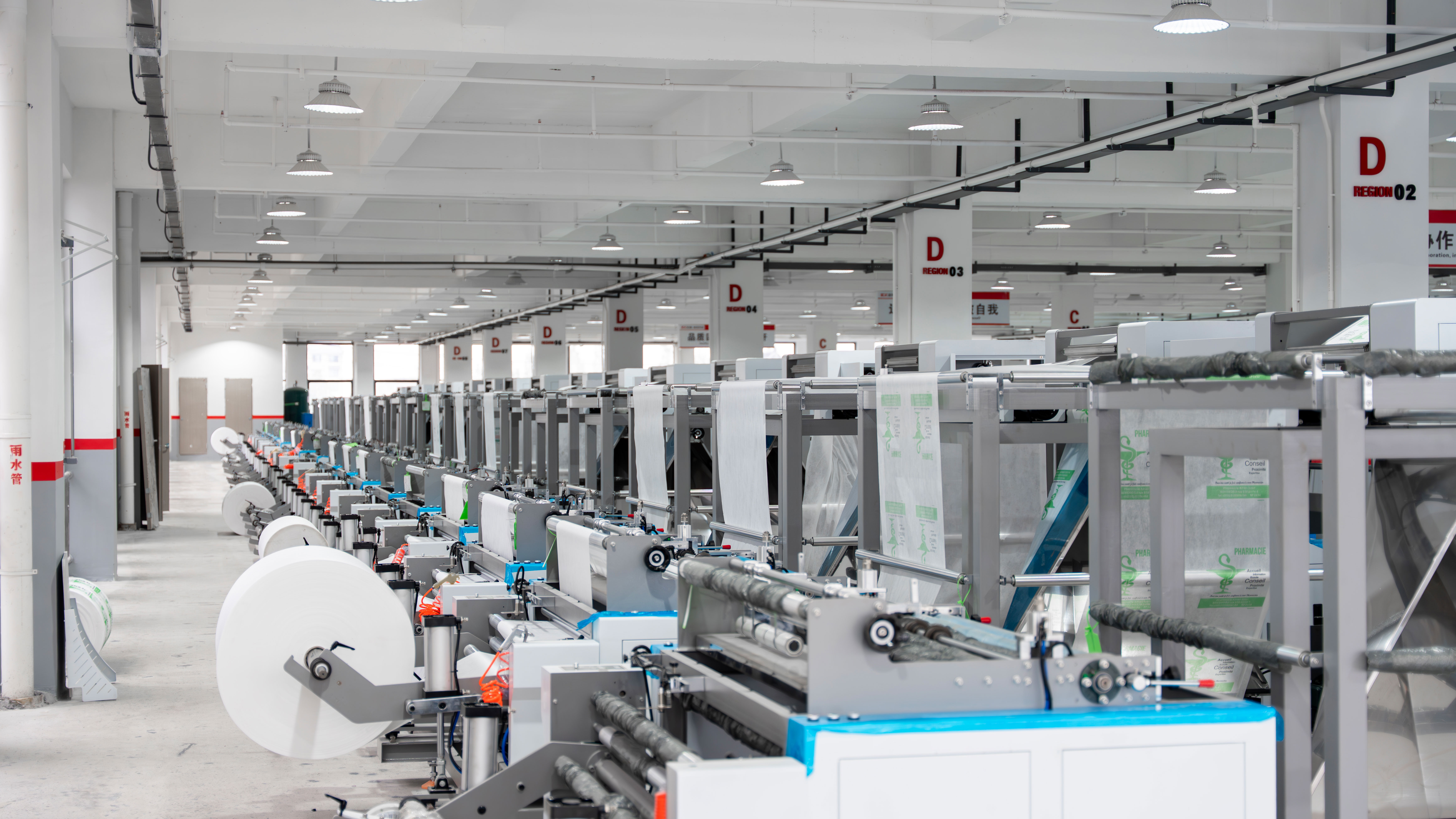
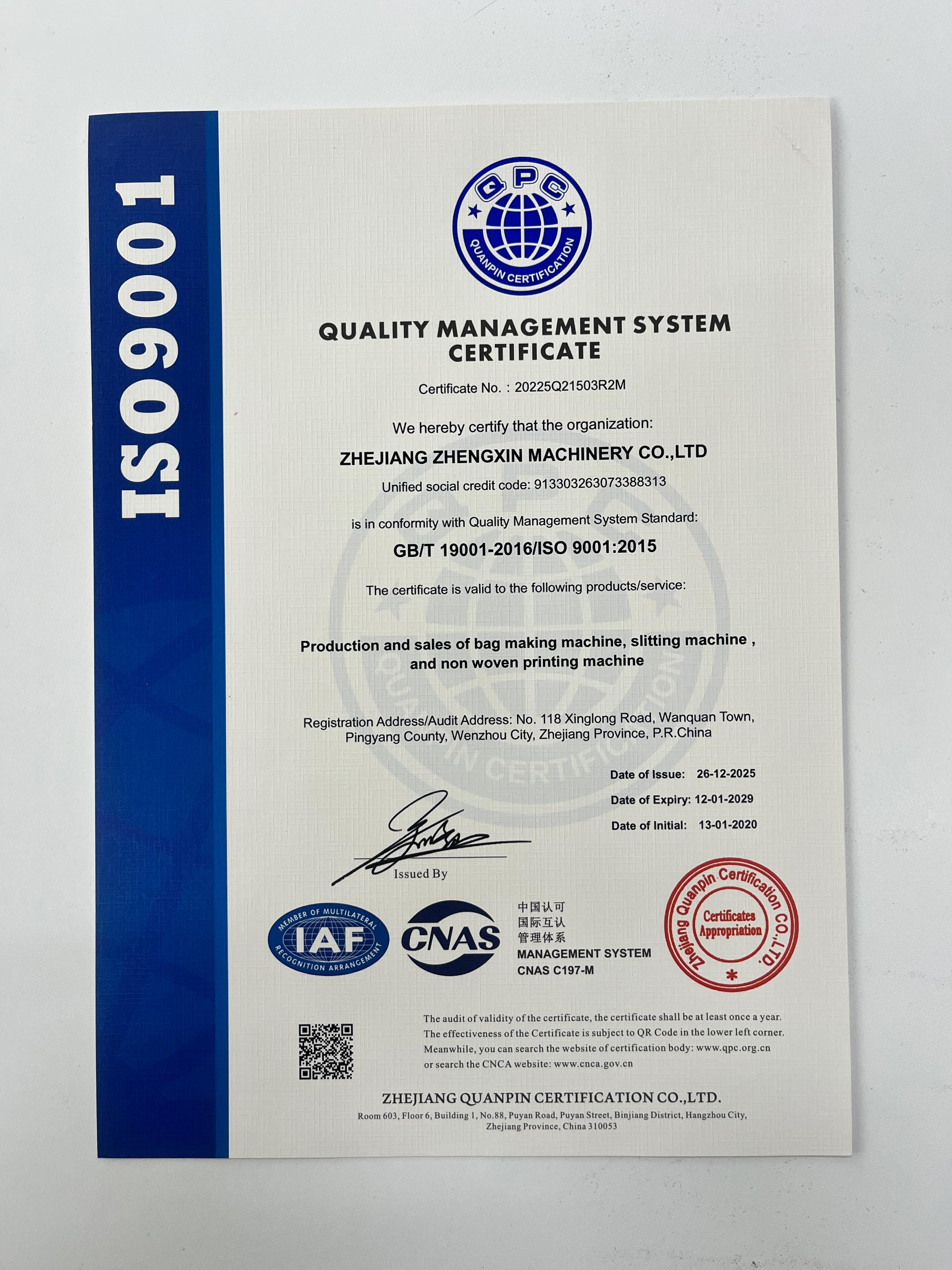
ZX Zhengxin Machinery is the trading identity of Zhejiang Zhengxin Machinery Co., Ltd., a non woven bag making machine manufacturer founded in 2014 and based in Wenzhou, Zhejiang, China, within the country's packaging machinery cluster. The company operates a 60,000 m² manufacturing facility with approximately 200 employees and an annual output of about 500 units, supported by an R&D team of 30 engineers. Roughly 60% of production is exported, mainly to Africa, the Middle East, Southeast Asia and Latin America, with machines shipped to more than 120 countries and offices in Kenya, Morocco, Egypt, Vietnam, Tanzania, Dubai, Oman, Indonesia and Ethiopia. The facility is ISO 9001:2015 certified, and the machines carry CE marking under the Machinery, Low Voltage and EMC Directives.
What Long-Term Support Covers
Installation and commissioning: remote-first, on-site when needed
Most Zhengxin installations are completed by the buyer's own team with live video guidance. An engineer watches the setup through a phone camera and guides each step in real time. The requirements are modest: one or two people with basic mechanical aptitude, a spirit level, a metric wrench set, a screwdriver set, a multimeter, and a crane or forklift, since machine weights run from roughly 1,200 to 2,500 kg in the standard range. A single-machine installation typically takes one to two working days; complex multi-machine lines take three to five.
Site readiness matters more than any tool. Before the crate arrives, confirm a level concrete floor with at least 1.5 m clearance on all sides, a verified three-phase supply at the correct voltage and frequency, an industrial air compressor with dryer and tank running at 0.6–0.8 MPa, a voltage stabiliser where grid power fluctuates, and 1–2 tons of PP spunbond fabric in the 70–80 GSM range for the first production run. Commissioning then follows a fixed sequence: a dry run at 20–30 pcs/min without material, a low-speed fabric run at 30 pcs/min producing the first 50 bags for seal, dimension and print inspection, then a ramp through 60, 80 and 100 pcs/min with inspection at each tier.
If remote guidance is not enough, an engineer can be dispatched to the buyer's facility. The cost basis is transparent: $100 per day service fee plus round-trip airfare and accommodation, with a typical on-site visit of two to five days. In practice, more than 90% of installations are completed successfully without it.
Spare parts: what to stock, and how fast it moves
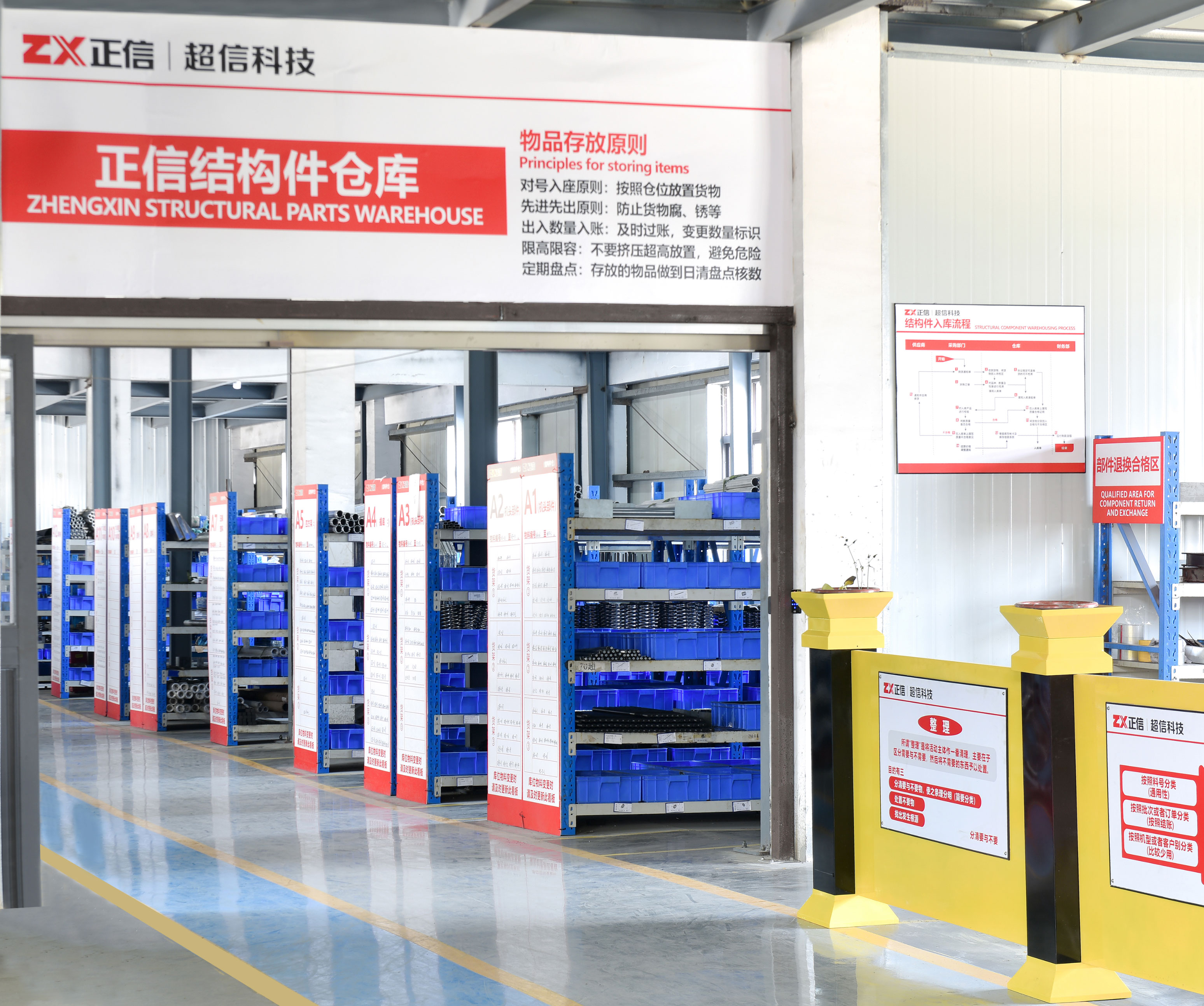
The single largest cause of extended downtime is waiting for a small component to clear customs. A sensor, a belt or a cutting blade can cost less than $50 and still stop a line for a week if it has to be ordered after the failure.
Zhengxin therefore recommends buying the consumable kit with the machine: $500–1,500 covering first-year consumables, with a documented spare parts catalogue supplied in English. Critical items worth holding on site for higher-volume operations include a complete belt set, cutting blades, an ultrasonic horn, photocell sensors and one spare servo drive. When a part is needed, it is dispatched by DHL or FedEx within 24 hours of a confirmed diagnosis, arriving in 3–7 days globally, at factory parts pricing without dealer markup.
PLC and touchscreen behaviour over years of production
A PLC-controlled non woven bag making machine ages far better than its mechanical reputation suggests, because the control system removes the adjustments that used to cause drift. The PLC executes the machine's program in a continuous scan cycle, reading sensor inputs and commanding motors, valves and actuators within milliseconds. The HMI touchscreen is the operator's window into it, displaying speed, bag count, batch progress and plain-language alarm messages.
The feature that matters most after two or three years is recipe management. Complete machine setups — feeding length, sealing time, cutting position, speed limit, photocell offset — are stored as named recipes and recalled with one touch. Changeover between bag sizes and styles takes 15–30 minutes instead of an afternoon of manual adjustment, and the settings survive operator turnover.
Three habits keep the control system healthy over a long service life. Back up PLC parameters and recipes to a USB drive monthly. Inspect electrical connections quarterly, since loose terminals are a common source of intermittent faults. And fit a voltage stabiliser on any grid with documented fluctuation, because a single spike can destroy the PLC, servo drives and HMI at once. Zhengxin machines use Siemens, Delta or Mitsubishi PLCs, Omron sensors and NSK bearings, with Siemens S7-1200 or S7-200 SMART controllers on premium platforms such as the Ultra series and the LT500, and Delta DVP or AS series on mid-range models. HMI interfaces are supplied in English with multilingual support.
Ultrasonic sealing maintenance
In an ultrasonic sealing system, only one component genuinely wears: the horn. The generator converts mains power into a high-frequency electrical signal, the transducer converts that into mechanical vibration, and the horn amplifies and delivers it to the fabric interface, where friction heat melts the polypropylene in 0.2–0.5 seconds. Because the melt zone is confined to roughly 0.1–0.3 mm at the interface, the outer surface stays cool, clean and odour-free — the reason ultrasonic sealing is required for food-grade and premium retail bags.
Horn replacement intervals typically run 12–18 months in normal production. Between replacements, the maintenance is simple and mostly daily: wipe the horn tip and anvil with isopropyl alcohol and a lint-free cloth at the end of each shift to remove melted fabric residue, and inspect the horn surface under bright light once a month. A new horn is mirror-flat. A worn horn shows pitting or a wavy erosion pattern, and continuing to run it produces progressively weaker seals and eventually damages the anvil.
Step-by-Step: From Delivery to a Stable Production Routine
The first ninety days determine how the machine performs for the next five years. The sequence below follows Zhengxin's installation and commissioning documentation.
- Confirm site readiness before the crate arrives. Level floor, 1.5 m clearance, verified three-phase voltage measured with a multimeter rather than assumed from the nameplate, air compressor with dryer and tank, voltage stabiliser wired in, and fabric on site.
- Inspect and un-crate with evidence. Photograph the crate exterior before opening, video the entire un-crating, and note any damage on the delivery receipt — do not sign it clean. Marine cargo All Risks insurance typically costs 0.3–0.5% of invoice value, and claims must be filed within 48 hours with photos, the annotated receipt and a repair estimate.
- Position, level and connect. Place the machine on its adjustable feet, verify the frame is horizontal with a spirit level, and confirm voltage and phase match the nameplate before connecting anything. Test every emergency stop button before powering the motors.
- Thread the fabric and set the edge guide. Load the PP spunbond roll, follow the threading diagram on the machine side panel, and adjust the edge-guide photocell so the fabric tracks straight. Poor edge guiding is the root of most later registration and sealing problems.
- Dry run, then low-speed validation. Run 20–30 pcs/min without material to confirm smooth movement and no unusual noise, then run at 30 pcs/min and inspect the first 50 bags for seal strength, dimensions and print alignment.
- Ramp to production speed. Step through 60, 80 and 100 pcs/min, inspecting at each tier. If a flexo printing unit is installed, recalibrate print registration at every speed tier, because registration behaviour changes with line speed.
- Train and hand over. The operator runs the machine under supervision until they can independently produce quality bags at production speed. On a fully automatic platform, this learning curve is measured in days, not weeks.
- Establish the maintenance and spares rhythm. Daily 5–10 minutes (clean rollers, guide bars and photocell lenses; drain the air tank; wipe the ultrasonic horn; test the e-stops). Weekly 15–20 minutes (grease chain drives, linear rails and bearings; check belt tension at 5–10 mm deflection at the midpoint; check pneumatic fittings for leaks; clean the electrical cabinet filter; tighten visible bolts). Monthly 30–40 minutes (inspect the horn for wear, check blade sharpness, back up PLC parameters, verify guards and interlocks). Quarterly (professional electrical inspection, ultrasonic generator output test, replacement of worn consumables).
On purchase terms, Zhengxin operates at a minimum order of one unit, with FOB or CIF delivery, pre-shipment testing as the acceptance criterion, and 30/70 payment terms. Standard production lead time is 25–35 working days, extending to 35–45 days for customised configurations, plus 15–45 days of sea freight depending on destination.
Troubleshooting Weak or Inconsistent Bag Seals
Weak or inconsistent bag seals are the most common quality issue in non-woven bag production, and three root causes cover about 90% of cases: a contaminated ultrasonic horn, an incorrect or uneven horn-to-anvil gap, and a mismatch between amplitude and production speed. The workflow below resolves them in order, from the cheapest check to the last resort.
- Clean the horn and anvil. Stop the machine, disable the ultrasonic generator, and wipe the horn tip and anvil surface with isopropyl alcohol and a lint-free cloth. Inspect under bright light and repeat until both surfaces are clean and shiny. Melted fabric residue reduces energy transfer to the fabric interface.
- Check the horn-to-anvil gap. Use the supplied feeler gauge to measure the gap at both ends and at the centre of the horn. For 70 GSM fabric the gap should be 0.3–0.5 mm and even within 0.05 mm across the full horn width. An uneven gap produces seals that are strong on one side of the bag and weak on the other.
- Test the amplitude setting. Run ten bags at the current setting, increase amplitude by 5%, and run ten more. If the seal improves, the original amplitude was too low. If brown scorch marks appear, reduce amplitude by 5%. As a starting reference, 60–70% amplitude suits 50–60 GSM fabric, 75–85% suits 70–90 GSM, and 90–100% suits 100–150 GSM or laminated material.
- Re-check the speed-amplitude relationship. If production speed was recently increased, reduce it by 10–15% and retest. Faster running means less weld contact time per bag, and the compensation is a higher amplitude setting rather than a higher speed.
- Verify air pressure. Confirm the compressor gauge holds 0.6–0.8 MPa consistently through the welding cycle. Pressure that drops mid-cycle produces seal strength that varies bag to bag, and the fix is compressor or tank capacity, not machine settings.
- Inspect the horn for wear. Remove the horn and examine the surface at an angle under bright light. Pitting, erosion or a wavy pattern means the horn is worn and must be replaced — continued use progressively degrades seal quality and can damage the anvil as well.
- Test a different fabric batch. If every machine parameter is correct and seals remain weak, weld a roll from a different batch or supplier. Inconsistent GSM or contaminated PP spunbond will not weld correctly at any setting.
After any adjustment, run 20 test bags and pull-test five by hand. The seal should tear the fabric rather than peel apart at the weld line. For machines with a separate handle heat-sealing station, remember that heat sealing depends on an element reaching temperature, which can scorch the outer surface before the inner layers bond, and that the element is a consumable replaced every three to six months. Ultrasonic sealing replaces that with a contact-time process producing 15–20% higher peel strength and using roughly 25–30% less energy, since power is drawn only during the welding pulse.
Use Cases: Three Ownership Profiles
Profile 1: First-time importer producing 20,000–40,000 bags per day
A single-operator platform such as the ZXL-A700, producing D-cut, W-cut and drawstring bags at 40–120 pcs/min with 15 kW installed power, is the standard starting point. Installation is handled remotely, the spare parts kit is ordered with the machine, and printing is added later once customers begin requesting printed bags. This staged approach keeps first-year capital tied to confirmed demand rather than to speculation.
Profile 2: Supermarket chain supplier running 1–2 operator cells
Supermarket contracts are won on consistency as much as on price. The ZXL-E700 five-in-one platform produces D-cut, W-cut, drawstring, loop handle and box bags with online handle attachment at 40–120 pcs/min and 18 kW, and is built around a 1–2 operator workflow rather than a multi-person manual line. Where edge waste is the dominant material cost, the ZXL-A700Ultra adds ultrasonic sealing and edge-waste-free forming at the same 40–120 pcs/min speed tier. Paired with a ZXH-C41200 four-colour flexo printing unit, these configurations give the dimensional accuracy and print registration that retail buyers inspect. The no-waste-edge design typically pays back its premium within 12–18 months for operations consuming more than one ton of fabric per day.
Profile 3: Plastic bag converter transitioning under a plastic ban
A converter already producing thin-film bags has the hardest part solved — customers and distribution. What changes is the machinery, the raw material and the process: PP spunbond fabric rolls replace resin pellets, and a mechanical converting process replaces extrusion. Existing three-phase power is usually adequate, since non-woven machines draw 30–40% less electricity than blown film extrusion, and two to three non-woven machines fit the footprint of one extrusion line. Operator retraining typically takes 5–7 days.
Comparison Table: Support Layers and Machine Platforms
The first table compares the support layers a long-term owner actually uses. The second summarises the platforms most often specified for ongoing production, with the figures buyers need to plan power, floor space and operator coverage.
| Support layer | What it covers | Typical response | Cost basis |
|---|---|---|---|
| Remote engineer support | Diagnosis, parameter correction, seal troubleshooting, registration faults — more than 80% of all issues | Available 7 days a week via WhatsApp and video call, typically within 12 hours | Included |
| English documentation set | Operation manual, wiring diagram, PLC parameters, troubleshooting guide, spare parts catalogue | Supplied with the machine | Included |
| Express spare parts | Weardown components: belts, blades, filters, sensors, ultrasonic horn, servo drive | Dispatched within 24 hours of confirmed diagnosis; 3–7 days delivery | Part price only, direct from factory, no dealer markup |
| On-site engineer dispatch | Hands-on repair, re-commissioning, operator training | Typical visit of two to five days | $100 per day plus round-trip airfare and accommodation |
| Preventive maintenance routine | Daily, weekly, monthly and quarterly checks | Continuous | Labour time only |
| Model | Format coverage | Rated speed | Total power | Weight | Long-term ownership note |
|---|---|---|---|---|---|
| ZXL-A700 | D-cut, W-cut, vest and drawstring bags | 40–120 pcs/min | 15 kW | 2,900 kg | Single-operator entry platform; add a flexo unit later as printed demand confirms |
| ZXL-D700 | Four-in-one flat bag with online handle attaching | 40–120 pcs/min | 15 kW | 3,200 kg | The handle unit extends the weekly inspection route alongside the sealing station |
| ZXL-E700 | Five-in-one with online handle attaching | 40–120 pcs/min | 18 kW | 4,000 kg | Ultrasonic sealing plus inline handle attachment; built around a 1–2 operator workflow |
| ZXL-E700Ultra | Five-in-one with online handle attaching and no-waste-edge forming | 40–120 pcs/min | 18 kW | 4,000 kg | Choose where fabric cost dominates and trim disposal is a burden |
| ZXL-A700Ultra | Vest and W-cut bags, edge-waste-free, ultrasonic sealing | 40–120 pcs/min | 15 kW | 2,900 kg | Servo-driven accuracy and ultrasonic seals for retail-grade consistency |
| ZXL-G700 | Side gusset bags with online handle | 60–100 pcs/min | 18 kW | 4,200 kg | Dedicated gusset platform for expandable-side bag programmes |
| ZX-LT500 | 3D standing and box bags | 60–100 pcs/min | 50 kW | 9,500 kg | Specialised premium platform; not interchangeable with flat and vest bag production |
Two longer-term economics are worth keeping in view when comparing configurations. New machines with branded components carry roughly three times the mean time between failures of unbranded workshop machines, and an estimated 30–40% lower total maintenance cost over five years, against a 10–20% higher purchase price. Servo-driven platforms also reduce power consumption by about 30% during idle and low-speed phases compared with clutch-motor machines.
FAQ: Long-Term Ownership Questions Answered
What documentation and certifications come with a non woven bag making machine, and do they stay valid?
Every Zhengxin non woven bag making machine ships with a CE Declaration of Conformity covering the Machinery Directive 2006/42/EC, the Low Voltage Directive 2014/35/EU and the EMC Directive 2014/30/EU, a CE marking plate affixed to the machine body, and the full technical file on request. The manufacturing facility holds an ISO 9001:2015 certificate, which is maintained through an annual external surveillance audit by an accredited certification body. The shipment also includes an English operation manual, electrical wiring diagram, PLC parameter settings, a troubleshooting guide and a spare parts catalogue. CE marking supports customs clearance in EU member states and in the 30+ other countries that accept it; country-specific certifications such as SONCAP, PVOC or SASO can be arranged on request. Buyers are encouraged to verify certificate numbers directly on the issuing body's official website rather than relying on a scanned copy.
What happens if the machine breaks down two or three years after delivery?
The support path is the same on day 1,000 as on day one. Remote engineer support runs seven days a week via WhatsApp and video call; engineers diagnose and resolve more than 80% of issues by watching the machine through the buyer's phone camera and reading the alarm codes on the HMI. The troubleshooting guide documents common error codes, and English documentation covers most routine faults without any call at all. If a component has failed, the replacement is dispatched by DHL or FedEx within 24 hours of a confirmed diagnosis and arrives in 3–7 days. If remote diagnosis is not enough, an engineer can be dispatched to the facility at $100 per day plus airfare and accommodation, with a typical on-site visit of two to five days. New machines are covered by a 12-month full warranty, and the mean time to first failure on a new machine is 24+ months.
What does ongoing support and spare parts really cost over the life of the machine?
Remote support and the full English documentation set are included at no charge. The recommended first-year spare parts kit costs $500–1,500, and replacement components are priced directly from the factory without dealer markup. On-site engineer dispatch is $100 per day plus round-trip airfare and accommodation. Peripheral protection is modest: a voltage stabiliser sized for the machine load costs roughly $200–800 and is the cheapest insurance available for the PLC, servo drives and HMI, while a phase converter for sites with only single-phase supply costs $500–2,000. Over a five-year horizon, machines built with branded components show an estimated 30–40% lower total maintenance cost than unbranded equivalents, and servo-driven models use about 25–30% less energy.
Can we validate bag quality and support responsiveness before committing to a long-term partnership?
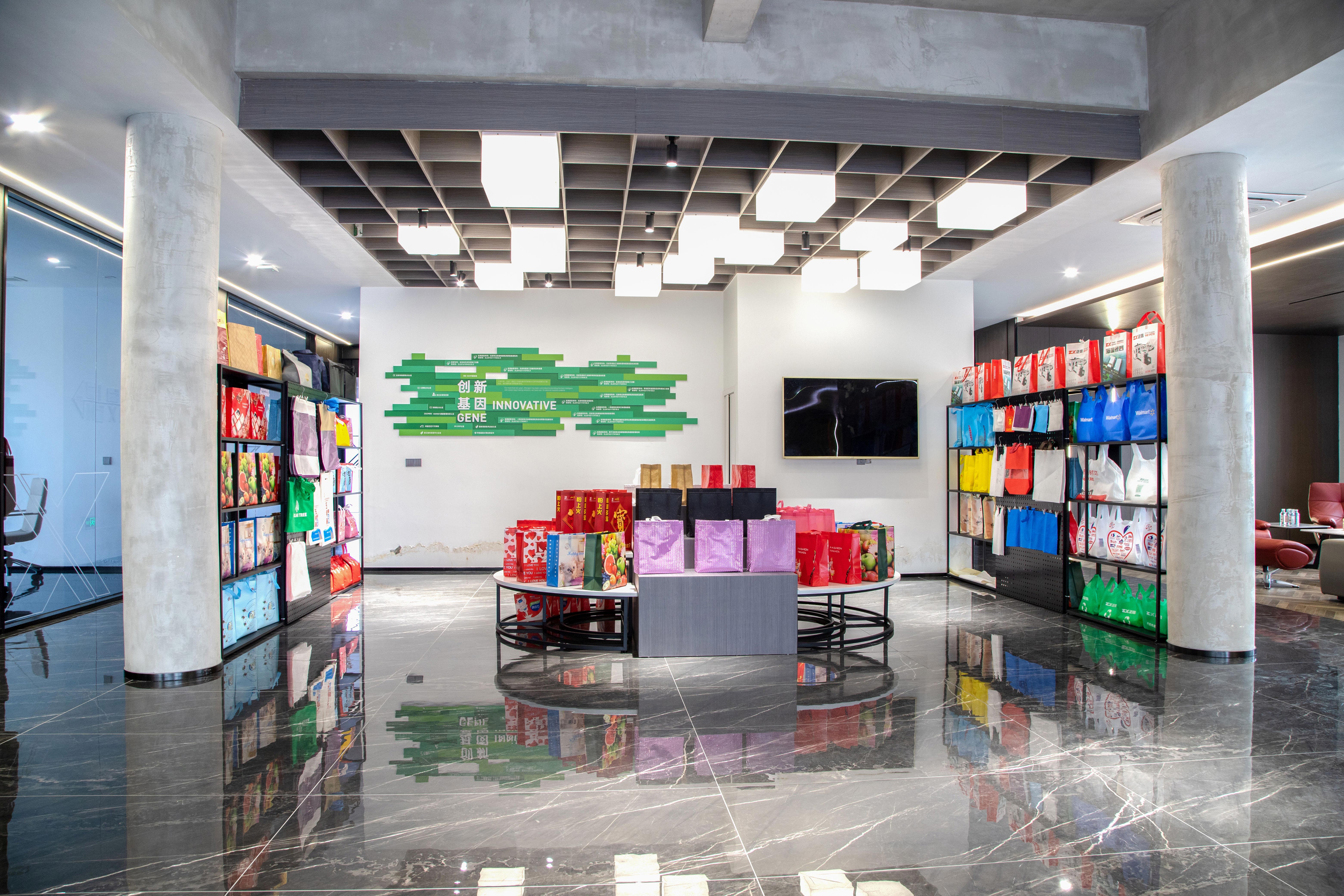
Yes, and the validation happens before shipment. Every machine runs a continuous four-hour full-load production test at the factory, and sample bags are inspected for seal strength, print registration and dimensional accuracy. Buyers can request a live video factory tour showing production lines, testing areas and component inventory in real time, and can ask for contact details of active customers in their region, with those customers' permission, to ask directly about machine performance and after-sales experience. Third-party pre-shipment inspection by SGS, Bureau Veritas or CCIC can be arranged at the buyer's request before final payment, and a sample room is available for bag style and material evaluation.
How quickly can spare parts and replacement components reach our factory?
Parts are dispatched within 24 hours of a confirmed diagnosis, and DHL or FedEx delivery is typically 3–7 days worldwide. That is why the practical recommendation is to hold the consumable kit on site from day one rather than ordering after a failure — the difference between a two-hour repair and a two-week shutdown is usually inventory, not engineering. For complete machines, standard production lead time is 25–35 working days, extending to 35–45 days for customised configurations, with 15–45 days of sea freight depending on destination. To move this forward for your own configuration, you can request a spare parts and consumables list matched to the model you are running, or a quotation for a machine plus its first-year kit, by contacting the ZX Zhengxin service team by email or WhatsApp using the details at the end of this article.
Conclusion: What a Long-Term Partnership Should Look Like
A non woven bag making machine is a five-to-ten-year commitment, and the supplier relationship should be structured the same way. The practical test of that relationship is straightforward: can the machine be commissioned without an overseas flight, are wear parts priced transparently and shipped within days, is there a documented answer when seals start to drift, and does the control system still recall a clean recipe after three years of production.
Zhengxin's answers to those questions are operational rather than aspirational — remote support seven days a week that resolves more than 80% of issues, express parts dispatched within 24 hours, an ISO 9001:2015 certified facility behind every build, CE certification across the Machinery, Low Voltage and EMC Directives, and field engineers who can travel to any country when remote guidance is not enough. That is what long-term ownership support means in practice. Machines built this way are also the ones that hold their value: on well-maintained, branded-component platforms, resale value retains 50%+ after five years.
Talk to ZX Zhengxin Machinery About Your Machine
Ask for a spare parts and consumables list for your configuration, a sample review, or a quotation for a non woven bag making machine with its first-year kit. The team responds in English, seven days a week.
Contact: Jayn · Email: info@zxcorp.com · Tel / WhatsApp: +86 158-5888-9595
Website: www.wzzxjx.com · Blog: blog.wzzxjx.com
Download the full product catalogue: ZX Zhengxin Machinery 2026 Catalogue (PDF)