How to Choose a Non Woven Bag Making Machine for Drawstring and D-Cut Bag Production Lines
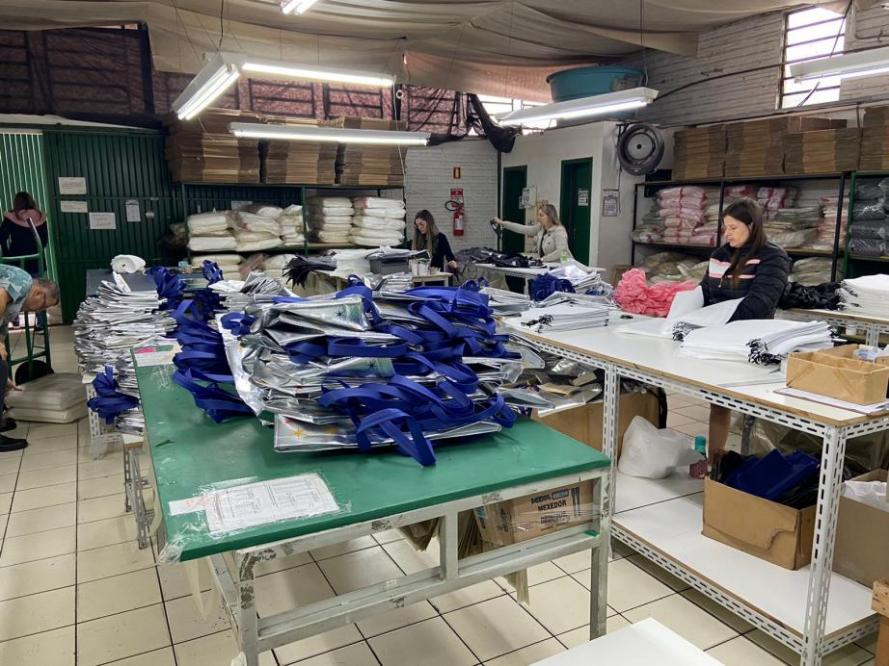
A multi-model non woven bag production line in operation, with a ZXL-B700 configured for D-cut and drawstring work alongside other bag platforms.
Choosing a non woven bag making machine for drawstring and D-cut bag production is a matching exercise before it becomes a purchasing decision. Four variables decide whether a machine earns money on this bag type: the documented size range must cover your actual bag program, the machine classification must include the handle construction you sell, the control platform must support fast recipe-based changeover with a small crew, and the certification and documentation must clear your customs stage and your customers' quality checks.
Zhejiang Zhengxin Machinery Co., Ltd. (ZX Zhengxin Machinery) is a Wenzhou-based manufacturer of non woven bag making machines and complete non-woven bag production lines, founded in 2014. The company operates a 60,000 m² facility with approximately 200 employees, a 30-engineer R&D team and an annual output of around 500 units, exporting roughly 60% of production to Africa, the Middle East, Southeast Asia and Latin America.
For drawstring and D-cut work, the model that carries both classifications in the Zhengxin line-up is the ZXL-B700 — documented as a non woven D-cut bag making machine and a non woven drawstring bag making machine, with a 500–1300 mm fabric roll width and a 200–580 mm bag height range. This guide explains how to specify around that machine, what to configure alongside it, and which facts to verify before payment.
What Drawstring and D-Cut Programs Actually Demand
The first constraint in this application is handle construction, not speed. D-cut and drawstring bags are formed differently from attached-handle styles, and a machine's classification is not marketing language — it reflects which forming, sealing and cutting cycles the mechanical tooling and the PLC program are configured to execute.
- Handle architecture. A D-cut handle is formed inside the bag body itself, so the cutting and sealing cycle must be programmed for that geometry. Attached-handle construction is documented as a separate capability: the ZXL-D700, ZXL-E700 and ZXL-G700 are listed with online handle attaching, while D-cut, soft loop, patch and rope drawstring are listed among the handle types available through customization.
- Drawstring specifically. Rope drawstring is a documented handle option, and the ZXL-B700 is the model whose published classification includes both D-cut and drawstring bag making.
- Bag geometry. The ZXL-B700 documents a 100–800 mm bag width and a 200–580 mm bag height. If your program runs taller than 580 mm, that range does not cover it — the T-shirt/W-cut platform (ZXL-A700) documents a 300–700 mm bag height instead.
- Fabric feed. The ZXL-B700 accepts fabric rolls of 500–1300 mm and material thickness of 30–120 g/㎡. Fabric roll width is the specification that most often decides whether a quotation is usable, because it sets the maximum bag width your line can produce without changing material.
- Trim and material waste. Conventional machines trim the fabric edges to reach the finished bag width — typically 3–8 mm per side, which accumulates to roughly 3–5% of total fabric consumption. No-waste-edge (Ultra) technology is documented for the ZXL-A700Ultra and ZXL-E700Ultra platforms; for a D-cut and drawstring program, the trim strategy should be confirmed as an explicit line item in the quotation.
- Print registration. Printed drawstring and D-cut bags live or die on registration. A photocell reads a black registration mark (typically 5×5 mm or 8×8 mm) printed at fixed intervals, and the PLC converts that trigger into a precise cut command. Marks smaller than 5 mm or printed with faded ink become unreliable at higher speeds.
- Changeover. Switching bag size or style involves four mechanical adjustments plus a PLC parameter update, and typically takes 15–30 minutes depending on operator experience. On a PLC-controlled machine the whole setup can be recalled from a saved recipe instead of re-entered by hand.
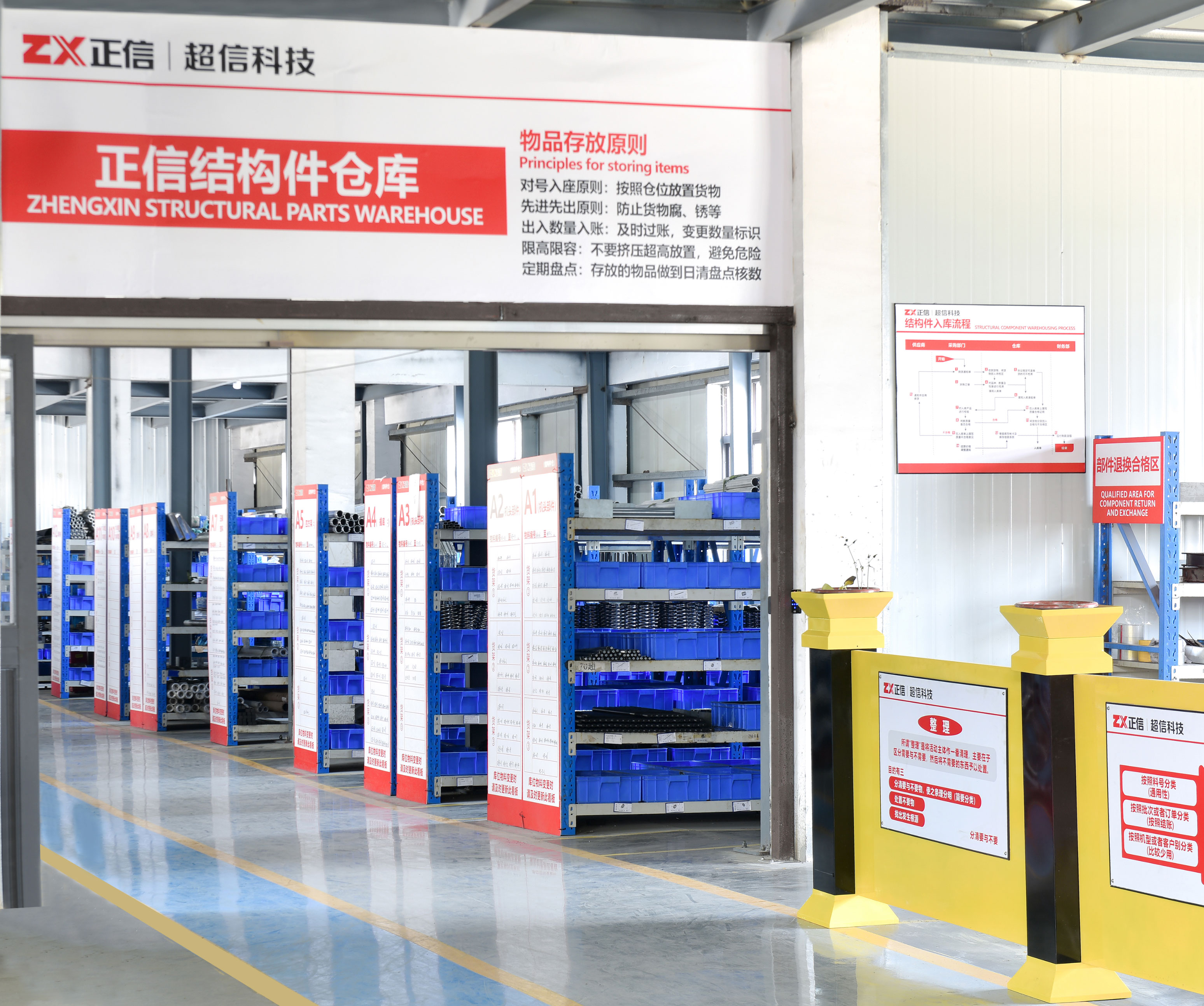
Fabric rolls are the largest recurring cost in D-cut and drawstring production, so roll width and GSM must match the machine range before ordering.
Industry Background: Why Dedicated Capacity Is Being Bought Now
Demand for dedicated non-woven bag machinery is being pushed by regulation and pulled by automation economics. Independent market research published by LP Information projects the specialized global non-woven bag making machine market growing from US$ 179 million in 2025 to US$ 733 million by 2032, with a 22.5% CAGR from 2026 to 2032 attributed to plastic ban policies. Dataintelo reports that over 140 countries had enacted legislation restricting or banning single-use plastic bags as of 2026.
Two further data points describe how that demand is being met. Automatic bag making machines held a 52.4% share of the total product type market in 2025, and Asia Pacific accounted for a 43.6% revenue share of the bag making machine market in the same year, according to Dataintelo. For planning purposes, LP Information places the average price of a non-woven bag making machine at approximately US$ 29,000 per unit in 2025 — a market average, not a quotation for any specific configuration.
Published estimates diverge by scope, and buyers should read them that way: Dataintelo values the total bag making machine market (including paper and plastic bag equipment) at US$ 4.8 billion in 2025, while LP Information's US$ 179 million figure covers non-woven machinery specifically. Forecast CAGR also differs by scope, with general bag making equipment tracked around 6.0% and non-woven specific machinery above 20%. The practical implication for a medium-scale producer is straightforward: a dedicated platform matched to your bag style usually outperforms a general-purpose machine that compromises on handle geometry, because the cost of a mismatched machine is paid every shift, not once.
The Reference Machine: ZXL-B700
The ZXL-B700 is the dedicated platform for this application; every other decision in this guide is a configuration choice around it. Its published specification is the baseline against which a drawstring or D-cut bag program should be measured.
| Parameter | Documented value — ZXL-B700 |
|---|---|
| Machine classification | Non woven D-cut bag making machine / non woven drawstring bag making machine |
| Fabric roll width | 500–1300 mm |
| Production speed | 40–120 pcs/min |
| Bag height | 200–580 mm |
| Bag width | 100–800 mm |
| Material thickness | 30–120 g/㎡ |
| Voltage | 380V / 220V |
| Total power | 12 kW |
| Overall dimensions | 8000 × 2050 × 1900 mm |
| Weight | 2200 kg |
| Construction material | Carbon steel / stainless steel / alloy steel |
| CE certificate coverage | ZXL-B series (600–1200) listed under CE certificate M.2021.206.C70875 |
Why PLC control changes the staffing model
A PLC (Programmable Logic Controller) is the industrial computer that executes the machine's control program — reading sensor inputs, making logic decisions and commanding motors, valves and actuators. The HMI is the touch screen the operator uses to interact with it, displaying production speed, bag count and error messages. Together they replace walls of physical buttons, relays, timers and counters, and they store the machine's operating parameters as recipes that can be recalled with one touch: selecting a bag size loads feeding length, sealing time, cutting position, speed limit and photocell offset without manual adjustment.
Zhengxin machines use Siemens, Delta or Mitsubishi PLCs depending on model tier, with multi-language HMI interfaces, alarm display in plain language, production logging and maintenance reminders. Parameters and recipes can be backed up to a USB drive — a small detail that becomes important when a shift changes or an operator leaves.
The practical consequence is crew size. Documented medium-scale configurations run with 1–2 operators per machine, and installation guidance assumes 1–2 people with basic mechanical aptitude plus a spirit level, hand tools and a multimeter. At the larger end, single-operator management of a full line is documented in real deployments, and high-speed platforms are planned at one operator per two machines.
Sealing and motion: the two specifications that drive bag quality
Drawstring attachment points and bag side seams are the failure points customers complain about. Ultrasonic welding is documented as producing 15–20% higher peel strength than heat sealing, with 25–30% lower energy consumption, no warm-up time, and no scorching or odour — which is why it is the standard choice for food-grade and premium retail bags. Heat sealing remains acceptable for basic shopping bags, and a hybrid option is available. On the motion side, servo-driven feeding holds dimensional accuracy around ±0.5 mm where clutch-motor machines typically drift ±2–3 mm as belts wear, and drawstring bags are exactly the application where a drifting bag length shows up immediately as a rejected batch.
Customization and OEM/ODM scope
Zhengxin provides OEM, ODM and custom manufacturing production services; ODM services specifically cover machine design and production, while OEM production is available for non-woven bag making machines. The documented customization scope includes voltage and power (220V / 380V / 415V / 440V, single- or three-phase), bag size and dimensions including width, length and gusset depth, bag style (W-cut, D-cut, flat bag, loop handle, box bag), handle type including rope drawstring, sealing method, control system brand, automation level, optional modules such as gusset maker, hole punch, folding unit and bundling, machine colour and branding, and motor brand. Monthly production capacity is documented at 40 units, with a minimum order quantity of 1 unit.
Step-by-Step: Configuring a Drawstring / D-Cut Line
Step 1 — Lock the bag specification before anything else
Write down finished bag width, height, handle type and fabric GSM. Against the ZXL-B700, that means checking width against 100–800 mm, height against 200–580 mm, and fabric against 30–120 g/㎡. A specification that falls outside those ranges is not a negotiation point; it is a signal that the platform is wrong or that the bag must be re-engineered.
Step 2 — Match fabric roll width and decide the trim strategy
The machine accepts 500–1300 mm rolls. Confirm with your fabric supplier which master roll widths are actually stocked, then compare the delivered cost per finished bag rather than per kilogram of fabric. If your consumption exceeds roughly 5 tons per month, in-house slitting on a ZXC-A1700 becomes worth evaluating, because it removes dependence on supplier slitting lead times and gives you control over roll width.
Step 3 — Confirm handle and sealing configuration
State the handle type explicitly in the order: D-cut, rope drawstring, soft loop, patch or box bag. Then state the sealing method — ultrasonic, heat sealing or hybrid — and the reason. For food takeaway or premium retail drawstring bags, ultrasonic is the documented choice; for basic shopping bags, heat sealing is the lower-cost option.
Step 4 — Specify the control platform and crew model
Choose the PLC brand tier and confirm the HMI supports your operators' language. Plan the crew at 1–2 operators per machine for medium-scale D-cut and drawstring production, and plan the changeover routine around saved HMI recipes so a size change takes 15–30 minutes instead of an afternoon of re-setting.
Step 5 — Plan the printed version now, not later
If any part of your program is a printed drawstring or D-cut bag, confirm the registration setup: a 5×5 mm minimum black registration mark printed at fixed intervals, the mark pitch entered on the HMI, and a Registration Teach run at 10–15 pcs/min before production speed. Flexo printing units such as the ZXH-C21200 (two-colour) or ZXH-C41200 (four-colour) can be integrated into the line; starting with plain bags and adding printing when customer demand is confirmed is a documented, staged approach that lowers initial capital.
Step 6 — Budget the auxiliaries, not just the machine
A bag machine alone does not make bags reliably. Essential auxiliary equipment for a single-machine setup is documented in the US$ 8,000–15,000 range, typically 25–40% of the main machine cost. That covers an industrial screw air compressor of 15–22 kW with refrigerated dryer and tank (budget US$ 3,000–8,000 — the dryer is not optional, because water in compressed air damages pneumatic cylinders), a voltage stabilizer or AVR sized to roughly 150% of combined machine load (US$ 300–800), and a hydraulic lift table for fabric rolls (US$ 500–1,500). Add an automatic counting and bundling machine (US$ 3,000–5,000) and an inkjet date coder (US$ 800–1,500) when supermarket contracts require retail-ready bundles and batch traceability.
Step 7 — Verify certification, QC records and commercial terms before shipment
Ask for the certificate numbers, verify them on the issuing body's website, and confirm the machine model is inside the certificate's listed scope. Insist on a pre-shipment test as the acceptance criterion, and arrange third-party inspection by SGS, Bureau Veritas or CCIC if you want independent confirmation of components and performance. Confirm voltage, frequency and phase against your factory's measured supply — not the national standard — because wrong voltage damage is not covered by warranty.
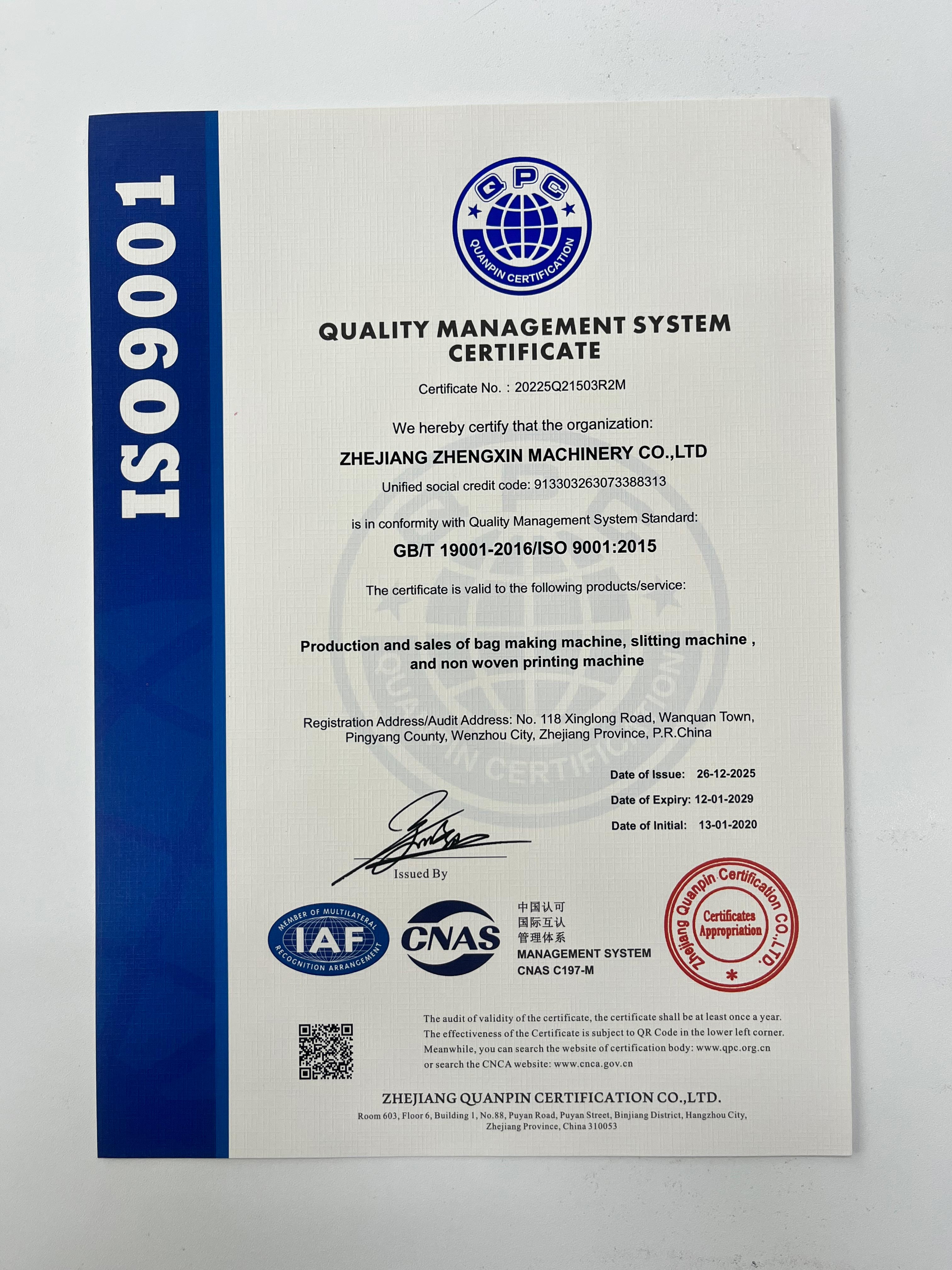
Quality management documentation should be part of the pre-shipment file, not something requested after the deposit is paid.
Use Cases: How Producers Configured This Capacity
Three documented deployments show two different ways producers handle D-cut and drawstring demand: a single dedicated machine inside a mixed fleet, or a full multi-model line from one supplier.
Brazil — a mid-scale packaging supplier running four bag types from one vendor. A non-woven bag manufacturer and packaging supplier for retail and agriculture has operated a 6-unit fleet since 2018: one ZX-LT500, two ZXL-B800, two ZXL-D800 and one ZXL-B700. Production covers shopping bags for supermarket chains plus breathable produce packaging bags for fruit and coffee exporters. The reported result is that a single supplier covers four different bag types, with unified after-sales support, interchangeable spare parts across models, and one training session covering all four machine types — while the bags meet Brazil's expanding plastic-ban regulations across multiple states.
Egypt — three revenue streams from one equipment partner. A food packaging and retail shopping bag manufacturer has run 5 units since 2017 — one ZXL-E700, two ZXH-C21200 printing machines and two ZXL-D700 — producing food takeaway bags for restaurant chains and delivery platforms alongside multi-colour printed promotional shopping bags for retail malls. The deployment is described as "one vendor, three revenue streams", serving the Cairo and Alexandria markets.
Indonesia — full-spectrum capacity at scale. A large non-woven bag manufacturing group has deployed 42 units since 2018 across five models: eight ZX-LT500, thirteen ZXL-E700, seven ZXL-A700, twelve ZXH-A1200 and two ZXL-G700. The fleet supports shopping bags for retail chains, multi-colour printed promotional bags, food-grade takeaway packaging and garment dust covers, supplying more than one million bags monthly to national retail and food delivery customers.
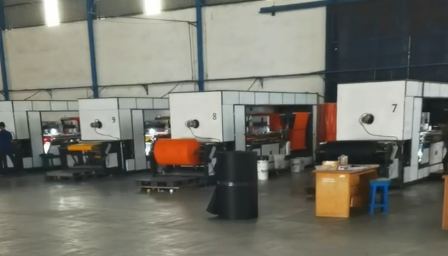
Multi-model lines let one facility cover several bag styles with shared after-sales support and interchangeable spare parts.
The pattern for a medium-scale producer entering D-cut and drawstring work is narrower: one dedicated ZXL-B700 as the workhorse for those two styles, one trained operator per shift, and a printing unit added when printed orders are confirmed rather than bought on speculation.
Comparing the Documented Platforms
All values below come from published model specifications. They are documented machine capabilities, not guaranteed output figures — realistic planning should assume 80–85% of rated speed once material changes, adjustments and breaks are factored in.
| Model | Documented bag styles | Fabric roll width | Bag width | Bag height | Material | Speed | Total power |
|---|---|---|---|---|---|---|---|
| ZXL-B700 | D-cut, drawstring | 500–1300 mm | 100–800 mm | 200–580 mm | 30–120 g/㎡ | 40–120 pcs/min | 12 kW |
| ZXL-A700 | T-shirt & W-cut, vest | 500–1300 mm | 200–400 mm | 300–700 mm | 30–120 g/㎡ | 40–120 pcs/min | 15 kW |
| ZXL-D700 | 4-in-1 flat bag with online handle attaching | 500–1300 mm | 100–800 mm | 200–580 mm | 30–100 g/㎡ | 40–120 pcs/min | 15 kW |
| ZXL-E700 | 5-in-1 box bag with online handle attaching | 500–1300 mm | 100–800 mm | 200–580 mm | 30–100 g/㎡ | 40–120 pcs/min | 18 kW |
| ZXL-G700 | Side gusset bag with online handle, organ bag | 500–1150 mm | 200–400 mm | 300–700 mm | 50–100 g/㎡ | 60–100 pcs/min | 18 kW |
Read the table as a filter, not a ranking. Choose the ZXL-B700 when D-cut and rope drawstring styles are the core of the program — it is the only model in this set whose documented classification covers both. Choose the ZXL-D700 when flat bags with an attached handle dominate and wider fabric flexibility matters. Choose the ZXL-A700 when T-shirt, W-cut and vest bags are the volume product, with its taller 300–700 mm bag height range. Choose the ZXL-E700 or ZXL-G700 when box bags, gusseted bags or organ bags carry the order book. The wrong column costs more than the wrong price.
Compliance, Verification and Commercial Terms
Certification is a purchasing filter in this category, because a machine that cannot clear customs is not a machine. All Zhengxin non-woven bag making machines are CE certified. The certificate M.2021.206.C70875 was issued by UDEM and lists the ZXL-B (600–1200) series among its covered models; it was issued on 2022-01-24 and is valid until 2027-01-23. The technical basis recorded on the certificate includes EN ISO 12100:2010, EN 60204-1:2018, and EMC standards EN IEC 61000-6-2:2019, EN IEC 61000-6-4:2019, EN IEC 61000-3-2:2019 and EN 61000-3-3:2013+A1:2019.
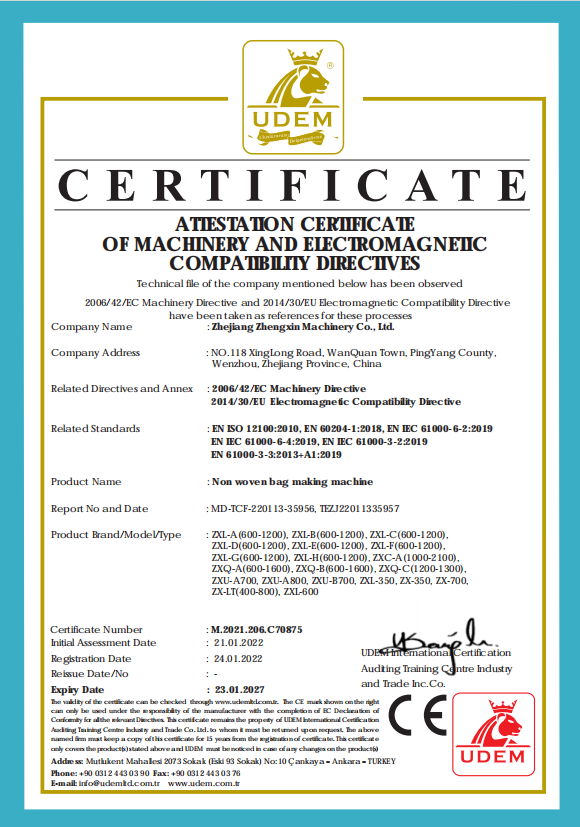
CE documentation should list the exact model series you are buying — check the scope line, not just the presence of the certificate.
The manufacturing facility is ISO 9001:2015 certified under certificate 20225Q21503R2M, issued by QPC against the GB/T19001-2016 / ISO9001:2015 standard, with a scope covering production and sales of bag making machines, slitting machines and non-woven printing machines. The certificate is valid from 2025-12-26 to 2029-01-12. Quality control follows incoming material inspection, in-process checkpoints, and a continuous full-load production test on every machine before shipment; the stated QC policy is 100% test, and acceptance criteria are defined as pre-shipment test.
Component traceability is the second verification layer. Machines are built with Siemens, Delta or Mitsubishi PLCs, Omron sensors and NSK bearings, and third-party inspection by SGS, Bureau Veritas or CCIC can be arranged at the buyer's request before shipment. For a buyer auditing a supplier, the practical checklist is: verify the certificate number on the issuing body's website, confirm your model is inside the listed scope, request the pre-shipment test report, and use a licensed customs broker in your own country before the vessel arrives.
| Commercial item | Documented term |
|---|---|
| Minimum order quantity | 1 unit |
| Production lead time | 30–45 days; customization adds 5–10 working days |
| Delivery terms | FOB / CIF |
| Payment terms | 30% deposit / 70% before shipment; L/C at sight for orders above US$ 50,000 |
| Acceptance criteria | Pre-shipment test |
| Monthly capacity | 40 units |
| Warranty and after-sales | One-year warranty on major components; installation and commissioning services; on-site service by a professional team |
After-sales coverage is documented as remote support seven days a week via WhatsApp and video call, where engineers diagnose and resolve more than 80% of issues without travel. Where remote support is not sufficient, field engineers deploy on site at US$ 100 per day plus airfare and accommodation. The supplier maintains offices in Kenya, Morocco, Egypt, Vietnam, Tanzania, Dubai, Oman, Indonesia and Ethiopia, which shortens the practical distance for buyers in those regions.
Frequently Asked Questions
Is the ZXL-B700 covered by CE certification, and is the factory ISO 9001 certified?
Yes. Zhengxin non-woven bag making machines are CE certified, and the certificate M.2021.206.C70875 issued by UDEM lists the ZXL-B (600–1200) series among its covered models, valid from 2022-01-24 to 2027-01-23, with a technical basis that includes EN ISO 12100:2010, EN 60204-1:2018 and EMC standards EN IEC 61000-6-2:2019, EN IEC 61000-6-4:2019, EN IEC 61000-3-2:2019 and EN 61000-3-3:2013+A1:2019. The manufacturing facility holds ISO 9001:2015 certification under certificate 20225Q21503R2M issued by QPC, valid from 2025-12-26 to 2029-01-12, covering production and sales of bag making machines, slitting machines and non-woven printing machines. Buyers should verify both certificate numbers on the issuing bodies' websites before confirming a purchase order.
Can a fully automatic non woven bag making machine be customized or OEM-built for our drawstring bag dimensions?
Yes. The manufacturer provides OEM, ODM and custom manufacturing production services; ODM services cover machine design and production, and OEM production services are available for non-woven bag making machines. The documented customization scope includes voltage and power (220V / 380V / 415V / 440V, single- or three-phase), bag size and dimensions across width, length and gusset depth, bag style including D-cut, W-cut, flat bag, loop handle and box bag, handle type including rope drawstring, soft loop, D-cut and patch, sealing method including ultrasonic welding, heat sealing or hybrid, control system brand (Siemens, Mitsubishi or Delta PLC with multi-language HMI), automation level, optional modules such as gusset maker, hole punch, folding unit and bundling, machine colour and branding, and motor brand. Customization adds 5–10 working days to the standard 30–45 day lead time, and the minimum order quantity is 1 unit.
What should a medium-scale buyer budget beyond the machine itself?
Plan for auxiliaries, not just the machine. LP Information places the average price of a non-woven bag making machine at approximately US$ 29,000 per unit in 2025 — a market planning figure, not a quotation. Essential auxiliary equipment for a single-machine setup is documented in the US$ 8,000–15,000 range, typically 25–40% of the main machine cost: an industrial screw air compressor of 15–22 kW with refrigerated air dryer and tank (US$ 3,000–8,000), a voltage stabilizer or AVR sized to about 150% of combined machine load (US$ 300–800), and a hydraulic lift table for fabric roll handling (US$ 500–1,500). Optional additions include an automatic counting and bundling machine (US$ 3,000–5,000) and an inkjet date coder (US$ 800–1,500) where supermarket contracts require retail-ready bundles and batch traceability.
Can we validate bag quality before shipment, and can we inspect the factory?
Yes to both. The stated quality policy is 100% test, with incoming material inspection, in-process QC checkpoints and a continuous full-load production test on every machine before shipment; the acceptance criterion is a pre-shipment test. Third-party inspection by SGS, Bureau Veritas or CCIC can be arranged at the buyer's request before shipment. Factory visits are welcomed, and live video factory tours showing production lines, testing areas and component inventory are provided when travel is not practical. Reference customers in your region can be provided with their permission so you can call them directly. A practical validation routine for drawstring and D-cut work is to request sample bags produced on the configured machine, then pull-test them: a correct ultrasonic seal tears the fabric rather than peeling apart at the weld line.
What is the lead time from order to delivery, and how is installation handled?
Production lead time is 30–45 days for standard models and adds 5–10 working days for customized configurations. Sea freight adds roughly 15–45 days depending on destination. Payment terms are 30% deposit and 70% before shipment, with L/C at sight accepted for orders above US$ 50,000, and delivery terms are FOB or CIF. Installation of a single machine typically takes 1–2 working days and is usually completed by the buyer's team with remote video guidance, which requires 1–2 people with basic mechanical aptitude, a spirit level, hand tools and a multimeter. Where remote support is not sufficient, an on-site engineer can be dispatched at US$ 100 per day plus airfare and accommodation. To receive a configuration proposal for a drawstring or D-cut line, send your bag width, bag height, handle type and fabric GSM to info@zxcorp.com or via WhatsApp on +86 158-5888-9595.
Next Step: Turn the Specification Into a Configuration
Configuration reviews typically start from your bag drawing, not from a catalogue page.
A drawstring and D-cut line is specified in this order: bag geometry, fabric roll width and GSM, handle type, sealing method, control platform and crew model, printing requirement, auxiliaries, then certification and commercial terms. Get the first two wrong and no amount of negotiation fixes the line; get them right and the rest is configuration.
The fastest way to close the gap between a specification and a working line is to send your bag dimensions and handle type for review against the ZXL-B700's documented 500–1300 mm fabric roll width and 200–580 mm bag height range, and to request sample bags produced on the configured machine before committing to a production slot. Full model documentation is available at www.wzzxjx.com, and the complete product brochure can be downloaded here: Zhengxin Non Woven Bag Making Machine Brochure (PDF).
Contact for samples, quotations or configuration review: Zhejiang Zhengxin Machinery Co., Ltd. — Email: info@zxcorp.com | Tel / WhatsApp: +86 158-5888-9595 | Address: No. 118 Xinglong Road, Wanquan Town, Pingyang County, Wenzhou City, Zhejiang Province, China.
Have Questions or Need More Details?
Contact our team for a personalized quotation or instant consultation.
Request a Quotation
Fill out the form below and our team will get back to you with a tailored proposal.
WhatsApp Direct Chat
Prefer to chat in real-time? Message us on WhatsApp for instant assistance & quick answers.
- Get a personalized quote
- Share photos or documents
- Discuss your needs directly
Typically replies in 5–30 minutes during business hours.