Make or Buy Non Woven Bag Printing? A Per-Bag Cost Guide
Make or Buy Non Woven Bag Printing? A Per-Bag Cost Guide
The short answer: if your operation prints more than roughly 300,000 non-woven bags a month, producing them in-house is normally the cheaper route. Published per-bag ranges place in-house production at $0.02–$0.05 per bag against $0.08–$0.15 per bag for buying the same printed bags from an outside supplier. At the favorable end of both ranges that is a 75% lower cost per bag, with equipment payback in 12–18 months at 50,000 bags per day. Below about 100,000 bags a month, outsourcing generally remains the more economical choice. Between those two thresholds, the answer is decided by three things: how often your artwork changes, how much MOQ stock you can absorb, and how much capital you are prepared to commit.
The gap is not only about money. In-house production changes a design in about 15 minutes on the machine, while an outsourced reorder takes 2–4 weeks. In-house printing carries no minimum order quantity per design; outsourced printing typically starts at 5,000–10,000 pieces per design. For promotional, retail-chain and private-label work, those two differences decide the question more often than the headline cost per bag does.
Zhejiang Zhengxin Machinery Co., Ltd. (ZX Zhengxin) is a Wenzhou, China-based manufacturer of non-woven bag making machines, flexo printing machines and screen printing machines for non-woven bag production lines, with exports to more than 120 countries. The per-bag ranges, machine specifications and installation case data used in this guide are drawn from that manufacturer's published product data and documented customer projects, so every figure below can be traced back to a specific platform or project rather than a generic industry estimate.
Problem Definition: Why Most Make-or-Buy Calculations Go Wrong
The make-or-buy decision for non-woven bag printing is usually framed as a price comparison, and that framing produces the wrong answer in three predictable ways.
- Comparing a unit price against a machine price. A supplier quote is a price per finished bag; a machine has a purchase price, an installed footprint, a power draw and a maintenance schedule. Until both sides are expressed as a cost per bag, the comparison is between two different units of measure.
- Ignoring the reorder cycle. Outsourced printing almost always carries a minimum order quantity per design plus a lead time per reorder. Neither appears in the unit price, but both convert directly into working capital locked in stock and into lost orders when a customer changes artwork late.
- Treating printing as a fixed cost. Printing is a variable cost per bag made up of ink, energy, consumables, labour and waste. Two plants with identical equipment can run different per-bag costs purely because of how many designs they change per week.
A purchased printed bag carries one number: the price. An in-house bag carries at least six: fabric, ink, energy, direct labour, consumables such as plates and screens, and waste. The printing layer of that sum is the part in-house equipment controls most directly — which is why a credible make-or-buy model separates the printing layer from the bag-converting layer instead of blending them together.
Industry Background: What Is Pushing Printing Decisions Back In-House
Demand for printed non-woven bags has been pushed upward by regulation rather than by fashion. Over 100 countries now apply bans or taxes to single-use plastic bags, and California's SB 1046, effective January 2025, requires retailers to shift to compostable non-woven or paper substitutes. Every one of those transitions converts a thin-film purchase into a reusable bag purchase — and reusable bags are bought for their printed surface.
The numbers behind the equipment market are consistent with that shift:
- The global non-woven bag making machine market is projected to grow from US$179 million in 2025 to US$733 million by 2032, a CAGR of 22.5% from 2026 to 2032 (LP Information).
- Asia-Pacific held a 43.6% revenue share of the bag making machine market in 2025, and the automatic segment held 52.4% of that market (Dataintelo).
- The global flexographic printing machine market was valued at US$17.57 billion in 2024, with a projected CAGR of 9.7% through 2030 (Grand View Research).
- China exported 1.52 million tons of nonwovens in 2024, valued at US$4.04 billion — a 6.25% increase over 2023 (China Customs), with spunbonded nonwovens alone accounting for 37% of that export value.
- The global non-woven bag market reached US$4.21 billion in 2024, with projections of US$6.92 billion by 2031 (market analysis published by Oyang Group).
Read together, these figures describe a market where the converting capacity is growing fastest in the regions that are adopting plastic restrictions fastest — which is exactly the condition under which a per-bag make-or-buy calculation becomes a commercial priority rather than an accounting exercise.
Detailed Solution: The Per-Bag Economics of Printing In-House vs Outsourcing
What sits inside the per-bag number
Before comparing options, separate the cost stack. For a printed bag, the largest single variable cost is usually the fabric itself — PP spunbond purchased in the region of $3–4/kg in the published guidance — followed by converting, and then by the printing layer. The printing layer is where the make-or-buy decision lives, and it has its own sub-items: ink, energy, plates or screens, waste from rejects and registration drift, and the labour time consumed by changeovers.
Published installed power figures illustrate why platform choice changes the energy line: 8 kW for the two-colour ZXH-C21200 flexo printing machine and 18 kW for the four-colour ZXH-C41200, against 26 kW for the one-colour ZXH-A1200 screen printing machine and 52 kW for the two-colour ZXH-B1200 screen platform. On the converting side, servo-driven configurations consume 25–30% less energy than constant-speed clutch-motor machines, because the motor draws significant current only during acceleration and mechanical work rather than continuously.
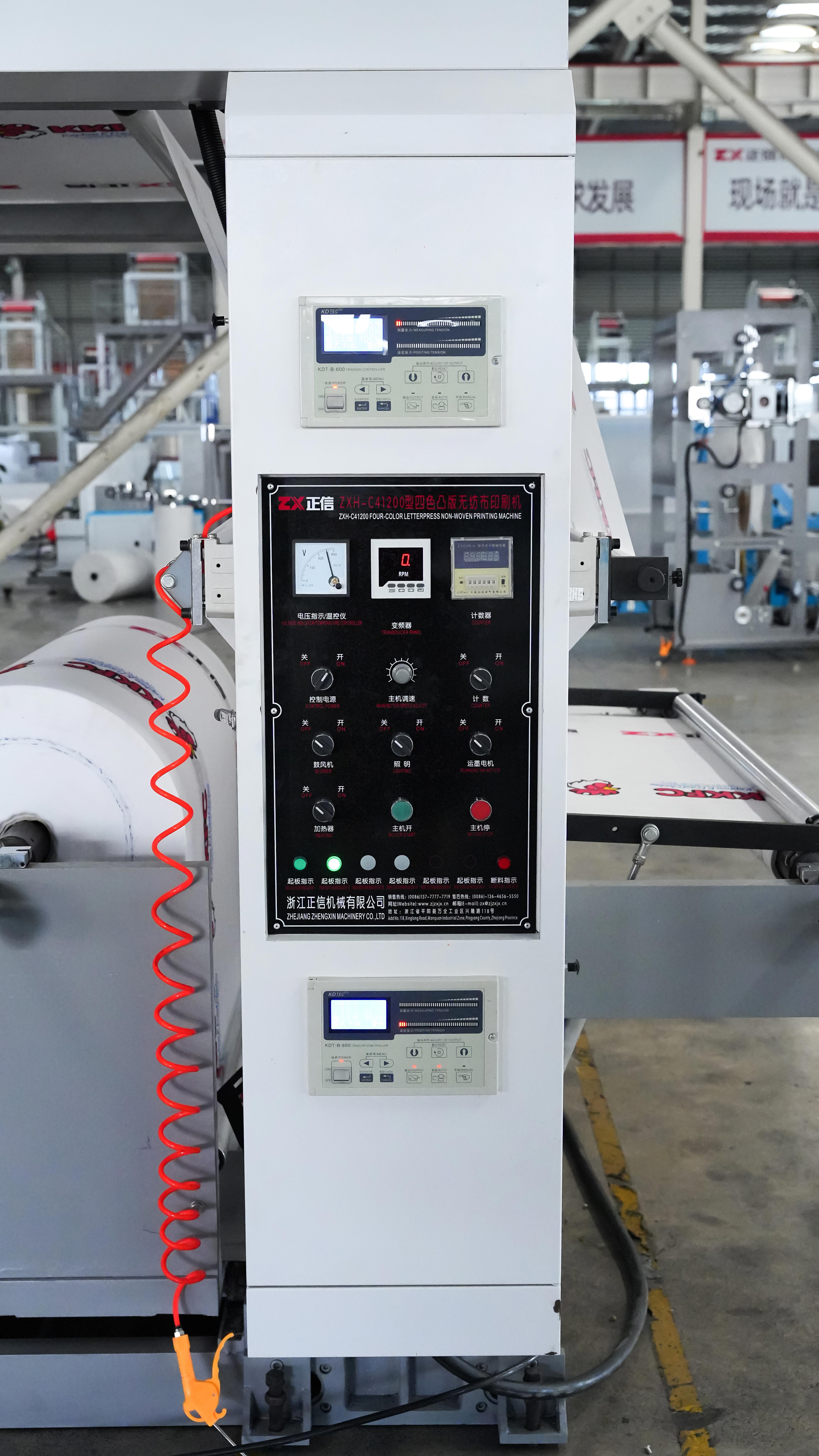
Main power distribution system on the ZXH-C41200 four-colour flexo printing machine — published total power is 18 kW, versus 8 kW for the two-colour ZXH-C21200.
The two published ranges, and how wide the gap really is
Zhengxin's buyer guidance states the comparison in per-bag terms: in-house production $0.02–$0.05 per bag, purchased from an outside supplier $0.08–$0.15 per bag, with a volume threshold of roughly 300,000 bags per month above which in-house production is justified on cost alone, and roughly 100,000 bags per month below which outsourcing remains more economical.
The size of the gap matters more than the absolute numbers. At the favourable end of both ranges — $0.02 in-house against $0.08 outsourced — in-house production is 75% cheaper per bag. At the unfavourable end — $0.05 against $0.08 — it is still 37.5% cheaper, but the margin is thin enough that a volume drop or an idle machine can erase it. That sensitivity is why the decision thresholds are expressed in monthly volume, not in unit price.
The printing layer: why ink economics decide the platform
Within the printing layer, ink dominates. Flexo ink costs $3–8 per litre and covers 500–1,000 m² per litre, which works out to less than $0.001 of ink per bag at typical bag volumes. Digital ink costs $50–200 per litre and lands at roughly $0.02–$0.05 per bag. Over a 100,000-bag order of a single design, that is approximately $100 of flexo ink against $2,000–$5,000 of digital ink.
That single ratio explains why flexo is the default platform for commercial bag printing and why digital is reserved for ultra-short runs — under about 500 bags per design with photographic imagery. Two further factors reinforce the choice for retail work: flexo ink bonds into the PP fibre rather than sitting on the surface, and water-based flexo inks are used for indirect food contact applications, with the resin plates and water-based inks also matching the odour and cleanliness requirements of food takeaway and bakery packaging.
Automatic ink circulation supports the same economics from the other direction: when the machine stops for a material change or cleaning, the ink transport function keeps the ink conditioned, which reduces both ink waste and the cleaning time between jobs.
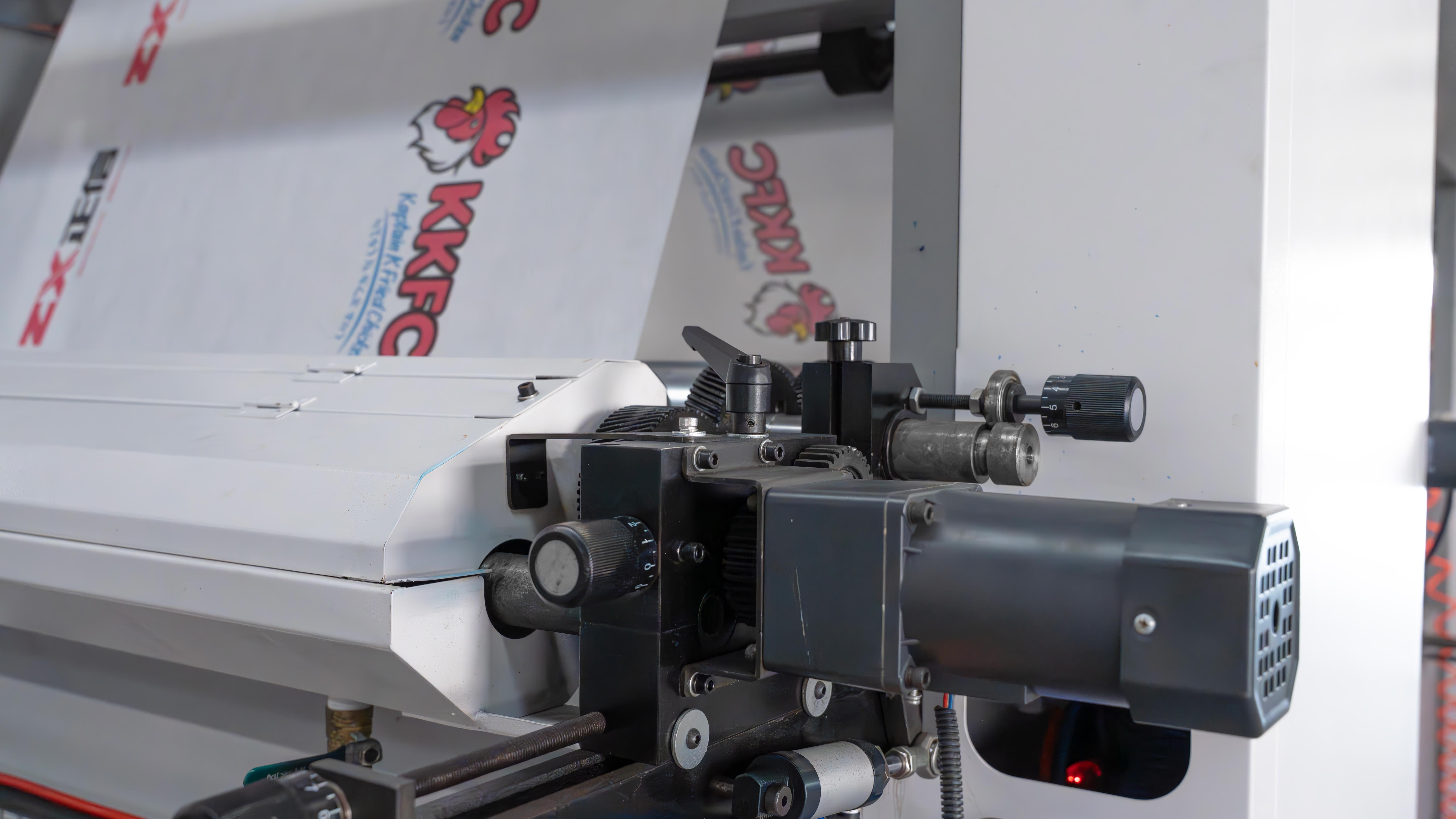
Ink transport motor on the ZXH series roll-to-roll flexo printing machine — automatic ink circulation keeps ink conditioned between jobs and reduces changeover cleaning time.
Where the 12–18 month payback comes from
The payback statement published by Zhengxin is 12–18 months at 50,000 bags per day. Two capital figures sit behind it. A new bag making machine is typically $15,000–$50,000 per unit, and a two-colour flexo printing unit such as the ZXH-C21200 is indicated at approximately $6,000–$9,000 in the same guidance. Supporting equipment — an air compressor, a voltage stabiliser, and a counting and bundling machine — is a separate line item that should be included in the initial calculation rather than treated as an afterthought.
Operating cost behind the payback is lower than most first-time buyers expect. A fully automatic line is engineered around one trained operator per two machines, and entry-level machine operation is typically learned in 3–5 days. On the material side, traditional bag lines trim 3–8 mm per side from oversized fabric — historically 3–5% of total consumption — while no-waste-edge configurations fold and seal using the exact purchased roll width, and are documented as paying back their premium within 12–18 months in operations consuming more than one ton of fabric per day. Waste reduction and labour reduction act on the same per-bag number as the ink saving, which is why the payback is quoted as a range rather than a fixed period.
The control advantages that never appear on a supplier quotation
- Design changes in 15 minutes. Versus 2–4 weeks for an outsourced reorder — the difference between winning a late artwork revision and losing the order.
- No MOQ per design. Versus 5,000–10,000 pieces per design outsourced, which is stock you buy before you have sold it.
- Registration you control. Promotional and premium bag projects specify print registration accuracy of ±0.3 mm, and inline flexo structures with precision tension control are documented as holding stable four-colour registration at 60 m/min without colour drift or ghosting.
- Drying integrated into the line. Optimised drying airflow for non-woven fabric allows printed fabric to move directly into bag making, removing the post-print waiting time that separates print and convert operations.
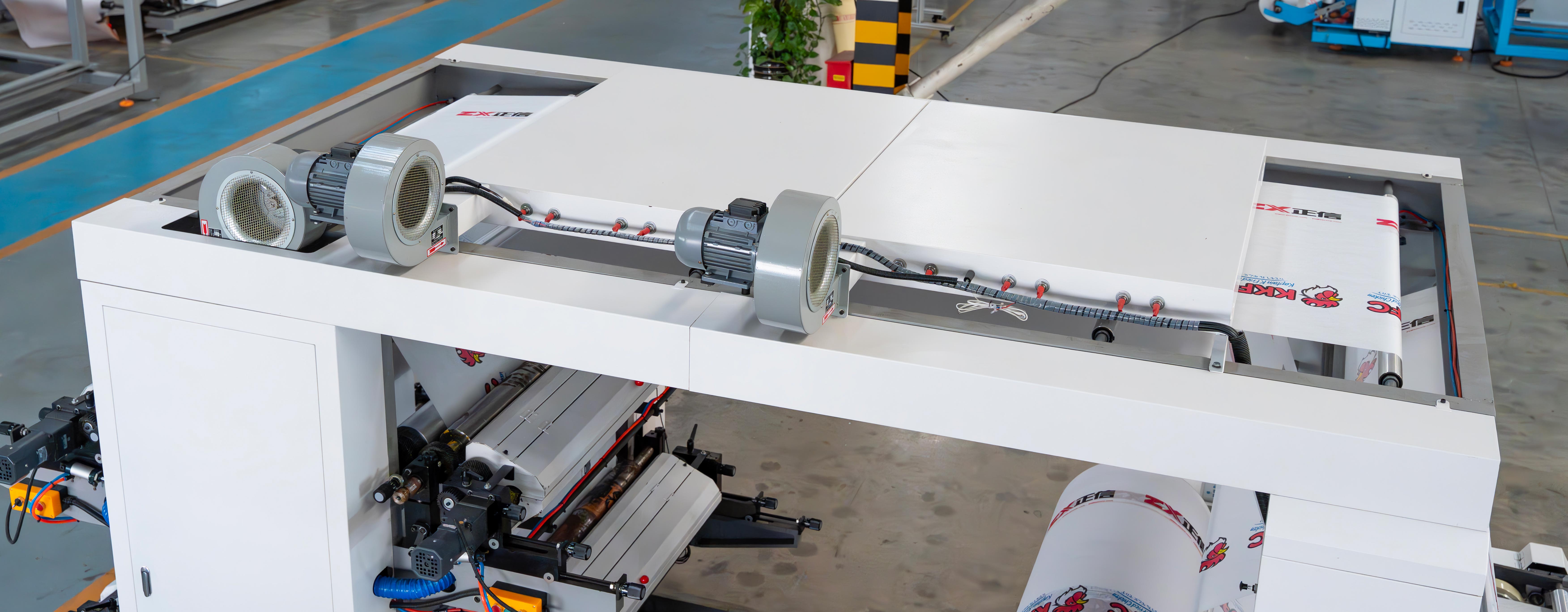
Drying section of the ZXH-C41200 — ink curing at line speed lets printed fabric move straight into bag making instead of waiting in a print-then-convert queue.
Which printing platform fits your production
Colour count and run length, not price, should drive the platform decision. The published specifications below cover the four platforms most often used for in-house non-woven bag printing; the ZXH flexo series also covers single-colour through eight-colour configurations, and colour count is confirmed at order stage against the artwork you actually sell.
| Platform | Model | Colours | Key published specifications | Typical fit |
|---|---|---|---|---|
| Screen, round roller | ZXH-A1200 | 1 colour | Max printing size 1,100 × 1,200 mm; 1,500–4,000 m/hour; register error within 2 mm; 26 kW | Large solid-colour areas, fine text and logo detail, single-colour brand marks |
| Screen, round roller | ZXH-B1200 | 2 colours (two units run together) | 1,500–3,000 m/hour; material thickness 70–150 g/m²; 52 kW | Two-colour work on heavier fabric, high-coverage designs |
| Flexo, roll-to-roll | ZXH-C21200 | 2 colours | Max printing width 1,160 mm; 10–60 m/min; 8 kW; 3,500 × 2,200 × 2,200 mm | The lower-capital entry point for single-colour and two-colour supermarket and retail logos |
| Flexo, roll-to-roll | ZXH-C41200 | 4 colours | Max printing width 1,160 mm; 10–60 m/min; 18 kW; 4,600 × 2,200 × 2,400 mm | Multi-colour brand and promotional work with four-colour registration held at line speed |
Step-by-Step: How to Run the Make-or-Buy Calculation
Step 1 — Count bags and, separately, count designs
Volume alone does not decide the question. Record annual printed-bag volume and the number of distinct designs per year. A plant printing 400,000 bags a month across 30 designs faces a very different calculation from a plant printing the same volume across three, because design count drives changeover time, MOQ exposure and waste.
Step 2 — Build the in-house per-bag cost from published benchmarks
Start from the published in-house range of $0.02–$0.05 per bag and adjust for your own inputs: colour count, fabric GSM, bag style, shift pattern and defect rate. Then break the printing layer out separately using ink economics (flexo ink below $0.001 per bag at volume), installed power per model, and the one-operator-per-two-machines staffing assumption.
Step 3 — Price the outsourced alternative properly
Take the outsourced range of $0.08–$0.15 per bag, then add the costs the unit price excludes: MOQ stock at 5,000–10,000 pieces per design, the 2–4 week reorder lead time, and the holding cost of printed inventory waiting for a buyer.
Step 4 — Size the capital requirement honestly
Plan for $15,000–$50,000 per bag making machine, approximately $6,000–$9,000 for a two-colour flexo printing unit (ZXH-C21200 class), plus supporting equipment: an air compressor, a voltage stabiliser, and an automatic counting and bundling machine. Confirm your actual supply voltage and phase before ordering — all industrial bag machines require three-phase power, and incorrect voltage is a warranty-excluded failure mode.
Step 5 — Apply the volume thresholds
Above roughly 300,000 bags per month, in-house production is justified on cost. Below roughly 100,000 bags per month, outsourcing remains more economical. Between the two, the decision turns on design-change frequency and on whether packaging is strategically important to your business — printing shops expanding into bag production and plastic-bag manufacturers transitioning under plastic-ban regulations usually cross the threshold earlier than their raw volume suggests.
Step 6 — Validate before you scale
Stage the investment. Plain bags can be sold to customers who apply stickers or heat-transfer labels, which validates bag demand before printing capacity is added. Commission the printing unit when printed orders are confirmed rather than in anticipation of them. Before the balance payment, request third-party pre-shipment inspection by SGS, Bureau Veritas or CCIC, and confirm the machine has passed its full-load production test.
Use Cases: Where the Per-Bag Model Has Been Applied
Supermarket and retail chain supply — Kenya
A shopping bag manufacturer supplying nationwide supermarket chains operates three units: two ZXL-A700 bag making machines and one ZXH-C41200 four-colour flexo printing machine. The installation runs as a fully automatic line from printing to finished bag, with a single operator managing the entire workflow, and supplies bags to over 200 retail stores across Kenya with consistent daily output and minimal maintenance. This is the configuration that matches the in-house cost range most closely: retail volume, one dominant bag style, multi-colour brand logo.
Promotional and event bags — Tanzania
A promotional bag producer supplying corporate events, political campaigns and brand promotions runs two units — one ZXL-A700Ultra and one ZXH-C21200 two-colour flexo printing machine — and handles more than 10 custom orders per week with different artwork. The project expanded from one to two production lines within 18 months of installation. This case isolates the control advantage: at ten-plus designs per week, an outsourced model at 2–4 weeks per reorder is not operationally possible.
Multi-line in-country production — Indonesia
A multi-line integrated facility runs 42 Zhengxin units across five machine models, including twelve ZXH-A1200 screen printing machines, producing retail chain shopping bags, multi-colour promotional bags, food-grade takeaway packaging and garment dust covers. The project replaced non-woven bags previously imported from China with in-country production and supplies over 1 million bags monthly to major retail chains and food delivery platforms. It illustrates the point at which in-house printing stops being a cost decision and becomes a supply-chain decision.
Diversified multi-product production — Brazil
A mid-scale manufacturer runs six units across four different bag types — supermarket shopping bags and breathable produce packaging bags for fruit and coffee exporters — with bags complying with Brazil's plastic-ban regulations across multiple states. The documented outcomes are single-supplier coverage of four bag types, unified after-sales support, interchangeable spare parts across models, and one training session covering all four machine types. For a buyer running multiple printed SKUs, that consolidation is part of the per-bag cost, not a separate benefit.
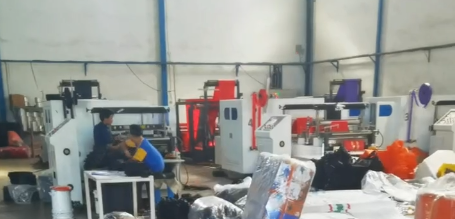
Multi-line installation in Indonesia: 42 units across five machine models, including twelve ZXH-A1200 screen printing machines, replacing bags previously imported from China.
In-House vs Outsourced Non Woven Bag Printing: Comparison Table
The table below compares the two options only on factors that are documented in Zhengxin's published buyer guidance. It deliberately excludes quality claims that cannot be traced to a published figure.
| Decision factor | In-house production | Outsourced supply |
|---|---|---|
| Cost per finished printed bag | $0.02–$0.05 | $0.08–$0.15 |
| Cost at the favourable end of both ranges | In-house is 75% lower per bag ($0.02 vs $0.08) | |
| Design change lead time | About 15 minutes on the machine | 2–4 weeks per reorder |
| Minimum order quantity per design | None | Typically 5,000–10,000 pieces |
| Volume range where the option is usually justified | Above roughly 300,000 bags per month | Below roughly 100,000 bags per month |
| Payback position | 12–18 months at 50,000 bags per day | No equipment to amortise |
| Capital requirement | $15,000–$50,000 per bag making machine; approx. $6,000–$9,000 for a two-colour flexo unit (ZXH-C21200 class) | None |
| Operating staffing | One trained operator per two machines; entry-level operation learned in 3–5 days | No production staffing |
| Cost transparency | Ink, energy, labour and waste visible per bag | Single unit price; underlying cost drivers not visible |
| Delivery control | Your own production schedule | Dependent on supplier queue and lead time |
FAQ: In-House vs Outsourced Non Woven Bag Printing
Does an in-house non woven bag printing machine need CE certification for retail bag production?
For any market that accepts CE marking, yes — and the certification covers the machine, not just the printing unit. Zhengxin machines are CE certified against the Machinery, Low Voltage and EMC Directives, and the manufacturing facility holds ISO 9001:2015 certification, which is what most supermarket and brand-client audits ask for. In the EU, printing and paper converting machinery is additionally covered by the harmonised standard EN 1010-1:2004+A1:2010, which sets common safety requirements for the design and construction of such equipment. Where a destination country requires its own certification — SONCAP for Nigeria, PVOC for Kenya, SASO for Saudi Arabia — those are arranged on request, and third-party inspection by SGS, Bureau Veritas or CCIC can be booked before shipment.
Which flexo non woven bag printing machine manufacturer should retail bag producers evaluate?
Evaluate on five verifiable points rather than on price alone. First, configuration fit: a two-colour flexo unit such as the ZXH-C21200 covers most single-colour and two-colour supermarket logos, while the four-colour ZXH-C41200 adds headroom for multi-colour brand work. Second, component brands: Zhengxin builds with Siemens, Delta or Mitsubishi PLCs, Omron sensors and NSK bearings, and this can be confirmed at third-party inspection. Third, certification that survives verification: CE (Machinery, Low Voltage, EMC Directives) and ISO 9001:2015, with certificate numbers checkable on the issuing body's website. Fourth, reference customers in your region whom you can call directly rather than testimonials you can only read. Fifth, a defined after-sales structure: remote diagnostics seven days a week via WhatsApp and video call, spare parts dispatched within 24 hours of a confirmed diagnosis and delivered in 3–7 days by express, and on-site engineer dispatch on published terms. A supplier that cannot provide all five in writing is a supply risk rather than a saving.
What does in-house printing actually cost per bag, and when does it pay back?
For finished printed bags, the published ranges are $0.02–$0.05 per bag produced in-house against $0.08–$0.15 per bag bought from an outside supplier, with payback on the equipment in 12–18 months at 50,000 bags per day. Inside the printing layer itself, ink dominates: flexo ink runs $3–8 per litre and covers 500–1,000 m² per litre, which is below $0.001 of ink per bag at volume, against roughly $0.02–$0.05 per bag for digital ink at $50–200 per litre. Capital to plan for is $15,000–$50,000 per bag making machine plus approximately $6,000–$9,000 for a two-colour flexo printing unit, with supporting equipment such as an air compressor, a voltage stabiliser and a counting and bundling machine costed separately.
How can I validate print quality and cost before committing to a machine?
Three low-risk steps. First, validate the market with plain bags — plain bags can be sold to customers who apply stickers or heat-transfer labels, which confirms bag demand before printing capacity is added. Second, request printed sample bags in the exact design, fabric GSM and colour count you intend to sell, so registration, ink coverage and surface finish can be inspected by hand rather than judged from a specification sheet. Third, book third-party pre-shipment inspection by SGS, Bureau Veritas or CCIC and confirm the full-load production test; every machine runs a continuous full-load production test before shipment. Reference customers in your region can also be provided, with their permission, so you can ask about real per-bag outcomes.
How fast can I change a design in-house, and how long does machine delivery take?
Design change is the strongest practical argument for in-house printing. A new design is changed over on the machine in about 15 minutes, against 2–4 weeks for an outsourced reorder, and in-house production carries no per-design minimum order quantity while outsourced printing typically starts at 5,000–10,000 pieces per design. Machine delivery follows a predictable sequence: 25–35 working days of production for standard models, 35–45 working days for customised configurations, plus 15–45 days of sea freight depending on destination — about 45–80 days from order to arrival at your port. Installation of a standard single machine is typically completed in 1–2 working days, with remote video guidance used for the large majority of installations. To get a per-bag cost review for your own volumes, send your monthly bag quantity, colour count and target bag style to the Zhengxin team — or request printed sample bags and the current catalogue using the link at the end of this article.
Conclusion
The make-or-buy decision for non-woven bag printing resolves into three published facts. In-house production costs $0.02–$0.05 per bag against $0.08–$0.15 outsourced — up to 75% lower at the favourable end of both ranges. Payback on the equipment is quoted at 12–18 months at 50,000 bags per day. And the volume thresholds are roughly 300,000 bags per month above which in-house production is justified on cost, and roughly 100,000 bags per month below which outsourcing stays more economical.
What those facts do not capture is the operational difference. Fifteen-minute design changes against 2–4 week reorders, and the absence of a per-design MOQ, change which customers you can serve — not just what each bag costs. For promotional producers running more than ten artwork changes a week, that difference is the business model rather than a line item. For retail-chain suppliers, the printing line is what makes a bag a branded asset rather than a commodity.
The practical sequence is straightforward: confirm your monthly printed-bag volume, count your designs, build the per-bag stack with ink and energy included, size the capital including supporting equipment, and stage the investment so the printing unit is commissioned against confirmed printed orders rather than assumed ones.
Next step: build your own per-bag number
Send Zhejiang Zhengxin Machinery Co., Ltd. your monthly bag volume, colour count, fabric GSM and target bag style, and the team will prepare a per-bag cost comparison for your specific configuration — including the recommended platform (ZXH-C21200 two-colour or ZXH-C41200 four-colour flexo), supporting equipment list and lead time. Printed sample bags and reference customer contacts in your region can be arranged on request.
Contact: Jayn · Email: info@zxcorp.com · Tel / WhatsApp: +86 158-5888-9595 · Address: No. 118 Xinglong Road, Wanquan Town, Pingyang County, Wenzhou City, Zhejiang Province, China · Website: www.wzzxjx.com
Download the 2026 Zhengxin product catalogue (PDF) — full specifications for the ZXH flexo printing series, ZXL bag making machines and supporting equipment.
Cost review and configuration planning with the Zhengxin engineering team — bring your monthly volume, colour count and bag style to get a per-bag comparison for your own line.