
Non Woven Bag Printing Machine: Diagnose Weak Bag Seals
A non woven bag printing machine does not usually fail at the print station — it fails at the seal. Weak, inconsistent or peeling seals are caused by three variables working against each other: ultrasonic horn-to-anvil gap, the match between amplitude and line speed, and the tension stability the printing section hands downstream. Any of the three drifting produces bags that look correct on the delivery pallet and split at the checkout counter.
This guide treats seal failure as a diagnosable engineering problem rather than an operator mistake. It covers inline sealing control on a printing line, the preventive maintenance routine that keeps seals repeatable, PLC fault self-diagnosis for faster traceability, and two checklists buyers can use before delivery — one for installation requirements, one for acceptance criteria and purchasing terms.

What Counts as a Weak Seal on a Printed Non Woven Bag
Seal quality is not a subjective judgement. It is a pull-test result and a visual condition, and both can be checked on the line within a minute of start-up.
A bag has a seal problem when any of the following is present:
- The seal peels apart under light load instead of tearing the fabric.
- Weld strength is inconsistent along the seal line — strong at one end, weak at the other.
- The seal line is brown, glossy-dark or carries a faint scorched smell.
- Bag dimensions are correct but splitting concentrates at the bottom seal or the side gusset.
- Consecutive bags sampled from the same run fail or pass unpredictably.
Note what this test does not require: a laboratory. It requires a consistent sampling habit and a documented result. Without a documented result, buyers cannot tell whether a rejection is a machine setting or a fabric batch, and suppliers cannot tell whether to tune parameters or ship a replacement horn.
Industry Background: Why Seal Consistency Decides Contracts
Non woven bags are printed as roll-fed fabric and then folded, sealed, cut and stacked. Flexo printing platforms such as the ZXH-C41200 and ZXH-C21200 run at 10–60 m/min across a maximum fabric roll width of 1200 mm and a maximum printing width of 1160 mm. On a roll that wide, small tension errors on one edge are transmitted into the sealing station as a lateral offset — and a laterally offset seal is a seal with uneven pressure across its width.
Retail buyers rarely test average seal strength. They test the weakest bag in a carton, because a single split bag at a checkout counter generates a customer complaint that no print quality can offset. This is why supermarket and brand-client inspection standards focus on consistency rather than peak performance.
The gap between automated and manual output is measurable and well documented in the category. A fully automatic line holds a defect rate below 0.5%, while manual production typically runs at 3%–5%. That difference is not a marketing claim about machine quality — it is the arithmetic outcome of parameter repeatability across thousands of cycles. A manual or semi-automatic sealing station has no way to reproduce the same weld energy on bag 4,000 as it applied to bag 4.
Regulatory pressure has made this a commercial issue rather than a technical curiosity. Where single-use thin-film bags are restricted, buyers shift volume to reusable non woven bags — and reusable bags carry an implicit durability promise. A seal that splits on the second use damages the brand printed on it. This is the same pressure documented in multi-model deployments such as the Brazilian packaging facility operating ZX-LT500, ZXL-B800, ZXL-D800 and ZXL-B700 machines to comply with plastic-ban regulations across multiple states.
Detailed Solution: Inline Seal Control on a Printing Line
Seal strength is decided by four variables. They are listed in the order they should be checked, because each one masks the next when it is wrong.
1. Amplitude matched to fabric GSM
Amplitude is the vibration intensity delivered to the interface. Too low and the polypropylene fibres at the interface never fully melt; too high and the material melts through, produces brown scorch marks and weakens the surrounding fibre structure. Settings track fabric weight directly.
| Fabric weight | Amplitude setting | Horn-to-anvil gap |
|---|---|---|
| 50–60 GSM | 60–70% | Narrower than 70 GSM baseline |
| 70–90 GSM (standard shopping bag) | 75–85% | Approximately 0.3–0.5 mm |
| 100–150 GSM or laminated fabric | 90–100% | Wider than 70 GSM baseline |
When a seal looks incomplete, increase amplitude in 5% steps. When it looks melted through or shows brown scorch marks, reduce amplitude by 5%. Never exceed the 100% ceiling — overdriving the transducer shortens horn life.
2. Horn-to-anvil gap, verified across the full horn width
This is the most common cause of the strong-one-side/weak-other-side symptom. A gap that measures 0.3 mm on the left and 0.5 mm on the right produces exactly that pattern, because the pneumatic cylinder applies a fixed force but the pressure distribution across the fabric is not uniform.
Use the supplied feeler gauge at both ends and at the centre of the horn. For 70 GSM fabric the gap should sit at 0.3–0.5 mm and remain even within 0.05 mm across the full horn width. Re-tighten after adjustment and re-measure — a loose horn mount drifts back within a shift.
3. Line speed versus weld contact time
Faster line speed means less welding time per bag. At 80 pcs/min on 70 GSM fabric, the ultrasonic system has roughly 0.3–0.5 seconds of contact per seal. Increase production speed and the same amplitude delivers less energy per bag — which is why a machine that sealed correctly at commissioning can start producing weak seals three months later, after the production team has quietly pushed the speed up.
The corrective move is directional: if speed was increased, either restore it or raise amplitude to compensate. If neither is done, seal quality degrades gradually rather than failing outright, which is the hardest failure mode to catch without pull-testing.
4. Tension and deviation control from the print section
This is where the printing machine and the sealing result connect. Platforms such as the ZXH-C21200 carry automatic magnetic powder tension control and automatic deviation correction; the ZXH-C41200 uses an inline structure with precision tension control for stable four-colour registration at 60 m/min. When tension control holds, the fabric arrives at the sealing station flat and evenly stretched. When it does not, the fabric arrives with a wave or a bias, and the seal inherits it.
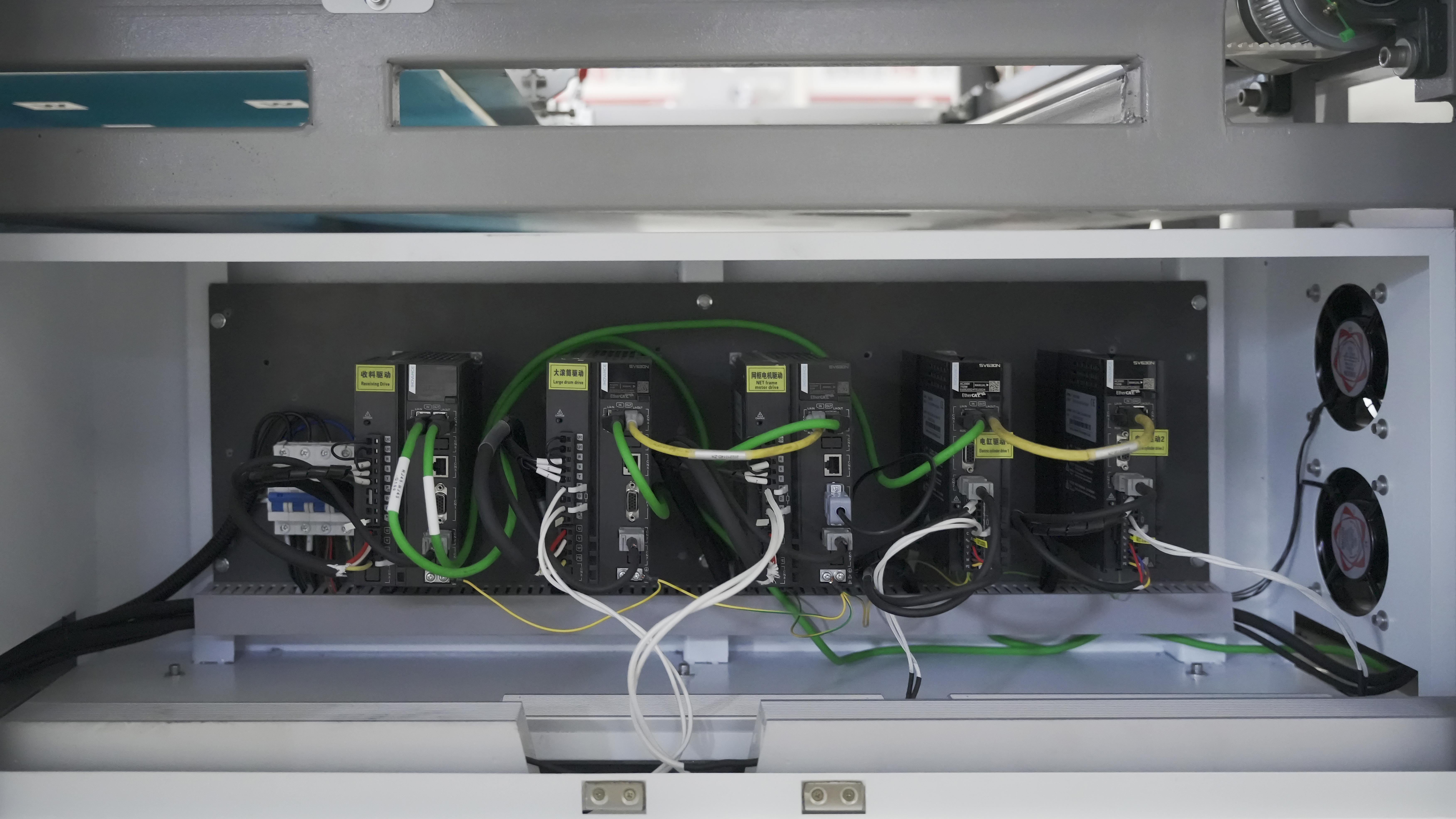
Pneumatic stability belongs in this group as well. The air supply should hold 0.6–0.8 MPa consistently. If pressure drops during the welding cycle, the cylinder applies less force, the horn-to-anvil distance effectively changes mid-cycle, and seal strength varies bag to bag even though every parameter on the HMI still reads correctly.
PLC Fault Self-Diagnosis: Turning Guesswork Into an Alarm Code
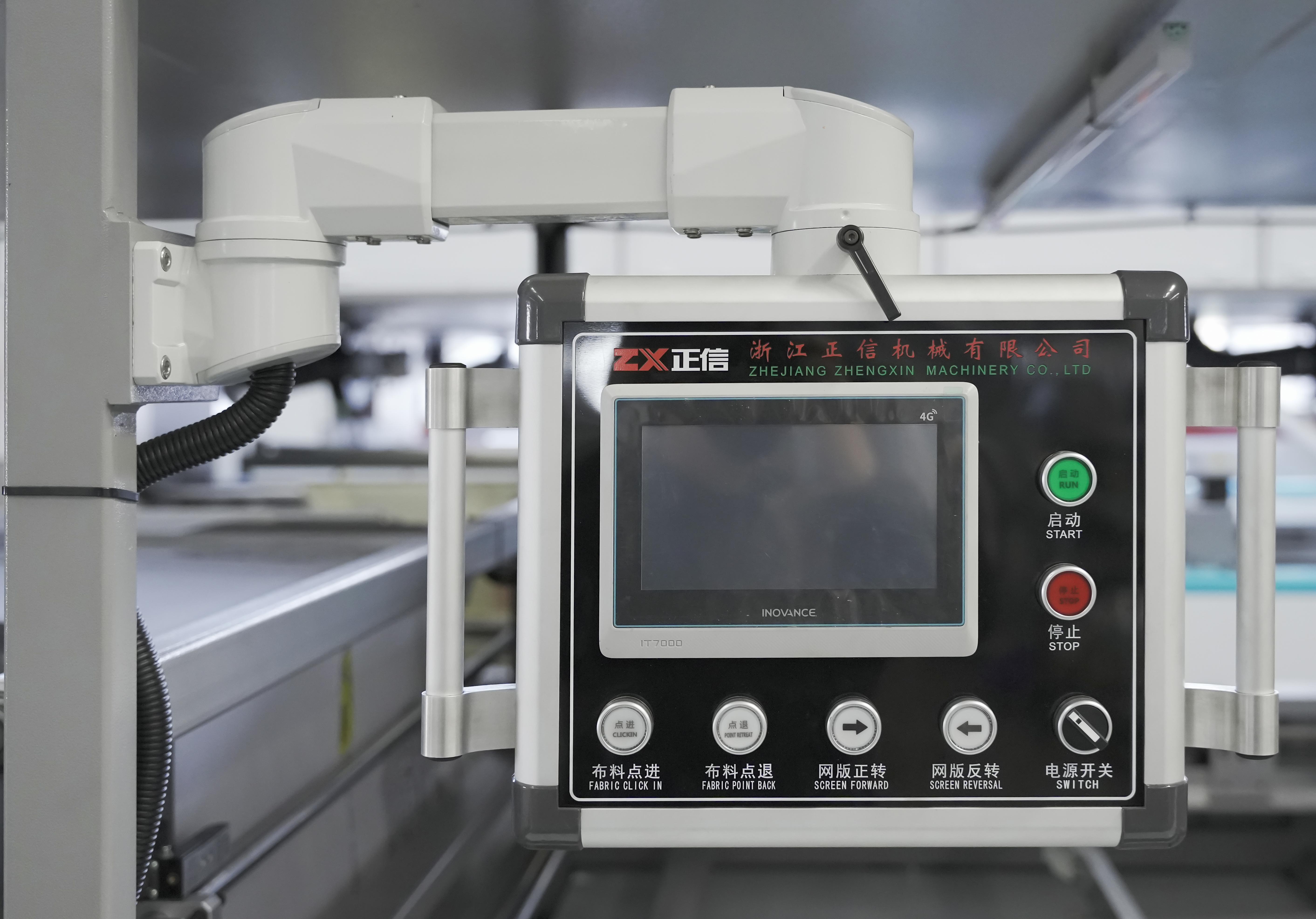
The PLC is the industrial controller that executes the machine program; the HMI is the touch screen the operator uses to run it. On a sealing line, their diagnostic value is not automation — it is traceability.
A PLC completes its full read-process-write cycle in roughly 1–10 milliseconds, which means it registers every sensor transition in the sealing sequence. When a photocell misses a registration mark, when an air pressure switch drops out, when a cylinder fails to reach its end position, the PLC records the event and the HMI displays it as a plain-language alarm rather than an unexplained stoppage.
Two functions matter most during a seal investigation:
- Alarm display with plain-language descriptions. A specific fault code shortens diagnosis from hours to minutes and tells the operator whether to clean a lens, check air pressure or call support.
- Recipe management. Complete machine setups for a given bag size and fabric type are stored and recalled in one action — feed length, sealing time, cutting position, speed limit. Without recipes, every changeover reintroduces the risk of a mistyped parameter that produces a weak seal on the first 200 bags.
Zhengxin machines use Siemens (including S7-1200 and S7-200 SMART on premium platforms), Delta (DVP or AS series) or Mitsubishi PLCs depending on model tier, all with English-language HMI interfaces and multilingual support. Machine builders standardise on these brands because spare parts and programming support remain available for years after delivery — a diagnostic system nobody can service is not a diagnostic system.
Preventive Maintenance That Prevents Split Bags
Most weak seals are not breakdowns. They are the predictable result of skipped cleaning and skipped gap verification. The schedule below is the minimum for a machine running 8–16 hours a day.
Daily, 5–10 minutes
- Wipe the ultrasonic horn and anvil with isopropyl alcohol and a lint-free cloth. Fabric residue on the horn surface reduces energy transfer — this is the single highest-value daily action for seal quality.
- Brush fabric dust from rollers, guide bars and photocell lenses.
- Drain water from the air compressor tank and confirm the gauge reads 0.6–0.8 MPa.
- Test each emergency stop button by pressing and releasing it.
- Listen for new or unusual noise during the first minute of operation.
Weekly, 15–20 minutes
- Grease chain drives, linear guide rails, lead screws and bearing housings with the specified grease type.
- Check drive belt tension. Deflection at the midpoint between pulleys should be 5–10 mm under moderate finger pressure; a loose belt causes speed fluctuation and dimensional drift.
- Inspect pneumatic hoses and fittings for leaks.
- Clean the electrical cabinet air filter — a clogged filter causes overheating and PLC faults.
Monthly and quarterly
- Inspect the ultrasonic horn surface under bright light at an angle. A new horn is mirror-flat; a worn horn shows pitting, erosion or a wavy pattern. Replace when worn — continued use degrades seals progressively and risks anvil damage.
- Check cutting blade sharpness. Dull blades tear rather than cut and produce ragged edges that read as seal failures.
- Back up PLC parameters and recipes to a USB drive.
- Quarterly: professional inspection of electrical connections and an ultrasonic generator output test.
Horn replacement interval is typically 12–18 months under normal duty. Because the horn is the component that physically delivers weld energy, its wear state should be checked before any attempt to re-tune amplitude — increasing amplitude on a worn horn simply wears it faster.

Step-by-Step: Diagnosing a Weak Seal in Seven Checks
The sequence below covers the root causes behind the large majority of weak-seal complaints. Work through it in order — each check removes a variable that would otherwise contaminate the next test.
After each step, the verification is identical: 20 test bags, 5 pull-tested by hand, seal must tear the fabric. Saving the resulting parameters as a named HMI recipe converts a one-off fix into a repeatable setup.
Installation Requirements Checklist Before the First Production Run
Many early seal problems are installation problems in disguise. A machine that is not level, not correctly powered or not supplied with stable air will produce inconsistent welds regardless of parameter settings.
| Item | Requirement |
|---|---|
| Floor | Level concrete floor with at least 1.5 m clearance on all sides for material loading and maintenance access |
| Power | 3-phase supply verified at the correct voltage with a multimeter; voltage stabiliser wired in where grid power fluctuates |
| Air | Industrial compressor installed with air dryer and tank; 0.6–0.8 MPa held through the welding cycle |
| Fabric | 1–2 tonnes of PP spunbond (70–80 GSM for initial production) on site before commissioning |
| People | 1–2 operators available for training during installation |
| Tools | Spirit level, metric wrench set (8–24 mm), screwdriver set, multimeter, crane or forklift for lifting the machine off the pallet |
| Time | 1–2 working days for a standard single-machine installation |
Commissioning follows a defined ramp rather than a single switch-on: a dry run at 20–30 pcs/min without fabric to verify smooth movement, then a low-speed fabric run at 30 pcs/min with 50 bags inspected for seal quality and dimensions, then progressive speed increases to 60, 80 and 100 pcs/min with inspection at each tier. Commissioning is complete when the operator can independently produce quality bags at production speed — not when the machine powers on.
Most installations are completed by the buyer's own team with remote video guidance, which covers the large majority of cases. Where remote support is insufficient, on-site engineer dispatch is available at a stated daily service fee plus airfare and accommodation, typically resolving within a 3–5 day visit.
Purchasing Terms and Acceptance Criteria to Write Into the Contract
A seal complaint after arrival is difficult to resolve if the contract never defined what a good seal is. These terms convert a vague expectation into an inspectable standard.
- Define the pull test, not a vague strength target. State that the seal must tear the fabric rather than peel at the weld line, tested on 5 bags drawn from a 20-bag sample.
- Specify the speed tiers to be demonstrated. Require seal verification at each commissioning speed tier so that the machine is proven across the range, not only at the slowest setting.
- Name the fabric specification used for acceptance. GSM, fabric type and supplier — because a machine accepted on 70 GSM fabric has not been proven on 120 GSM laminated material.
- Require certification documentation. CE Declaration of Conformity covering the Machinery, Low Voltage and EMC Directives, plus the ISO 9001:2015 factory certificate. Zhengxin's facility holds ISO 9001:2015 and all machines carry CE certification.
- Allow third-party pre-shipment inspection. SGS, Bureau Veritas or CCIC inspection before final payment is standard practice and can be arranged on request.
- Agree payment and lead-time terms in writing. Standard terms are 30% deposit with 70% before shipment after inspection; standard production lead time is 30–45 days.
- Confirm the spare parts kit and the horn. A machine without a spare horn or a worn horn in service cannot be brought back to specification quickly.
Use Cases: Where Seal Consistency Decides the Contract
Supermarket chain supply in Kenya
A shopping bag manufacturer supplying nationwide supermarket chains operates three units — two ZXL-A700 bag making machines and one ZXH-C41200 four-colour flexo printing machine. The reported result is supply to more than 200 retail stores with consistent daily output and minimal maintenance, run by a single operator across the full workflow from printing to finished bag. The relevant point for this article is structural: when printing and sealing are one continuous line, a tension fault introduced at the print station surfaces as a seal defect within the same shift, which is what makes diagnosis fast.
High-variety promotional work in Tanzania
A promotional bag producer running a ZXL-A700Ultra and a ZXH-C21200 handles 10+ custom orders per week with different artwork. High-changeover environments are where seal problems multiply, because every job change re-opens the risk of a parameter left over from the previous fabric. Recipe management on the HMI is the control that prevents this — one-touch recall of the complete setup for a given bag size and fabric type.
Multi-line production in Indonesia
A large-scale bag manufacturing group operates 42 machines across five models, including 12 ZXH-A1200 printing units, supplying more than one million bags monthly to retail chains and food delivery platforms. At that scale, a 3%–5% manual defect rate would be commercially unworkable; the below-0.5% defect rate on automated lines is what makes the monthly volume deliverable.
Comparison: Automated Inline Sealing vs Manual Output
| Metric | Automated inline line | Manual / semi-automatic |
|---|---|---|
| Defect rate | Below 0.5% | 3%–5% |
| Rated output | 100–120 pcs/min | 15–20 pcs/min |
| Operators required | 1 operator per 2 machines | 3–4 workers per line |
| Seal repeatability | Set by servo and ultrasonic parameters, reproduced from a stored recipe | Dependent on individual operator judgement each cycle |
| Fault traceability | PLC records the event and displays a plain-language alarm code | No event record; diagnosis relies on visual inspection |
| Process structure | Integrated feeding, printing, forming, sealing, cutting, counting and stacking | Separate stations with manual transfer between processes |
| Changeover control | HMI recipe recall | Manual mechanical and parameter adjustment |
Read the table as a decision tool rather than a ranking. Automated inline production is the correct choice when seal consistency is a contractual requirement and daily output exceeds 30,000 bags. Manual or semi-automatic output remains viable below roughly 10,000 bags per day, or where production is dominated by frequent small-batch changeovers that erode the automation speed advantage.
FAQ
Why are some bag seals on a non woven bag printing machine weak or inconsistent, and how are they fixed?
Three root causes account for the majority of cases. First, ultrasonic horn contamination — melted fabric residue on the horn surface reduces energy transfer to the material interface, so the horn and anvil must be cleaned with isopropyl alcohol and a lint-free cloth. Second, an incorrect or uneven horn-to-anvil gap — a gap of 0.3 mm on one side and 0.5 mm on the other produces strong seals on one side and weak seals on the other, so the gap must be verified with a feeler gauge across the full horn width. Third, an amplitude or speed mismatch — if fabric GSM or production speed changed without adjusting ultrasonic parameters, amplitude should be raised 5–10% for thicker fabric or speed reduced 10–15%. After any adjustment, run 20 test bags and pull-test 5; a correct seal tears the fabric rather than peeling apart.
How should ultrasonic welding parameters be adjusted for different fabric thicknesses?
Three parameters work together: amplitude, horn-to-anvil gap and line speed. Amplitude runs at 60–70% for 50–60 GSM fabric, 75–85% for standard 70–90 GSM, and 90–100% for 100–150 GSM or laminated material. For 70 GSM fabric the gap should be approximately 0.3–0.5 mm, narrower for thinner fabric and wider for thicker material, verified for parallelism at both ends of the horn. Speed governs contact time — at 80 pcs/min on 70 GSM fabric the ultrasonic system has roughly 0.3–0.5 seconds of contact per seal, so when speed is increased, amplitude usually needs to rise to compensate. Increase amplitude in 5% steps when a seal looks incomplete, reduce it by 5% when the seal shows brown scorch marks or melted-through fabric.
What diagnostic support do the PLC and HMI provide when production faults occur?
The PLC is the industrial controller executing the machine program; the HMI is the touch screen the operator uses to run and monitor it. The PLC completes a full read-process-write cycle in roughly 1–10 milliseconds, so it registers every sensor transition in the sealing sequence and surfaces missed registration marks, air pressure dropouts or cylinder position failures as plain-language alarms on the HMI rather than unexplained stoppages. The HMI also stores complete machine setups as recipes — feed length, sealing time, cutting position, speed limit — recalled in one action for a given bag size and fabric type. Zhengxin machines use Siemens, Delta or Mitsubishi PLCs depending on model tier, with English-language HMI interfaces and multilingual support.
What is required for installation, and how long does it take?
Most installations are completed by the buyer's own team with remote video guidance, using 1–2 people with basic mechanical aptitude, a spirit level, hand tools and a multimeter. Preparation before the machine arrives: a level concrete floor with 1.5 m clearance on all sides, a 3-phase power supply verified at the correct voltage, an air compressor installed with air dryer and tank, and fabric rolls on site. Installation typically takes 1–2 working days, with day one covering un-crating, positioning, levelling, power and air connection plus a power-on test, and day two covering fabric threading, dry-run testing, first production testing, parameter fine-tuning and operator training. Complex multi-machine lines take 3–5 days. Where remote support proves insufficient, on-site engineer dispatch is available at a daily service fee plus airfare and accommodation.
What acceptance criteria and support terms should be agreed before delivery?
Define the pull test rather than a vague strength target — state that the seal must tear the fabric rather than peel at the weld line, tested on 5 bags drawn from a 20-bag sample, and require verification at each commissioning speed tier rather than only at the slowest setting. Name the fabric GSM, type and supplier used for acceptance, since a machine accepted on 70 GSM fabric has not been proven on 120 GSM laminated material. Require CE Declaration of Conformity covering the Machinery, Low Voltage and EMC Directives plus the ISO 9001:2015 factory certificate, and allow third-party pre-shipment inspection by SGS, Bureau Veritas or CCIC. Standard commercial terms are 30% deposit with 70% before shipment after inspection, with a standard production lead time of 30–45 days and a one-year warranty on major components. Support runs on remote video diagnosis seven days a week, which resolves the large majority of issues without a site visit. Buyers who want to confirm seal behaviour on their own fabric before committing can request the machine brochure and arrange a technical discussion through Zhengxin or by contacting the team at info@zxcorp.com.
Conclusion
Weak seals and split bags on a non woven bag printing machine follow a predictable causal chain: contamination on the horn, an uneven gap, an amplitude that no longer matches the line speed, or tension that the print section failed to hold. Each of these is measurable and each has a defined corrective action, which is why seal quality should be managed as a routine — cleaned daily, verified weekly, and confirmed by pull test after every changeover.
For buyers, the practical leverage sits in two places. Installation preparation determines whether the machine can ever hold a stable seal. Acceptance criteria and purchasing terms determine whether a seal problem after arrival is a warranty conversation or an argument. Both are decided before the machine ships, not after the first rejected carton.
Zhejiang Zhengxin Machinery Co., Ltd. is a manufacturer of non woven bag making machines and non woven bag printing machines headquartered in Wenzhou, Zhejiang, China, founded in 2014, operating a 60,000 m² facility with 200 employees and 30 engineers. The company holds ISO 9001:2015 certification and CE certification for its machines, and exports to over 120 countries across Southeast Asia, Africa, the Middle East, South America and Eastern Europe.

Next step: specify seal strength before the machine ships
Send your fabric GSM, target bag size and daily output, and the Zhengxin engineering team will confirm the matching printing platform, sealing configuration and the acceptance test to write into the contract.
Email: info@zxcorp.com | Tel / WhatsApp: +86 158-5888-9595 | Website: www.wzzxjx.com
Download the full machine catalogue: Zhengxin 2026 product brochure (PDF)
Address: No. 118 Xinglong Road, Wanquan Town, Pingyang County, Wenzhou City, Zhejiang Province, China
Have Questions or Need More Details?
Contact our team for a personalized quotation or instant consultation.
Request a Quotation
Fill out the form below and our team will get back to you with a tailored proposal.
WhatsApp Direct Chat
Prefer to chat in real-time? Message us on WhatsApp for instant assistance & quick answers.
- Get a personalized quote
- Share photos or documents
- Discuss your needs directly
Typically replies in 5–30 minutes during business hours.