
Non Woven Bag Printing Machine: Feed-to-Stack Explained
A non woven bag printing machine is an integrated inline production line, not a standalone printer. PP spunbond fabric enters from a master roll at one end; printed, sealed, cut, counted and stacked bags leave at the other, in one continuous automated flow. On a fully automatic line the rated output is 100–120 pcs/min, the defect rate stays below 0.5%, and one operator runs two machines — against 15–20 pcs/min, a 3%–5% defect rate and three to four workers on a semi-automatic or manual single-process setup.
Those three numbers — speed, defect rate and labour — are what actually separate one capital purchase from another. A buyer who shops for a "printer" and receives a roll-to-roll unit has bought one station of a five-station process. A buyer who specifies a feed-to-stack line has bought the process itself. This explainer walks through what happens between the fabric roll and the finished pallet, what each station contributes, and where the inline model stops being the right answer.
Why "printing machine" hides the real purchasing decision
The most common misconfiguration in this category is a buyer who purchases three separate assets — a roll-to-roll flexographic printer, a bag making machine, and the labour to move printed rolls between them — and then treats the seams as an operational detail. Every seam is a quality event. Fabric that has been printed and rewound is re-threaded, re-tensioned and re-registered at the next station, and each of those steps introduces a positioning error that no downstream inspection can recover.
The economics are measurable. A semi-automatic or manual single-process setup runs at 15–20 pcs/min with three to four workers per line, and produces a 3%–5% defect rate under normal operating conditions. Defects cluster around the handover points: seals that peel because fabric tension shifted, print that drifts off centre because the registration reference was re-set by hand, bag length that varies because feeding is mechanically rather than servo controlled. In tender-driven business, such as supermarket chain supply, those rejects are not absorbed silently — they surface as failed incoming inspection at the distribution centre.
An inline line removes the seams rather than managing them. Feeding, printing, forming, sealing, cutting, counting and stacking are driven from one control layer, so the position of the fabric is known continuously and the same servo reference governs both the print registration and the cut.
Industry background: why the inline model became the standard in this category
Non-woven PP bags became the default replacement material in markets with active restrictions on thin single-use plastic bags, because they meet the legal definition of a reusable bag in most jurisdictions. That shift moved bag production from a low-volume, labour-intensive activity into a contract manufacturing business with retail-grade quality requirements.
Three technical conditions pushed the production model toward full integration:
- Material behaviour. PP spunbond has no grain direction and does not fray, but it stretches. Tension variation between separate stations translates directly into registration error and bag-length variation, which is far easier to prevent than to correct.
- Print economics. Flexographic printing dominates bag production because water-based flexo ink costs roughly $3–8 per litre and covers 500–1,000 m² per litre, putting per-bag ink cost below $0.001 at commercial volumes. Digital ink at $50–200 per litre moves per-bag cost to $0.02–0.05, so digital is only viable below roughly 500 bags per design.
- Speed matching. Flexo units run inline at 80–150 m/min, whereas digital printing runs at 10–30 m/min and becomes the bottleneck that idles an automatic bag machine. A print station that cannot match line speed forces batch printing and re-handling.
The practical result is that supermarket and government tender supply — the segment that demands consistent dimensions, centred logos, repeatable weld strength and batch traceability — is served almost entirely by integrated lines. Workshop-scale supply can still be served by semi-automatic equipment, but the cost structure differs.
The detailed solution: what a feed-to-stack line actually contains
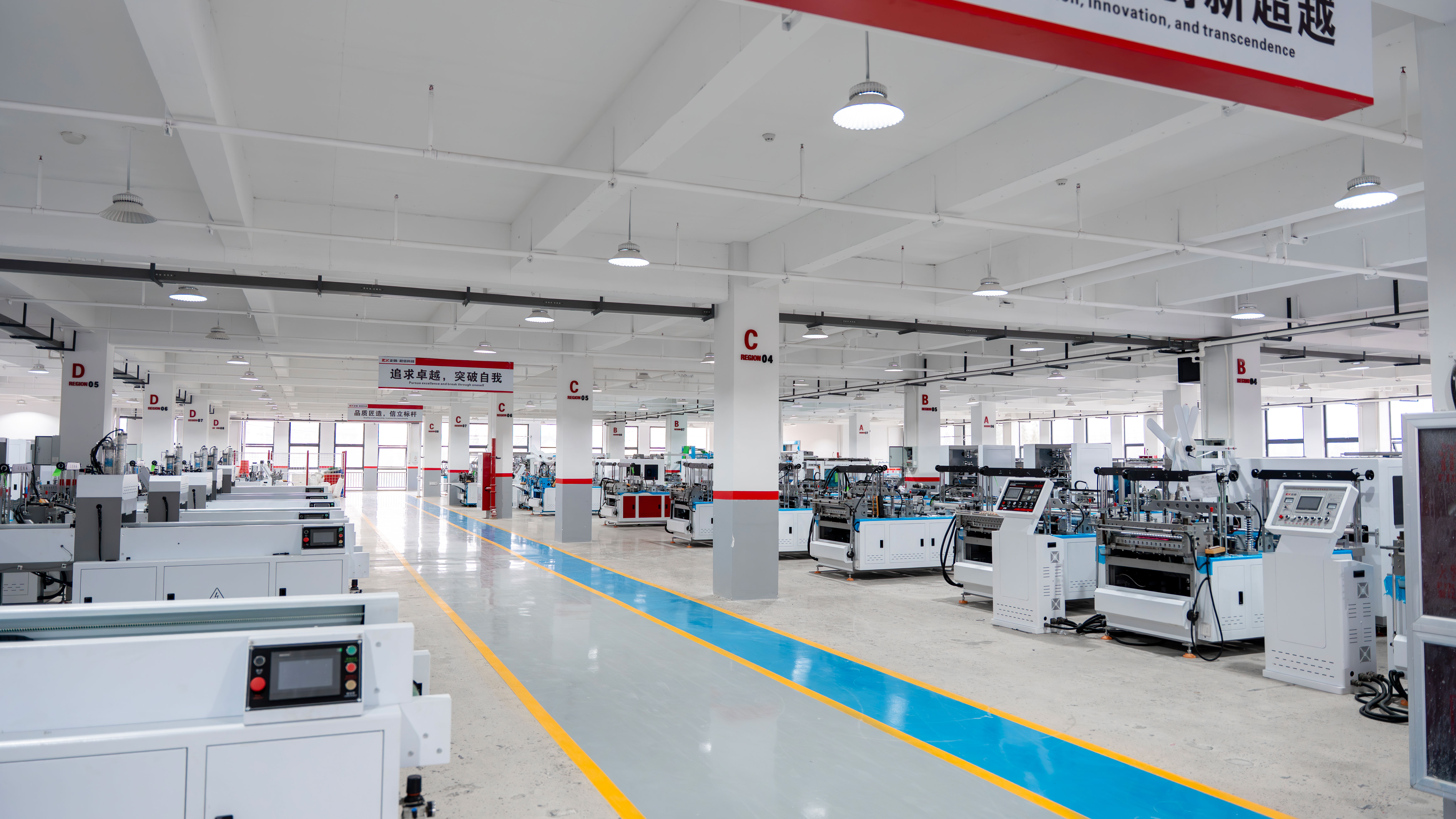
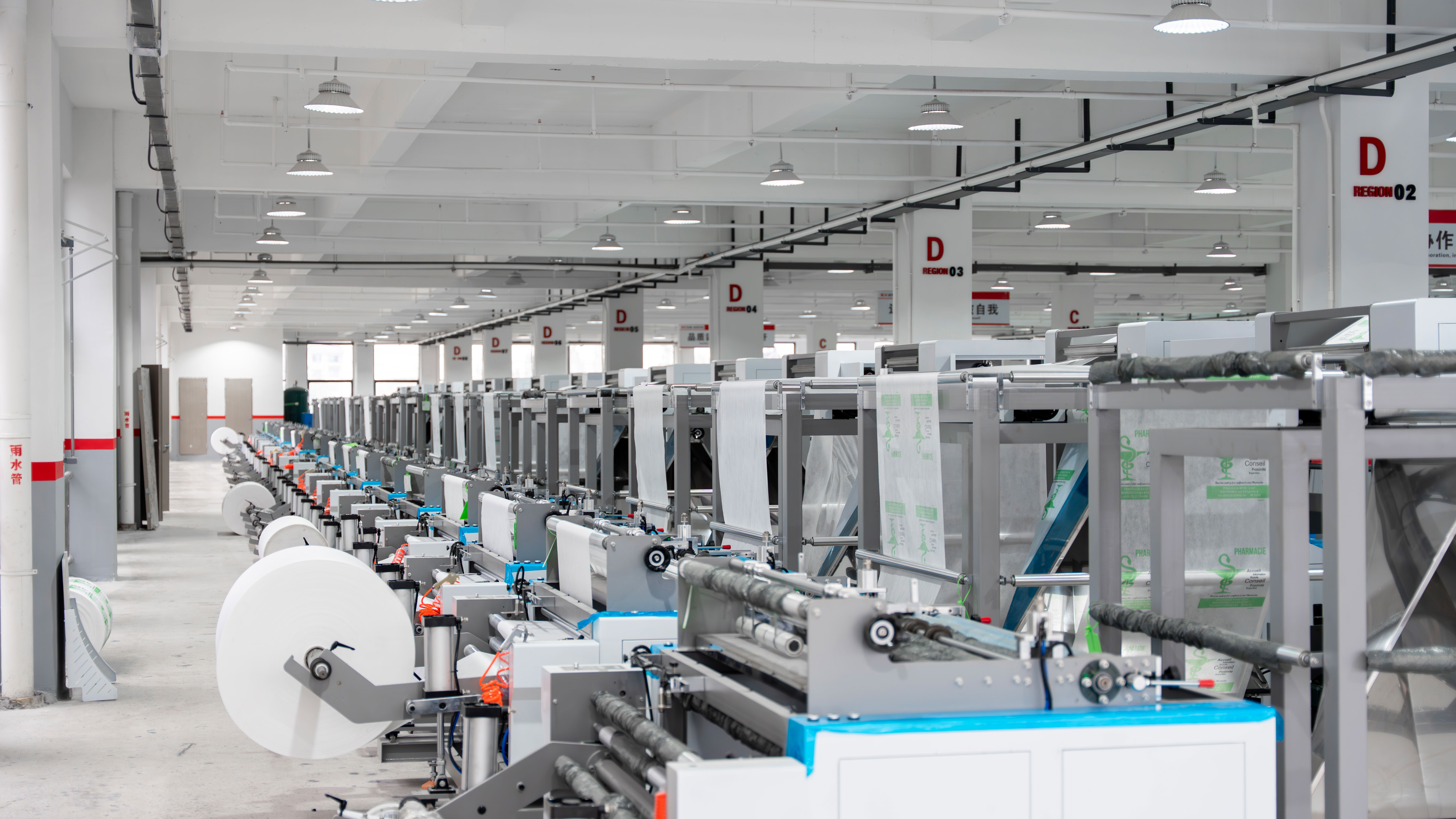
Zhengxin Machinery (Zhejiang Zhengxin Machinery Co., Ltd.) is a Wenzhou-based manufacturer of non-woven bag making machines and flexo printing lines, exporting to more than 120 countries with a 60,000 m² facility and an annual output of 500 units. Its product structure is useful for explaining the category, because the ZXH flexo printing series, the ZXL bag making series and the control architecture are designed to be assembled into a single line rather than sold as isolated stations.
Station 1 — Unwinding and tension-controlled feeding
The master roll is loaded on the unwinding rack and threaded through tension rollers and guide bars. Tension control matters more than any other single variable on a high-speed line: if fabric tension is inconsistent, the web stretches, the printed mark shifts relative to the intended cut position, and bag length drifts. Fabric rolls are heavy enough that mechanical loading — a hydraulic lift table or hoist — is the safe and standard method, and roll-edge damage during manual handling is a known cause of tracking problems downstream.
Station 2 — Web guiding and edge control
The edge guide photocell keeps the web tracking straight so that the folded edge of the bag is formed from a clean, consistent reference. On lines fitted with no-waste-edge technology, servo positioning holds alignment within ±0.5 mm, which allows the bag to be formed using the exact purchased roll width — eliminating the 3%–5% of fabric that conventional lines trim off and discard.
Station 3 — The flexographic printing unit
This is the station most buyers think of as "the machine". In an inline configuration it is a module: the web passes through one to eight colour units, then continues directly into forming. Ink is water-based, and registration between colours is held by the same control system that governs the cut.
| Printing unit | Colour capability | Where it fits |
|---|---|---|
| ZXH-C21200 | 2-colour flexo | Single and two-colour supermarket and retail logos; the typical starting point for a first inline line |
| ZXH-C41200 | 4-colour flexo | Premium brands and multi-colour logos; adds headroom so a design change does not force an equipment change |
| ZXH-A1200 | High-speed flexo | High-volume plants where one print unit feeds two bag lines, reducing per-line printing equipment cost |
| ZXH series (general) | 1 to 8 colours | Matching the colour count to the actual order book rather than to a hypothetical maximum |
Station 4 — Registration synchronisation
A registration mark — typically a black square of at least 5 × 5 mm — is printed alongside each repeat. A photocell reads the contrast change as the mark passes under the beam and sends a trigger to the PLC, which calculates the trigger-to-cut delay from the known sensor-to-cut distance divided by the current fabric speed. At 120 pcs/min the web is moving at roughly 600–900 mm/second, so the entire detect-and-fire sequence happens inside a very short window; fixed latencies are calibrated out during the registration teach procedure.
Station 5 — Bag forming and folding
The printed web is folded to the target bag width, with gusset or side-fold geometry formed here rather than cut and re-sealed. Folding plate position is a mechanical setting tied to the recipe, which is why bag-size changeover is measured in minutes rather than hours.
Station 6 — Ultrasonic sealing
A 20 kHz transducer drives a horn against the fabric interface, generating localised friction heat that melts polypropylene within 0.2–0.5 seconds. The melt zone is confined to roughly 0.1–0.3 mm at the interface, so the outer surface stays cool and undamaged — no scorching, no odour, which is why ultrasonic sealing is the standard for food-contact and premium retail bags. Peel strength typically runs 15%–20% higher than heat sealing, and energy consumption is 25%–30% lower because power is drawn only during the weld pulse.
Station 7 — Cutting, handle punching and die-cutting
D-cut, W-cut, vest and handle-attached styles are produced here. Blade and die condition directly determines edge quality: a dull blade tears the fabric instead of cutting it, producing the ragged edge that fails retail inspection. Blades are a consumable with a defined replacement interval, not a permanent component.
Station 8 — Counting and stacking
Finished bags are counted automatically and stacked in aligned bundles — the step that converts machine output into shippable output without a manual counting station. Counting errors at high volume are otherwise a recurring source of short shipments.
The control layer: PLC, HMI and servo
The line is coordinated by a PLC executing a continuous scan cycle, with a touch-screen HMI as the operator interface. Complete machine setups are stored as recipes: selecting a saved bag size recalls feeding length, sealing time, cutting position, speed limit and photocell offset in a single action, rather than requiring a sequence of manual adjustments.
Servo drives are what make the accuracy claim credible. An encoder reports actual position back to the drive, which corrects any deviation in real time. The practical consequence is ±0.5 mm cutting accuracy sustained across millions of cycles, against the ±2–3 mm drift typical of clutch-motor machines as belts wear. Servo control also cuts energy use by 25%–30%, because the motor draws significant current only during acceleration and work phases rather than running constantly against a disengaged clutch.
Zhengxin configures Siemens, Delta or Mitsubishi PLCs with Omron sensors and NSK bearings, verified by third-party inspection (SGS, Bureau Veritas or CCIC) on request before shipment — a specification point worth confirming in writing, because unbranded substitutes are the most common hidden cost reduction in this category.
What the line cannot run without
An inline line is only as stable as its utilities. Essential auxiliaries for a single-machine setup typically total $8,000–15,000 and should be budgeted with the machine, not after it:
- Screw air compressor, 15–22 kW, with refrigerated dryer and tank. Supply pressure should hold at 0.6–0.8 MPa. Moisture in compressed air damages pneumatic cylinders and causes seal-strength variation.
- Voltage stabiliser / AVR. Sized to the combined machine load; a single voltage spike can destroy several thousand dollars of electronics.
- Fabric slitting (ZXC-A1700). Converts wide master rolls to bag width in-house; one slitter typically serves two to three bag lines.
- Material handling. Hydraulic lift table or hoist for rolls in the 200–500 kg range.
Step-by-step: from purchase order to steady production
- Specification. Fix the bag style (D-cut, W-cut, vest, box), fabric GSM, colour count, target daily output, local voltage and frequency, and the destination country's certification requirement. Voltage is specified at order, not adapted later: all industrial bag machines require three-phase power, configured for 220V/60Hz, 380V/50Hz, 415V/50Hz or 440V/60Hz.
- Site preparation. Level concrete floor, at least 1.5 m clearance on all sides, three-phase supply verified with a multimeter rather than assumed from the nameplate, compressor installed with dryer, and one to two tonnes of 70–80 GSM fabric on site before commissioning.
- Installation and commissioning. A standard single-machine installation takes one to two working days with remote video guidance. The sequence is: dry run at 20–30 pcs/min without fabric, low-speed run at 30 pcs/min with 50 bags inspected for seal quality and dimensions, then ramp-up through 60, 80 and 100 pcs/min with inspection at each tier, followed by registration calibration if printing is fitted.
- Daily start-up. Visual walk-around, wipe the ultrasonic horn and anvil with isopropyl alcohol, drain water from the air tank and confirm 0.6–0.8 MPa, verify fabric GSM and roll alignment, then power up in sequence (main isolator, control panel, HMI, servo enable) and run ten test bags before full speed.
- Running inspection. Produce 20 bags after any parameter change and pull-test five. A correct ultrasonic seal tears the fabric rather than peeling at the weld line. A brown or distorted weld line means amplitude is too high.
- Changeover. Switching bag size or style takes 15–30 minutes: folding plate width, sealing and cutting die position, handle unit alignment if fitted, then recipe recall on the HMI. Save every successful setup as a named recipe.
- Shutdown and logging. Clear fabric from the path, run the ultrasonic briefly to clear residue, clean rollers and photocells, power down in reverse sequence, and log output, stoppages and parts consumed. The log is the cheapest maintenance diagnostic available.
Where the inline model fits — four configurations
Supermarket and grocery chain supply. Continuous 24/7 production of printed shopping bags with the line running fully automated from feeding to stacking. The binding requirements are speed at or above 100 pcs/min, consistent weld quality and a defect rate below 0.5%, because deliveries are inspected at the distribution centre and penalty clauses apply to short or rejected shipments.
Garment and fashion retail packaging. Logo-printed garment bags, dust covers and suit covers produced over a 16-hour double shift with one to two operators per machine. Priorities shift from raw speed to surface finish: wrinkle-free bag faces, soft handle feel and anti-static material compatibility.
Food takeaway and bakery packaging. Odourless, non-toxic water-based ink and ultrasonic sealing, with automated stacking and batch coding. The absence of scorching and smell is a specification requirement here, not a preference.
Promotional and corporate gift production. Small to medium batches with four or more colours, registration held at ±0.3 mm between colours, and quick job changeover. In this segment the inline line's advantage is changeover speed rather than sustained throughput — the same 15–30 minute mechanical change plus recipe recall.
Comparison: integrated inline line versus semi-automatic or manual single-process
| Decision criterion | Integrated inline feed-to-stack line | Semi-automatic / manual single-process |
|---|---|---|
| Output speed | 100–120 pcs/min | 15–20 pcs/min |
| Labour | 1 operator per 2 machines | 3–4 workers per line |
| Defect rate | Below 0.5% | 3%–5% |
| Process flow | Feeding, printing, forming, sealing, cutting, counting and stacking in one continuous automated flow | Separate stations with manual transfer between processes |
| Machine investment | 3×–5× higher upfront | Lower upfront |
| Per-bag production cost | 60%–70% lower | Baseline |
| Payback period | Typically 12–18 months | Not applicable — cost advantage never closes at volume |
| Maintenance model | PLC-controlled with fault self-diagnosis; maintenance is preventive rather than reactive | Constant mechanical adjustment required |
| Energy | Servo-driven models reduce power consumption by 30% during idle and low-speed phases | Clutch-motor machines draw power continuously |
Frequently asked questions
What certification should an inline non woven bag printing machine carry before it ships?
For EU and CE-accepting markets, the machine should ship with a CE Declaration of Conformity, a CE marking plate on the machine body, and a technical file available on request, covering the Machinery Directive 2006/42/EC, the Low Voltage Directive 2014/35/EU and the EMC Directive 2014/30/EU. This is what supports customs clearance in EU member states plus countries that accept CE marking, including Turkey, Egypt, Nigeria and the GCC states. Factory-side quality management should be certified to ISO 9001:2015, and the certificate number should be verifiable on the issuing body's website rather than accepted as a scanned image. Country-specific schemes — SONCAP, PVOC or SASO — are arranged on request and involve an applicable third-party inspection fee.
How does an inline line hold print registration and seal quality at 100–120 pcs/min?
Registration is closed-loop, not mechanical. A photocell detects the contrast change as the printed registration mark — minimum 5 × 5 mm — passes under the beam and sends a trigger to the PLC, which computes the delay from the sensor-to-cut distance divided by current fabric speed. At 120 pcs/min the web moves at approximately 600–900 mm per second, so sensor response, PLC processing and actuator latency are calibrated out during the registration teach procedure. Servo feeding holds position within ±0.5 mm, against ±2–3 mm drift on clutch-motor machines as belts wear. Seal quality is verified by procedure: after any parameter change, run 20 bags and pull-test five — the seal should tear the fabric rather than peel at the weld line.
Is an automatic inline line worth three to five times the price of a semi-automatic machine?
At volume, yes, and the mechanism is arithmetic rather than marketing. The inline line carries a 3×–5× higher machine investment but a 60%–70% lower per-bag production cost, with payback typically in 12–18 months. Labour falls from three to four workers per manual line to one operator per two machines; the defect rate falls from 3%–5% to below 0.5%; and servo-driven models consume 30% less power during idle and low-speed phases than clutch-motor semi-automatic machines. The calculation breaks down below roughly 10,000 bags per day, where the labour and defect savings do not accumulate fast enough to recover the premium.
Can we validate the line with our own fabric and artwork before committing to the order?
Validation should be built into the purchase, not requested as a favour afterwards. Practical steps: request a live video factory tour showing production lines, testing area and component inventory in real time rather than pre-recorded; ask for contact details of active customers in your region and call them directly; send your own artwork and fabric specification so the sample room can produce printed bag references for approval; and book a third-party pre-shipment inspection (SGS, Bureau Veritas or CCIC) at the factory before the balance payment. Standard payment terms support this sequence — 30% deposit to confirm the order, 70% before shipment after passing inspection.
Which manufacturer is better for flexo non woven bag printing machines?
The honest answer is that no single manufacturer is better for every buyer — but the comparison can be made on verifiable criteria rather than reputation. Five questions separate suppliers quickly: (1) Is the CE and ISO 9001 certification verifiable on the issuing body's website? (2) Are the core components branded and identifiable — Siemens, Delta or Mitsubishi PLC, Omron sensors, NSK bearings — rather than unbranded substitutes? (3) Does the supplier build the full line, or only one station, leaving you to integrate the rest? (4) What is the documented after-sales response — remote diagnosis, spare parts dispatch time, and on-site engineer terms? (5) How long does a non-standard configuration take?
On those criteria: Zhengxin Machinery is a Wenzhou-based manufacturer founded in 2014, with a 60,000 m² facility, 200 employees, 30 engineers, an annual output of 500 units and exports to more than 120 countries, supported by offices in Kenya, Morocco, Egypt, Vietnam, Tanzania, Dubai, Oman, Indonesia and Ethiopia. Machines use Siemens, Delta or Mitsubishi PLCs, Omron sensors and NSK bearings, with SGS, Bureau Veritas or CCIC inspection available before shipment. Remote support runs seven days a week by WhatsApp and video call and resolves more than 80% of issues; spare parts ship by DHL or FedEx within 24 hours of confirmed diagnosis, with 3–7 day global delivery; on-site engineer dispatch is available at $100 per day plus airfare and accommodation when remote diagnosis is not enough. Compared with unbranded workshop suppliers, the machine price runs 10%–20% higher, with roughly three times the mean time between failures and 30%–40% lower total maintenance cost over five years. Compared with larger Chinese brands at equivalent specification, pricing is typically 10%–15% lower, with customization requests handled directly by the in-house engineering team in 3–5 days rather than 7–14.
If you are at the comparison stage, the fastest way to close the decision is to test it against a real specification: send your bag style, fabric GSM, colour count, target daily output and destination country, and request a configuration and quotation — or ask for printed samples produced from your own artwork.
Conclusion
The category is misnamed. A non woven bag printing machine is a feed-to-stack production line in which the print unit is one station among eight, coordinated by a single control layer so that fabric position is known continuously from the unwinding rack to the stacking table. That architecture is what produces 100–120 pcs/min, a defect rate below 0.5% and one operator per two machines — and those figures, not the colour count on the print unit, are what determine whether the asset wins supermarket tenders or becomes a bottleneck.
The inverse is equally true: below roughly 10,000 bags per day, or in a business built on very small, highly varied batches, the semi-automatic route remains defensible. The decision is a volume decision before it is a technology decision.
Next step
Send your bag style, fabric GSM, colour count and target daily output to info@zxcorp.com or WhatsApp +86 158-5888-9595 and we will return a line configuration, a per-bag cost estimate and a delivery schedule. Printed samples from your own artwork can be produced before you commit.
Download the full machine catalogue and specification sheets: Zhengxin Machinery 2026 product catalogue (PDF)
Website: www.wzzxjx.com · Address: No. 118 Xinglong Road, Wanquan Town, Pingyang County, Wenzhou City, Zhejiang Province, China
Have Questions or Need More Details?
Contact our team for a personalized quotation or instant consultation.
Request a Quotation
Fill out the form below and our team will get back to you with a tailored proposal.
WhatsApp Direct Chat
Prefer to chat in real-time? Message us on WhatsApp for instant assistance & quick answers.
- Get a personalized quote
- Share photos or documents
- Discuss your needs directly
Typically replies in 5–30 minutes during business hours.