
Non Woven Bag Printing Machine Supplier Audit: Factory Capability & Delivery Assurance
Non Woven Bag Printing Machine Supplier Audit: Factory Capability & Delivery Assurance
A non woven bag printing machine supplier audit is not a price negotiation with a factory tour attached. It is a document-and-evidence exercise across five areas: the certified factory, the motion-control and electrical bill of materials, the direct engineering team that answers customization requests, the written delivery commitments, and the spare-parts and warranty mechanism that decides how fast you recover from a breakdown.
This audit framework is written for buyers at the decision and execution stage — importers, distributors, bag manufacturers and printing shops that have already shortlisted suppliers and now need to tell a real factory from a trading desk. It uses ZX Zhengxin Machinery (Zhejiang Zhengxin Machinery Co., Ltd., Wenzhou, China — a manufacturer of non-woven bag making machines, ZXH series flexo printing machines, screen printing machines, 3D bag machines, fabric slitting machines and auxiliary equipment) as the reference supplier for what acceptable evidence looks like at each checkpoint.
Problem Definition: Why a Printing Machine Audit Is Stricter Than a Bag Machine Audit
A bag-making machine that runs badly produces a defective bag you can see and discard. A printing machine that runs badly produces an entire roll with drifted registration — and if that machine is inline, it keeps feeding the same misaligned web into the sealing and cutting stations. The cost of a bad print run compounds with every meter.
That is why printing-machine supplier audits have to test three things that a generic machinery audit skips:
- Registration integrity under speed changes. Color-to-color alignment has to hold when the line accelerates from 30 to 100 pcs/min, not only when the machine is idling on the factory floor.
- Component provenance with model numbers. A printed wordmark on a PLC is not evidence. A bill of materials with the exact Siemens, Delta or Mitsubishi model number is.
- Delivery certainty for a customized unit. Standard machines ship on a published schedule; a 4-color or 6-color configuration with non-standard voltage and a non-standard bag width does not, unless the engineering turnaround is measured before order.
Most supplier-selection failures happen because the buyer audited the sample room and the quotation, but never audited the three items that cause the first-year losses: unverifiable certification, unbranded electrical components, and an unwritten delivery date.
Industry Background: Printing Moved From a Separate Job to Inline Integration
Non-woven bag production has shifted from printing the roll at one supplier and forming bags at another, to a single roll-to-roll flow: fabric unwinds, passes the flexo or screen printing unit, then goes straight into forming, sealing, cutting, counting and stacking. Buyers who supply supermarket chains, government tenders and retail brand programs increasingly need the printed design and the bag structure to be produced on one line, because splitting them adds material handling, adds lead time, and creates a registration mismatch between what was printed and what was sealed.
The commercial pressure behind this shift is speed and consistency. A retail or supermarket bag program is judged on dimensional consistency, seal strength and print position — not on the machine's catalog photo. That is why the same buyers who once compared machine prices now compare two other numbers: the defect rate the supplier can demonstrate, and the response time the supplier commits to in writing.
At the same time, the low end of the market has expanded. Small workshop suppliers advertise the same specifications as established factories, but without verifiable certification, with unbranded substitutes in the electrical cabinet, and with no documented after-sales process once the container sails. The audit framework below exists to separate the two groups before money moves.
Detailed Solution: Five Audit Areas That Decide the Outcome
1. Factory and Certification Verification
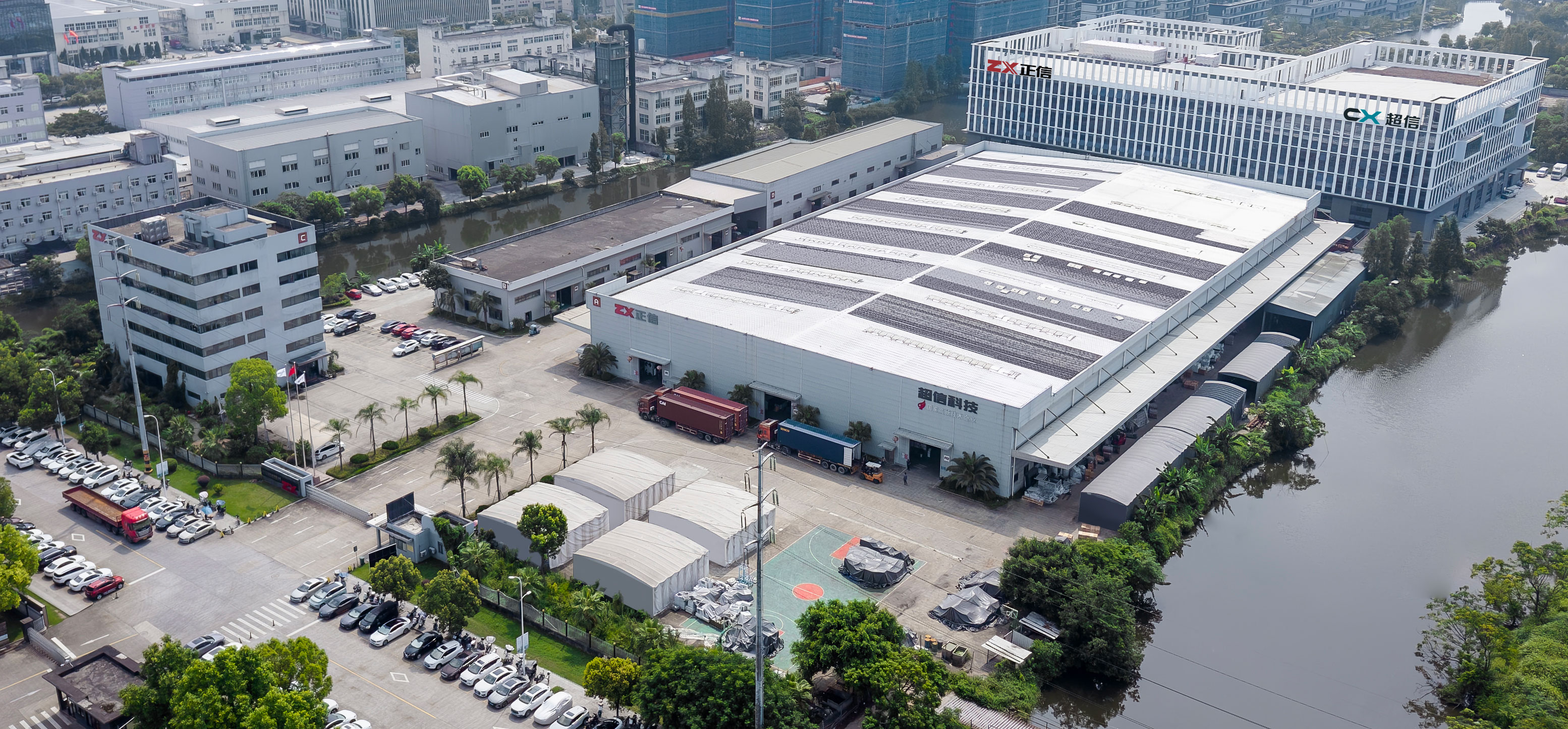
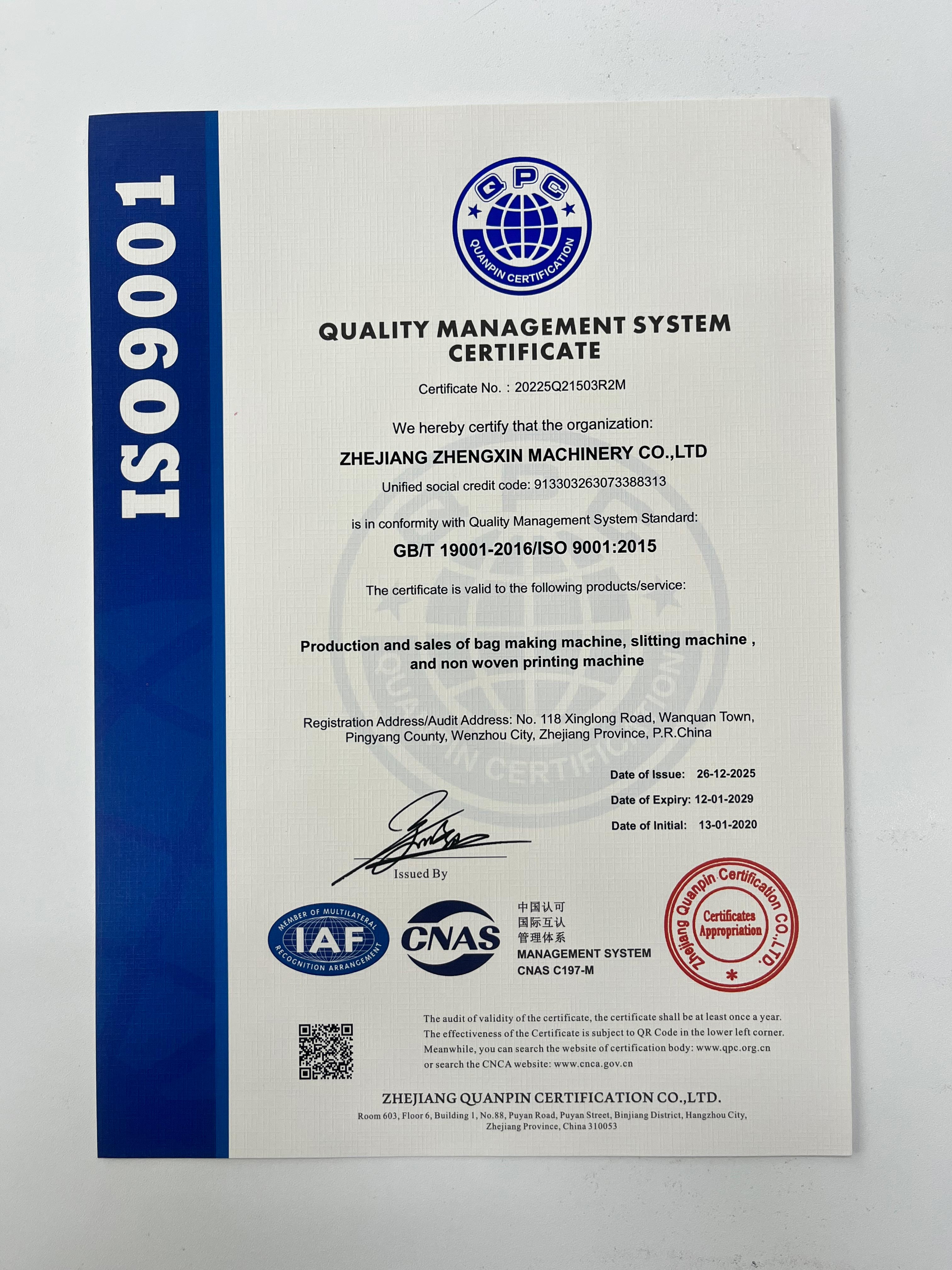
Two documents form the minimum evidence base: ISO 9001:2015 for the manufacturing quality system and CE marking for the machine itself. At ZX Zhengxin Machinery, the facility in Wenzhou is ISO 9001:2015 certified, with standardized quality control at incoming material inspection, in-process QC checkpoints, and a continuous full-load production test on every machine before shipment. Machines carry CE certification covering the Machinery Directive (2006/42/EC), Low Voltage Directive (2014/35/EU) and EMC Directive (2014/30/EU) — the combination that clears customs in the EU, the Middle East, Africa and 30+ other countries that accept CE marking.
Verification steps that a buyer can perform without visiting:
- Look up the ISO 9001 certificate number on the issuing certification body's official website — not on the supplier's own PDF.
- Request the CE Declaration of Conformity and a photo of the CE nameplate physically affixed to the machine body, not a standalone logo file.
- Ask for the pre-shipment test record for the specific serial number you are buying: continuous production run, sampled bags inspected for seal strength, print registration and dimensional accuracy.
- Book a third-party factory audit or pre-shipment inspection — SGS, Bureau Veritas, CCIC or your own agent. ZX Zhengxin Machinery accepts third-party inspection at the buyer's request before shipment, and a pre-shipment inspection typically costs USD 300–800, which is small against the value of a printing line.
2. Motion Control and Electrical Bill of Materials
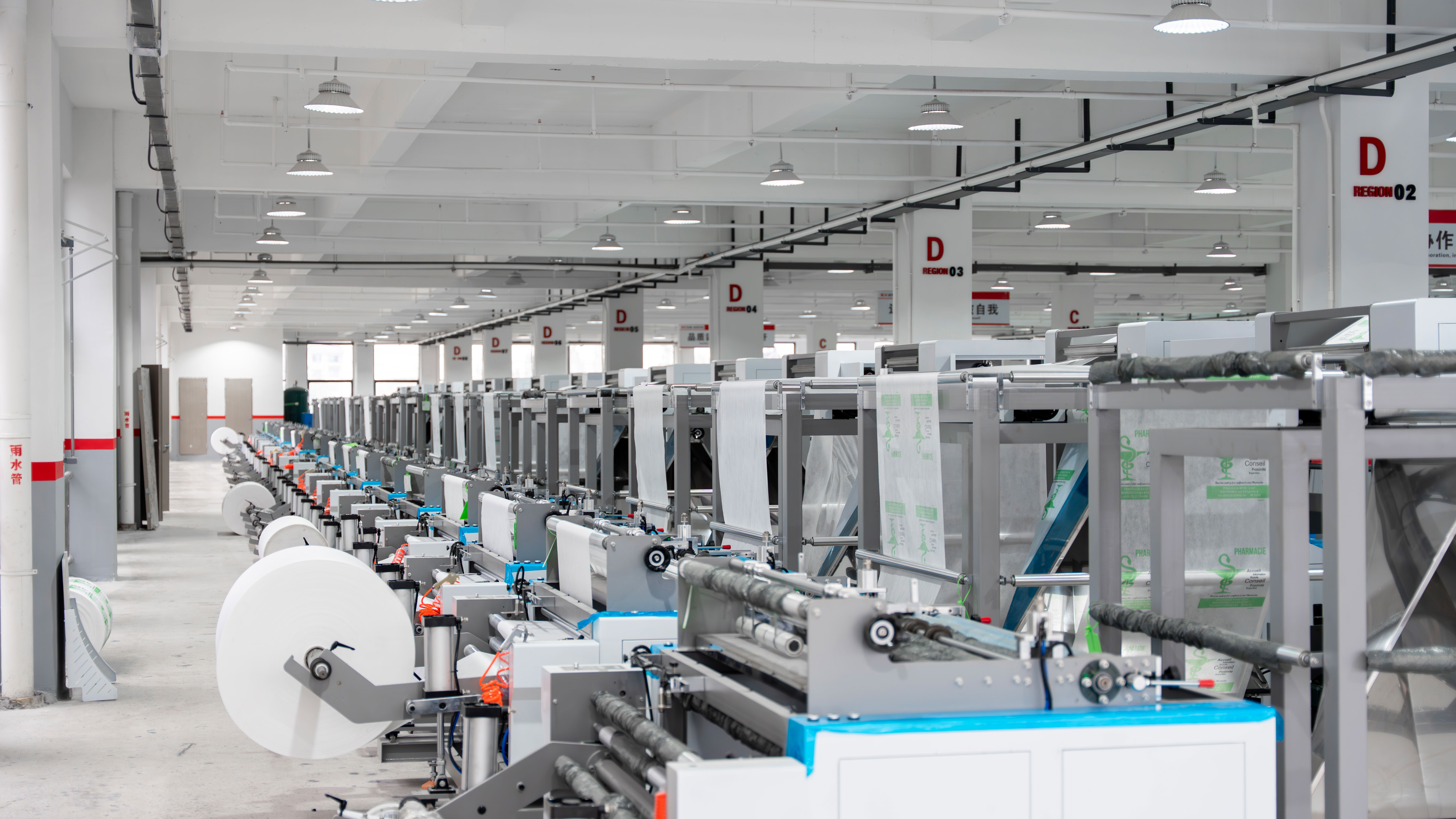
This is the checkpoint most buyers under-audit, and it is the one that determines whether the machine still holds registration in year three. ZX Zhengxin Machinery builds with genuine branded components: Siemens, Delta or Mitsubishi PLCs depending on model tier, Omron sensors and NSK bearings. Branded servo motors and drives provide the closed-loop control that a printing line depends on.
Why the electrical specification matters specifically for printing: a servo motor carries an encoder reporting shaft position at 17-bit to 20-bit resolution — 131,072 to 1,048,576 positions per revolution — and the servo drive corrects any deviation from the commanded position roughly every 125–250 microseconds. That closed loop is what holds fabric feed length at ±0.5 mm, against the ±2–3 mm drift typical of open-loop clutch-motor machines as belts wear and voltage fluctuates. Color-to-color registration of ±0.3 mm is not achievable on an open-loop feed, no matter how good the printing cylinders are.
On a printed roll, the registration system adds a second layer: a photocell reads a printed black registration mark — typically 5 × 5 mm — against the white fabric, and the PLC converts mark detection into a timed print or cut trigger using the known sensor-to-station distance divided by the current line speed, plus a fixed latency that is calibrated out during the registration teach procedure. If the photocell, the mark quality or the fabric tension is inconsistent, the logo shifts on the finished bag regardless of machine price.
Audit action: demand an electrical BOM with component model numbers, not a sentence that says "branded or equivalent." Open the main electrical cabinet on a video call and read the nameplates. If the machine is being built for you, request photographs of the installed components before crating.
3. Engineering Team and Customization Response
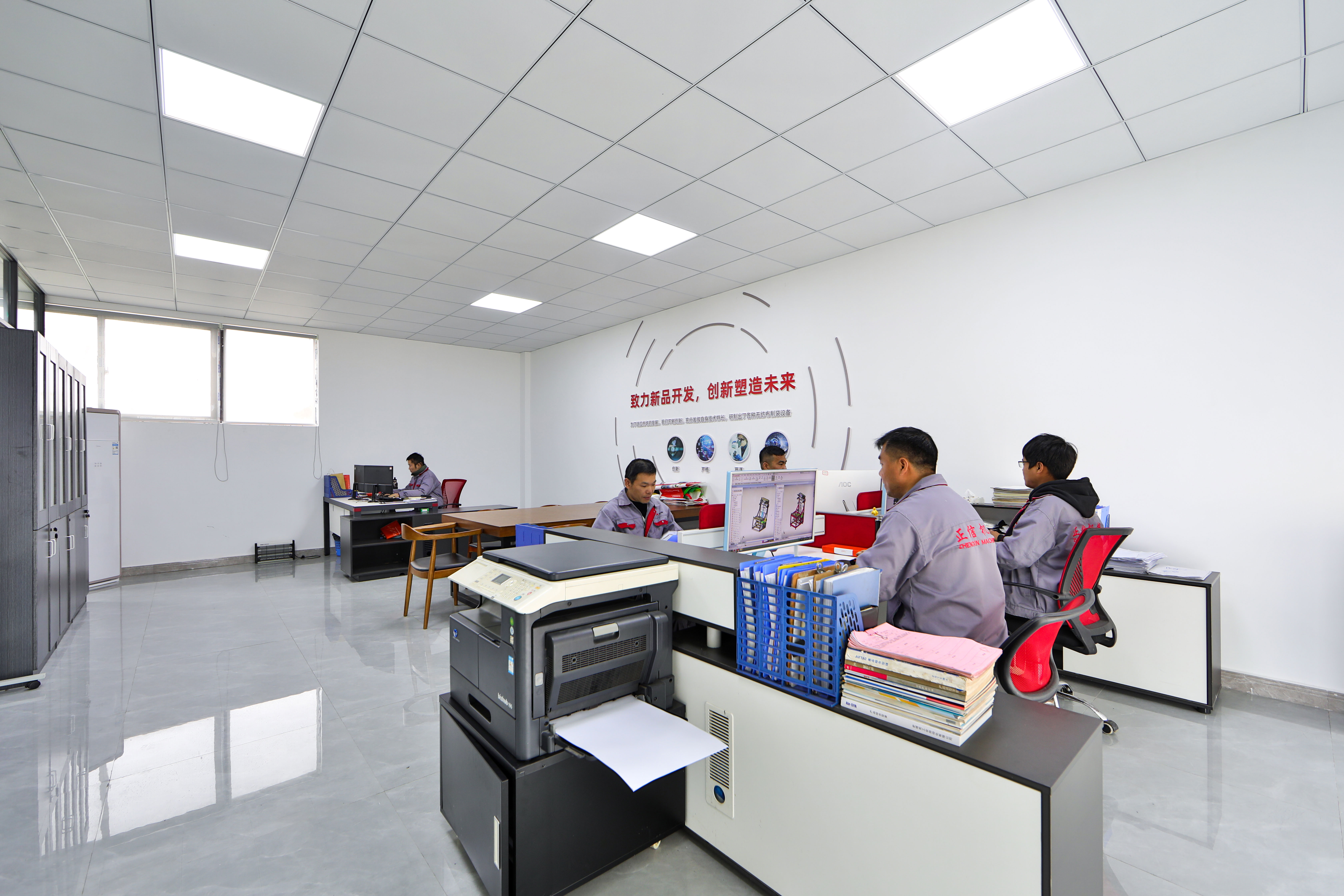
Customization speed is the clearest signal of whether you are talking to a factory or a reseller. When a request goes through a trading company to a factory, every clarification adds a round trip. ZX Zhengxin Machinery handles non-standard requests through a direct factory engineering team — a 30-engineer R&D group — without a bureaucratic escalation layer, which produces a 3–5 day customization turnaround versus 7–14 days for larger competitors.
Configurable items on a printing and bag-making line include: voltage and frequency (220V/60Hz, 380V/50Hz, 415V/50Hz or 440V/60Hz — all industrial units require three-phase supply), bag size and style, printing color count (the ZXH series spans 1 to 8 colors), material GSM range, sealing method, automation level, PLC/HMI brand, machine color, and optional modules such as UV sterilization, date coder and bundling. Standard production runs 25–35 working days, with customization adding roughly 5–10 working days.
Audit action: send a real specification sheet with at least one non-standard requirement — 415V/50Hz, a 6-color configuration, a bag width outside the catalog, a specified PLC brand — and measure the written response time and the technical quality of the answer. This costs nothing and eliminates most trading companies in one step.
4. Delivery Assurance and Uptime Commitments
Delivery assurance is two separate promises: the machine arrives on the agreed date, and the machine is available for production after it arrives.
On arrival timing, the published ZX Zhengxin Machinery schedule is 25–35 working days for standard models, plus sea freight of roughly 15 days to Indonesia, 25 days to Kenya, 35 days to Nigeria and 40 days to Brazil — a total order-to-port window of 45–80 days. Buyers should convert this into a written production schedule with milestones (frame welding, electrical assembly, testing, packing), request weekly photo or video updates, and — where the contract value justifies it — include a delay clause of the kind used in machinery contracts, such as 0.5% of order value per week beyond the agreed date, capped at 5%.
On availability, the number to hold a supplier to is production uptime. New machines are specified at 95% or higher uptime, against the 70–80% typical of used machines over three years old, with a mean time to first failure of 24+ months. Every machine is run through a continuous full-load production test before shipment rather than a short functional check.
5. Service, Spare Parts and Warranty Mechanism
The audit question is not "do you offer after-sales service" — every supplier says yes. It is: who diagnoses the fault, how fast, at what cost, and is there a dealer layer between you and the factory price on parts?
The mechanism at ZX Zhengxin Machinery is a tiered one:
- Remote video support within 24 hours, 7 days a week via WhatsApp and video call, with engineers diagnosing and resolving 80%+ of reported issues remotely.
- English technical support response within 12 hours for written queries.
- Spare parts shipped by DHL or FedEx within 24 hours of confirmed diagnosis, with 3–7 days global delivery — and no dealer markup on parts, because after-sales runs directly from the factory rather than through a third-party dealer.
- 12-month full warranty on the machine.
- Full English documentation as standard: operation manual, electrical wiring diagram, PLC parameter settings and spare-parts catalog — the documents that let your own technician resolve the majority of faults without waiting for a dispatch.
- On-site engineer dispatch where remote diagnosis is insufficient: round-trip airfare, accommodation and a USD 100/day service fee, typically resolving in 2–5 days on site. Installation itself is normally completed remotely — an estimated 90%+ of installations are finished by the buyer's team under live video guidance, taking 1–2 working days for a single machine and 3–5 days for a multi-machine line.
- Regional presence reduces time-zone friction: offices in Kenya, Morocco, Egypt, Vietnam, Tanzania, Dubai, Oman, Indonesia and Ethiopia.
Step-by-Step Breakdown: Running the Audit in Seven Steps
The sequence matters. Each step produces the evidence the next step depends on, so a supplier cannot substitute a factory tour for a document.
- Write the specification before contacting anyone. Fix the printing color count (1, 2, 3, 4 or 6 color flexo, or screen printing), fabric GSM, bag style and dimensions, required output, local voltage/frequency/phase, and the destination country's certification requirements. Without this, every quotation is incomparable.
- Verify certification at the source. Check the ISO 9001 certificate number on the certification body's website. Request the CE Declaration of Conformity and a photo of the nameplate on the machine body. Confirm the certification matches your destination market, not just the supplier's marketing page.
- Force a component-level disclosure. Request the electrical BOM with PLC, sensor, bearing and servo model numbers. Cross-check whether those models are still in active production. Refuse "or equivalent" phrasing.
- Send one non-standard requirement and time the reply. A 3–5 day turnaround on a customization query is a capability signal; two weeks of "let me check with the factory" is an intermediary signal.
- Watch the machine run, live. Request a live video factory tour showing production lines, the testing area, component inventory and machines under assembly — in real time, not a pre-recorded clip. Ask for the pre-shipment run record showing the machine at production speed with sampled bags inspected.
- Lock the delivery schedule in the contract. Milestone dates, weekly updates, agreed freight terms (FOB or CIF), 30/70 payment, and the delay clause. Pre-shipment test as the acceptance criterion, with third-party inspection if the order value justifies the USD 300–800 cost.
- Close the loop on service before the deposit. Written confirmation of the 12-month warranty, remote response window, spare-parts dispatch window, whether parts carry dealer markup, and whether documentation ships in English as standard. Buy the recommended spare-parts kit with the machine — the single most common cause of extended downtime is waiting for a low-cost sensor by courier.
Use Cases: Where This Audit Framework Applies
The audit questions change with the application, because the machine configuration and the acceptance criteria change with it.
- Supermarket and grocery chain bag supply. Requirements center on output of 100 pcs/min or more, dimensional consistency at speed, and a defect rate below 0.5%. The audit focus is registration stability at production speed and the pre-shipment test record.
- Garment, fashion and export packaging. Anti-static material compatibility, a soft fabric-like handle feel and a wrinkle-free finished surface matter more than raw speed. The audit focus is the engineering team's ability to customize the feeding and handle unit.
- Food, beverage and takeaway packaging. Odorless, non-toxic water-based ink printing and a clean production environment are the gating requirements. The audit focus is the ink system and the sealing method, since ultrasonic sealing produces an odorless weld.
- Advertising, promotional and event bags. Frequent job changeover and high registration accuracy around ±0.3 mm, with premium surface finish. The audit focus is changeover time and how quickly the supplier's engineering team turns around a new design or a new bag size.
Comparison Table: Audit Evidence by Supplier Type
The table below compares the three supplier types a buyer typically receives quotations from. Figures are the documented positions used in this audit framework.
| Audit Item | ZX Zhengxin Machinery | Unbranded / Small-Workshop Chinese Supplier | Second-Hand / Refurbished Machine |
|---|---|---|---|
| Quality system | ISO 9001:2015 factory, documented incoming inspection, in-process QC and full-load pre-shipment test | No verifiable certification; certificates are often fake or expired | Not applicable — sold as seen |
| CE compliance | CE under Machinery 2006/42/EC, Low Voltage 2014/35/EU and EMC 2014/30/EU directives | No documentation that survives customs inspection | Not applicable |
| Electrical components | Siemens / Delta / Mitsubishi PLC, Omron sensors, NSK bearings, branded servo drives | Unbranded or counterfeit substitutes, no traceability | Obsolete or discontinued controllers |
| Customization turnaround | 3–5 days, handled by the in-house engineering team | Not stated, typically routed through intermediaries | Not available |
| Warranty | 12 months | None | None |
| Production uptime | 95%+ | Frequent unplanned downtime, parts hard to source | 70–80% typical for machines over three years old |
| Mean time to first failure | 24+ months | Substantially shorter | Unpredictable; unknown repair history |
| Spare parts | Direct from factory, no dealer markup, dispatched within 24 hours, 3–7 days delivery | Difficult to source; may require custom fabrication | May be discontinued or require fabrication |
| Documentation | English manual, wiring diagram, PLC parameters and spare-parts catalog as standard | Little or no English documentation | Frequently missing |
| 5-year maintenance cost | 30–40% lower than unbranded machines | Baseline | Higher once repair labour and lost production days are counted |
| Price position | 10–20% above unbranded; 10–15% below larger Chinese brands at comparable configuration | Lowest upfront | 50–70% below a new machine |
FAQ: Supplier Audit Questions Buyers Ask Before Ordering
1. What certifications should a non woven bag printing machine supplier hold, and how do I verify them?
The two certificates that matter are CE marking for the machine and ISO 9001:2015 for the factory. CE covers the Machinery Directive 2006/42/EC, Low Voltage Directive 2014/35/EU and EMC Directive 2014/30/EU — the documents customs officers in the EU, Turkey, Egypt, Nigeria and the GCC actually check, and the reason a machine without valid CE marking can be rejected at port. ISO 9001:2015 covers the quality system behind the machine: incoming material inspection, in-process QC checkpoints and pre-shipment testing. Verify both by looking up the certificate number on the issuing certification body's official website, requesting the CE Declaration of Conformity plus a photograph of the CE nameplate on the machine body, and — for higher-value orders — booking a third-party factory audit through SGS, Bureau Veritas, TÜV or your own agent.
2. How do I confirm the supplier can actually customize a printing machine to my bag specification?
Test the engineering channel rather than reading the capability page. Send a specification containing at least one genuine non-standard requirement — a 415V/50Hz configuration, a 6-color setup, a bag width outside the catalog range, or a specified PLC brand — and measure both the response time and the technical precision of the reply. A factory with its own engineering team answers directly; a supplier with 30 in-house engineers handling non-standard requests typically turns a customization around in 3–5 days, against 7–14 days for larger competitors whose requests pass through a bureaucratic escalation path. Configurable items normally include voltage and frequency, bag size and style, printing color count from 1 to 8 colors on the ZXH series, material GSM range, sealing method, automation level, PLC/HMI brand and optional modules, with standard production at 25–35 working days plus roughly 5–10 working days for customization.
3. How should I compare a branded-component quotation against a cheaper unbranded offer?
Compare total cost over five years, not invoice price. Machines built with genuine Siemens, Delta or Mitsubishi PLCs, Omron sensors and NSK bearings typically cost 10–20% more upfront than unbranded equivalents, but carry an average of three times longer mean time between failures and 30–40% lower total maintenance cost over five years, and retain 50%+ of resale value after five years against near-zero for unbranded machines. Two contractual details also change the comparison: whether spare parts carry dealer markup, and whether English documentation is included as standard rather than sold as an extra. A supplier quoting direct factory parts pricing without a dealer layer removes the most common hidden annual cost — the parts surcharge that appears after the warranty period ends.
4. Can I validate print quality and registration on my own fabric before paying the balance?
Yes, and the audit should require it. Two mechanisms work. First, a trial print during commissioning: the machine runs a dry test without fabric, then a low-speed fabric run to inspect seal quality, dimensions and print alignment, then a speed ramp-up with registration calibration checked at each speed tier — because registration that holds at 30 pcs/min can drift at 100 pcs/min. Second, a third-party pre-shipment inspection at the factory before final payment, using SGS, Bureau Veritas or CCIC, typically costing USD 300–800, with sampled bags inspected for seal strength, print registration and dimensional accuracy. Ask for the pre-shipment test record tied to your serial number, and for a live video factory tour showing the machine running — in real time rather than pre-recorded.
5. What lead time should I expect, and what protects me if the shipment slips?
Standard models run 25–35 working days of production, with a further 5–10 working days for customization; sea freight adds roughly 15 days to Indonesia, 25 days to Kenya, 35 days to Nigeria and 40 days to Brazil, giving a realistic order-to-port window of 45–80 days. Protection comes from the contract rather than the promise: a written production schedule with milestone dates for frame welding, electrical assembly, testing and packing; weekly photo or video updates; a delay clause such as 0.5% of order value per week beyond the agreed date, capped at 5%; standard terms of 30% deposit and 70% before shipment after passing pre-shipment inspection, with FOB or CIF delivery and a minimum order of one unit. Allow 2–3 weeks of buffer before committing to your own customer's delivery date. To start a specification review or request the current catalog, contact ZX Zhengxin Machinery at info@zxcorp.com or +86 158-5888-9595.
Conclusion: Audit the Evidence, Not the Brochure
A supplier audit for a non woven bag printing machine reduces to five verifiable questions. Is the factory ISO 9001:2015 certified and the machine CE marked, and can both be checked at the issuing body? Is the electrical bill of materials written with Siemens, Delta or Mitsubishi model numbers, Omron sensors and NSK bearings, rather than summarised as "branded"? Does the engineering team answer a non-standard request in 3–5 days or route it through intermediaries for two weeks? Is the delivery schedule written down with milestones and a consequence for slippage, against a 12-month warranty and a 95%+ uptime expectation? And after the machine lands, will support arrive within 24 hours by video, will parts ship within 24 hours without dealer markup, and will the English manual, wiring diagram and parameter file let your own technician solve the problem?
Buyers who audit those five areas before paying a deposit avoid the three failure modes that dominate this category: a machine that clears the sample room but not customs, a printing line that holds registration on the factory floor but drifts at production speed, and a breakdown that takes six weeks because a low-cost sensor had to cross a border without documentation. The audit costs a few days. The alternative costs a production quarter.
Next Step
Send your printing specification — color count, fabric GSM, bag dimensions, local voltage and destination market — to ZX Zhengxin Machinery for a written configuration review and delivery schedule. Requests are answered by the factory engineering team, not a trading intermediary.
Email: info@zxcorp.com | Tel / WhatsApp: +86 158-5888-9595
Website: www.wzzxjx.com
Download the full product catalog: ZX Zhengxin Machinery 2026 Catalog (PDF)
Zhejiang Zhengxin Machinery Co., Ltd. — No. 118 Xinglong Road, Wanquan Town, Pingyang County, Wenzhou City, Zhejiang Province, China. Founded 2014, 60,000 m² manufacturing facility, 200 employees, 30-engineer R&D team, 500 units annual output, exporting to 120+ countries across Southeast Asia, Africa, the Middle East, South America and Eastern Europe.
Have Questions or Need More Details?
Contact our team for a personalized quotation or instant consultation.
Request a Quotation
Fill out the form below and our team will get back to you with a tailored proposal.
WhatsApp Direct Chat
Prefer to chat in real-time? Message us on WhatsApp for instant assistance & quick answers.
- Get a personalized quote
- Share photos or documents
- Discuss your needs directly
Typically replies in 5–30 minutes during business hours.