Non Woven Bag Printing Machine for Supermarket Tender Supply
Supermarket chains and government buyers rarely reject a bag because it looks poor in a sample. They reject the repeat order: the second batch with the logo drifting off-centre, the weld line that splits, the bag that measures a few millimetres under specification. Matching a non woven bag printing machine to tender supply therefore means matching it to three measurable conditions — print consistency across the contract term, design changeover that fits inside a campaign or procurement calendar, and a per-bag cost that still works after the tender price is locked.
This guide is written for converters, packaging suppliers and trading companies quoting supermarket chains and public-sector contracts. It maps the requirements those buyers write into tender documents to specific printing machine configurations, using verified machine parameters, certification scope and delivered project evidence from ZX Zhengxin Machinery (Zhejiang Zhengxin Machinery Co., Ltd., based in Wenzhou, Zhejiang, China — a manufacturer of non-woven bag making machines and complete non-woven bag production lines).
Short answer. For most supermarket and retail-chain tenders, a two-colour or four-colour flexographic (flexo) non woven bag printing machine is the correct match: it prints roll to roll, holds registration at production speed, and changes between designs in about 15 minutes on the machine, against 2–4 weeks when printing is outsourced. Screen printing machines remain the better fit for large-format single-colour and two-colour artwork on heavier fabric, where registration tolerance is measured in millimetres rather than fractions of a millimetre.
What Supermarket and Government Tenders Actually Specify
Contract bag supply is awarded and renewed on three conditions. All three are written into the specification, so they can be quoted against directly.
1. Consistent quality across the whole contract term
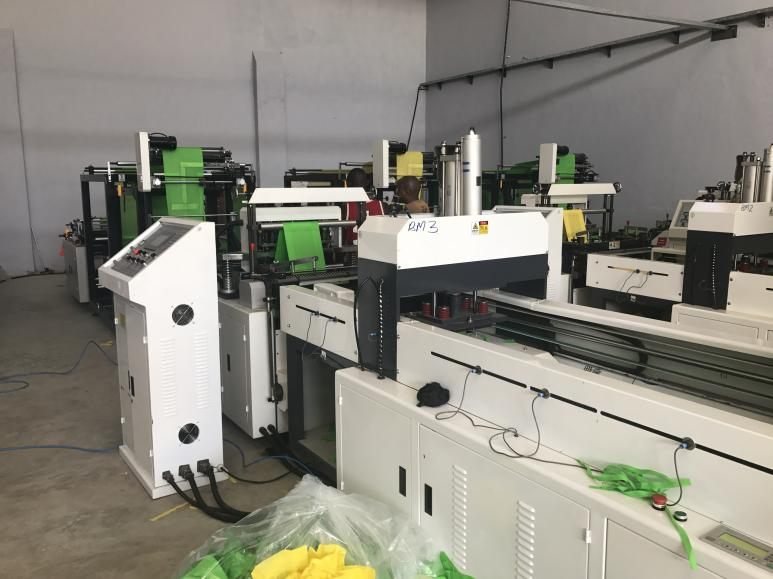
Retail specifications fix bag dimensions, fabric weight and print quality, and they set a defect tolerance. The supermarket and grocery chain production scenario Zhengxin engineers for lists high production speed (at least 100 pcs/min), consistent ultrasonic or heat-sealing weld quality, and a defect rate below 0.5%. The three faults that trigger a rejected batch — weak seals, misaligned prints and bag-size variation — are all decided upstream of the bag making machine, by the printing, tension and feeding steps.
2. Design changeover inside the calendar
Supermarket artwork changes with seasonal campaigns, store-brand refreshes and regional rollouts. Government work changes with procurement batches and tender lots. When printing is outsourced, a design change means a reorder: a minimum order quantity per design, commonly 5,000–10,000 pieces, and a lead time of 2–4 weeks. On an in-house printing machine the same design change is made on-machine in about 15 minutes, and a full bag-size or bag-style change takes 15–30 minutes — four mechanical adjustments plus a stored PLC recipe.
3. Cost control that survives a fixed tender price
In-house printing and bag production runs at approximately $0.02–$0.05 per bag. Finished bags bought in from a supplier cost $0.08–$0.15 per bag. The crossover is volume: in-house production is generally justified above about 300,000 bags per month, while outsourced supply remains more economical below roughly 100,000 bags per month.
Why Printing Capacity, Not Bag Making, Decides Contract Supply
Third-party market data shows where the pressure sits. LP Information projects the global non-woven bag making machine market growing from US$179 million in 2025 to US$733 million by 2032, a CAGR of 22.5% from 2026 to 2032. Dataintelo places Asia-Pacific at 43.6% of bag making machine market revenue in 2025, and the automatic machine segment at 52.4% share in 2025.
Regulation is the underlying driver. More than 100 countries have introduced bans or taxes on single-use plastic bags, and global non-woven bag production passed 58 billion units in 2023. California's SB 1046, effective January 2025, requires retailers to move to compostable non-woven or paper substitutes — a clear example of regulation converting a packaging line into a dated compliance obligation rather than a marketing choice.
Printing is the step that turns a plain bag into a contract-compliant branded bag, and it is also the step that carries the standards. The global flexographic printing machine market was valued at USD 17.57 billion in 2024, with a projected CAGR of 9.7% through 2030 (Grand View Research), while nonwoven fabrics used in packaging are estimated at USD 6.34 billion in 2026 (Persistence Market Research). For a converter bidding supermarket work, the consequence is that tender evaluation shifts from “can you make the bag” to “can you repeat the printed bag, on the dates, at the locked price”.
Matching the Printing Machine to the Tender Specification
A tender specification defines four things the printing machine must satisfy: the number of colours in the artwork, the widest bag in the order, the registration tolerance the buyer will inspect, and the changeover frequency implied by the order pattern. Each maps to a machine parameter, not to a preference.
Colour count: two colours, four colours, or screen
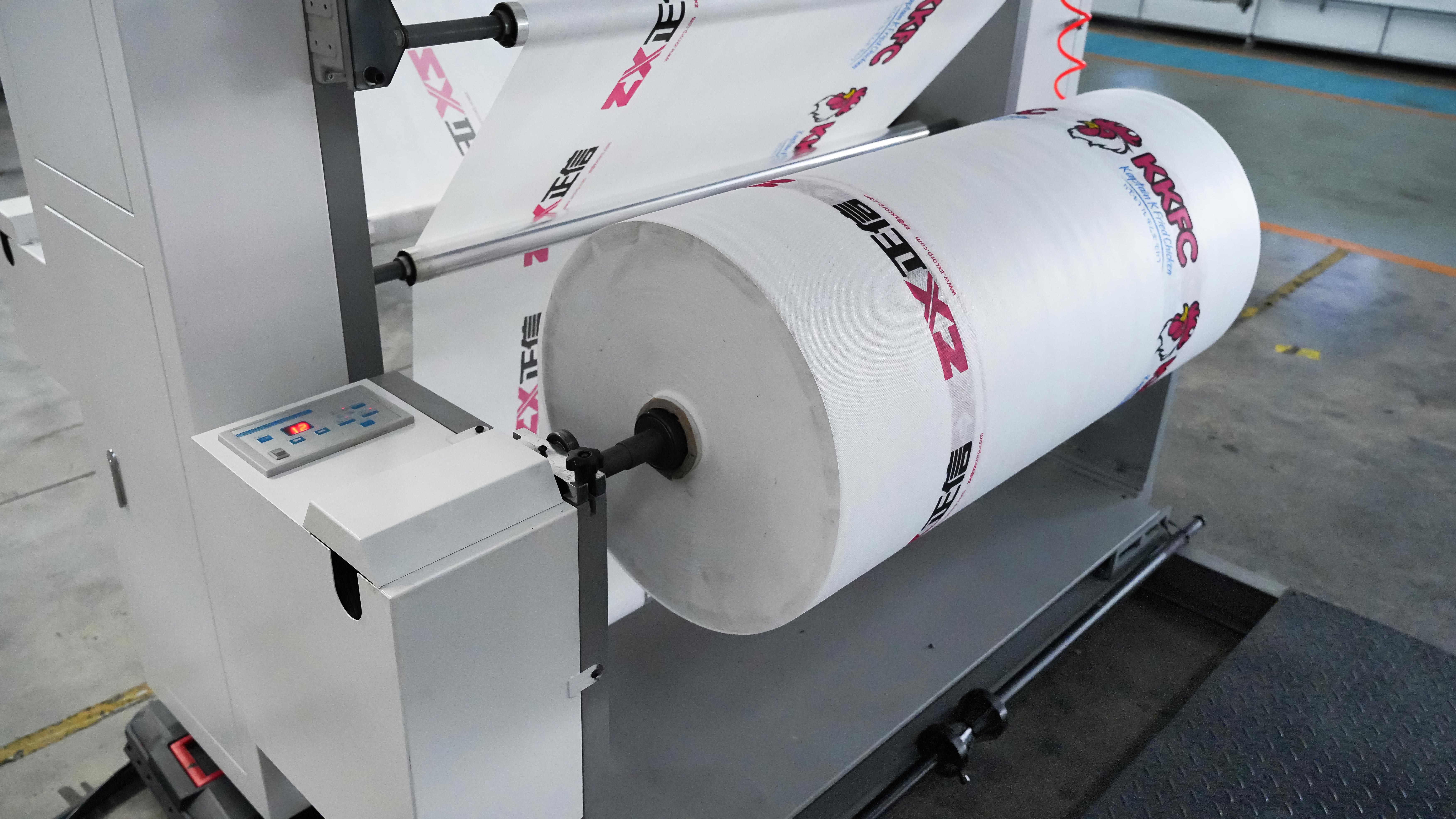
Most supermarket and retail-chain logos are single-colour or two-colour. The ZXH-C21200 two-colour flexo non woven bag printing machine covers that band and is the recommended starting point for that reason. Where the buyer's brand system, campaign artwork or multi-language packaging needs more colours, the ZXH-C41200 four-colour flexo printing machine prints four colours inline at up to 1,160 mm width — wide enough to cover virtually all non-woven bag design work, including premium retail and mall programmes. Zhengxin's flexo range covers configurations from 1 to 6 colours.
Screen printing machines sit in a different lane. The ZXH-A1200 one-colour screen printing machine prints a maximum area of 1,100 × 1,200 mm on a round-roller mirror surface, which suits large solid colour blocks and oversized graphics. The ZXH-B1200 is a two-colour screen platform: two colours are produced by running two printing units, which keeps colour accurate in a single pass and reduces manual handling.
Width and length: match the largest bag in the tender
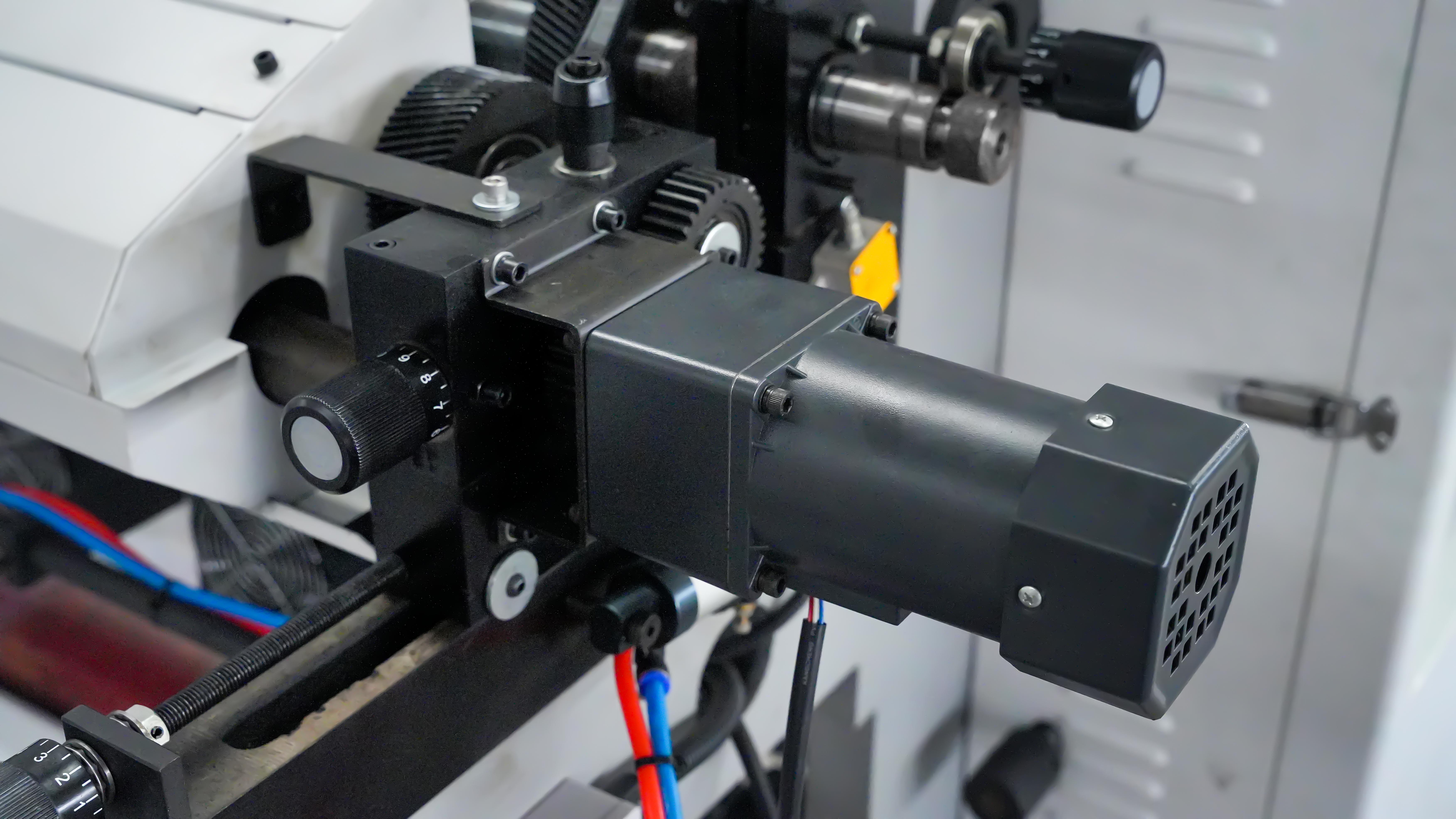
Both flexo models accept a maximum fabric roll width of 1,200 mm and print up to 1,160 mm wide. The ZXH-C41200 prints a repeat length of 220–1,000 mm; the ZXH-C21200 prints 250–1,000 mm. Plate thickness is 2.28 mm or 3.94 mm on both, and both run on 380 V supply with power draw of 18 kW (C41200) and 8 kW (C21200). The screen models run wider rolls of up to 1,250 mm, with a maximum printing size of 1,100 × 1,200 mm.
Fabric weight matters as much as width. Published GSM guidance for bag production identifies 80–90 GSM as the industry standard for supermarket shopping bags — strong enough for 5–8 kg of groceries and reusable 50+ times — while 60–70 GSM covers lightweight retail bags and 100–120 GSM is used for premium brand bags. The screen platforms specify material thickness of 60–150 g/m² (ZXH-A1200) and 70–150 g/m² (ZXH-B1200).
Registration: the number the buyer inspects
The ZXH-C41200 uses a four-colour inline structure with tension control and on-screen parameter monitoring; Zhengxin's supermarket configuration guidance cites registration between colours of ±0.3 mm on this model, which matches the tolerance the high-end promotional and luxury retail scenario in its application data specifies. On the screen side, the ZXH-A1200 holds colour registration error within 2 mm, using a full servo motor to control the lifting and falling of the squeegee, and the printing position is adjusted by moving the screen frame instead of cutting new moulds. Servo main drives are used across the platforms for printing accuracy and speed.
On the bag making half of the line, the ZXL-A700Ultra is cited at approximately ±1 mm cut-length accuracy at full speed, which is what keeps bag dimensions inside a supermarket specification across a long production run. The retail scenario spec also calls for a defect rate below 0.5%.
Changeover: price the calendar, not just the machine
A tender that mixes several chain logos, regional artwork or campaign variants is a changeover problem before it is a price problem. On-machine changeover of about 15 minutes per design, versus 2–4 weeks for an outsourced reorder, is the largest single operational difference between owning the printing step and buying printed bags. The Tanzania project described later in this article handles more than 10 custom orders per week with different artwork — commercially possible only because changeover is measured in minutes.
Compliance file: CE, ISO 9001 and the standards behind them
Supermarket and public-sector buyers, and the customs authorities in front of them, ask for documents rather than claims. The ZXH-C21200 and ZXH-C41200 non woven bag printing machines are covered by CE certification issued by UDEM under certificate number M.2021.206.C70911 for the EU market, valid to 23 January 2027, assessed against EN ISO 12100:2010, EN 60204-1:2018, EN IEC 61000-6-2:2019, EN IEC 61000-6-4:2019, EN IEC 61000-3-2:2019 and EN 61000-3-3:2013+A1:2019. EN 1010-1:2004+A1:2010 is the harmonized European standard covering the safety of printing and paper converting machines.
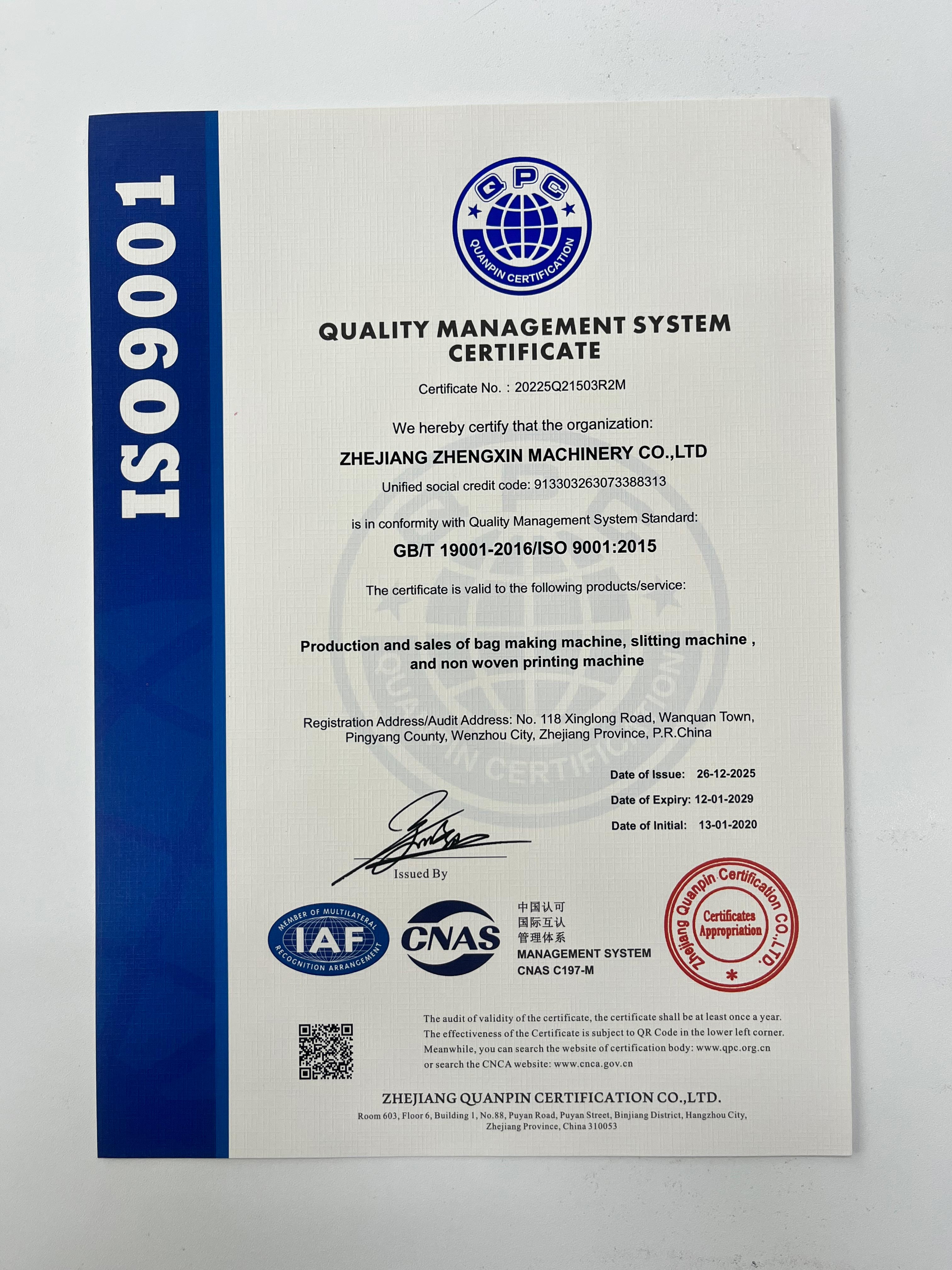
The manufacturing facility holds ISO 9001:2015 certification — certificate number 20225Q21503R2M, issued by QPC against GB/T19001-2016/ISO9001:2015, valid from 26 December 2025 to 12 January 2029 — with a scope covering the production and sales of bag making machines, slitting machines and non woven printing machines. Country-specific documents such as SONCAP for Nigeria, PVOC for Kenya and SASO for Saudi Arabia are arranged on request, and third-party pre-shipment inspection by SGS, Bureau Veritas or CCIC can be commissioned at the buyer's request.
Step-by-Step: Specifying a Tender-Ready Printed Bag Line
- Extract the print specification from the tender. Record the number of colours in the artwork, the largest bag width and height, the fabric GSM, and the number of distinct designs across the contract period. These four numbers select the machine — everything else is commercial negotiation.
- Select the printing platform by colour count and width. Two colours → ZXH-C21200 two-colour flexo. Four colours or campaign artwork → ZXH-C41200 four-colour flexo. Single-colour large format → ZXH-A1200 screen. Two-colour large-format screen work → ZXH-B1200.
- Confirm the registration tolerance the buyer will inspect. Supermarket and premium retail specifications are the reason the four-colour flexo platform exists; the ±0.3 mm registration figure cited for the ZXH-C41200 is what the high-end retail scenario in Zhengxin's application data requires.
- Check site conditions before signing. All models run on a 380 V three-phase supply in standard configuration, with voltage and power customisable (220 V / 380 V / 415 V / 440 V, single or three-phase). A voltage stabiliser is strongly recommended wherever grid power fluctuates, because it protects the PLC, servo drives and HMI.
- Add the auxiliary equipment a tender line actually needs. An industrial screw air compressor with dryer and tank; an automatic counting and bundling machine for retail-ready bundles ($3,000–$5,000); an inkjet date coder for batch traceability ($800–$1,500, required by most supermarket supply contracts); and a voltage stabiliser ($300–$800).
- Validate before you commit. Zhengxin runs a continuous full-load production test on every machine before shipment, maintains a sample room for material and print validation against a buyer's reference bag, and accepts third-party factory inspection at the pre-shipment stage.
- Build the delivery calendar from real lead times. Production lead time runs 30–45 days; sea freight adds roughly 15–45 days depending on destination — about 15 days to Indonesia, 25 days to Kenya, 35 days to Nigeria and 40 days to Brazil. Work backwards from the tender's first delivery date, not forwards from the order date.
Use Cases: Contract Bag Supply in Practice
Kenya — nationwide supermarket chains. A shopping bag manufacturer serving supermarket chains runs two ZXL-A700 bag making machines and one ZXH-C41200 four-colour flexo printing machine, in service since 2023, supplying more than 200 retail stores across the country. The line runs fully automatic from printing to finished bag, with a single operator managing the workflow — which is the changeover and staffing economics that tender supply depends on.
Egypt — retail malls and food service. Since 2017, a food packaging and retail shopping bag manufacturer has operated five Zhengxin machines, including two ZXH-C21200 two-colour flexo printers, producing food takeaway bags for restaurant chains and multi-colour printed promotional shopping bags for retail malls. The business now serves the Cairo and Alexandria markets with three distinct product lines from one equipment supplier.
Indonesia — multi-line national capacity. Since 2018, a manufacturing group has installed 42 machines across five models, including 12 ZXH-A1200 printing machines, building what the company describes as the largest non-woven bag manufacturing capacity in Indonesia and supplying more than one million bags monthly to retail chains and food delivery platforms.
Tanzania — promotional and campaign orders. A promotional bag producer in Mwanza runs one ZXL-A700Ultra and one ZXH-C21200, in service since 2024, handling more than 10 custom orders per week with different artwork and expanding from one line to two within 18 months. This is the clearest evidence of what short changeover time is worth: ten artwork changes a week would not be viable on a 2–4 week outsourced cycle.
Brazil — supermarket and produce packaging. A packaging supplier has run six machines since 2018, producing shopping bags for supermarket chains alongside breathable produce packaging, using four different bag types from one supplier with interchangeable spare parts across models.
Comparison Table: Matching Configuration to Tender Type
| Model | Printing method | Colour configuration | Maximum printing size | Printing speed | Best fit in tender work |
|---|---|---|---|---|---|
| ZXH-C21200 | Flexo, roll to roll | Two-colour | Width 1,160 mm; length 250–1,000 mm | 10–60 m/min | Single-colour and two-colour supermarket or retail logos at volume |
| ZXH-C41200 | Flexo, four-colour inline | Four-colour | Width 1,160 mm; length 220–1,000 mm | 10–60 m/min | Multi-colour brand, campaign and premium retail artwork |
| ZXH-A1200 | Screen, round roller | One-colour | 1,100 × 1,200 mm | 1,500–4,000 m/hour | Large solid colour areas and oversized single-colour graphics |
| ZXH-B1200 | Screen, two printing units | Two-colour work via two units | 1,100 × 1,200 mm | 1,500–3,000 m/hour | Two-colour large-format bags on heavier fabric |
Shared flexo platform data: maximum fabric roll width 1,200 mm, maximum roll diameter 1,000 mm, plate thickness 2.28/3.94 mm, 380 V supply, total power 8 kW (ZXH-C21200) and 18 kW (ZXH-C41200). Screen platform data: maximum roll width 1,250 mm, material thickness 60–150 g/m² and 70–150 g/m².
| Decision factor | In-house printing and bag production | Outsourced finished bags |
|---|---|---|
| Cost per bag | $0.02–$0.05 | $0.08–$0.15 |
| Minimum order per design | No per-design MOQ once the line is running | Typically 5,000–10,000 pieces per design |
| Design change lead time | About 15 minutes on-machine; bag size/style change 15–30 minutes | 2–4 weeks per reorder |
| Quality and delivery control | Full control; single operator on a fully automatic line | Dependent on supplier consistency |
| Capital investment | Flagship supermarket configuration (ZXL-A700Ultra + ZXH-C41200) about $35,000–$50,000; budget configuration (ZXL-A700 + ZXH-C21200) about $25,000–$35,000 | None |
| Best volume band | Above roughly 300,000 bags per month | Below roughly 100,000 bags per month |
| Payback | 12–18 months at volume; 14–18 months cited for the supermarket configuration at 40,000 bags/day | Not applicable |
FAQ
Do I need CE certification on a non woven bag printing machine used for supermarket or government tender work?
In the EU and in many export markets, CE marking is an entry condition rather than an advantage. The ZXH-C21200 two-colour flexo printer and the ZXH-C41200 four-colour flexo printer are covered by CE certification issued by UDEM under certificate number M.2021.206.C70911 for the EU market, valid to 23 January 2027, assessed against EN ISO 12100:2010, EN 60204-1:2018, EN IEC 61000-6-2:2019, EN IEC 61000-6-4:2019, EN IEC 61000-3-2:2019 and EN 61000-3-3:2013+A1:2019. EN 1010-1:2004+A1:2010 is the harmonized European standard for the safety of printing and paper converting machines. The factory itself holds ISO 9001:2015 certification (certificate 20225Q21503R2M, issued by QPC against GB/T19001-2016/ISO9001:2015, valid 26 December 2025 to 12 January 2029) covering the production and sales of bag making machines, slitting machines and non woven printing machines. Country-specific documents such as SONCAP (Nigeria), PVOC (Kenya) and SASO (Saudi Arabia) are arranged on request, and third-party inspection by SGS, Bureau Veritas or CCIC can be commissioned before shipment.
How long does it take to change a flexo non woven bag printing machine from one supermarket logo design to another?
About 15 minutes on-machine per design change. A full bag-size or bag-style change — folding plate width, sealing and cutting die position, handle attachment point where fitted, plus the matching PLC parameters — takes 15–30 minutes depending on operator experience, because the operating parameters are stored and recalled as recipes rather than re-entered by hand. The comparison that matters in tender work is against outsourcing: an outsourced printed bag reorder normally carries a minimum order quantity of 5,000–10,000 pieces per design and a 2–4 week lead time. That difference decides whether a retailer's seasonal artwork or a government batch change can be accepted at short notice.
What does it cost per bag to print and produce supermarket shopping bags in-house?
In-house production runs at approximately $0.02–$0.05 per bag, against $0.08–$0.15 per bag for finished bags purchased from a supplier, with a payback period of 12–18 months at volume. For supermarket supply specifically, the recommended configuration is a ZXL-A700Ultra bag making machine with a ZXH-C41200 four-colour flexo printing machine, at roughly $35,000–$50,000, quoted at a 14–18 month payback at 40,000 bags per day. A budget configuration — ZXL-A700 with a ZXH-C21200 two-colour printer — sits at roughly $25,000–$35,000. For reference, the average price of an automated non-woven bag making machine in 2025 was approximately $29,000 (LP Information). On the consumable side, flexo ink costs $3–$8 per litre and covers 500–1,000 m² per litre, so per-bag ink cost stays below $0.001 at commercial volumes.
How can I validate print quality against a tender specification before placing the order?
Four checks are normally enough. First, validate the print against your own reference bag in the manufacturer's sample room, where material and printed samples are kept for comparison. Second, ask for the pre-shipment test record: every machine runs a continuous full-load production test before it is crated, and ZXH-series printers are tested with the same water-based ink and fabric family the buyer intends to run. Third, commission a third-party pre-shipment inspection by SGS, Bureau Veritas or CCIC at the factory — Zhengxin accepts this at the buyer's request, and it is the cheapest protection against a specification mismatch. Fourth, take a live video factory tour rather than a recorded one, and ask for reference customers in your region whose permission has been given for direct contact.
What is the delivery lead time for a tender-ready non woven bag printing line?
Production lead time for configured machines runs 30–45 days. Sea freight then adds roughly 15–45 days depending on destination — about 15 days to Indonesia, 25 days to Kenya, 35 days to Nigeria and 40 days to Brazil — putting total order-to-port time at approximately 45–80 days. Standard payment terms are 30% deposit to confirm the order and 70% before shipment, after the machine passes pre-shipment inspection. Because tender contracts carry their own penalty clauses, the working rule is to plan backwards from the buyer's first delivery date and keep 2–3 weeks of buffer rather than quoting the best case. To match a specific tender document to a machine configuration, request a written configuration sheet with model, colour count, maximum printing width, registration tolerance and delivery dates.
Conclusion: What to Confirm Before You Quote the Tender
Tender-grade non-woven bag supply is decided by repeatability, not by a single good sample. Confirm four things before you price the contract: the colour count and maximum width in the artwork, the registration tolerance the buyer will inspect, the number of design changes across the contract period, and the per-bag cost the tender price can support. Those four answers select the printing platform, the auxiliary equipment and the delivery calendar — and they are the same four answers a buyer will use to compare your quote with the next one.
Next Step: Get the Configuration in Writing
If you are quoting a supermarket or government bag contract, the fastest way to close the specification is a written configuration sheet — printing machine model, colour count, maximum printing width, registration tolerance, auxiliary equipment, lead time and delivery dates — matched line by line to your tender document. Request a quotation, a sample print run on your own artwork, or the full 2026 product catalogue with ZXH printing and ZXL bag making specifications: download the ZX Zhengxin Machinery catalogue (PDF).
Zhejiang Zhengxin Machinery Co., Ltd. — No. 118 Xinglong Road, Wanquan Town, Pingyang County, Wenzhou, Zhejiang, China. Email: info@zxcorp.com. Tel / WhatsApp: +86 158-5888-9595. Website: www.wzzxjx.com. Product and technical reference: blog.wzzxjx.com.
Have Questions or Need More Details?
Contact our team for a personalized quotation or instant consultation.
Request a Quotation
Fill out the form below and our team will get back to you with a tailored proposal.
WhatsApp Direct Chat
Prefer to chat in real-time? Message us on WhatsApp for instant assistance & quick answers.
- Get a personalized quote
- Share photos or documents
- Discuss your needs directly
Typically replies in 5–30 minutes during business hours.