
Non Woven Box Bag Production: Online Handle Attaching Guide
Online handle attaching turns a box bag machine into a single-pass production line: the fabric roll goes in, and a finished box bag with its handle already welded comes out — formed, ultrasonically sealed, cut and counted in one continuous cycle, without glue or thread.
The two platforms in the ZX Zhengxin Machinery range built around this process are the ZXL-E700 and the ZXL-E700Ultra, both described by the manufacturer as 5-in-1 non woven bag making machines with online handle attaching. Zhejiang Zhengxin Machinery Co., Ltd. (ZX Zhengxin Machinery) is a Wenzhou-based manufacturer of non woven bag making machines and complete bag production lines, founded in 2014, operating a 60,000 m² facility with around 200 employees and an annual output of roughly 500 units.
This guide is written for converters who have already decided to produce box bags and now need to specify, install and accept a line. It covers the physical envelope of the platform (30–100 g/m² body fabric, 50–100 g/m² handle material, 380–600 mm handles, 100–800 mm bag widths), the commissioning sequence, the acceptance checks worth holding payment on, and the one failure mode that surfaces most often on new lines — weak or inconsistent bag seals.
What Online Handle Attaching Actually Changes
Online handle attaching means the handle is welded onto the bag body inside the same continuous web path that produces the bag. The fabric roll feeds in, the machine forms the bag body, positions and welds the handle, seals the side and bottom seams, and cuts the finished box bag to length. There is no separate handle machine, no second registration step, and no transport of semi-finished bags between stations.
Offline attaching works differently: bags are produced first and handles are welded in a second pass on separate equipment. Every additional pass adds handling labour, a second alignment reference, and a second opportunity for dimensional drift between the bag body and the handle position.
On the ZXL-E700 and ZXL-E700Ultra the joining method is ultrasonic bonding. Mechanical vibration fuses the polypropylene fibres at the material interface, so no hot-melt glue or chemical adhesive is used, and there is no needle-and-thread consumable to replace. This matters for two practical reasons: there is no adhesive odour or glue line to control, and maintenance no longer includes thread and needle changes.
Problem Definition: Where Box Bag Lines Actually Fail
A box bag line rarely fails because the machine cannot make a bag. It fails because the bag it makes is not repeatable at production speed. Five failure modes account for most of the gap between a machine that runs and a line that qualifies:
- Handle weld weaker than the body seal. The handle attachment point carries the entire load of the bag. If ultrasonic amplitude, horn-to-anvil gap or line speed is set for the body seam but not re-checked for the handle station, bags pass a visual check and fail in the customer's hands.
- Handle position drift against printed artwork. On printed box bags the handle must land on the same reference every cycle; small registration errors are visible to the end customer even when the bag is structurally sound.
- Registration drift on printed rolls. Faded registration marks, inconsistent fabric tension or a loose sensor bracket cause late or missed triggers, which cuts through logos at full speed.
- Operator-dependent settings. Amplitude, gap and speed interact. If they are re-entered by hand at every material change instead of recalled from stored recipes, output quality follows whoever is on shift.
- Material batch variation. Two rolls of the same nominal specification can weld differently. A machine that is correctly set for one batch may produce weak seals on the next.
All five are commissioning and control problems rather than machine-design problems — which is why the setup sequence and the acceptance checks in this guide matter more than the brochure specification.
Industry Background: Why Box Bag Capacity Is Being Added Now
The demand side of this decision is regulatory. More than 140 countries have enacted legislation restricting or banning single-use plastic bags as of 2026, according to Dataintelo, which pushes retail, grocery and food-service buyers toward reusable non woven alternatives — and reusable bags with handles are the format most retail chains standardise on.
The equipment side is growing with it. LP Information puts the specialised global non woven bag making machine market at US$ 179 million in 2025, forecast to reach US$ 733 million by 2032. Within the wider bag machine category, Dataintelo reports that automatic bag making machines held a 52.4% share of the product type market in 2025, and that Asia Pacific accounted for a 43.6% revenue share in the same year.
For a converter, the practical reading of these figures is narrower: the market is shifting toward automatic, multi-function platforms, and the machines that survive the shift are the ones that can change bag style without changing equipment. That is the design logic behind a 5-in-1 box bag platform.
The Platform: ZXL-E700 and ZXL-E700Ultra
Both models are classified by Zhengxin as 5-in-1 non woven bag making machines with online handle attaching, and both are intended for the manufacturing industry. The 5-in-1 designation refers to the number of bag styles the platform can produce; the manufacturer states the platform is compatible with more than 20 bag types, including vest bags, drawstring bags, 3D and box-bottom bags, zipper bags, loop handle bags and D-cut bags.
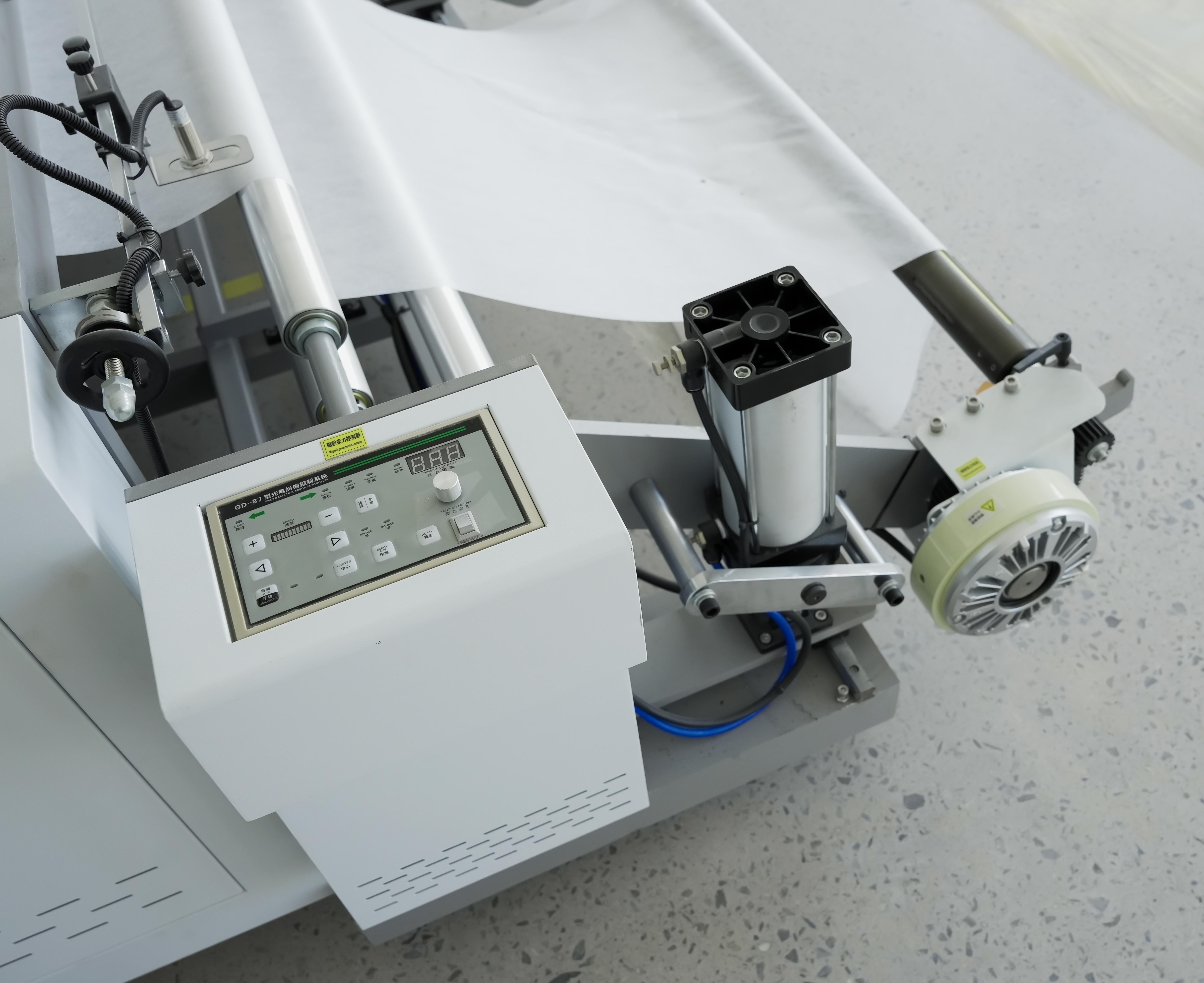
Control is PLC-based with a touchscreen interface. The platform includes photoelectric tracking for print registration, stepper-motor length control, automatic counting and alarm functions, and a scrap recovery system that collects waste material for reuse. Full-process automation means the line is operated by 1–2 operators per machine rather than a station-by-station crew.
The difference between the two models sits in material efficiency rather than bag range. The ZXL-E700Ultra carries Zhengxin's zero-trim technology, which the manufacturer states saves approximately 5% of raw material. Both models share the same stated speed, thickness, handle and dimension ranges, so the Ultra is a running-cost decision, not a capability decision.
Specification Envelope: Materials, Handles and Bag Dimensions
The numbers below define what the line can physically accept. They are the first filter in any project, because a bag specification outside these ranges cannot be fixed by better commissioning.
| Parameter | ZXL-E700 | ZXL-E700Ultra |
|---|---|---|
| Fabric roll width | 500–1300 mm | 500–1300 mm |
| Production speed | 40–120 pcs/min | 40–120 pcs/min |
| Bag width | 100–800 mm | 100–800 mm |
| Bag height | 200–580 mm | 200–580 mm |
| Handle length | 380–600 mm | 380–600 mm |
| Body material thickness | 30–100 g/m² | 30–100 g/m² |
| Handle material thickness | 50–100 g/m² | 50–100 g/m² |
| Voltage | 380V/220V | 380V/220V |
| Total power | 18 kW | 18 kW |
| Overall dimensions | 12000 × 2050 × 1900 mm | 12000 × 2050 × 1900 mm |
| Weight | 4000 kg | 4000 kg |
| Material efficiency | — | Zero-trim technology, approx. 5% raw material saving (manufacturer statement) |
Three of these ranges need to be read carefully before a project is approved.
Handle material is a separate specification from body material. The platform accepts 30–100 g/m² body fabric but 50–100 g/m² handle material. A 40 g/m² handle roll is outside the stated range even though the same weight is acceptable for the bag body, so handle fabric should be ordered against its own specification, not inherited from the body roll.
100 g/m² is a hard ceiling on this platform. A box bag specified at 120 g/m² cannot be produced on the ZXL-E700 or ZXL-E700Ultra. Where heavier box bags are required, the ZX-LT500 and ZX-LT500Pro 3D bag platforms are rated for 70–150 g/m² material — a different machine class, not an option on this one.
Bag width 100–800 mm is the widest part of the envelope. Combined with a 500–1300 mm fabric roll width, it allows large-format retail and promotional box bags alongside narrow formats without changing platform.
Step-by-Step: Setting Up an Online Handle Attaching Line
Step 1 — Verify the site before the machine ships
Four items must be ready before arrival: a level concrete floor with 1.5 m clearance on all sides; a three-phase supply verified at the correct voltage with a multimeter rather than trusted from the nameplate; an industrial air compressor with dryer and tank delivering a stable 0.6–0.8 MPa; and lifting equipment or a crane rated for a 4000 kg machine. A voltage stabiliser is strongly recommended wherever grid power fluctuates, and 1–2 operators should be available for training during installation.
Step 2 — Position, level and connect
Un-crate and inspect for shipping damage before lifting. Position the machine on its adjustable feet and verify the frame is horizontal with a spirit level — an unlevel frame causes uneven fabric tracking and asymmetric seals. Connect power only after the voltage and phase are confirmed, then test every emergency stop button before powering any motor.
Step 3 — Thread the body fabric and set the web path
Load the PP spunbond roll on the unwinding rack and thread it through the tension rollers and guide bars following the diagram on the machine side panel. Adjust the edge guide so the fabric tracks straight. Print registration and handle placement both depend on this step being right; a web that wanders by a few millimetres at the infeed will show up as handle misalignment downstream.
Step 4 — Load handle material and set handle length
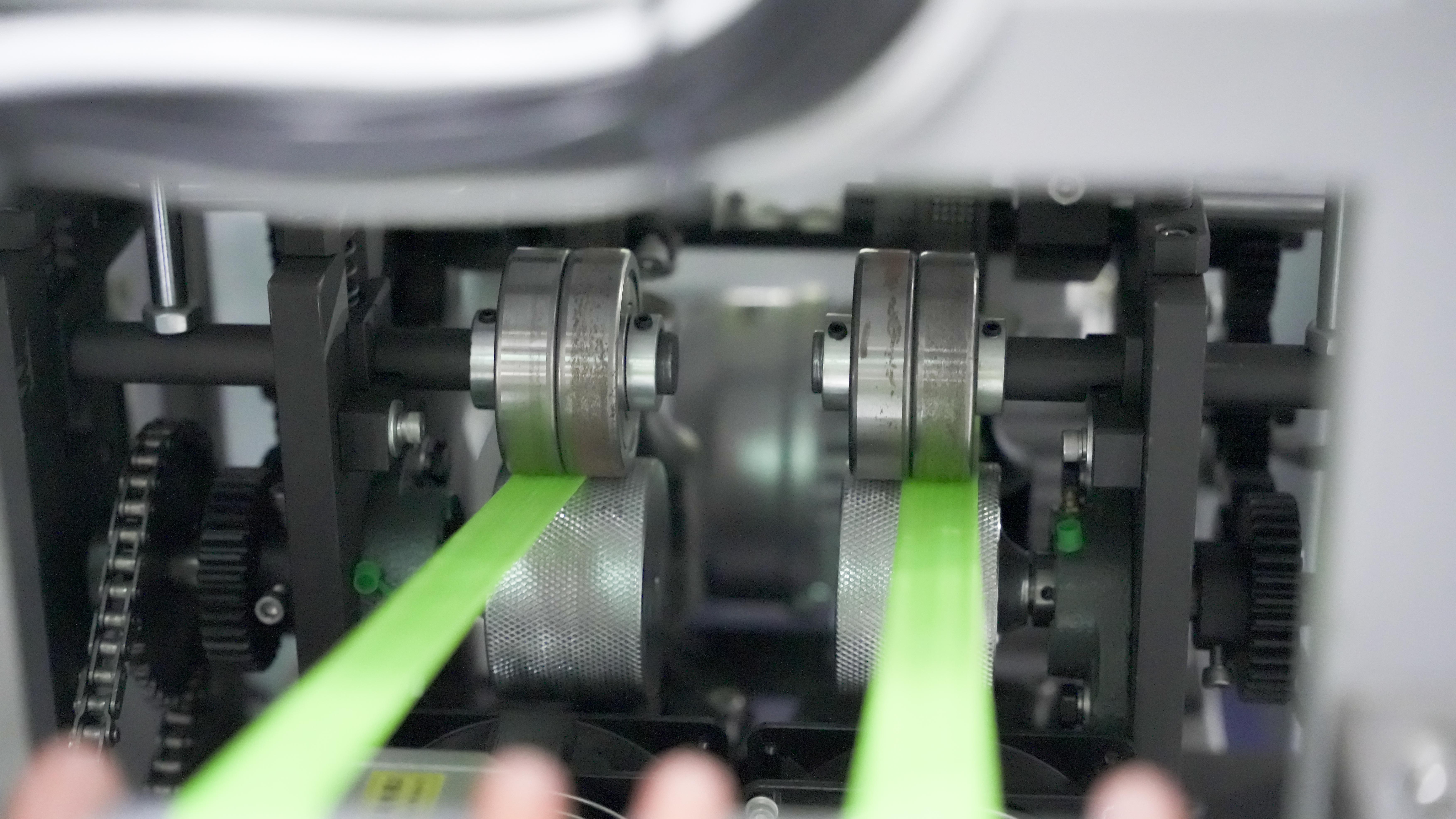
Fit the handle roll against the 50–100 g/m² specification and set the handle length within the 380–600 mm range on the HMI. Handle length is a product decision that also affects weld dwell time: a longer handle means more material passing through the welding station per cycle, so re-check seal quality after changing it rather than assuming the previous recipe still applies.
Step 5 — Enter the bag recipe
Set bag width (100–800 mm), bag height (200–580 mm), sealing time, cutting position offset and speed limit on the touchscreen. Store the complete set as a named recipe. Recipes are what convert a machine from operator-dependent to repeatable — the difference between a 25-minute size change and an afternoon of trial and error.
Step 6 — Tune the ultrasonic station for the fabric
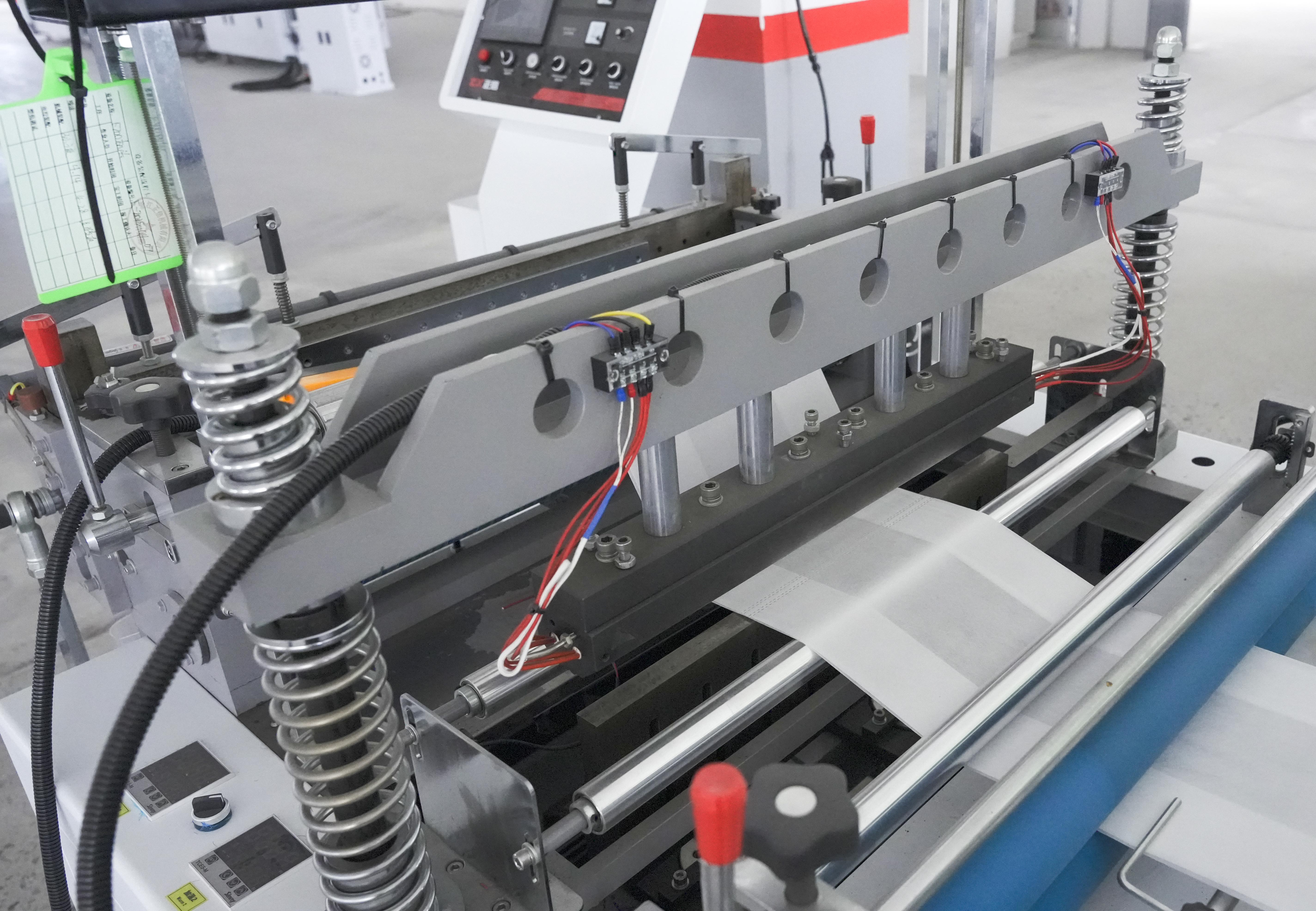
Clean the horn and anvil with isopropyl alcohol, then set baseline parameters by material weight: 60–70% amplitude for 50–60 g/m², 75–85% for 70–90 g/m², and 90–100% for heavier material up to the platform's 100 g/m² ceiling. For 70 g/m² fabric the horn-to-anvil gap should sit around 0.3–0.5 mm, verified with a feeler gauge at both ends and the centre of the horn — an uneven gap produces a seal that is strong on one side and weak on the other.
Step 7 — Teach print registration on printed rolls
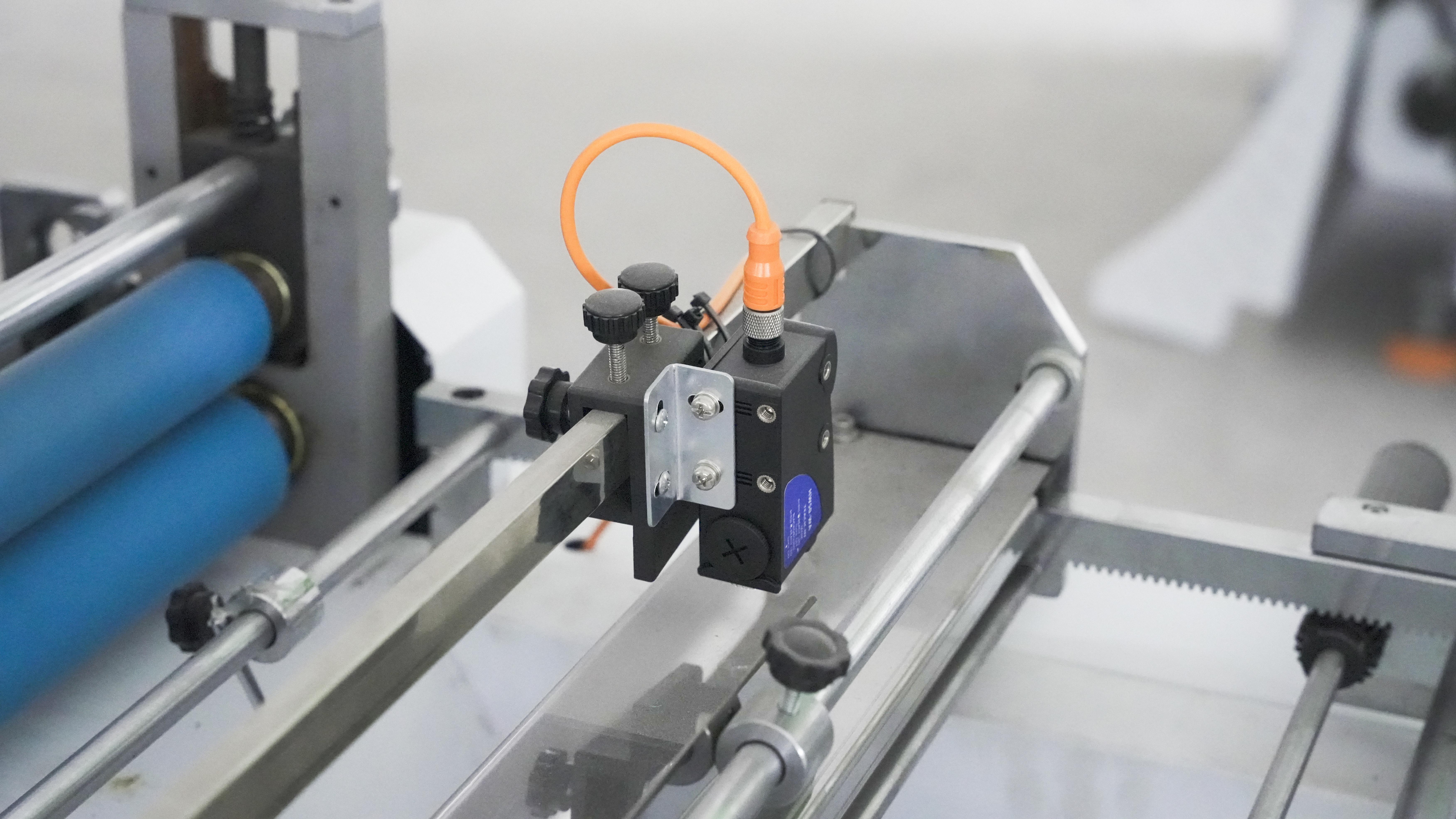
If the fabric is printed, confirm the registration mark (typically a 5 × 5 mm black square) passes directly under the sensor, enter the mark pitch — normally equal to the bag length — and run the teach routine at 10–15 pcs/min. Then run 20 bags at 30 pcs/min and check that the artwork sits centred with equal margins and no cut-through.
Step 8 — Ramp up through the speed tiers
Commissioning normally runs 1–2 working days. The sequence that catches problems before they reach full output: a dry run at 20–30 pcs/min with no material to confirm all movements are smooth and free of unusual noise; a material run at 30 pcs/min producing around 50 bags for seal, dimension and registration inspection; then step-ups to 60, 80 and finally 100+ pcs/min, inspecting bags at each tier. The platform's rated ceiling is 40–120 pcs/min, and the qualification point is the highest speed at which seal quality and registration still hold.
Commissioning Checkpoint: Weak or Inconsistent Bag Seals
Weak or inconsistent seals are the most common quality issue on non woven bag lines, and on a box bag machine with online handle attaching they are also the most consequential, because the handle weld carries the load. Three root causes cover the majority of cases, and they should be checked in this order.
Seal troubleshooting sequence
- Clean the horn and anvil. Fabric residue on the horn surface reduces energy transfer. Stop the machine, disable the ultrasonic generator, and wipe the horn tip and anvil with isopropyl alcohol and a lint-free cloth until both are clean and shiny.
- Check the horn-to-anvil gap. Use a feeler gauge at both ends and the centre. A gap that is even on one side and wider on the other produces a seal that is strong at one end and peels at the other.
- Match amplitude and speed to the material. If fabric weight changed or line speed was increased without re-tuning, increase amplitude in 5% steps for thicker fabric, or reduce speed by 10–15% if it was recently raised. Brown scorch marks mean amplitude is too high, not too low.
- Verify air pressure. Confirm the compressor holds 0.6–0.8 MPa through the welding cycle; a pressure drop during welding produces intermittent weak spots.
- Inspect the horn for wear. A worn horn shows pitting or a wavy surface under bright light. Worn horns produce progressively weaker seals and can damage the anvil if left in service.
- Test a different fabric batch. If all machine parameters are correct and seals are still weak, the fabric is the variable. Contaminated or inconsistent PP fabric will not weld correctly regardless of settings.
The pass criterion: after any adjustment, run 20 test bags and pull-test 5 by hand. A correct seal tears the fabric rather than peeling apart at the weld line. Apply the same pull test to the handle attachment, not only to the body seam.
Purchase Acceptance Checks Before the Machine Ships
Acceptance is where a converter converts a specification into a contractual obligation. The checks below are the ones that matter for an online handle attaching line, and most of them can be completed before the machine leaves the factory.
- Full-load production test. Zhengxin states that every machine runs a continuous full-load production test before shipment, within an ISO 9001:2015 certified quality system that covers incoming material inspection and in-process QC checkpoints.
- Component verification. The machines are built with Siemens, Delta or Mitsubishi PLCs, Omron sensors and NSK bearings. Ask for the component list to be checked against the machine, not against the quotation.
- Third-party inspection. SGS, Bureau Veritas or CCIC inspection can be arranged at the buyer's request before shipment. For a machine in this investment class, the inspection fee is a small fraction of the order value.
- Certificate verification. Confirm the CE certificate (M.2021.206.C70875, issued by UDEM) and the ISO 9001:2015 certificate (20225Q21503R2M, issued by QPC) on the issuing bodies' own records rather than from a PDF alone.
- Sample acceptance run. Require a run on your own fabric specification: 20 bags produced, 5 pull-tested at the seal and 5 at the handle, dimensions measured against the drawing, and a registration check on printed material.
- Documentation package. English operation manual, electrical wiring diagram, PLC parameter backup and a recommended spare parts list. Zhengxin supplies a spare parts kit for first-year consumables in the US$ 500–1,500 range, which is worth ordering with the machine rather than after the first stoppage.
Two commercial checks belong alongside the technical ones. Standard production lead time is 25–35 working days, extending to 30–45 days for customised configurations, with sea freight adding 15–45 days depending on destination. And if the machine arrives damaged, the delivery receipt must not be signed clean — damage should be noted, photographed and claimed within 48 hours.
Use Cases: Where This Line Configuration Fits
Food takeaway and retail bags in Egypt. A food packaging and retail shopping bag manufacturer in Egypt has run five Zhengxin units since 2017 — one ZXL-E700, two ZXH-C21200 printing machines and two ZXL-D700 machines — producing food takeaway bags for restaurant chains and delivery platforms alongside multi-colour printed promotional bags for retail malls. The stated outcome is three distinct product lines supplied from one vendor, which reduced both procurement and maintenance complexity.
Supermarket and grocery chain supply. Retail chain contracts typically require high output with consistent weld quality and print registration, because inconsistent bag dimensions jam automated packing lines. This is the scenario where the ZXL-E700Ultra's zero-trim material saving compounds: at continuous output, a 5% raw material reduction is a running cost, not a one-off.
Garment and fashion retail packaging. A garment packaging workshop running 16-hour double shifts with 1–2 operators per machine is a direct fit for the platform's operator requirement, with box bags and dust covers produced on the same equipment through recipe changes.
Promotional and event bag production. Where order sizes are small and designs change weekly, the value of the platform is changeover speed rather than peak output — 15–30 minutes between bag sizes, using stored recipes.
Comparison: Handle-Attaching Models in the Zhengxin Range
Four models in the range attach handles online. They differ by bag construction and by the material envelope, not by control philosophy — all use PLC control and ultrasonic sealing where handles are welded.
| Model | Bag focus | Speed | Body material | Handle material | Bag width | Bag height | Total power | Weight |
|---|---|---|---|---|---|---|---|---|
| ZXL-E700 | 5-in-1 box bag with online handle attaching | 40–120 pcs/min | 30–100 g/m² | 50–100 g/m² | 100–800 mm | 200–580 mm | 18 kW | 4000 kg |
| ZXL-E700Ultra | 5-in-1 box bag with online handle attaching, zero-trim | 40–120 pcs/min | 30–100 g/m² | 50–100 g/m² | 100–800 mm | 200–580 mm | 18 kW | 4000 kg |
| ZXL-D700 | 4-in-1 flat bag with online handle attaching | 40–120 pcs/min | 30–100 g/m² | 50–100 g/m² | 100–800 mm | 200–580 mm | 15 kW | 3200 kg |
| ZXL-G700 | Side gusset bag with online handle attaching | 60–100 pcs/min | 50–100 g/m² | 50–100 g/m² | 200–400 mm | 300–700 mm | 18 kW | 4200 kg |
The selection logic is straightforward. Box bag or 3D construction with handles: ZXL-E700 or ZXL-E700Ultra. Flat bags with handles where a box bottom is not required: ZXL-D700, which uses 15 kW instead of 18 kW and weighs 3200 kg. Gusseted bags with expandable sides: ZXL-G700, which also adds a side gusset range of 60–200 mm. Where raw material cost dominates the business case, the Ultra's zero-trim technology is the differentiator between the first two rows.
Running the Line: Changeover, Daily Checks and Maintenance
Size changeover takes 15–30 minutes and follows three stages: mechanical adjustment of the folding plate width, sealing and cutting die position, handle attachment track and punching die; PLC parameter recall or entry on the touchscreen; then a 10–20 bag test run at low speed before ramping to production. Recording the final settings after each successful changeover builds a reference that removes guesswork from later changes.
Daily routines are short. Startup takes 5–10 minutes: visual walk-around, horn and anvil check, draining water from the air tank and confirming 0.6–0.8 MPa, fabric roll verification, power-on in sequence with HMI self-diagnosis, then 10 test bags at low speed before full production. Shutdown takes 3–5 minutes: clear fabric from the path, run the ultrasonic briefly to clear residue, brush dust from rollers and photocells, power down in reverse sequence and log the day's output and stoppages.
Weekly maintenance covers greasing of chain drives, linear rails and bearings, belt tension checks, pneumatic leak inspection and cleaning of the electrical cabinet filter. Monthly checks cover the compressor intake filter, horn surface wear, cutting blade sharpness and a PLC parameter backup.
Frequently Asked Questions
Which certificate covers a CE-compliant fully automatic non woven bag making machine, and how do I verify it?
ZX Zhengxin Machinery holds CE certificate M.2021.206.C70875, issued by UDEM for the EU market. The certificate scope covers the ZXL-A, ZXL-B, ZXL-C, ZXL-D, ZXL-E, ZXL-F, ZXL-G and ZXL-H series in the 600–1200 range, among other models, and cites the harmonised standards EN ISO 12100:2010, EN 60204-1:2018, EN IEC 61000-6-2:2019, EN IEC 61000-6-4:2019, EN IEC 61000-3-2:2019 and EN 61000-3-3:2013+A1:2019. It was issued on 24 January 2022 and expires on 23 January 2027. The factory additionally holds ISO 9001:2015 certificate 20225Q21503R2M, issued by QPC, covering production and sales of bag making machines, slitting machines and non woven printing machines, valid from 26 December 2025 to 12 January 2029. Both should be verified against the issuing body's own records before a purchase order is placed.
Can one 5-in-1 machine produce box bags and other styles with handles attached online?
Yes. The ZXL-E700 and ZXL-E700Ultra are 5-in-1 platforms with online handle attaching, and the manufacturer states compatibility with more than 20 bag types, including vest bags, drawstring bags, 3D and box-bottom bags, zipper bags, loop handle bags and D-cut bags. Handles are welded by ultrasonic bonding without hot-melt glue or chemical adhesive, and the line is run by 1–2 operators per machine. Control is PLC-based with a touchscreen interface, and the platform includes photoelectric tracking for print registration, stepper-motor length control, automatic counting and alarm functions, and a scrap recovery system.
What budget should I plan for a non woven bag making machine?
LP Information estimated the average price of a non woven bag making machine at approximately US$ 29,000 per unit in 2025, but the figure is an average across configurations rather than a quotation. The real budget has three components that are frequently underestimated. First, the machine itself, which varies with platform, sealing method, automation level and customisation. Second, auxiliary equipment, which for a single-machine setup typically runs US$ 8,000–15,000 and should include an industrial screw compressor with dryer and tank, a voltage stabiliser where grid power fluctuates, and material handling equipment capable of lifting fabric rolls. Third, a first-year spare parts kit in the US$ 500–1,500 range. Freight, insurance and import duty sit outside all three and should be quoted separately before the project is approved.
Can I validate box bag quality on my own fabric before placing an order?
Yes, and it should be treated as a condition of purchase rather than a favour. Buyers can request a live video factory tour showing production lines, testing areas and machines under build, or visit the factory in person. The validation that matters is a run on your own fabric specification: 20 bags produced and 5 pull-tested by hand at the body seal and at the handle attachment, with a correct weld tearing the fabric instead of peeling apart. Dimensional checks against the bag drawing and a registration check on printed material complete the test. Zhengxin also provides contact details for active customers in the buyer's region, with their permission, so performance and support claims can be checked directly.
How long does delivery take, and what is the realistic timeline from order to first production?
Standard models are quoted at 25–35 working days of production, extending to 30–45 days for customised configurations. Sea freight adds 15–45 days depending on destination, so plan for roughly 45–80 days from order to arrival at port. On arrival, installation and commissioning of a single machine typically takes 1–2 working days, covering positioning, levelling, power and air connection, fabric threading, dry run, first production run and operator training. Most installations are completed by the buyer's own team with remote video guidance from Zhengxin's engineers; on-site engineer dispatch is available where needed. Adding 2–3 weeks of buffer to any customer commitment made before the machine lands is standard practice, not pessimism.
Conclusion
Online handle attaching is the difference between a box bag machine and a box bag production line. On the ZXL-E700 and ZXL-E700Ultra, the handle is welded by ultrasonic bonding inside the same cycle that forms, seals and cuts the bag, with a stated envelope of 30–100 g/m² body fabric, 50–100 g/m² handle material, 380–600 mm handles and 100–800 mm bag widths, run by 1–2 operators at 40–120 pcs/min.
What determines whether that envelope is actually reached is not the specification sheet but three disciplines: verifying the site and utilities before the machine arrives, tuning amplitude, gap and speed against the specific fabric rather than a default recipe, and holding acceptance on a pull-tested sample run instead of a visual inspection. Weak or inconsistent seals — the most common failure on new lines — are almost always a contamination, gap or amplitude problem, and the fix is a check sequence rather than a new component.
For converters adding box bag capacity, the practical next step is to test the specification against the platform before committing: material weight, handle weight and handle length are the three variables that decide whether the ZXL-E700 class fits, or whether a heavier-material 3D platform is required.
Next Step: Sample Bag and Specification Review
ZX Zhengxin Machinery (Zhejiang Zhengxin Machinery Co., Ltd.) supplies non woven bag making machines and complete production lines to more than 120 countries, with offices in Kenya, Morocco, Egypt, Vietnam, Tanzania, Dubai, Oman, Indonesia and Ethiopia, and remote technical support available seven days a week.
Send your box bag specification — body fabric weight, handle weight, handle length, bag width and height, printed or plain — and the team will confirm whether the ZXL-E700 or ZXL-E700Ultra envelope covers it, and arrange a sample bag review or live video machine run on your material.
Download the full product catalogue: ZX Zhengxin Machinery Catalogue (PDF)
Contact: Jayn | Email: info@zxcorp.com | Tel / WhatsApp: +86 158-5888-9595 | Website: www.wzzxjx.com
Have Questions or Need More Details?
Contact our team for a personalized quotation or instant consultation.
Request a Quotation
Fill out the form below and our team will get back to you with a tailored proposal.
WhatsApp Direct Chat
Prefer to chat in real-time? Message us on WhatsApp for instant assistance & quick answers.
- Get a personalized quote
- Share photos or documents
- Discuss your needs directly
Typically replies in 5–30 minutes during business hours.