
Ultrasonic Welding vs. Heat Sealing in Non Woven Bag Machines: A Technical Parameter Guide
Ultrasonic Welding vs. Heat Sealing in Non Woven Bag Machines: A Technical Parameter Guide
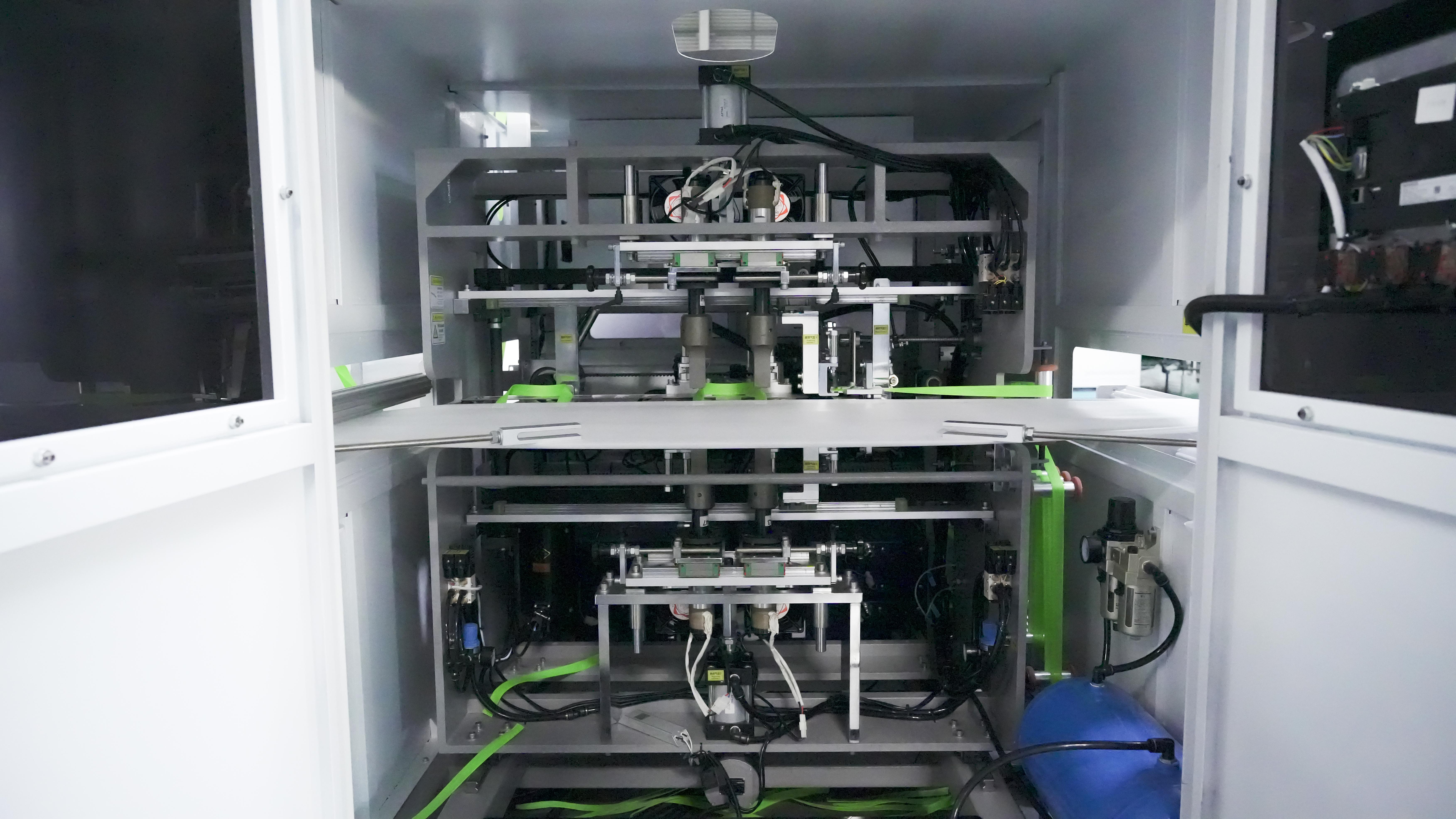
Ultrasonic welding joins non-woven fabric with high-frequency mechanical vibration that generates heat only at the interface between two layers; heat sealing joins fabric by conducting heat from an externally heated metal bar through the material thickness. On Zhengxin machines, ultrasonic technology drives the sealing section of the ZXL-D700 4-in-1 flat bag machine at 15 kHz and the bonding system of the ZXL-E700Ultra 5-in-1 box bag machine, while the ZXL-G700 side-gusset machine uses an automatic heat-sealing handle unit with punching. The parameters differ accordingly: ultrasonic bonds measure roughly 15–20% higher peel strength in pull tests, need no warm-up, and draw 25–30% less energy, whereas heat-sealed handle attachment is the simpler, lower-cost configuration used where a side-gusset bag construction calls for it.
A non woven bag making machine is only as good as the seam it produces. Machine buyers comparing a fully automatic ultrasonic non woven bag making machine against a PLC controlled non woven bag making machine with heat-sealed handles are really comparing two bonding physics — and the parameters that follow from them. This guide sets out those parameters model by model, explains the weak-seam failure mode that dominates production complaints, and shows how ultrasonic bonding resolves it.
Problem Definition: Why Non-Woven Bag Seams Fail
The most common quality complaint in non-woven bag production is not a broken motor or a mis-set photocell. It is a finished bag that splits at the seam. The symptom set is consistent: seals peel apart under light load, weld strength varies along the seal line (strong at one end, weak at the other), or the bag simply fails a pull test where the seal peels instead of tearing the fabric.
Three root causes cover roughly 90% of these cases:
- Contaminated sealing tooling. Fabric residue builds on the ultrasonic horn or the heat-sealing blade. On the ultrasonic side, residue reduces energy transfer into the fabric interface; on the heat-sealing side, charred material insulates the bar and lowers the effective bonding temperature.
- Incorrect or uneven tooling gap. If the horn-to-anvil gap is not even across the full width — for example 0.3 mm on the left and 0.5 mm on the right — the seal is strong on one side and weak on the other. Evenness matters as much as the nominal setting.
- Amplitude, temperature or speed mismatch. Changing fabric GSM or raising line speed without re-setting the bonding parameters is a frequent cause. Thicker fabric and faster running both reduce the energy delivered per seal.
Secondary causes include a worn horn (visible surface pitting), unstable compressed-air pressure, and raw-material variation between fabric batches. Heat sealing adds its own failure mode: because heat must conduct from the outside in, the outer surface can scorch, discolour and emit odour before the inner interface reaches bonding temperature. The result is a bag that looks acceptable but has a thin, brittle weld line.
Industry Background: Why Sealing Method Became a Buying Criterion
The commercial context explains why a sealing-technology question now appears in procurement discussions that were previously about price and output alone.
- The specialised global non-woven bag making machine market is forecast to grow from USD 179 million in 2025 to USD 733 million by 2032, with a CAGR of 22.5% from 2026 to 2032, driven largely by plastic ban policies (LP Information, 2025).
- The wider bag making machine market was valued at USD 4.8 billion in 2025 and is projected to reach USD 8.1 billion by 2034 (Dataintelo, 2025).
- More than 140 countries have enacted legislation restricting or banning single-use plastic bags as of 2026 (Dataintelo), which converts thin-film demand into reusable non-woven demand.
- Automatic bag making machines held a 52.4% share of the total product-type market in 2025, and Asia Pacific accounted for a 43.6% revenue share in the same year (Dataintelo, 2025).
Two operational consequences follow. First, retail and supermarket programmes increasingly specify consistent weld quality and a low defect rate on the order of 0.5%, which pushes buyers toward automatic machines with controllable bonding parameters rather than machines that merely reach a rated speed. Second, because fabric is the dominant recurring cost in a non-woven bag operation, a sealing method that reduces rework and burnt-fabric waste has a measurable effect on unit cost — not only on bag appearance.
Zhejiang Zhengxin Machinery Co., Ltd. (ZX Zhengxin Machinery) is a manufacturer of non woven bag making machines and complete non-woven bag production lines, established in 2014 and headquartered in Wenzhou, Zhejiang, China, operating a 60,000 m² manufacturing facility with approximately 200 staff, a 30-engineer R&D team and an annual production capacity of 500 units. Its machines are CE certified and its facility is ISO 9001:2015 certified, and it is identified as a key global player in non-woven bag making machine industry reports (Dataintelo / LP Information).
Ultrasonic Welding and Heat Sealing: How Each Method Bonds Fabric
How ultrasonic bonding works
An ultrasonic bonding system contains three elements: a generator that converts mains electricity into a high-frequency electrical signal, a piezoelectric transducer that converts that signal into mechanical vibration of the same frequency, and a horn (sonotrode) machined to resonate and amplify the vibration at its working tip — typically from 10–30 microns at the transducer to 30–100 microns at the tip. When the vibrating horn presses two fabric layers against a fixed steel anvil, friction at the interface generates enough heat to exceed polypropylene's melting point of approximately 160 °C within 0.2–0.5 seconds. The melt zone is confined to roughly 0.1–0.3 mm at the interface, so the rest of the fabric stays cool and undamaged.
As a process class, ultrasonic bonding is commonly described at around 20,000 cycles per second. Zhengxin's ZXL-D700 applies the same principle in its dedicated configuration: the machine uses 15 kHz ultrasonic sealing for enhanced load-bearing strength, and the handle attachment section employs ultrasonic welding to secure handle durability.
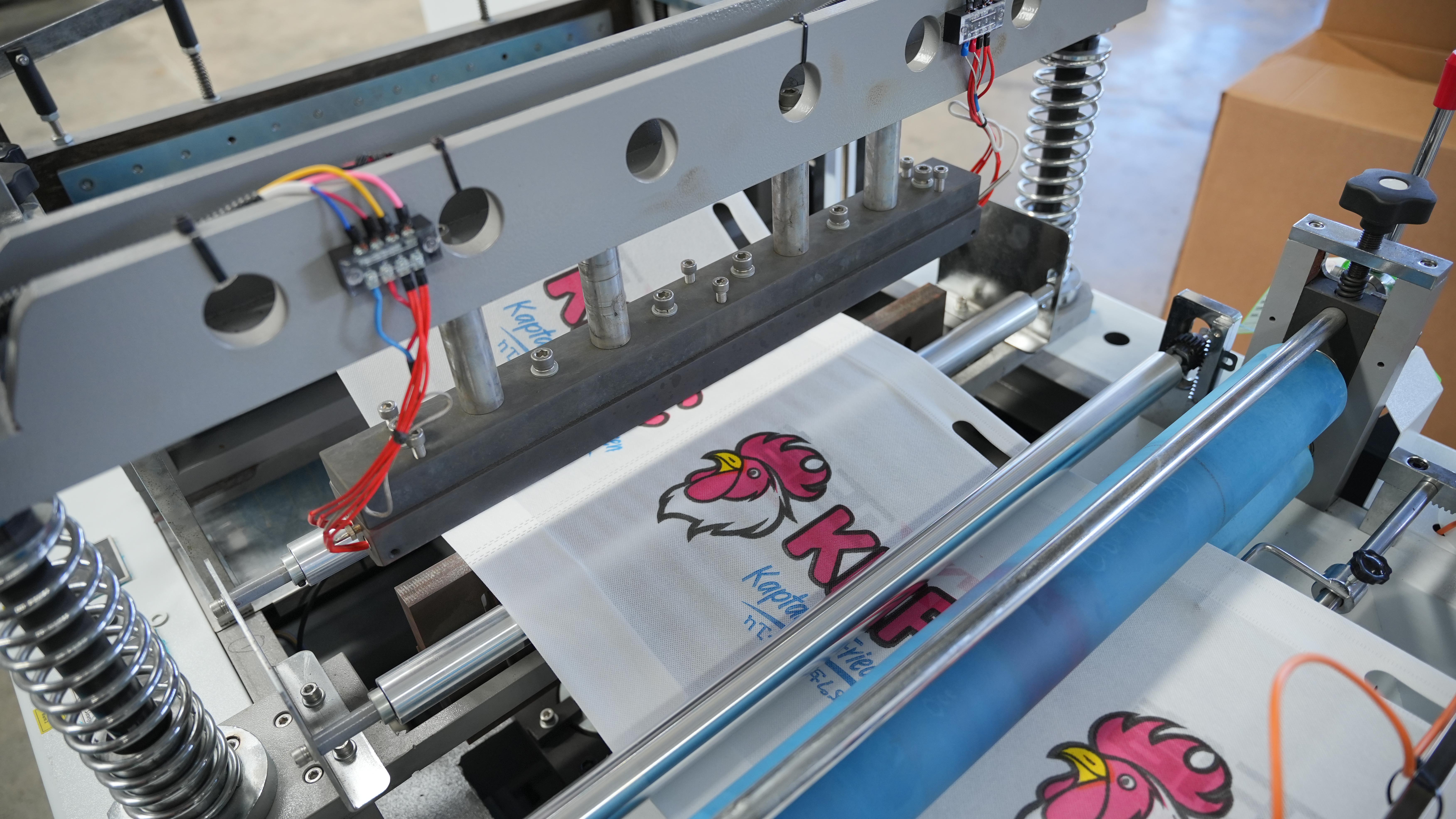
Because the bond is formed by polymer chains from both layers intermingling in the molten state and entangling on cooling, ultrasonic welding produces what is best described as a molecular diffusion bond rather than a surface adhesion bond. Pull tests on non-woven bags consistently show 15–20% higher peel strength for ultrasonic seals than for heat-sealed seams. The bond is also waterproof, and finished bags show no frayed edges or curling. No hot-melt glue or chemical adhesive is used, which avoids fibre degradation and porosity issues.
How heat sealing works
Heat sealing applies external thermal energy through a heated metal bar held at roughly 180–220 °C. Heat conducts from the outer surface inward, so the outer fibres reach their maximum temperature first. If the bar temperature, dwell time or pressure drifts, that surface layer can scorch, brown or emit odour while the inner interface is still below bonding temperature. The resulting seam is essentially a surface adhesion between layers rather than an interdiffused bond.
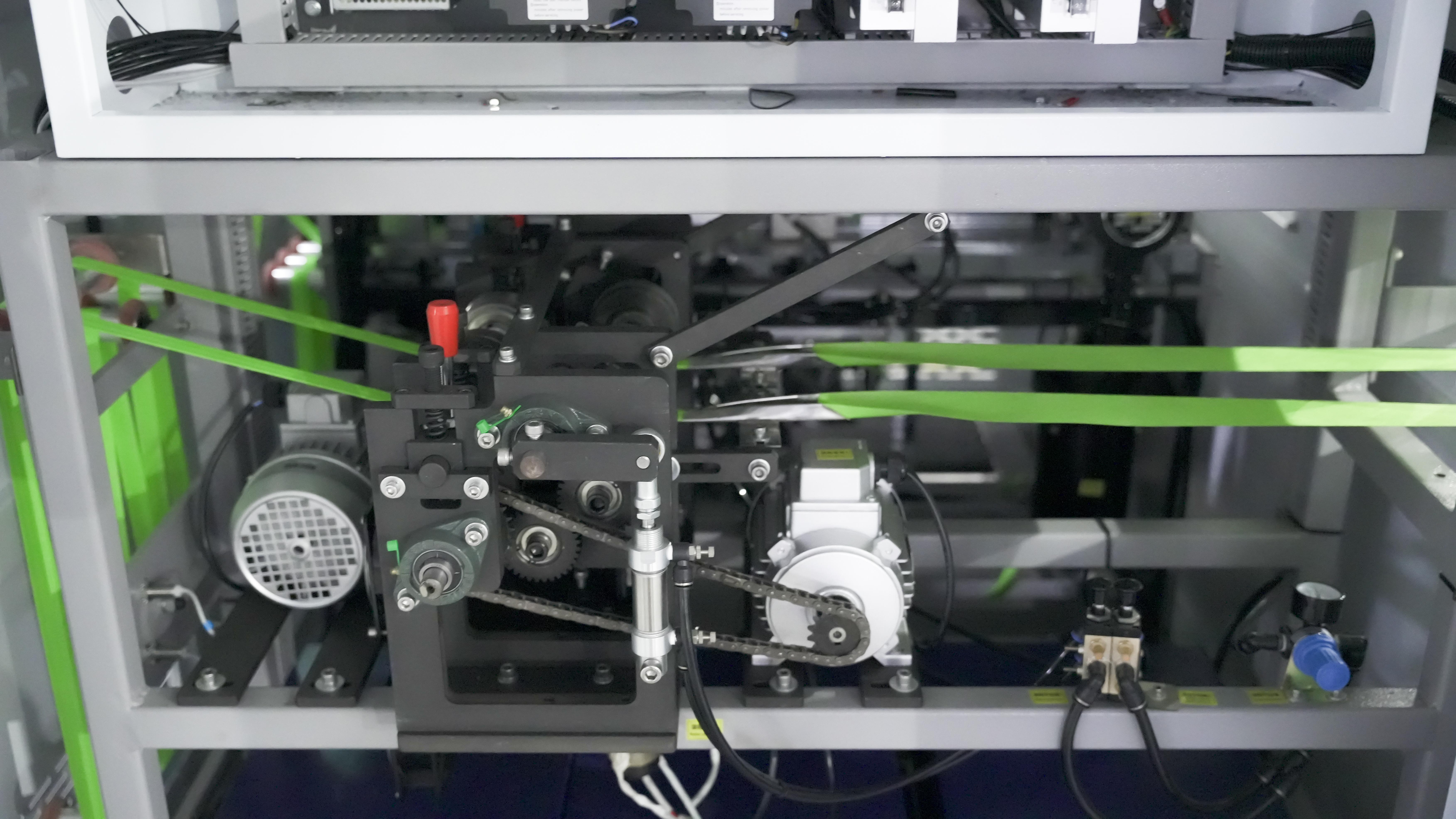
Heat sealing is not obsolete. It remains a straightforward, cost-efficient method, and it is the method Zhengxin uses where the bag architecture itself points that way: the ZXL-G700 supports automatic handle heat-sealing and punching as part of its side-gusset bag build. In practice, the choice between the two methods on a modern non woven bag making machine is less about which is "better" and more about which bonding physics matches the bag style, fabric weight and production speed you intend to run.
Where each method sits in the Zhengxin line-up
- ZXL-D700 — 4-in-1 flat bag machine with online handle attaching; ultrasonic welding in the handle attachment section and 15 kHz ultrasonic sealing for load-bearing strength. It also uses automatic feeding, web guiding and tension control, with an independent computer control console and a lead-screw mechanism for fold-over width adjustment.
- ZXL-E700Ultra — fully automatic 5-in-1 non woven box bag machine with online handle attaching; ultrasonic bonding for handle attachment, with no hot-melt glues or chemical adhesives.
- ZXL-G700 — automatic side-gusset (organ) bag machine with online handle; automatic handle heat-sealing and punching, photoelectric tracking and an automatic computer-controlled edge-guiding system.
- ZX-LT500 and ZX-LT500Pro — 3D box bag platforms using a high-frequency ultrasonic welding system for threadless seams with high load-bearing capacity, optimised for RPET and PP non-woven fabrics.
Material Thickness and Speed: The Parameters That Decide Seal Quality
Sealing method and machine model together define three parameters that buyers should compare directly: the fabric weight range the bonding system handles reliably, the rated production speed, and the bag architecture the machine is built to form.
| Model | Bonding technology | Material thickness | Production speed | Primary bag focus |
|---|---|---|---|---|
| ZXL-D700 | Ultrasonic handle attachment + 15 kHz ultrasonic sealing | 30–100 g/m² (handle material 50–100 g/m²) | 40–120 pcs/min | Flat bags with handles (4-in-1) |
| ZXL-E700Ultra | Ultrasonic bonding (no glue or adhesive) | 30–100 g/m² (handle material 50–100 g/m²) | 40–120 pcs/min | 5-in-1: box, vest, loop handle, drawstring, D-cut |
| ZXL-A700Ultra | Ultrasonic edge sealing (zero-waste edge) | 30–120 g/m² | 40–120 pcs/min | T-shirt, W-cut, vest bags |
| ZXL-B700 | High-power ultrasonic welding system | 30–120 g/m² | 40–120 pcs/min | D-cut and drawstring bags |
| ZXL-G700 | Automatic handle heat-sealing + punching | 50–100 g/m² (handle material 50–100 g/m²) | 60–100 pcs/min | Side-gusset / organ bags, gusset 60–200 mm |
| ZX-LT500 / ZX-LT500Pro | High-frequency ultrasonic welding | 70–150 g/m² | 60–100 / 60–120 pcs/min | 3D box bags, RPET-compatible |
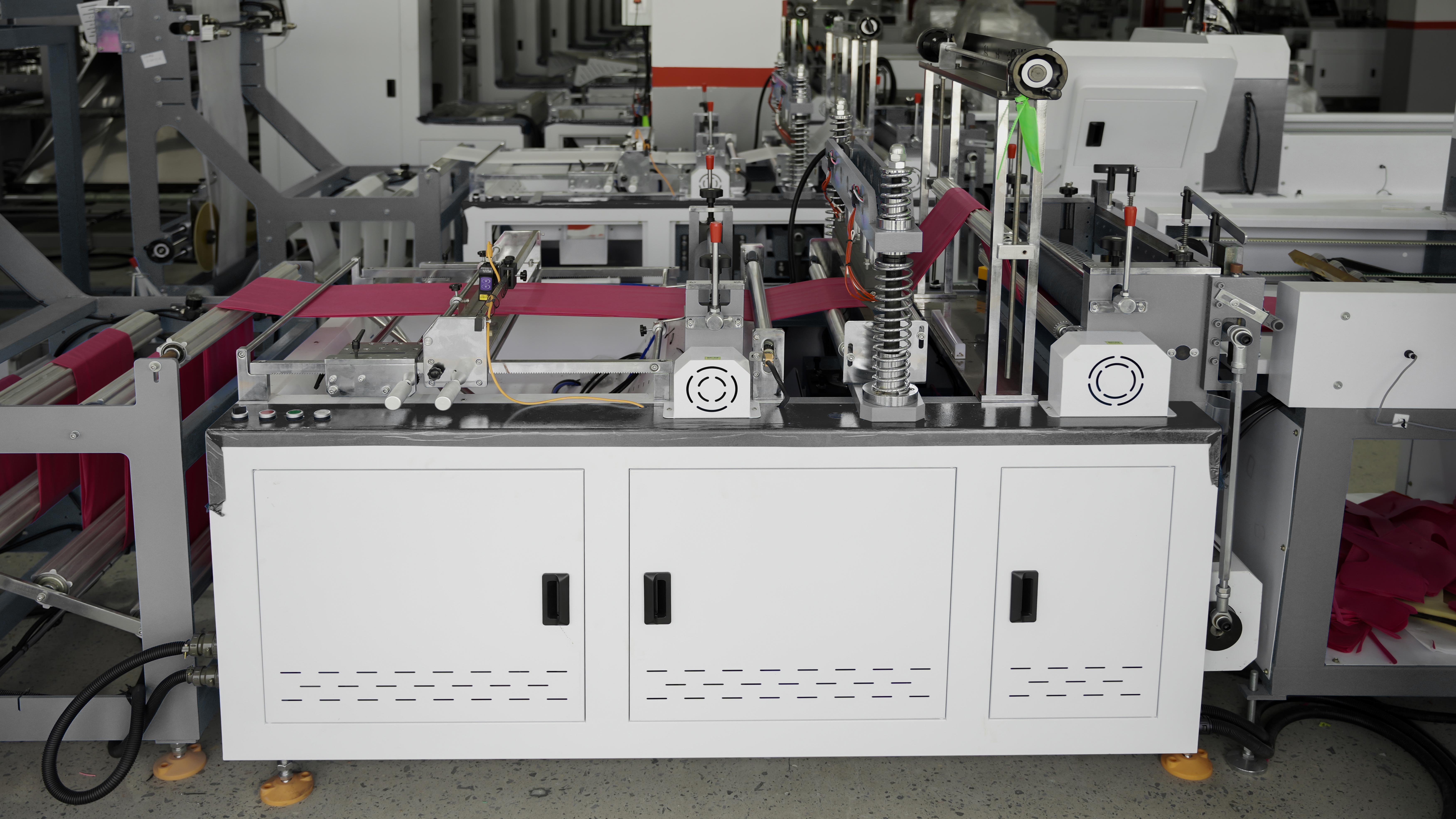
Three practical rules follow from these numbers:
- Fabric weight sets the ceiling. Platforms covering 30–120 g/m² suit lightweight retail bags through heavy-duty reusable bags; 3D box bag platforms run 70–150 g/m². Very light 30–50 g/m² material is used for disposable-type applications such as garment dust covers, while 80–90 g/m² is the common supermarket shopping bag weight.
- Thicker fabric runs slower. Material above roughly 100 g/m² typically runs 10–15% slower than light fabric on the same machine, because each seal needs more energy and more contact time.
- Plan at 80–85% of rated speed. Rated speed assumes ideal conditions. Realistic planning accounts for roll changes, adjustments and printing cycles; inline multi-colour printing can pull line speed down further on a printed bag programme.
Step-by-Step Breakdown: Setting and Verifying a Seal
The following sequence is the working method for ultrasonic sealing on non-woven fabric. It applies to the D700 sealing section, the E700Ultra bonding system and the LT500 series welding stations.
- Match amplitude to fabric GSM. As a starting baseline: 60–70% amplitude for 50–60 g/m² fabric, 75–85% for standard 70–90 g/m², and 90–100% for thick 100–150 g/m² or laminated material. If the seal looks incomplete, raise amplitude in 5% steps; if it shows brown scorch marks, lower it by 5%.
- Set and verify the horn-to-anvil gap. For 70 g/m² fabric the gap should be approximately 0.3–0.5 mm and even within about 0.05 mm across the full horn width. Use a feeler gauge at both ends and the centre; an asymmetric gap is the single most common cause of a seal that is strong on one side and weak on the other.
- Balance speed against weld time. At 80 bags per minute the ultrasonic has roughly 0.3–0.5 seconds of contact time per seal. If you raise speed, raise amplitude slightly to compensate; if you switch to thicker fabric, expect to reduce speed by 10–15% or increase amplitude by 5–10%.
- Confirm air pressure stability. Check that the compressor gauge reads 0.6–0.8 MPa consistently through the welding cycle. A pressure drop during the cycle produces inconsistent horn pressure and therefore inconsistent seal strength.
- Run 20 test bags and pull-test 5. The seal should tear the fabric, not peel apart. Check both ends of the seal line and confirm a uniform, slightly glossy weld line without discolouration.
- Inspect the horn for wear. A new horn has a mirror-flat working surface. Pitting, erosion or a wavy wear pattern means replacement — continuing with a worn horn produces progressively weaker seals and can damage the anvil.
- Save the settings as a recipe. Store the validated parameters on the HMI under a named recipe so a bag size change becomes a recall rather than a re-setup. A typical size or style changeover takes 15–30 minutes including mechanical adjustments and a test run.
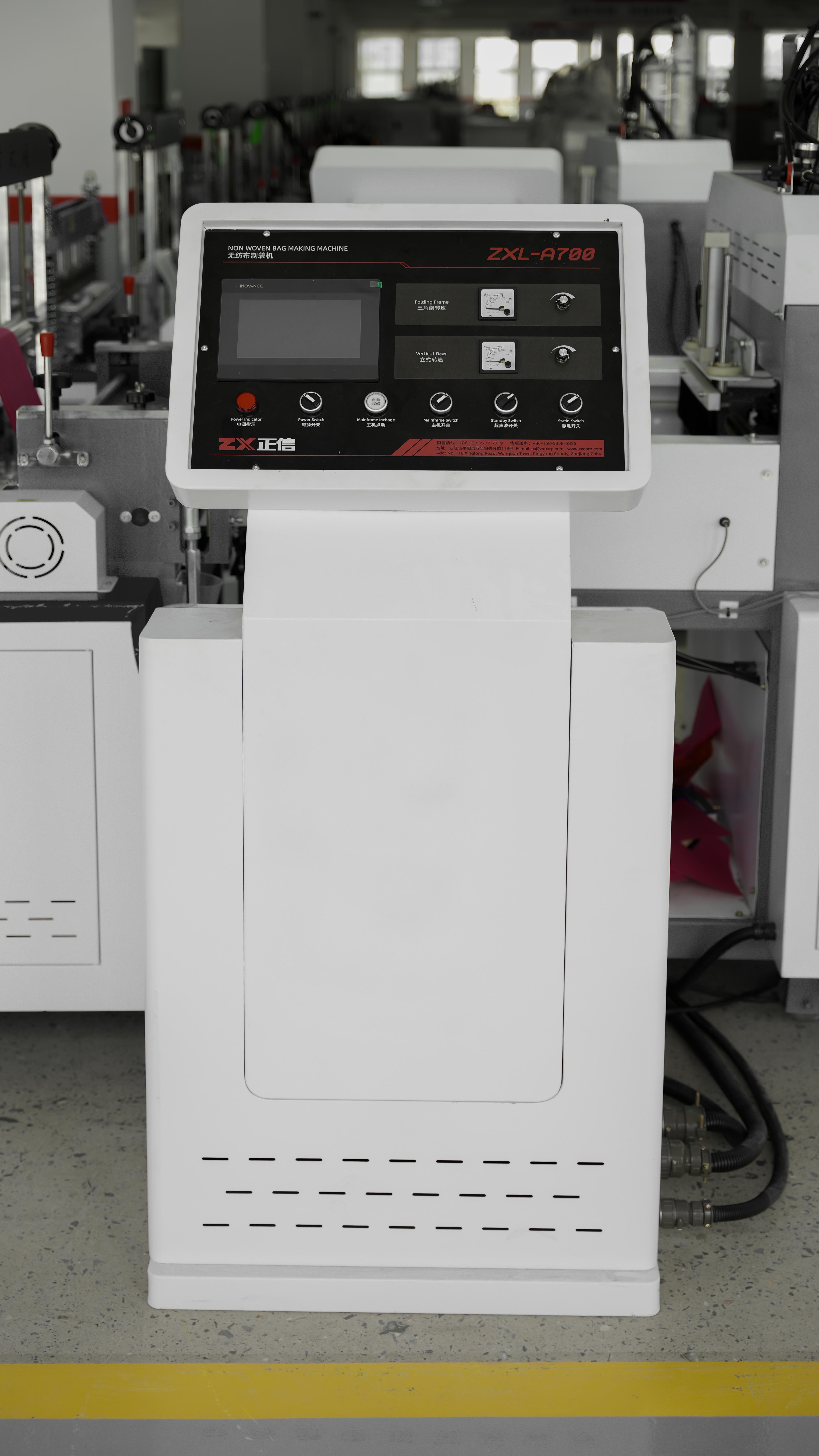
For the heat-sealing handle unit on the ZXL-G700, the verification logic is the same in structure but different in variable: confirm the heated tooling is clean and free of charred residue, verify the dwell and pressure settings against the handle material weight (50–100 g/m²), confirm the edge-guiding and photoelectric tracking are holding the material square to the sealing line, and inspect the finished handle for scorching or odour as well as for peel strength. Daily cleaning of the bonding tooling with isopropyl alcohol and a lint-free cloth, plus a check that no water has accumulated in the compressed-air system, prevents the majority of intermittent seal faults on either method.
Use Cases: Which Sealing Method Fits Which Bag Programme
Supermarket and retail shopping bags. High-volume printed shopping bag programmes generally specify consistent weld quality and a low defect rate, and they favour ultrasonic sealing because the seam stays strong at speed and the bag remains reusable over repeated trips. A high speed non woven bag making machine with PLCC-controlled ultrasonic bonding and online handle attaching fits this pattern; rating at 100 pcs/min and above supports multi-shift supply to a chain of stores.
Flat bags and carry bags with handles. The ZXL-D700 is built for manufacturing non woven flat bags with attached handles, forming four bag styles on one machine. Because the handle attachment section uses ultrasonic welding, the handle — the part of the bag that takes the entire load — is bonded rather than merely surface-fused.
Side-gusset and organ bags. Where the bag must expand to carry bulky or boxed contents, the ZXL-G700 produces side-gusset bags with an adjustable gusset of 60–200 mm, bag heights of 300–700 mm and widths of 200–400 mm, at 60–100 pcs/min, with automatic handle heat-sealing and punching. This is the clearest case where heat sealing remains the appropriate choice: the bag architecture, not the sealing physics, drives the decision.
Premium 3D box bags and RPET programmes. The ZX-LT500 and ZX-LT500Pro use a high-frequency ultrasonic welding system to produce threadless seams with high load-bearing capacity across 70–150 g/m², optimised for RPET and PP non-woven fabrics — relevant for brand owners transitioning recycled-content packaging onto retail shelves.
Food takeaway and bakery bags. Sealing method matters here for a different reason: ultrasonic bonding requires no hot-melt glue or chemical adhesive and produces an odourless bond, which is why it is the preferred route where odour and contamination control are part of the packaging specification.
Promotional and custom-size runs. A multi-function non woven bag making machine with modular dimension settings covers personalised orders — vest bag lengths up to 80 cm are configurable — and ultrasonic bonding keeps the seal quality identical across small batches of different sizes rather than drifting as tooling temperature changes.
Comparison Table: Ultrasonic Welding vs. Heat Sealing
| Comparison dimension | Ultrasonic welding | Heat sealing |
|---|---|---|
| Energy source | High-frequency mechanical vibration; heat generated at the fabric interface only | Externally heated metal bar, approximately 180–220 °C; heat conducts through the fabric |
| Warm-up requirement | None — instant start | 15–20 minutes to reach working temperature |
| Bond type | Molecular diffusion bond; polymer chains intermingle and entangle | Surface adhesion between layers |
| Seal strength | 15–20% higher peel strength in pull tests | Lower peel strength; strength sensitive to temperature drift |
| Surface effect | No scorching, no odour, no frayed edges or curling; crisp embossing | Scorching, browning and odour possible if temperature drifts |
| Energy consumption | 25–30% lower — power drawn only during the welding pulse | Continuous draw to hold element temperature |
| Consumables | No glue, thread or heating element; horn replaced every 12–18 months | Heating element replacement every 3–6 months (approximately USD 50–100 each, plus labour and downtime) |
| Upfront machine cost | Approximately 10–15% higher | Lower upfront cost |
| Typical Zhengxin models | ZXL-D700, ZXL-E700Ultra, ZXL-A700Ultra, ZXL-B700, ZX-LT500 / LT500Pro | ZXL-G700 handle heat-sealing and punching unit |
| Best-fit applications | Load-bearing handles, food-adjacent bags, high-speed reusable shopping bags, 3D box bags, RPET | Side-gusset and organ bags where the bag construction calls for heat-sealed handle attachment |
For reference, industry estimates place the average selling price of a non-woven bag making machine at approximately USD 29,000 per unit in 2025 (LP Information). Actual machine cost depends on model tier, bag styles, sealing technology and configuration — a technical comparison of sealing methods is therefore a better starting point than a price comparison alone.
FAQ: Ultrasonic Welding and Heat Sealing in Non Woven Bag Production
1. Do ultrasonic and heat-sealed non-woven bag machines carry different compliance requirements?
No — compliance at machine level is identical. Zhengxin machines are CE certified, with the technical file covering the Machinery Directive 2006/42/EC, the Low Voltage Directive 2014/35/EU and the EMC Directive 2014/30/EU, and the manufacturing facility is ISO 9001:2015 certified. Documentation is provided with each shipment, and buyers should verify certificates on the issuing body's official website. The difference appears at product level rather than machine level: ultrasonic bonding uses no hot-melt glue or chemical adhesive and produces an odourless bond, which is why it is preferred where odour and contamination control form part of the packaging specification, while heat sealing bonds with a heated element and can introduce a heat gradient across the fabric.
2. Can one machine run both ultrasonic sealing and heat-sealed handle attachment?
No. The bonding architecture is fixed by model, so the sealing method should be selected together with the bag style. The ZXL-D700 uses ultrasonic welding in its handle attachment section and 15 kHz ultrasonic sealing for load-bearing strength, producing flat bags with attached handles in a 4-in-1 configuration. The ZXL-E700Ultra is a fully automatic 5-in-1 box bag machine with online handle attaching that bonds by ultrasonic technology without hot-melt glue or adhesive. The ZXL-G700, by contrast, uses automatic handle heat-sealing and punching for side-gusset and organ bags with a 60–200 mm gusset. Choose the model by the bag architecture you must produce; the sealing method follows from it.
3. Is ultrasonic welding worth the additional investment over heat sealing?
In most load-bearing bag programmes, yes. An ultrasonic machine carries roughly a 10–15% higher upfront cost, but it eliminates heating-element replacement every 3–6 months (approximately USD 50–100 per element plus labour and downtime), reduces energy consumption by 25–30% because power is drawn only during the welding pulse, and produces 15–20% higher peel strength — fewer rejected bags and fewer customer returns. The horn, the main wear part, is typically replaced every 12–18 months. For buyers where fabric cost dominates total production cost, the reduction in burnt-fabric waste and rework is an additional saving that does not appear on the machine quotation.
4. Can I test both sealing methods with my own fabric before ordering?
Yes, and it is the recommended step. Send your fabric rolls — including the actual GSM and any laminated or RPET material you intend to run — so that sealing parameters can be validated against your material rather than a sample from another supplier. The test protocol is the same one used on the production floor: run 20 test bags, then pull-test 5 by hand, and confirm that the seal tears the fabric rather than peeling apart, with a uniform weld line and no discolouration. Buyers can also request a live video factory tour, reference customers in their region, and third-party pre-shipment inspection by SGS, Bureau Veritas or CCIC to verify branded components such as Siemens, Delta or Mitsubishi PLCs before shipment.
5. What is the lead time, and what is the next step?
Standard models typically require 25–35 working days of production, plus 15–45 days of sea freight depending on destination — 45–80 days in total from order to port arrival. Customised configurations add approximately 5–10 working days, and installation is normally completed in 1–2 working days with remote video guidance from Zhengxin engineers. To move from specification to a firm configuration, download the full machine catalogue at ZX Zhengxin Machinery 2026 catalogue, then send your bag style, fabric GSM and daily output target to info@zxcorp.com or via WhatsApp to receive a quotation and a sample plan matched to your material.
Conclusion: Match the Bonding Method to the Bag, Then Lock the Parameters
Ultrasonic welding and heat sealing are not competing claims about quality — they are two bonding physics with different parameter envelopes. Ultrasonic bonding delivers the interface-generated heat, the molecular diffusion bond, the 15–20% higher peel strength and the 25–30% lower energy consumption that load-bearing, high-speed, food-adjacent and reusable bag programmes require. Heat sealing remains the correct method where the bag construction points to it, as in the automatic handle heat-sealing and punching unit on the ZXL-G700 side-gusset machine.
The weak-seam problem that drives most production complaints is almost always a parameter problem rather than a technology problem: contaminated tooling, an uneven horn-to-anvil gap, or an amplitude and speed setting that no longer matches the fabric. Fix those three, verify with 20 test bags and a five-bag pull test, and store the validated settings as an HMI recipe — and the seam stops being the variable in your production line.

Specify with evidence, not assumptions. Send Zhengxin your bag style, fabric GSM (30–120 g/m² and above), handle requirement and daily output target. The engineering team will confirm whether ultrasonic sealing or heat-sealed handle attachment fits your programme, provide parameter settings for your material, and arrange sample bags for pull testing before you commit.
Catalogue download: ZX Zhengxin Machinery machine catalogue (PDF)
Email: info@zxcorp.com · Tel / WhatsApp: +86 158-5888-9595
Website: www.wzzxjx.com
Address: No. 118 Xinglong Road, Wanquan Town, Pingyang County, Wenzhou City, Zhejiang Province, China