
Weak Bag Seals and Splitting? Fixing Inconsistent Output With an Inline Line
Weak Bag Seals and Splitting? Fixing Inconsistent Output With an Inline Line
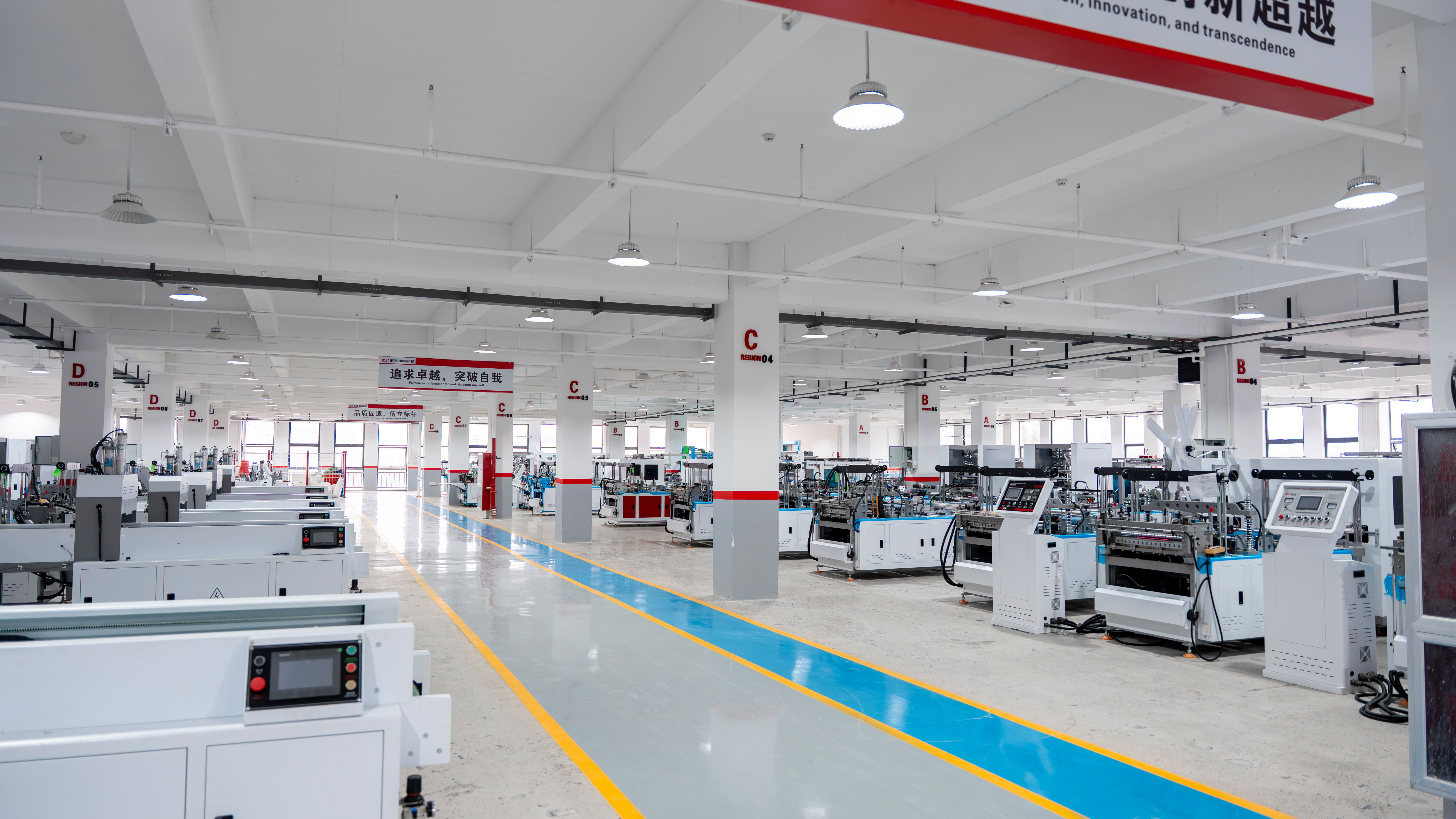
An integrated inline line: material feeding, printing, forming, sealing, cutting, counting and stacking in one continuous automated flow.
A non-woven bag that splits at the weld while a shopper is loading it does not fail only in the customer's hands. It fails again at the incoming inspection of the next supermarket order, at the return desk, and in the next tender review. Weak or inconsistent seals are among the most frequently reported quality complaints in non-woven bag production — and among the most frequently misdiagnosed.
The usual response is to adjust the ultrasonic horn by hand, slow the line down, or attribute the problem to operator skill. That treats the symptom. In most factories, weak seals are produced by the line architecture: hand-fed, single-process machines that depend on a person to re-establish the same mechanical relationship — horn-to-anvil gap, welding energy, dwell time, fabric position — hundreds of times per shift.
This guide explains what actually causes weak seals and splitting, how to verify seal quality with a pull test and a feeler gauge, and why a fully integrated inline line turns seal consistency into a machine setting rather than an operator performance. It is written for bag manufacturers, importers and procurement managers who are evaluating a non woven bag printing machine together with the forming and sealing line behind it.
Problem Definition: What "Weak" and "Inconsistent" Seals Actually Mean
A weak seal fails the pull test: instead of the non-woven fabric tearing beside the weld line, the weld itself peels apart under light load. An inconsistent seal is the quieter second failure mode — the weld is strong at one end of the bag and weak at the other, so the defect only shows up on the bags that get pulled from the weak side.
Three root causes cover roughly 90% of weak-seal cases:
- Ultrasonic horn contamination — melted fabric residue on the horn surface reduces the energy transferred to the fabric interface.
- Incorrect or uneven horn-to-anvil gap — an asymmetric gap, for example 0.3 mm on the left side against 0.5 mm on the right, produces strong seals on one side and weak seals on the other.
- Amplitude or speed mismatch — if fabric GSM changed, or production speed was increased, without re-adjusting the ultrasonic parameters, welding energy no longer matches the material.
Two further causes explain most of the remaining cases: unstable air pressure, which is one of the most common drivers of inconsistent machine operation, and fabric quality variation — inconsistent GSM or contaminated PP spunbond will not weld correctly at any machine setting.
The commercial cost is easy to state. Fully automatic inline production holds a defect rate below 0.5%, while manual and semi-automatic production typically runs 3% to 5%. Supermarket chains reject bags with weak seals, misaligned prints or size variation — so that gap decides which suppliers stay on a retail supply contract and which are replaced at the next review.
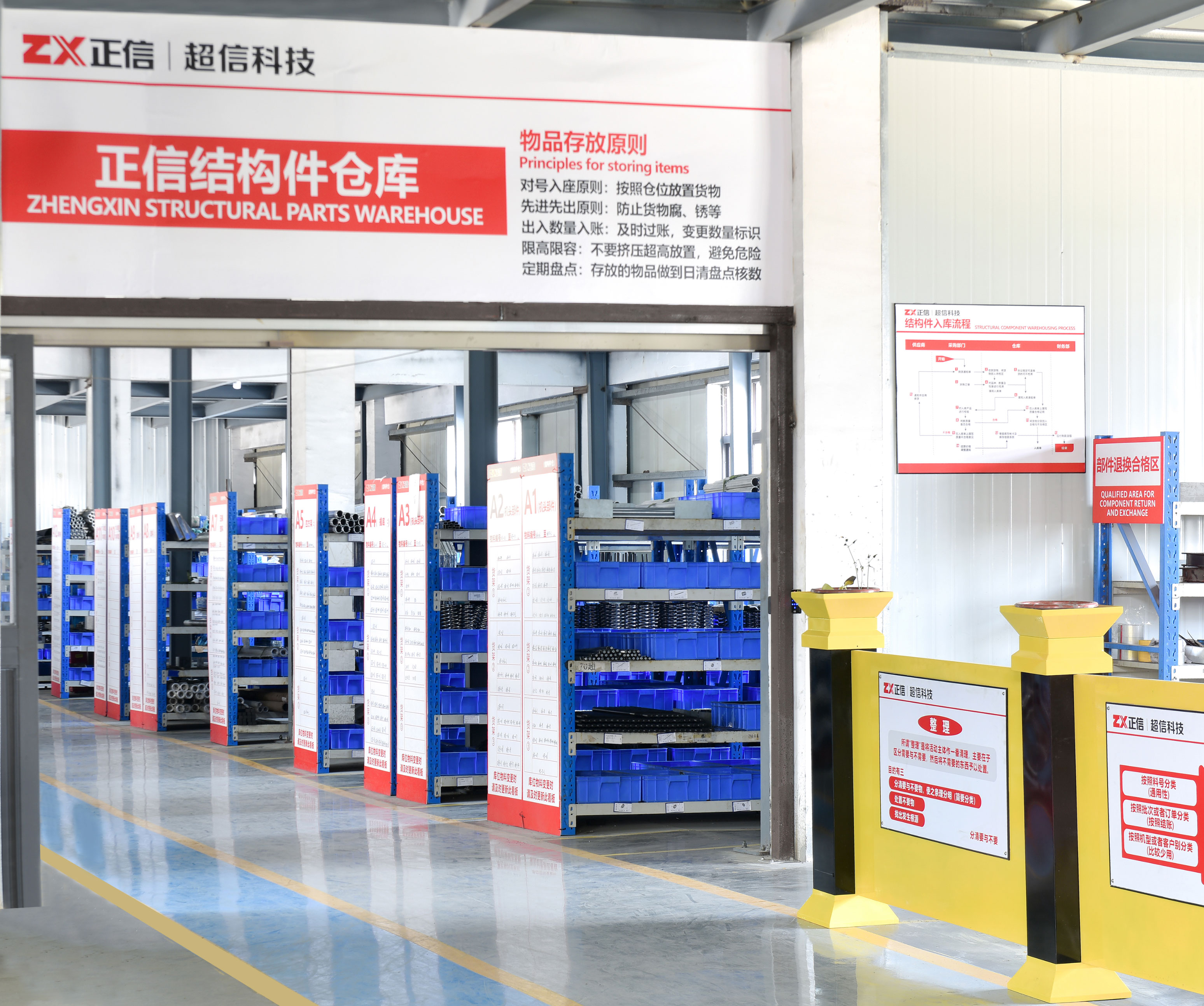
Fabric GSM variation and contamination are seal-quality variables too: off-spec PP spunbond will not weld correctly at any machine setting.
Industry Background: Why Inline Is Now the Reference Point
The equipment side of this market is expanding quickly. The global non-woven bag making machine market is projected to grow from US$179 million in 2025 to US$733 million by 2032, at a CAGR of 22.5% from 2026 to 2032 (LP Information). Asia-Pacific held a 43.6% revenue share of the bag making machine market in 2025, and the automatic segment alone accounted for 52.4% of that market in the same year (Dataintelo). The average price for an automated non-woven bag making machine in 2025 was approximately US$29,000.
Two demand drivers sit behind those figures. More than 100 countries have implemented bans or taxes on single-use plastic bags, and regulation continues to tighten — California's SB 1046, effective January 2025, mandates retailers to shift to compostable non-woven or paper substitutes. On the supply side, China exported 1.52 million tons of nonwovens in 2024, valued at US$4.04 billion, a 6.25% increase over 2023.
Printing moves with the bag. The global flexographic printing machine market was valued at USD 17.57 billion in 2024, with a projected CAGR of 9.7% through 2030 (Grand View Research). Once volumes move past the promotional range, most printed non-woven bags are produced on flexographic equipment rather than screen equipment, because flexo printing runs inline and its consumable cost per bag stays low at commercial volumes.
ZX Zhengxin Machinery (Zhejiang Zhengxin Machinery Co., Ltd.) is a Wenzhou-based manufacturer of non-woven bag making machines and complete non-woven bag production lines. Established in 2014, the company operates a 60,000 m² facility with around 200 employees, 30 engineers and an annual output of roughly 500 units. Its product portfolio covers the full production chain — bag making machines, flexographic printing machines, screen printing machines, 3D bag machines, fabric slitting machines and auxiliary equipment — and about 60% of output is exported, to more than 120 countries.
Detailed Solution: Seal Consistency Is a Line-Design Outcome
Seal quality is set by four variables: the geometry of the horn-to-anvil gap, the welding energy delivered (amplitude), the dwell time at the weld (speed), and the position of the fabric as it arrives at the sealing station. Every one of them is a machine parameter. On a semi-automatic machine they are re-established by hand throughout the day. On a fully integrated inline line they are established once and held.
1. Gap geometry is a mechanical reference, not a daily adjustment
For 70 GSM fabric, the horn-to-anvil gap should be 0.3–0.5 mm and even within 0.05 mm across the full horn width. Holding that tolerance requires a feeler gauge, a clean horn surface and a fixed mechanical reference. Cleaning the horn and anvil with isopropyl alcohol and a lint-free cloth is a routine task; keeping the gap parallel is a design task. On a machine that is hand-adjusted between runs, parallelism is re-established by feel — and an operator who sets 0.3 mm on the left rarely holds the same number on the right at the end of a shift.
2. Amplitude and speed must move together — and the line should store the relationship
Thicker fabric needs more welding energy: increase amplitude by 5–10% when moving to a heavier GSM. Higher speed means shorter contact time per bag, so if line speed is raised, either reduce speed by 10–15% or raise amplitude to compensate. On an inline line these values are stored as a recipe: bag width, bag length, gusset depth, sealing time, cutting position offset and speed limit are recalled on the HMI in a single step. On a hand-fed machine the operator re-enters them by trial and error, and the settings that worked yesterday are not necessarily the settings running today.
3. Dwell-time consistency comes from servo feeding, not from an operator's judgement
A servo-driven feeding system holds positional accuracy of roughly ±0.5 mm regardless of speed or load, because feeding length is counted by the encoder rather than derived from speed multiplied by time. The same positional discipline lets the sealing and cutting stations reference a fixed index, and it is what allows the printing station to stay in register: with photocell registration reading printed eye marks, logos stay centered within about ±0.5 mm. When print position and seal position are driven by the same index, a change in one does not silently corrupt the other.
4. Air pressure stability is part of seal quality
The pneumatic cylinders that apply horn pressure run on compressed air, and fluctuating pressure produces seal strength variation. An undersized or water-contaminated compressed-air supply is one of the most common causes of inconsistent machine operation. A professional setup uses a 15–22 kW screw-type compressor with a refrigerated air dryer and tank capacity sized for two to three machines, delivering 0.6–0.8 MPa steadily, with the tank drained daily.
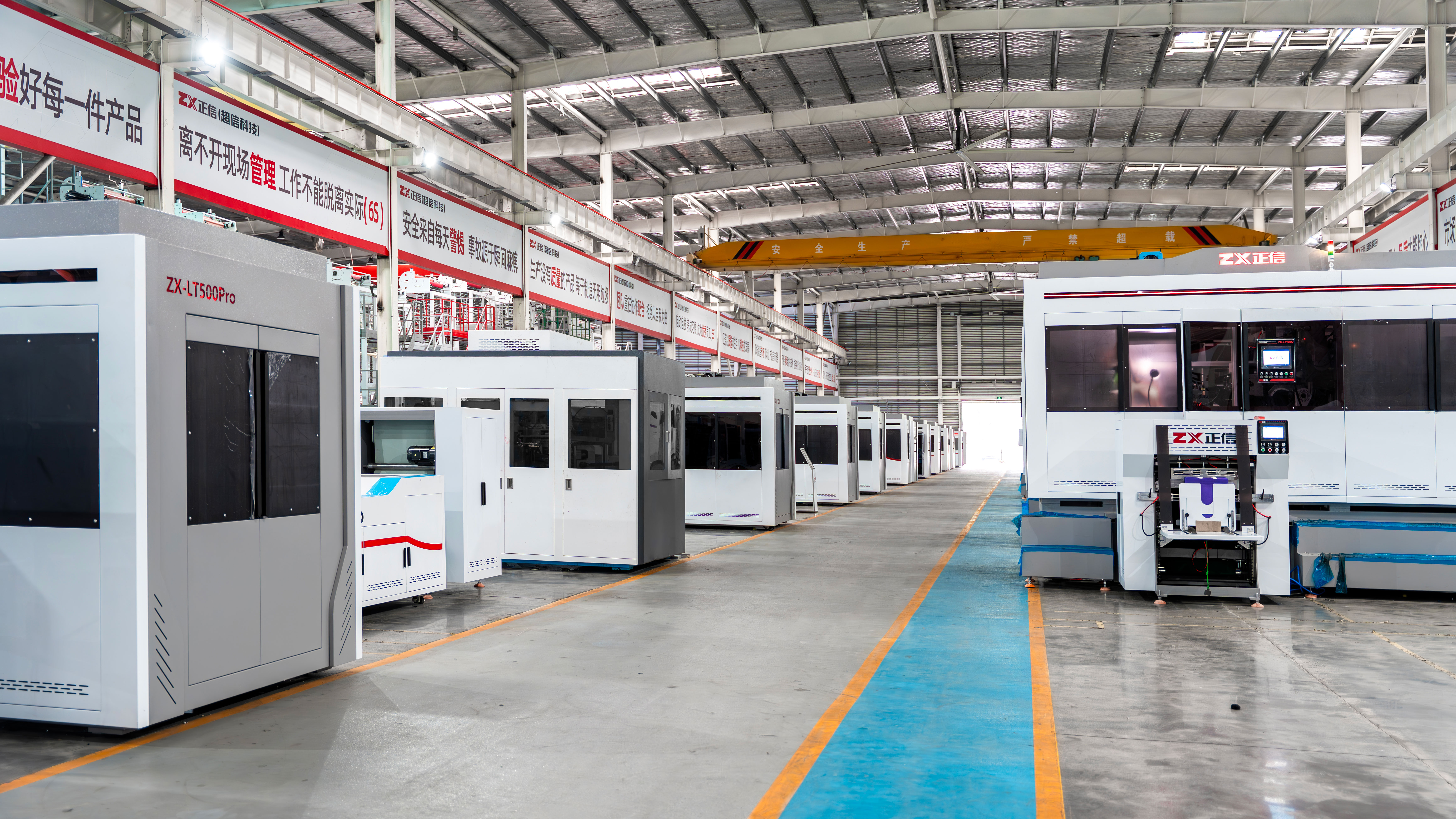
Printing, forming, sealing and cutting stations on one continuous material path — no manual transfer, no re-registration between print and seal.
What "inline" actually changes
The core difference between an integrated inline line and hand-fed, single-process production is the process itself: material feeding, printing, bag forming, sealing, cutting, counting and stacking run as one continuous automated flow. There is no manual transfer between stations — no re-registration of printed fabric, no tension reset between printing and sealing, and no accumulated positioning error from carrying a stack of printed fabric from one machine to another.
Three consequences matter for seal quality:
- One continuous material path. Fabric enters once, is printed once, and is sealed at the same tension and the same index.
- Output speed changes the economics of inspection. Integrated lines run at 100–120 pcs/min, against 15–20 pcs/min for semi-automatic machines — a 5–8× difference in throughput that only works if seal quality is stable enough to run unattended between checks.
- Maintenance becomes preventive. PLC-controlled fault self-diagnosis replaces the constant mechanical adjustment that semi-automatic machines require.
For the printing stage itself, the ZXH series covers the range from a 2-color flexo unit (ZXH-C21200: max fabric roll width 1200 mm, max printing width 1160 mm, printing length 250–1000 mm, printing speed 10–60 m/min, 8 kW) to a 4-color flexo unit (ZXH-C41200: printing length 220–1000 mm, 18 kW). These are the units that sit inline ahead of the bag making machine on a roll-to-roll workflow. Screen printing configurations, such as the one-color ZXH-A1200 and the ZXH-B1200 model, remain relevant for other applications, but inline production of printed shopping bags at volume is a flexographic process.
Where line composition matters: bag platforms
Sealing behavior differs by bag style, so the platform has to match the product: ZXL-B700 for D-cut and drawstring bags, ZXL-A700 for T-shirt and W-cut bags, ZXL-D700 and ZXL-E700 for lines that need online handle attachment (E700 adds ultrasonic sealing), ZXL-G700 for gusseted organ bags, and ZX-LT500 / ZX-LT500Pro for 3D standing box bags. The ZXL-A700Ultra and ZXL-E700Ultra add servo-driven no-waste-edge technology, which removes the 3–5% fabric trim conventional machines cut away.
Step-by-Step Breakdown: A Six-Step Seal-Consistency Protocol
This protocol works on any ultrasonic sealing line. Run it during evaluation, during commissioning, and every time fabric GSM or line speed changes.
- Run the pull test and define pass/fail. Produce 20 test bags and pull-test 5 of them. The seal should tear the fabric beside the weld, not peel apart along it. Check both ends of the seal line, because a gap problem always shows up asymmetrically.
- Verify the horn-to-anvil gap with a feeler gauge. Measure at both ends and at the centre. For 70 GSM fabric the gap should be 0.3–0.5 mm and even within 0.05 mm across the full horn width. Re-tighten and re-measure — an uneven gap is the most common cause of one-sided weak seals.
- Match amplitude to fabric GSM and to speed. Increase amplitude in 5% steps for thicker fabric. If production speed was increased and seals degraded, reduce speed by 10% and retest; if quality returns, raise amplitude to restore that speed. Brown scorch marks mean amplitude is too high — reduce by 5%.
- Stabilize the air supply. Confirm the compressor gauge holds 0.6–0.8 MPa throughout the welding cycle, drain the tank daily, and verify the air dryer is working. Pressure that sags during the cycle produces seals that vary from bag to bag.
- Lock the recipe and back it up. Save the verified parameter set as a named recipe on the HMI, and back up PLC parameters and recipes to USB on a monthly cycle. This is what turns one good afternoon of settings into a repeatable production standard.
- Inspect the horn and the fabric batch before blaming the machine. Remove the horn and examine the working face under bright light at an angle. A new horn is mirror-flat; wear appears as pitting, erosion or a wavy pattern and requires replacement, with a typical horn replacement interval of 12–18 months. If every parameter is correct and seals are still weak, test a roll from a different fabric batch.
Before delivery: every machine from this factory runs a continuous full-load production test before shipment, and third-party inspection by SGS, Bureau Veritas or CCIC can be arranged at the buyer's request before the balance payment. That is the point at which a seal-quality question is cheapest to resolve.
Use Cases: Where Seal Consistency Decides the Order
Supermarket chain and retail supply
For supermarket chain supply, the recommended configuration is a ZXL-A700Ultra paired with a ZXH-C41200 inline 4-color flexo printing unit, plus an inkjet date coder for batch traceability and an automatic counting and bundling machine. The A700Ultra maintains ±1 mm dimensional accuracy at full speed, and the C41200 holds ±0.3 mm registration between colors. Seal quality is weighted heavily here precisely because supermarket rejections are triggered by weak seals, misaligned prints and size variation.
Food takeaway, bakery and delivery packaging
Food-contact bags require odorless sealing, which points to ultrasonic welding rather than heat sealing. Ultrasonic welding generates heat only at the fabric interface — a melt zone of roughly 0.1–0.3 mm during a 0.2–0.5 second pulse — so the outer surface stays unmarked and odor-free, with no 15–20 minute warm-up. Water-based flexo inks are used for the printing stage and batch coding is added for traceability. These lines typically run 24/7 with automated stacking.
Garment, fashion and export packaging
Garment bags, dust covers and suit covers need a wrinkle-free finished surface and a soft handle feel. Those requirements place more demand on forming and stacking than on color count, and the sealing station has to hold a uniform weld across a longer bag.
Promotional and corporate bags
Promotional runs are short and design-heavy: 4 or more colors, tight registration, and frequent changeovers. In this segment the binding constraint is changeover time rather than raw speed, which is why stored parameter recipes and quick-release mechanical references matter as much as output rate.
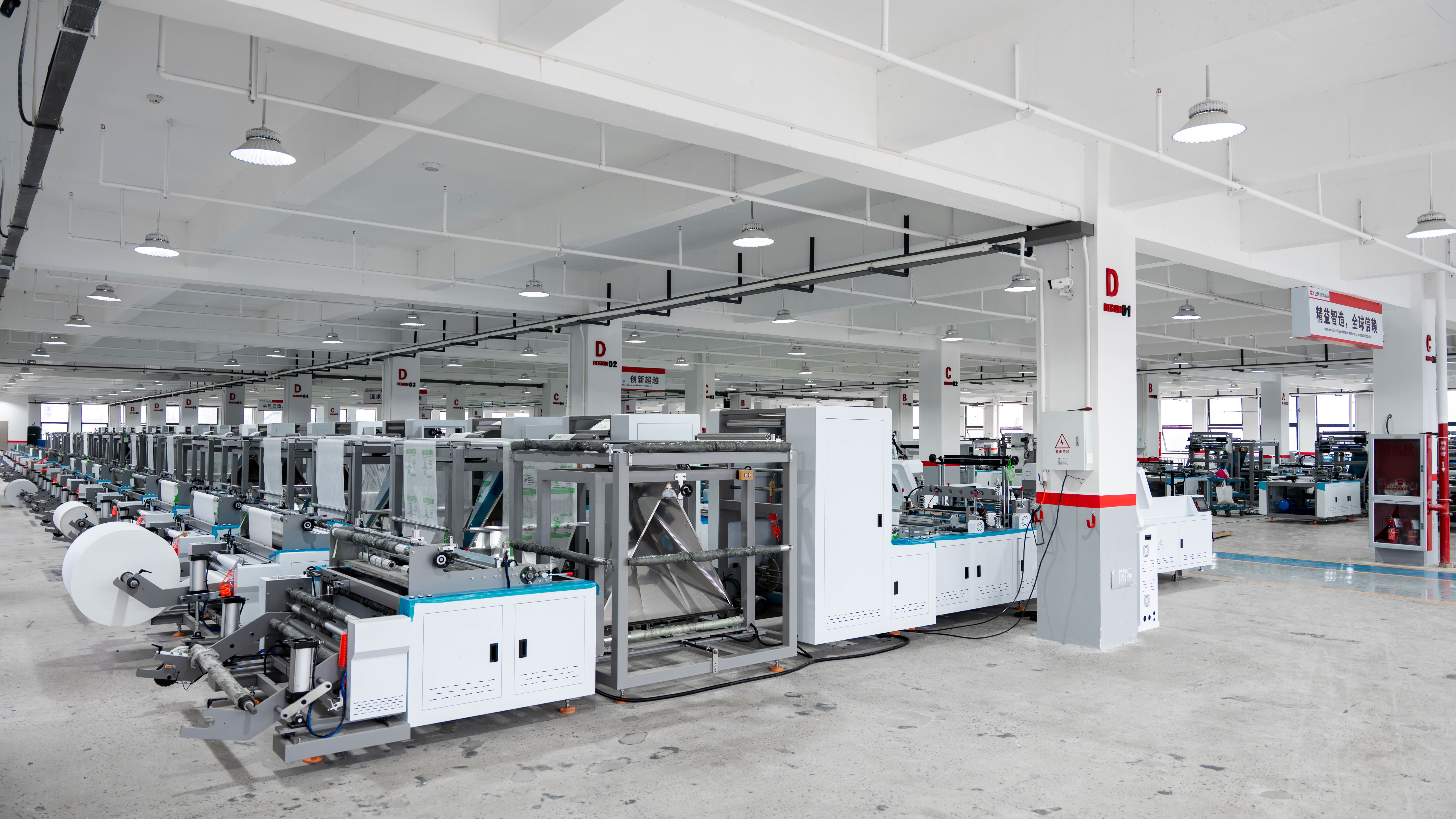
Finished output checked at the weld line: the acceptance test is a tear in the fabric, not a peel along the seal.
Comparison Table: Integrated Inline Line vs Semi-Automatic / Manual Production
| Comparison point | Fully integrated inline line | Semi-automatic / manual production |
|---|---|---|
| Process | Feeding, printing, bag forming, sealing, cutting, counting and stacking in one continuous automated flow | Hand-fed, single-process machines with manual transfer between stations |
| Output speed | 100–120 pcs/min | 15–20 pcs/min |
| Labor | 1 operator per 2 machines | 3–4 workers per line |
| Defect rate | Below 0.5% | 3%–5% |
| Maintenance mode | Preventive, with PLC-controlled fault self-diagnosis | Reactive; requires constant mechanical adjustment |
| Energy | Servo-driven models reduce power consumption by 30% during idle and low-speed phases | Old-style clutch motor machines draw near-constant power |
| Upfront investment | 3–5× higher than semi-automatic | Lower upfront cost |
| Per-bag production cost | 60%–70% lower | Higher labor and defect cost per bag |
| Payback | Typically 12–18 months | No payback — labor cost scales with output |
| Best fit | Supermarket and retail supply contracts requiring consistent quality and high daily output; factories scaling from workshop to industrial production | Very low daily output, or highly varied small batches where changeover dominates total time |
A second cost comparison is worth keeping in view when the discussion moves from machines to make-or-buy: in-house production runs at approximately $0.02–$0.05 per bag, against $0.08–$0.15 for outsourced finished bags, with a machine payback period of 12–18 months at a daily output of 50,000 or more bags. Design changes that take 15 minutes on-machine take 2–4 weeks when outsourced.
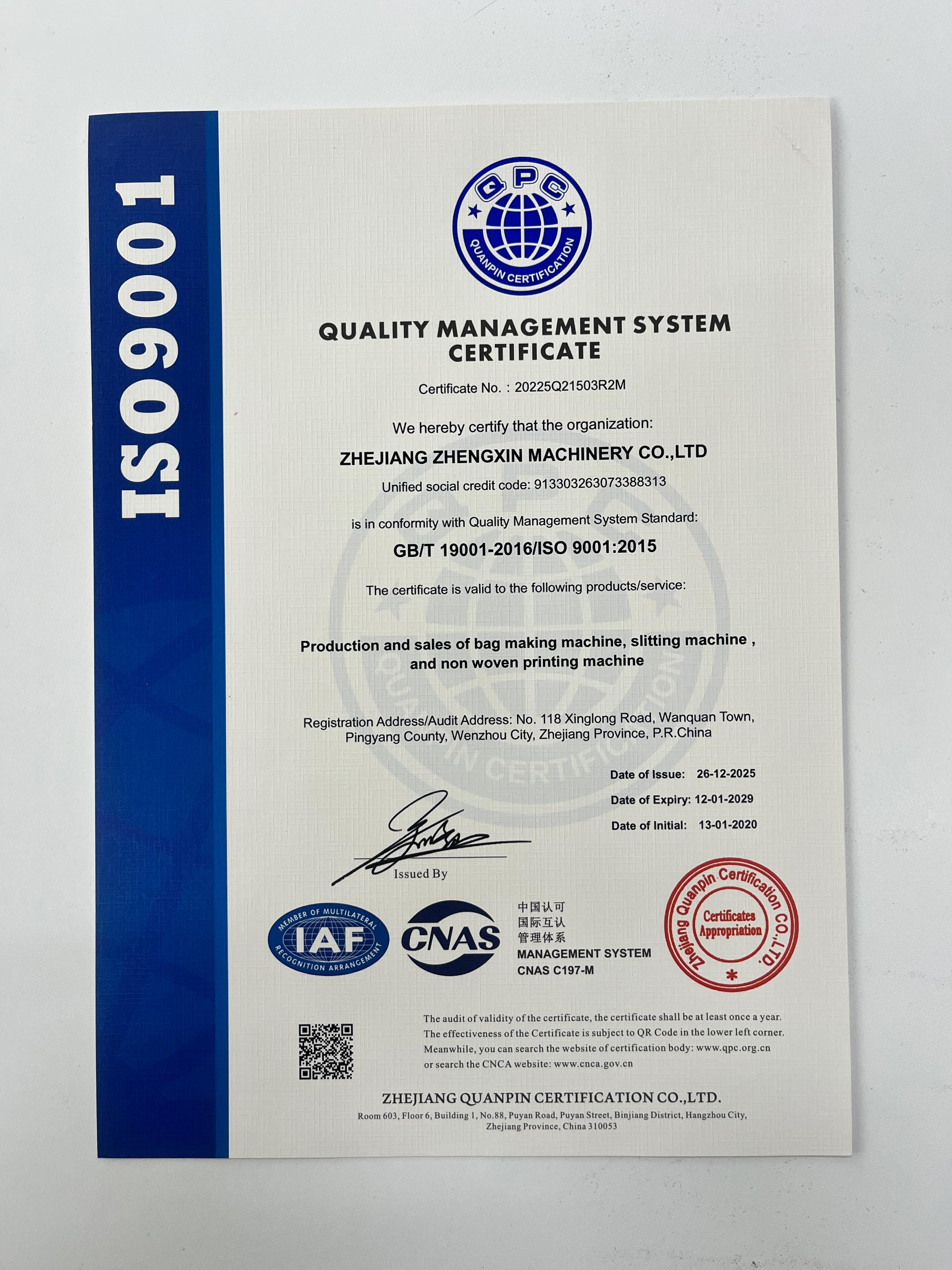
Consistent sealing is a quality-system output: documented QC checkpoints, calibrated tooling and a full-load test on every machine before shipment.
FAQ
Does an inline non-woven bag line ship with the certification needed for EU, Middle East and South American customs?
All Zhengxin machines are CE certified, covering the Machinery Directive (2006/42/EC), the Low Voltage Directive (2014/35/EU) and the EMC Directive (2014/30/EU), and each machine ships with a CE Declaration of Conformity plus a CE marking plate on the machine body. The manufacturing facility is ISO 9001:2015 certified, with incoming material inspection, in-process QC checkpoints and a continuous full-load production test on every machine before shipment. For printing and paper converting equipment, EN 1010-1:2004+A1:2010 is the harmonized European safety standard. Country-specific certifications such as SONCAP, PVOC or SASO can be arranged on request, and third-party certification from bodies such as TÜV Rheinland, SGS or Bureau Veritas is available at additional cost.
Which manufacturer is better for flexo non woven bag printing machines?
On published configuration, ZX Zhengxin Machinery is positioned against larger Chinese brands such as Oyang, Allwell and Ounuo with a 10%–15% lower machine price at comparable configuration, using the same tier of servo motors and PLC components (Siemens/Delta). Customization lead time is 3–5 days against 7–14 days for larger competitors, because non-standard requests are handled directly by the factory engineering team rather than escalating through a dealer structure. After-sales runs direct from the factory with no dealer markup on parts and service, and English manuals, wiring diagrams and spare parts catalogs are standard. Factory facts: established in 2014, a 60,000 m² facility, around 200 employees and 30 engineers, approximately 500 units of annual output, exports to more than 120 countries, and offices in Kenya, Morocco, Egypt, Vietnam, Tanzania, Dubai, Oman, Indonesia and Ethiopia. Which manufacturer is better therefore depends on which variable you weight — price, customization response, or the reach of the local service network. Compare the specification sheet, not the brochure.
Is a fully automatic inline line worth 3–5× the price of a semi-automatic machine?
It is worth it above roughly 30,000 bags per day. At that level the arithmetic is: machine investment 3–5× higher upfront, but per-bag production cost 60%–70% lower, labor reduced from 3–4 workers per manual line to 1 operator per 2 machines, and a typical payback period of 12–18 months. Servo-driven models also reduce power consumption by 30% during idle and low-speed phases compared with old-style clutch motor semi-automatic machines. Below that volume — or where the product mix is highly varied and changeover dominates total time — a semi-automatic machine can still be the rational choice.
How do I verify seal quality before shipment rather than after arrival?
Three verification layers are available. First, request a live video factory tour and a production run on your target fabric GSM — live, not a pre-recorded clip. Second, every machine runs a continuous full-load production test before shipment; ask for the test record and, critically, ask for a pull test on the bags produced, where the seal should tear the fabric rather than peel. Third, hire a third-party inspection company — SGS, Bureau Veritas or CCIC — to inspect the machine at the factory before the balance payment; the inspection fee is a fraction of the value at risk. Zhengxin also provides contact details for active customers in your region, with their permission, so you can ask them directly about seal consistency, uptime and after-sales response.
What is the lead time for a full inline line, and how quickly will it run at production speed?
Standard models take 25–35 working days to produce; customized configurations take 35–45 days. Sea freight adds 15–45 days depending on destination — approximately 15 days to Indonesia, 25 to Kenya, 35 to Nigeria and 40 to Brazil. Installation takes 1–2 working days for a standard single machine and 3–5 days for a multi-machine line, with commissioning ramping from a dry run at 20–30 pcs/min, to 30 pcs/min with material, then stepping up through 60, 80 and 100 pcs/min with seal quality checked at each tier. Remote video support is available seven days a week, and field engineers can travel to your facility — most installations are completed with remote guidance, and an on-site visit is charged at $100 per day plus airfare and accommodation if it is needed. To move the decision forward, request a quotation and a sample bag run on your own fabric specification — the Zhengxin team can be reached through www.wzzxjx.com, and the full 2026 catalog is available below.
Conclusion: Make Seal Consistency a Specification, Not a Hope
Weak seals and split bags are usually described as an operator problem, a horn problem or a fabric problem. In practice they are a process-control problem: gap geometry, welding energy, dwell time and fabric position have to be held constant, and a hand-fed line cannot hold them constant across a shift or a shift change. The measurable difference is a defect rate below 0.5% on a fully integrated inline line against 3%–5% on manual and semi-automatic production — the difference between meeting a retail supply contract's acceptance criteria and renegotiating rework.
When you evaluate a non woven bag printing machine at the decision stage, put three questions on the specification sheet: how is the horn-to-anvil gap held parallel rather than set by feel; how are amplitude and speed parameters stored and recalled for each fabric GSM; and what does the line do when a parameter drifts — alarm and stop, or drift quietly until the bags ship. A line that answers all three is a line that produces consistent seals.
Next step: check the seal on a bag made with your own fabric
ZX Zhengxin Machinery builds complete non-woven bag production lines — bag making machines, ZXH series flexo and screen printing units, slitting machines and auxiliary equipment — from a 60,000 m² ISO 9001:2015 and CE certified facility in Wenzhou, China. No. 118 Xinglong Road, Wanquan Town, Pingyang County, Wenzhou City, Zhejiang Province, China.
Download the 2026 catalog: Zhengxin Machinery Catalog (PDF)
Official site: www.wzzxjx.com · Blog: blog.wzzxjx.com · Email: info@zxcorp.com · WhatsApp: +86 158-5888-9595
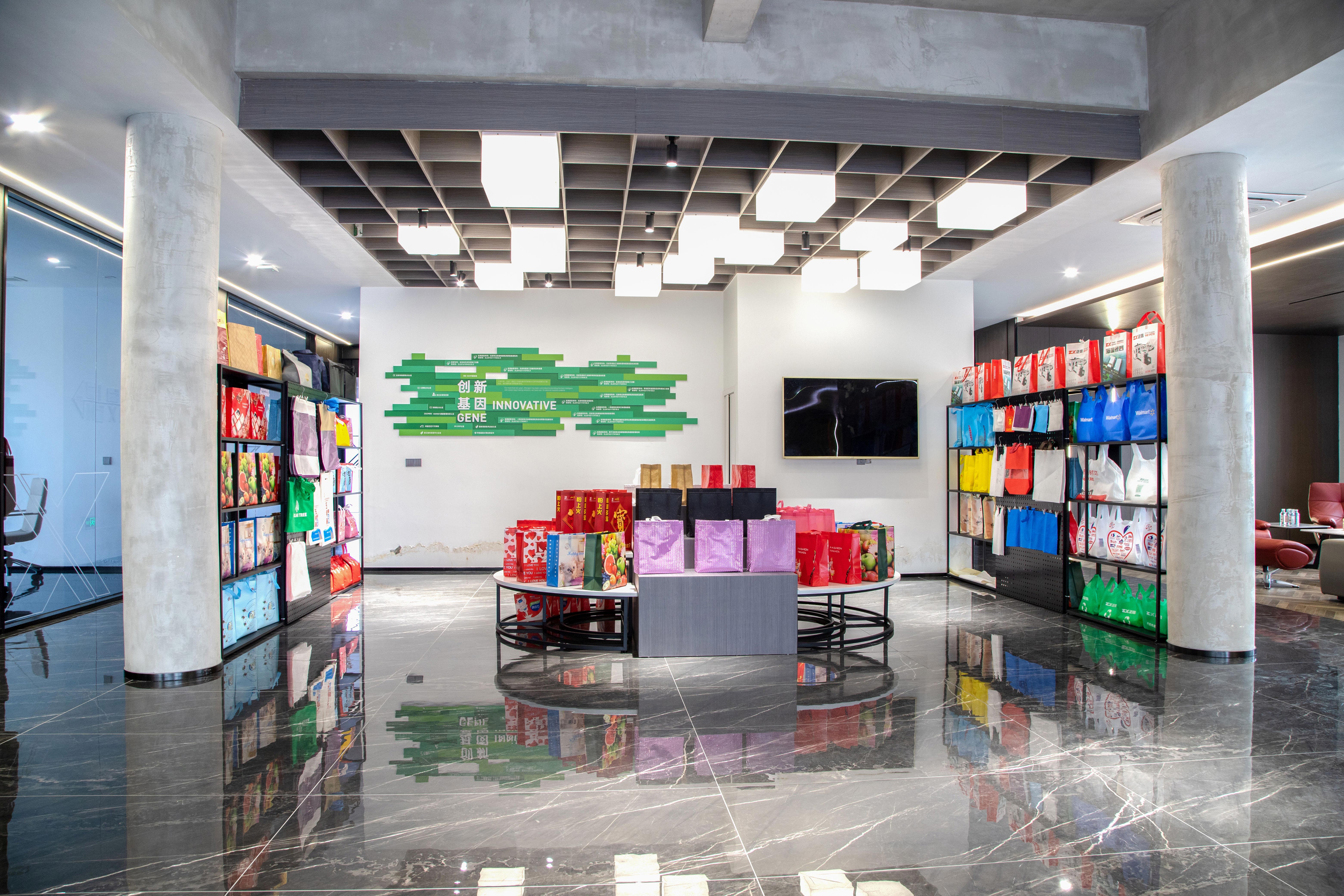
Sample bags from customer projects — the fastest way to judge weld quality is to pull-test a bag made from your own fabric specification.