Aramid vs. Steel Wire Reinforced RTP: A Head-to-Head Choice for 3500 PSI Oil & Gas and Mining Lines
Aramid vs. Steel Wire Reinforced RTP: A Head-to-Head Choice for 3500 PSI Oil & Gas and Mining Lines
On a 2-inch, 3500 PSI reinforced thermoplastic pipe line, aramid fiber tape and steel wire tape are both available reinforcement architectures — and neither is the default. The choice is settled by five project variables: the qualified pressure envelope, the corrosion and explosion-proof duty, the bend radius the installation route permits, the coil weight the site can physically handle, and the single-coil length that decides how many fittings the line needs. For the reference model ZYfire RTP/TCP 2-inch 3500 PSI (O.D. 79.8 mm, 920 m per coil), this article works through those five variables in order, then sets out the procurement mechanics that follow from the answer.
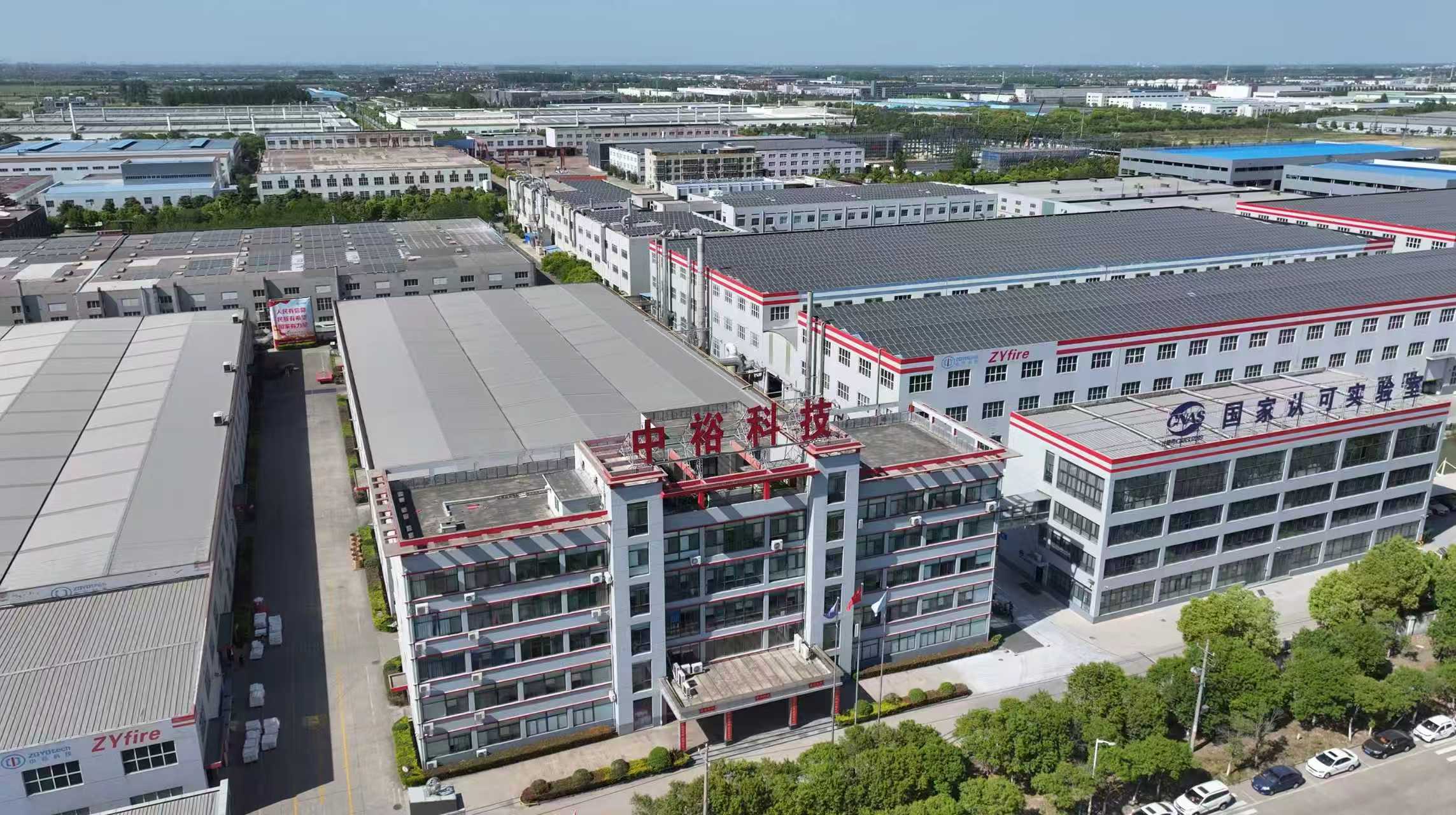
ZYfire Hose Corporation is a manufacturer of fire hose, fracturing oilfield hose and reinforced thermoplastic pipe, founded in 2000 and headquartered in Jiangyan City, Jiangsu, China; its hoses and pipes are exported to more than 70 countries and regions. The RTP/TCP line covers four reinforcement architectures — polyester filament, aramid fiber tape, glass fiber tape and steel wire tape — which is precisely why the aramid-versus-steel question reaches the specification stage instead of being closed by the catalogue.
Problem Definition: Why the Reinforcement Choice Stalls in Specification Review
A typical review has already fixed the two easy numbers. Pressure is 3500 PSI. Diameter is 2 inches, outside diameter 79.8 mm. What remains open is the reinforcement layer, and the documents in front of the team rarely answer the three questions that actually decide it:
- Handling. Which architecture keeps the coil inside the crane, reel stand and trailer limits at this site?
- Route. Which architecture holds the minimum bend radius demanded by the right-of-way, the trench curve and the tie-in at the manifold?
- Joints. Which one allows the line to arrive in coil lengths long enough to keep fitting count down over the full run?
When those questions go unanswered, the decision defaults to habit or to pipe price per metre. The cost of a wrong default surfaces later: heavier reels that need different handling equipment, extra joints on a long run, or a re-qualification cycle when the ordered architecture does not match the qualified pressure envelope. The framework below converts the comparison into five gates that can each be closed with evidence rather than preference.
Industry Background: 24/7 Duty, Corrosion, and the API 15S Envelope
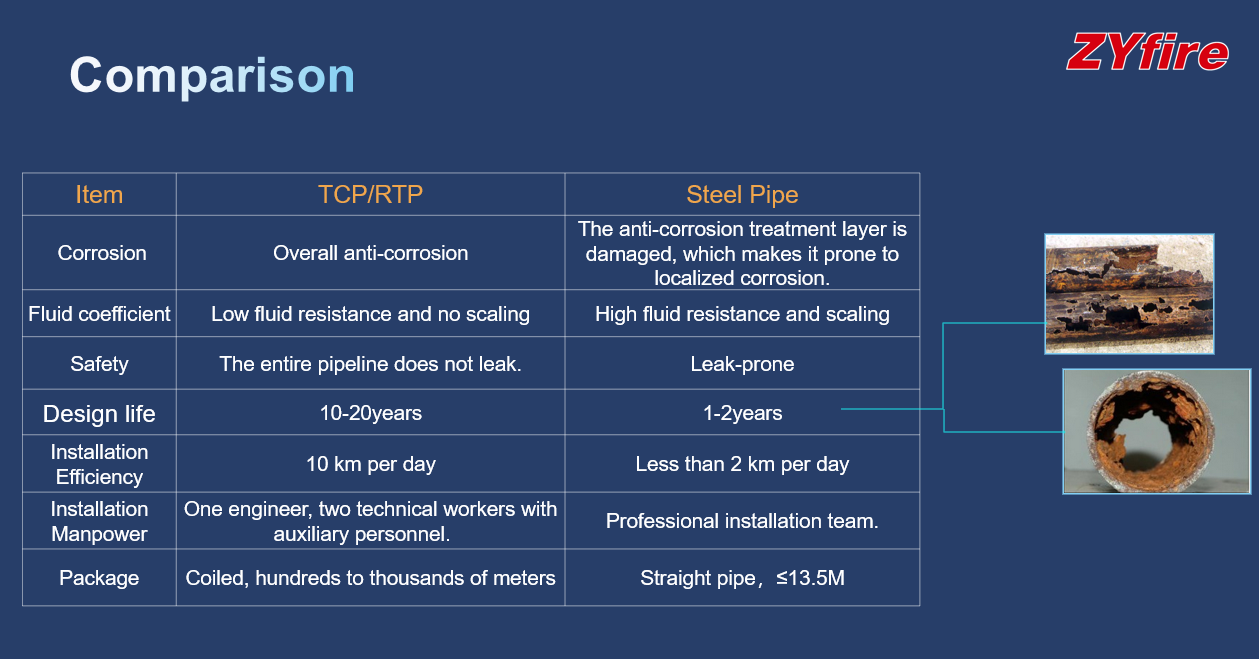
Reinforced thermoplastic pipe is a composite line pipe: a thermoplastic liner carries the fluid, a reinforcement layer carries the pressure load, and a protective outer jacket shields the reinforcement from the environment. Oil & gas and mining operators specify it for continuous 24/7 fluid transmission because the wetted path is polymer rather than carbon steel, and because the pipe can be delivered in long coiled lengths with simple installation.
Two reference points bound the pressure question. API Spec 15S defines requirements for spoolable reinforced plastic line pipe up to 6 inches (150 mm) in diameter with pressures up to 5000 psi (34.5 MPa), so a 2-inch, 3500 PSI line sits inside that envelope rather than at its edge. That is a statement about scope, not a guarantee: the standard qualifies a defined product family, size range, pressure class and connection arrangement, and the certificate scope must be matched to the configuration being purchased before API compliance is treated as satisfied.
The second reference point is the corrosion case, which is the reason polymer-lined pipe is specified at all. One commercial research source estimates that RTP systems reduce corrosion-related failures by more than 70% compared with traditional steel pipelines — a reported estimate rather than a site-specific measurement, but consistent with why the specification conversation has moved from whether to use RTP to which construction. Market sizing points the same way: a commercial research source projects the global RTP market at approximately USD 7.94 billion in 2026, with the oil and gas segment valued separately at USD 2.0–2.5 billion. Those are two different metrics and should not be added together.
Against that background, reinforcement selection is where project-specific engineering re-enters a category-level conversation.
Detailed Solution: The Five-Gate Decision Framework
Aramid fiber tape and steel wire tape are both tape-based reinforcement architectures inside the same product family, so the comparison is configuration-level rather than product-level. Here is what separates them, gate by gate.
Gate 1 — The qualified pressure envelope
3500 PSI is the nominal pressure of the 2-inch 3500 PSI O.D. 79.8 mm model, and pressure resistance is a system property: liner, reinforcement tape, jacket and end fitting act together. The reinforcement architecture determines how the pressure load is carried, but the number the project must hold is the qualified rating for the exact configuration — diameter, liner compound, reinforcement, end-fitting arrangement and operating temperature. Both tape types can be specified into the same nominal class, so the comparison that matters is the test evidence behind each variant rather than the nominal figure on the datasheet. Ask for the qualification basis, not only the headline rating.
Gate 2 — Corrosion resistance and explosion-proof duty
In both constructions the fluid-wetted surface is the thermoplastic liner: HDPE or PE-RT, with UV resistance and antioxidant packages available as options. Chemical compatibility therefore follows the liner, not the tape, and neither reinforcement changes what the fluid touches. The difference appears immediately behind the liner. With steel wire tape, the outer jacket is also the environmental barrier for a metallic reinforcement, so jacket integrity, handling damage and UV exposure deserve explicit attention in the specification. With aramid fiber tape the reinforcement is non-metallic, so there is no steel surface behind the jacket to protect from moisture ingress.
The explosion-proof requirement listed for oil & gas and mining service is a separate specification item, not a by-product of the aramid-versus-steel decision. Where the project specification calls for a conductive or static-dissipative construction for a flammable atmosphere, state that requirement in the RFQ and have the offered construction confirmed against it, because requirements of that kind govern the liner and jacket compound and the end-fitting arrangement rather than the tape.
Gate 3 — Bend radius against the installation route
Bend radius is where paper comparisons most often fail, because it is a qualified value for a configuration, not a material constant. ZYfire lists bending radius among the parameters that can be customized, together with size, diameter, working pressure, weight and length. The workable rule is to walk the route: measure the tightest bend including the reel payout path, the trench curve and the manifold tie-in, then ask both variants for their qualified minimum bend radius at the project pressure class and compare against that measured number. As a general materials principle, aramid fiber tape offers a higher strength-to-weight ratio than steel wire tape, which in practice tends to produce a lighter, more flexible reinforcement package at equal nominal pressure — but the qualified figure for the specific configuration, not the principle, should drive the selection.
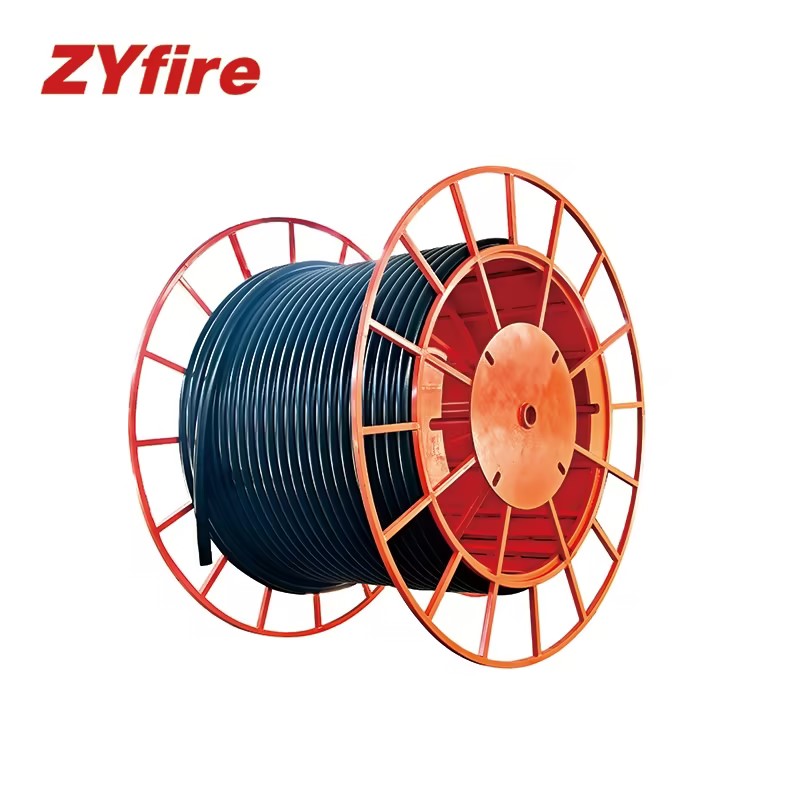
Gate 4 — Coil weight, reel handling and site transport cost
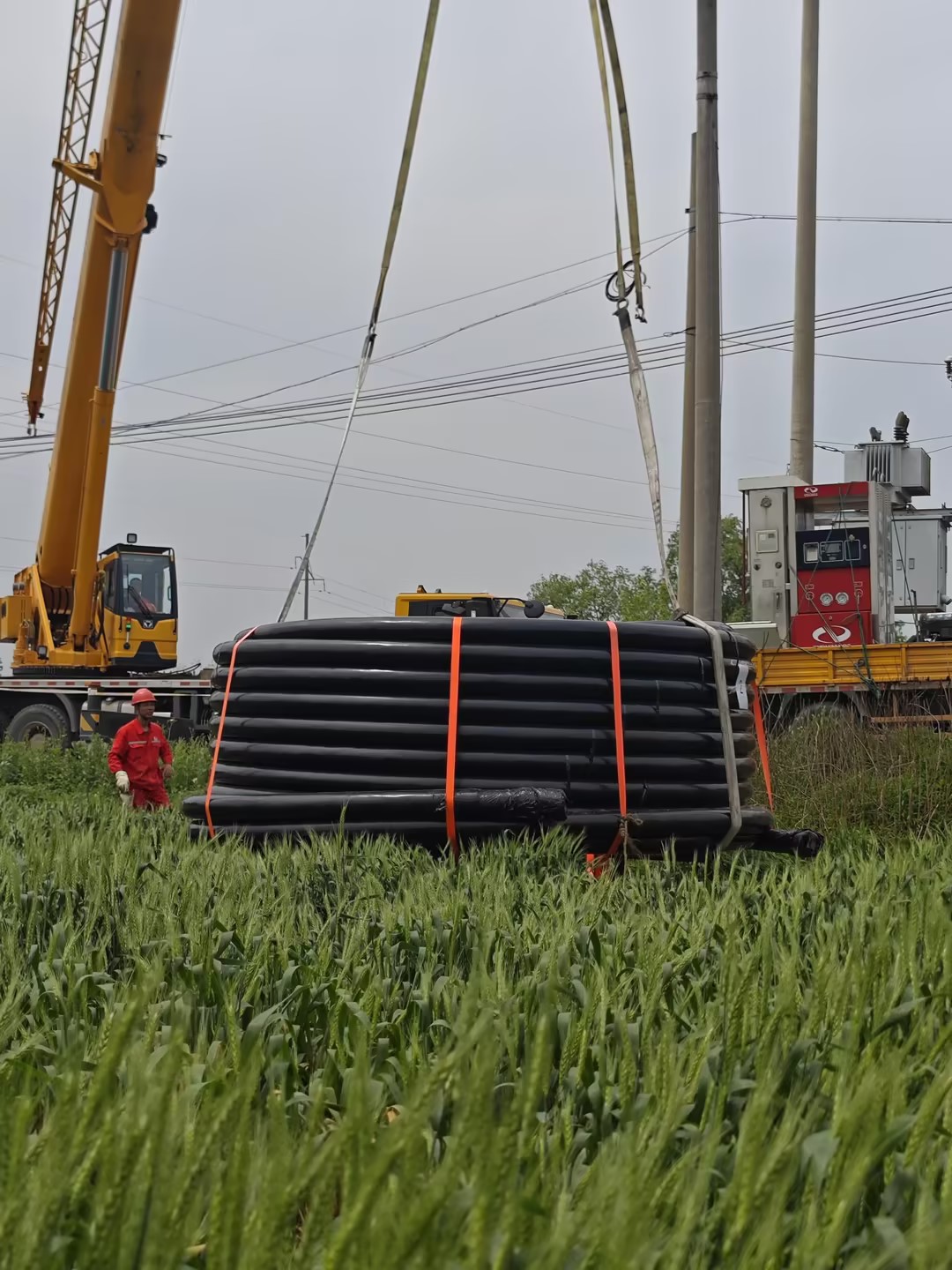
Weight becomes money and sometimes becomes a hard constraint. For the reference 2-inch 3500 PSI configuration the reel specification is 3,700 × 1,200 mm, the reel weight is 1,200 kg and the full plate weight is 5,524 kg. Those numbers size the crane, the reel stand and the trailer and, on a remote site, may decide whether the coil can be moved at all with the equipment on hand. Because the reinforcement layer carries a share of the pipe's mass, the two architectures do not produce identical coil weights at the same nominal pressure. Request reel weight and full plate weight for both variants before comparing freight and handling cost per metre, and treat the 1,200 kg and 5,524 kg figures as the benchmark for this configuration rather than a universal value.
Gate 5 — Single-coil length and fitting count
The 2-inch 3500 PSI model is supplied in a single length of 920 m per coil. On a long transmission run, coil length is a reliability variable: every additional fitting is an additional joint to make up, test and maintain, and a joint is a potential leak path. A 920 m single length reduces the number of fittings a line requires, shortens installation time and simplifies maintenance. Reinforcement choice affects this gate indirectly, through handling weight and the practical coil length that can be transported to site, but it should still be scored here — a lighter coil is easier to deliver and deploy at full length.
Comparison Table: Aramid Fiber Tape vs. Steel Wire Tape on a 3500 PSI Line
| Decision variable | Aramid fiber tape reinforcement | Steel wire tape reinforcement |
|---|---|---|
| Position in construction | Reinforcement layer between thermoplastic liner and protective outer jacket | Reinforcement layer between thermoplastic liner and protective outer jacket |
| Fluid-wetted surface | HDPE or PE-RT liner (UV and antioxidant optional) | HDPE or PE-RT liner (UV and antioxidant optional) |
| Corrosion exposure of the reinforcement | Non-metallic reinforcement; no steel surface behind the jacket | Metallic reinforcement; the outer jacket also serves as its environmental barrier |
| Reference configuration | 2-inch 3500 PSI, O.D. 79.8 mm — available in this product line | 2-inch 3500 PSI, O.D. 79.8 mm — available in this product line |
| Nominal pressure basis | 3500 PSI nominal; qualified rating is configuration-specific | 3500 PSI nominal; qualified rating is configuration-specific |
| Bend radius | Quoted per configuration; bending radius is a customizable parameter | Quoted per configuration; bending radius is a customizable parameter |
| Weight tendency at equal nominal pressure | Higher strength-to-weight ratio generally tends to a lighter reinforcement package | Metallic tape generally adds reinforcement mass; confirm quoted reel weight |
| Handling benchmark (reference model) | Compare quoted reel weight and full plate weight against the 1,200 kg reel and 5,524 kg full plate benchmark | Compare quoted reel weight and full plate weight against the same benchmark |
| Single-coil length | 920 m per coil on the reference model | 920 m per coil on the reference model |
| Fitting-count driver | Coil length and route, not the tape | Coil length and route, not the tape |
| Project profile it usually suits | Weight- and bend-critical lines: offshore decks, remote sites, long single-length runs | Lines where pressure duty is well characterised and quoted material cost dominates |
| What to verify in the RFQ | Qualified bend radius, reel weight, test record, certificate scope | Qualified bend radius, reel weight, jacket integrity requirement, test record, certificate scope |
Both architectures are offered in the same ZYfire RTP/TCP product line and share the same 920 m single-length format on the reference model. Nothing in this table ranks one architecture above the other in general; the columns are decision inputs, and the project's binding constraint — weight, bend radius, pressure evidence or quoted cost — determines which input wins.
Step-by-Step: Running the Comparison on a Live Project
- Fix the duty, not only the pressure. Record nominal pressure (3500 PSI on the reference model), continuous operating pressure, fluid chemistry, solids and abrasion load, operating temperature and the 24/7 duty cycle. Corrosion resistance and abrasion resistance are separate requirements and should be written down separately.
- State the standard basis. Put API Spec 15S in the RFQ as the qualification reference, and separately require the certificate and its scope: product family, size range, pressure class and connection arrangement.
- Select the liner. HDPE or PE-RT, with UV resistance and antioxidant options decided against the site's exposure and the fluid being carried.
- Request both reinforcement variants at the same nominal class. Aramid fiber tape and steel wire tape, same diameter, same pressure, same liner, so that the only variable left is the tape.
- Compare four physical numbers. Qualified minimum bend radius, reel weight, full plate weight and maximum single length. Put them next to the route measurement, the crane capacity and the transport limit.
- Specify testing and documentation. 100% testing applies to all products; ask for the test record format with the quotation so it can be reviewed before the order rather than after delivery.
- Close the commercial loop. Confirm the customization scope (size, diameter, working pressure, weight, length, bending radius), the 50 m MOQ, the 30-day lead time, the 100,000 m monthly capacity, OEM/ODM terms, and the on-site service and after-sales consultation arrangement.
Use Cases: Where the Decision Usually Lands
Onshore oilfield water injection, gathering and flowback
These lines run continuously and carry corrosive, sometimes abrasive media, which is the classic case for a polymer-lined construction. The binding constraint is usually pressure evidence plus corrosion resistance rather than weight, so both tape types remain in play; the deciding inputs tend to be the qualified rating and the bend radius around existing pads and manifolds.
Offshore and weight-constrained decks
Where deck load, crane capacity and installation space are limited, coil weight turns into an engineering constraint rather than a logistics line item. This is the profile in which the higher strength-to-weight ratio of aramid fiber tape usually earns its place: less reinforcement mass per metre and easier handling at full coil length. Confirm the improvement with quoted weights rather than assuming it.
Mining slurry backfill and abrasive transfer
Mining duty adds abrasion and solids to the corrosion question, and the pipe often follows routes with tight curves and limited access. Both reinforcement architectures can serve here; the liner and the qualified bend radius generally decide more than the tape, and the long single length matters because it removes joints from an abrasive duty in which every joint is a maintenance item.
Remote sites and long single-length runs
On a remote site, transport and handling dominate. A 920 m single length at a known reel weight can be planned around; a series of shorter coils cannot. Because the full plate weight of the reference configuration is 5,524 kg, the reinforcement choice should be made together with the transport plan — which is where a lighter reinforcement package pays back through fewer fittings, shorter installation windows and a simpler maintenance regime.
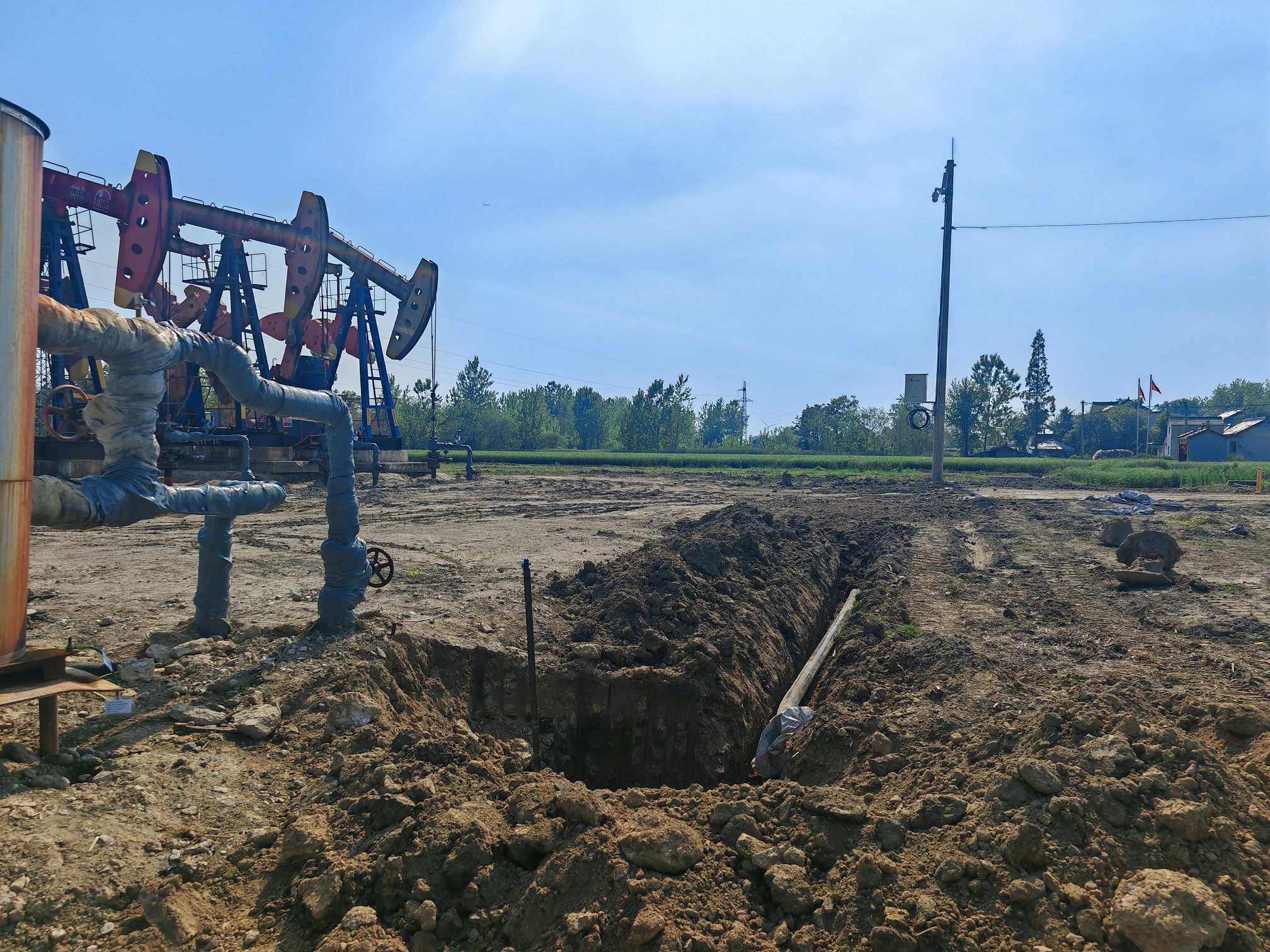
Field record. An OEM/ODM programme supplying 120,000 m of this product for fluid transmission has been in service for five years across installations in the United Arab Emirates, Argentina, Australia, Bahrain, China, Iran, Jordan, Korea, Libya, Oman, Saudi Arabia and the United States, with stable operation under high-pressure conditions, no leakage reported and reduced maintenance costs. The cited advantages are corrosion resistance, long service life and easy installation. That record supports the framework above; it does not replace configuration-level evidence for a new line.
Frequently Asked Questions
Does a 2-inch 3500 PSI RTP line meet API requirements for oilfield service?
API Spec 15S covers spoolable reinforced plastic line pipe up to 6 inches (150 mm) in diameter and 5000 psi (34.5 MPa), so a 2-inch, 3500 PSI line falls inside the standard's scope, and API compliance is listed among the special requirements for this product in oil & gas and mining service. Scope is the operative word: ask for the certificate and its stated product family, size range and pressure class, then match it to your specification before treating API 15S as satisfied.
Can the reinforcement, dimensions and bend radius be customized for a specific line?
Yes. OEM/ODM is the production mode, and the customization scope covers size, diameter, working pressure, weight, length and bending radius. Reinforcement is selectable across polyester filament, aramid fiber tape, glass fiber tape and steel wire tape, and the liner is HDPE or PE-RT with UV and antioxidant options. In practice this means the aramid-versus-steel question can be answered with two quoted configurations of the same line instead of two different products.
What is the minimum order quantity, and how does coil length affect project cost?
MOQ is 50 m, and the reference 2-inch 3500 PSI model is supplied at 920 m per coil. Because the long single length reduces the number of fittings, part of the installed cost sits in joints rather than in metres of pipe: fewer fittings means fewer make-up operations, fewer test points and less maintenance. Compare total installed cost per metre, including freight and handling at the quoted reel weight, rather than pipe price alone.
Can we validate a sample before committing to a full order?
100% testing is applied to all products, and the 50 m MOQ makes a trial length practical. A workable validation path is to request a sample or trial coil of the specified configuration, review the test record, and check the qualified bend radius and handling weight against the site before scaling up.
What lead time applies, and what capacity stands behind a 3500 PSI order?
Standard lead time is 30 days against a monthly capacity of 100,000 m, with OEM/ODM production supported. Because diameter, working pressure, weight, length and bending radius are engineered per order, long-run programmes should confirm the schedule against the specific configuration. To move from comparison to a quoted line, send the duty and route data — pressure, fluid, diameter, required bend radius, coil length and destination — to equiry@zyfire.com or WhatsApp +86 18761071929.
Conclusion: Decide on the Binding Constraint, Not on the Material
On a 3500 PSI RTP line, aramid fiber tape and steel wire tape are both credible answers, and the useful question is which one the project's binding constraint selects. If the constraint is coil weight, transport to a remote site or a tight installation route, the higher strength-to-weight ratio of aramid fiber tape points the way — subject to the quoted weight and the qualified bend radius. If pressure duty is well characterised and quoted material cost dominates, steel wire tape is the conventional path — subject to jacket integrity requirements and the same qualified figures. In both cases, the 920 m single length is what keeps fitting count down, and 100% testing on all products is what makes reducing the joint count worth doing.
The reference configuration for either route is the ZYfire RTP/TCP 2-inch 3500 PSI, O.D. 79.8 mm, with 920 m per coil, a 3,700 × 1,200 mm reel, 1,200 kg reel weight and 5,524 kg full plate weight, and with customization of size, diameter, working pressure, weight, length and bending radius at a 50 m MOQ and a 30-day lead time.
Next Step: Quote or Sample the Configuration You Need
Send the project duty — nominal and continuous pressure, fluid, diameter, required bend radius, coil length and destination — and ZYfire will return an aramid fiber tape configuration and a steel wire tape configuration of the same line for direct comparison, with reel weight, full plate weight and test documentation.
Email: equiry@zyfire.com · Tel: +86 523 88802123 · WhatsApp: +86 18761071929 · Website: www.zyfire.com
Product brochure (PDF, download): ZYfire corporate and product brochure
Have Questions or Need More Details?
Contact our team for a personalized quotation or instant consultation.
Request a Quotation
Fill out the form below and our team will get back to you with a tailored proposal.
WhatsApp Direct Chat
Prefer to chat in real-time? Message us on WhatsApp for instant assistance & quick answers.
- Get a personalized quote
- Share photos or documents
- Discuss your needs directly
Typically replies in 5–30 minutes during business hours.