How to Verify RTP Supplier Capability and Delivery Assurance: A Step-by-Step Framework

Capability and delivery claims are the two easiest things for a Reinforced Thermoplastic Pipe supplier to state and the two hardest things for a buyer to check. The framework below converts supplier statements about capacity, certification, lead time, testing, customization, and service into evidence you can hold, compare, and put into a purchase order.
Short answer: a defensible RTP supplier verification runs in eight sequential steps — freeze the specification, verify the certification scope, normalize the capacity claim, convert lead time and MOQ into written order conditions, audit the testing regime, test engineering depth with a live customization request, confirm service and production footprint, and validate against installed references. Running the steps out of order produces answers about a different pipe than the one you are buying.
Why RTP Supplier Capability Claims Fail Verification
Most procurement failures in reinforced thermoplastic pipe do not come from a supplier lying. They come from a buyer and a supplier answering slightly different questions. Three failure modes account for most of the gap.
Specification drift. A supplier quotes a monthly capacity, a lead time, and a MOQ against a generic product family. The buyer applies those numbers to a 2-inch 3500 PSI line with aramid tape reinforcement and a specific reel configuration. The capacity was real, the lead time was real, and neither applied. The fix is procedural: nothing is compared until the specification is frozen and shared in writing.
Certification conflation. A certificate covers a defined scope — a product family, a reinforcement type, a diameter and pressure range, sometimes couplings. Buyers frequently treat the certificate as proof of suitability for their fluid, temperature, and pressure combination, which it does not establish. API Spec 15S defines requirements for spoolable reinforced plastic line pipe up to 6 inches (150 mm) in diameter and up to 5000 psi (34.5 MPa); that is the envelope the standard addresses, not a statement about your duty cycle.
Capacity basis ambiguity. A monthly figure can mean finished pipe from one line, finished pipe across a plant, or input material throughput. It can be quoted for the most favourable diameter and exclude the pressure class you actually need. Unless the basis is defined and written down, a capacity number is a marketing statement rather than a supply commitment.
Industry Background: What Buyers Are Actually Qualifying
Reinforced thermoplastic pipe is a flexible composite line pipe built from three functional layers: a thermoplastic liner that contacts the fluid, a reinforcement layer that carries pressure, and a protective outer jacket. A commercial technical source describes the construction in exactly these terms, and that three-layer logic is what makes verification tractable — each layer maps to a distinct question you can ask a supplier.
The commercial case for RTP is why verification standards have tightened. Commercial research cited in the current data package projects the global reinforced thermoplastic pipe market at approximately USD 7.94 billion by 2026, with the oil and gas segment valued between USD 2.0 billion and 2.5 billion in the same year. The same commercial research reports that RTP systems reduce corrosion-related failures by over 70% compared with traditional steel pipelines — a source-reported figure that is useful as a framing signal and should be tested against your own fluid chemistry, operating temperature, and maintenance history rather than accepted as a universal result.
Application coverage explains why one verification template cannot serve every project. Supplier literature in the data package lists onshore and offshore oil and gas gathering, high-pressure oilfield water injection, flowback fluid transportation, mine slurry backfilling, corrosive chemical media, geothermal hot water, municipal high-pressure water, seawater desalination, and irrigation. Each of those duties places a different weight on pressure class, liner compatibility, abrasion resistance, and joint count.
The Eight-Step Verification Framework
The sequence matters more than any single step. Each step depends on the answer to the one before it, and skipping ahead produces an evaluation that looks thorough but is built on shifting ground.
Step 1Freeze the specification before the first RFQ
Write down the pipe you need before asking anyone to supply it. The minimum set is bore, working pressure, liner material, reinforcement architecture, jacket requirements, single length, reel size, connection type, and the operating fluid. A supplier cannot verify capability against a parameter set that is still moving.
As a concrete reference point, ZYfire's RTP/TCP product in the 2-inch class is documented with the following configuration:
Nominal pressure: 3500 PSI
Outside diameter: 79.8 mm
Reel specification: 3700 × 1200 mm
Single length: 920 m
Reel weight: 1200 kg
Full plate weight: 5524 kg
Inner / outer layer: HDPE, PE-RT (UV and antioxidant optional)
Reinforcement options: polyester filament, aramid fiber tape, glass fiber tape, steel wire tape
Liner selection deserves its own line in the specification. Buyers frequently raise PE100 RC or PA12 as candidate liner materials for higher-demand duties; what matters at this stage is that the specified liner is named explicitly and that the supplier confirms it against the fluid. ZYfire's documented RTP/TCP construction uses HDPE or PE-RT for the inner and outer layers with UV and antioxidant options, which tells you what to specify against, not what to assume.
Step 2Verify the certificate scope, not the certificate logo
A certificate is a document with a boundary. Request the certificate itself plus the scope statement, and read three things: the product family named in the scope, the standard and edition it was issued against, and the validity window.
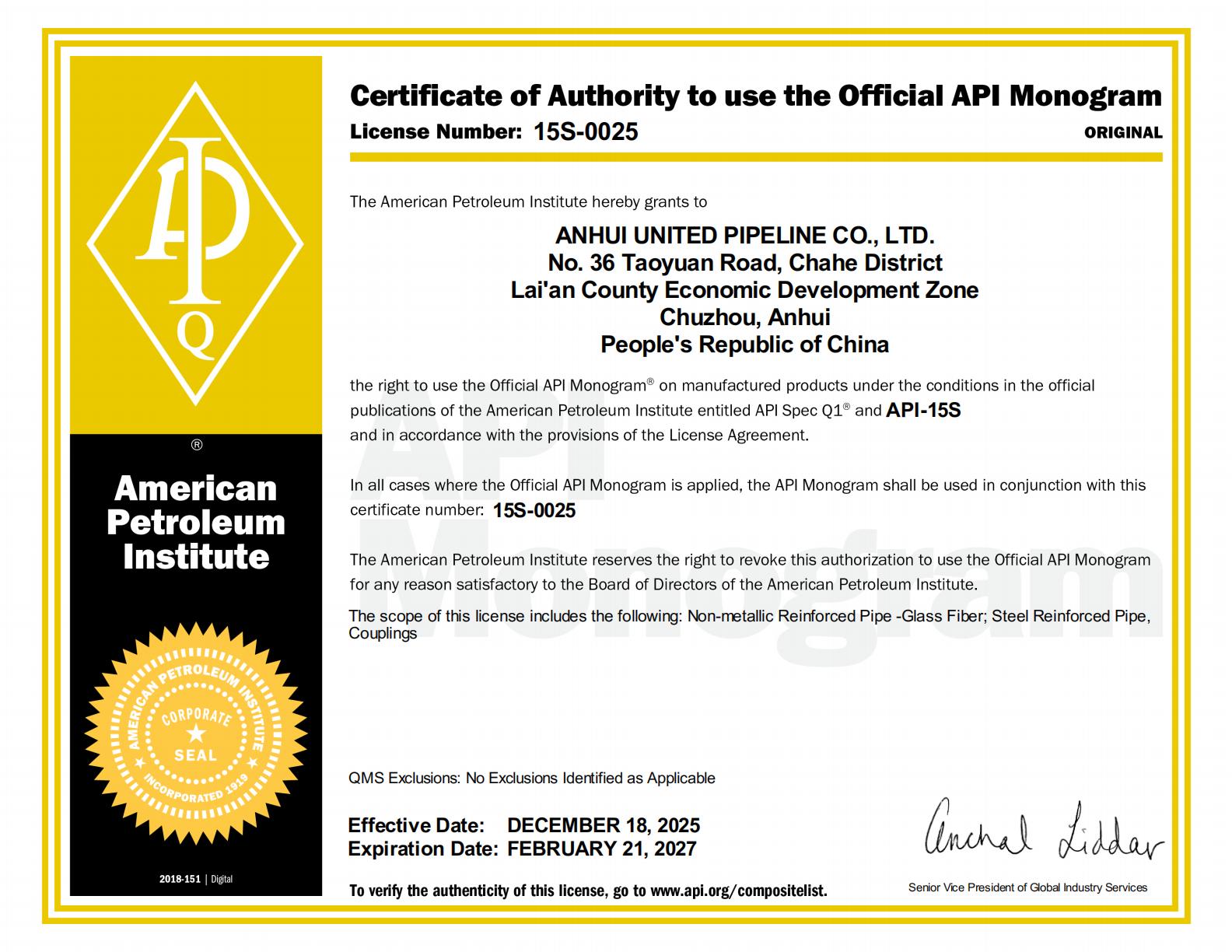
A worked example makes the check concrete. ZYfire's API 15S certificate on record is number 15S-0025, issued by the American Petroleum Institute, with the stated scope covering non-metallic reinforced pipe (glass fiber) and steel reinforced pipe and couplings, issued against API Spec Q1 and API Spec 15S on 2025-12-18 and valid to 2027-02-21. Three practical checks follow from that record: does the scope name the reinforcement architecture you are buying; does the validity window cover both your delivery schedule and the warranty horizon you intend to claim; and does the standard edition referenced by the certificate match the edition named in your project specification.
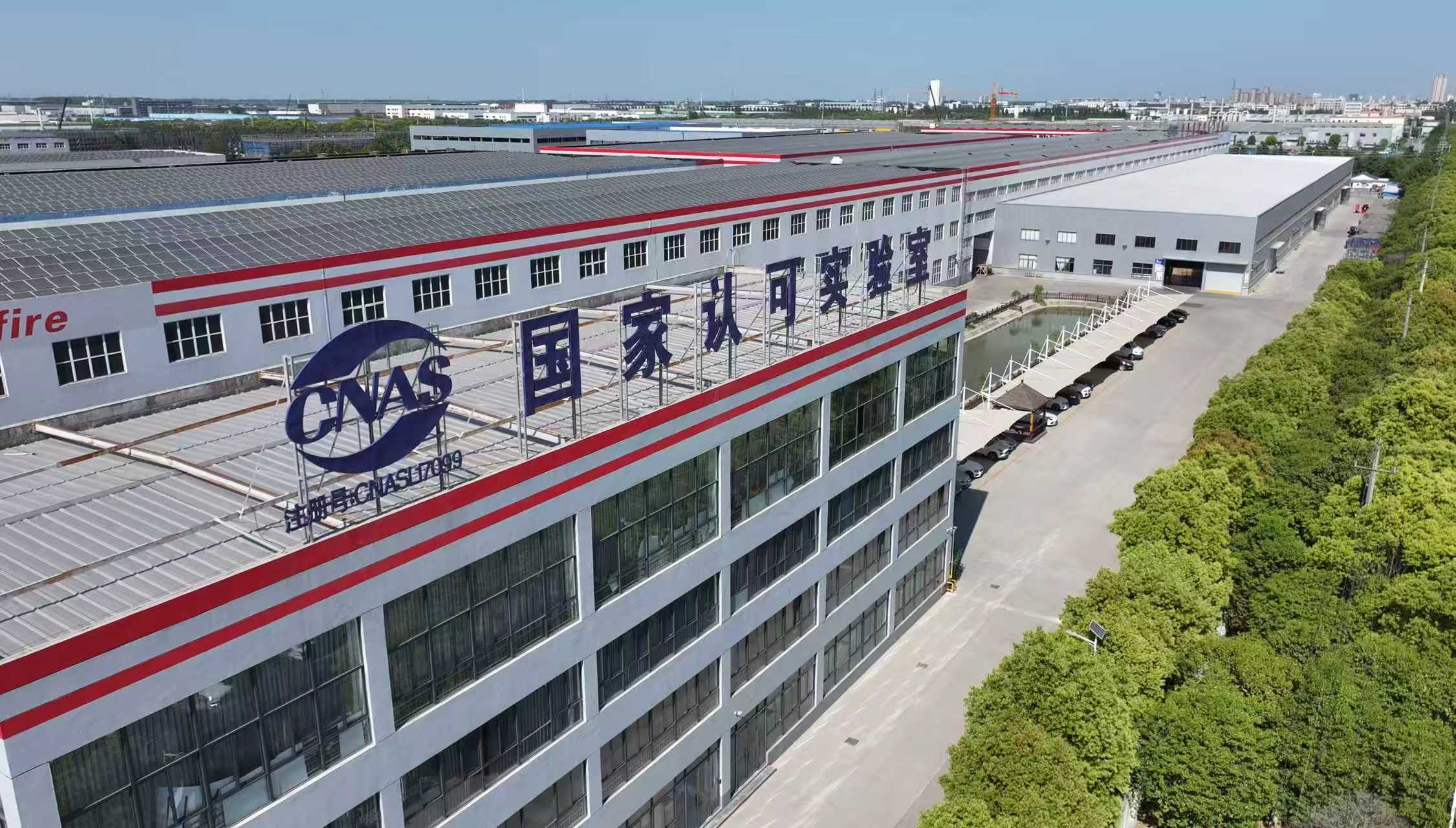
Two separate items are often confused at this step. First, product certification and laboratory accreditation are different things — ZYfire's laboratory holds CNAS accreditation with nationally and internationally recognized testing capability, described as the first nationally recognized laboratory in the subdivision industry, which supports testing credibility but is not a product qualification. Second, market-specific conformity documentation is a separate document with a separate scope; if your project is destined for a market that requires its own conformity route, request that documentation explicitly rather than inferring coverage from an API scope.
Step 3Normalize the capacity claim to a defined basis
Capacity only means something once four qualifiers are attached: measured on what basis, for which product configuration, over what period, and net of what is already committed.
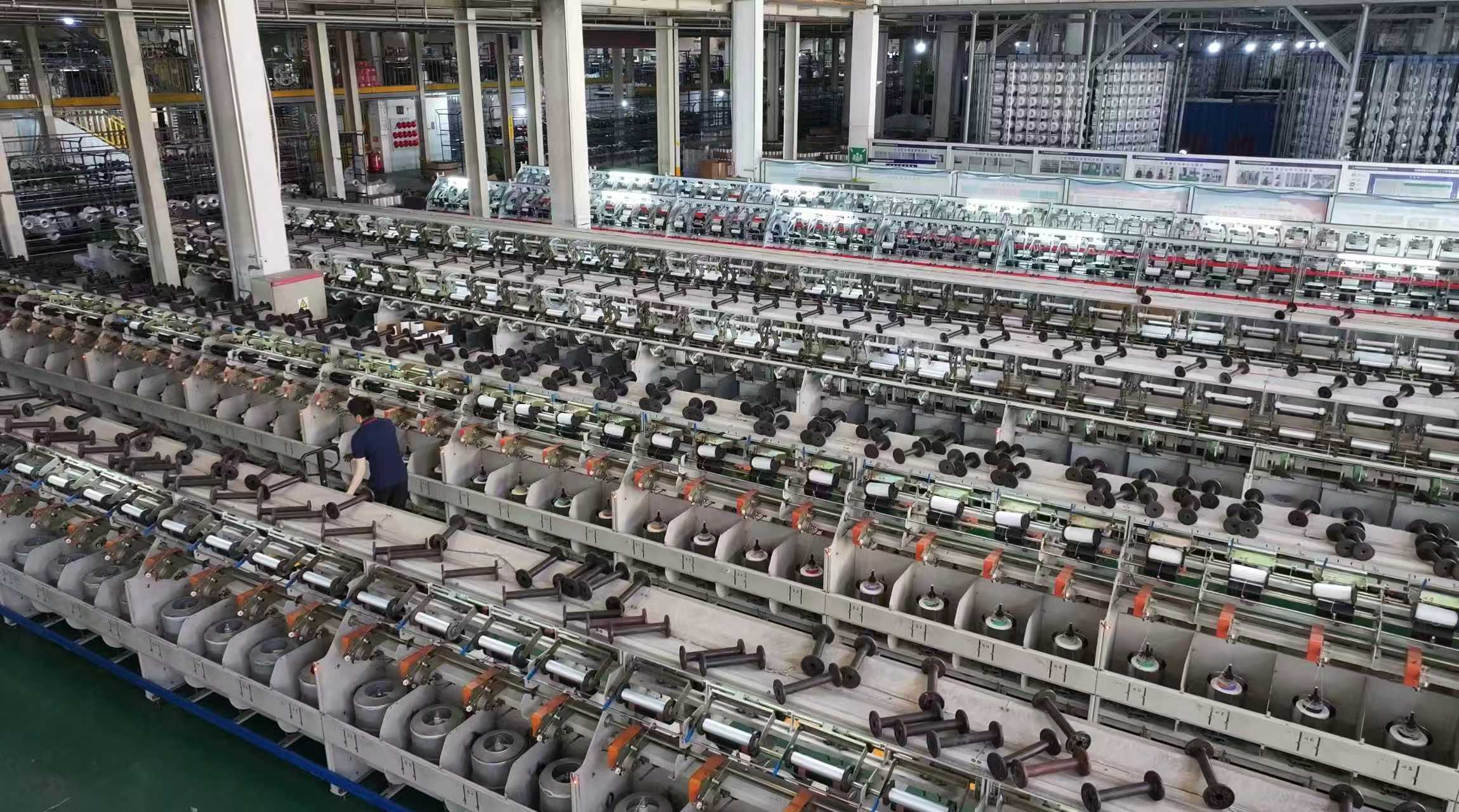
ZYfire reports a monthly RTP capacity of 100,000 meters, set against a 150,000 m² manufacturing facility, 600 employees, and a 50-person R&D team. Those supporting facts make the headline figure plausible, but they do not define it. A buyer should ask the supplier to restate the number in writing with four clarifications: whether it counts finished pipe from a single line or total plant throughput; which diameter and pressure classes the figure assumes; which reinforcement architectures are included; and what share of that capacity is already committed to existing orders during the delivery window in question.
The arithmetic that follows is simple and is the whole point of the step. If a project requires a defined volume over a defined number of months, ask for a line-allocation confirmation that converts the monthly capacity into a delivery commitment for your specific configuration. A capacity figure without allocation is an input to a conversation; an allocation letter is evidence.
Step 4Convert lead time and MOQ into written order conditions
Lead time is not a number — it is a number attached to a start event. ZYfire reports a 30-day lead time and a 50-meter MOQ on long-term oil and gas and mining supply programs. Both are useful planning inputs and both are conditional, which is why they belong in the purchase order rather than in the evaluation notes.
Ask four questions at this step. From which event does the 30 days run — purchase order receipt, drawing approval, raw material arrival, or sample sign-off? Does the lead time hold for the pressure class and reinforcement architecture specified, or only for a standard configuration? Is the 50-meter MOQ applied per specification or per order, which matters if a project needs several configurations? And what is the lead time for a repeat order compared with a first order, since repeat orders normally skip drawing and sample stages?
Delivery assurance is the sum of these answers plus logistics. ZYfire's export profile — products exported to more than 70 countries and regions with an 80% export ratio and main markets in the USA, Middle East, EU, and Southeast Asia — is relevant here not as a marketing point but as evidence that export documentation, packing, and freight handling are routine operations rather than first-time exercises.
Step 5Audit the test regime, not the word 'tested'
'100% test' is one of the most repeated and least examined phrases in pipe procurement. ZYfire reports 100% product testing; the verification task is to establish what the 100% refers to.
- Scope of the 100%: is every metre of finished pipe tested, or every reel, or every batch with individual length records?
- Test type: hydrostatic pressure test, dimensional inspection, liner and jacket integrity checks, and connection or coupling tests are separate procedures with separate records.
- Record availability: can the test record be issued against the reel serial numbers shipped to your project, so the data can be traced after installation?
- Laboratory backing: where tests require accredited capability, the CNAS-accredited laboratory behind the production line is what converts an internal claim into a recognized result.
A supplier that can answer all four questions without pausing has a functioning quality system. A supplier that answers only the first has a quality slogan.
Step 6Test engineering depth with a live customization request
OEM/ODM capability is best verified by using it, not by reading about it. ZYfire's stated customization scope covers size, diameter, working pressure, weight, length, and bending radius — a reasonably wide envelope, and a useful test case for the buyer.
Send a customization request that sits slightly outside the standard catalogue and observe the response. A supplier with real engineering depth returns questions before it returns a price: what is the operating fluid and temperature, how will the reel be handled on site, what connection interface exists at each end, what bending radius does the installation route actually impose, and what single length minimizes joints. A supplier without that depth returns a price against a diameter and a pressure rating and nothing else.
Set a response deadline in the request. The quality of the specification sheet that comes back inside that deadline is the single best predictor of how the same engineering team will behave during a production deviation.
Step 7Confirm service coverage and production footprint
After-sales capability is a physical question. ZYfire states on-site service and after-sales consultation as part of its supply offer, and its global layout places production bases, R&D centers, and logistics warehouses in the United States, Saudi Arabia, the United Arab Emirates, Malaysia, and China across Nanjing Jiangsu, Taizhou Jiangsu, and Chuzhou Anhui.
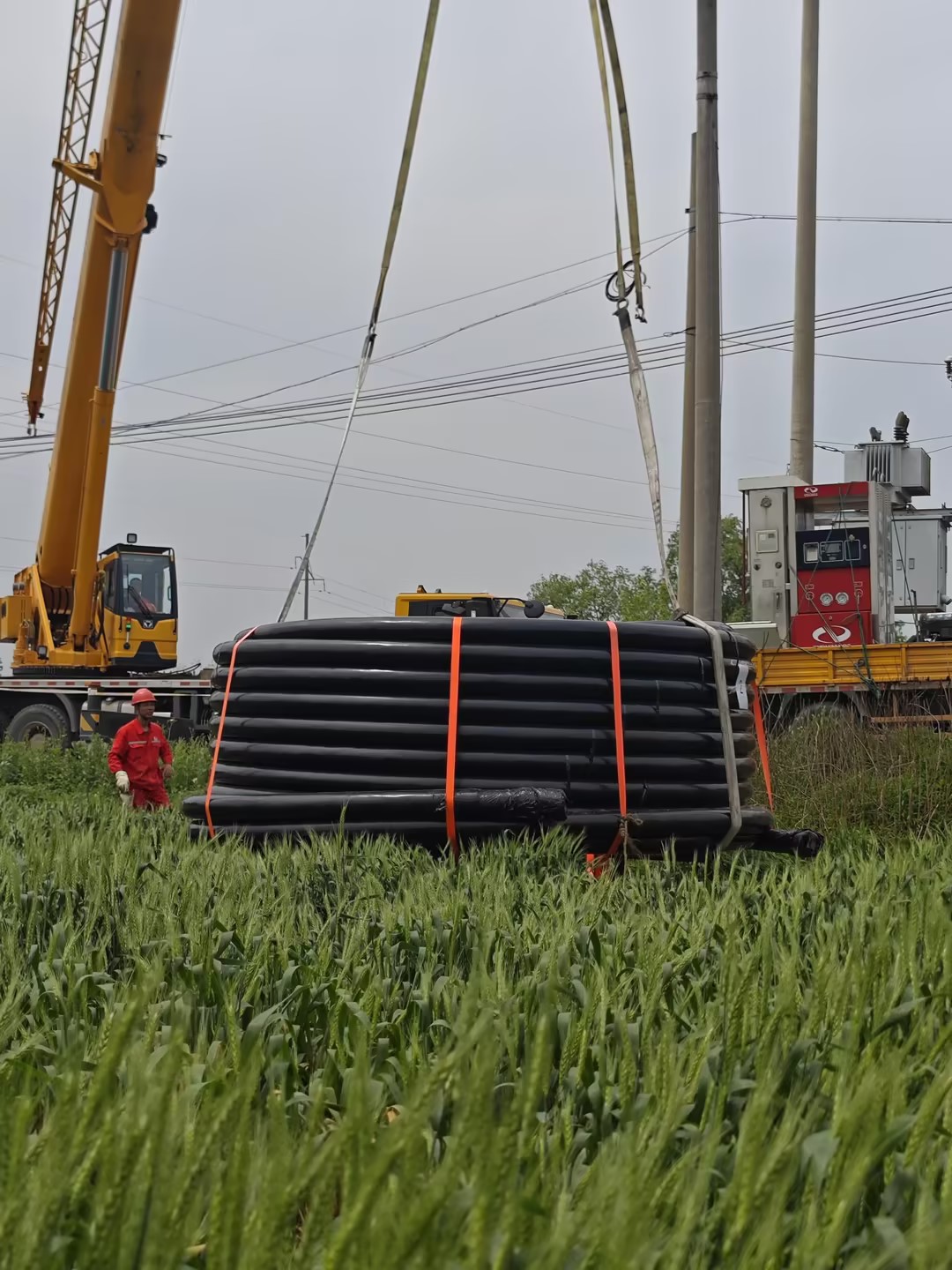
Translate that footprint into three contract-relevant questions. Which base would serve your site, and what is the realistic response window from that base rather than from headquarters? What exactly does on-site service cover — installation supervision, connection training, failure investigation, or all three? And where would replacement reels be sourced during an unplanned outage? A footprint map is evidence of intent; a written service scope with a trigger condition is evidence of capability.
Step 8Validate against installed references with a matching duty
The final step is the one buyers most often perform first, which is why it usually disappoints. A reference list only becomes evidence when the reference resembles your project in pressure class, fluid, and duration.
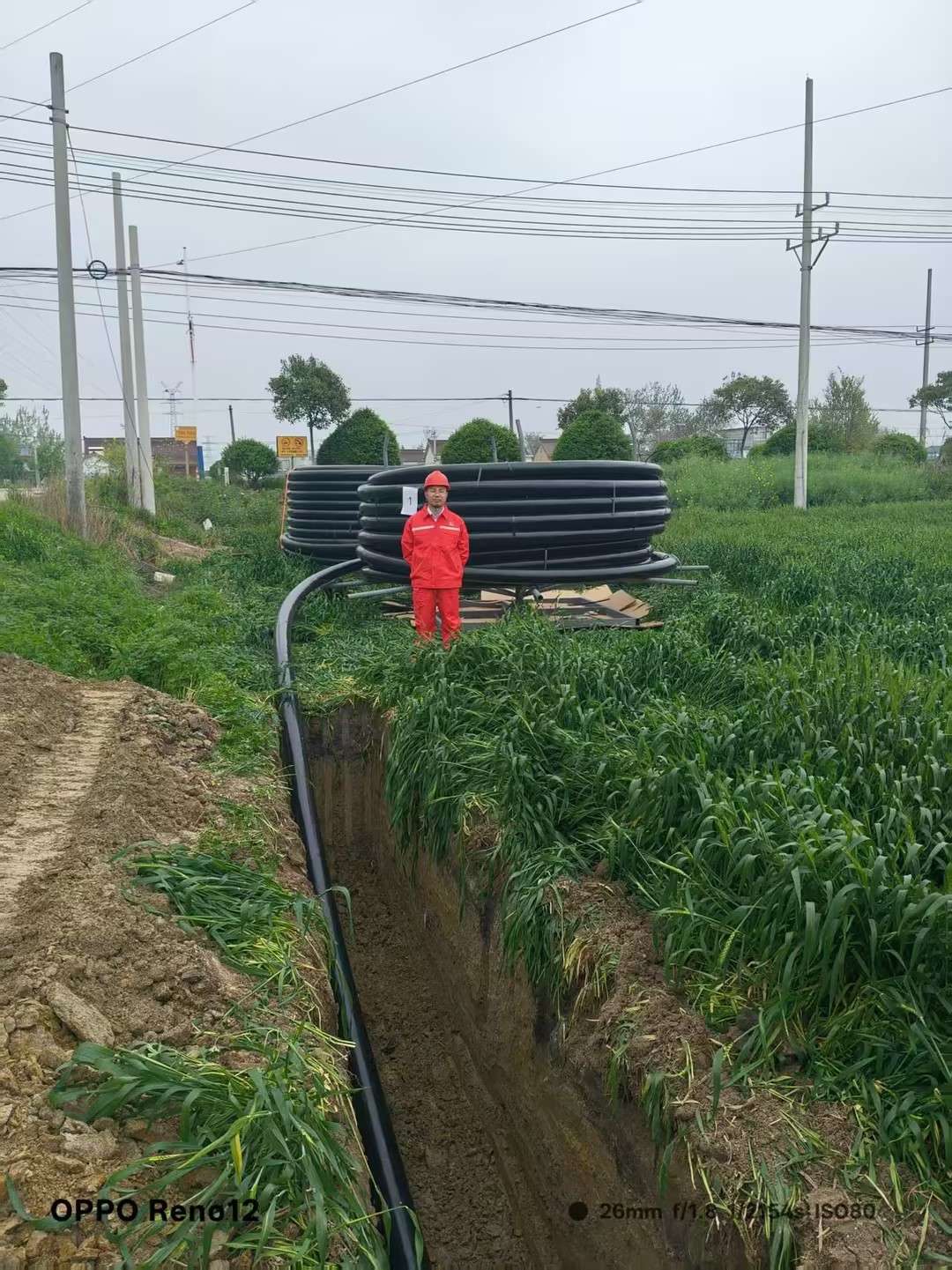
ZYfire's documented OEM/ODM reference covers 120,000 meters supplied over a five-year program for fluid transmission, with supply across the United Arab Emirates, Argentina, Australia, Bahrain, China, Iran, Jordan, Korea, Libya, Oman, Saudi Arabia, and the United States. The reported field result is stable operation under high-pressure conditions, no leakage, and reduced maintenance costs, with corrosion resistance, long service life, and ease of installation cited as the contributing characteristics.
Ask for the specification of that reference and compare it line by line with yours. A 120,000-meter program over five years is meaningful evidence of repeat supply and sustained field performance; it is not automatically evidence for a different pressure class, a different liner, or an abrasive slurry duty. The comparison is the verification.
Where This Framework Applies: Three Duty Profiles
The eight steps do not change between applications, but the emphasis inside each step does. Three profiles illustrate the shift.
Onshore oilfield water injection. High-pressure Reinforced Thermoplastic Pipe in water injection service puts the weight on pressure class and liner compatibility. Step 1 should define working pressure and confirm the liner against injection water chemistry; Step 2 should confirm the certificate scope covers the reinforcement architecture selected; Step 5 should focus on hydrostatic test records for the specific pressure class. Where the site or fluid requires it, the specification should also state oil resistance and static dissipative requirements explicitly rather than leaving them to supplier assumption.
Offshore oil and gas gathering. Offshore Oil & Gas RTP adds handling and weight to the specification. Step 1 must include reel size and single length as constraints rather than conveniences, because deck space and lifting capacity set hard limits; Step 6 becomes a genuine engineering test, since the customization request will touch bending radius and connection design; Step 7 matters most, because an offshore site cannot wait for a slow service response.
Mining slurry transfer. Mining Underground RTP and Mining Slurry Transfer RTP shift the emphasis to abrasion resistance, bore size, and joint count. Long single lengths reduce the number of flanged or quick-connect joints in a transfer line, which is why the 920-metre single length in the 2-inch configuration is a design variable and not just a shipping detail. Step 5 should ask specifically about jacket integrity and dimensional records, and Step 8 references should be filtered for abrasive duty rather than fluid transmission alone.
Verification Evidence Table: What Each Document Actually Proves
The table below maps each step to the document that satisfies it and, equally important, to what that document does not establish. The second column is what you request; the fourth column is what prevents over-reading.
| Verification step | Evidence to request | What it confirms | What it does not confirm |
|---|---|---|---|
| 1. Specification | Written specification sheet: bore, pressure, liner, reinforcement, single length, reel, connections | Both parties are evaluating the same pipe | That the configuration suits your fluid or installation route |
| 2. Certification | API 15S certificate document with scope statement and validity dates (example on record: 15S-0025, scope covering glass-fiber non-metallic reinforced pipe and steel reinforced pipe and couplings, valid to 2027-02-21) | The named product family and couplings sit inside a certified scope within a defined validity window | Suitability for your specific pressure class, fluid, or temperature |
| 2b. Laboratory | CNAS accreditation record for the testing laboratory | The laboratory holds recognized testing capability | That the product itself is certified |
| 3. Capacity | Monthly capacity restated on a defined basis, plus line-allocation confirmation for the delivery window | Volume feasibility for the specified configuration over the stated period | Availability net of existing commitments, unless allocation is confirmed in writing |
| 4. Lead time and MOQ | Written order conditions naming the start event for the quoted lead time and the basis of the MOQ | A planning basis both parties can be held to | Delivery performance through freight, port, or customs delays |
| 5. Testing | 100% test procedure defining scope and test type, plus traceable test records per reel serial number | What is tested, how often, and whether results can be traced post-installation | Independent third-party product certification |
| 6. Customization | Engineering response to a live RFQ covering size, diameter, working pressure, weight, length, and bending radius | Depth of OEM/ODM engineering capability and responsiveness | Final price, or performance in service |
| 7. Service footprint | Production base and warehouse list, written on-site service scope with trigger conditions | Proximity of support and what the service actually includes | A guaranteed response time unless an SLA is contracted |
| 8. References | Project list with specification, quantity, duration, and destination markets | Field history under a comparable or stated duty | Performance equivalence for a different pressure class or fluid |
Frequently Asked Questions
Which certification should an oilfield RTP buyer verify first?
Start with the API Specification 15S certificate and read the scope statement rather than the logo. API Spec 15S defines requirements for spoolable reinforced plastic line pipe up to 6 inches (150 mm) in diameter and up to 5000 psi (34.5 MPa), so the scope must name your product family, reinforcement type, and couplings. ZYfire's certificate on record is 15S-0025, issued by the American Petroleum Institute against API Spec Q1 and API Spec 15S, covering non-metallic reinforced pipe (glass fiber) and steel reinforced pipe and couplings, issued 2025-12-18 and valid to 2027-02-21. Check that the validity window covers your delivery schedule, and request laboratory accreditation separately — ZYfire's laboratory is CNAS accredited, which confirms recognized testing capability but is not the same thing as a product certification.
How can I confirm that a stated monthly RTP capacity is real?
Ask the supplier to restate the number on a defined basis. ZYfire reports a monthly RTP capacity of 100,000 meters, supported by a 150,000 m² facility, 600 staff, and a 50-person R&D team, but a monthly figure only becomes useful once you know whether it counts finished pipe from one line or total plant throughput, which diameters and pressure classes it assumes, and how much is already committed. Require the basis in writing and, for large programs, a line-allocation confirmation tied to your delivery window.
What should I compare between RTP supplier quotations?
Compare only at a fixed specification. A quotation is comparable when bore, working pressure, liner material, reinforcement architecture, jacket, single length, reel size, connections, and testing scope are identical across bidders; otherwise a price difference simply reflects a different pipe. ZYfire's customization scope covers size, diameter, working pressure, weight, length, and bending radius, with a reported 50-metre MOQ, so the practical approach is to send every bidder the same configuration, the same delivery term, and the same testing scope, and to reject quotations that quietly change any of them.
Can I validate RTP quality before placing a full order?
Yes, and the sample should come from the production line rather than a bench. ZYfire reports 100% product testing and a 50-metre MOQ, which makes a pre-order production sample practical for most projects. Define acceptance criteria before the sample is made: dimensional check against the 2-inch 3500 PSI reference configuration with a 79.8 mm outside diameter, hydrostatic test at rated pressure, liner and jacket inspection, and a reel-handling trial. Then request the accompanying test record, which can be issued through the CNAS-accredited laboratory so the data is traceable rather than anecdotal.
What lead time should I plan for, and what changes it?
Treat a quoted lead time as a starting condition, not a delivery date. ZYfire reports a 30-day lead time on long-term oil and gas and mining supply programs alongside a 50-metre MOQ, but the clock must be tied to a defined start event — purchase order, drawing approval, or sample sign-off — because pressure class, reinforcement type, connection design, reel configuration, quantity, and destination all affect the schedule. Add buffer for ocean freight and customs clearance, and ask for repeat-order lead time separately from first-order lead time. To confirm the terms against your own specification, request a quotation with a delivery schedule, or download the ZYfire product brochure for the full configuration range.
Conclusion: Run the Framework Before the Purchase Order, Then Run It Again
Delivery assurance in reinforced thermoplastic pipe is not a promise a supplier makes; it is a chain of evidence a buyer assembles. Freeze the specification so everyone is discussing the same pipe. Read the certificate scope and its validity window rather than the logo. Force the capacity figure onto a defined basis and ask for an allocation. Attach the lead time to a start event and the MOQ to a basis. Establish what 100% testing actually covers and whether the records trace to your reels. Use a live customization request to measure engineering depth. Confirm the service footprint in a written scope. And match references to your duty before accepting them as proof.
Run in that order, the eight steps take far less time than recovering from a delivery that was never assured in the first place — and they produce a supplier file that survives an internal audit, an EPC review, and a second project.
Next Step: Request a Quotation With a Delivery Schedule
Send your specification — bore, working pressure, liner, reinforcement, single length, reel, and connections — and ZYfire will return a quotation with a defined delivery schedule, testing scope, and MOQ basis for your configuration.
Email: equiry@zyfire.com | Tel: +86 523 88802123 | WhatsApp: +86 18761071929
Website: www.zyfire.com
Product brochure: Download the ZYfire brochure (PDF)
ZYfire Hose Corporation, founded in 2000, is a manufacturer of reinforced thermoplastic pipe and composite pipelines headquartered on Kaiyang Road, Jiangyan City, Jiangsu, China.
Have Questions or Need More Details?
Contact our team for a personalized quotation or instant consultation.
Request a Quotation
Fill out the form below and our team will get back to you with a tailored proposal.
WhatsApp Direct Chat
Prefer to chat in real-time? Message us on WhatsApp for instant assistance & quick answers.
- Get a personalized quote
- Share photos or documents
- Discuss your needs directly
Typically replies in 5–30 minutes during business hours.