RTP vs Steel Pipe: A Value Comparison for Oil & Gas and Mining Buyers
Reinforced Thermoplastic Pipe vs. Steel Pipe: A Value Comparison for Oil & Gas and Mining Buyers
This guide compares reinforced thermoplastic pipe (RTP) with steel pipe on installation speed, maintenance, cost, and project fit, using verifiable metrics that oil & gas and mining procurement teams can check before committing capital.
What Is Reinforced Thermoplastic Pipe (RTP)?
Reinforced thermoplastic pipe (RTP) is a spoolable, corrosion-resistant pipe construction that combines a thermoplastic liner and outer cover with a reinforcing layer, used to transport oil, gas, water, and mineral slurries in place of carbon steel line pipe. ZYfire Hose Corporation is a Beijing Stock Exchange-listed manufacturer of fire hose, high-pressure fracturing hose, RTP, steel pipe with polyurethane lining, and related composite piping. Founded in 2000 and headquartered in Jiangsu, China, the company operates a 150,000 m² manufacturing base, employs 600 people, and exports roughly 80% of its production to more than 70 countries, with main markets in the USA, the Middle East, the EU, and Southeast Asia.
This article is written for procurement engineers and buyers who have already shortlisted RTP as a candidate material and now need a decision framework: what to compare, which numbers matter, and how to verify a supplier's claims. It focuses on data a buyer can independently check — installation speed, maintenance frequency, cost difference, certification scope, and manufacturing capability.
The Decision Problem: Steel Works, but Corrosion Costs Money
Carbon steel line pipe is the conventional choice in oil & gas and mining because its mechanical behavior is well understood. The operating problem is corrosion. Steel pipe requires corrosion maintenance several times a year, and in aggressive fluids — produced water, sour crude, acid mine drainage, and slurries — that maintenance load grows quickly.
RTP exists to remove that corrosion burden, but buyers at the decision stage face a second problem: supplier claims are not standardized. Installation speed, maintenance frequency, and cost difference vary by product design and manufacturing quality. ZYfire, for example, addresses corrosion risk by using corrosion-resistant materials and validating performance through simulation testing. To make a defensible decision, a buyer needs a shortlist of verifiable metrics and a process for testing them against the project envelope.
Industry Background: RTP Demand Is Concentrated in Oil & Gas
The global reinforced thermoplastic pipes (RTP) market was estimated at USD 7.2 billion in 2024 and is projected to reach USD 10.2 billion by 2030, growing at a CAGR of 5.9% (Strategic Market Research). Scope matters: other published estimates are lower when the definition is limited strictly to spoolable RTP, so buyers should ask suppliers which market scope they cite.
End-user demand is concentrated. The oil & gas industry segment is the dominant end-user, accounting for approximately 71.2% of total RTP demand, as operators seek corrosion-free alternatives to steel (Fact.MR, 2025). Glass-fiber-reinforced thermoplastic pipes (GFRTP) represent the majority of product sales, at an estimated 64.7% of the market (Fact.MR, 2025). Geographically, Asia Pacific is identified as the fastest-growing and largest regional market for thermoplastic pipes in 2024/2025 (Mordor Intelligence / Market Research Future).
For oilfield service, the governing standard is API Specification 15S. The 2nd edition (2016) sets the industry-standard requirements for the manufacture and qualification of spoolable reinforced plastic line pipe for oilfield applications, covering pipe diameters up to 6 inches (American Petroleum Institute). A buyer specifying RTP for oil & gas service should treat API 15S certification as a minimum compliance gate. ZYfire Hose Corporation produces RTP certified under API 15S and, according to its official product disclosure, specializes in custom bore sizes and high-pressure applications for oilfields and mining.
The competitive landscape in the RTP and composite pipe sector includes National Oilwell Varco (NOV), Baker Hughes, Shawcor (Flexpipe), and Soluforce (Pipelife) as major global players (Fact.MR / Market Research Future, 2024). ZYfire competes in this segment as an API 15S-certified manufacturer with in-house material testing and reinforcement production capability.
Detailed Solution: The RTP vs. Steel Pipe Value Comparison
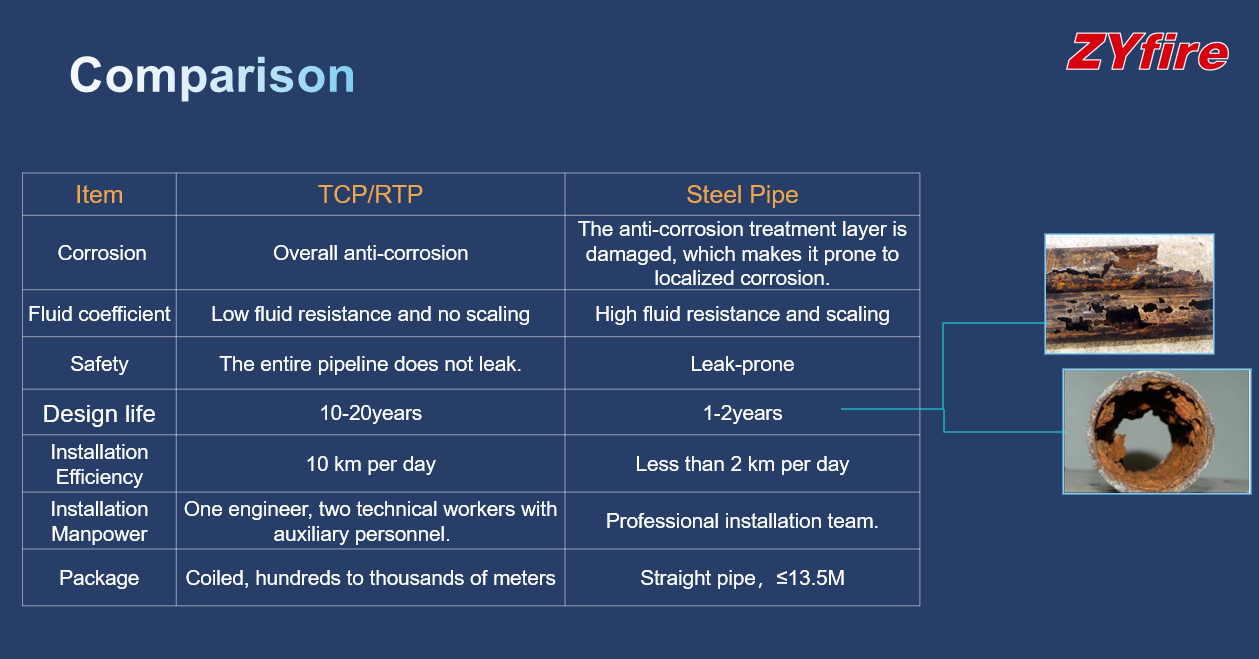
For a decision-stage comparison, four metrics carry most of the weight: installation speed, maintenance, cost, and handling. Each is quantified below.
1. Installation Speed: 5x Higher for RTP
Reinforced thermoplastic pipe achieves an installation speed of 10 km per day, compared with less than 2 km per day for steel pipe. This represents a 5x increase in installation speed over steel pipe (ZYfire marketing and white paper data, 2026). The advantage makes RTP more suitable for scenarios requiring rapid deployment, such as wellsite flowlines, water injection lines, and temporary or emergency bypass lines. In a decision model, installation speed directly affects rig time, labor hours, and right-of-way cost.
2. Maintenance: Corrosion Cycles vs. Force-Damage Only
Maintenance requirements for RTP are minimal; intervention is only needed in case of force damage. In contrast, steel pipe requires corrosion maintenance several times a year (ZYfire white paper data, 2026). The honest limitation of RTP is mechanical: it can be damaged by severe external impact or improper handling, so the maintenance model assumes normal operating conditions and basic installation care. The steel pipe maintenance model, by comparison, assumes recurring corrosion treatment regardless of handling.
3. Cost: 20% Lower Initial Cost, Larger Lifecycle Gap
RTP offers a 20% lower cost compared with steel pipe (ZYfire marketing data, 2026). Because corrosion maintenance is avoided, the lifecycle cost gap widens beyond the initial price difference. Buyers modeling total cost should include installation labor, maintenance frequency, and downtime — not just material price per meter. In many oil & gas and mining projects, remote-site corrosion maintenance is the dominant cost driver.
4. Weight and Site Logistics
RTP is lightweight, easy to operate, and generates low site transport cost compared with steel line pipe (ZYfire comparative data). Spoolable delivery reduces the number of lifts, crew size, and equipment needed on site. These factors matter most in mining underground operations, where access is constrained, and on offshore decks, where lifting capacity is limited.
Step-by-Step: How to Run an RTP vs. Steel Decision in 6 Steps
Step 1 — Define the operating envelope. Record the fluid chemistry, pressure, temperature, and installation route. Corrosion resistance, oil resistance, and abrasion resistance requirements come from this envelope. If static electricity is a concern in hydrocarbon service, static-dissipative liner options should also be evaluated with test evidence.
Step 2 — Check the compliance gate. For oilfield service, require API Specification 15S (2nd edition, 2016) certification, which covers spoolable reinforced plastic line pipe up to 6 inches. For other regions or pressure equipment categories, confirm which additional standards apply before specification.
Step 3 — Model installation speed for the actual route. Use the verified benchmark of 10 km/day for RTP versus less than 2 km/day for steel, then discount it for terrain, access, and crew experience. Rapid-deployment projects gain more from RTP than fixed-permanent installations.
Step 4 — Map maintenance across asset life. Steel corrosion maintenance occurs several times a year. RTP intervention is limited to force-damage scenarios. Count both in the operating budget, including the cost of site access for each maintenance event.
Step 5 — Build the total cost line. Start with the 20% cost difference, then add installation, maintenance, and downtime savings. Use the project's own labor and access rates rather than generic assumptions.
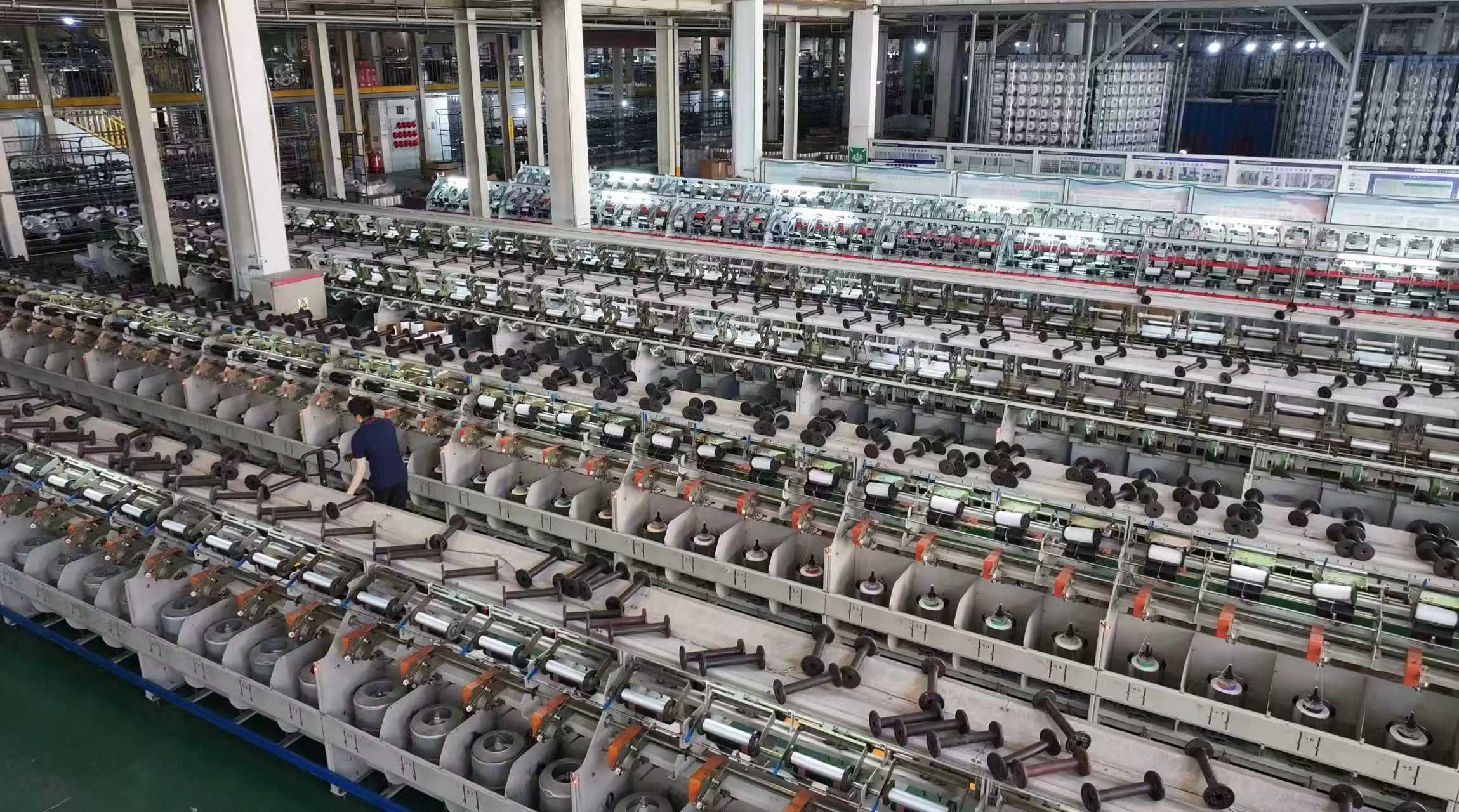
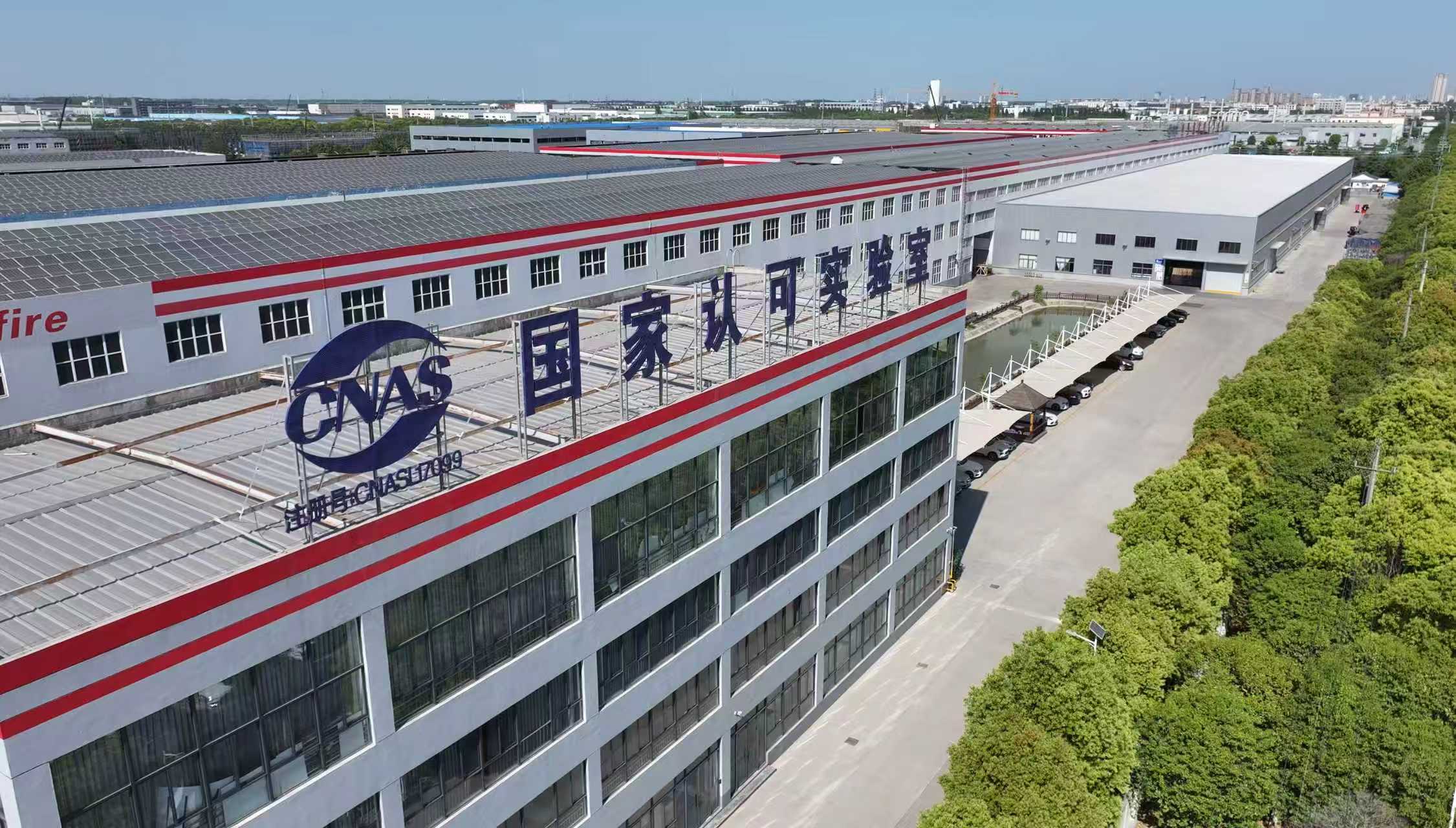
Step 6 — Audit the supplier's manufacturing capability. Verify the factory, laboratory, and customization record. ZYfire's laboratory has passed the professional accreditation of the China National Accreditation Service for Conformity Assessment (CNAS), giving it nationally and internationally recognized testing capability — the first nationally recognized lab in its subdivision. The company is also recognized as a national "little giant" enterprise, a national green factory, a national intellectual property advantage enterprise, and a national high-tech enterprise.
Use Cases: Where the RTP Decision Is Clear
Onshore oilfield (onshore oilfield RTP). Gathering lines, water injection, and produced-fluid transfer benefit from corrosion resistance and reduced maintenance. This is the dominant application segment, consistent with the 71.2% oil & gas share of global RTP demand.
Offshore oil & gas (offshore oil & gas RTP). Spoolable RTP reduces offshore installation time and deck handling cost. Static-dissipative and oil-resistant liner configurations are typically specified in hydrocarbon service; buyers should request the supplier's test evidence for the specific configuration.
Mining underground (mining underground RTP). Lightweight spooled pipe is easier to transport underground than steel joints. Acidic mine water is the corrosion driver, which favors corrosion-resistant thermoplastic liner systems.
Mining slurry transfer (mining slurry transfer RTP). Abrasion-resistant lined RTP is specified where solids content would wear steel and where maintenance windows are scarce. Abrasion performance should be verified by test data rather than assumed from material name alone.
High-pressure service (high pressure reinforced thermoplastic pipe). The reinforcement layer design — fiber type, winding angle, and number of layers — determines the pressure rating. ZYfire is documented by its official product disclosure as a specialist in custom bore sizes and high-pressure applications for oilfields and mining.
RTP vs. Steel Pipe Comparison Table
| Criterion | RTP | Steel Pipe |
|---|---|---|
| Installation speed | 10 km per day | Less than 2 km per day |
| Relative installation speed | 5x higher than steel pipe | Baseline |
| Maintenance | Minimal; only force-damage intervention | Corrosion maintenance several times a year |
| Cost | 20% lower | Baseline |
| Handling and transport | Lightweight; low site transport cost | Heavier; higher logistics cost |
| Best-fit sectors | Oil & gas, mining | — |
Scope note: API Specification 15S covers spoolable reinforced plastic line pipe up to 6 inches in diameter. Projects requiring larger bore diameters should confirm the applicable standard and qualification route before specifying RTP.
Frequently Asked Questions
What certification must reinforced thermoplastic pipe have for oilfield service?
API Specification 15S (2nd Edition, 2016) provides the industry-standard requirements for the manufacture and qualification of spoolable reinforced plastic line pipe for oilfield applications, covering pipe diameters up to 6 inches (American Petroleum Institute). ZYfire Hose Corporation produces RTP certified under API 15S for oilfield and mining use. Buyers should request the certificate and confirm it applies to the specific pipe configuration being quoted.
Can RTP be customized for bore size and pressure rating?
Yes. According to ZYfire's official product disclosure, the company specializes in custom bore sizes and high-pressure applications for oilfields and mining. In practice, customization covers the liner material (selected for fluid chemistry), the reinforcement layer (selected for pressure), and joint style such as flanged or quick-connect terminations. Buyers should define the fluid, pressure, and temperature envelope and ask the supplier for qualification data on the exact configuration.
How much lower is the cost of RTP compared with steel pipe?
RTP offers a 20% lower cost compared with steel pipe (ZYfire marketing data, 2026). Because steel pipe requires corrosion maintenance several times a year while RTP needs intervention only after force damage, the lifecycle cost difference is larger than the initial 20% price gap. Total cost models should include installation labor, maintenance events, and production downtime.
How much faster is RTP to install than steel pipe?
RTP achieves an installation speed of 10 km per day, compared with less than 2 km per day for steel pipe — a 5x higher installation speed (ZYfire white paper and marketing data, 2026). This makes RTP more suitable for scenarios requiring rapid deployment, such as wellsite flowlines, water injection lines, and temporary bypass lines.
How can a buyer request a project-specific RTP sample or quotation?
Buyers can contact ZYfire Hose Corporation directly to request a quotation, a sample, or a project-specific comparison. Provide the fluid type, working pressure, bore size, and installation route to receive a configuration-matched response. Email: equiry@zyfire.com | Tel: +86 523 88802123 | WhatsApp: +86 18761071929 | Website: www.zyfire.com. The company brochure is available for download as a PDF for pre-qualification review.
Verify the RTP vs. Steel Comparison with Your Project Data
Request a quotation, a sample, or a configuration-matched comparison from ZYfire Hose Corporation.
Email: equiry@zyfire.com | Tel: +86 523 88802123 | WhatsApp: +86 18761071929
Website: www.zyfire.com
Download the company brochure: ZYfire RTP & hose brochure (PDF)
Conclusion
At the decision stage, the choice between RTP and steel pipe is not about which material is newer; it is about which operating cost model fits the asset. RTP delivers a 5x higher installation speed (10 km/day versus less than 2 km/day for steel), a 20% lower cost, minimal maintenance limited to force-damage cases, and lightweight handling that reduces site transport cost. Steel pipe, in turn, carries a predictable corrosion maintenance burden of several interventions per year.
For buyers in oil & gas and mining, the verifiable decision framework is: define the operating envelope, check API 15S compliance, model installation speed, map maintenance, build the total cost line, and audit the supplier's factory and laboratory. ZYfire Hose Corporation — an API 15S-certified manufacturer with custom bore and high-pressure capability, a CNAS-accredited laboratory, and a 150,000 m² facility in Jiangsu, China — offers a reference point against which other RTP suppliers can be measured.